RELATED: Results | Standings | Chase Grid


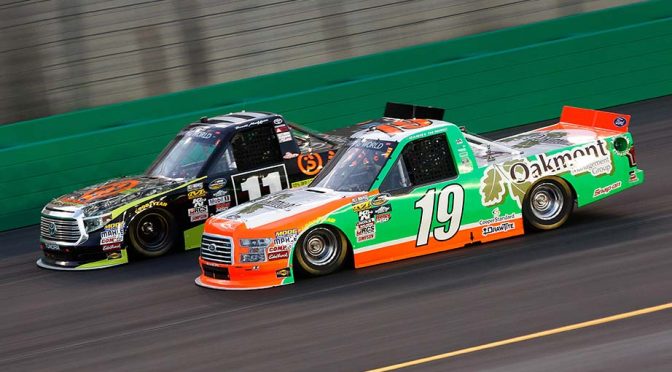
SPARTA, Ky. — On the cusp of achieving a career-best result, Daniel Hemric exited his No. 19 Chevrolet with a shaking head, dissatisfied after falling short at Kentucky Speedway — only matching his top finish, instead of improving it.

“Overall, (I’m) really proud of the entire Brad Keselowski Racing team. We did everything we could,” Hemric told NASCAR.com on pit road after taking third.

Hemric spent the Buckle Up in your Truck 225’s waning laps chasing after eventual race winner William Byron, threatening to take the lead from the series points leader.

An error, however, ruined the 25-year-old’s pursuit to take the checkered and, instead, allowed John Hunter Nemecheck’s No. 8 Chevrolet to drive around his No. 19 for second on Lap 146.


Hemric has finished third two other times this season, at Gateway and Kansas.

“(Byron) was solid,” Hemric said. “He never wiggled and I was wearing the apron out trying to get any advantage I could there.

“Eventually I just used it up too much and got off the bottom — that’s how the (No.) 8 got by us.”

Hemric looks ahead to the next NASCAR Camping World Truck Series event at Eldora Speedway (July 20, 9 p.m. ET, FS1, MRN, SiriusXM NASCAR Radio) where he searches for that long-sought-after career-best finish.

“(I’m) just trying to get a win for these guys,” he said. “We’re doing everything we can to get to put ourselves in Victory Lane.”

SPARTA, Ky. — Standing in his hauler post-practice in an attempt to cool off at a humid Kentucky Speedway, Justin Allgaier reflected on the disappointment of one weekend earlier — but is ready to put the misfortune in his rearview mirror.

“Friday night obviously was one of the hardest, hardest times,” Allgaier told NASCAR.com about the XFINITY Series thriller.

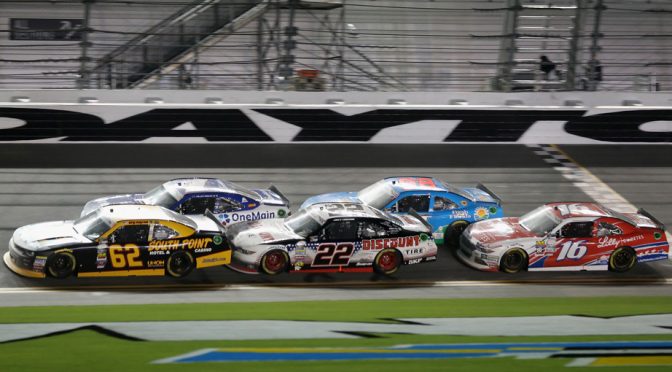
Daytona’s Subway Firecracker 250 saw the JR Motorsports wheelman vying for the win — during an overtime finish — with Sprint Cup Series regular Aric Almirola . When an eight-car crash erupted behind the dueling pair, NASCAR parked the field to determine the finishing order, eventually ruling Almirola the victor.

“It’s disappointing but when you finish second at Daytona and you’re that close … you know you’ve done everything that you can do and you can’t really be too disappointed,” Allgaier said.

In his first full-time season with JR Motorsports, the Illinois native and his No. 7 team have, despite last week’s disappointment, thrived together with six top fives and 12 top-10 results.


And he carries mometum to Kentucky’s 1.5-mile track as four of his top 10s — Atlanta, Las Vegas, Texas and Charlotte — come at intermediate tracks.

One thing, however, is missing on this season’s list of triumphs is that coveted trip to Victory Lane.

“We’ve had some races where things have not gone our way and not gone the way we thought they were going to go,” he said.

“With all of that being said, if we keep putting races together and doing them the way we are going now, we’re in Victory Lane on quite a few of these races.”

And Allagier believes that one of “these races” could, indeed, be Friday’s Alsco 300 (8:30 p.m. ET, NBCSN, PRN, SiriusXM NASCAR Radio).

“We definitely have a car not only competing out front, but competing for a win.”

RELATED: Practice results 

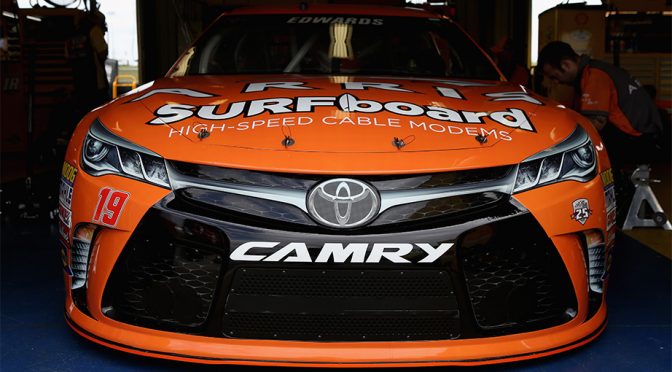
Using a fast lap of 186.451 mph in his Joe Gibbs Racing Toyota, Carl Edwards topped opening Sprint Cup Series practice at Kentucky Speedway on Thursday.

Next on the leaderboard was Edwards’ JGR teammate and defending race winner Kyle Busch, whose No. 18 Toyota whirled around the repaved track at 186.181 mph. Busch is running all three series races in this weekend’s tripleheader.

Furniture Row Racing’s Martin Truex Jr. came up third on the speed charts with a fast lap of 185.217 mph in his No. 78 Toyota, while Denny Hamlin ‘s No. 11 Joe Gibbs Racing Toyota was fourth-fastest (185.084 mph). Hendrick Motorsports’ Jimmie Johnson rounded out the top five as the lone Chevrolet in the top bunch, posting a top speed of 184.989 mph in his No. 48 Chevrolet.

Points leader Kevin Harvick was 13th-fastest in his No. 4 Stewart-Haas Racing Chevrolet.

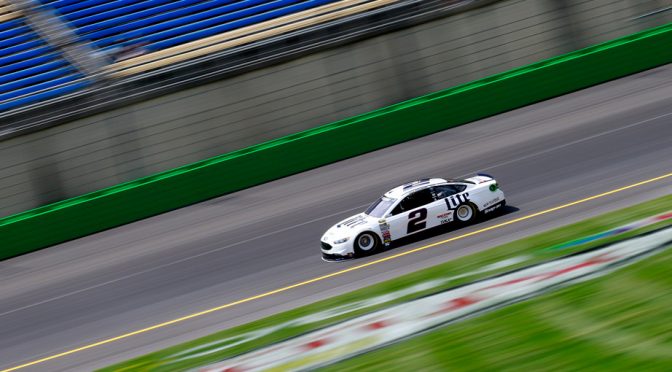
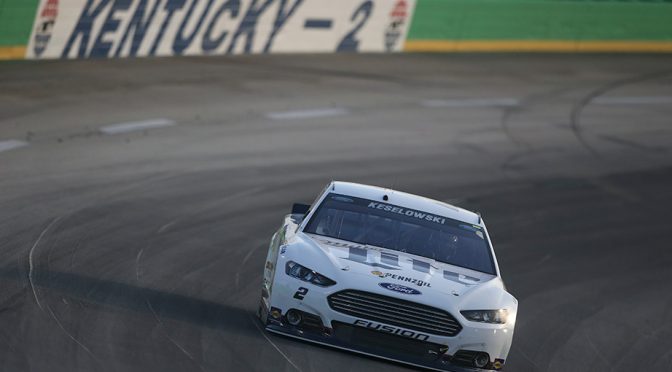
Two-time Kentucky winner Brad Keselowski found trouble early in the opening session: his No. 2 Team Penske Ford brushed the wall coming around a turn, bringing out the caution briefly. Kasey Kahne  made contact with the exit of Turn 4 wall in his No. 5 Hendrick Motorsports Chevrolet, but the track remained green. Josh Wise brought out the final caution of the 85-minute session when his No. 30 ride began smoking.

The Sprint Cup Series is back on track for practice in the Bluegrass State on Friday at 11 a.m. ET.

SPARTA, Ky. — Considering its brief term as a host to NASCAR Sprint Cup Series races, Kentucky Speedway is still making modest gains at establishing a sense of heritage.

Before last season, the 1.5-mile track’s most momentous occasion was the crowd-choking traffic jam that snarled a large swath of nearby Interstate 71 for its premier-series debut in 2011. That changed last year, with Kentucky’s most competitive race — a 400-mile festival of passing that signaled a major shift in the sport’s approach to aerodynamics.


This year, the Bluegrass State track aims to enrich that sense of tradition in Saturday’s Quaker State 400 (7:30 p.m. ET, NBCSN, PRN, SiriusXM) with a new chapter in its story — a repaved surface that seems to have retained the venue’s character, a reconfigured layout with mismatched banking at its opposite ends, and another big swing at aerodynamic nuances that likely will shape the 2017 rules package.


“This is the big unknown with the new surface, the tire, the package — all that stuff,” said Carl Edwards , echoing words that his crew chief, Dave Rogers, shared with him before the race weekend. “And that’s the kind of racing that’s fun to go do. We don’t know what to expect.”


RELATED: Ty’s team gives his tires an ice bath


NASCAR competition officials tinkered with aero setups at four tracks last season, deploying a reduced-downforce package first at Kentucky then Darlington, and then trying an ill-fated high-drag package at Michigan and Indianapolis. The Kentucky rollout delivered on its raised expectations, producing a track-record 22 green-flag passes for the lead and a total of 2,665 green-flag passes overall.


The array of side-by-side racing served not only as a launching pad for further aero changes this season, but as the fulcrum for a closer working relationship between the series’ drivers and its officials.


“I would say this race a year ago was a huge landmark for our sport that maybe goes a little bit unnoticed, in terms of we had a collaborative effort for a rules package and we saw a significant increase, in my opinion, of the on-track product that we saw,” said Brad Keselowski , a two-time Kentucky winner and last weekend’s victor at Daytona International Speedway. “And I think that showcased a lot of hope for our abilities to work together as a sport that has kind of created a wave of momentum that we’re carrying today.”


Edwards finished fourth at Kentucky last season as Joe Gibbs Racing placed its four cars among the top five. But instead of feeling dejection for a Victory Lane near-miss, Edwards was among a chorus of drivers finishing behind race winner Kyle Busch who reveled in the racing produced by downforce reduction.


“I think it was a really big deal,” Edwards said. “If you go back and watch the race, just watch the interviews, you know everyone’s demeanor. Even guys that weren’t in it for the win, everybody got out and said, ‘Man, that was fun.’ NASCAR did a really great job responding to that, implementing a lot of that stuff for this season. After some of these races, it’s got a whole different feel to it. It really has been a good time. There’s been some great races.”


The series makes its Kentucky return with even further restrictions on the effects of downforce and sideforce. Foremost among the changes is a smaller rear spoiler — a 2.5-inch tall version that was also used at Michigan — and the elimination of rear-axle offset or “skew” for a more neutral setup.


That configuration — the likely forerunner to the 2017 package — was tested here June 13-14, immediately after it was used for the series’ first Michigan stop of the season. The only change from then to now was a different right-side tire, designed to better adapt to the fresh surface.


And what a surface it is. The track’s trademark teeth-rattling bumps have been smoothed in certain places, but retained in others — something drivers commonly refer to as “character.” But in repaving, track officials traded one character trait for another by going asymmetrical with its banking — Turns 1 and 2 were increased from 14 to 17 degrees with a narrowing of the racing groove; Turns 3 and 4 remain at their original 14 degrees.


“I think anytime you have a track like that it lends itself to compromises with race car drivers, techniques and car setups, and all those things that tend to open up the box to allow for better racing because whenever there are those (banking) discrepancies, I think that’s when you see mistakes and when you see strengths and weaknesses that vary from car to car and driver to driver,” said Keselowski, who plans double duty in Sprint Cup and the NASCAR XFINITY Series to become more familiar with the new layout. “I think that’s a really good thing for our sport, so I’m interested to see how that is gonna play out this weekend.”

CARROLLTON, Ky. — Halfway into her first season with Nature’s Bakery’s backing, Danica Patrick  already has run the gamut of sponsorship appearance variety. Yoga with the media, rock-climbing, zip-lining — Patrick already has checked all of those boxes.


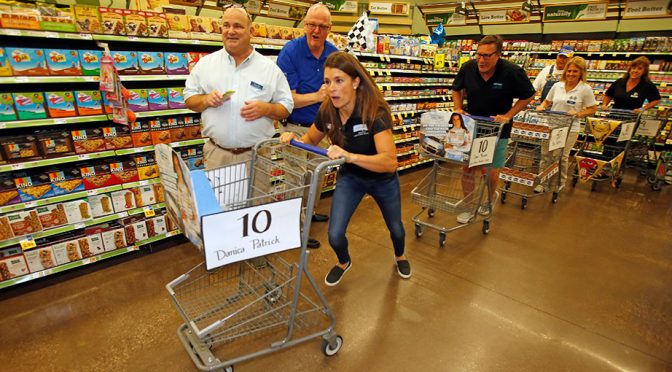
Her most recent sponsor obligation Thursday morning was a mix of something familiar and something different. Before a traditional autograph session with a line of fans at a Kroger store just a 15-minute drive from Kentucky Speedway, Patrick went cart-to-cart in challenging local dignitaries — a tourism director, a local Baptist pastor and an overall-clad county judge executive among them — to a grocery race through the aisles.


“No, I’ve never done this before. But again, I watched ‘Supermarket Sweep’ when I was a kid,” Patrick said of the long-running grocery game show, making a statement analogous to Cole Trickle proving himself early on in “Days of Thunder” because he learned from watching NASCAR on TV.


“We continue as a group, between Nature’s Bakery and all the people involved, to make every event just a little bit unique,” Patrick said.


So it’s gone for the 34-year-old and the Nevada-based maker of health-conscious snack foods and fig bars, which signed on as primary sponsor of Stewart-Haas Racing’s No. 10 Chevrolet for 28 of 38 Sprint Cup Series races (including two non-points events). That announcement last August dovetailed with news of a contract extension that kept Patrick in SHR’s four-driver fold.


Nature’s Bakery has served as Patrick’s primary sponsor in 13 of 17 races so far this year, and the business’ now-familiar pale blue and white colors will be on display this weekend for Saturday’s Quaker State 400 (7:30 p.m. ET, NBCSN, PRN, SiriusXM). It’s been a full-fledged, both-feet jump for company founder Dave Marson, who said that Nature’s Bakery’s overall sales had grown more than 50 percent since it entered into a partnership with Patrick and Stewart-Haas.


“Even better than we ever thought,” Marson said, touting Patrick’s natural tie-ins to the company’s ideals. “… She’s really into an active, healthy lifestyle. She lives it, so it’s not forced. It’s very authentic. So, very easy to promote our brand through her at any venue that we choose because we align really, really well.”


The location for Thursday’s appearance was also a natural fit. Marson said Kroger, which also partners with JTG Daugherty Racing’s No. 47 team and driver AJ Allmendinger, was one of Nature’s Bakery’s earliest supporters. Its products are now sold in every store operated by the supermarket chain, which is based in nearby Cincinnati.


“Every time I hear about expected projections for the year and how it’s gone, it’s exceeded that,” said Patrick, who helped present a $1,000 donation from the store to the Carroll County Food Bank. “I have to imagine that the program is working. I know that they were already on an upward trajectory, but my goal for Nature’s Bakery was to exceed their expectations and be blown away by how it’s gone. From everything I understand, it’s going really well and all I know is I see Nature’s Bakery fig bars everywhere.”


Though the business relationship has flourished, Patrick is still seeking the proverbial express lane to on-track growth in 2016. She’s mired in 26th in the Sprint Cup drivers’ standings, with eight laps led and no top-10 finishes.


Meanwhile, her Stewart-Haas teammates — points leader Kevin Harvick , Kurt Busch and team co-owner Tony Stewart — have all secured victories this season, virtually paving their way into the Chase for the NASCAR Sprint Cup playoffs. Patrick said she doesn’t view the disparity as a pressure-building negative, but that she can benefit from the organization’s overarching strength.


“For the health of the team, it’s great to have cars that have wins that are in the Chase. I know that’s just a great thing overall,” Patrick said. “Kevin and Kurt won last year and it’s Tony’s last year. I want to see him do well like so many others; I was so happy for him at Sonoma. But for me, it’s only really an upside.


“The fact that all your teammates win, there’s potential sitting there. We’ve got to figure it out and you just never know when that day could come. I feel like you just have to be ready and I don’t know when that day is going to come. I don’t feel confident enough in how it’s gone that we’ve been so fast that the win’s around the corner, but you just never know what can happen. There are all kinds of things that can happen in a race, and someday you might show up like it’s happened to me over the last couple of years where you’re just good and that might be the day, so you have to be ready and you have to be focused.”


By his own admission, Marson said he’s still learning the racing end of things halfway home through the first season of their partnership. While he said he’d love to have Patrick’s No. 10 among SHR’s Chase-eligible roster, the performance thus far hasn’t detracted from the sponsorship’s boon.


“We can use her and her popularity and what she believes in with our brand,” Marson said. “Do we want her to be better in the race car? If you’re competitive, anybody wants to be. You look at the challenges within a race team, Stewart-Haas Racing is looking at it and saying how can we get her up there. She’s looking at it, she’s very driven, so they’ll do their work to become more competitive but it doesn’t really affect us from a branding side.”
RELATED: Results | Standings | Every 2016 winner


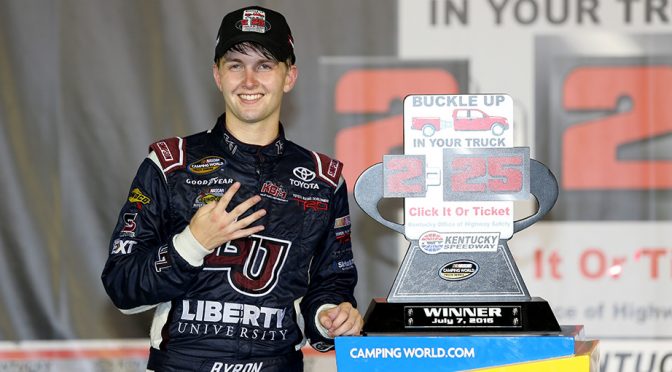
SPARTA, KY. — William Byron didn’t have the fastest truck at the end of Thursday night’s Buckle Up In Your Truck 225 at Kentucky Speedway.


But Byron had the most important ingredient in the NASCAR Camping World Truck Series race at the newly repaved and reconfigured 1.5-mile track. Byron held the top spot for all 42 laps after the final restart of the event on lap 108 of 150.


It was no cakewalk. Byron had to stave off assaults from both runner-up John Hunter Nemechek and third-place finisher Daniel Hemric , who dogged the race winner — and each other — for the entire closing green-flag run.


At the end, after surviving a last-ditch effort from Nemechek, Byron’s No. 9 Kyle Busch Motorsports Toyota crossed the finish line .190 seconds ahead of Nemechek’s family-owned No. 8 Chevrolet. Hemric was .291 seconds behind the winner at the finish.


The victory was the fourth in 10 starts this season for the 18-year-old Sunoco Rookie of the Year frontrunner, and it was the 51st win for KBM, most all-time for a NASCAR Camping World Truck Series team.


The win also officially clinched Byron’s spot in the eight-driver NASCAR Camping World Truck Series Chase. Byron needed to exit Kentucky with a 223-point edge over the 31st-place driver to mathematically clinch his postseason spot. He leads Jennifer Jo Cobb (31st place) by 224 points, which locks his spot in the top 30 for the regular season, one of the Chase’s requirements. Matt Crafton , who has two wins this season, also clinched a Chase berth.


“It’s a dream come true to get a fourth win like this,” Byron said. “I can’t thank the team enough.”


With Christopher Bell finishing fourth, KBM grabbed two of the top four spots, but team owner Kyle Busch had to watch the last 93 laps from the sidelines after Spencer Gallagher checked his Chevrolet up in front of him and triggered a wreck that sent Busch’s Toyota spinning into the outside wall on Lap 57.


Busch expressed frustration in the aftermath of the crash, but was more upbeat after the race when reflecting on the meteoric rise of the team he launched in 2010.


“This is a special moment,” said Busch, whose drivers have won the last four series races. “It’s been really cool. What to me makes it most special, I think, is how we’ve done it in such a short period of time.


“From 2010 through 2016, we’ve gotten 51 wins, and many of the teams that we excelled ahead of have been around a lot longer than we have. That’s pretty awesome.”


Byron felt a vibration in his truck in the closing laps but stayed on the throttle.


“It was tough,” he acknowledged. “I honestly felt like I had a right rear tire going down. With the new surface, it’s hard to get a tire to last that long. I had quite the vibration the last three or four laps.


“I was just hoping and praying that there would be no cautions. Just a great run for us. Our Liberty University Tundra was really good tonight, and we were able to stay out front that last run and that was the key.”


Though they had faster trucks in the closing laps, Nemechek and Hemric couldn’t focus solely on Byron because they were battling each other. Hemric lost momentum into Turn 1 on Lap 146 when he closed quickly on Byron’s bumper, and he and Nemechek ran side-by-side for the better part of two laps before Nemechek took the second spot on Lap 147.


Though Nemechek was clearly stronger than Byron through high-speed Turns 1 and 2, he wasn’t able to get to Byron’s rear bumper on the final lap.


“The 19 (Hemric) got down on my right rear a couple of times and got me loose, but that’s just racing, I guess,” Nemechek said. “It sucks to be disappointed with second, but I guess that’s a good thing.”


Hemric gave a tip of the hat to Byron, who had to work extremely hard to stay out front.


“The 9 (Byron) was put in a position where he had to run perfectly for the last 40-45 laps, or else he wouldn’t have won,” Hemric said. “So congratulations to him.”


Byron, locked into the inaugural NASCAR Camping World Truck Series Chase, extended his series lead to 13 points over second-place Matt Crafton , who ran eighth, and 17 points over Hemric and Timothy Peters (ninth Thursday), who are tied for third.

NASCAR implemented rule changes two years ago in its Sprint Cup Series aimed at limiting the action known as tandem drafting, the ability for two cars to lock up and advance past another competitor.


Changes now are being considered to halt the activity for the XFINITY Series after a one-day test at Daytona International Speedway July 2.


“You no longer see that in the Sprint Cup Series and that’s what we wanted to try and accomplish,” XFINITY Series Director Wayne Auton told NASCAR.com. “We stayed in Daytona and tested several things to make sure two XFINITY Series cars can’t lock up. Then NASCAR doesn’t have to try and police the cars locking bumpers in an effort to beat another competitor.


“We have a rule that says two cars cannot lock bumpers in an effort to push another car. As we saw in the past, the Sprint Cup cars used to be able to push, but the aerodynamics of their cars today don’t allow them to do that.


“We’re trying to get our cars more like the Sprint Cup cars to where they can’t lock bumpers.”


NASCAR outlawed the practice of tandem drafting, the process of two cars hooking up nose-to-tail to increase overall speed, by implementing changes that affected engine cooling, thus increasing the likelihood of overheating the engines if the practice continued.


Cars still use the draft, run nose-to-tail with minimal or no contact to advance, but they are not allowed to lock onto the back of another car and push the car in front around the track.


Auton called policing the practice of locking up “the hardest thing I’ve ever done at a race track by far.


“There’s a way we can fix the cars after what we saw Sunday to not have to worry about it, go back to Daytona and have great racing,” he said.


Officials worked with three drivers and teams at Daytona during the four-hour test – Daniel Suarez (Joe Gibbs Racing No. 19 Toyota), Ryan Blaney (Team Penske No. 22 Ford) and Brandon Jones (Richard Childress Racing No. 33 Chevrolet).


“You can find out a lot about the aero package with just three cars,” Auton said. “The way we did the test, we had two cars that went out and tried to hook up with the aero packages that we put on them. And we had another car with all kinds of devices on it to see what the air was actually doing with the car.


“We then took all that off and put all three cars out there together. We found that the third car is very instrumental in getting the second car to the car up front.


“The drivers could tell you whether it was possible to get locked up. We put the spoiler on that we ran Friday night with one of the configurations on the front end and it didn’t take them two seconds to get locked up.


“We put a device on the front and reduced the spoiler on the rear end and they couldn’t get locked up. So you don’t need a lot of cars.”


Specific changes likely won’t be announced until the 2017 rules package for the XFINITY Series is unveiled, but it is possible that some of what was learned during the test could be implemented across the board for the series. NASCAR’s Sprint Cup Series rules package, which features a reduction in downforce, has improved competition and XFINITY Series teams appear willing to go down a similar road.


The XFINITY series will not compete in a restrictor-plate race again until it returns to Daytona in February 2017.


“I’m pretty confident that it was a very successful test,” Auton said. “With everything we threw at it, we found out a lot of information about our cars in four hours.


“We made multiple, multiple runs. Mid-30 to 40-lap runs (again and again) on the race track to accomplish the goals we had. The drivers hardly ever got out of the cars.”

Officials used a combination of science and common sense when it came to preparing the fresh racing surface at Kentucky Speedway for this weekend’s NASCAR tripleheader.


An application of lime helped draw the oils out of the new asphalt and expedited the aging process, while a generous helping of soap and water, removed by pressure washing, cleansed the surface before officials trotted out a device to measure the frictional value of the racing surface.


The 1.5-mile track will host the Quaker State 400 Saturday (7:30 p.m., NBCSN, PRN, SiriusXM NASCAR), the 18th of 36 Sprint Cup Series events of 2016. NASCAR Camping World Truck Series and XFINITY Series events are slated for Thursday and Friday, respectively.


An off-season repaving project using a coarser type of asphalt will greet teams in all three series this weekend.


Following a two-day test at the facility (June 13-14), workers continued preparations by using a device known as the tire dragon to work more rubber into the racing surface, using tires that had come off the cars after the test, in an effort to wear off the “new” and hopefully speed up the process of creating multiple racing grooves.


“When we arrived, there was no driving line, no rubber, it was a clean sheet of paper,” Jerry Kaproth, Manager, Testing Logistics and Track Engineering for NASCAR said during last month’s test.


“The goal is not only to allow the rubber to get embedded into the track, but (create) a wide racing groove so we can … get to the point where we’re having double-wide racing. We feel very comfortable with what we see.


“When we’re done … we think it will be a very competitive race track.”


Officials measured the frictional value, or slipperiness, of the racing surface on several occasions to gauge how much rubber was able to adhere to the surface. Measurements were taken before and after the lime was applied, again once the surface had been cleaned and then again after the first morning session during last month’s test.


According to Kaproth, officials saw between a five- and 10-percent increase.


Several drivers participating in the test said rubber buildup was more noticeable in Turns 1 and 2, which are now banked higher than those in 3 and 4.


Kaproth said readings did not indicate any drastic change in the rubber buildup in different turns, but said that “the dynamics of the car handling may indicate that to the driver.


“Our readings are pretty consistent,” he said. “We break the tracks up into three different grooves — low, mid and high — and we average the readings from those three grooves.”


A key component that will determine how much rubber builds up on the racing surface will be the tires provided by Goodyear for this weekend’s races.


According to a release from the company, teams in all three series will run the same left-side tires while Sprint Cup teams will have a specific right-side tire for their event.


The tire choice was made following last month’s organizational test at the speedway and features the same left-side tire code as was used earlier this year at Las Vegas Motor Speedway.


The right-side tire is the same, construction-wise, as that which was used at Michigan in June. However, it is a single compound rather than the multi-zone used at several other venues.

RELATED: Chase bubble heading into Dover


DOVER, Del. — If practice makes perfect, expect a bit of imperfection Sunday when NASCAR Sprint Cup Series teams compete in the Citizen Solider 400 here at Dover International Speedway.


Rain that hampered practice on Friday and forced the cancelation of qualifying continued to be an issue on Saturday. The start of the morning practice was delayed briefly and then cut short, and conditions had not improved in time for the day’s final practice to take place.

The result? Two hours or so of track time heading into a race that will determine who remains in contention for this year’s Chase for the Sprint Cup and who does not.

Sunday’s elimination race (2 p.m. ET, NBCSN, MRN, SiriusXM NASCAR Radio) is the final stop in the opening Field of 16; Charlotte, Kansas and Talladega make up the second round that will see the 12-team field cut to eight.

Austin Dillon, driver of the No. 3 Chevrolet for Richard Childress Racing, is one of four drivers outside the top 12 and facing an early exit. He and Jamie McMurray (Chip Ganassi Racing) trail 12th-place Kyle Larson (CGR) by five points. Tony Stewart (Stewart-Haas Racing) and Chris Buescher (Front Row Motorsports) are 15th and 16th, respectively.

“It is not ideal by any means,” Dillon, ninth and 23rd in the two practice sessions, said. “I wish we just had a regular sunny weekend where we could work on the car and really adjust the car, but it hasn’t been that. 

“We’ve got to take our knowledge from everything and do our best job to put together a piece on the track that we can go after. We are going to see how it works out.”


RELATED: Drivers who have been clutch in the Chase

With qualifying canceled, the 40-car field was set per the NASCAR rulebook, leaving officials to determine the lineup based on current owner points. That put Brad Keselowski (Team Penske No. 2 Ford) on the pole with Martin Truex Jr. (Furniture Row Racing No. 78 Toyota) completing the front row.

Joe Gibbs Racing teammates Matt Kenseth and defending series champion Kyle Busch will line up on the second row.

Truex and Kevin Harvick (SHR) are the only two drivers who posted wins in the opening round to lock themselves into the Round of 12. Harvick will start sixth, alongside Joey Logano (Team Penske).

Denny Hamlin (JGR) will start seventh and said his No. 11 team has “had our struggles for sure (in) the first practice, trying to get everything set.

“The balance is not where we need it to be so (we) definitely wanted a little bit more track time. We would like to have it … but we’ve also got some good teammates as well, so we’ll play off that.”

MORE: Starting lineup, rosters for Sunday’s race at Dover

Carl Edwards, the fourth entry out of JGR, said he wasn’t worried about the lack of on-track activity. But it’s been nearly a decade since the 37-year-old scored his only win on the 1-mile concrete track. He hasn’t finished in the top 10 at Dover since 2012 and was 28th here earlier this season.

“My gut (feeling) is we’re going to be just fine,” Edwards said. “We’re going to move through here, go to Victory Lane and move on to Charlotte. But man, this place … it can bite you. You’ve got to respect this place so we’ve got to be smart and think of the big picture.”

Those outside the Chase picture said they were no less certain of what to expect when the green flag drops for Sunday’s race.

“It’s tough,” noted Roush Fenway Racing driver Ricky Stenhouse Jr.. “You want to set your car up based off the end of that (final) practice, but you know that the race track is going to get worse than that and it’s going to build more rubber than that. So that’s what we’ve been deciphering back and forth.”

Stenhouse was second fastest in the lone Saturday session and said he felt good about the speed in his No. 17 Ford. Only Jeff Gordon, subbing for the recovering Dale Earnhardt Jr. in the No. 88 Chevrolet for Hendrick Motorsports, posted a faster lap.

“It drove OK and had OK speed,” Stenhouse said. “Hopefully we don’t mess that up. Sometimes you overthink things and try too much instead of just doing small things and keeping your car close. I think fortunately this weekend we’re close and we can fine-tune it.”