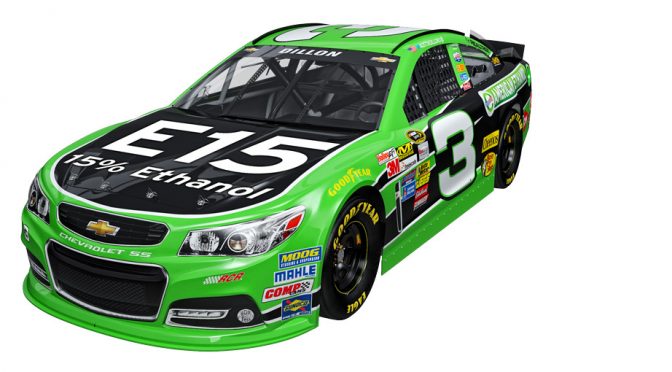
American Ethanol revealed its 2016 paint scheme for Austin Dillon‘s No. 3 Richard Childress Racing Chevrolet SS on Wednesday.

American Ethanol will return to the No. 3 team as a primary sponsor for six races during the 2016 Sprint Cup Series season:

– March 20 — Auto Club Speedway, California

– May 7 — Kansas Speedway Kansas

– July 31 — Pocono Raceway, Pennsylvania

– Sept. 4 — Darlington Raceway, South Carolina

– Oct. 23 — Talladega Superspeedway, Alabama

– Nov. 13 — Phoenix International Raceway, Arizona

For the Darlington race, the paint scheme will feature a retro theme to go along with the throwback weekend the track has planned.

American Ethanol was the primary sponsor for Dillon for six Sprint Cup races during the 2015 season.

RELATED: NASCAR announces landmark new ownership structure

If there was ever a perfect anecdote to illustrate how hard NASCAR executives and the alliance of Sprint Cup team owners worked to reach their historic Charter agreement this offseason, it’s the one provided by Brian France himself.

The NASCAR Chairman and CEO offered a glimpse with his Tuesday remarks, providing visions of working the phones on Christmas Eve against the backdrop of gift wrap, trimmed trees and mulled cider. In addition to pushing through the typically sacrosanct time around the holidays, France also navigated around offseason knee surgery to help broker the deal.

But a more evident, powerful visual from both sides came during Tuesday’s groundbreaking announcement. When the eight representatives — four from NASCAR’s executive board and four from the team ownership group — took the stage, each sat intermingled across company ranks. No divisions.

When the Race Team Alliance formed in July 2014 with the hopes of providing owners a unified voice and a path to a better financial model, France was among the early skeptics, telling SiriusXM NASCAR Radio that he didn’t think such a coalition was necessary. A year and a half later and with any battle lines erased, the eight reps sat on stage in harmony — loose, amiable, and with both sides sharing smiles and the feeling of mutual benefit.

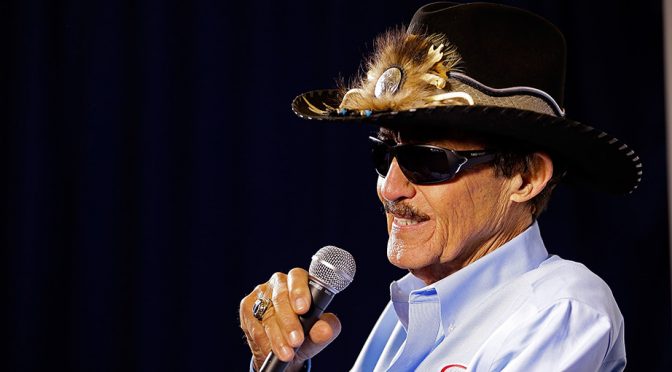
“To me, this is the second-most important thing that’s ever happened in NASCAR, because now the drivers and owners and stuff now can really work across the aisle,” said King Richard Petty, who ranked Tuesday’s landmark announcement behind only the meetings that set the foundation for NASCAR’s formation in 1947 and ’48.

“I was telling him a while ago, it’s sort of like the Democrats and Republicans, they’ve been doing their thing, we’ve been doing our thing, meeting in the middle a little bit. We’re getting rid of that. We’re all going to be in the middle of the deal now.”

Based on the newfound collegiality, the Congressional halls in Washington could take a cue from the boardrooms of Charlotte and Daytona Beach. Though both sides had to yield on certain points to reach a compromise, each emerged with a considerable number of positives to create a true win-win scenario from the nine-year agreement.

For team owners, the plusses include stability and palpable value for their Charters, an enticing selling point for sponsors. The agreement also provides a share of revenue, which may conceivably help smaller-budget teams reinvest and make modest performance gains on their well-heeled competitors within the Charter system.

For NASCAR, the premier stock-car series stands to benefit from seeing its current Charter members thrive, but also in seeing value build for prospective new sponsors and owners. The sanctioning body will retain a firm grasp on its governance of the on-track product, but the newly forged bonds of cooperation and open communication with its team owners should buoy the sport for many years.


WATCH: France calls Tuesday a ‘historic day in NASCAR’


“It’s not surprising there were a lot of different opinions, lots of different perspectives expressed during the process,” said Roush Fenway Racing president Steve Newmark. “You expect that with the diversity in our sport that we have. There was always an unwavering commitment to a single goal, a single mission. That was to make our sport better and stronger for our fans and partners. That commitment translated into a willingness of everyone involved to pursue and explore a complete paradigm shift in how we operate and to create a much stronger and stable foundation going forward.

“If you poll everyone involved in this process, the prevailing sentiment would be the collaborative precedent we set during this process bodes very well for our future.”

The spirit of collaboration — with team owners, with tracks in reaching a five-year sanctioning deal last October, and with the drivers’ council that was created just last season — represents a major advancement for NASCAR’s brass. It’s a reason why France, when asked what his father and predecessor, Bill France Jr., would think about the Charter agreement, politely joked that he’d expect a largely conservative approach.

But this isn’t your father’s NASCAR, or even France’s father’s NASCAR. That both sides drew inspiration from the ownership models of other professional sports such as the NFL, European soccer and cricket — cricket! — rams that point home.

NASCAR has long operated under a system with its participants acting as independent contractors. Now team owners can claim a degree of equity for their investment in an expensive sport.

“We always have said, because we mean it, that our owners and their success and their viability is very important to us,” France said. “That remains true yesterday; it remains true today. But these agreements and this new course that we’re on today gives us a chance to really back that up. We get to align our interests in a way we never thought we could. I’m excited about that. We’re going to be partners in a different way going forward. I couldn’t be more thrilled.”

France and the team owners may have interrupted their holidays to keep hammering away at negotiations in the face of a hard deadline — the season-opening Daytona 500 — looming just several weeks off. The culmination of those efforts made a historic holiday all its own, turning an otherwise ordinary Tuesday in February into a turning point for stock-car racing.
Huntersville, N.C. (February 10, 2016) Joe Gibbs Racing (JGR) announced today a partnership with NOS Energy Drink, as primary sponsor of the team’s No. 18 NOS Energy Drink Camry in the NASCAR XFINITY Series. 2015 NASCAR Sprint Cup Series Champion Kyle Busch, the all-time race winning driver in the history of the XFINITY Series with 76 wins, will drive his first NOS program race at Atlanta Motor Speedway and in subsequent races that total 16 XFINITY Series events this season.


To kick off the 2016 race schedule at Daytona International Speedway, Joe Gibbs Racing and NOS Energy Drink are excited to announce they are also bringing back another champion for the XFINITY series program start, longtime race winner and past Joe Gibbs Racing veteran racecar driver Bobby Labonte.


“We’ve always sought out the most determined, fearless and committed athletes to represent our company and brands,” said Vice President of Sports Marketing, Mitch Covington. He commented further, “With Kyle (Busch) in the seat most of the year and a strong Daytona start with Bobby (Labonte), we have every reason to believe our program will win.”


The NOS Energy Drink brand is no stranger to victory lane with Busch. A partnership between the two earlier in his career afforded them much success together. Between 2011 and 2008 (Busch’s first season with Joe Gibbs Racing) the orange and blue NOS colors were represented across 25 races in the XFINITY Series when Busch earned seven victories and three pole-position wins to further their brand exposure. Also in 2008 Busch represented the NOS Energy Drink colors with one NASCAR Camping World Truck Series entry, in which he earned a second-place result.


Newly minted 2015 NASCAR Sprint Cup Series champion Busch remarked, “I’m pumped to be back with NOS Energy Drink, a brand that supported me initially when I came to Joe Gibbs Racing. We had a lot of success together and I can’t wait to win with them again!”


In 311 starts over 13 seasons, Busch has proven himself to be the winningest competitor in the history of NASCAR’s XFINITY Series. In addition to 76 career wins, the 30-year old has recorded 186 top-five finishes, 48 pole-qualifying wins and 15,766 laps led. In 2010 Busch made series history with a record 13-win race season. Past XFINITY Series Championships for Kyle include a Driver’s Championship in 2009 and Owner’s Championships in 2010 and 2008 –- all with Busch’s NASCAR Sprint Cup Series and XFINITY Series team owner Joe Gibbs Racing.


Labonte proved to be a strong selection to kick off the NOS Energy Drink program for the first race of the season as he rejoins Joe Gibbs Racing while they celebrate their 25th year of NASCAR racing.

“I’m excited about the opportunity to drive for JGR again. I didn’t think this would ever happen and when Joe called me about the program, it was a ‘no-brainer.’ Great race team, great cars, the opportunity is a good one. There would be nothing better than to hang a flag in this building too,” Labonte said of the Daytona opportunity in front of him with the No. 18 JGR XFINITY Series team.


A Texas native, Labonte was an early driver of the No. 18 with JGR and earned them 21 victories and a NASCAR Sprint Cup Series Championship in 2000. Labonte is also a NASCAR Champion in the XFINITY Series (1991) and the IROC Series (2001) and has victories recorded in all three of NASCAR’s premier racing series. 2016 marks Labonte’s 30th consecutive year as a professional racecar driver.


The No. 18 team’s goal will again be to capture an Owner’s Championship in the XFINITY Series. With Busch and Labonte confirmed and the recent announcement of Matt Tifft as driver of the No. 18 for races later in the schedule, crew chief Chris Gayle is eager to attack that goal. Gayle remarks, “Owners points matter and it’s important for us to keep striving for that team goal. Looking forward to having NOS Energy Drink back with us and hopefully we are able to give them more trips to Victory Lane.”


Joe Gibbs Racing and NOS Energy Drink are two brands at the top of the field in their respective industries. With this partnership, the two have positioned themselves for great success together in 2016.


NOS Energy Drink will be featured on the No. 18 XFINITY Series Camry for 18 total races this season: Daytona International Speedway (February 20, Labonte); Atlanta Motor Speedway (February 27, Busch); Las Vegas Motor Speedway (March 5, Busch); Phoenix International Raceway (March 12, Busch); Auto Club Speedway (March 19, Busch); Texas Motor Speedway (April 8, Busch); Bristol Motor Speedway (April 16, Busch); Talladega Superspeedway (April 30, TBD driver); Pocono Raceway (June 4, Busch); Michigan International Speedway (June 11, Busch); Kentucky Speedway (July 8, Busch); Indianapolis Motor Speedway (July 23, Busch); Watkins Glen International (August 6, Busch); Richmond International Raceway (September 9, Busch); Chicagoland Speedeway (September 17, Busch); Dover International Speedway (October 1, Busch); Kansas Speedway (October 15, Busch); Phoenix International Raceway (November 12, Busch).

RELATED: Furniture Row to field Toyota Camrys in 2016

Jimmy Makar knows all about switching manufacturers.
 
In 2008, Makar, the Senior Vice President of Racing Operations at Joe Gibbs Racing, helped guide the organization during its transition from Chevrolet to Toyota.
 
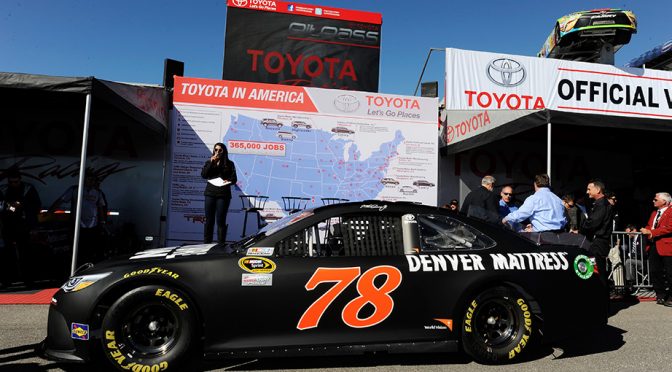
With Furniture Row Racing making the change from Chevrolet to Toyota for the 2016 NASCAR Sprint Cup Series season, a move that includes a technical alliance with JGR, Makar has a keen understanding of what lies ahead for the Denver, Colorado-based team.
 
“I hate to say it’s easier,” Makar, crew chief at JGR for more than a decade, said, “but it is easier than it used to be.”
 
The biggest issue for Makar and his group when JGR made the move involved the engine department, which at that time built and maintained engines for its Sprint Cup and XFINITY Series programs.
 
While the organization continued to build its own engines through 2011, swapping from building the Chevrolet R-07 to the Toyota engine was time-consuming and costly. In 2012, JGR teams began using engines built by Toyota Racing Development, an arrangement that continues today.
 
There will be no such problem for Furniture Row since the team doesn’t build its own engines. Previously, Earnhardt Childress Racing supplied the horsepower; now it will come from TRD.
 
“The engine program is a huge undertaking if you have to change that,” Makar said. “The bodies aren’t nearly as big of a deal anymore, especially now with the way the rules are. You have to install different sheet metal but it’s basically the same, so that’s not as bad of a deal.
 
“They’ve got their work cut out for them to do all that work, certainly. But the partnership that we’ve developed with them and what we’re doing for them will help a lot, too.”
 
Furniture Row, owned by Barney Visser, has fielded Chevrolet-branded entries since 2005 when it debuted the No. 78 in a one-race effort with driver Jerry Robertson. It began competing full time in 2008 with Joe Nemechek. The team enters ’16 with 307 starts and two wins — in ’11 with Regan Smith and ’15 with current driver Martin Truex Jr., who made it all the way to the Championship 4 at Homestead-Miami Speedway last season.

RELATED: Truex picks up familiar sponsor
 
Changing manufacturer allegiances in NASCAR is hardly uncommon, but the reasons behind such a move can vary. Team Penske made the switch from Dodge to Ford after the 2012 season when Dodge pulled out of NASCAR; Chip Ganassi Racing with Felix Sabates went from Dodge to Chevrolet in 2009 when it began a short-lived association with Dale Earnhardt Inc. And in 2010, Richard Petty Motorsports ended its Dodge affiliation to align itself with Ford.
 
When JGR made the move, the automaker was in just its second season at the Sprint Cup level and struggling to get its footing. But the long-range outlook appeared promising to JGR officials, who have said they felt they had more of a voice with the new alliance.
 
Today Toyota teams boast 79 premier series victories — including 70 by JGR drivers — and Kyle Busch (JGR) enters the season as the defending series champion.
 
Similarly, Joe Garone, general manager for Furniture Row said his group’s move to Toyota had nothing to do with the support it received from Richard Childress Racing, with whom it shared a technical alliance but was more about “Chevrolet, as far as the level of support you get to run.
 
“If we were going to run and be happy running in the middle of the field week in and week out, we would have been fine where we were,” Garone said. “But Chevrolet has their hands full. They have plenty of teams and, as a new one coming in we were always going to be the bottom team. They can only spread themselves so thin. So, honestly, there wasn’t the opportunity for us to get to the upper tier.
 
“Toyota looked at it completely differently. They could see the benefits that we bring to the table as a single-car team partnered with one of their teams, and they jumped right on board.”
 
The association with JGR, he said, was “like icing on the cake.”
 
While there were previous conversations about JGR and the now defunct Michael Waltrip Racing working more closely together, team owner Joe Gibbs said “that never kind of came together.”
 
“I think this one was something we all talked over and Toyota thought it would be good for them. We seemed to hit it off with Barney and myself, and we decided to share a lot of technology and stuff, so that’s what we’re going to do.”
 
In addition to chassis and technical support, JGR will also provide the bulk of the pit crew for the No. 78 team. Adam Mosher (rear tire carrier) and Brian Dheel (gas man) return from Truex’s 2015 over-the-wall crew. The members will train and be based out of Gibbs shop in Huntersville, North Carolina.
 
“Honestly, it’s about the car you take to the track and being better than the next guy’s,” Garone said. “We take the rock and polish it. We’re really good at polishing it, but we don’t necessarily build the rock. We get a Joe Gibbs chassis, we build that and we focus on that.
 
“As a single-car team, we put all our energy on that one car and R&D and technology, and don’t have to spread ourselves over many cars. So sometimes we can move quicker than some of the other guys.”

RELATED: Official release from NASCARNASCAR’s 36 Charter teams

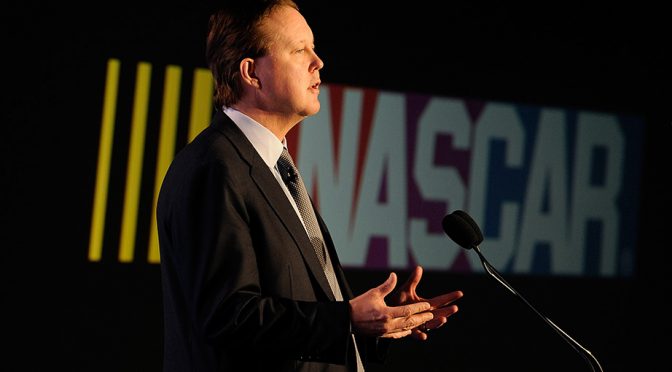
CHARLOTTE, N.C. — NASCAR Chairman & CEO Brian France announced a milestone long-term agreement Tuesday, unveiling a Charter system that is expected to substantially increase team value and sustainability for owners competing in NASCAR’s premier series.


“Today represents a landmark change to the business model of team ownership in NASCAR,” France said. “The Charter agreements provide nine years of stability for NASCAR and the teams to focus on the growth initiatives together with our track partners, auto manufacturers, drivers and sponsors.”


Thirty-six teams have been granted Charters and are guaranteed entry into each of the 36 points events. Standards for obtaining a Charter were based on participation during the past three seasons (from 2013 through July of ’15).


Four additional positions in the field each week will be determined through normal qualifying procedures as outlined in the 2016 NASCAR Sprint Cup Series Rule Book.

RELATED: Fast facts about the team owner Charter system


As a result of the changes, fields for Sprint Cup races will now consist of 40 cars.


The Charter system, a form of which owners have sought in an effort to bolster value of their organizations and which was initiated by NASCAR more than a year ago, will provide stability by guaranteeing sponsors and other potential partners continued participation for an extended period of time.


NASCAR officials said the system would not have come into being without positive support and input from the various industry stakeholders with an end goal of providing the best racing and product possible.


Charters are transferable, which France said “will aid in the development of long-term enterprise value for Charter members.”


Those organizations that have been awarded Charters are: Richard Petty Motorsports (2), Richard Childress Racing (3), Team Penske (2), Hendrick Motorsports (4), Roush Fenway Racing (3), Chip Ganassi Racing with Felix Sabates (2), Joe Gibbs Racing (3), Michael Waltrip Racing (2), Stewart-Haas Racing (3), Furniture Row Racing (1), Front Row Motorsports (2), JTG Daugherty Racing (1), Tommy Baldwin Racing (1), Germain Racing (1), Go FAS Racing (1), BK Racing (2), Premium Motorsports (1), Circle Sport Racing (1) and HScott Motorsports (1).


Three teams that competed full time in 2015 do not currently have Charters — the No. 19 of Joe Gibbs Racing with driver Carl Edwards, the No. 41 of Stewart-Haas Racing with Kurt Busch and the No. 46 of HScott Motorsports with Michael Annett.


The only way to obtain a Charter would be to purchase one of the existing 36 Charters. Michael Waltrip Racing closed its doors at the end of the 2015 season.

RELATED: Kauffman plans to sell MWR Charters

France said the team owner agreements “will offer a more appealing environment for both current and prospective team owners at the NASCAR premier series level.


“I’ve always stressed that if we can do things to improve the business of our stakeholders, we will pursue it,” he said. “I’m very proud of what we’ve accomplished today with this agreement.”


The Charter system is the latest long-term effort put into place by NASCAR. Last season it was announced that individual track sanctioning agreements, which previously had been handled on a year-to-year basis, had been extended to five-year arrangements beginning in 2016. And new multi-year broadcast agreements with FOX and NBC began last season as well.


In addition to the Charters, the agreement also includes the establishment of the Team Owner Council, a non-voting entity, which will have input into competitive and marketing matters going forward.

RELATED: Stewart hospitalized after back injury


Legendary crew chief Ray Evernham recalled the events of the weekend of Jan. 30-31 surrounding Tony Stewart‘s injury while riding sand rails in the sand dunes near the Arizona-California border.


Don Prudhomme, a veteran NHRA driver, said last week that Evernham was a leader on the scene of the accident and rode the rescue helicopter with Stewart from the dunes to the hospital.


In his regular Tuesday appearance on SiriusXM NASCAR Radio, Evernham said he received way too much credit for his actions during the efforts to get Stewart to help.


Evernham said Jeff Gordon volunteered to fly to the hospital with Stewart, but he said, “Really, dude, you’re going to roll into a hospital with Tony Stewart? That’s gonna turn into a zoo so quick.” 

RELATED: Dr. Jerry Punch explains a ‘burst fracture’

“The chopper flight was pretty interesting,” Evernham told host Dave Moody. “When we landed it was a little bit funny because the first thing they did was question us. They’re like, ‘Where did you get this helicopter?’ … It finally dawned on me, holy mackerel, they think that we’re drug runners.


“We finally got Tony to the hospital and got him some care.”


Evernham emphasized that blaming Stewart for the accident was uncalled for.

“The speeds were very low,” Evernham said, echoing what fellow dune riding enthusiast Greg Biffle said last week.

RELATED: Biffle discusses Stewart’s accident

Evernham said the accident overshadowed what had been a great gathering of racers with many good stories to tell.

“Some day we can talk about the fun things. Sitting around the camp fire listening to Don Prudhomme is like sitting with the Godfather,” Evernham said.

He also said he learned some things about his fellow NASCAR competitors.

“I was impressed with my man RW,” Evernham said. “Rusty Wallace has some dirt skills. Don’t let anyone fool you.”

Stewart had back surgery last week, and it was unclear when he’d be able to return to racing in the No. 14 Stewart-Haas Racing Chevrolet SS.

RELATED: NASCAR announces landmark new ownership structure

NASCAR Chairman & CEO Brian France joined with NASCAR Sprint Cup Series team owners on Tuesday in Charlotte, North Carolina, to announce a landmark long-term agreement on an owner Charter system.
 
The agreement provides teams with an increased business certainty and the ability to work more closely with NASCAR to continue to produce best-in-class racing.
 
Below are fast facts about the comprehensive agreement.
 
This long-term agreement is for nine years.
 
There are 36 Charter teams, currently from among 19 organizations. The number 36 was not pre-determined — NASCAR analyzed which teams showed a long-term commitment to the sport by attempting to qualify every week for the past three years. That criteria yielded 36 Charters.


Because of the above criteria, the following teams were not initially awarded Charters: the No. 19 of Joe Gibbs Racing (which purchased a Charter from Michael Waltrip Racing), the No. 21 of Wood Brothers Racing, the No. 41 of Stewart-Haas Racing (which purchased a Charter from Michael Waltrip Racing) and the No. 46 of HScott Motorsports (HScott reached agreement with Premium Motorsports for its Charter in 2016. This Charter was later sold by Premium to Furniture Row Racing.) Late in 2016, the No. 7 of Tommy Baldwin Racing sold its charter to Leavine Family Racing. In 2017, the No. 16 Charter of Roush Fenway Racing will be leased to JTG Daugherty Racing‘s second team. For 2017, the No. 15 Charter of HScott Motorsports was sold to Premium Motorsports. The No. 21 Wood Brothers Racing is leasing the No. 32 Charter of Go Fas Racing in 2017, while Go Fas Racing is leasing the No. 44 Charter of Richard Petty Motorsports
 
A Charter guarantees entry into the field of every Sprint Cup Series points race. Qualifying speeds still determine the lineup.
 
Sprint Cup Series fields will shift from 43 cars to 40 cars. That means 36 Charter teams are guaranteed to make every points race, and four non-Charter (or “open”) teams will complete the rest of the field.
 
Charter owners may transfer their Charter to another team, for one full season, once over the first five years of the agreement.
 
Charter teams are held to a minimum performance standard. If a Charter team finishes in the bottom three of the owner standings among all 36 Charter teams for three consecutive years, NASCAR has a right to remove the charter.
 
Teams may sell their Charters on the open market.
 
Organizations now have a hard cap of four cars; there will be no fifth car for rookie drivers.

NASCAR revealed in February 2016 which race teams own the sport’s 36 Charters. Each Charter team owner has a guaranteed entry into the field of every NASCAR Sprint Cup Series points race.

The table below shows the initial Charters (which were awarded following the 2015 season), and updates some of the Charters for 2017.


Listed by historical inception of race team entity, then numerical

*HScott Motorsports reached agreement with Premium Motorsports for use of its Charter in 2016. This Charter was eventually sold to Furniture Row Racing for its second team, the No. 77.

** Michael Waltrip Racing sold its two Charters to the No. 19 of Joe Gibbs Racing and the No. 41 of Stewart-Haas Racing.
***Near the end of the 2016 season, Tommy Baldwin Racing sold its Charter to Leavine Family Racing.
****Roush Fenway Racing will lease the No. 16 Charter to JTG Daugherty Racing‘s newly formed second team (No. 37) in 2017.
*****HScott Motorsports‘ No. 15 Charter was sold to Premium Motorsports for 2017.
******Go Fas Racing is leasing the No. 32 Charter to the No. 21 team of Wood Brothers Racing.
*******Richard Petty Motorsports is leasing the No. 44 Charter to the No. 32 team of Go Fas Racing.

NASCAR Charter Teams

2015 Car # 2016 Car # Organization
43 43 Richard Petty Motorsports
9 44******* Richard Petty Motorsports
3 3 Richard Childress Racing
27 27 Richard Childress Racing
31 31 Richard Childress Racing
2 2 Team Penske
22 22 Team Penske
5 5 Hendrick Motorsports
24 24 Hendrick Motorsports
48 48 Hendrick Motorsports
88 88 Hendrick Motorsports
6 6 Roush Fenway Racing
16 16**** Roush Fenway Racing
17 17 Roush Fenway Racing
1 1 Chip Ganassi Racing
42 42 Chip Ganassi Racing
11 11 Joe Gibbs Racing
18 18 Joe Gibbs Racing
20 20 Joe Gibbs Racing
15 19/41** Michael Waltrip Racing
55 19/41** Michael Waltrip Racing
4 4 Stewart-Haas Racing
10 10 Stewart-Haas Racing
14 14 Stewart-Haas Racing
78 78 Furniture Row Racing
35 34 Front Row Motorsports
38 38 Front Row Motorsports
47 47 JTG Daugherty Racing
7 7*** Tommy Baldwin Racing
13 13 Germain Racing
32 32****** Go Fas Racing
23 23 BK Racing
83 83 BK Racing
62 46* Premium Motorsports
33 95 Circle Sport Racing
51 15***** HScott Motorsports

Representatives for Stewart-Haas Racing and Joe Gibbs Racing said Tuesday afternoon that their teams are in the final stages of acquiring Charters from the former Michael Waltrip Racing organization.


RELATED: NASCAR announces landmark new ownership stucture

The news comes shortly after Rob Kauffman — chairman of the Race Team Alliance, a coalition of NASCAR Sprint Cup Series teams — indicated that the Stewart-Haas No. 41 team (with driver Kurt Busch) and the Gibbs No. 19 team (with driver Carl Edwards) were likely in the late stages of negotiations for the two available Charters.


“I think it’s very likely JGR and StewartHaas will probably be acquiring those in the nottoodistant future,” Kauffman said during Tuesday’s presentation, where major changes to the ownership structure in stock-car racing’s premier series were unveiled.


Kauffman added that the transactions would need to be completed before the season-opening Daytona 500 on Feb. 21. According to the terms of the nine-year agreement, any transfer of Charter ownership would require approval by NASCAR.

MORE: NASCAR’s 36 Charter teams


A representative for SHR said Tuesday afternoon that “Stewart-Haas Racing will have four Charters and that process is nearly complete.” NASCAR granted Charters to the organization’s other three teams — No. 4 (with driver Kevin Harvick), No. 10 (Danica Patrick) and No. 14 (Tony Stewart).


A Joe Gibbs Racing representative said Tuesday afternoon that it was “just a matter of finalizing the transaction” that would bring a Charter to the No. 19 entry. The Toyota organization was issued Charters for its remaining three teams — No. 11 (Denny Hamlin), No. 18 (defending series champion Kyle Busch) and No. 20 (Matt Kenseth).


Kauffman was co-owner of Michael Waltrip Racing from October 2007 until last season, when the organization closed its doors. NASCAR granted charters to MWR’s two full-time teams (No. 15 and No. 55), both of which met the performance-based eligibility qualifications to become one of the series’ 36 Charter teams.


MORE: Fast facts about Charter system


Kauffman became a part-owner of Chip Ganassi Racing with Felix Sabates last summer.

RELATED: NASCAR announces landmark new ownership stucture | NASCAR’s 36 Charter teams | Fast facts about Charter system


DAYTONA BEACH, Fla. (February 9, 2016) — During a historic event held today in Charlotte, N.C., NASCAR Chairman and CEO Brian France joined with NASCAR Sprint Cup Series team owners to announce a landmark long-term agreement that provides teams with increased business certainty and the ability to work more closely with NASCAR to produce best-in-class racing.


In effect as the 2016 NASCAR season prepares to kick off this weekend, the new Charter system addresses three key areas — participation, governance and economics — to promote a more predictable, sustainable and valuable team business model. The agreement grants NASCAR Sprint Cup Series Charters to 36 teams, establishes a Team Owner Council that will have formal input into decisions, and provides Charter teams with new revenue opportunities including a greater interest in digital operations.


“Today represents a landmark change to the business model of team ownership in NASCAR,” France said. “The Charter agreements provide nine years of stability for NASCAR and the teams to focus on growth initiatives together with our track partners, auto manufacturers, drivers and sponsors. The Charters also are transferable, which will aid in the development of long-term enterprise value for Charter members.”


The system affords Charter teams that remain in good standing more predictable revenue over the nine years of the agreement. Along with improved financial certainty, the new framework is designed to increase the long-term market value of teams and provide the ability to plan farther ahead with existing, new and prospective partners.


Similar to the five-year sanctioning agreements that NASCAR begins with tracks in 2016, team owner Charter agreements allow for longer planning cycles around competition, innovation, digital marketing, governance and research and development.


“The new Charter program strengthens each of our businesses individually and the team model as a whole, which is good for NASCAR, our fans, drivers, sponsors and the thousands of people who we employ,” said Rob Kauffman, co-owner of Chip Ganassi Racing. “This will give us more stability and predictability, and it will allow us to take a more progressive, long-term approach to issues.


“NASCAR and the teams share a desire to preserve, promote and grow the sport and ultimately produce great racing for our fans and partners. These common goals served as the foundation for discussions and helped bring us to this unprecedented agreement. This is a great step forward for the entire sport made possible by Brian France setting a new course for the NASCAR industry and the owners coming together on shared issues. Everyone involved then compromised a bit to be able to come up with something that worked for all.”


Each Charter team owner has a guaranteed entry into the field of every NASCAR Sprint Cup Series points race. To maintain the historical openness of NASCAR racing, the balance of the field will be open for team owners who do not hold Charters. These Open team owners will compete for the remaining starting spots and positions in the race, as each event in the NASCAR Sprint Cup Series’ starting lineup shifts in 2016 to a 40-car field.


“The new team owner agreements will offer a more appealing environment for both current and prospective team owners at the NASCAR premier series level,” France said. “I’ve always stressed that if we can do things to improve the business of our stakeholders, we will pursue it. I’m very proud of what we’ve accomplished today with this agreement.”


NASCAR Charter teams

(Listed by historical inception of race team entity, then numerical)
*HScott Motorsports reached agreement with Premium Motorsports for use of its Charter in 2016.

** Michael Waltrip Racing sold its two Charters to the No. 19 team of Joe Gibbs Racing and the No. 41 team of Stewart-Haas Racing.

2015 Car #

2016 Car #

Organization

43

43

Richard Petty Motorsports

9

44

Richard Petty Motorsports

3

3

Richard Childress Racing

27

27

Richard Childress Racing

31

31

Richard Childress Racing

2

2

Team Penske

22

22

Team Penske

5

5

Hendrick Motorsports

24

24

Hendrick Motorsports

48

48

Hendrick Motorsports

88

88

Hendrick Motorsports

6

6

Roush Fenway Racing

16

16

Roush Fenway Racing

17

17

Roush Fenway Racing

1

1

Chip Ganassi Racing

42

42

Chip Ganassi Racing

11

11

Joe Gibbs Racing

18

18

Joe Gibbs Racing

20

20

Joe Gibbs Racing

15

19/41**

Michael Waltrip Racing

55

19/41**

Michael Waltrip Racing

4

4

Stewart-Haas Racing

10

10

Stewart-Haas Racing

14

14

Stewart-Haas Racing

78

78

Furniture Row Racing

35

34

Front Row Motorsports

38

38

Front Row Motorsports

47

47

JTG Daugherty Racing

7

7

Tommy Baldwin Racing

13

13

Germain Racing

32

32

Go Fas Racing

23

23

BK Racing

83

83

BK Racing

62

46*

Premium Motorsports

33

95

Circle Sport Racing

51

15

HScott Motorsports