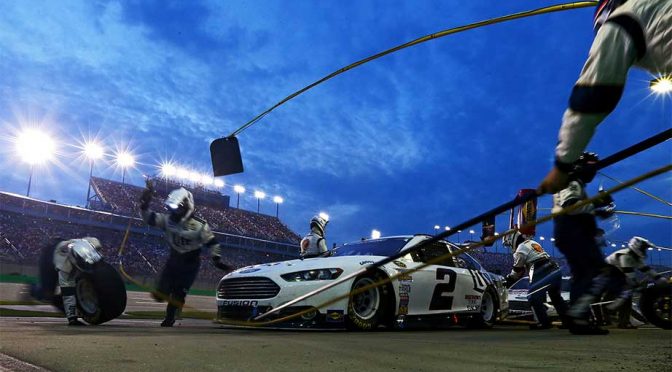
That was the question raised Saturday night at Kentucky Speedway after Jeremy Ogles, the front tire carrier for Brad Keselowski’s Team Penske No. 2 team, took a fall while coming around the front of the car following a two-tire stop.
Ogles stumbled as he went to retrieve the tire, which had fallen over, just as Keselowski was pulling out of his pit stall. The tire carrier was clipped and the tire went bouncing out of the pit box before being stopped by a teammate.
The penalty for an uncontrolled tire violation is re-starting at the tail end of the field (when under yellow) or a pass-thru (green).
Keselowski wasn’t penalized and while he lost track position for the lengthy stop, eventually finished sixth in the Sprint Cup Series’ Quaker State 400 presented by Advance Auto Parts.
Tires that have rolled out onto pit road and posed a hazard have resulted in penalties, as have those that have been rolled from the outer half of the pit stall back to pit wall by crewmen.
"That’s something that we’re looking at in terms of tires staying inside the car area near the wall where we haven’t called that in the past," Steve O’Donnell, Executive Vice President and Chief Racing Development Officer for NASCAR, told SiriusXM NASCAR Radio Monday.
"Where you’ve seen us make calls it’s a tire has come across pit road and gets in the way of another car. We’ll look at that and review it, and if it’s something we can tweak for ’16, that’s certainly something we would do."
It’s a Jungle Out There
Ogles wasn’t the only crewman struck by a car during Saturday night’s race. The No. 1 of Jamie McMurray struck John Gianninoto, jack man for the Hendrick Motorsports No. 24 with driver Jeff Gordon, during a round of pit stops.
Neither crewman was injured.
RELATED: Best in-car audio from Kentucky
Kentucky Rules Postmortem
Take away a little more downforce? That was an initial thought from Jason Ratcliff, crew chief for the No. 20 Joe Gibbs Racing Toyota and driver Matt Kenseth following the Kentucky race.
"I think if we give Goodyear an opportunity to work on it, they can make it even better," Ratcliff said. "Maybe we need to go one step more. If that was a 20 percent reduction, and I’m just kicking numbers out there, maybe we need to go another 5 percent reduction on downforce, trying to keep the balance the same. Let Goodyear work on it and I think it was just a great race."
The aero package for Kentucky featured a shorter spoiler as well as changes to the splitter and splitter extension panel. A similar package will be used later this year at Darlington Raceway.
"It looked like with the aero package guys could really follow each other down in the corner and it was less sensitive. A lot of times, we see guys follow each other down and there’s just such a disadvantage to the guy in front of them, whereas tonight I thought that was closed up a bit. I like it."
Todd Gordon, crew chief for Joey Logano and the No. 22 Team Penske Ford, concurred.
"I feel like it’s something that could be a good direction for us," Gordon said. "If you’re the car behind, you’ve got a little bit of speed and you can get up on ’em and move some air behind them and you’re not stuck with that big, old bubble. I would say it’s in the right direction."
Although Goodyear was unable to produce a tire built specifically for the lower downforce package at Kentucky, there were no tire issues during the race.
"My hat’s off to everybody for making the change and taking a chance like this in race trim," Goodyear’s Greg Stucker, Director of Race Tire Sales for Goodyear, told SiriusXM NASCAR Radio. "It’s one thing to go out and test different concepts and different packages but … really the ultimate test as we’ve always said is really the race itself. That’s really where you prove out a concept one way or the other.
"We had a lot of confidence in the package as we went in. I think everybody was prepared to take a step back if we needed to and go back to the conventional (aero) package, but I think once we all got on the race track everybody knew that this thing had a lot of potential and it was a good way to go."
Stucker said being able to gather race data from Kentucky as well as testing information from Darlington gives the tire maker "two really good bookends … we ran low downforce here at Kentucky with conventional tire grip and at Darlington we’re going to go there with low downforce and we’re going to have more grip.
"I think we have a couple of really good data points to look at and learn from and as an industry decide which way we want to go," he said.
Wind Tunnel Update
For the second time this season, NASCAR obtained additional cars to be taken to the wind tunnel for further evaluation.
The cars taken following the Quaker State 400 were those of Jeff Gordon, Denny Hamlin and Brad Keselowski. Earlier this year, the cars of Dale Earnhardt Jr., Joey Logano and Aric Almirola were chosen following the QuikTrip Folds of Honor 500 at Atlanta Motor Speedway.
NASCAR conducts such tests to gauge aerodynamic numbers for the different makes (Chevrolet SS, Toyota Camry and Ford Fusion). The tests are conducted at the AeroDyn Wind Tunnel in Mooresville, North Carolina
NHMS Tire Selection
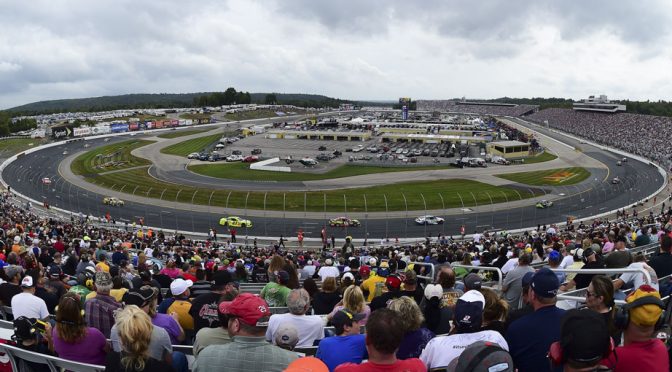
Tires for this weekend’s NASCAR Sprint Cup and XFINITY Series races at New Hampshire Motor Speedway will feature the same tire codes and the combination is the same that’s been run at the 1.058-mile track since 2012. This particular tire will be used only at New Hampshire.
NASCAR K&N Pro Series East teams will be using a tire combination that’s previously been run at Iowa and Phoenix. It will be the first time it’s been used at NHMS.