It’s not only the cars on the tracks that are going faster these days.
Thanks to a collaborative effort with Microsoft, NASCAR’s technical inspection process has been setting its own track records as the 2014 racing season hustles toward its conclusion.
The development of a mobile inspection application has helped streamline the labor-intensive process of on-site technical inspection, trimming nearly in half the time spent examining cars and recording pertinent data.
"We’re moving faster and our jobs are much easier than they were before," Richard Buck, managing director for the NASCAR Sprint Cup Series said. "The inspection app was designed to make the overall process more efficient and it has."
Inspectors use the devices for eight different disciplines, from safety and templates to engine inspection, throughout the course of a race weekend.
"We saw some opportunities to bring the speed up and the efficiency of our inspection process," Fred Prendergast Jr., vehicle inspection tools and procedures engineer for NASCAR, said at Charlotte Motor Speedway earlier this month. "We talked to all of the guys in the field, and said ‘This is what we’re doing. How do you want it to work? How do you want it to look? What are your complaints and what are your concerns in the field?’ And that’s where all of this came from."
For years, individual NASCAR inspectors would record a car’s progress through the inspection process on paper, signing off when the car cleared a certain station while making notations when an issue or issues arose. Prendergast estimated that officials were initialing paperwork upwards of roughly 2,000 times each weekend for 38 weeks.
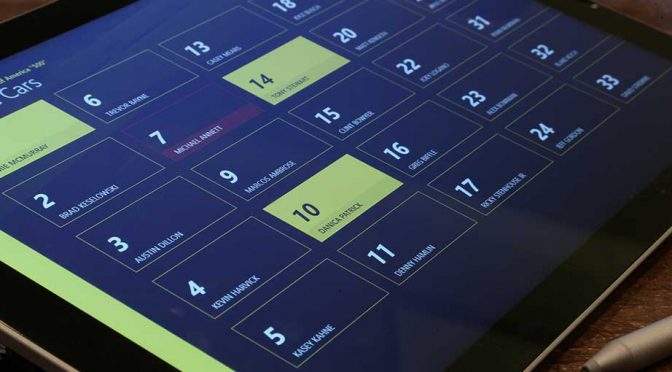
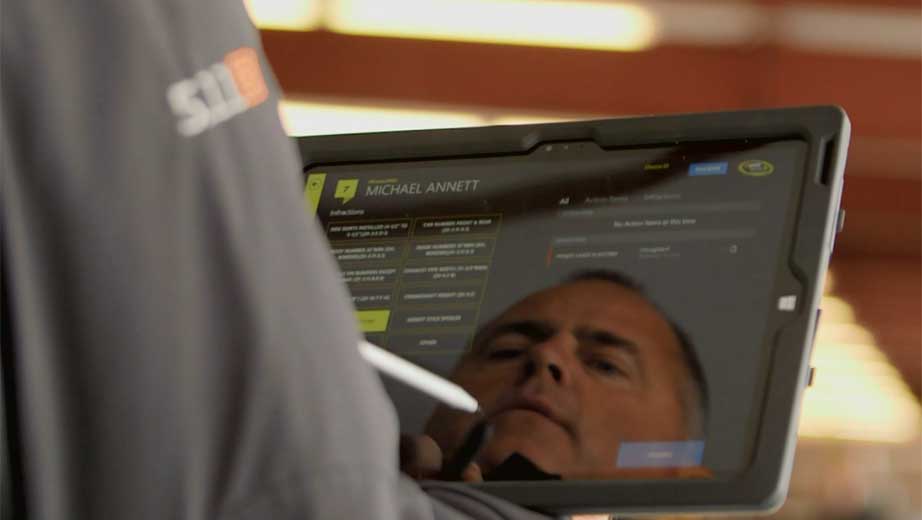
Now, they simply note on the handheld device when the car has cleared, or indicate any issues when applicable, and the information is stored in the database. Each series director can track the progress of the inspection process, as a whole or for an individual car, by simply viewing the application’s dashboard on his desktop or laptop device, regardless of where he might be located.
According to Jason Campbell, senior product marketing manager for Windows marketing, the technology "is connected to a dedicated network. If it’s out of range, the device still captures the data, and when it’s in range, it syncs up."
"It actually works in an off-line manner," Prendergast said, "so if they lose connectivity, they just keep on going."
Buck, Wayne Auton and Chad Little serve as series directors for the Sprint Cup, Nationwide and Camping World Truck Series, respectively. Prendergast said the directors wanted "a more efficient way to manage race-day events, the inspection events, with more real-time data they could see."
The app provides access to the various inspection disciplines with a "real-time view of everything that’s going on in the field," he said. "Each discipline, and where it’s at in terms of completion.
"On the right side, they’ve got what they call the score — how many cars are ready to compete and have gone through the complete inspection process. How long do we have until the race?"
Previously, the only way to determine how far along the inspection process was, or if any team or teams had an issue, was for the series director to personally walk through the garage to the various inspection stations.
"He would have had to have spoken to the official at that point, talked to the team. You don’t have to do that anymore; it’s all right here," Prendergast, a former engineer in the aviation aerospace industry, said.
Each car is considered good to go by default. As it moves through the inspection process, should an issue arise, officials can note the problem with the touch of an icon — the level of infractions are color-coded for easy reference — and even have the ability to include a photograph when necessary.
"One of the things we weren’t able to do before was see real-time data, real-time notes," Prendergast said. When an icon on the screen is highlighted, "that means someone has written a note related to this infraction. So (an official or director) can open that up and read what’s going on with that particular car."
Such real-time data, combined with a growing database, also allows officials to detect trends. If teams are working in an area of the cars that’s caught the attention of the officials, it can be easily traced. It’s also made it easier to confirm issues that have surfaced previously.
Now, when a car comes through, a crew member has to sign off on any infraction "so there’s a record of it," he said.
"I can go back and pull the image of the signature from the database. It’s all saved. We will save a full season’s worth of records, then we’ll archive it. We can keep it for however long we need."
Prendergast said he’s hoping that the technology will also be used to record items away from the track, such as chassis certification at the NASCAR Research & Development Center in Concord, North Carolina. And the process is expected to be completely paperless by next season, when he said details of infractions in inspection would be emailed to those parties involved.
Additionally, the ability to give fans access to the results of the process as it unfolds is also being studied.
"The possibilities of this … are absolutely tremendous," Prendergast said.
Microsoft’s Campbell said the development of the application from initial concept to in-race use took about six months.
"The design experience, how we created the visual; image engineering, how do we take the Windows image and put it on the device; the infrastructure, tying into the NASCAR infrastructure, the database and where all this stuff is housed," he said.
"That’s a very, very short time. When thinking about a commercial installation, and the fact that you’re capturing sensitive data and you have to secure that, that is a very short time.
"Typically in commercial scenarios, we see anywhere from probably 12 to 18 months for something like this. This is very accelerated … the officials and our services team really immersed themselves into what it is going to take to deliver what they want to be more efficient."
For Buck and the other series directors, as well as the inspectors in the garage, it’s made the entire process much smoother.
"With the dashboard in my office," Buck said, "I can monitor the progress of all 43 cars and the dynamic movements of what it takes to get ready for a race on race day."
MORE: