Drivers reminisce on chaotic 1994 Brickyard 400 qualifying

RELATED: Play NASCAR Fantasy Live | Sign up for RaceView today

Everybody knows how it ended, with members of the Rainbow Warrior crew hopping over the pit wall and into one another’s arms, Jeff Gordon rolling into a Victory Lane so choked with people there was hardly room for the car, and the future four-time champion standing with both arms raised. But how it all started — well, that’s another story altogether. Because the race just to get into that inaugural NASCAR event at Indianapolis Motor Speedway two decades ago was every bit as frenzied as the race to win it.

Enough cars showed up to fill two full starting fields. Drivers came out of retirement. Open-wheelers slid into vehicles with fenders. Qualifying took hours, and practice was choked like midtown Manhattan during the evening commute. Everybody who could scrounge up a race car, it seemed, wanted to be a part of it. The prestige was massive. The money was huge. The pressure was enormous. With 83 teams trying to wedge their way into that first Brickyard 400, just making the race was a victory.

FULL SERIES COVERAGE

Latest news
Standings
Schedule

"There were cars everywhere," remembered Bobby Labonte, who would go on to finish 16th.

"It was very chaotic," recalled Rick Mast, who won the pole.

For stock-car drivers, qualifying at Indianapolis has always been an adventure — the notoriously temperature-sensitive track has long left competitors watching the sky for passing clouds that could mean the difference in 10 rows on the starting grid, critical on a narrow layout where most winners come from the front. That process takes on a new wrinkle this weekend, when group qualifying debuts on the 2.5-mile rectangle. But from a NASCAR perspective, nothing will ever beat 1994, and the crazy scramble which entailed enough entries to fill two races at Indianapolis, much less one.

Everyone knew it would be a big deal. That first Brickyard promised a huge payday, to the point where last-place finisher Jimmy Spencer would earn more in purse winnings at Indianapolis ($21,825) than Ricky Rudd would collect for finishing fifth the next week at Watkins Glen ($20,875). But the history-making aspect of that first NASCAR race, coming at a track which prior to that point had hosted only one event each year, turned grizzled drivers into little kids on Christmas eve. Everybody wanted to be a part of it.

"You’re right in the middle of the explosion, and you didn’t even know it," Mast said, referring to the tremendous growth NASCAR experienced around that time. "The Indy thing was just part of that explosion. And in the year leading up to it, that’s what it was all about — the Indy race. And I’m talking drivers. I’ve never seen that much anticipation from drivers. … So when we got there, everybody who had a race car, or ever had a race car, or ever dreamed of having a race car, showed up with a race car."

 Did they ever. The great lion A.J. Foyt, who had been retired for over a year, was lured back to give it a go. So was Charlie Glotzbach, who had set that first speed record at Talladega back in 1969. So was Ken Bouchard, who hadn’t started a premier-series event in five years. The ageless Hershel McGriff came from Oregon, the ageless James Hylton from South Carolina. Butch Gilliland, father of current Sprint Cup Series driver David, entered the race. So did open-wheelers Geoff Brabham, Danny Sullivan and Davy Jones, none of whom had ever raced a stock car, and Gary Bettenhausen, who hadn’t raced one in two decades. Regional and touring series drivers showed up like deer flushed from the woods.

There were so many entries — a total of 83 cars would take qualifying laps — that the NASCAR regulars began to worry about just making the race. Understandably so, given that only three provisional spots were available at the time, and not even past series champions were guaranteed a spot.

"I was very nervous at the race, because I was one of those having to make the race on time at Joe Gibbs Racing," said Dale Jarrett, who won the event twice and will call Sunday’s race for ESPN. "… I’ll be quite honest — I was as nervous in qualifying as I’d ever been. I wanted to be a part of that first Brickyard 400. To be quite honest, I think it’s probably the most loose and out of control I ever drove in a qualifying lap that I didn’t crash. But we made it, and that was important. It was just a huge weight lifted off our shoulders whenever we ran the time. We ended up (14th). It was tremendous, but the pressure was immense."

Ricky Rudd could relate. "It had a lot of people concerned about making the race, people that would normally make the race," said the 1997 winner. "Obviously at that time provisional spots were laid out a little bit differently.  There were quite a few Indy teams that put stock cars there for the first time — never been in stock car races, but fielded a car for the first Brickyard 400. It was a little intimidating knowing how much pressure was on qualifying. Definitely it wasn’t just about a starting place, it was about making the race. A lot of guys were concerned."

The setting only added to the anxiety. Then as now Indianapolis has its own unique set of policies and procedures, with an expansive cadre of yellow-shirted security officers in place to enforce them. There were certain gates to be used, certain passes which were required, and certain rules to be followed — for instance, cars had to be pushed into the garage area rather than driven in. "Intimidation by the yellow shirt guys, intimidation by the race track, intimidation by can you make the race," Labonte called the experience. All this with 83 cars piloted by 83 nervous drivers, many of whom weren’t exactly sure where to go.

"Heck, we’d never done anything like that," Mast added. "Half the time you’d forget and come in with the motor running, and they’d come down and chastise you. You’d have cars running everywhere, and pulling out in front of you, and you’d try to get on the race track and there’s 50 cars sitting there waiting to go. Everything was like a pack of dogs chasing a piece of meat, and nobody sure of where to go. That to me added more to the confusion part than just the sheer numbers."

Still, the steer numbers were overwhelming. Kyle Petty told reporters on the scene that the track was "too crowded to practice." Qualifying itself was a marathon. "It felt like it took a week," Mast said. The first driver out was H.B. Bailey, a Houston native who had made just one premier-series start the past six years, at just after 3 p.m. local time. Mast went out  a half-hour later in 13th, and laid down a lap of 172.414 mph that bumped Dale Earnhardt off the provisional pole. With still over 50 cars remaining to go, the pride of Rockbridge Baths, Va., headed back to the garage area.

"I finally just laid down on the dadgum bench and took a nap," he remembered. "To hell with this, man. Everybody’s walking around nervous. ‘Y’all leave me alone. Lord a-mercy. I can’t run another lap. We’ve done all we can do. Just chill out a little bit.’ So I just went over to the bench and laid down. Took a nap, woke up, and they were still qualifying."

That first day of qualifying, 70 cars made attempts. Rick Bickle was among the 20 who secured spots in the event. "Many times I have seen crews exhibit far less joy after winning a race," wrote Charlotte Observer reporter Tom Higgins. NASCAR regulars like Terry Labonte, Harry Gant, Darrell Waltrip and Petty were among those who would have to try again the next day, when 54 drivers made second-round attempts. Foyt snagged the 40th starting spot, the final one awarded on speed. The third and final provisional went to Mike Case, then the points leader in what is now K&N Pro Series West. The last driver to try and qualify was also the first — Bailey, who again came up short.

Dozens went home. Bettenhausen and Jones. McGriff and Hylton. Bouchard, Glotzbach and Gilliland. P.J. Jones and Stan Fox. Dick Trickle, Ron Hornaday, and Randy LaJoie. The pole winner Mast earned $50,000 and a new van, both of which he split with owner Richard Jackson. And the next day in the driver’s meeting, all 43 fortunate starters received a stern message from NASCAR chairman Bill France Jr. — who might have been specifically addressing Mast and Earnhardt, the two men who would comprise the front row.

"He was looking right at me and Earnhardt, but was talking to everybody," Mast remembered. "He said, ‘Boys, when they drop that green flag and all y’all get down in the first turn, do not screw up. We’re not coming up here and embarrassing ourselves in the first turn of the first lap at Indianapolis.’"

They didn’t — in fact the exact opposite happened, and a day capped by Gordon’s dramatic and popular victory helped raise NASCAR to a new level. It was more than the sport could ever hope for, though for Mast, the afternoon remains bittersweet. "My car was just perfection then. Just perfection," he recalled. That was, until the fourth turn of the second lap, when he lost a cylinder and had to race the remainder of the day with seven instead of eight. He finished a deflating 22nd. "That kind of supersedes everything for me," he said.

And yet the legacy of that weekend remains. Even now, two decades later, Mast estimates that once a month he opens the mailbox to find a memento from that inaugural Brickyard race along with an autograph request. "It still comes up all the time," he said. Understandable, given that coming out on top of perhaps the craziest, most chaotic, and most nerve-rattling qualifying session in modern NASCAR history was quite an accomplishment in itself.

MORE:

READ: Latest
NASCAR news

WATCH: Latest
NASCAR video

PLAY: NASCAR
Fantasy Live

FOLLOW LIVE: Get
RaceView

KBM driver will start on pole in the first of five qualifying races

RELATED: Full lineups for qualifying heat races

Erik Jones took the top spot in NASCAR Camping World Truck Series single-truck qualifying on Wednesday night at Eldora Speedway as each truck got two laps on the muddy surface to post a best time.

FULL SERIES COVERAGE

Latest news
Standings
Schedule

Jones will start on the 21 Means 21 pole position for the first of five 10-lap qualifying races, which begin at 7 p.m. ET (FOX Sports 1).

Joining Jones with the poles for the other qualifying races were Mason Mingus, Ron Hornaday Jr., Matt Crafton and Ken Schrader, who finished second through fifth, respectively, in the single-car runs.

A caution came out when the No. 50 of T.J. Bell made contact with the wall and blew a tire. Caution also came out when the No. 07 of Jared Landers made contact with the wall.

The five qualifying races, plus a sixth last-chance race, will set the lineup for tonight’s 1-800-CARCASH Mudsummer Classic (9 ET on FOX Sports 1).

For more information on how Eldora qualifying works, click here.

MORE:

READ: Latest
NASCAR news

WATCH: Latest
NASCAR video

PLAY: NASCAR
Fantasy Live

FOLLOW LIVE: Get
RaceView

Jones leads first session; Blaney rebounds in second practice

SECOND PRACTICE (Results)

After a sluggish run in the opening practice session, Ryan Blaney bounced back with the top time in the second session in preparation for the 1-800-CarCrash Mudsummer Classic, being run tonight (9 p.m. ET on FOX Sports 1) on the half-mile dirt track at Eldora Speedway.

Blaney, driving for Brad Keselowski Racing, turned in a time of 87.869 mph on the seventh of his 70 laps. He edged out Mason Mingus (87.771) by .023 of a second.

FULL SERIES COVERAGE

Latest news
Standings
Schedule

Mingus, a 19-year-old in his first full season as a Trucks driver, had a solid morning; he also placed second in the first practice of the day.

Austin Dillon had the third-fastest lap of the second practice with a time of 87.596. Now a full-time driver on the NASCAR Sprint Cup Series, Dillon won last year’s Mudsummer Classic, which marked the first NASCAR race on dirt since 1970 and the first ever in the Trucks Series.

Regarded as a dirt-track ace — he does it in his spare time — Dillon will be among the favorites to win tonight’s race. He has five Truck Series wins in 58 starts, and won the Series title in 2011.

Ron Hornaday Jr. (87.125 mph) was fourth in the session, and Ty Dillon, Austin’s younger brother, placed fifth (87.007).

Also among the top 10 were: Jody Knowles (86.931), JR Heffner (86.747), Chase Pistone (86.714), Kyle Larson (86.647) and Ken Schrader (36.626).

Camping World Truck Series points leader Matt Crafton was 16th on the speed chart in the second session (86.261).

The times in the second session were slower. Five drivers in the opening practice had a lap of 90-plus miles per hour.

FIRST PRACTICE (Results)

Erik Jones will race on dirt for the first time in his career tonight, but it didn’t look like it in his first practice session.

Jones, an 18-year-old rookie coming off his first career Trucks win at Iowa on July 12, had the fastest lap of the opening practice session at 90.749 miles per hour Wednesday morning. He covered his eighth lap (out of 11) on the half-mile dirt track in 19.835 seconds to finish just ahead of Mingus (19.856), who had a best lap of 90.653 mph.

Kyle Busch Motorsports has won seven of the nine Trucks races this season, and Jones will try to keep that trend going at Eldora.

Crafton had the third-fastest lap in the first practice at 90.221 mph, followed by Tyler Reddick (90.149) and Larson (90.009).

Rounding out the top 10 were German Quiroga Jr. (89.632), Darrell Wallace Jr. (89.592), Timothy Peters (89.486), Chase Pistone (89.321) and Johnny Sauter (89.303).

Austin Dillon placed 25th (out of 32) on the speed chart at 87.796 mph. Crowd favorite Norm Benning, a 62-year-old who was a last-chance qualifier at Eldora last season, was 26th (87.383).

Blaney, ranked second in the Truck Series standings, placed 28th (87.256).

The start of the opening practice was delayed slightly due to a muddy track, and the session was extended 10 minutes.

Keystone Light Pole Qualifying is scheduled for 5:10 p.m. ET (FOX Sports 1). The best of two laps will determine the order. The first of five qualifying races starts at 7 p.m. ET, and a last-chance qualifying race begins at 8:10 p.m. ET.

MORE:

READ: Latest
NASCAR news

WATCH: Latest
NASCAR video

PLAY: NASCAR
Fantasy Live

FOLLOW LIVE: Get
RaceView

Young gun hard on himself, but fellow drivers impressed with performance

Related: Full race results | Updated series standings

ROSSBURG, Ohio — Kyle Larson couldn’t begin to estimate how many times he hit the wall during the course of the night on Eldora Speedway‘s dirt half-mile before his Turner Scott Motorsports entry finally succumbed to the damage. Pressed for a tally, the number he pulled out of the air would’ve averaged out to contact nearly every other lap.

"Oh, I’d say at least … I probably hit it close to 70 times," said Larson, who added he lost count after the first five brushes with the outside barrier. "No joke. I probably hit it 20 times before practice was over."

FULL SERIES COVERAGE

Latest news
Standings
Schedule

Larson’s dogged pursuit of race winner Darrell Wallace Jr. filled up the highlight reel again in the NASCAR Camping World Truck Series‘ 1-800-CarCash Mudsummer Classic. The NASCAR Sprint Cup Series rookie finished second last year in the inaugural running of the only current national series race on dirt. Even though the race results listed him in 26th place, two laps down at the finish, his performance rivaled that of the winner’s.

Even so, Larson was left kicking himself for another near-miss in NASCAR’s most unique race at a facility near and dear to his heart.

"I feel stupid. It’s tough to lose a race like that," Larson said. "I don’t think anybody hit the wall as many times as I hit it."

Larson’s background of racing at Eldora continued to pay dividends as he wheeled his truck up against the cushion all night, pulling off slide jobs and crossover moves to finally take the lead from Wallace in the 128th lap. He held it for five circuits, benefitting from a scoring decision that placed him first for the final restart.

A late caution period stalled his momentum in the 2013 running of the Mudsummer Classic. Though he benefitted from Wednesday night’s yellow flag, he was unable to hold the lead, giving way to Wallace shortly after the green re-emerged. Though Larson was able to close on the race winner down the stretch, sparks flew from his No. 32 truck as the hits got progressively heavier.

"It sucks that I got the benefit of it this time and didn’t take advantage of it," said Larson, who started 11th in the 30-truck field. "It’s easier to take the defeat of this one, I guess since I DNF’ed out of it, but it still sucks that I got to the lead and then couldn’t really hold onto it."

The on-the-edge performance was reminiscent of his dazzling run to second place last season. But it also drew the notice of Eldora Speedway owner Tony Stewart, who like Larson lives and breathes dirt-track racing.

"Kyle had one of those gladiator runs," Stewart said. "He did not leave anything on the table. If he didn’t win it, he was going to wear. Again, that’s moments that happen at places like this that make for great racing."

After Larson finished his interviews beside his used-up Chevrolet, he accepted several commendations from fans and met the appreciation with a sheepish grin and a what-can-you-do shrug. He also savored a pat on the back and high praise from fourth-place finisher Ken Schrader, a veteran dirt-track master cut much from the same cloth.

"He’s a phenomenal young talent," Schrader said. "I guess I’m partial, the fact that he wins and can drive the hell out of so many different types of cars. I’m just a big fan."

MORE:

READ: Latest
NASCAR news

WATCH: Latest
NASCAR video

PLAY: NASCAR
Fantasy Live

FOLLOW LIVE: Get
RaceView

Folk hero: ‘I wasn’t going to go home. It’s that simple’

ROSSBURG, Ohio — Norm Benning was barely out of his truck when he heard a voice call out, "Hey, rock star!" Soon after, Benning was suddenly in a big bear hug courtesy of Eldora Speedway owner Tony Stewart.

FULL SERIES COVERAGE

Latest news
Standings
Schedule

Benning, in a near-repeat of last year’s determined drive into the 1-800-CarCash Mudsummer Classic lineup, made it into the field of 30 trucks for the NASCAR Camping World Truck Series main event Wednesday night with another stellar finish in the last-chance qualifying race.

"Again, I wasn’t going to go home. It’s that simple," Benning said. "I did what I had to do. … We’re in. Now we’ve got to make some adjustments and go faster."

Benning finished fourth in this year’s last-chance race, clinching his berth in the feature with a one-spot cushion since five trucks transferred in. Still, he had to survive a handful of restarts and plenty of two- and three-abreast contact to drive his way into the starting lineup.

He did it with another strong cheering section of his peers — Stewart included.

"I thought I was going to climb the wall there at one point," Benning said. "Like I told you, we were going to make it happen. Both sides of the truck are worn out, but we’re in the show."

MORE:

READ: Latest
NASCAR news

WATCH: Latest
NASCAR video

PLAY: NASCAR
Fantasy Live

FOLLOW LIVE: Get
RaceView

Dirt track improving its facilities; Stewart ‘open-minded’ to ideas

ROSSBURG, Ohio — Eldora Speedway owner Tony Stewart helped bring the NASCAR Camping World Truck Series to the dirt a year ago. Now he and his staff are taking measures to make sure all forms of motorsports benefit from the half-mile facility for years to come.
 
If that includes the NASCAR Sprint Cup and Nationwide Series, so be it, Stewart said.

FULL SERIES COVERAGE

Latest news
Standings
Schedule

Stewart and Eldora promoter Roger Slack announced an expansion project that will transform the dirt track’s infield, including upgraded concessions and restrooms, plus dedicated medical center and media center facilities. In doing so, the three-time Sprint Cup champion said attracting NASCAR’s premier and second-tier divisions to the Western Ohio track would be a dream come true.
 
"This is part of the continued process of us making the commitment to keep improving the facility and making it bigger and better every year," Stewart said Wednesday afternoon before the second running of the 1-800-CarCash Mudsummer Classic. "We hope we continue to have this event every year and I’m going to throw it out there, I’d love for the truck series to not be the only NASCAR series that comes here. If this continues to go as well as we hope it does, there’s no reason that the other two divisions couldn’t possibly come in the future.
 
"That’s not what we’re planning for, but we’re very open-minded that as well as the truck race went last year and if it goes as well as I think it will tonight, it’s definitely something we want to make sure we’re doing the right steps for."
 
Stewart said that the infield expansion plans were long in the making and were not intended to be an overture toward potentially expanding NASCAR’s calendar of events at Eldora. The project is expected to be complete by spring 2015.

In terms of perhaps following the truck series’ lead with a midweek race day, Stewart said he was open to any and all possibilities.
 
"I can run on whatever night they want to run on," Stewart said. "They can pick. We’ll run on whatever night they choose. I think we can make it work. If you can take the trucks and make them work here, the Cup cars, the Nationwide cars aren’t a big stretch from that. It’s definitely feasible to do that; it’s just a matter of if that’s something the want to do.
 
"We’re very appreciative and very content if we only run truck races from here on out. If we get the privilege to keep hosting truck races, we’re very happy doing that. If the opportunity presents itself down the road to have Nationwide or a Cup race … I don’t think anyone in short-track racing would be able to top that. I think that would be the ultimate crowning achievement for a short-track promoter to be able to do that and pull it off."

Stewart has already pulled off a historic first, bringing a NASCAR national series event to a dirt track for the first time since 1970. The roaring success of the inaugural truck race here was just another feather in the cap of the Eldora, which was built by Earl Baltes in 1954 and rose to prominence as one of the premier dirt tracks in the country for its aptitude in hosting star-studded, big-money events.
 
Stewart, who took ownership of the track in 2004, said the expansion project would continue Eldora’s tradition of grand-scale ideas.
 
"We’ve got a lot of big things in mind," Stewart said. "This is something that I look at not as an investment; this is something that I look at, this is a personal project for me. This is something that we will continue to re-invest as much as we can into this facility and keep the tradition and this history of this facility alive and thriving as long as we can."
 
Said Slack: "It’ll be a significant investment, but will be a significant improvement and will stay the very same height of the existing building so it will not affect the fans or the grandstand sight lines in any way. We’re really excited about this. This is probably the second-biggest undertaking since building the suites. Looking forward to starting work on it."

MORE:

READ: Latest
NASCAR news

WATCH: Latest
NASCAR video

PLAY: NASCAR
Fantasy Live

FOLLOW LIVE: Get
RaceView

Get start times, race stats and more for the Truck Series’ dirt race

RELATED: Full starting lineup for Eldora race

What: 2nd annual 1-800-CarCash Mudsummer Classic
Where: Eldora Speedway, a half-mile dirt oval in Rossburg, Ohio
When: Wednesday, July 23 at 9 p.m. ET
TV/Radio: FOX Sports 1, MRN, SiriusXM NASCAR Radio
Distance: 150 laps; 75 miles (3 segments: 60 laps, 50 laps, 40 laps)
 
Pit road speed: 30 mph
Caution car speed: 35 mph
Fuel window: 162 laps
 
Keystone Light Pole Qualifying: 5:10 p.m. ET; Five qualifying races of 10 laps each, 7 p.m. ET, plus 15-lap last-chance qualifying race (all events airing on FOX Sports 1)
 
Fastest in practice:
First practice: Erik Jones, Kyle Busch Motorsports No. 51 Toyota
Final practice: Ryan Blaney, Brad Keselowski Racing No. 29 Ford
 
Last year’s winner: Austin Dillon, RSS Racing No. 39 Chevrolet (will drive the No. 2 Chevrolet for Richard Childress Racing in this year’s event)

FULL SERIES COVERAGE

Latest news
Standings
Schedule

They said it I: "I want to go around the campgrounds and I want to see what the atmosphere is like. Last year it was a draining experience for me. Every night when we were done, all I wanted to do was go to sleep. But this year after you get that first event under your belt, it’s like the final scene of the movie Field of Dreams. You’re out in the middle of a corn field and all of a sudden there is a speedway, and you’ll see campers before you’ll ever see the racetrack." — Eldora Speedway owner and three-time NASCAR Sprint Cup Series champion Tony Stewart
 
They said it II: "Among Truck Series races, I would definitely say (Eldora’s) probably right around the Daytona level, probably second or third. I wouldn’t really see too many other races there that would really be much higher than it." — Erik Jones, the NASCAR Camping World Truck Series’ most recent winner, July 11 at Iowa Speedway
 
They said it III: "If the fans are happy, that’s what makes the sport go ’round. I think that it’s good that NASCAR has allowed it to come back. I still like my pavement racing, but once in a while on dirt’s not bad." — Jeb Burton, who took 18th place in the inaugural event at Eldora last season
 
They said it IV:
"It’s probably the most fun we’ll have besides going to Canada. I say that because we’re on dirt for Eldora, then we’re turning right for Canada, so it’s totally different than what we go to throughout the rest of the season." — Darrell Wallace Jr., looking ahead not only to dirt-track racing, but the series’ road course race Aug. 31 at Canadian Tire Motorsport Park, the former Mosport circuit
 
They said it V: "The energy was very high and it was cool to be a part of it for sure. Looking forward to going back. Always the second time you go back, you still want it be the same as the first. There isn’t any doubt in my mind there will still be a lot of excitement." — Timothy Peters, the sixth-place finisher from the inaugural Mudsummer Classic
 
Sibling act: The Brothers Dillon — Austin and Ty — have an extensive dirt-track pedigree with their penchant for extracurricular racing. They also may hold the distinction for being the earliest to publicly commit to the second Mudsummer Classic. During Austin Dillon’s NASCAR Nationwide Series Champion’s Day last December in Columbus, Ohio, he was asked by a Nationwide Insurance employee about whether he’d defend his Eldora crown. Without missing a beat, he replied, "Oh, we’ll be at Eldora." Sure enough, seven months later, both brothers are on the entry list.
 
Different type of encore: Tyler Reddick raced a year ago at Eldora Speedway, but it wasn’t in the NASCAR Camping World Truck Series. Reddick, 18, finished third here in both preliminary races for dirt late model cars in 2013. This season, he’ll have a chance in the main event in the No. 19 Ford for Brad Keselowski Racing.
 
The Fraternal Order of Go-Fast: Short-track racing veteran Ken Schrader made history during Keystone Light Pole Qualifying for last year’s event, becoming the oldest pole winner in NASCAR national series history at age 58 and earning his place in "the Fraternal Order of Go-Fast," as the Eldora public address announcers put it. One year older, Schrader is back for more in No. 52 for team owner Gene Haas.
 
Fast times: Schrader’s pole-winning lap clocked in at 92.329 mph (19.709 seconds), underscoring the unfamiliar turf for the heavier trucks that compete on asphalt every race except this one. As a comparison, the overall record at the half-mile track is a blazing 141.654 mph (12.707 seconds) by Craig Dollansky in a winged sprint car on April 13, 2002.
 
Former Iowa Speedway winners in the field:
Austin Dillon (1).

MORE:

READ: Latest
NASCAR news

WATCH: Latest
NASCAR video

PLAY: NASCAR
Fantasy Live

FOLLOW LIVE: Get
RaceView

Collected water on track forces practices to go on hold

Opening practice for the NASCAR Camping World Truck Series was delayed Wednesday morning by overnight rain that turned Eldora Speedway into a muddy mess.
 
Two practices — from 10 to 11 a.m. ET and 11:30 a.m. to 1 p.m. ET — were scheduled for the second annual 1-800-CarCash Mudsummer Classic (9 p.m. ET, FOX Sports 1). The track’s service trucks were circling Wednesday morning to work the half-mile track’s slick dirt surface to a raceable condition.
 
Keystone Light Pole Qualifying is scheduled for 5:10 p.m. ET (FOX Sports 1) in a single-car format, with the best of two laps establishing the order for qualifying races. Five qualifying races are scheduled to roll off starting at 7 p.m. ET, plus a last-chance qualifying race at 8:10 p.m. ET that will fill the 30-truck field.

MORE:

READ: Latest
NASCAR news

WATCH: Latest
NASCAR video

PLAY: NASCAR
Fantasy Live

FOLLOW LIVE: Get
RaceView

Team working to improve after poor showing at what was once a strong track

It was the low point in the first half of the year for Roush Fenway Racing. In this year’s June visit to Michigan International Speedway, the three-team organization failed to put a driver in the top-10 for the first time since the 2000 NASCAR Sprint Cup Series season.
 
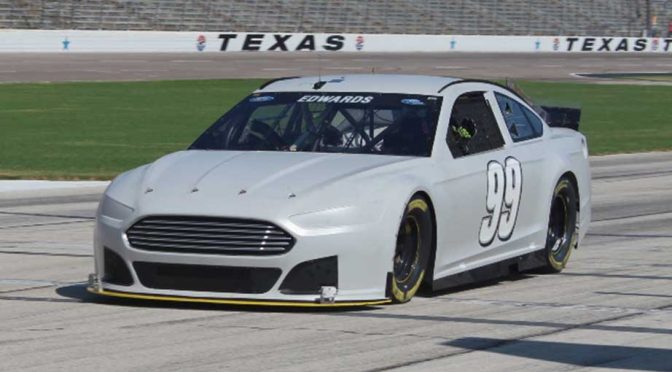
That’s one of the reasons the team, with drivers Greg Biffle, Carl Edwards and Ricky Stenhouse Jr., made the trip back to the Irish Hills this week for a two-day test session at the 2-mile track.
 
Biffle finished 20th in the Quicken Loans 400, Edwards was 22nd and Stenhouse 27th. For an organization that has 13 Sprint Cup victories at the track, it was embarrassing.
 
"That was really the low point for us in a number of ways," Edwards said during a break in testing Tuesday. "We didn’t expect to come here and perform that poorly."

FULL SERIES COVERAGE

Latest news
Standings
Schedule

"We truly believed we would come here and this was going to be a track where we could turn things around."
 
Instead, he said, the results showed the team two things: that there are areas where Roush Fenway is still behind, and that "you can’t rely on past performance."
 
"My average finish might be great here, but that doesn’t matter now," he said.
 
Edwards is enjoying a solid season in spite of the organization’s struggles, with wins at Bristol and Sonoma. He is sixth in points and could all but lock up a spot in this year’s Chase for the NASCAR Sprint Cup with a solid finish this weekend at Indianapolis Motor Speedway.
 
Biffle currently resides right on the line for the Chase cutoff in 16th. A win in any of the next seven races would go a long way toward easing his team’s Chase concerns.
 
The odds for Stenhouse Jr. are much longer. The former Nationwide Series champion has yet to win at the Cup level and his sophomore season has been less than memorable. His ninth-place finish two weeks ago at New Hampshire Motor Speedway was only his fourth top-10 of the season, and his first since finishing 10th at Talladega in early May. He heads to Indianapolis 28th in the points standings.
 
Although Ford teams have won the last four Sprint Cup races, only one — Edwards’ win at Sonoma — has come from the Roush Fenway camp.
 
Brad Keselowski, driver of the Team Penske No. 2 Ford, has two of the wins, while Aric Almirola (Richard Petty Motorsports) won at Daytona earlier this month.
 
"You look at the Penske cars and they are beating the Chevrolets every week," Biffle said. "It’s pretty obvious that we need to catch up. That is why we are here testing … and we are finding some of that speed.
 
"We just need to continue to work hard and narrow in on it and see if we can close that gap to the fast Penske cars."
 
While the Penske teams of Keselowski and teammate Joey Logano might be setting the standard for Ford at this point in the season, Edwards says their success is helpful to each of the Ford organizations.
 
"That is really a gift to us, I believe,” Edwards said of the rival group’s success, "because it rules out some of the things we could blame our struggles on.
 
"It rules out the Ford Fusion body; it is obviously a great body and works well in the air. It rules out our engines, because we have the same engines. Those are two giant pieces we don’t have to worry about.
 
"We have a few things we have to work on. Really, we have found a couple of things recently that are going to be good. We plan on coming back and being better."


MORE:

READ: Latest
NASCAR news

WATCH: Latest
NASCAR video

PLAY: NASCAR
Fantasy Live

FOLLOW LIVE: Get
RaceView

Crew chiefs break down how they predict the amount of fuel left in their tanks

RELATED: Play NASCAR Fantasy Live | Sign up for RaceView today

The white flag was out as Dale Earnhardt Jr. led the field across the start/finish line at Las Vegas Motor Speedway earlier this year.
 
And Earnhardt knew his car was running dangerously low on Sunoco Green E15.
 
Halfway through the final lap, his car began to slow. Brad Keselowski swept past to collect the win, while Earnhardt coasted across the line in second place.
 
"We weren’t supposed to make it," the Hendrick Motorsports driver said afterward. "We were a lap short. We tried to save as much as we (could) … make it work, but it didn’t work. We knew we were short. It’s not a shock to us to run out."
 
Four months later, teammate Jeff Gordon ran out of fuel under caution at New Hampshire Motor Speedway as the field prepared for a green-white-checkered finish.
 
Denny Hamlin (Joe Gibbs Racing), running second, was called to pit road during the caution by crew chief Darian Grubb, who knew Hamlin didn’t have enough gas to make it to the end of the race.
 
And Stewart-Haas Racing‘s Kevin Harvick, also low in the tank, began to run out just as the field took the green flag for the final time.
 
"We knew we were very close," said Gordon, whose car was pushed to pit road and refueled before the final restart. "That (fuel) pickup is in the right side (of the fuel cell) … I was scuffing my tires and I think I took just enough fuel out of the pickup and I could never get any back in there. … We might have run out anyway."
 
• • •
 
With reams of information at their fingertips, NASCAR Sprint Cup Series teams have a pretty good idea of just how much fuel their cars have in the tank at any time, as well as the car’s fuel mileage during each race.

FULL SERIES COVERAGE

Latest news
Standings
Schedule

How do they know?
 
• The standard fuel dump can weighs approximately 95 pounds when filled with 12 gallons of racing fuel;
 
• A gallon of racing fuel weighs about 6 pounds (the actual weight will vary depending on temperature);
 
• The dump cans are weighed before and after refueling the car during pit stops to get a precise measurement of fuel consumption.
 
If a can weighs 30 pounds after a pit stop, then 10.8 gallons of fuel were dispensed into the car (95 lbs.– 30 lbs. = 65 lbs., and 65/6= 10.8)
 
To determine fuel mileage at that point, a team would divide the amount of fuel replaced into the number of laps completed since the last fuel stop – for instance, if it had been 45 laps, then 45/10.8 = 4.15 mpg.
 
Because of a number of variables that impact mileage — is the driver out front in clean air or battling traffic?, for instance) — it’s impossible to know exactly how much fuel is in the tank or how far a driver can go before his car begins to sputter.
 
It’s an educated guess, but a guess just the same.
 
• • •
 
Among the various track sizes found on the 36-race Sprint Cup Series schedule, eight are 1.5-mile venues. So fuel mileage should be approximately the same at each one, right?
 
Approximately, yes. But approximately can sometimes be the difference in speeding across the finish line first, or coasting across in 10th or lower.
 
"It changes. At every track you go to, it changes," said Rodney Childers, Harvick’s crew chief.
 
The reasons are numerous. Some 1.5-mile tracks are faster than others — at Texas Motor Speedway and Kentucky Speedway earlier this season, the pole-winning speeds varied by nearly 7 mph. And faster speeds mean an engine is burning fuel at a faster rate.
 
Running a race during the day versus running one at night also impacts fuel mileage; cooler conditions under the lights often mean higher speeds with, again, engines burning fuel at a faster rate.
 
Driving styles differ, too, and charging deeper into a turn before easing off the gas pedal can also use more fuel.
 
Even the racing surface (abrasive versus smooth) plays a role, impacting tire wear, which in turn affects fuel mileage.
 
"(At) some places that don’t have much falloff (in speed), your race fuel mileage would be the same, or close to the same, that it was in practice," Childers said. "At other places where the falloff is a lot, your fuel mileage is often way better than what it was in practice."
 
What does practice have to do with calculating fuel mileage?
 
Everything.
 
The process begins before the cars are on the track. Prior to fueling the cars, the fuel dump cans are weighed. That weight, as well as the time and temperature, are noted on the outside of each fuel can.
 
Temperature affects the weight of the fuel — "the warmer the fuel is, the lighter it weighs," Len Wood, co-owner of Wood Brothers Racing, said earlier this year during a break at one NASCAR Sprint Cup Series stop.
 
"If it’s a 60-degree day at Richmond, and you come to Talladega where it’s 85 degrees, your fuel is going to be 60 degrees at one place and 85 at the other … so you have to adjust for that.
 
"If (temperature) stayed the same, say you ran all 1.5-mile tracks — 20 laps, that’s 30 miles. That doesn’t matter if it’s Kansas or Charlotte or Las Vegas. But that has nothing to do with it. It’s how much you’re on throttle at those tracks and things like that, yeah, that’s what makes it different."
 
Teams begin charting fuel mileage during opening practice each weekend. When a driver heads back to the garage for adjustments, the car is often refueled. And the amount of fuel that’s been used is carefully noted.
 
"I’ve already done three (fuel) checks here in the last 50 minutes," Wood said. "When you come in and change tires, that’s when you typically add fuel during practice.
 
"If you were going to run one set of tires at Texas for 35 laps during practice, then you would only get one (fuel) check at the end. But if you stopped with 15 minutes to go and said, ‘Let’s throw a set of tires on and see what we’ve got,’ say you’ve run 24 laps and go out and run 12 more, then you figure each one of those separately. In that case, I typically would add them together and average them."
 
In addition to figuring mileage based on how much gas a team is putting in the tank, electronic control units also provide information that can help a team determine fuel mileage.
 
"So after practice," Childers said, "you have two different figures you can look at.
 
"Then you’ve got to look at past history — ‘Every other time we’ve been here, our mileage has been two-tenths better than it was in practice.’ Kind of bank on that a little bit.
 
"But you really don’t know for sure until after your first pit stop or first two pit stops. By the time you get toward the end of the race you’re pretty confident on what you’ve got."
 
Of course, just as the competition on the track changes during the course of a race, fuel mileage can change as well.
 
"The thing than can kind of mess you up a little bit," said Childers, "is if you ride around 20th most of the day and the next thing you know you get up there in the top four in clean air. The lap times are almost a second a lap faster than what you were running (in the pack), and your mileage goes way down. You’ve got to be a little careful.
 
"It’s kind of up to the engineers and the crew chief to almost remind each other, ‘Hey, we’re way faster right now and our mileage isn’t going to be as good. We probably need to knock a couple of laps off just to be safe.
 
"It’s not easy, but the tools just keep getting better and better."


MORE:

READ: Latest
NASCAR news

WATCH: Latest
NASCAR video

PLAY: NASCAR
Fantasy Live

FOLLOW LIVE: Get
RaceView