Late-race cut tire thwarts Team Penske driver’s Nationwide hopes

RELATED: Play NASCAR Fantasy Live

BROOKLYN, Mich. — Joey Logano, a winner of 21 NASCAR Nationwide Series races, appeared to be headed toward yet another Saturday at Michigan International Speedway.

But that was before a cut tire with less than six laps to go sent the Team Penske driver to pit road. 

When the Ollie’s Bargain Outlet 250 ended, Logano pulled into the garage instead of Victory Lane.

FULL SERIES COVERAGE

"I ran over something," Logano said after finishing 16th, his No. 22 Ford the final car on the lead lap. "That pretty much sucks." 

Logano, 24, led Paul Menard by 1.5 seconds down the stretch, with the latter closing on the leader. "We were going to have a race," Logano said, "because he was catching me a little bit."

But "a little bit" quickly became a lot when the right-rear tire began to go soft.

"I could tell something was wrong on the back straightaway," Logano said, "and then it made us go up the race track.

"I hate to give them away like that. You look at the silver lining I guess, which is we had a fast … car and should have won this race. You win some this way and lose some this way." 

Menard, one of three drivers in the No. 33 Chevrolet this season for Richard Childress Racing, ended up in Victory Lane. Sam Hornish Jr., Dale Earnhardt Jr., Kyle Busch and Brian Scott completed the top five.

The Michigan start was just the fourth of the season in the series for Logano. It looked to be his best finish, although his past efforts weren’t shabby — fourth at Auto Club Speedway, fifth at Darlington and third at Dover

Logano qualified ninth and didn’t fall out of the top 10 until the tire problem. His 43 laps led was second to only Kyle Larson’s 46. 

"That’s just racing for you," he said. "… You think you are in good shape and you are worried about a caution more than anything else and then the next thing you know you hear (the tire) starting to come apart on the back straightaway. Things happen. … We move on."

MORE:

READ: Latest
NASCAR news

WATCH: Latest
NASCAR video

PLAY: NASCAR
Fantasy Live

FOLLOW LIVE: Get
RaceView

A crew chief, a driver and an engine builder discuss how trash can affect a race car

RELATED: Play NASCAR Fantasy Live | Sign up for RaceView today

BROOKLYN, Mich. — When a large piece of trash became lodged on the front of his race car, no one had to inform Brad Keselowski.
 
A quick glance at his car’s gauges told the Team Penske driver all he needed to know.
 
With the final laps of the Pocono 400 winding down, and Keselowski in the lead, the water and oil temperature gauges on his No. 2 Ford were continuing to climb.
 
"Really, really hot," the 2012 NASCAR Sprint Cup Series champion radioed his team, "but I don’t want to give up the win."
 
His best bet was to pull close enough to another car to create a break in air pressure on the front of his car, a move that often sends debris blowing off the grille.

FULL SERIES COVERAGE

Latest news
Standings
Schedule

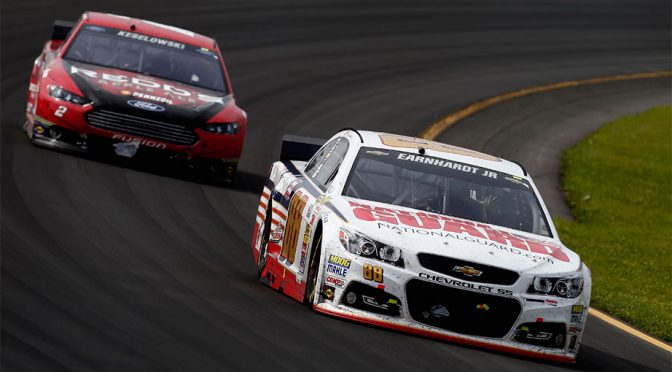
Attempting such a maneuver while also holding off a charging Dale Earnhardt Jr., Keselowski’s speed dipped briefly as he moved up the track and momentarily behind Danica Patrick. But the move didn’t take, the trash stayed put and Earnhardt Jr. went to the front and eventually collected the win.
 
"We’re trying to maximize performance every weekend," said Paul Wolfe, Keselowski’s crew chief. "We’re so close to that window that you run in without being too hot, because that’s how important performance is. Every little bit of tape we can put on that grille is speed.
 
"We’re running right up against the window so we’re paying attention to that. If there’s any type of debris or anything, we usually know pretty quick."
 
The normal operating temperature for a NASCAR Sprint Cup engine varies among teams, but most run in the 230 to 260 degree range.
 
What happens when debris begins to collect or a piece of trash becomes lodged on the front of a race car?
 
Left too long, water and oil temperatures quickly begin to escalate. But depending on the size of the track, the degree of damage can vary.
 
"It’s not always the same," said Doug Yates, who operates Roush Yates Engines. "At different tracks, it might be different things (that are affected).
 
"What usually happens when the temps get elevated, it increases the fatigue of the valve springs. Basically they’ll break sooner. That’s number one.
 
"The second thing, when the water temperature gets hot, the engine has a tendency to detonate. Because everything that’s cooling that chamber and that piston is getting hotter."
 
Yates said one of the plusses coming with the move to electronic fuel injection systems is the ability to program the units "so that when the engines gets hotter, we reduce the timing and add some fuel.
 
"Unlike a carburetor and a distributor where you couldn’t adjust that before, now we can adjust that.
 
"So if the engine and the system doesn’t lose water, it will probably be OK. Once the water is gone, everything bad happens. Head gaskets, things like that."
 
Ford teams underwent a change to the front grille area of the Fusion during the break between the 2013 and ’14 seasons, in large part because the previous grille, which was inset, had a tendency to collect much more debris.
 
The new nose features a much more flush grille and less likely to suffer from the buildup of debris.
 
"That’s the main reason (for the change)," Wolfe said, "when you get rubber buildup and stuff can collect in there.
 
"The flushed-out grille helps that a lot. We’ve definitely noticed a difference. We can run closer to that optimal temp and not worry about getting a bunch of buildup as the race goes on. Every little bit helps."
 
It’s not a track-specific problem — it can happen anywhere — but Yates said it can be more of an issue if it occurs on the larger tracks the series visits.
 
"The bigger tracks are the tougher ones because you’re on throttle, your wide-open throttle time is (longer) so … the load on the engine is higher," he said.
 
"Last week, seven laps around Pocono with a bag on the front of your car is like an eternity. Seven laps at Bristol, you’d have been done and the race would have been over and we’d be in the winner’s circle spraying champagne."
 
Drivers usually report a drop in horsepower when the temperatures inside the engine rise too high. Cooler air being sent into the cylinder means more horsepower; the hotter the air becomes, the less horsepower.
 
"When we go out to qualify and the water temp is low, it’s making a lot of power. When it gets hot, it makes less power," said Yates.
 
"We kind of use the ECU to protect the engine at higher temps; that would be the power that (Keselowski) was feeling that he lost."
 
Yates said each team programs the units differently.
 
"A lot of people this week have asked me, ‘How hot did it get?’" he said. "Well, really hot is my answer. Because every team out here has a different strategy on how they tune. That’s their choice.
 
"It worked OK, it was just unfortunate. Brad was doing everything he knew to do to get the trash off; it was just unfortunate he caught the 10 car at the wrong time."
 
The gauges notify a driver that he might have a problem, but Brian Vickers said even without such information, a driver would likely notice a difference in the handling of the car.
 
"If it’s a big piece of trash that really blocks off the grille, then you’re going to notice it in the balance of the car," the Michael Waltrip Racing driver said. "It’s going to be like putting tape on for qualifying without taping the car up.
 
"It’s probably going to be loose and eventually as the temps climb … you would start to lose some power right until it blew up."
 
While it doesn’t occur often, Vickers said it’s probably happened to every driver in the garage at some point in his or her career. There’s rarely a favorable solution; either let another driver get by to try and dislodge the trash or pit to remove it. Or ride it out and hope the engine doesn’t fail.
 
"There are a lot of variables in our sport that are unknowns … no matter how talented you are, no matter how good of a car you have and no matter how great of a race your crew chief calls … there are factors that just happen.
 
"You run over debris and you cut a tire. You get trash on your grille. Things happen."


MORE:

READ: Latest
NASCAR news

WATCH: Latest
NASCAR video

PLAY: NASCAR
Fantasy Live

FOLLOW LIVE: Get
RaceView

Polesitter Cole Custer will roll off pit road first

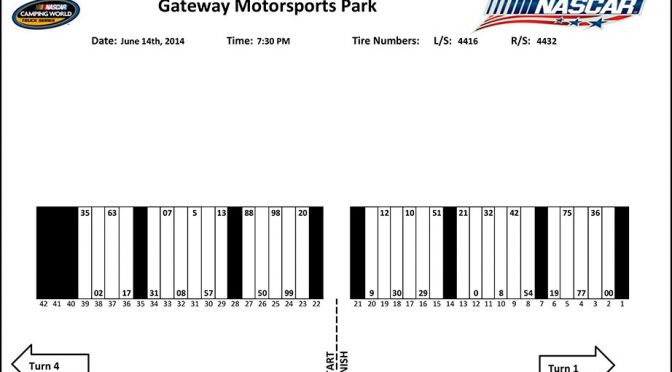
The pit stall assignments are out for Friday’s NASCAR Camping World Truck Series Drivin’ for Linemen 200 at Gateway Motorsports Park (8:30 p.m. ET, FOX Sports 1).

Cole Custer, who won the 21 means 21 pole for the event, chose the pit stall closest to the pit road exit.

In addition to Custer, Darrell Wallace Jr., Erik Jones, Gray Gaulding, Jeb Burton and Timothy Peters all chose stalls with an empty space in front of them.

Mason Mingus chose the first stall onto pit road.

FULL SERIES COVERAGE

Latest news
Standings
Schedule

MORE:

READ: Latest
NASCAR news

WATCH: Latest
NASCAR video

PLAY: NASCAR
Fantasy Live

FOLLOW LIVE: Get
RaceView

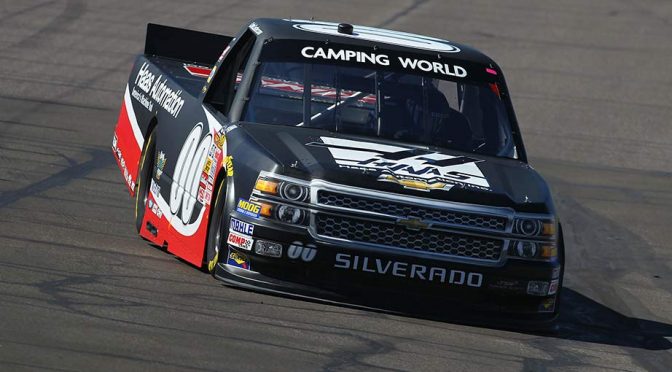
Cole Custer will lead the start of the Drivin’ for Linemen 200

Entry No. Driver Sponsor
1 00 Cole Custer Haas Automation Chevrolet
2 54 Darrell Wallace Jr. Toyota Toyota
3 51 Erik Jones ToyotaCare Toyota
4 20 Gray Gaulding # Krispy Kreme/Gemini Southern Chevrolet
5 9 Chase Pistone # NTS Motorsports Chevrolet
6 13 Jeb Burton Estes/Carolina Nut Toyota
7 19 Tyler Reddick # DrawTite Ford
8 21 Joey Coulter Allegiant Chevrolet
9 77 German Quiroga Net 10 Wireless Toyota
10 17 Timothy Peters Red Horse Racing Toyota
11 88 Matt Crafton Ideal Door/Menards Toyota
12 8 John H. Nemechek MDAndrsnCncrCntr/smkeandsr.cm Toyota
13 98 Johnny Sauter Smokey Mountain/Curb Records Toyota
14 29 Ryan Blaney Cooper Standard Ford
15 5 John Wes Townley Zaxby’s Toyota
16 30 Ron Hornaday Jr. Rheem Chevrolet
17 31 Ben Kennedy # Turner Scott Motorsports Chevrolet
18 32 Tayler Malsam Outerwall Chevrolet
19 35 Mason Mingus # Call 811 Toyota
20 07 Ray Black Jr. ScubaLife/NASE Worldwide Chevrolet
21 63 Justin Jennings LGSds/MittlerBrosMchne/SkiSoda Chev
22 02 Tyler Young # Randco/Young’s Building Systems Chevrolet
23 99 Bryan Silas Bell Trucks America, Inc. Chevrolet
24 50 TJ Bell Drivin’ For Linemen Chevrolet
25 12 Ted Minor Blastis.com Chevrolet
26 57 Norm Benning Boedecker Construction Chevrolet
27 08 Korbin Forrister McNrMcLmreMddlebrks&CoLLC Chev
28 42 Charles Lewandoski Randco/Young’s Building Systems Chevrolet
29 10 Jennifer Jo Cobb TheParkwayHotel.com RAM
30 36 Scott Stenzel Mittler Bros. Machine & Tool RAM
31 0 Caleb Roark The Parkway Hotel Chevrolet
32 75 Adam Edwards Chevrolet

MORE:

READ: Latest
NASCAR news

WATCH: Latest
NASCAR video

PLAY: NASCAR
Fantasy Live

FOLLOW LIVE: Get
RaceView

Combine offers a taste of life as a pit-crew member

MADISON, Ill. — Nick Peebles is a strong looking young man who at first glance might seem like a star football player. But thanks to the NASCAR Drive for Diversity Program, Peebles, who is African-American, is now open to a career path as a NASCAR pit-crew member.

Peebles, along with Dedrick Perry and Joseph Peebles, were walking pit road before Saturday night’s Drivin’ for Linemen 200 at Gateway Motorsports Park, soaking in the atmosphere of their first NASCAR race. They were fresh off a pit crew combine they participated in a couple of days earlier, and they were getting revved up about the whole experience.

"This is amazing, especially being out here on the track and meeting some of the drivers and pit crew members," Nick Peebles said. "It’s like a family. And I love the experience out here right now."

Nick was selected to take part in the combine, which took place on Thursday, by Demetrious Johnson, a former Detroit Lion and University of Missouri football player who runs summer sports camps and a charitable foundation in the St. Louis area. In choosing whom to take to the combine, Johnson was looking for special qualities.

"I looked at young men who are very responsible and work hard but just need an opportunity, and those are the guys I tried to bring to the combine," Johnson said. "They can try to be like pioneers, especially in the St. Louis area and the Missouri area, at being some of the first guys out of Missouri to be part of a NASCAR program who are African-American."

Johnson is a friend of Phil Horton of Rev Racing, who is the pit crew coach for the Drive for Diversity Crew Member Development program. With NASCAR returning to the St. Louis area for the first time since 2010, Horton and Johnson thought it was time to get the community not only excited about NASCAR, but also excited about the opportunities NASCAR can provide.

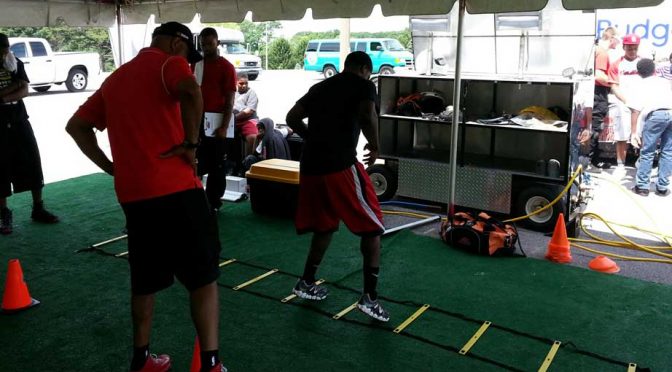
At the pit-crew combine, Horton coached up the young men, trying to match their skills with the various jobs on a pit crew (jackman, tire changers, tire carriers and gasman). Then, he and Johnson watched as more than a few eyes were opened.

"They didn’t realize how much fun it is but how competitive it is at the same time," Johnson said. "Only thing they’ve been talking about is NASCAR, and how NASCAR is so special now, because it was an area and an opportunity they never thought they could be a part of."

And that’s just the type of reaction Jim Cassidy, who is NASCAR’s VP of racing operations overseeing NASCAR’s multicultural development, likes to see.

"Exposing a lot of new not only potential fans but potential employees in our sport, I think it’s obviously a good day when you can do that," Cassidy said.

And Cassidy has seen these combines produce results. He said the program has turned out about 60 new pit-crew members since 2009.

"The placement is almost 100 percent," Cassidy said. "So if they make the commitment to move to Charlotte and spend time training with coach and hone their skills there, it’s almost a guarantee they’ll find some level of placement among the national series."

Could Nick Peebles be one of those new pit-crew members someday?

At least now he knows it’s a possibility and he has a newfound respect for the sport.

"I didn’t know you had to be in such good shape to be a pit crew member," Nick Peebles said. "It’s a real sport. Being a part of it opened my eyes to new avenues that I can possibly venture there later in life."

MORE:

READ: Latest
NASCAR news

WATCH: Latest
NASCAR video

PLAY: NASCAR
Fantasy Live

FOLLOW LIVE: Get
RaceView

Catch up ahead of Saturday night’s return to Gateway

What: Drivin’ for Linemen 200
Where: Gateway Motorports Park, Madison, Ill.
When: Saturday, June 14
TV/Radio: FOX Sports 1 (8:30 p.m. ET), MRN, SiriusXM NASCAR Radio 90
Distance: 200 miles (160 laps)
Pit road speed: 45 mph
Caution speed: 50 mph
Fuel window:
65 laps

FULL SERIES COVERAGE

Latest news
Standings
Schedule

Keystone Light Pole Qualifying: Saturday, 5:10 p.m. ET on FOX Sports 2 (three segments)

Fastest in practice
First practice: Chase Pistone, NTS Motorsports, No. 9 Chevrolet (136.141 mph).
Second practice: Justin Lofton, NTS Motorsports, No. 20 Chevrolet (136.753 mph).
Final practice: Cole Custer, Haas Racing Development, No. 00 Chevrolet (136.786 mph)

Most recent race winner: Kevin Harvick, July 17, 2010. This is the first time NASCAR has raced at Gateway Motorsports Park since 2010.
 
Summer break? "I’ve been doing online school for the past couple years, so it’s nice to finally have that out of the way and really be able to get in the swing of things at the shop. I’ve been at the shop every day this past week meeting with everybody, trying to get as much as I can out of everybody and seeing what’s up. It’s nice to be able to keep up on things like that and put my full focus in it." — Erik Jones, on what it’s like to have high school graduation complete
 
Cornered at Gateway: "This place looks fun. Both corners are different, so you’re going to have to adapt to both corners. I think the tricky one is going to be (Turns) 1 and 2 and not getting bogged down quite enough where you still get the run off the corner. I definitely love flat tracks, so this place is definitely going to be fun and is going to make for some good racing." — John Hunter Nemechek, on what he expects racing at Gateway for the first time

Experience matters? "You keep saying that, but these kids are just impressing me. You say, ‘What are you going to do on the track?’ Well, you know, I’m going to do whatever the rookies do because being an elder spokesperson and knowing what not to do, we had hard hard walls and now we have soft walls around here. These kids are doing stuff that I’ve never seen before." — Ron Hornaday Jr., on whether his experience gives him an advantage at Gateway and in the points race in general
 
Double duty, Part I: Justin Lofton is the standby driver for Gray Gaulding, who finished fifth in the NASCAR K&N Pro Series East race at Five Flags Speedway in Pensacola, Florida, on Friday before flying overnight to Gateway Motorsports Park for final practice and qualifying.
 
Double duty, Part II: Nelson Piquet Jr. was the standby driver for John Wes Townley, who finished fourth in the ARCA event at Michigan International Speedway on Friday. Townley arrived safely at the track with time to spare.

High marks for Hornaday: Hornaday Jr. has the top driver rating of 114.5 for point-paying races in the past nine years at Gateway. Johnny Sauter is second at 109.7, and Matt Crafton is fifth at 91.8. Hornaday also has the most laps led (324), laps in the top 15 (698) and number of fastest laps (117).

From the pole: In the 13 times the NASCAR Camping World Truck Series has raced at Gateway, the pole winner has found Victory Lane three times. Ted Musgrave did it twice (2001, ’05) and Harvick did it in 2010.
 
Former Gateway winners in the field: Hornaday (1), Sept. 6, 2008.

MORE:

READ: Latest
NASCAR news

WATCH: Latest
NASCAR video

PLAY: NASCAR
Fantasy Live

FOLLOW LIVE: Get
RaceView

The lure of automobiles, and the work done on them, a constant for Jarretts

RELATED: Mobil 1 Tech Center page
MORE: Share your #NASCARwithDAD stories, enter sweepstakes

Since its invention in the late 1800s, the automobile, with its ever-changing and innovative technology, has captured the imagination and passion of fathers and sons everywhere.

Spending some quality time with dad in the family garage being under the hood of a favorite car holds fond memories for many.

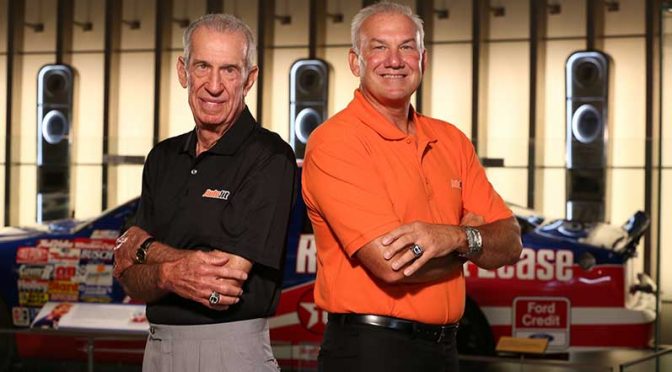
That is certainly the case with Ned and Dale Jarrett: both NASCAR champions and one of the three father-son combinations inducted into the NASCAR Hall of Fame.

"The automobile is a tool that dads and sons use to bond their relationships," said Ned, the patriarch of the Jarrett family. "It’s something they will be involved with all of their lives. The more they learn about them helps nurture their relationship with each other."

Ned Jarrett was the 1961 and 1965 premier series champion and earned 50 wins in his career. His passion comes from his own father, and it was passed down to his son Dale.

"I was fortunate to grow up on a farm and worked at a saw mill," continued Ned. "My dad had a truck and the first thing I ever drove was a truck. When Dale and our other children came along, they wanted to be involved with vehicles. Of course, they had seen their dad drive on the race track. It just seemed like something that drew us together and kept us together."

Dale followed his father’s footsteps. He was the 1999 premier series champion and winner of 32 races.

"It was that special thing that we had," recounted Dale. "I think that families learning about the automobile, how do drive it and what makes it work is something you take through your entire life. It’s something you can always discuss as you become more familiar with it and as your style and tastes change."

While the automobile serves as a bond between fathers and sons, racing cars takes that bond to a different level.

"One thing that has made NASCAR racing so popular is the fact that we all drive an automobile," Dale said. "And probably for most people we have driven one too fast at times, you know trying to be Dale Earnhardt or Richard Petty or Ned Jarrett. So, everyone can identify with it.

"Everybody doesn’t get the opportunity to play football, basketball, baseball or golf, so you really can’t talk about that. The automobile is a big part of our lives in so many ways and is a big part about what has made NASCAR racing so big for so many years."

Learning about race car technology has been the big bonding tool for the Jarretts over the years.

"One thing I tried to impress upon Dale was to learn as much about the racecar as he could," remembered Ned. "He needed to know what made that car tick to help him get that feel under him to get maximum performance on the race track."

With Father’s Day on Sunday, that relationship is cherished by both.

"I was fortunate that I didn’t have to look far to find a hero," Dale said. "My hero was right there in front of me."

Did you spend time with dad in the garage growing up? Tell us your story at autolitegreatdads.com.

Harvick wins third pole of 2014 season, sets track record

RELATED: Harvick on fast qualifying time | Sunday’s full lineup

BROOKLYN, Mich.- Three laps were all Kevin Harvick needed Friday afternoon.
 
He set a new Michigan International Speedway record on his first qualifying lap, then broke it during his last to claim his third Coors Light Pole Award of the season for Sunday’s NASCAR Sprint Cup Series Quicken Loans 400. He ran just one lap in each of the three periods and his No. 4 Chevy was the fastest car on the track each time.
 
His 204.557 mph lap in the final period was about a half-second faster than the mark he set in the first session. He parked the car after the hot lap and waited for the session to end.
 
"Obviously it was a really fast couple laps," Harvick said. "The car has been great since we unloaded it off the truck.
 
"When you have fast cars, it makes the driver’s job easier."

FULL SERIES COVERAGE

Latest news
Standings
Schedule

How fast? Harvick’s final lap is the fastest pole speed in NASCAR since Bill Elliott earned the pole at Talladega in April 1987 with a 212.809 mph run. That effort came before the sport mandated restrictor plates on high speed ovals.
 
He said not to expect similar speeds Sunday when the green flag waves.
 
"Michigan’s been fast for a long time," Harvick said, "but the cars will slow down a tremendous amount when we get them into traffic."
 
It’s the ninth pole of his career. He also started and finished first at Darlington this season and was second at Kansas after securing the pole there.
 
Harvick is seeking his third victory of the season and second career win at MIS. His first at Michigan came Aug. 15, 2010.
 
Hendrick Motorsports claimed the next two spots in the lineup thanks to Jeff Gordon and Dale Earnhardt Jr. Aric Almirola, Paul Menard and Brad Keselowski rounded out the first three rows.
 
Harvick set a new track record of 203.995 mph on his only lap of the first practice session to break the 203.949 mark set by Joey Logano in August.
 
The rest of the field noticed.
 
"Man, he was strong," Gordon, the Sprint Cup points leader, said. "The first time out I thought my lap was pretty good but nowhere near Kevin’s. Those guys are really tough, especially in qualifying."
 
Earnhardt, last weekend’s winner at Pocono, said he couldn’t tell how much faster he was during his lone lap of the final session.
 
"I didn’t feel like we were going that much faster here than in the past," he said.
 
Kasey Kahne was the first driver to miss the cut in the second round of qualifying and will start 13th next to Kyle Busch. Greg Biffle, who won last June’s race here, will start 18th.
 
AJ Allmendinger and Tony Stewart were the first two drivers to miss the cut after the first qualifying run.
 
Juan Pablo Montoya, in his first Sprint Cup race since leaving the series at the end of last season, will start 28th on Sunday in a Team Penske Ford.
 
"Having tomorrow as a practice day will be a lot better," said Montoya, who’d had just the morning practice session in the car on the two-mile track.
 
Denny Hamlin, who entered the weekend eighth in the series’ points standings, will start 29th.
 
Ryan Truex was the lone entrant who failed to qualify.

MORE:

READ: Latest
NASCAR news

WATCH: Latest
NASCAR video

PLAY: NASCAR
Fantasy Live

FOLLOW LIVE: Get
RaceView

NASCAR Hall of Famer enjoys watching son, Zach, chase his baseball dream

MORE: Share your #NASCARwithDAD stories, enter sweepstakes
RELATED: Ned and Dale discuss Dale’s first win | See our Father’s Day photo gallery 

CHARLOTTE, N.C. — The ballplayer is tall with broad shoulders, just like his dad, and he moves with that enviable fluidity which comes so natural to athletes. He digs into the dirt with one cleat, touches the tip of the bat to home plate, and settles into his stance. Each move is studied by another tall man with broad shoulders, this one sitting on the other side of the protective netting and three rows up in the grandstand, his face so tensed with concentration it’s like he’s focusing every bit as hard as the player at the plate.

Which he is. But don’t be fooled — Dale Jarrett is loving every moment of this.

"I am having a blast," the NASCAR Hall of Famer said, sitting in the sunshine outside the baseball stadium at the University of North Carolina at Charlotte, where his son Zach plays for the 49ers. Jarrett may be famous for a NASCAR career which saw him claim 32 victories and the 1999 championship, but before pursuing racing he was as well-rounded an athlete as you could find in Newton, North Carolina. He pitched and played shortstop on the high school baseball team, played quarterback and defensive back in football, was a scratch golfer. Had racing never called to him, he had scholarship offers in several other sports to fall back upon.

Of course, racing ultimately did beckon, and Jarrett went on to a championship career in NASCAR just like his father. But because he started as a driver so relatively late — Jarrett didn’t make his first start in what’s now the NASCAR Nationwide Series until he was 25 years old — he had the chance to excel in several other sports, prompting a natural curiosity over what life might have been like had he chosen another path. Now he’s finding out through Zach, who indeed veered down a road different from the one taken by his father and grandfather, and in the process of forging his own identity is giving his dad a glimpse of what might have been.

Sometimes, it’s hard to tell who’s enjoying it more.

"It’s like seeing another different side for him," said Zach, a 6-foot-4, 217-pound third baseman and outfielder who recently completed his freshman season. "He loves it. He loves traveling around and watching it."

Indeed, the breaks in the elder Jarrett’s ESPN broadcasting schedule have allowed him to become a fixture at 49ers games this past season, traveling to road series in places like Boca Raton, Florida, Norfolk, Virginia, and San Antonio, and maintaining his usual seat — third row, right behind the plate — at Charlotte’s Robert and Mariam Hayes Stadium. Although he’s occasionally asked for autographs, most of the time the NASCAR champion is just another baseball parent. Well, to a point — he doesn’t just watch, he observes, with a locked-in focus as if he’s examining every number on a speed chart or listening to a crew chief during a debrief.

"He’s so tense because he’s studying it," Zach said. "He’s looking at what I’m trying to do, and trying to see every little thing so we can talk about it after the game. It’s funny. But that’s awesome to have somebody who’s that interested."
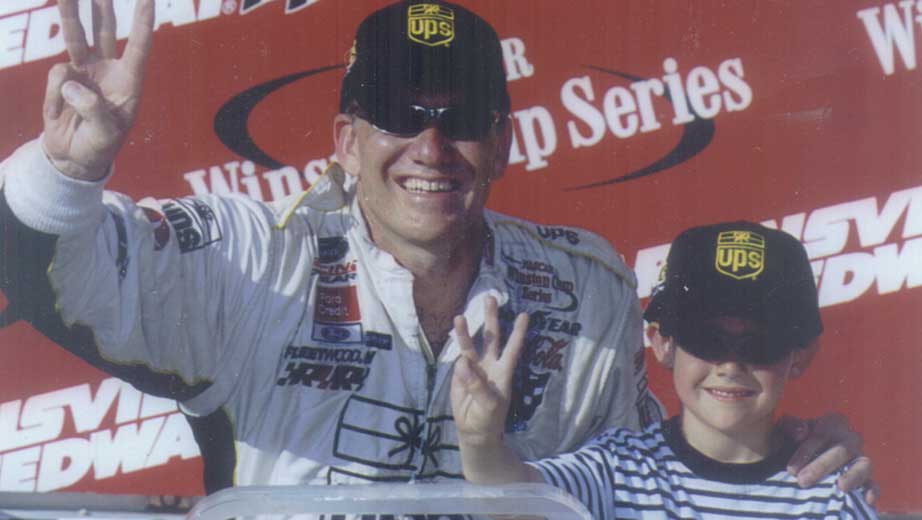
Dale Jarrett celebrates a 2001 win in Victory Lane at Martinsville Speedway with son Zach. (Photo courtesy of Jarrett Family)

Driven toward racing

The interest is understandable — not just because Dale Jarrett is watching his son, but because he’s been in the arena himself, and for almost as long as he can remember. Influenced by his older brother Glenn, who would go on to start 77 NASCAR national series events and become a broadcaster in his own right, Dale began playing baseball at age 5, and would go on to pitch and play shortstop at Newton-Conover High School in the North Carolina foothills. Jarrett quickly became hooked on competition, an urge which would eventually drive him toward racing.

Racing, though, would wait. Dale was 9 when his father Ned retired from NASCAR to pursue a broadcasting career that would redefine the medium, so there was no pressure to jump into a stock car. He discovered a deep love for football, and not just the glamor position of quarterback, but the gritty role of cornerback. "I enjoyed hitting more than I enjoyed getting hit," Dale said. He was good enough that smaller local colleges such as Gardner-Webb and Lenoir-Rhyne came forward with scholarship offers.

But if there was one real temptation, it was golf. A scratch golfer with a lifetime low round of 63, Jarrett received a full scholarship offer from the University of South Carolina. He loved the game, but was unsure if he’d ever be good enough to play professionally. "I could play," Jarrett said, "but I have my doubts it would have been good enough to make much money on the PGA Tour. Because I’ve had opportunities since to see how good those guys are, and I wasn’t that good."

Even so, for someone named his high school’s Athlete of the Year as a senior, the offers were tempting. "Very tempting. I had done this my entire life," he said. But he also knew he wanted to try his hand at racing, and by that point his father was managing Hickory Motor Speedway. So Dale continued to work on his golf game, practicing and playing in area events, all while building the groundwork for a racing career that wouldn’t begin in earnest until Jarrett was 20 years old. And once that started, it was game over for everything else.

"Once I got in the race car, everything else took a back seat then," he said. "I still practiced a lot at golf, but my time was spent trying to figure out how I was going to make (it in racing). Because that excited me more than anything I’d done. … There were moments I wasn’t sure how far racing would take me, but I never felt like I made the wrong decision."

Clearly not, given that racing took him all the way to the NASCAR Hall of Fame, where he and his father are both enshrined. His days playing high school sports, though, continued to pay dividends long after he left them behind.

"There’s a mental side to every one of these sports you get involved in, and you’ve got to be tough with that," Jarrett said. "I would not have been ready for NASCAR racing in particular if I hadn’t have done that."

After 32 victories and a series championship, there are no regrets about his career choice. Still, Jarrett always wondered what it would have been like had he followed a path that took him not into racing, but into college sports. Although his daughters Natalee and Karsyn were high school soccer and basketball players, they chose not to compete beyond high school and now work in business in New York. So his first true glimpse has come through Zach, who was wooed by a few major league teams and recruited by several schools before choosing to play relatively close to home in Charlotte.

And his proud dad has been able to watch it all unfold, right there from the third row behind home plate. "It’s amazing with the recruiting process and what they go through," Dale said. "I’ve been able to live that, and to come watch him play a major sport at a major college. It really is thrilling. Now I’m getting to see what that side of it is about."
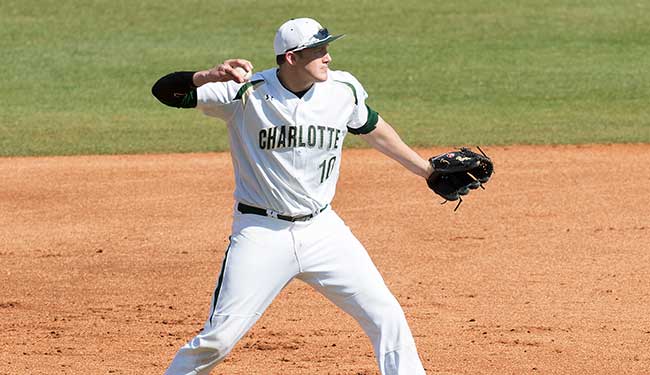
With father Dale Jarrett at nearly every game, Zach Jarrett started 42 of 44 games at Charlotte as a freshman. (Photo courtesy of Stan Cochrane)

‘My own thing’

Zach Jarrett was barely in grade school when his father won his third and final Daytona 500 in 2000, but the rising college sophomore still retains a vivid memory of the experience.

"Every time your dad wins — and I can relate it with all my friends in racing — you don’t think it’s going to feel the way it does, but you feel so good for him," he said, sitting in the home dugout at Hayes Stadium before a practice. "You’re so happy for him. It’s such a great feeling for the family. It’s like you all won the race, not just him. That’s pretty cool."

The younger Jarrett often went to the track with his father, tagging along for races within driving distance from home. He became friends with many other children of the garage area, like Chase Elliott, Tyler Labonte and Matt Martin. Even then, though, you could tell which members of that next generation would follow their fathers into racing. Kids like Chase Elliott — now a two-time winner in the Nationwide Series — were there every single week. Zach Jarrett was not. Although his older brother Jason went into racing and made 42 national series starts in NASCAR, Zach was bound for a different road.

"I loved being there and watching it," he said. "It’s so exhilarating to be there. The crowd is awesome, and the fans and everything. But I never really had interest in getting into it and pursing it as a career."

Zach focused on the sports he would later play in high school, where he grew six inches his freshman year. Baseball in particular would become his calling, and even within the Jarrett family, there was precedent — Jasper Spears, Zach’s maternal grandfather, played in the Brooklyn Dodgers organization and progressed as far as Triple-A. But as far as being behind the wheel of a race car, the younger Jarrett simply had no interest. His dad once built a go-kart track behind the house in Hickory, and Zach’s buddies used it more than he did.

"I never drove," he said. "It’s funny, because all my NASCAR friends who are racing now, like Chase Elliott and all them, they were racing in go-karts and everything, and I was just playing baseball or basketball or doing whatever. I never really got into the whole go-kart type deal. For some reason, I just never got into it. I was just always doing my own thing."

Although NASCAR is a team sport in the sense that drivers depend on a pit crew to help them win the race, there was something about the bonding element of traditional team sports — where teammates play, practice, travel, eat and do so many other things together during the course of a season — that grabbed Zach and wouldn’t let go. His father never pressured him to take another look at racing. "Not at all," Zach said. "He just said, ‘Do what you want to do. I’m going to support you in whatever you want to do, and be happy with it.’ "

The younger Jarrett was a standout in high school, where he earned team MVP honors as a senior, and received interest from a few professional teams — such as Washington, Kansas City and the Los Angeles Dodgers — before eschewing the major league draft and deciding on college. Although he started 42 of 44 games, his freshman year coincided with Charlotte’s worst campaign in a decade, a 19-31-1 season where Jarrett hit .248 with two homers and 17 runs batted in.

The losing wore on both father and son. "You kind of live and die with him," Dale said. "When it’s going well, it’s a lot of fun. But they’ve had a lot of hard times, between the team and himself where things haven’t gone well. And that’s hard to watch your kid go through that."

That’s where it helps to have a Hall of Fame father to turn to for guidance. Zach may never have raced, and Dale may never have played college baseball, but the lessons inherent to both pursuits are the same. The elder Jarrett learned to cope with defeat in NASCAR, where even the best don’t finish first most of the time. "The winningest driver with 200, Richard (Petty) lost what, 1,000 or 1,200 times if you look at it," Dale said. So he knows a little about perseverance and maintaining attainable goals, advice he once gave to his future car owner Joe Gibbs before the former Washington Redskins coach started his NASCAR team.

He now imparts that same wisdom to his son. "You have to have gains from here," said Dale, who won once in his first 278 premier series starts before breaking through with Gibbs in the 1993 Daytona 500. "It’s been difficult to keep his mind on that, especially as he’s struggled."

Toward that end, the Jarretts talk after almost every game. "Just the fact that he’s been there and has been though everything with racing — it doesn’t matter what sport it is, he can relate to it as an athlete," Zach said. "Any time I’m having trouble, I go to him, and we talk about everything — how to get better, how to stick with it, how to be mentally strong. It definitely helps. He played baseball in high school, and he can still give me intake on it. He loves watching baseball, and we talk about it all the time."
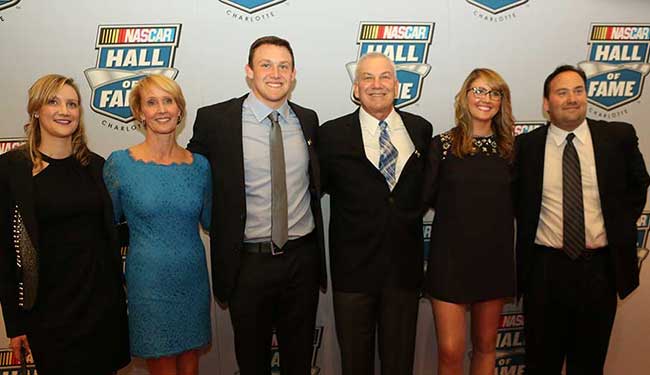
"It’s such a great feeling for the family," Zach Jarrett said when describing what it was like for his father to win. The same could be said about seeing Dale Jarrett go into the NASCAR Hall of Fame. (Photo courtesy of the Jarrett family)

Fine-tuned mechanics

They do much more than talk. On a Sunday evening this spring, Dale Jarrett sat in his home in Hickory, a major league baseball game on the television, poring over images of baseball players on his computer in the hope of helping Zach improve at the plate. "I get upset with it too," Dale said, "Just because I want him to do well." He searched for players with body styles similar to his son’s — Albert Pujols of the Angels and Jayson Werth of the Nationals among them — with an emphasis on the width of their stance, which had recently become an issue for Zach.

"His stance had gotten too narrow for a guy 6-foot-4, and he was just way off balance and it was creating issues with his swing," he said. Dale had the images all queued up when Zach came by, and after reviewing them together they headed off to the batting cages.

Once there, they eschewed the pitching machines, which Dale believes allow a hitter to get into too easy of a rhythm. "We seldom use the pitching machine unless I want to videotape him," Dale said. So Zach hit first off a tee, working on fine-tuning his mechanics. And then dad, the former high school pitcher, stepped in to throw some live ones to his son. Yes, 57-year-old NASCAR champion dad, raring back and mustering the heater. In fairness, he throws from a little closer than the regulation 60-foot, 6-inch distance.

"My back pays for it a day or two later," Dale said. "But you have to see it live. The biggest thing is, I don’t want to hit him. But I want to throw hard enough that it makes a difference."

Indeed, Dale Jarrett is as involved with his son’s baseball career as he was with his own race car during his driving days, leaving no detail unexamined in the pursuit of improved performance. There are limits — Dale is careful not to step on things Zach’s college coaches have emphasized, and knows not to overload his son with information lest he begin to overthink rather than react. But he taught Zach the swing basics to begin with. He’s seen him in the batter’s box more than anyone else. And he’s always nearby when his son needs advice, or a few extra cuts to work his way out of a slump.

"That means a lot to me, because that means he cares so much about it, and he wants me to do well," Zach said. "… It really means a lot, how he’s so interested. He’ll go out and look for all these different types of things to help me out."

It’s in that batting cage where Zach Jarrett perhaps gets the truest glimpse of the competitor his father was before he got into racing — that pitcher, quarterback and golfer who was Athlete of the Year at Newton-Conover High School, and still isn’t shy about throwing a hard one over the plate today. And Dale Jarrett can look across at his son, tall and strong and a starter of nearly every game his freshman season, and maybe see a hint of what he might have become had he not strapped on a crash helmet and driven down a different career road. Either way, the similarities go well beyond just broad shoulders and an easy smile.

"People tell me he was so athletic, and that I remind them of him and everything," Zach said. "That’s a good feeling to know, that I’m sort of how my dad was then. I can sort of picture how he was."
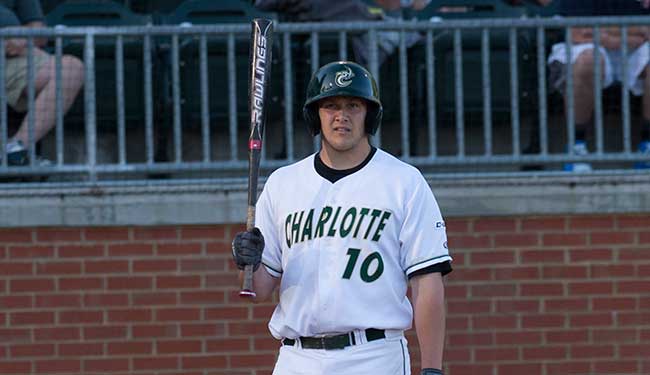
At 6-foot-4, Zach Jarrett carries a big stick. In his collegiate debut against High Point, he hit a double and three singles in his first four plate appearances, going 4-for-6 with a run driven in. (Photo courtesy of Stan Cochrane)

MORE:

READ: Latest
NASCAR news

WATCH: Latest
NASCAR video

PLAY: NASCAR
Fantasy Live

FOLLOW LIVE: Get
RaceView

Hendrick Motorsports driver discusses Pocono wreck, Farmers Insurance extension

RELATED: Play NASCAR Fantasy Live | Sign up for RaceView today

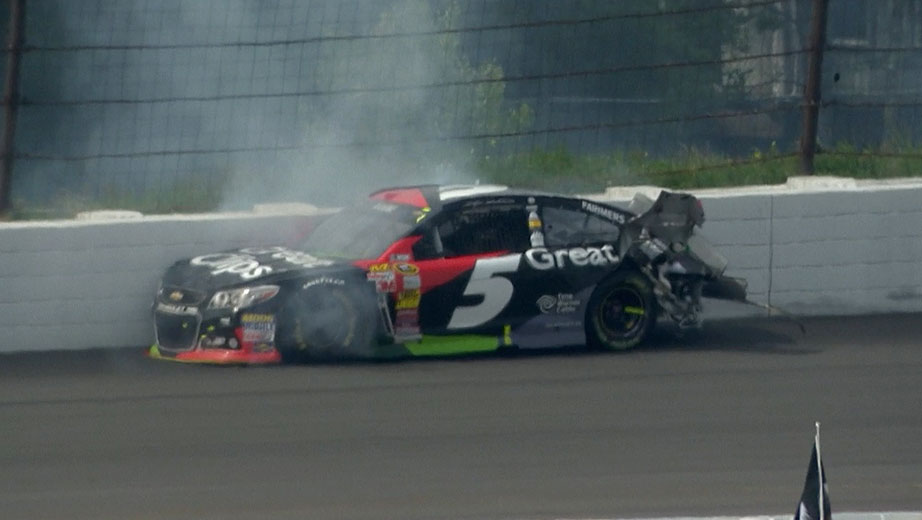
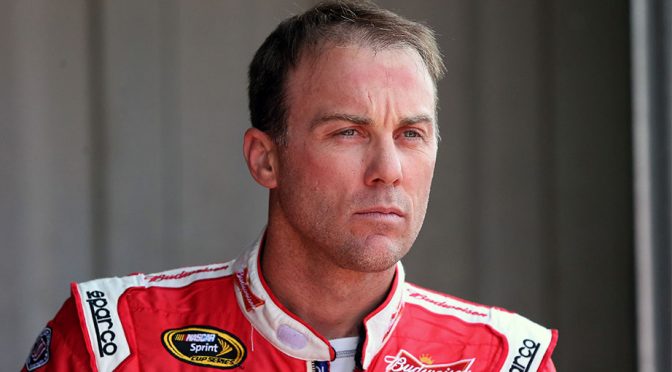
BROOKLYN, Mich. — Friday was a big day for Kasey Kahne.

The Hendrick Motorsports driver had the pleasure of kicking his weekend off with the announcement of an extension to his No. 5 Chevrolet’s primary sponsor in Farmers Insurance that runs through 2017 and shortly after topped opening Sprint Cup Series practice at Michigan International Speedway, pacing the field with a best speed of 203.332 mph.

However, Friday was also the first time he faced questions about his run-in with Kyle Busch last Sunday at Pocono Raceway since his harsh comments about the Joe Gibbs Racing driver after being evaluated and released from the infield care center.

FULL SERIES COVERAGE

Latest news
Standings
Schedule

As a quick refresher, the two were racing hard and Busch tried to close in ahead of the No. 5, thinking Kahne would lift. Kahne, knowing he had the faster car because he had just passed the No. 18, did not, and the two cars collided and Kahne ended up in the wall, finishing 42nd.

No stranger to incidents with the No. 18 Toyota of Busch — the pair seemed to have a strong magnetic pull toward each other in 2013, when they wrecked each other several times — Kahne on Sunday said, "That’s just Kyle being Kyle … he races however he races."

Five days later, his stance hasn’t changed.

"He sent me an email, then a text to ask if I got it. I told him I did, and that is how it went," said Kahne, 21st in points. "I talked through every situation and scenario last year with him when we had them, and to this day, I’ve still raced him the exact same way. For him to do that, I knew it was coming as soon as he floored it in the corner. I was like ‘He can’t. He can’t. He’s going to run me right in the wall.’ I think he was having a bad day, and just loses it. But as far as us talking, we haven’t. He did write me an email, but I don’t really care anymore. I don’t care to talk to him or anything."

Even if Kahne was open to reconciling his relationship with Busch — keep in mind they placed a friendly public Super Bowl bet just a handful of months ago — he’s got a lot more important affairs to deal with, such as getting into the Chase for the NASCAR Sprint Cup.

A multiple race-winner the past two seasons, Kahne has yet to even get a whiff of Victory Lane champagne in 2014, leading laps in just four out of 14 races with a best finish of third at Kansas. Given his early success this weekend and his past history at Michigan (win in 2006; wrecked after cutting a tire while leading this race last year), the two-mile facility could offer the 34-year-old his best shot to win so far this season.

"Really, where we are at right now, as a team, we need to show up each weekend, and put full weekends together; from myself to Kenny (Francis, crew chief) to everybody on our team," Kahne said. "We all have talked about this all weekend, and all week long leading into this race. We just need to step up, and if we do that, I feel like ‘yes, there is going to be pressure, we want to be in the Chase.’ But we have fast enough cars. We have all the equipment; everything there to do it. We just need to put those weekends together. Put ourselves in position, and there is still plenty of time to win races."

There have been a lot of factors leading to Kahne’s down season, but bad luck seems to be the one that continues to rear its ugly head. It started in the season-opening Daytona 500 when the No. 5 hit a patch of grass while headed to pit road, spinning out and going from sixth to 40th in the process. It’s been a trend, seeing Kahne finish laps down in two of the four races that he has led. Even when he is getting out front, circumstances keep him from staying there.

With his sponsorship locked down for 2015 — his contract was set to expire at the end of 2014 — he’s got one less thing on his mind to worry about. Maybe it’ll be just the push it takes to get this struggling team going.

"It feels good when you know you have sponsorship. They are such a big part of what makes us able to race each weekend and put everything into it that Hendrick Motorsports does. I’m glad about Farmers Insurance. We have Great Clips there as well. I’m excited about it; I think there will be some good things there. … I’m looking forward to winning also, and getting them in Victory Lane more than we have at this point."

Kahne’s sponsors aren’t the only ones that want to see him in Victory Lane, either. His Hendrick contract is set to run dry at the end of next year as well, and contract negotiations have yet to begin. The driver has no plans to leave, but Kahne is keen enough to understand that with the gravity of an organization such as HMS, results talk.

"I like being at HMS. It is just an unbelievable place. Getting to work with the three teammates that I get to work with each week is better than anything I’ve ever done in racing as far as guys I’ve been able to work with. I am getting information there from three of the best in racing. I’ve enjoyed every bit of it. Mr. Hendrick is always trying to help me as a driver; as a person and he gives us every opportunity. So, I want to be there a long time. We still have a year-and-a-half before my deal’s up. So I think performance, and sponsors that want to be part of them, and just getting our team back where it needs to be. We’ve struggled some this year for really no reason. We can’t have that. If we can get rid of some of those struggles, I would hope that I would be at Hendrick Motorsports for a long time.”

MORE:

READ: Latest
NASCAR news

WATCH: Latest
NASCAR video

PLAY: NASCAR
Fantasy Live

FOLLOW LIVE: Get
RaceView