Editor’s Note: This story has been updated to reflect additional changes made late Thursday evening.
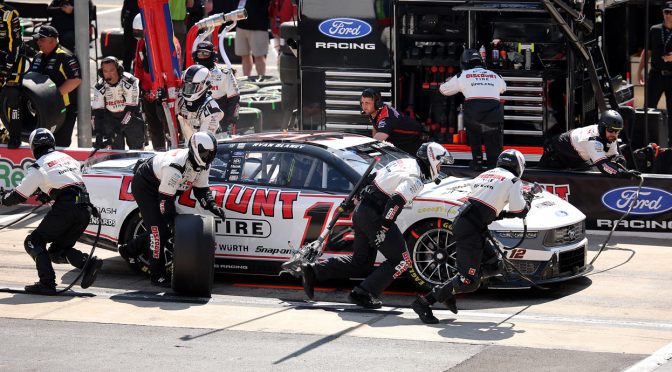
Team Penske has made a change to the No. 12 pit crew that services Ryan Blaney’s car in the NASCAR Cup Series, the team confirmed.
Graham Stoddard will join as the team’s new jackman for Sunday’s race at Kansas Speedway (2 p.m. ET, FOX, HBO Max, MRN Radio, SiriusXM NASCAR Radio). Stoddard had been the jackman for the No. 4 Front Row Motorsports Ford driven by Noah Gragson.
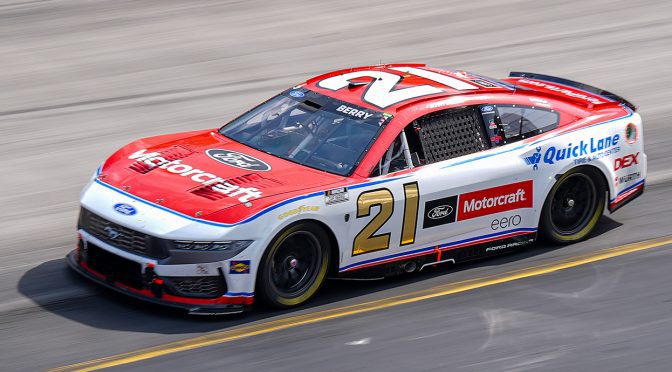
Stoddard replaces Landon Honeycutt, while Honeycutt joins the No. 21 Wood Brothers Racing team with driver Josh Berry.
Patrick Gray, who began the season as the jackman on the No. 21 Ford, was originally announced Thursday as the jackman who would replace Honeycutt until a late change was made Thursday evening.
The move comes as the No. 12 pit crew has been under scrutiny this season. Although Blaney sits second in the points standings with one win, three top fives and six top 10s in eight races, his pit crew has statistically been ranked among the lowest in the Cup Series. Per NASCAR Insights, the No. 12 crew ranked 35th of 36 full-time entries in season-long stats following last week’s race at Bristol Motor Speedway. Blaney finished second but lost a total of 11 spots on pit road on Sunday, with his crew ranking 30th.
According to Racing Insights, the No. 12 crew has posted an average time of 12.54 seconds for a four-tire change — ranked 35th in the series — while making a series-worst six mistakes. In total, the No. 12 team had lost 88 positions on pit road, earning a position-retention rate of just 51% for just the 35th-best. At Phoenix Raceway, Blaney overcame two loose wheels and a net loss of 45 positions to rally to the race win.
The No. 4 pit crew Stoddard leaves ranked 26th at Bristol and is ranked 34th overall per NASCAR Insights, tied with Blaney’s crew for six mistakes this season, three of which are attributed to the jackman. However, the No. 4 crew holds the sixth-best plus-minus in positions gained or lost on pit road at minus-1. Replacing Stoddard on the No. 4 car is jackman Tommy Bebie, who served as jackman on the No. 51 Rick Ware Racing Chevrolet for driver Cody Ware.
The No. 21 pit crew that Honeycutt joins ranked 15th at Bristol despite sitting 27th overall for the season. Per Racing Insights’ stats, the No. 21 team has averaged a 20th-best average time of 11.12 seconds for four-tire stops with a 36th-place retention percentage of 46%.
In addition to a new jackman, Berry will also have a different crew chief on the headset at Kansas. Matt Swiderski will serve as the acting crew chief this weekend as regular crew chief Miles Stanley will not travel this weekend for personal reasons.
Blaney has two top fives in his last three Kansas starts. In five Kansas starts, Berry has a best finish of sixth.
In a sport as fickle as auto racing, correct predictions can be hard to come by — so whenever you land on one, it’s important to crow about it as much as possible, for as long as possible.
(I’m kidding, of course.)
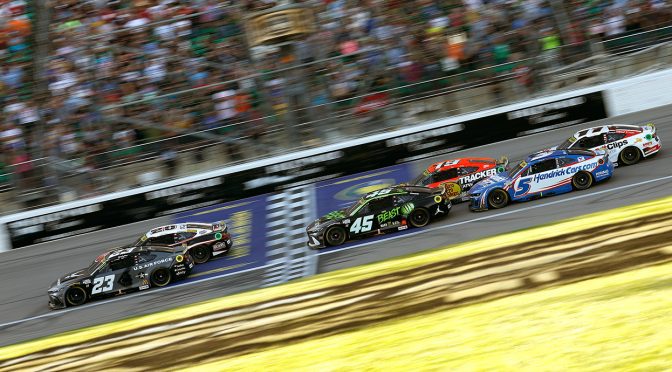
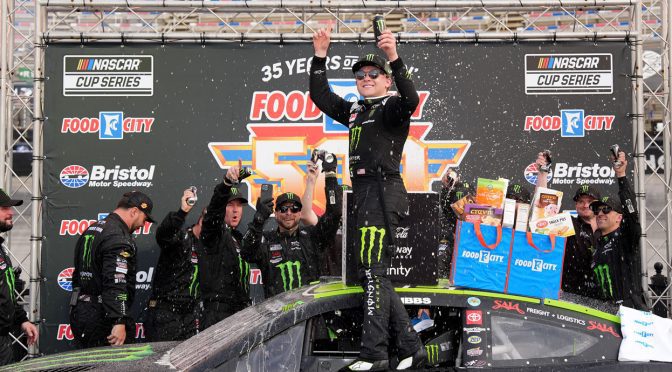
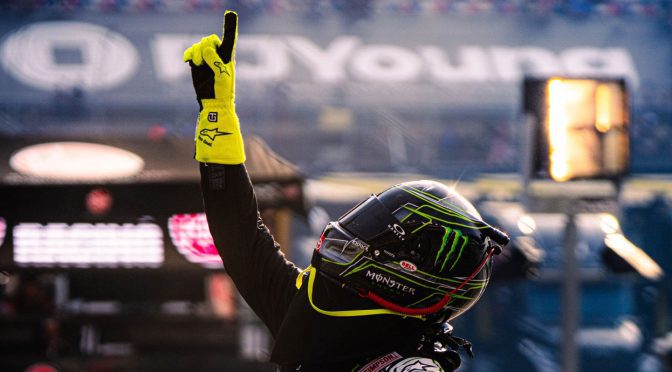
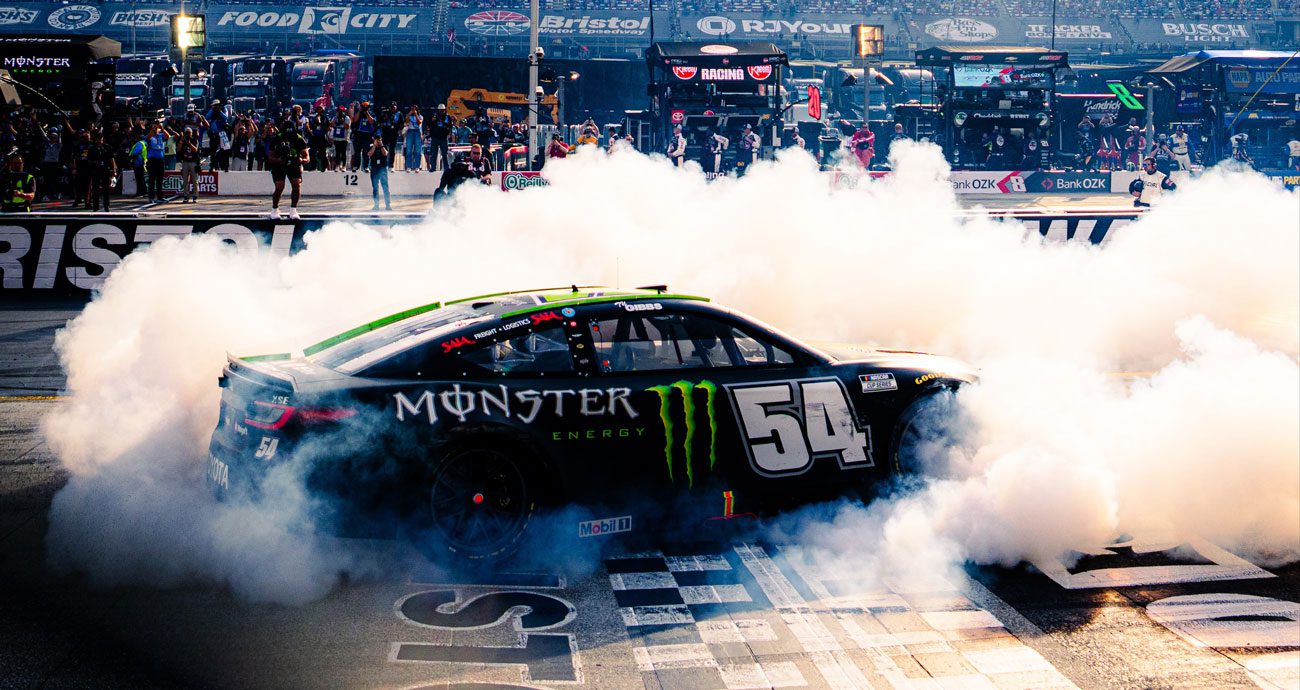
But I did feel suitably validated when Ty Gibbs delivered on our prognostication that he could earn his first-ever win at Bristol this past weekend. The way he did it, too, saw Gibbs hold off Ryan Blaney, Kyle Larson and Tyler Reddick — basically the last trio of drivers you want in the rearview mirror — on a late restart to claim his debut victory the hard way.
Now we’re on the hunt for the next phenom who might join the same club as Gibbs … if not right now, then at least fairly soon. And that’s why we’ve got our eye on the No. 77 Spire Motorsports Chevy of Carson Hocevar.
Just like Gibbs, Hocevar is a 23-year-old phenom with a documented history of — let’s just say “aggressive” — driving, which hasn’t always endeared him to his colleagues out on the track. But he also possesses tremendous talent, which eventually ought to translate into his own Cup Series win sooner rather than later.
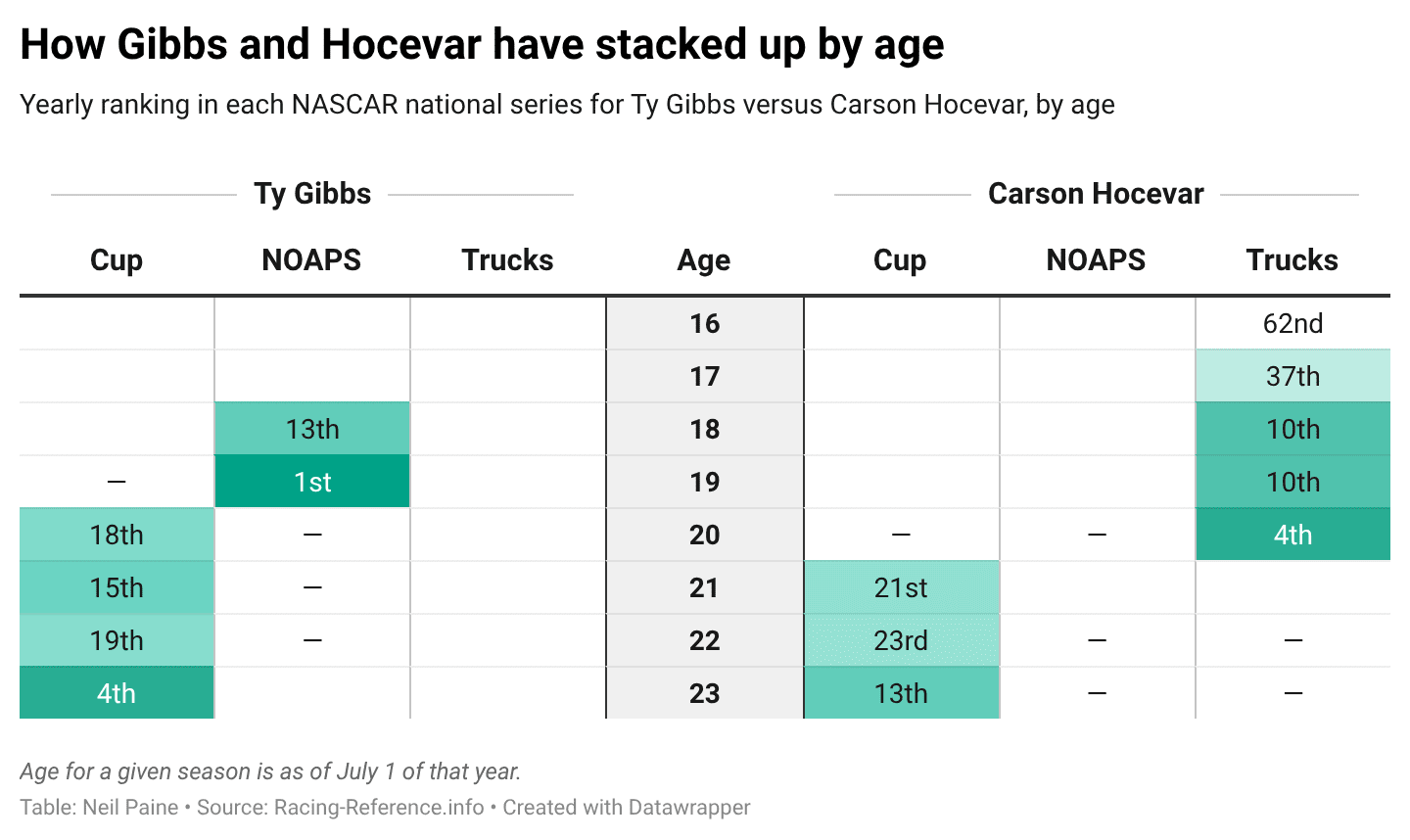
Because they were born within 117 days of each other in the fall/winter of 2002-03, it’s natural to compare the two young drivers. But although they have both risen to make names for themselves in Cup, it hasn’t been done completely in parallel. While Gibbs famously skipped the Truck Series entirely — winning his first-ever NASCAR national series race in the O’Reilly Auto Parts Series just 4½ months after turning 18 — Hocevar spent all or parts of five seasons in the Trucks, working up to a fourth-place finish in the standings in 2023.
By then, Gibbs had already won the O’Reilly title and was in his first full-time Cup season after a part-time season spent driving in relief of an injured Kurt Busch for 23XI Racing:
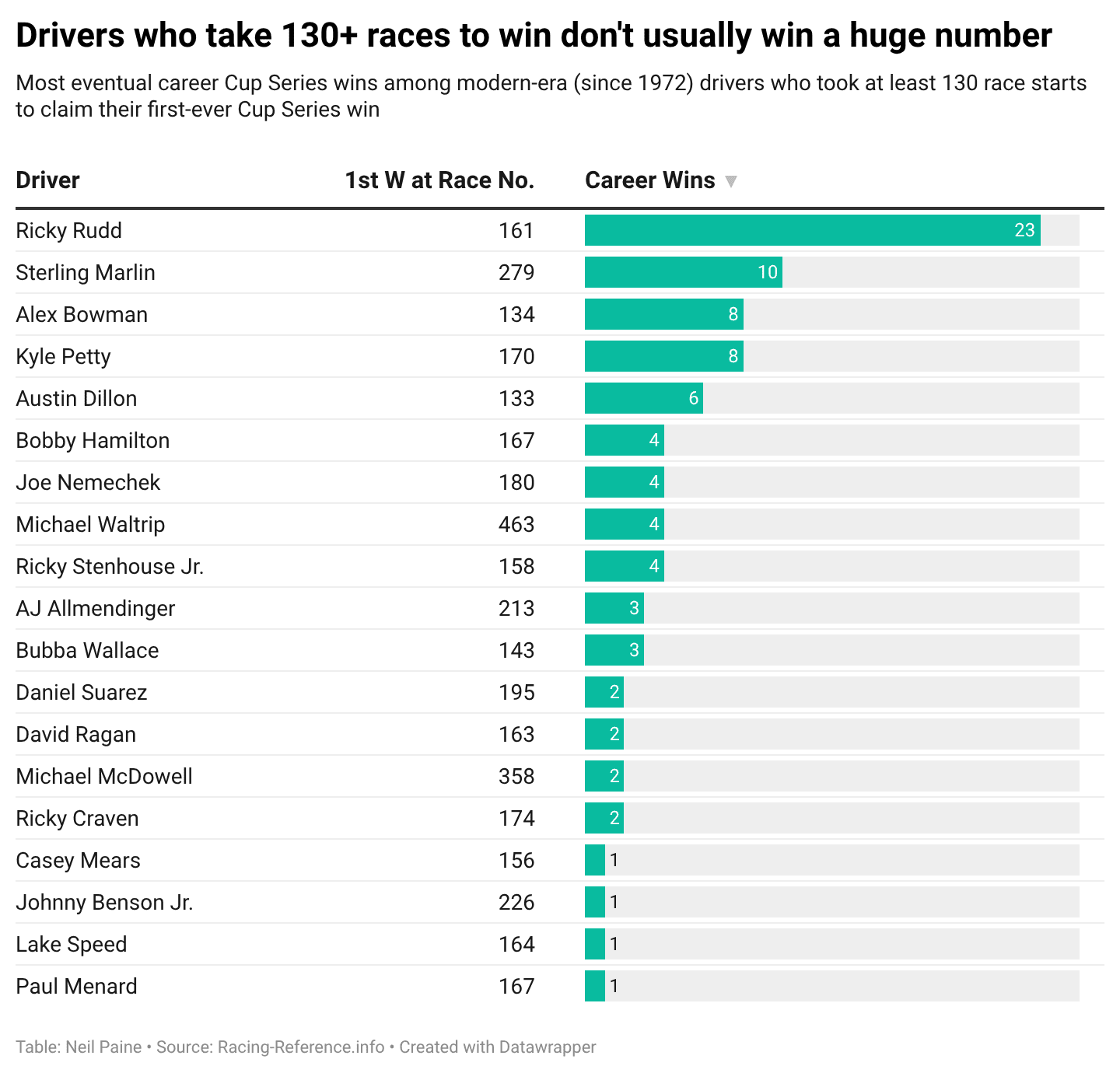
So even though Hocevar went straight from a primary Truck Series ride — with 14 additional races spread across the O’Reilly and Cup Series — to a full-time spot in Cup starting in 2024, he’s always been running a bit behind the meteoric pace set by Gibbs. That’s why Hocevar has only 89 career Cup starts, versus 131 for Gibbs (and why Gibbs was so much younger than the other drivers who took 130+ races to record their first career Cup wins), despite the two being the same age.
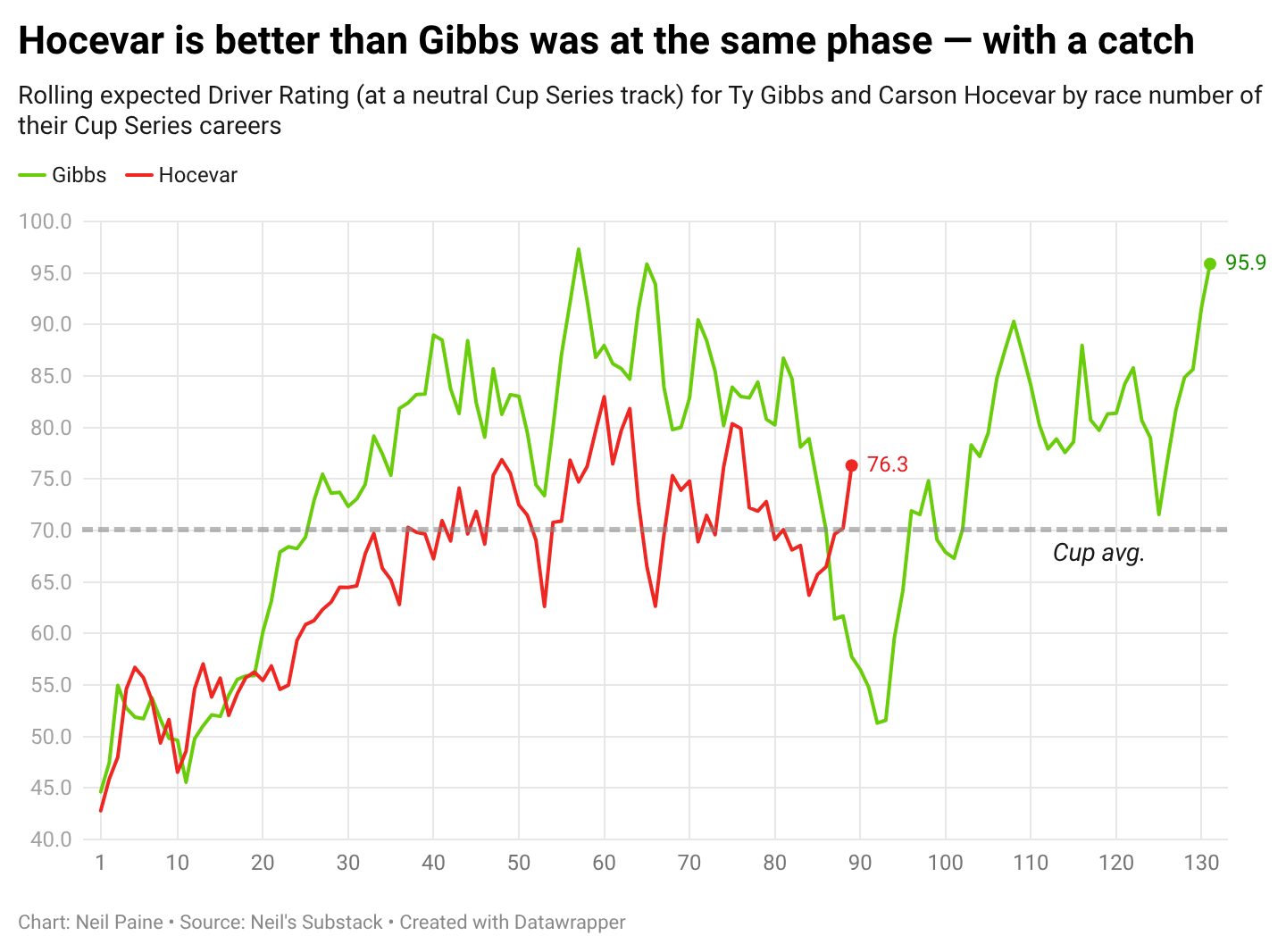
Gibbs may also have more potential than Hocevar at baseline. If we plot out their rolling projected Driver Ratings — according to my Cup Series ranking method, which assigns each driver a number based on their recent performance — after each race of their Cup Series careers, the two followed very similar early trajectories, but ultimately seemed to settle into a pattern with Gibbs in a higher range than Hocevar has reached recently.
(Granted, JGR equipment is no doubt helping Gibbs here. By comparison, Hocevar is with a less-established team but has long outperformed its standard to date, with a 98-71 career head-to-head record against his Spire teammates.)
All of that being said, Gibbs also began a dramatic downturn in performance right before the same point where Hocevar is now, by career race number. So, technically speaking, Hocevar is actually currently ahead of where Gibbs was then — though Gibbs eventually recovered and returned to (even later surpassing) his previous norms for performance.
It’s still unclear what drove Gibbs’ extended slump in late 2024 and early 2025 — but whether due to personnel turnover at JGR (switching crew chiefs from Chris Gayle to Tyler Allen, among other moves), frictions with former competition director Chris Gabehart, or other factors, he had an uncharacteristic period of 20 or so down races before returning to form.
Hocevar, by contrast, has enjoyed a measure of stability as Spire’s focal-point driver, leveling off at an above-average Driver Rating relative to the rest of Cup without too many abnormal changes in recent performance. But will that be good enough to win?
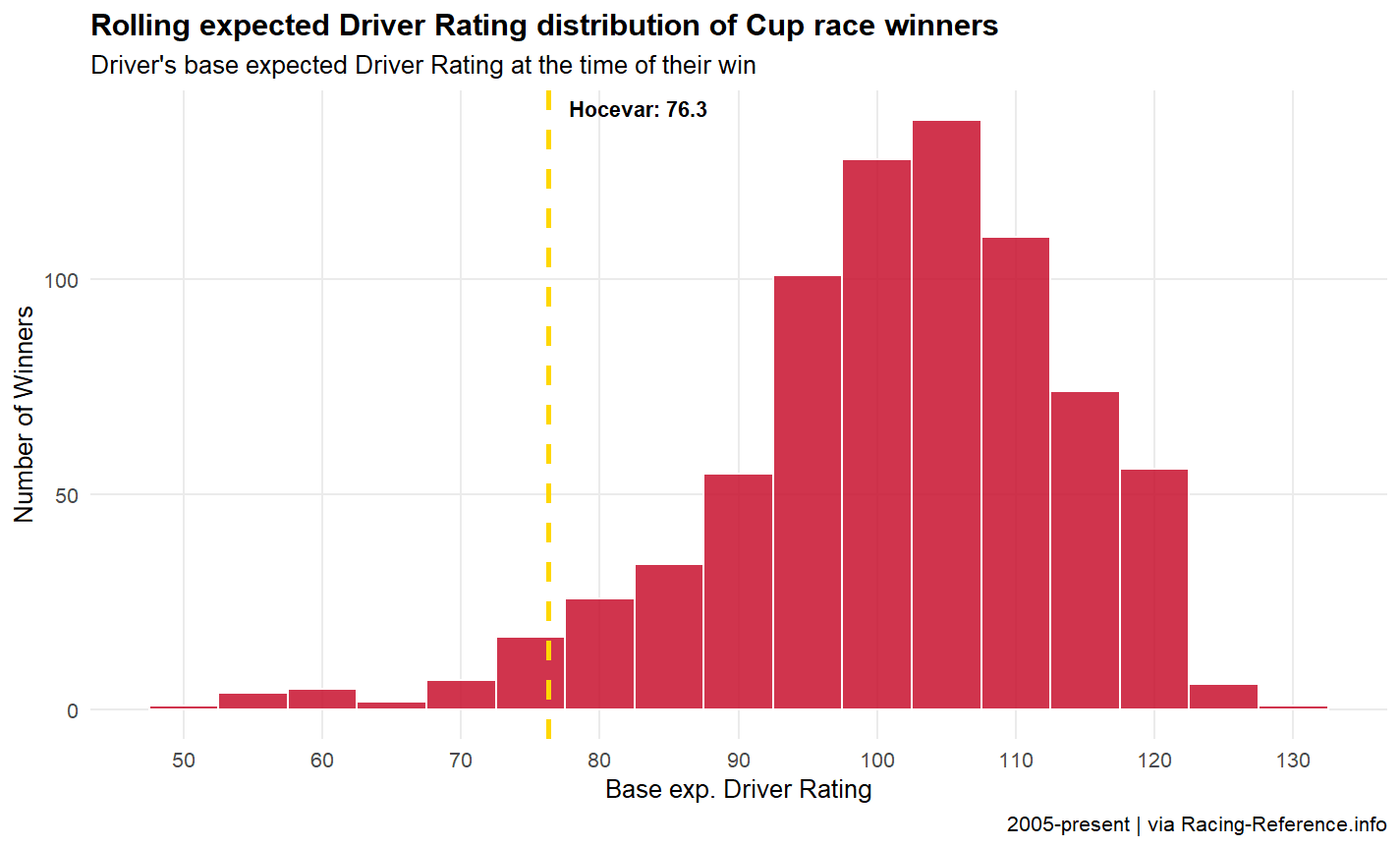
Most likely, Hocevar will need to improve at least a bit more in order to become a race winner — much like Gibbs has done this season. If we plot out the rolling expected Driver Ratings for all race winners since 2005, the large majority of winners were better at the time of their wins than Hocevar is right now:
That’s not to say it’s impossible for Hocevar to win at his current performance level. But only 4.1% of winners since 2005 had a lower rating than his current mark of 76.3 at the time of their win, while 95.9% of winners had a higher rating at the time they won.
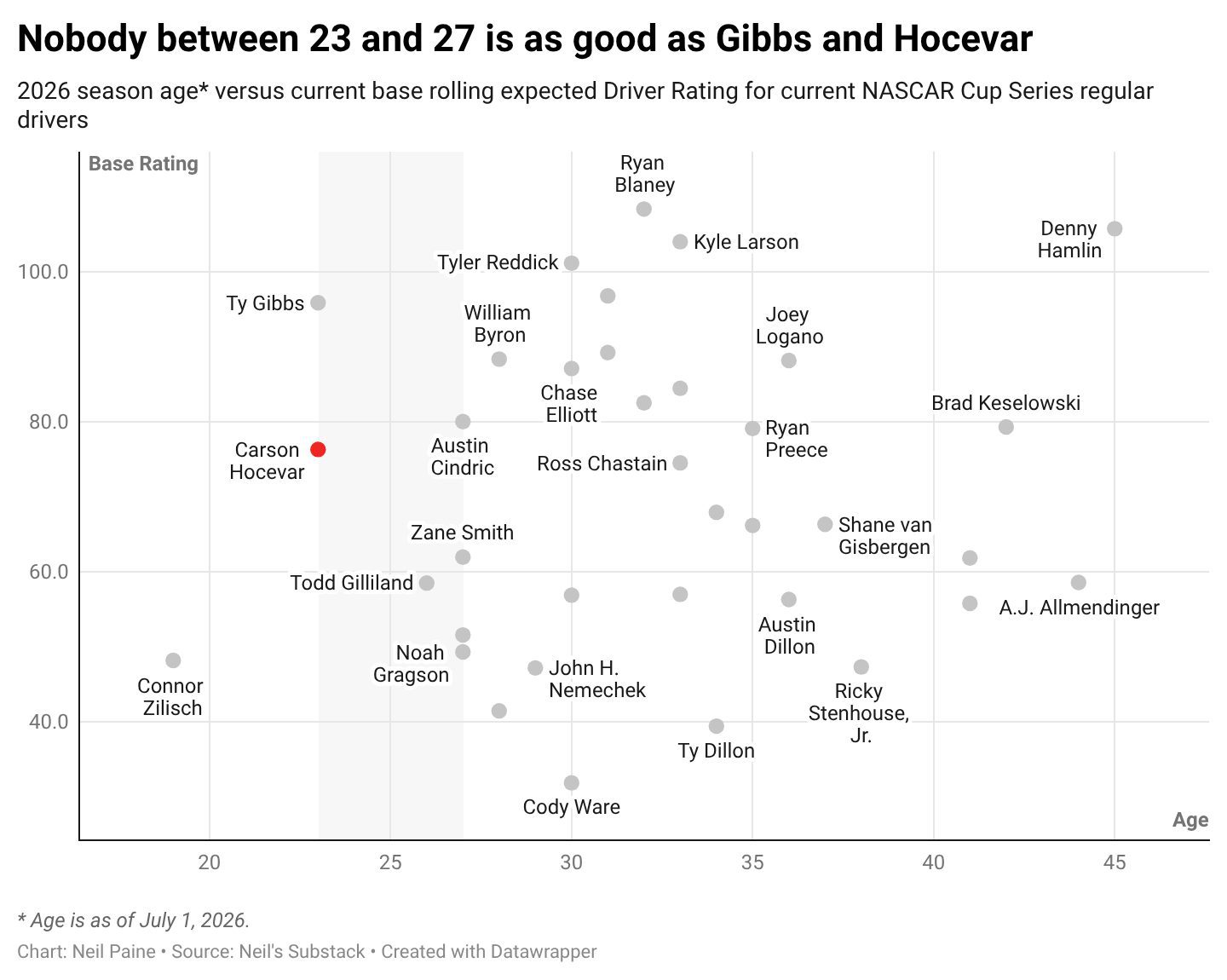
One thing working for Hocevar, though, is that time is on his side — and this is where the comparison with Gibbs comes in handy again. Here’s a plot of all the current rolling expected Driver Ratings for 2026 Cup Series regulars, with their ages listed (as of July 1):
There is a notable generational “void” in the chart between William Byron (age 28) and Austin Cindric (27), and Gibbs and Hocevar (both 23). The only driver in the middle zone between them is Todd Gilliland (26), and he carries a rating well below Cup average. Meanwhile, on the other side of Gibbs/Hocevar is just Connor Zilisch, who’s still just 19 and remains one of the sport’s greatest-ever prospects, but for now is struggling as a rookie to adapt to the Cup Series learning curve.
Others in a similar age range are currently competing in the O’Reilly Series: William Sawalich (19), Corey Day (20), Jesse Love (21), Sammy Smith (21), Carson Kvapil (22) and Parker Retzlaff (22). Like Zilisch, all will eventually be threats to win at the Cup level, potentially siphoning away chances to win from Hocevar.
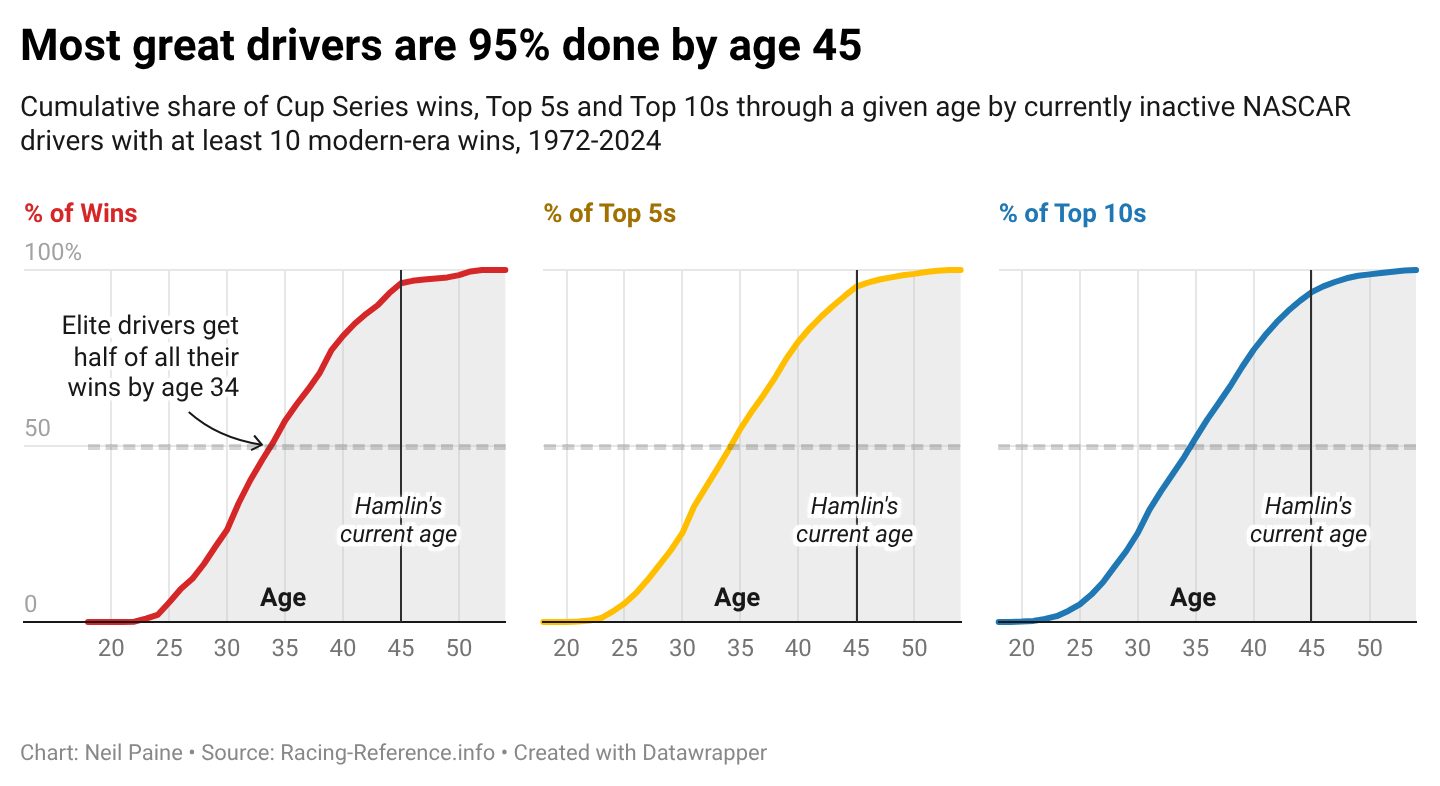
But as things currently stand, Hocevar has an uncommon amount of runway in front of him. He’s at an age when great drivers begin to make rapid progress; he only has one proven rival in the same age bracket (Gibbs) — who was in the midst of a deep slump at the same moment (in terms of career Cup races) when Hocevar has been busy putting together a solid season — and who later provided a template for how a young, brash, hard-charging driver can mature into a race winner.
Yes, the sport’s many mid-to-late-prime superstars will have plenty to say about when (or even whether) Hocevar reaches Victory Lane. But like all forces of nature, don’t be surprised if “The Hurricane” blows his way into that conversation, too.
Matt Swiderski will serve as acting crew chief for Wood Brothers Racing’s No. 21 Ford this weekend at Kansas Speedway, the team confirmed to NASCAR.com on Wednesday.
Miles Stanley, the permanent crew chief for Josh Berry, is not traveling this weekend due to personal reasons, according to a team spokesperson.
Swiderski joined Wood Brothers in the offseason as the team’s performance engineer director after five years as a Cup Series crew chief. He spent the last two seasons at Trackhouse Racing, leading Daniel Suárez and the No. 99 team. Swiderski also spent three seasons at Kaulig Racing. Swiderski has three Cup victories – one with Suárez and two with AJ Allmendinger.
Through eight races, Berry sits 25th in the Cup Series standings with a pair of top-10 finishes, the most recent coming at Martinsville Speedway last month. He finished 32nd last weekend at Bristol Motor Speedway.
Stanley has been Berry’s crew chief since he joined Wood Brothers ahead of the 2025 campaign.
The NASCAR Cup Series and NASCAR O’Reilly Auto Parts Series head to Kansas Speedway for their annual springtime visits to the heartland. Below are the qualifying orders for both series.
Ty Gibbs’ first NASCAR Cup Series victory came in electric — and emotional — fashion, outlasting the field on older tires to prevail at Bristol Motor Speedway in what was his 131st career start in NASCAR’s premier circuit.
The 23-year-old Joe Gibbs Racing driver has had his fair share of trials and tribulations in the lead-up to Sunday’s conquest of “The Last Great Colosseum.” There were close calls, headlined by 21 career top-five finishes for Gibbs spanning back to his 2023 rookie campaign. There were some misses, too; look no further than his 17 career DNFs.
Such is the journey — a journey that requires time and patience — that every driver must take. That patience has paid off, and if recent history is any indication, more fruit from Gibbs’ labor could blossom into even more Victory Lane appearances.
Success can come in bunches, and if Gibbs follows a similar path to his peers, his next victory would come much sooner than 131 starts.
Following his Bristol win, Gibbs ranks fourth in the driver standings, trailing Tyler Reddick, Ryan Blaney and Denny Hamlin, with Chase Elliott, Kyle Larson and William Byron behind the No. 54 driver. Among these seven drivers, let’s see how many starts it took each driver to collect their second career win following their first, with information courtesy of Racing Insights.
DRIVER
FIRST WIN START
STARTS FROM FIRST TO SECOND WIN
Tyler Reddick
92
4
Ryan Blaney
68
51
Denny Hamlin
21
6
Ty Gibbs
131
TBD
Chase Elliott
99
8
Kyle Larson
99
17
William Byron
98
13
Gibbs is the outlier at first glance, picking up his first victory in start No. 131; the other six averaged their first win in only 80 starts. But when looking at when those six drivers collected their second victory, the gap between the first and second wins is starkly reduced. In this instance, Blaney is the outlier, with 51 starts between his first two Cup wins. The other five drivers collected their second victory in 17 or fewer starts.
Combine the numbers, and even with Blaney’s mark, the average start total for the six drivers between their first and second wins was 17 starts. If Gibbs followed this trend, that means his second win would come this season.
Of course, this is entirely hypothetical. Gibbs still has to go to the track and race. Numbers can only suggest so much. But let’s stick with the hypotheticals and say Gibbs were to pick up his second win this season. Sticking with the same drivers as before, what was the start gap between the second and third wins and beyond?
DRIVER
GAP FROM SECOND TO THIRD WIN
GAP FROM THIRD TO FOURTH WIN
GAP FROM FOURTH TO FIFTH WIN
Tyler Reddick
8
12
22
Ryan Blaney
38
18
29
Denny Hamlin
33
25
51
Chase Elliott
2
14
12
Kyle Larson
10
8
3
William Byron
38
3
31
The numbers here tend to fluctuate a little bit more. Hamlin, for instance, has gaps of 25 starts or more between his third, fourth and fifth wins. Blaney is roughly similar, with gaps of 38, 18 and 29, respectively. But even these start totals for both drivers are but a blink of an eye compared to their career start accumulations. Blaney has tallied 386 starts in his career with 18 total wins, while Hamlin has logged 729 starts with 61 Cup victories.
Then there is the other extreme. Reddick’s gap from his second win to fifth equaled 42 starts, but even this doesn’t come close to the Hendrick Motorsports duo of Chase Elliott and Kyle Larson. Elliott’s gap from his second win to his fifth was 28, while Larson — the defending Cup Series champion — went from his second win to fifth in 21 total starts.
So, what does this suggest for Gibbs? If nothing else, the 23-year-old has contended with the sport’s elite through the opening eight races of the 2026 campaign. While Gibbs has only one victory, many more could be on the way soon should he follow a path similar to his championship-winning competitors — once they started winning, they started winning.
Whatever the case, though, one thing is for certain: Ty Gibbs can now call himself a Cup Series winner. And if momentum — and prior history — is any indicator, the next win could be right around the corner.
During the latest episode of the “Hauler Talk” podcast, NASCAR vice president of race communications Mike Forde said there will be a follow-up conversation with Eckes, who denied the crash was intentional, before the next NASCAR Craftsman Truck Series race.
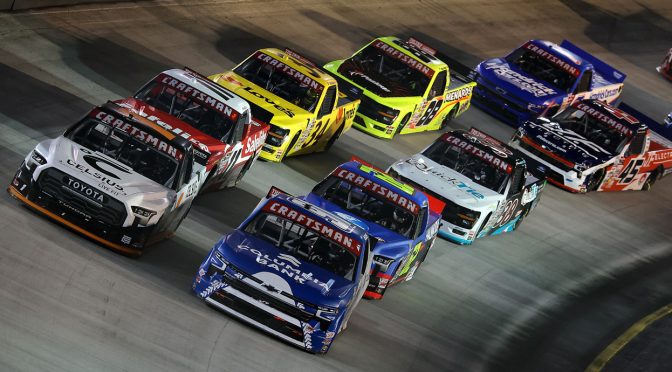
Truck series managing director Seth Kramlich assembled a PowerPoint-style slide presentation with multiple angles of the incident from the FS1 broadcast and NASCAR’s own cameras.
“We had a camera in Turn 1 that was looking at the trucks that was, ‘Oh, that looked a little worse than the broadcast and the above angle,’ ” Forde said. “From above and back, it didn’t look that bad. The Turn 1 (camera), it looked like he missed it way worse than the above or behind view. I’m not saying that it looked like he did it intentionally, it just looked like he got more of (Heim’s) truck than I realized at first glance.
“Seth did a really good job of laying it all out. As we have in the past, any time you’re talking about anything that remotely smells of a right-rear hook, we take that pretty seriously. So Seth did take it seriously. After that review, we decided not to penalize.”
NASCAR agreed with Heim’s assessment, who believed Eckes misjudged the timing of the move. Forde said Kramlich also talked with Heim and Eckes about the wreck before making his presentation in NASCAR’s weekly competition briefing on Tuesday.
The crash cost Heim the chance at a Bristol victory that would have paid a $500,000 total bonus in the Triple Truck Challenge. During the episode, NASCAR senior director of racing communications Amanda Ellis explained the eligibility rules for the Triple Truck Challenge.
Forde also addressed why there was no yellow flag in Sunday’s NASCAR Cup Series race after Chase Elliott spun his No. 9 Chevrolet coming to the white flag.
“When that happens, we kind of look for two different things,” Forde said. “One is how close to the start-finish line are they? And then how into the racing surface and racing groove are they?
“(Elliott) stayed on the apron, and Tim Bermann, the race director, chose to hold (the yellow). He wanted to get a green-flag finish. As long as we can do it safely, we’ll do our best to do that for the fans. And luckily, Chase never came up to the racing surface, and then we were able to have that fantastic finish between (Ryan) Blaney and Ty Gibbs and see Gibbs get his first win under green.”
Other topics covered by Forde and Ellis during the 49th episode of “Hauler Talk,” which explores competition issues in NASCAR:
— The rash of pre-race inspection failures at Bristol and why one team received a different penalty for failing twice.
— The record number of Cup drivers in the Truck Series race at Bristol.
— The car fire involving driver Mason Maggio in the NASCAR O’Reilly Auto Parts Series race at Bristol.
— The rules of the Triple Truck Challenge.
Nate Ryan has written about NASCAR since 1996 while working at the San Bernardino Sun, Richmond Times-Dispatch, USA Today and for the past 10 years at NBC Sports Digital. He is a contributor to the “Hauler Talk” show on the NASCAR Podcast Network. He has also covered various other motorsports, including the IndyCar and IMSA series.
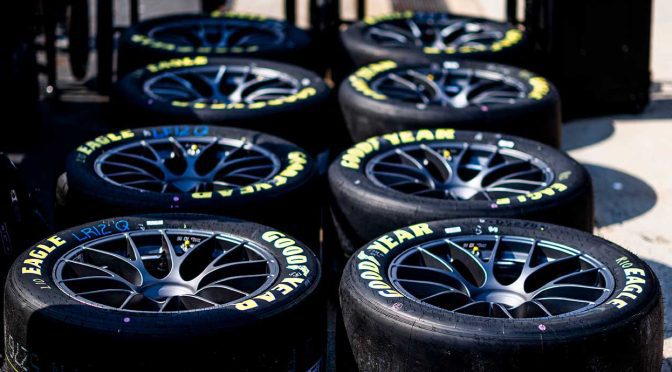
A familiar Goodyear tire combination will return to the NASCAR Cup Series and NASCAR O’Reilly Auto Parts Series this weekend at Kansas Speedway.
New right-side rubber featuring a tire-construction update debuted in both series for last September’s events at the 1.5-mile Kansas City oval. That same setup will be back in place for the Cup Series’ AdventHealth 400 on Sunday (2 p.m. ET, FOX, HBO Max, MRN Radio, SiriusXM NASCAR Radio) and the O’Reilly Auto Parts Series’ Kansas Lottery 300 on Saturday (7 p.m. ET, The CW, MRN Radio, SiriusXM NASCAR Radio).
“We introduced new right-side Goodyear Racing Eagle tires last fall, which help give teams different strategy options as the race unfolds,” Goodyear NASCAR product manager Rick Heinrich said. “This will already be the third time Cup Series teams have run this setup in 2026, so they come to Kansas with valuable data under their belts.”
This same Goodyear configuration also ran in the Cup Series this year on intermediate-style tracks at Las Vegas Motor Speedway and Darlington Raceway. O’Reilly Series teams used this tire setup on the 1.5-mile Vegas oval.
Cup Series teams will have 10 total sets for the weekend — eight new sets for Sunday’s 400-miler, one for practice and another for qualifying that will transfer to the race. O’Reilly teams will work with an allotment of six sets of tires — four new for Saturday’s 300-mile event, one practice and one for qualifying that carries over.
Todd Gilliland, fresh from a sixth-place finish Sunday at Bristol Motor Speedway, said he expects teams to be aggressive with tire pressures with a forecast for chilly temperatures in the series’ first of two Kansas visits this year.
“I think all the work Goodyear’s been doing has been super-helpful,” Gilliland said. “Over even the last four years now, it’s just been a continual progression of all that stuff. I mean, we put them in a really, really tough spot at these mile-and-a-halfs, going as low as possible on air, and probably even a half-pound lower at times, just because you have to get every ounce of speed you can out of the car and the tires. That puts them in a tough box. … It’s going to be cooler this weekend, speeds are going to be up. I don’t think we had a ton of tire issues on the right sides (last year), so I’m sure the teams will keep pushing it. The more the tires have been wearing out, the more it seems like at these places, it just becomes easier to pass. A place like Kansas is very wide, so it makes the racing more fun.”
The 2027 NASCAR Hall of Fame Fan Vote is now open, and that means you have the opportunity to cast your ballot and help decide who should be forever enshrined among NASCAR’s greatest.
Voting begins on April 14 at noon ET and closes on May 17 at noon ET. To vote, click here.
Voters may select up to two nominees from the Modern Era ballot and up to one nominee from the Pioneer Era ballot. To complete the submission form, you must provide your email address. Fan voters may submit up to one overall vote per day, per email address.
Kevin Harvick, Ray Elder and Ernie Elliott have been added to the Modern Era Ballot, while Ray Fox and Herb Nab join the nominees on the Pioneer Era Ballot. The Class of 2027 will be announced on Tuesday, May 19, after the voting panel meets in Charlotte.
Dale Earnhardt, Bill France Sr., Bill France Jr., Junior Johnson and Richard Petty made up the inaugural class in 2010. Kurt Busch, Harry Gant and Ray Hendrick were elected as the Class of 2026. Don’t miss out on your chance to help honor other legends of the sport in 2027.
BRISTOL, Tenn. — Winning has always been in Ty Gibbs’ blood.
The grandson of Joe Gibbs — a Super Bowl-winning football coach who owns and operates an eponymous multi-time NASCAR Cup Series championship-winning team — lived up to and surpassed expectations in Sunday’s Food City 500 at Bristol Motor Speedway.
And after 130 previous starts, it had been a long time coming.
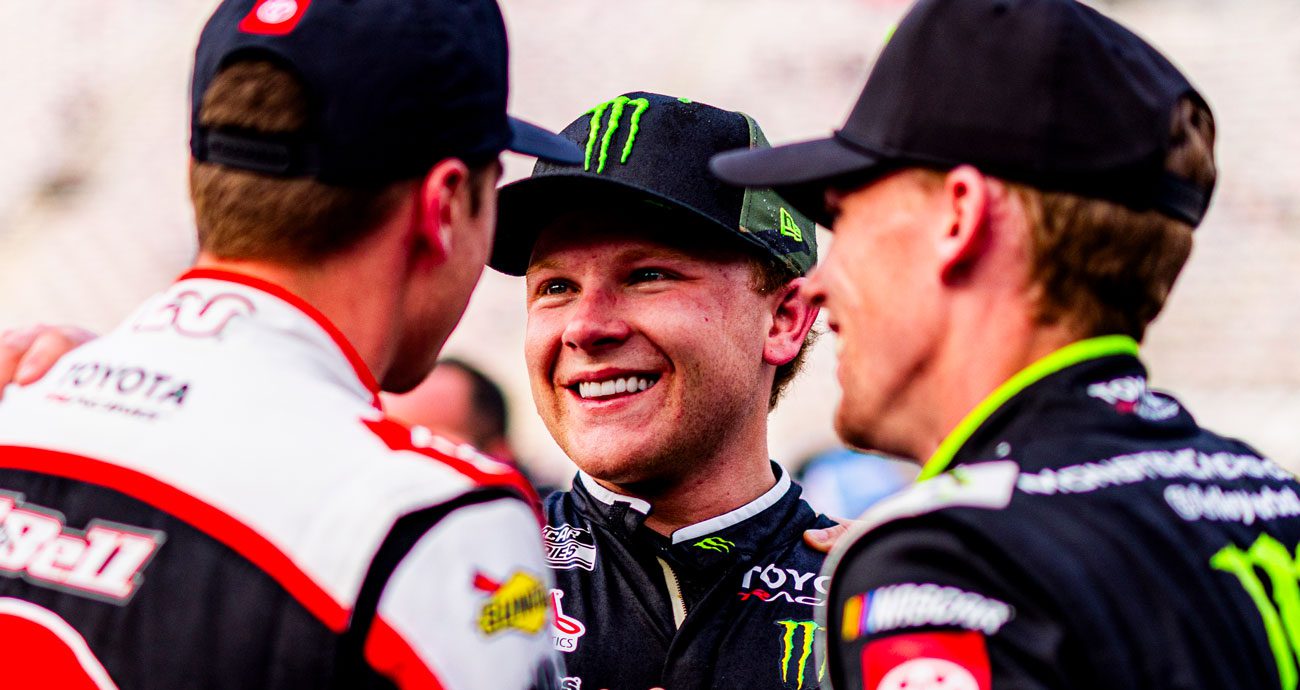
He seemed destined to be a NASCAR Cup Series winner, especially with early lower-series success and a tight-knit family alongside. In addition to his grandfather’s fame, Ty’s mother, Heather Gibbs, is also a team co-owner at JGR. Ty Gibbs’ cousin, Jackson Gibbs, is a tire changer on the No. 54 Toyota that Ty Gibbs drives. And Sunday, as Ty Gibbs got to drive Heather to Victory Lane and give her the checkered flag he earned, the family got to celebrate a moment of enormity with unity.
But the family isn’t as whole as it once was.
“I’d love for my father to have seen this,” Ty Gibbs said. “I knew he knew it was going to happen and expected it as well.”
Coy Gibbs, Ty’s father and Heather’s husband, died in his sleep in November 2022, just hours after Ty won the NASCAR O’Reilly Auto Parts Series championship. The son of Joe Gibbs, Coy was immensely influential in Ty’s life, especially as the youngster rose to O’Reilly Series stardom at ages 19 and 20. The devastation of his loss came shortly after the family endured the death of Coy’s brother J.D. in 2019. Their absence, in part, added to the emotion and tears shared Sunday in the Tennessee mountains.
“My husband, I mean, I think he would have been so happy,” Heather Gibbs told NASCAR.com Sunday. “I think that’s what’s probably the hardest part today, right? So bittersweet. I wish it were him with (Ty) and not me today. I wish Coy were here to celebrate with his son, but he prepared him for all these moments.”
Coy guided his son through plenty of adversity, even in the early stages of his son’s NASCAR career. Gibbs’ fiery nature and unrelenting desire to win would, at times, put himself, his father and his grandfather’s team in precarious positions as he charged up the ranks, most notably in October 2022 at Martinsville Speedway. Gibbs crashed teammate Brandon Jones for a win that would have propelled two cars to the O’Reilly Auto Parts Series championship race instead of just his. One week later, Gibbs was celebrating a title with his father present, beaming with pride.
That night at Phoenix Raceway, Coy Gibbs said, “We were both proud, just because he just hammered down and did his job. If he wants to do this for a living, he’s going to learn how to do that.”
It seems his son has learned. In fact, that’s why Gibbs loves Bristol so much — and why he’s done so well on the 0.533-mile bullring.
“You just hammer the hell out of it,” Gibbs described Saturday. “I might have done that too hard in the past and blown a tire out and screwed myself, but stay after it. It’s fun. It’s fast. You can lap people quick. It’s a fun track. I think it’s a driver’s track, but also I think it comes down to the car, too. I think it’s 50-50, and I think that you’ve got to hustle it to make speed up.”
Gibbs hustled it Sunday to hold off some of the best of the best. Ryan Blaney and Kyle Larson dominated the day together, combining to lead 474 of Sunday’s 505 laps. Their tires were nearly 100 laps fresher than Gibbs’ when the green flag flew in overtime, but the 23-year-old Gibbs fended off fierce charges from two past NASCAR Cup Series champions, beating Blaney to the line by just 0.055 seconds for his first win with Larson in third.
“Ryan and Kyle, I have a ton of respect for them,” Gibbs said. “To be able to race them is awesome. Honestly, I was just happy that the race was sick at the end and we were all sliding around and racing for the win. I think that was super cool. Hopefully, it put on a great show for the fans. Super cool. I’ve watched those guys a lot of my life in NASCAR. To race with them is awesome. It’s an honor.”
A parade of drivers visited Gibbs in Victory Lane to offer congratulations, including Blaney, Daniel Suárez, Riley Herbst, as well as JGR teammates Chase Briscoe and Christopher Bell.
Bell shared considerable praise of Gibbs on Saturday, before the breakout victory sparked a shower of confetti. The development of Gibbs, which Bell says he’s seen, has shifted the dynamics among the drivers at JGR for the better.
“His input has become so much more valuable through our team debriefs and stuff like that,” Bell said. “He’s taken a huge step, and he’s a joy to be around right now.”
Crew chief Tyler Allen has seen that growth firsthand.
“We noticed more questions from the teammates, asking sort of our philosophy,” Allen said. “As for Ty’s feedback, it’s something we’ve been working on. I think stringing together these top fives has given him the confidence to speak up in the meetings, when before we were running 24th, didn’t feel like he had a lot to contribute. He gives really good feedback. It’s been really productive working with the other three teams.”
That signifies a tonal shift around swirling narratives that have arisen from an ongoing lawsuit between Joe Gibbs Racing and Spire Motorsports over Spire’s hiring of Chris Gabehart, who spent 2025 as JGR’s competition director and much of the season as Gibbs’ quasi-crew chief. In a February court declaration, Gabehart alleged that “the No. 54 driver was not held to the same meeting attendance standards as others on the team,” as part of the “differential treatment” Gibbs received as the team owner’s grandson.
Negative perceptions and distractions could have led to dips in on-track performance. Instead, Gibbs has elevated above the noise to produce a career-best six-race streak of top-10 finishes, including Sunday’s win at Bristol. Dating back to Circuit of The Americas on March 1, Gibbs hasn’t finished worse than sixth in a Cup Series race.
“I’ve stayed after it the whole time,” Gibbs said of his dedication. “Obviously, people are going to say false things about how I wasn’t present in meetings. I’ve been the same the whole time, just to clarify that. We’ve had a ton of fun this year. Tyler has been such a great crew chief. People are going to stir stuff up in the media. I might not be the most-liked person, so everybody is going to jump on it because they don’t have much going on. That’s what’s going to happen. We’ve been in all the meetings, hammering down, working hard, pushing teammates to the win and stuff like that.”
“I know there was a lot out there,” Joe Gibbs said. “I think he did a good job of kind of putting things aside and just concentrating on racing. I think it’s kind of showed that. I think his team means a lot to him. I think he’s been able to focus on all those things. He knows when you’re in the situation he’s in, there’s going to be a lot going on. That’s part of handling it, and handling it the right way. I think he’s compartmentalized. I think he’s put it up to one side, has been able to focus and has a drive on racing. That’s what he wants to do.”
Gibbs was a phenom in his rise to Cup, winning 18 ARCA Menards Series races, the 2021 series title, his O’Reilly Series debut and posting a seven-win campaign on the way to the O’Reilly Auto Parts Series championship in 2022. That year, he also made his first Cup start, filling in for Kurt Busch on late notice at Pocono Raceway and earning a top-20 finish.
The road has been full of adversity and pressure. But his father was willing to give him grace from the start.
“You don’t know with any of them,” Coy Gibbs told NASCAR.com the day of Ty’s Cup debut. “You bring the young ones up and you figure it’s a long, cold winter for 70, 75 races. That’s kind of traditionally what it’s been. And then hopefully at the end of two and a half, three years, you got something. And that’s the hard part because it’s a tough, tough deal up here. These guys are so fast. So you’ve just got to look at a longer-term period to see what you got. You can’t judge it off one day.”
Nearly four years later and now a Cup Series victor in his 131st start, his son still agrees that one day doesn’t define everything.
“One win doesn’t change my career not one bit,” Gibbs said. “I knew I was capable of it. My team, obviously, I know they’re capable of it. Doesn’t mean anything. I could win the next five or just win this one and be done for a long time. It doesn’t mean anything. I feel like I knew I was capable of doing it. It’s obviously about putting it together. We’ve had great runs in the past. People are going to hammer me on my position I’m in. That’s fair. I don’t really care. Just keep working hard. I really love racing, so it’s fun.”
But it wasn’t always fun. Heather Gibbs and Tyler Allen both expressed an offseason emphasis on making sure Gibbs could enjoy competition. After ending 2025 with one top 10 in the final seven races, Gibbs is having fun with the results to show for it.
“Getting your ass kicked kind of sucks. I don’t think a lot of people — maybe if they put a face on, they’ll come in here and be all butterflies and everything, but it kind of sucks sometimes,” Gibbs said. “But I really love it. If I didn’t love it, I wouldn’t be doing it, maybe doing something else. I just truthfully love it.”
The 2026 season marks Gibbs’ fourth full year at the Cup level. For the first time in that tenure, Gibbs appears comfortable not only in his own skin but also contending at the front of the Cup Series field. He has found gratification through that process.
He’s also doing it with family, and that isn’t lost on Gibbs.
“Coach is after it. My mother is after it. My cousins are after it,” Gibbs said. “We’re all chasing one goal: winning.”
“This is our future,” Joe Gibbs said. “This is what we want to do as a family. We love it.”
“It’s not really Ty’s win. It’s all the people that walked through the hardest times with our family. The win is theirs,” Heather Gibbs said. “Like, this is a JGR family day, and there are special people that you’re going through really tough stuff (with), and there’s doubters. And I think just to carry them on his shoulders and be like, ‘We got this, and we’re gonna help. We’re gonna stick with you.’ It’s a win for those guys.”
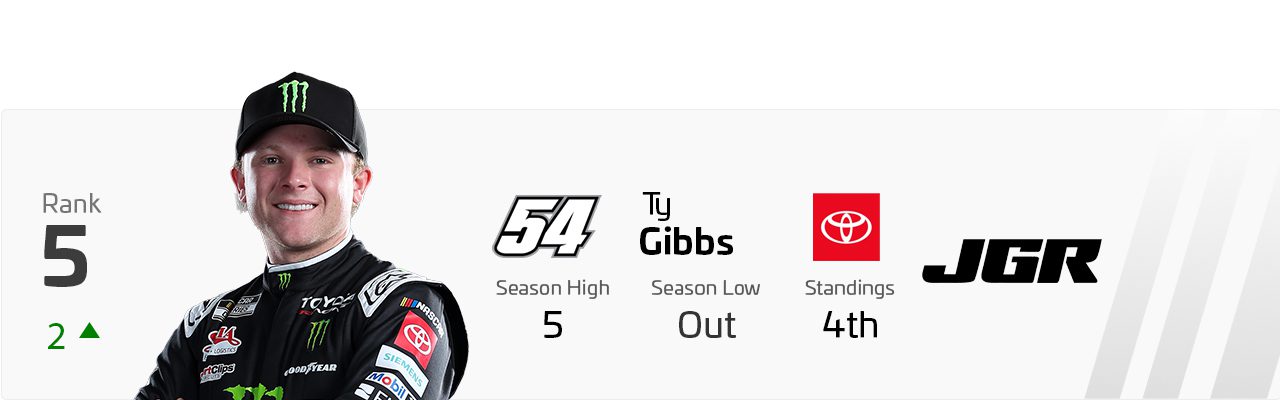
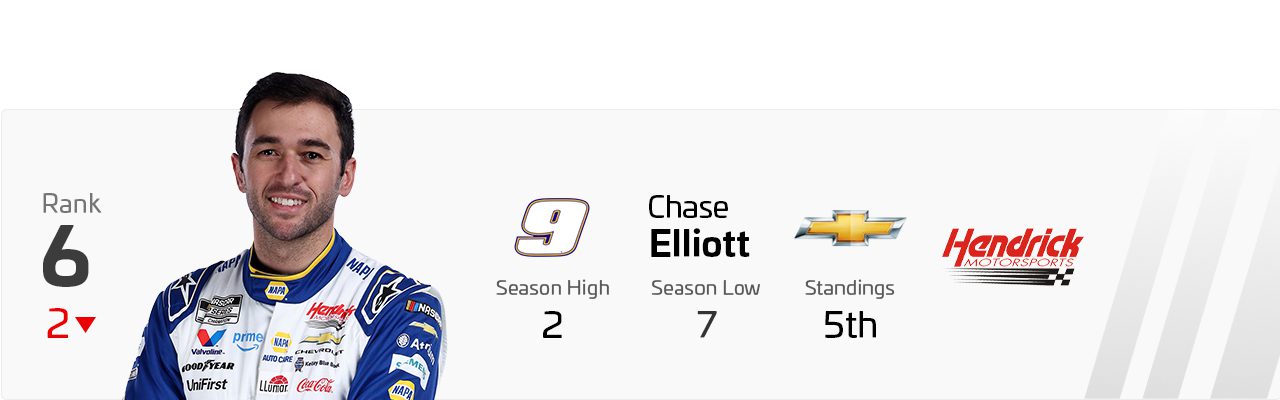
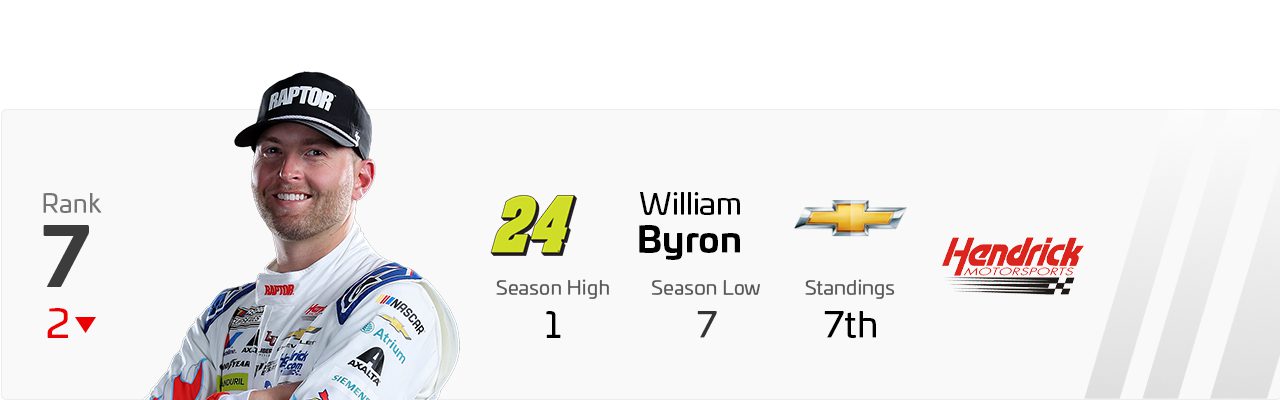
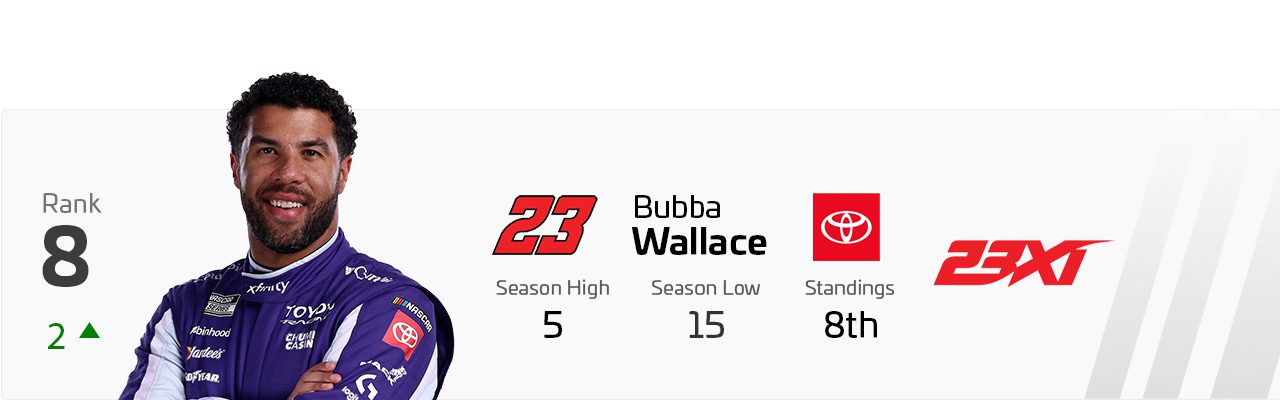
NASCAR.com’s Pat DeCola ranks the top 20 Cup Series drivers competing for the 2026 championship after Ty Gibbs’ win at Bristol Motor Speedway and before Sunday’s AdventHealth 400 at Kansas Speedway (2 p.m. ET, FOX, HBO Max, MRN Radio, SiriusXM NASCAR Radio). Kyle Larson enters as the defending winner.
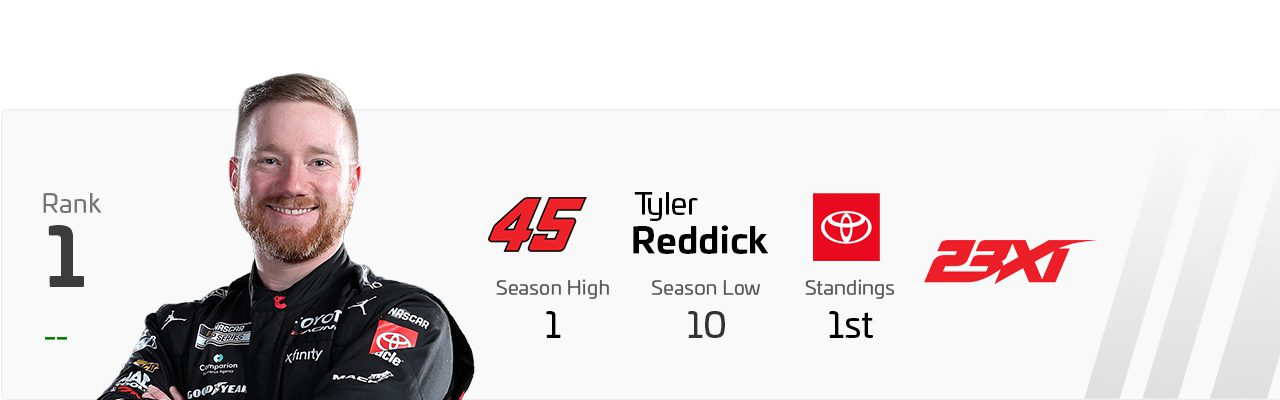
Analysis: In case you needed further evidence of 2026 being Reddick’s year, Sunday’s fourth-place run at Bristol was, arguably, the best he’d ever had at a short track, collecting just his third-ever top five at such venues. There have been plenty of Kansas Speedway highs for 23XI Racing, himself included, over the past handful of years and despite some recent lows there, there’s little reason to think he won’t again be in the mix, given how this season is playing out for him.
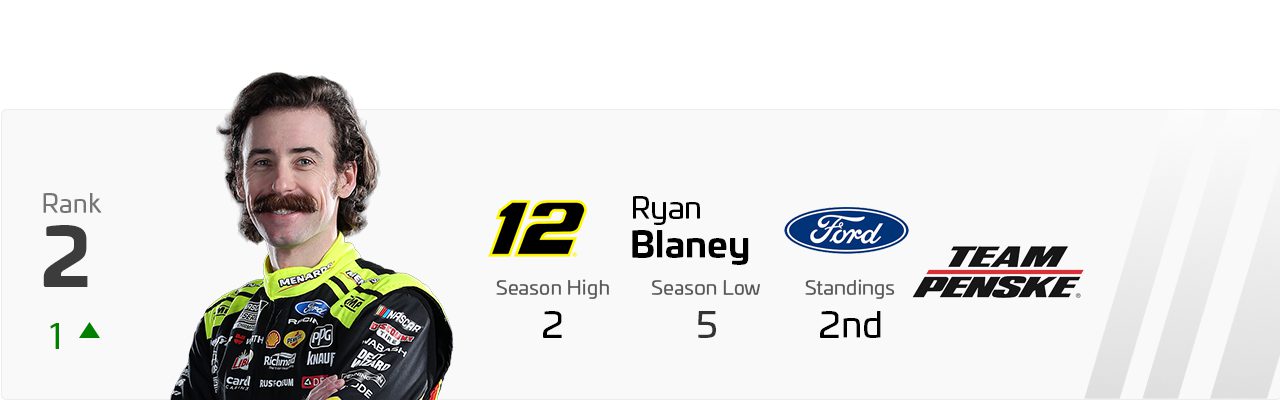
Analysis: It’s become abundantly clear — not that we didn’t already know this — that Blaney’s pure talent of just passing cars is perhaps unparalleled in the Cup Series, and his pit crew continually allows him ample opportunity to flex this muscle. He’ll probably have another chance to do so at Kansas, where, like Bristol, he tends to pass a lot of cars (led laps in 11 of 22 Kansas starts) but has yet to actually land a win there.
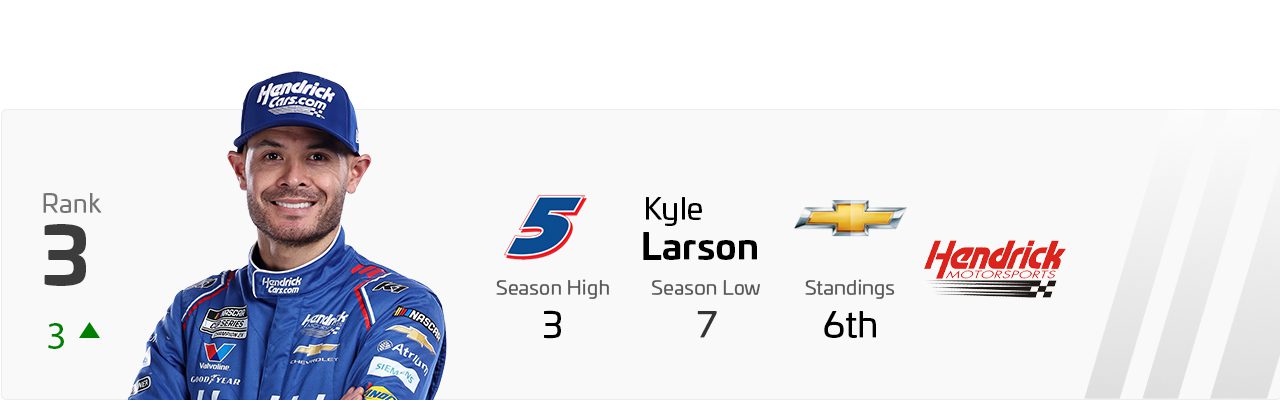
Analysis: Larson was once again dominant at Bristol, leading a race-high 284 laps before falling short to Blaney and first-time race winner Ty Gibbs. We’ve now come full circle since Larson, the current defending series champion, has won a Cup race — as you’ll have to go all the way back to Kansas in May last year since his last trip to Victory Lane. In no way has he been bad during that stretch, but it does feel notable that we’re now arriving at the site of his last win. Probably just makes him hungrier — so, don’t expect that drought to last much longer.
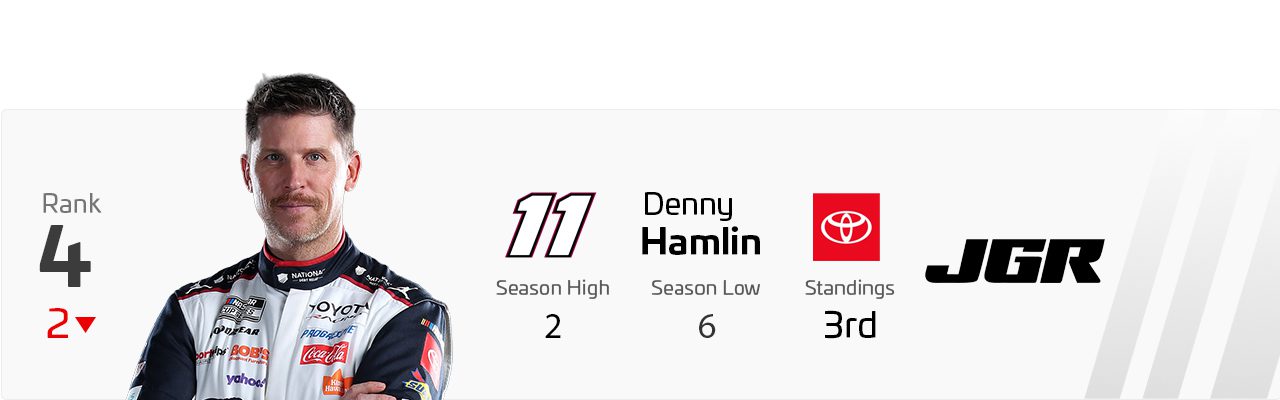
Analysis: Hamlin contended at Bristol, but the “Thunder Valley” master ultimately didn’t have a winning car under him, fading to ninth at the end. The four-time Kansas winner is arguably the best ever at the track, however, and — like most weekends — he’ll have an excellent chance to pick up an eye-popping 16th top five at the track on Sunday. At least.
Analysis: Well, there you go. In some ways, it was only a matter of time that a driver in a well-engineered ride with a national series title in the not-too-distant past would eventually figure it out at the Cup level, but the questions were certainly piling up here the past couple of seasons. Regardless, Gibbs is now a full-fledged Cup winner and drove an incredible race from start to finish Sunday at Bristol. Kansas has been a bit of a trainwreck for him (24.6 average finish), but Gibbs turned in a top five there in the 2024 fall race, so we shall see.
Analysis: Elliott spent a paltry amount of time at the front of the field, but a late-race spin killed any chance of a decent finish for the short-track maven. He’s also on another level at Kansas, owning the best career average finish there among active drivers (9.9), with nearly half of his 20 starts resulting in top-five finishes. He’ll be good.
Analysis: Just an absolute throwaway weekend for the No. 24 team, which has yet to really excel there with Byron, after starting from the rear for unapproved adjustments and making no headway the entire race — very atypical of Hendrick, regardless of track. A Kansas win feels like an inevitability for him, though, and let’s not be surprised if we see a notable performance out of this group on Sunday.
Analysis: Not a banger of a race for Wallace, but he did net some stage points and did what he had to do — we’re gonna see a lot of these kind of days across the board for drivers in this revamped championship format. He has, however, had bangers at Kansas with 23XI, and could very well add a second win there this weekend, given how well he’s running this year.
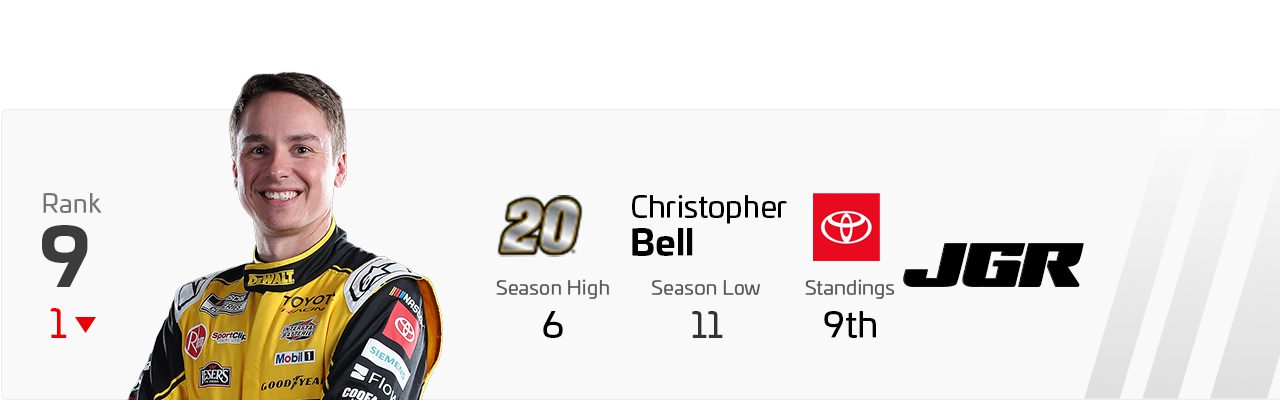
Analysis: Bell appeared early on that he’d once again be capable of figuring into the win at Bristol, all derailed by a Lap 144 brush with the wall and … later on by another spin on Lap 313. No concerns here, though, especially with Kansas on the horizon. While he’s never won there, Bell owns the second-best average finish among active drivers (11.9).
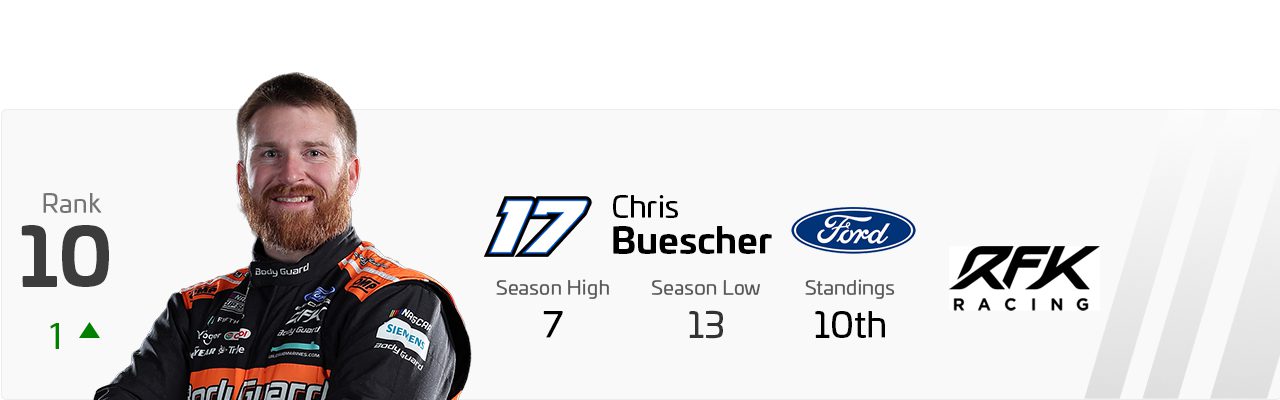
Analysis: A steady but minorly impactful Bristol race for Buescher, who had a decent run but remained steadfast at 10th in the standings. Kansas has turned into a pretty decent track for the veteran, as well, and he’ll look to land one spot higher on Sunday than he did in the 2024 running of this race.
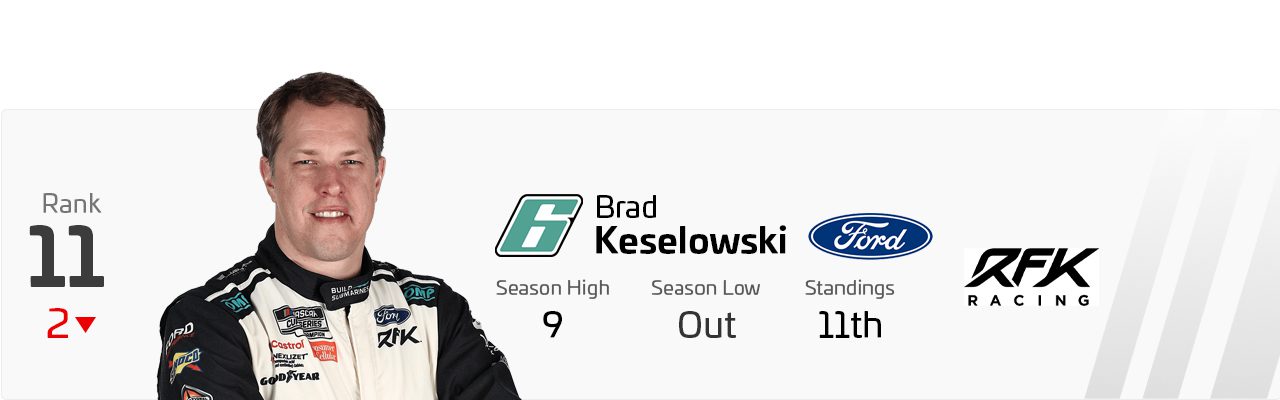
Analysis: Keselowski recovered nicely from an early spin, briefly finding himself back in the top five later on in the race, but later needing the free pass shortly before the checkered flag to ultimately finish just inside the top 15 and lose three spots in the standings. The 2019 (and 2011!) winner of this race could find himself putting all the pieces together at Kansas on Sunday, but he hasn’t had a top 10 finish in the spring at Kansas since 2021.
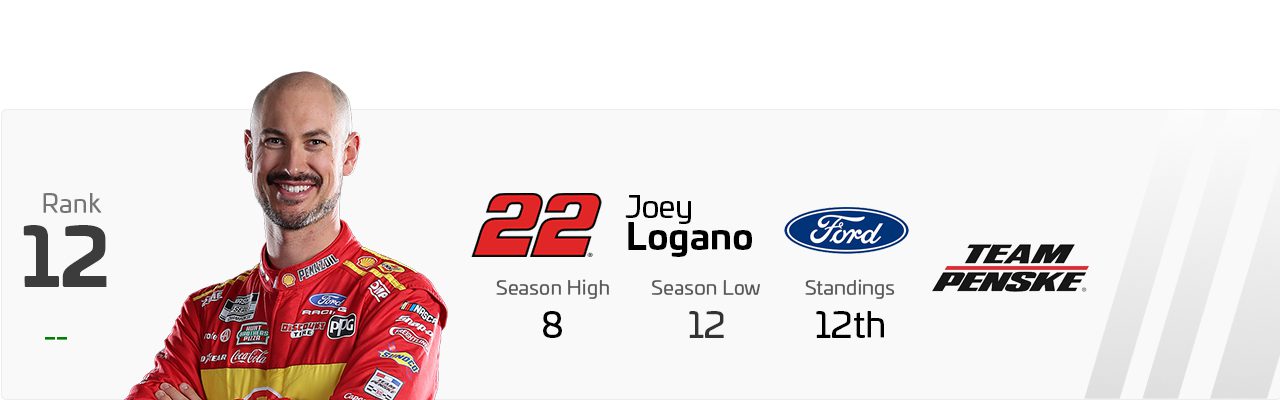
Analysis: Logano improved throughout the Bristol race, moving his way into the top 10 and picking up a much-needed P7 when all was said and done in Tennessee. No standings movement for him, but there’s a good chance Kansas could move the needle — the three-time champ is a three-time winner there.
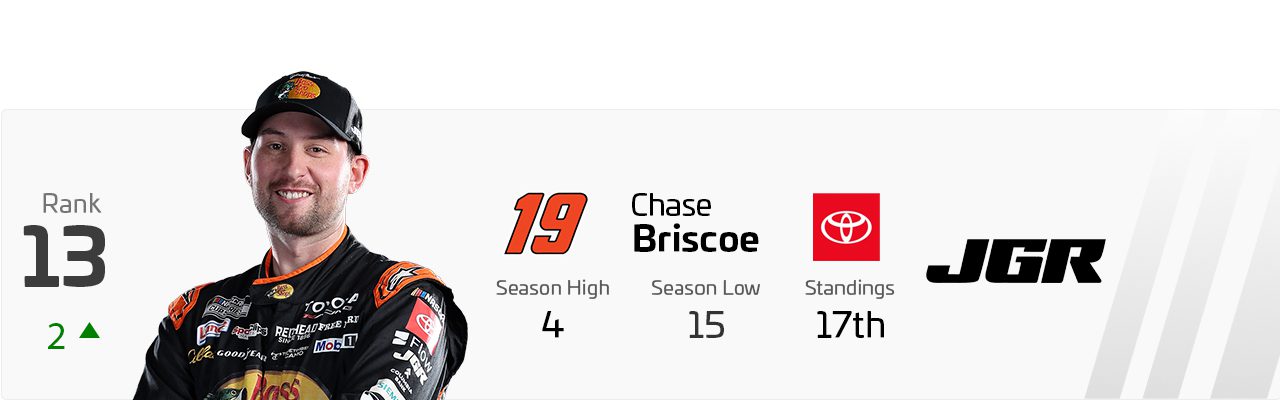
Analysis: Briscoe’s No. 19 Toyota lacked winning pace at Bristol, but he hung around the top five for a significant portion of the day and landed there to quell the bleeding a bit. He’ll have to buck his career trends at Kansas if he wants that to continue this weekend, but perhaps those trends have been assuaged already now that he’s with JGR — Briscoe turned in a pair of fourth-place runs in his first races there with the team last year.
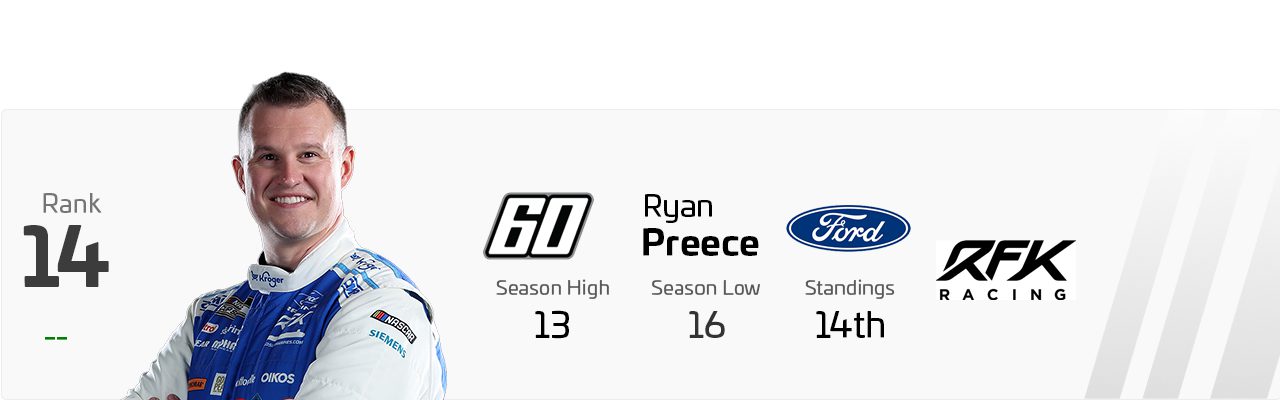
Analysis: Preece turned in an efficient, clean day at Bristol on Sunday, never quite finding the front but doing enough to escape the short track without hazard. Kansas hasn’t been overly kind to him throughout the years, but he notably did turn in his first top 10 there in this race last year; his first at the track with RFK Racing.
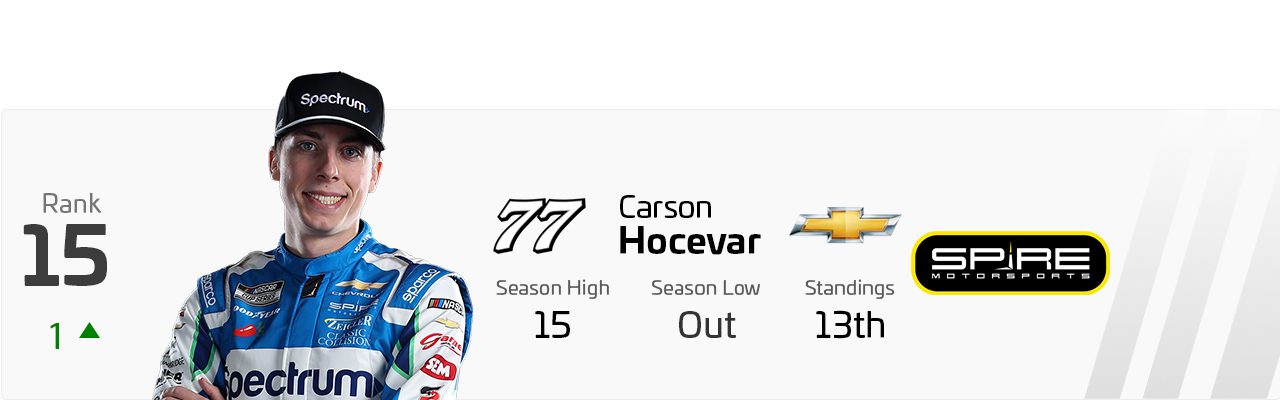
Analysis: You’re up, kid. Now that Gibbs has the first-win monkey off his back, much of the spotlight now shines on Hocevar, who has shown more than enough talent to become a prolific winner in the Cup Series, albeit with an unrefined race craft that has arguably kept it from happening already. Kansas could be interesting, though — he’s led multiple laps in two of his five starts there, but has yet to finish any better than 20th across them.
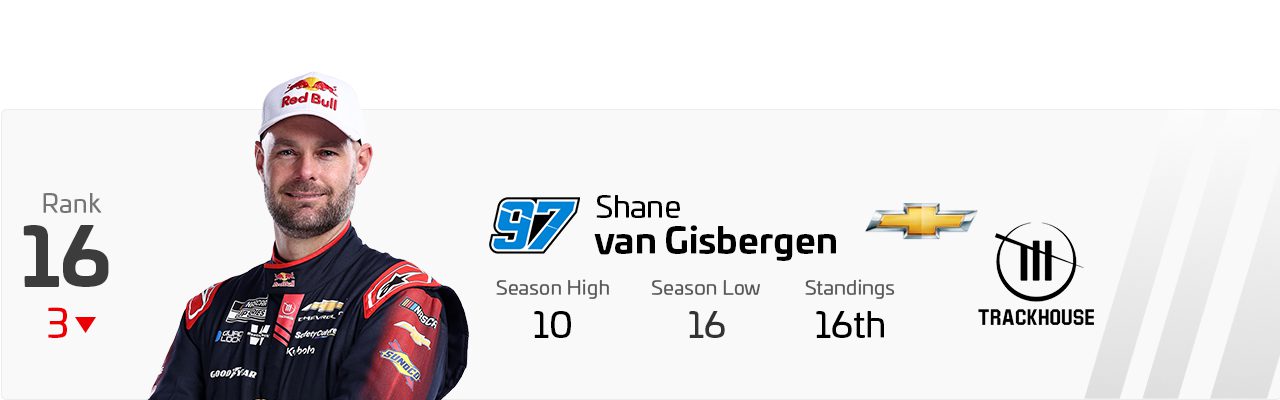
Analysis: Not a whole lot to take away from a messy Bristol afternoon for SVG, who just has not had a very fun time at the “Last Great Colosseum” thus far in his NASCAR journey. Kansas, however, has gone measurably better for him in its limited sample size; he posted a pair of top-20s there last year — including a P10 last fall.
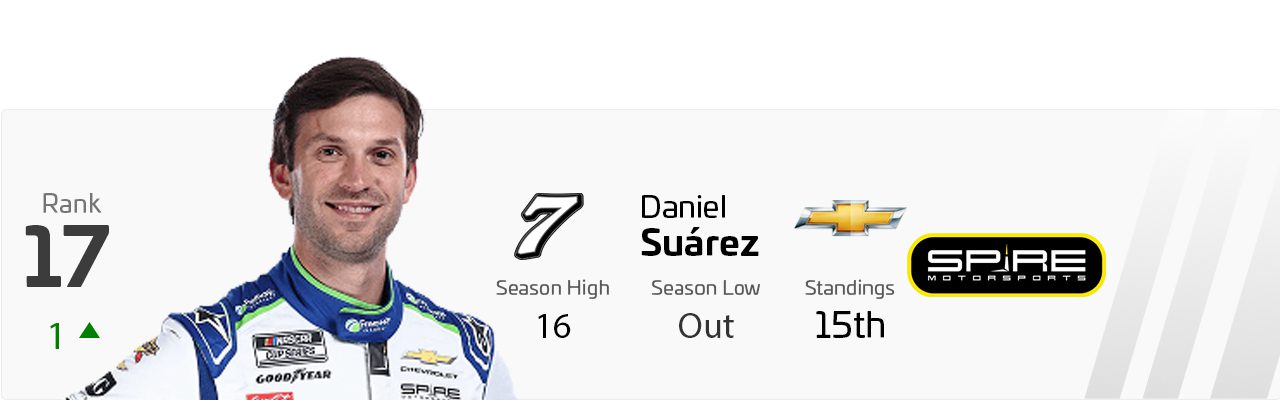
Analysis: Bristol was sneakily impressive for Suárez, who fell a lap down mid-race, later got the free pass and still managed to finish just outside the top 10 and move into the top 15 in the standings. Unfortunately, that’s all likely about to be squandered, as Suárez can count Kansas as one of his worst tracks, with just two top 10s and an average finish outside the top 20 in 18 starts scattered across several teams and manufacturers.
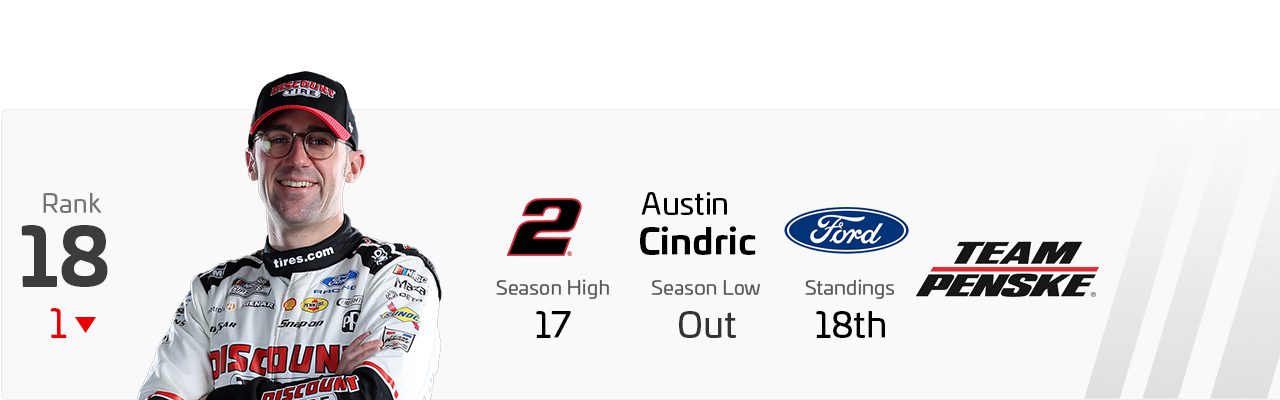
Analysis: Cindric grabbed some points in each stage to soften the blow a bit, but he was essentially mired in the mid-pack for the remainder of Bristol. For Kansas, let’s start with the positive — Cindric has a pair of 11th-place runs in the spring race, including one last year. Unfortunately, the flip side of that is that overall, his average finish there is 24.3 across nine starts, none of which resulted in top 10s.
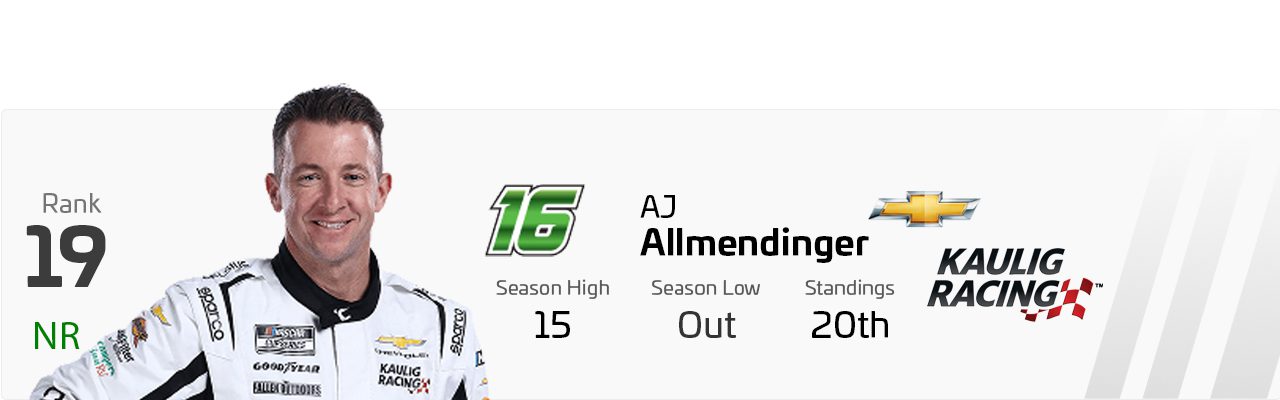
Analysis: Allmendinger continues to show that he’s a more-than-capable Cup Series driver who is often outpacing the performance of his equipment, and he sure did muscle his way around Bristol to notch a top 15 on Sunday. He’ll need some of that good mojo to keep it rolling this weekend at Kansas, where he has three straight finishes of 30th or worse, but interestingly did turn in a pair of eighth-place runs in 2016.
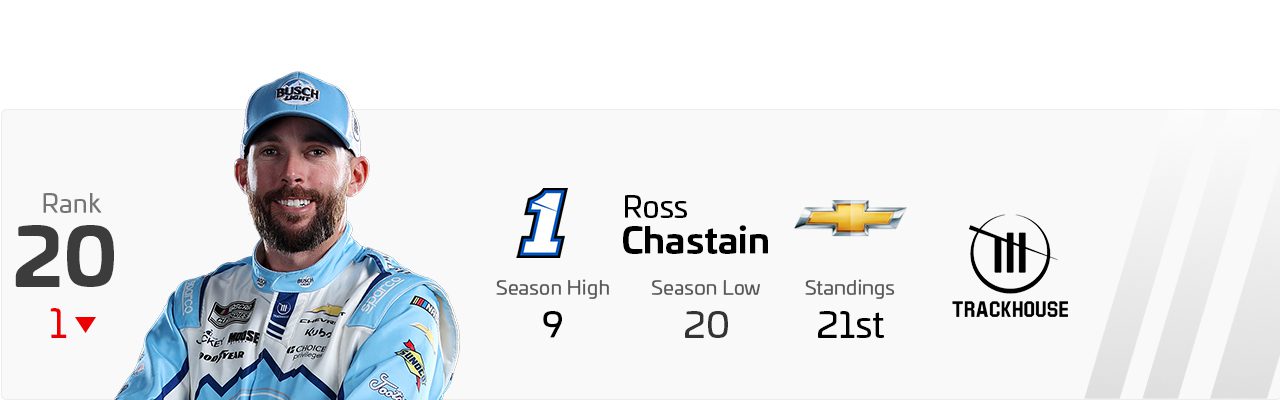
Analysis: A brief flirt with the front of the field at the beginning of the race was but a passing moment in the wind, as Chastain was unable to muster much fight to stay up there the rest of the way and landed 20th, which is about on par with his 2026 average finish (19.4). It’s fair to wonder if any of that 2022 magic is left here, but we’ve seen the No. 1 team pull a miracle out of their hats before (2025 Coca-Cola 600), and Chastain himself fended off playoff drivers for a win at Kansas in 2024. This might be a bit of a make-or-break weekend ahead; if it doesn’t go well, the standings hole may be deepening beyond repair.