MARTINSVILLE, Va. — Justin Allgaier has another busy weekend ahead — his “9-to-5” job competing for the NASCAR O’Reilly Auto Parts Series championship on Saturday and then continuing to fill in for the injured Alex Bowman in Sunday’s Cup Series race at the famous half-mile Martinsville Speedway.
So far, the 2024 O’Reilly Auto Parts Series champ has done admirable work balancing the heavy schedule. He’ll drive the No. 7 JR Motorsports Chevy in Saturday’s NFPA 250 (3:30 p.m. ET, The CW, MRN Radio, SiriusXM NASCAR Radio) and then suit up again for Sunday’s Cook Out 400 (3:30 p.m. ET, FS1, HBO Max, MRN Radio, SiriusXM NASCAR Radio) to steer the No. 48 Hendrick Motorsports Chevrolet for Bowman, who has been battling vertigo.
Allgaier earned his second O’Reilly Auto Parts Series victory of the season — and 30th of his decorated career — last weekend at Darlington Raceway and now leads the championship by an impressive 52-point margin over Richard Childress Racing’s Jesse Love.
He’s finished 25th (Las Vegas) and 24th (Darlington) in two Cup Series starts in the No. 48 Chevy. The team has said Bowman will be out at least through the April 12 Bristol Motor Speedway race.
“Obviously, the goal is to get Alex back into the car as soon as possible,’’ Allgaier said Friday before O’Reilly Auto Parts Series qualifying at Martinsville. “That’s the main thought and transitioning from there, how do we strengthen the 48 program. The hard part for me is, obviously, I want to do the best job I can for both parties and I also don’t want to hold anyone back, whether that be the 48 or the 7. I owe it to both teams to give 100 percent so it’s made for a bit of a challenge over the last two weeks with family time but it’s worth it and you take a team like Hendrick Motorsports and they’ve obviously been successful in the series for so long because of the way they operate, and how much stuff they have and how great they are.
“It’s been a really unique and fun journey to see the back end of that and hope to get Alex back in the car soon. Hopefully, we can do a good job until that time comes.’’
Editor’s Note: Keep tabs on this page for lineup advice following qualifying, including changes you should consider.
Fantasy Update: NASCAR’s biggest organizations have dominated Martinsville Speedway in recent years, with Hendrick Motorsports, Joe Gibbs Racing and Team Penske combining to sweep the last 15 events at “The Paperclip.” My lineup is completely full of those three organizations for Sunday’s Cook Out 400. While Ryan Preece was steady over the long haul in practice, Chase Elliott was simply faster, bumping the No. 9 car into my lineup. Preece is also being replaced by quasi-Penske driver Josh Berry as my 36 for 36 pick, with the No. 21 car starting third, immediately in position for stage points.
My lineup: Denny Hamlin, William Byron, Joey Logano, Ryan Blaney, Chase Elliott.
Garage: Kyle Larson.
After a grueling, old-school 400 miles at Darlington Raceway, the Cup Series heads north to Martinsville Speedway for the first true short-track race of the 2026 season. Many of the usual cast of characters run up front at “The Paperclip,” so expect Hendrick Motorsports, Joe Gibbs Racing and Team Penske — with a sprinkle of RFK Racing — to lead the pack on Sunday.
Returning to Fastlane this year is my weekly NASCAR 36 for 36 pick, where you can come play along. It’s a season-long points battle introduced in 2024 where strategy is the primary emphasis. With 36 chartered cars and 36 races on the 2026 schedule, players can choose each car once for the duration of the season.
Driver:Denny Hamlin, No. 11 Joe Gibbs Racing Toyota Selections remaining: 7 Comment: With only seven starts remaining for Hamlin over the course of the regular season, I’m debating whether to use him this weekend. He is hard to pass up at Martinsville, leading active drivers in wins (six), top fives (21), top 10s (27) and laps led (2,722) here. He enters with four top-five finishes in the last seven races at the Virginia track, so I think I’ve convinced myself that he needs to be in my lineup.
Driver:Ryan Blaney, No. 12 Team Penske Ford Selections remaining: 7 Comment: Blaney is in the mix for being the new short-track king. He has a pair of victories at Martinsville, with 11 top-five and 13 top-10 finishes, including finishes of seventh or better in seven of the last eight trips to the Commonwealth. He also scored 41 more points than any other driver last year at short tracks.
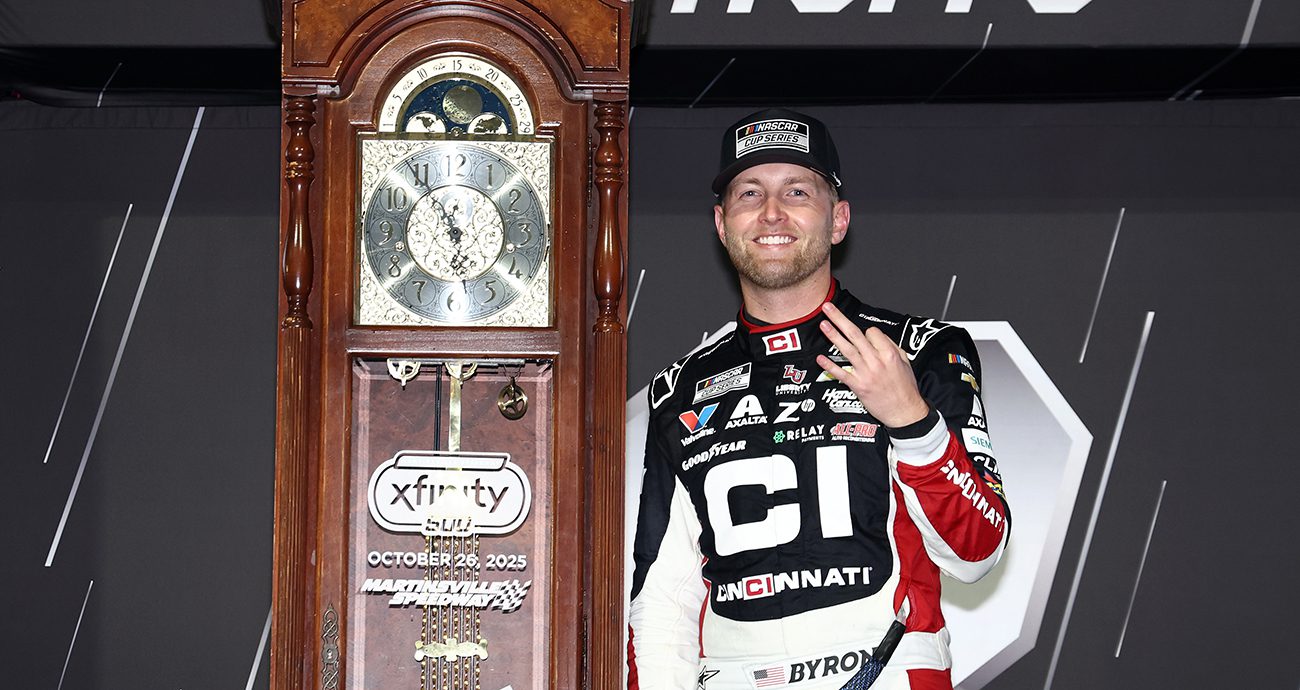
Driver:William Byron, No. 24 Hendrick Motorsports Chevrolet Selections remaining: 9 Comment: When the Cup Series visited Martinsville in October, nobody could dethrone William Byron, who has won three of the eight Next Gen races at the 0.526-mile venue. His six top-five finishes and 664 laps led at Martinsville are his best at any circuit on the calendar, with nearly half of those laps coming in the fall (304).
Jared C. Tilton | Getty Images
DRIVERS TO AVOID
Driver:Tyler Reddick, No. 45 23XI Racing Toyota Selections remaining: 8 Comment: Reddick put it best while departing his post-race press conference at Darlington when he quipped the world would end if he were to win at Martinsville. The four-time 2026 winner has a pair of top-10 finishes in 12 Martinsville starts, with a best finish of seventh. It’s his only track where he hasn’t placed inside the top five with at least 10 starts.
Driver:Brad Keselowski, No. 6 RFK Racing Ford Selections remaining: 8 Comment: Vintage Keselowski was on full display at Darlington, leading a race-high 142 laps en route to a runner-up finish. And while he is a multi-time Martinsville winner, it’s been a dreadful track for the No. 6 team in recent years. The 2012 Cup Series champion has finished 20th or worse in six of the last seven Martinsville races.
Patrick McDermott | Getty Images
SLEEPERS OF THE WEEK
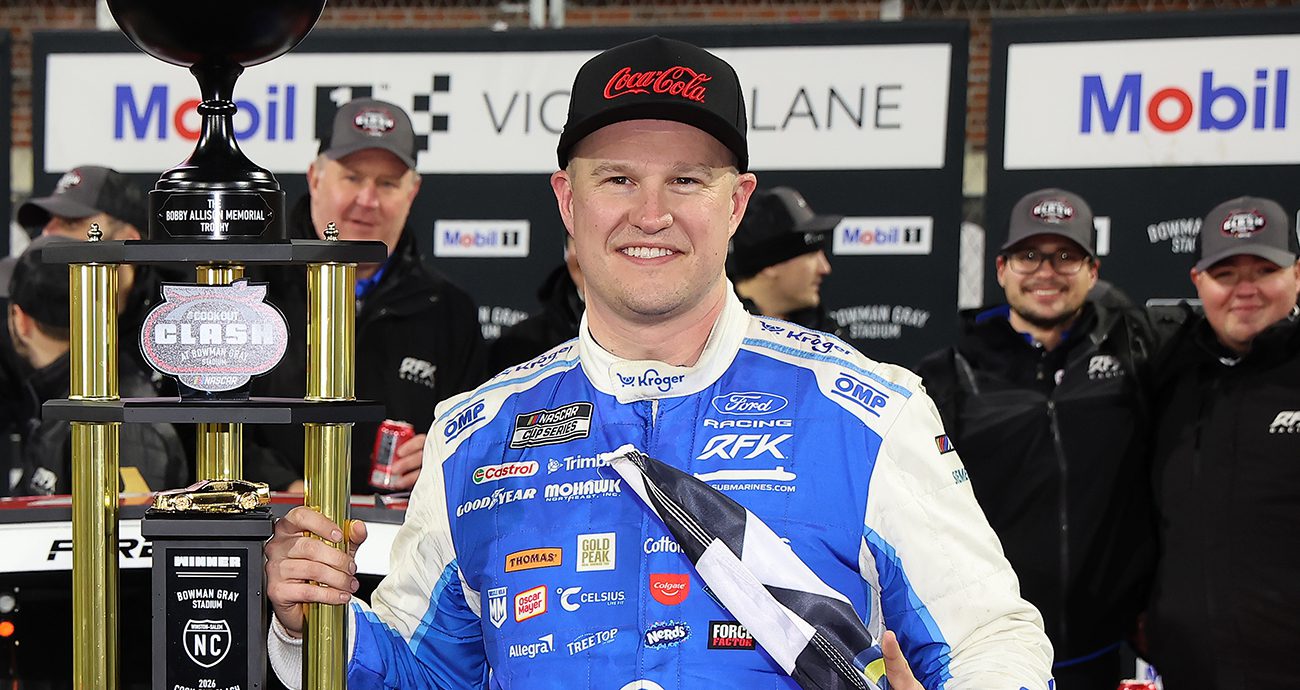
Driver:Ryan Preece, No. 60 RFK Racing Ford Selections remaining: 10 Comment: Expect Preece, who won this year’s Cook Out Clash at Bowman Gray Stadium, to lead the way for RFK at Martinsville. He made a name for himself running short tracks across the Northeast, and it’s led to some success on the big stage. He won the Busch Light Pole Award for this race in 2023 and has a trio of top-10 finishes in the last four races here.
Driver:Josh Berry, No. 21 Wood Brothers Racing Ford Selections remaining: 10 Comment: Like Preece, Berry is another short-track standout who has found success in other divisions of motorsports at Martinsville. In his first attempt with the Wood Brothers, he had a mechanical issue while leading and finished 32nd. He rebounded with a 10th-place effort in October.
Jonathan Bachman | Getty Images
FEATURED MATCHUPS
Tyler Reddick vs. Christopher Bell Pick: Bell Comment: Expectations are minimal for Reddick at Martinsville, giving Bell plenty of wiggle room. He is a former Martinsville winner and placed runner-up last spring to Hamlin. Bell is always in the mix at short tracks, recording 11 top-10 finishes in the last 15 races.
William Byron vs. Kyle Larson Pick: Byron Comment: Because Byron’s highs have been higher at Martinsville, he’s the pick. However, Larson is flirting with must-start territory at Martinsville — something he never thought would be possible. But he’s finished sixth or better in each of the last seven Martinsville events.
Carson Hocevar vs. Brad Keselowski Pick: Keselowski Comment: While Keselowski hasn’t had recent success at Martinsville, his 12 top-five finishes at “The Paperclip” are tied for the most at any venue in his career. Meanwhile, Hocevar has a best finish of 17th in five Martinsville attempts, and he completed the hat trick for spins in a single race last fall.
Bubba Wallace vs. Joey Logano Pick: Logano Comment: Wallace has steadily improved at Martinsville in Cup, finishing inside the top 10 in four of the last seven races. In those same seven races, plus six before that, Logano’s name was a mainstay inside the top 10 in all of them. His 13 consecutive top 10s at Martinsville is the fourth-longest streak in track history.
MY LINEUP
Starting five: Denny Hamlin, Ryan Blaney, William Byron, Kyle Larson, Joey Logano. Garage pick: Ryan Preece.
36 FOR 36
Pick: Ryan Preece, No. 60 RFK Racing Ford Comment: A little humble brag, but by swapping to Keselowski after Darlington qualifying, I now have three consecutive 51-plus point performances. The goal this weekend is to stay clean, something Preece can do. He is an absolute menace at short tracks, with four finishes of seventh or better in the last eight races, and that dominant Bowman Gray showing leaves plenty of optimism.
DAYTONA BEACH, Fla. – Due to potential weather forecasted for the Martinsville area late Friday night, NASCAR and Martinsville Speedway officials will move up the start time for the Virginia is for Racing Lovers 200 to 7 p.m. ET.
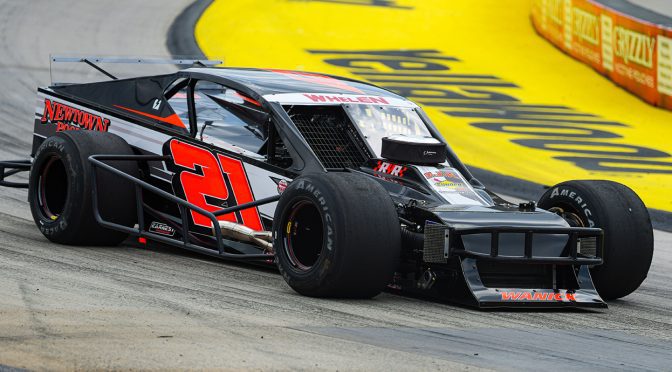
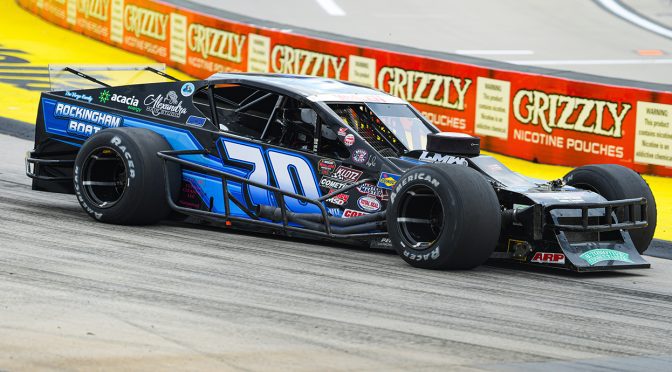
Friday’s NASCAR Whelen Modified Tour event was originally scheduled for a 7:30 p.m. ET start time.
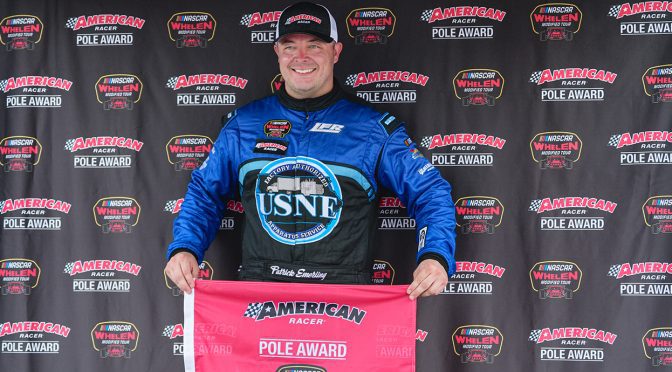
Justin Bonsignore enters Martinsville Speedway with momentum firmly on his side. After opening the season with a victory at New Smyrna Speedway in February, Bonsignore has also captured each of the last two Modified Tour races at Martinsville. A win this weekend would place him alone in the record books, as no driver in series history has ever won three consecutive Modified Tour events at the historic half-mile.
Reigning NASCAR Whelen Modified Tour champion Austin Beers enters Friday’s race in the midst of a historic run of consistency. Beers has recorded 31 consecutive top-10 finishes dating back to April 7, 2024, at Thompson Speedway Motorsports Park, marking the longest streak of its kind in series history. During that span, he has earned three victories while posting an average finish of 4.77 and has finished outside the top 10 just four times since the start of the 2023 season.
Friday’s event also marks the NASCAR Whelen Modified Tour’s return to Martinsville Speedway in the spring for the first time since 2021. The previous spring race at the venue, held on April 8, 2021, saw Eric Goodale take the checkered flag.
Fans unable to attend Friday’s race in person can watch live on FloRacing. For updated event information as available, fans can visit nascar.com/regional.
The NASCAR O’Reilly Auto Parts Series resumes competition Saturday afternoon at Martinsville Speedway with the NFPA 250 (3:30 p.m. ET on CW, MRN, SiriusXM NASCAR Radio).
Richard Childress Racing’s Austin Hill is the defending race winner, leading only the last lap of overtime to claim the win last spring after that day’s most dominant driver, Connor Zilisch — now a NASCAR Cup Series rookie — spun on the last regularly-scheduled lap, resulting in an overtime restart. Zilisch had started from pole position and led 100 of the opening 250 laps.
Taylor Gray’s 87 laps out front were second to Zilisch, and the 21-year-old Gray answered that production later in the year, scoring his first series victory the following October race at Martinsville.
Three other championship contenders own Martinsville clocks, including last week’s Darlington winner, JR Motorsports’ Justin Allgaier (2023), Joe Gibbs Racing’s Brandon Jones (2022) and Sam Hunt Racing’s Harrison Burton (2020).
The 2024 series champion Allgaier holds a 52-point edge over last year’s champ, Richard Childress Racing’s Jesse Love atop the standings. JR Motorsports’ Carson Kvapil (-84), Haas Factory Team’s Sheldon Creed (-88) and Love’s teammate Hill (-96) round out the top-five atop the standings.
JR Motorsports has won the last four races (with three different drivers), and a victory Saturday would mark the second-longest streak of wins for a team in series history. Joe Gibbs Racing won six consecutively in 2008.
NASCAR O’Reilly Auto Parts Series Practice & Kennametal Pole Qualifying at Martinsville is scheduled for Friday at 4:30 p.m. ET (CW App). The last time a pole sitter won this race was 1987 (Jimmy Hensley).
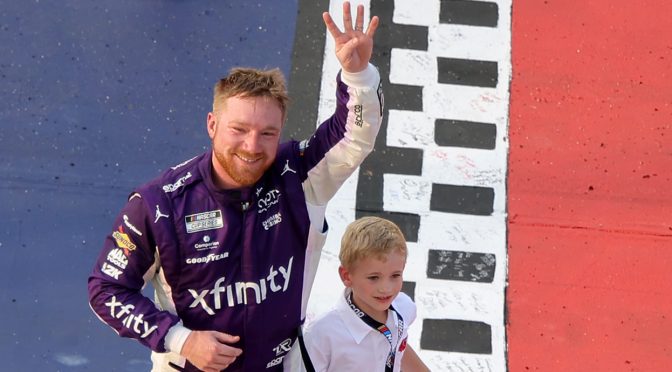
Tyler Reddick is racing like a man on a mission to win every single race – and he sure picked the right year to do it.
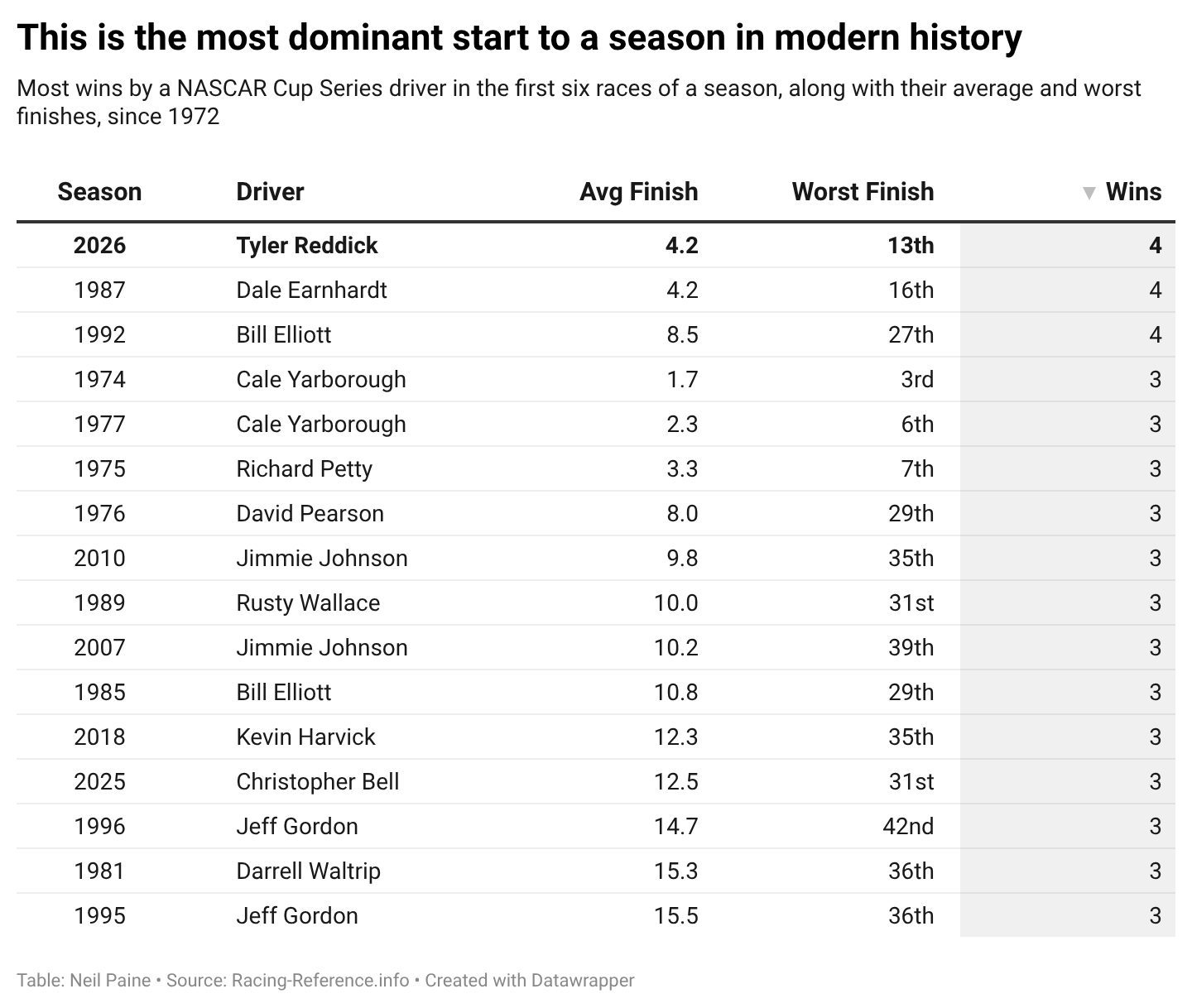
The driver of the No. 45 23XI Racing Toyota is off to an absolute season for the ages so far in 2026, winning again last Sunday at Darlington for his fourth victory in the first six races on the schedule. Going back to the dawn of NASCAR’s modern era in 1972, only two other drivers also won four times in the first six races of a season: Dale Earnhardt in 1987 and Bill Elliott in 1992 – and Reddick had greater consistency and/or a higher floor in his non-wins:
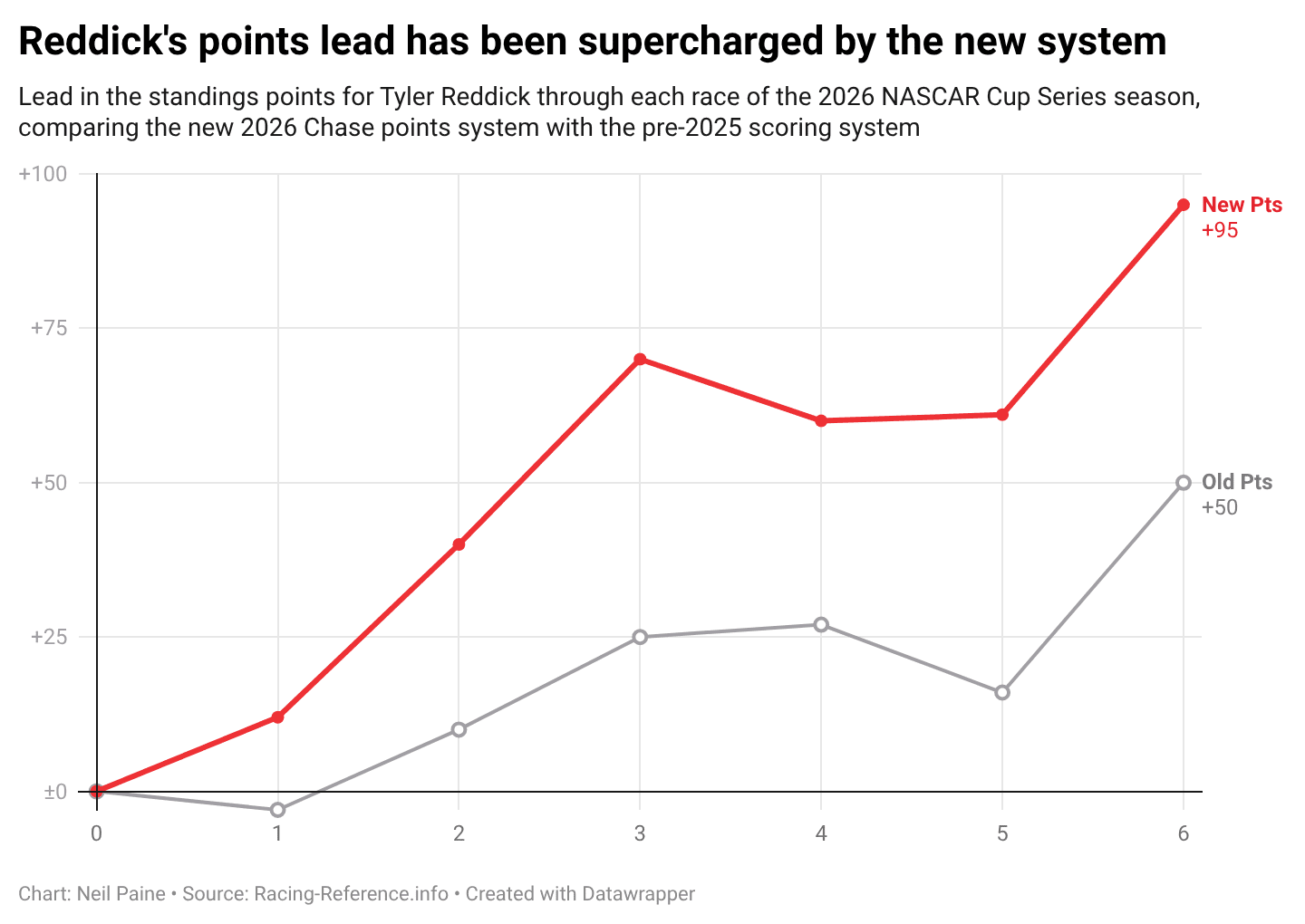
Simply put, we haven’t really seen a performance like this in the early phase of a season in a long time, if ever. And the benefit to Reddick in the standings is disproportionate this particular season, due to the new Chase system’s points format. As part of the trade-off for mothballing the old win-and-in mechanism for clinching a playoff spot, each trip to Victory Lane carries an extra 15-point bonus (compared with last year) to encourage a priority on winning.
And as it turns out, when you win almost every race in a season, those bonuses really start to pile up quickly.
Here’s a comparison between Reddick’s cumulative lead in the standings each week of the 2026 season under the current Chase points system – currently +95 over Ryan Blaney – and what his lead would be under the old system, without the 15-point bump for winning:
Under the old points format, Reddick would still be the clear standings leader at this point of the season. But he would “only” be up 50 points on the rest of the field: a healthy margin for sure, but also well within striking distance of a win, plus a strong performance in the stages, under the old system. Instead, as the wins have piled up within this new format, Reddick’s lead over Blaney and company is nearly doubled compared with what it would have been a year ago.
The better he keeps driving, the more Reddick leaves the competition further and further in the standings dust. Of course, the extra bonus potentially makes a comeback quicker to pull off as well – it’s a bit like the 3-pointer for a trailing team in basketball that way. But to catch the guy with a big winning streak, you need to put together one of your own, which feels like the way it should be.
Now the main question might be, how many wins can Reddick reach by season’s end?
The record for wins in a single Cup Series season was 27 by – who else? – Richard Petty in 1967, though he did it in 48 races. Pro-rated to a 36-race schedule, that works out to 20.3 wins, which means Reddick’s current 24-win pace is actually ahead of the record as we sit one-sixth of the way through the 2026 calendar. But before we get too excited, Reddick will obviously not go on to win anything close to two out of every three races he enters all season, so winning at the requisite 54.2% clip to match Petty from here is probably out the window. (Sorry to disappoint!)
The modern-era Cup record of 13 wins, however, is held by Jeff Gordon in 1998 and Petty himself in 1975, and Reddick would need to win 30% of races from here on to match that. (Still a very tall order – although, incredibly, Gordon won 39.4% of his races that season, so it can be done … in theory at least.)
More realistically, at the most basic level, Reddick has won 5.4% of his career Cup races, which works out to an expectation of 1.6 additional wins over the rest of the year (and 5.6 overall). But that includes his early seasons with Richard Childress Racing, which may not be very relevant; at his 7.9% win rate since moving to 23XI, we might expect 2.4 additional wins (and 6.4 overall) for Reddick by season’s end – still only half of the record number.
This method is simplistic, treating every remaining race the same (regardless of track type) and lumping all seasons together, which isn’t ideal. We can do a better job of estimating Reddick’s true odds of winning each remaining race by looking at track-specific data weighted by recency. If we anchor his win percentages in recent years at each track type to the typical rates for a top-10 driver in the standings during the Next Gen car era, giving more weight to more recent years (including 2026), we can come up with more reasonable guesses at his “true” chance to win at each track type.
(This includes an estimated 5% chance to win at short tracks, even though Reddick himself is 0-for-36 on short tracks in his career – the only track type he’s never won on before. Through our method, he still gets some small odds of winning because the average top-10 Cup driver wins 8% of the time on short tracks.)
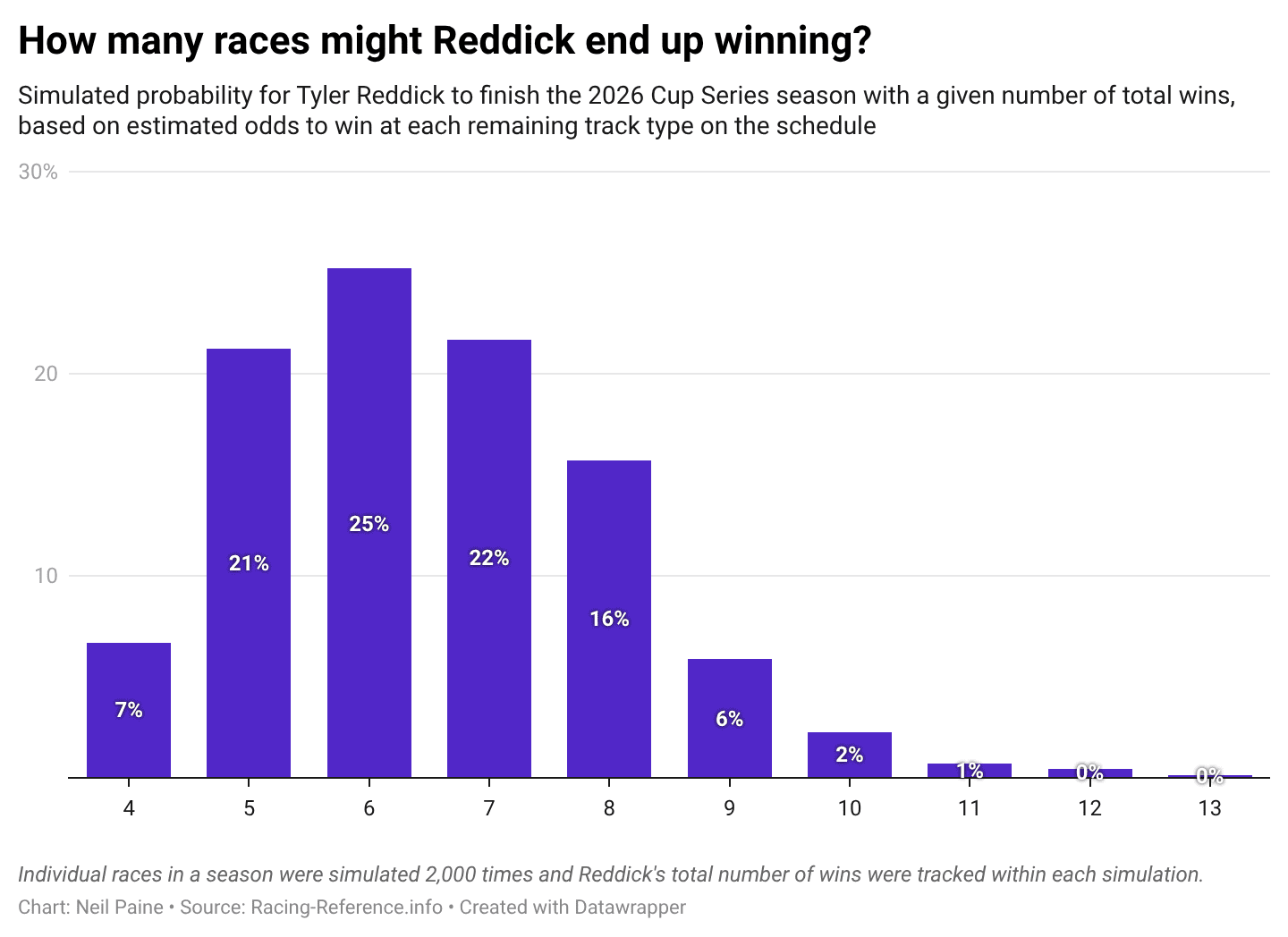
Plug all of those values into the remaining schedule, simulate the rest of the 2026 season a bunch of times, track how often Reddick wins a given number of races and we arrive at a plausible distribution of winning outcomes for his year in full:
According to this method, there’s around a 7% chance he doesn’t win another race all year, which would be somewhat shocking but absolutely possible – think about Christopher Bell winning three of the first four races last year, then not winning again for more than six months.
More likely, though, Reddick will win at least one more race. On average, he wins 2.5 additional times to finish with either six or seven victories on the year. (Exactly six wins was the most common outcome in the simulations.) There is a 47% chance he ends up with at least seven wins, which would break the Next Gen-era record of six (co-held by William Byron in 2023, Kyle Larson in 2024 and Denny Hamlin in 2025), a 4% chance he gets to double-digits – joining a club with Jimmie Johnson (2007) and Larson (2021) for the most of the 2000s – and even a 0.15% probability (1 in around 600 to 700) that he gets to 13 and ties Gordon’s record.
So we’re saying there’s a chance!
But just the same, Reddick doesn’t need to catch Petty or Gordon to make history. He’s looking for his first career Cup Series title, so although a wins record would be nice, the main function of these victories is to keep padding that standings lead with the extra emphasis on winning in this year’s points format. Anything beyond that is just icing on the cake of a season that’s already off to a historic start.
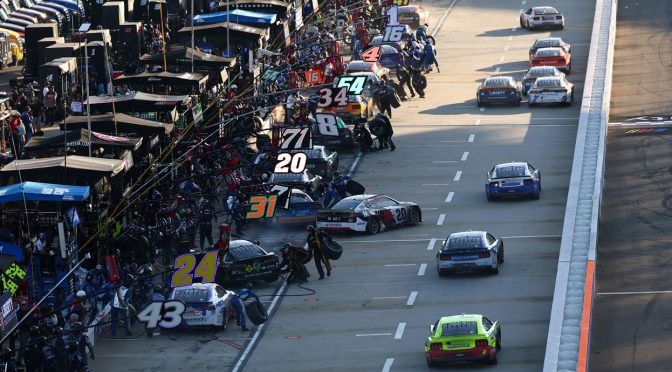
As NASCAR’s oldest track, Martinsville Speedway presents a timeless challenge. Fitting for the track that presents its winners a grandfather clock.
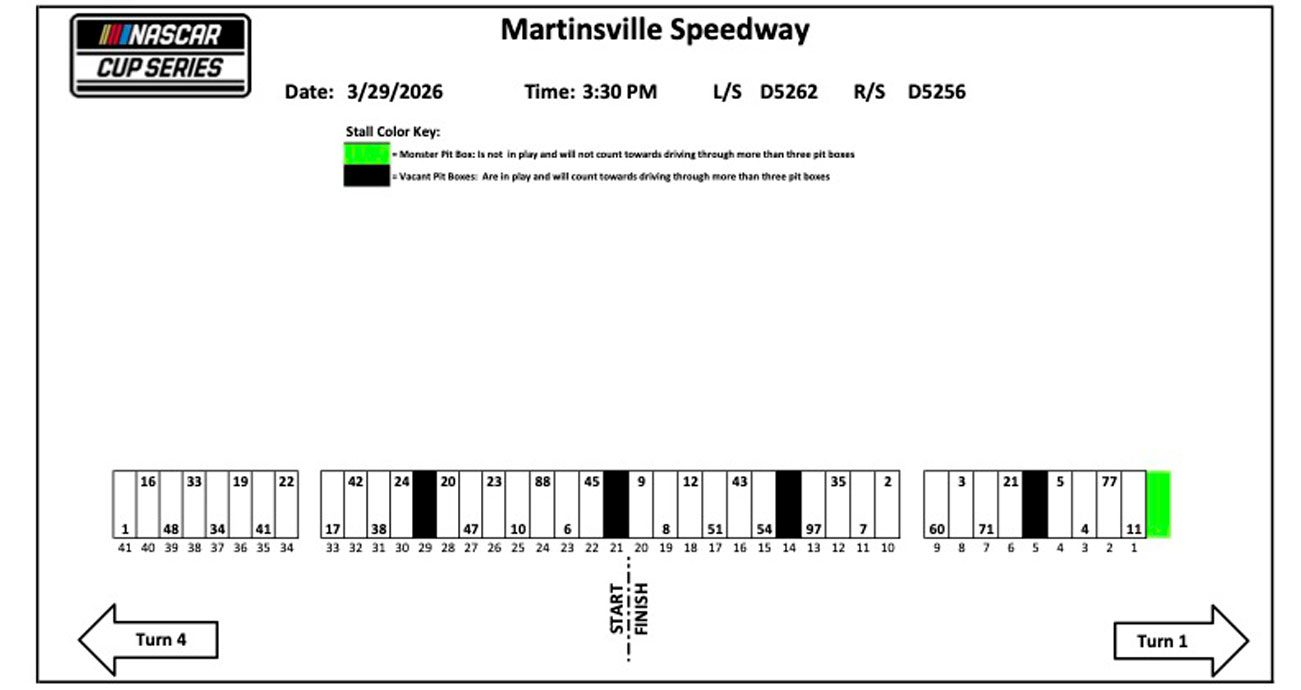
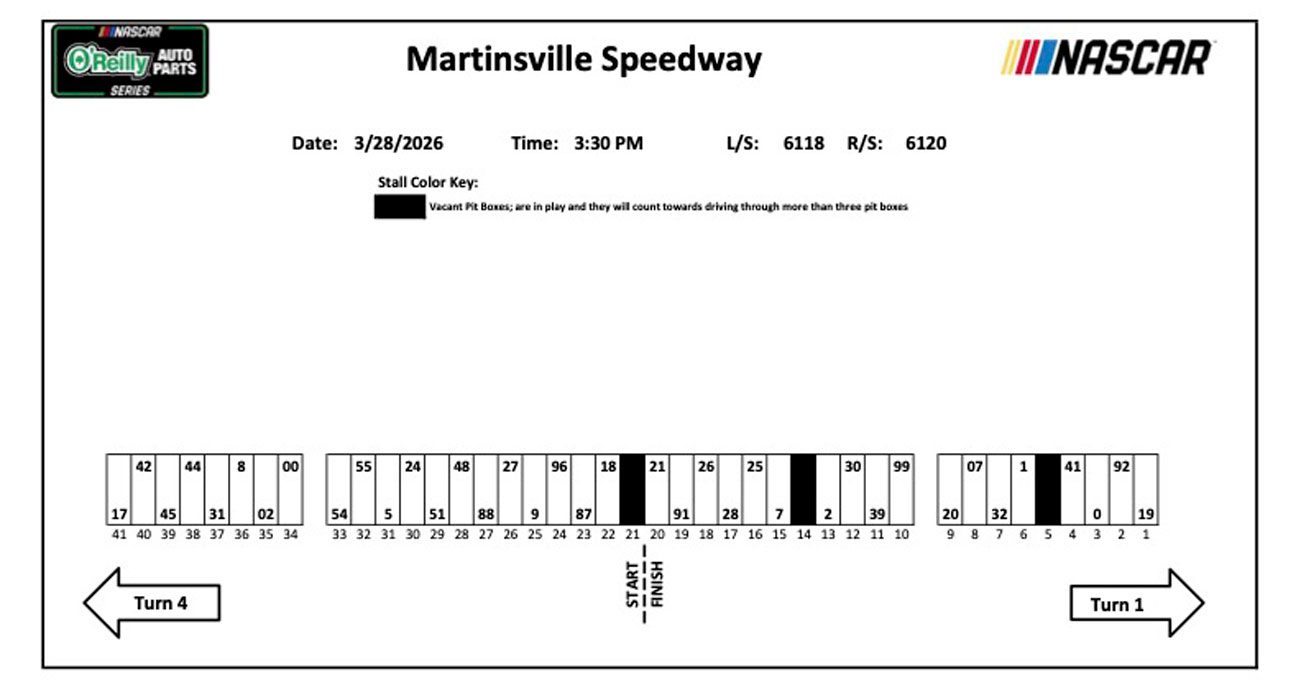
Its drag-strip straights connected by abrupt, flat U-turns on either end create its iconic paperclip shape, a layout accentuated by a winding pit road.
Some drivers naturally find success in Martinsville’s tight confines. But others, well, they need a minute to feel around in the dark to find the light switch.
Heading into Sunday’s Cook Out 400 (3:30 p.m. ET, FS1, HBO Max, MRN Radio, SiriusXM NASCAR Radio), the 2023 NASCAR Cup Series champion is easily considered a favorite to win again at Martinsville. But once upon a time, it wasn’t hard to consider him an also-ran there.
The sample size was small for Blaney back in 2017, his second full-time season at the Cup level. He was steady in five NASCAR Craftsman Truck Series starts from 2012 through 2014, with three fifth-place efforts and an eighth-place finish in that span. But his first three Cup starts there were forgettable, finishing 19th twice in 2016 and 25th in the 2017 spring race.
That all changed in October 2017.
“Fall 2017, it really clicked for me of, hey, here’s what I need to have the car feel like, and here’s how I need to drive it,” Blaney told NASCAR.com. “And I can’t say it was really anything specific. It’s just that we had a good race there, and it’s like, ‘Oh!’ Like a light switch all of a sudden. And, you know, fortunately, it’s transferred to the current car as well.”
Boy, has it. After those three throwaway starts, it now seems Blaney is inevitable every time the series heads to Martinsville: In 17 starts since the 2017 fall race, Blaney has two wins to bolster an astonishing 11 top fives and 13 top 10s. He has finished worse than eighth only four times in that span.
What changed between April 2 and Oct. 29, 2017? As always, the details are in the data. Then driving for Team Penske affiliate Wood Brothers Racing and its No. 21 Ford, Blaney leaned on quasi-teammates Brad Keselowski and Joey Logano for feedback and input, with the added benefit of having their in-car data available to him before that information became public in the garage in 2019. He also studied film to analyze who did what well around the 0.526-mile short track, particularly six-time Martinsville winner Denny Hamlin and two-time winner Kyle Busch.
“Those four guys, especially around that time — like ’16, ’17 — I really studied those guys a lot,” Blaney said. “And for me, just being able to talk to Joey and Brad, who were teammates at the time, like, picking their brains about how do they approach or see these certain things and moments in corners really helped me out. And then you can apply it, and you hope that it works, you know? So I’d say those three or four guys I really watched and tried to learn from more than others.”
Alejandro Alvarez | NASCAR Digital Media
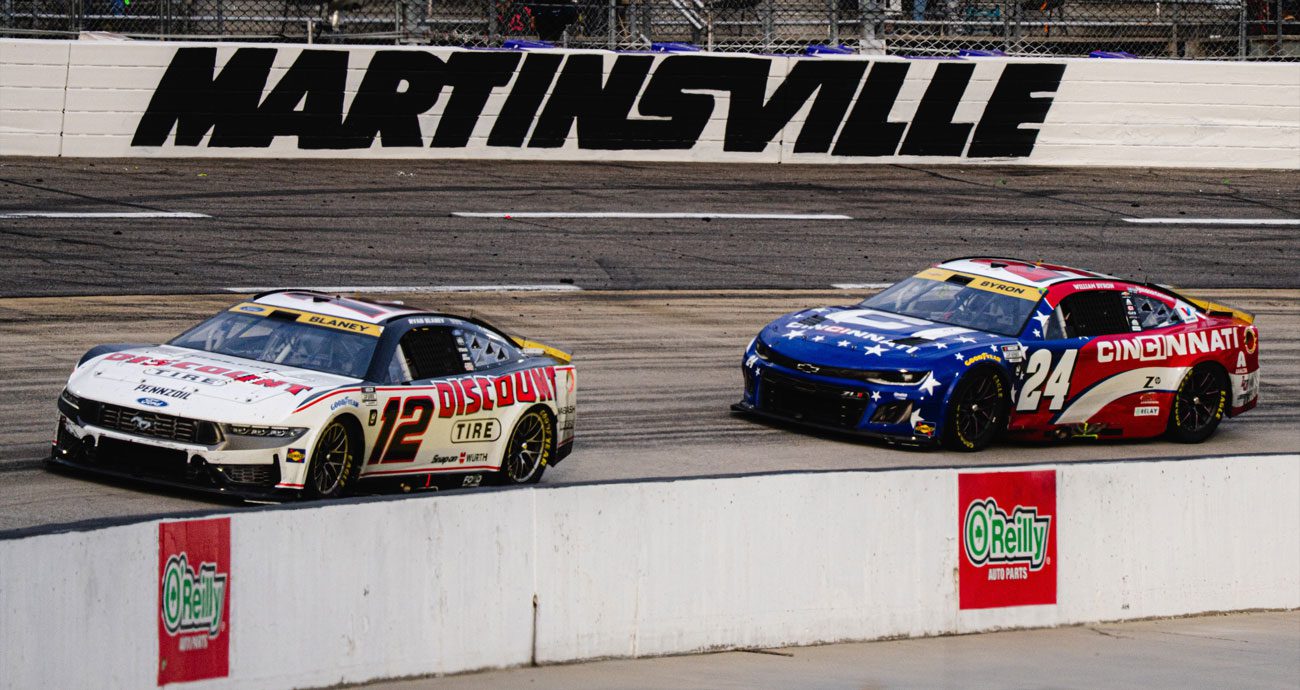
William Byron has a shockingly similar stat line to Blaney’s, down to the crummy first three starts — 20th, 39th (DNF, crash), 22nd — and only four finishes worse than eighth since. So it’s only fitting that last year’s penultimate race came down to a thrilling battle between Blaney’s No. 12 Team Penske Ford and Byron’s No. 24 Hendrick Motorsports Chevrolet, with Byron getting the upper hand and earning his third Martinsville victory.
Now boasting a total of three wins, six top fives and nine top 10s in 16 starts, Byron had strong results at the short oval before breaking through for his first win there in the spring of 2022 — including a runner-up performance in 2019. But it wasn’t until that victory that he found what he was looking for.
“We had been pretty good there, but not great. There was always that little bit missing,” Byron said. “And I feel like there was just the last little bit of getting through the corner that I needed to understand. And I feel like when I understood how to make that part of the corner work, I feel like everything started to flow and I had more pace and just could take care of the tires better. So I would say it takes a good car, but it takes that feel and what you’re looking for to put it all together.”
Unlike Blaney, though, Byron said he didn’t lean on his teammates to figure out what was missing. That had to be found behind the wheel.
“I feel like I just kind of figured that out myself,” Byron said. “I had some advice from different people. … I think it kind of took a few races, and then it took my own learning to figure it out.”
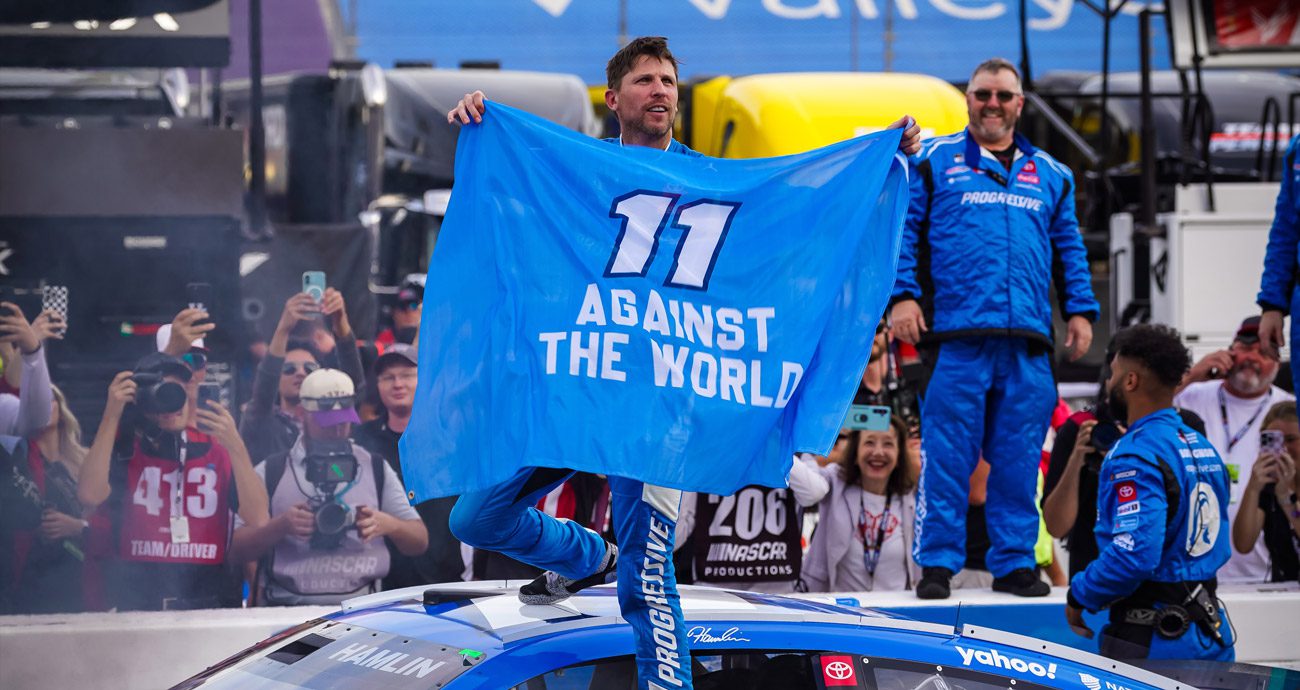
In contrast to his younger counterparts, Denny Hamlin never quite had that light-switch moment. Instead, his background competing on short tracks around the Southeast prepared him for one of the Cup Series’ most unique challenges by the time he arrived for his first start in October 2005.
“It really started in late models,” Hamlin told NASCAR.com. “I had gotten to participate in the big late model race there for quite a few years before I got to the Cup Series. So if anything, it was one of the more easier tracks for me to adapt to. Speeds weren’t all that much different. Like, every other Cup Series track that I went to for the first time, it was like a late learning experience. And there, it was like my let-off points are similar, how you get back on the throttle was similar, how you roll the corner was similar. So I was able to adapt to it pretty early, just because of the short-track experience.”
Hannah Gentlesk | NASCAR Digital Media
What’s more fascinating is the prolonged success all three have found. All three had already proven themselves as Martinsville contenders long before the Cup Series shifted from team-built stock cars through 2021 and introduced the Next Gen vehicle in 2022, a radically different ride than what they had grown up racing.
But the success kept pouring in. Blaney and Byron each earned all of their Martinsville wins in the Next Gen car, and Hamlin enters Sunday’s Cook Out 400 as the event’s defending winner, with top fives in five of his last seven Martinsville starts.
“It is different, and how you make speed at Martinsville has changed with shifting, tires and the car,” Hamlin said. “But the general premise of what you need is the same.”
The driver has never been busier at Martinsville, shifting four times per lap through upshifts and downshifts while trying to nail braking points lap after lap — 400 times in the spring, 500 times in the fall.
The greats, though, know how to handle those stressors nearly unconsciously.
“It’s a lot of stuff going on in there, for sure,” Blaney said. “But at those places like Bristol and Martinsville, the shorter places like that, you just get into this trance of doing it to where you’re not really thinking about it. But then you’re constantly having to adjust as the run goes on. So I feel like if you could just get into that rhythm zone quickly …
“And yeah, it’s pretty crazy that the old car drives completely different than this one with downshifts, brakes and roll speed, stuff like that. But the feel itself — like, this is how I feel like I have to roll through the corner (and) enter this certain way — that stuff kind of translates.”
This week’s race will present its own challenges. NASCAR arrives at Martinsville with 750 horsepower under the hood for the first time in the Next Gen era — an 80-horsepower increase from years past — with a simpler diffuser underneath, helping reduce the aerodynamic impact. There may be some unanswered questions, but Blaney, Byron and Hamlin surely know the feel they will need to earn another grandfather clock on Sunday.