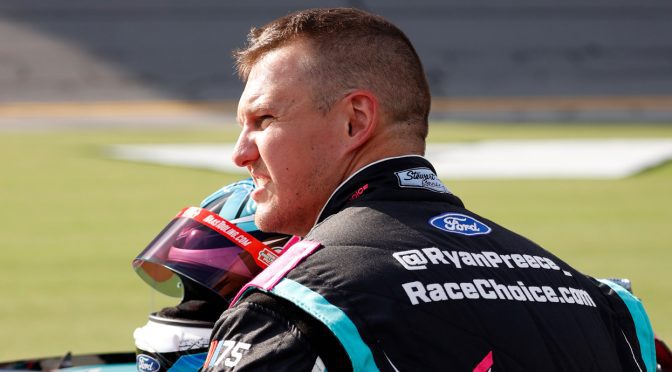
Ryan Preece was released from Halifax Medical Center on Sunday morning and on his way back to North Carolina, according to a press release from Stewart-Haas Racing. Preece went for a violent barrel roll in the closing laps of Saturday’s NASCAR Cup Series race at Daytona International Speedway.
Traveling down the backstretch at Lap 156, Preece’s No. 41 Stewart-Haas Racing Ford was contacted in the rear bumper by Erik Jones. Preece’s car veered left across the nose of teammate Chase Briscoe’s car. The right side of his vehicle lifted off the ground, resulting in a series of tumbles through the grass on the back straightaway.
After flipping at least 10 times, Preece emerged from his car under his own power and with assistance from the AMR Safety Team. The 32-year-old got on a stretcher and was transported to the infield care center.
Preece was later transported to a local medical facility for further evaluation.
In the early-morning hours of Sunday, Stewart-Haas Racing provided an update on Preece’s condition:
“NASCAR Cup Series driver Ryan Preece will remain overnight at Halifax Health Medical Center for continued observation,” the team said in a statement. “The driver of the No. 41 Ford Mustang for Stewart-Haas Racing is awake, alert and mobile and has been communicating with family and friends. Preece will undergo another evaluation by medical personnel later this morning. An update will be provided in the afternoon.”
Preece posted on social media Saturday night, noting, “if you want to be a race car driver, you better be tough.”
If you want to be a race car driver, you better be tough.
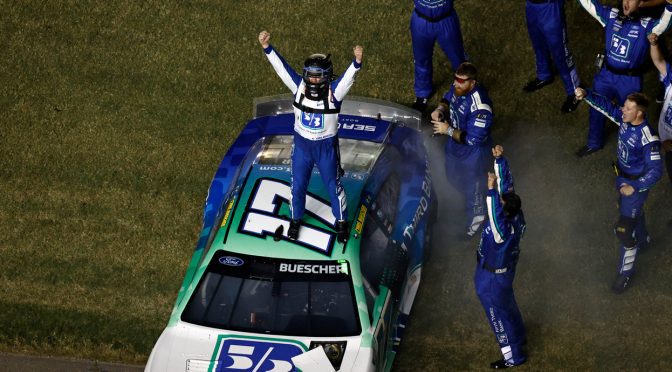
DAYTONA BEACH, Fla. — When owner-driver Brad Keselowski pushed RFK Racing teammate Chris Buescher to victory in NASCAR Overtime on Sunday night, it was ecstasy for Bubba Wallace and the epitome of frustration for Chase Elliott.
Buescher picked up his third victory of the season in the Coke Zero Sugar 400 at Daytona International Speedway, the regular-season finale for the NASCAR Cup Series, but not until Ryan Preece’s barrel-roll wreck on the backstretch forced three extra laps.
With Buescher’s repeat win, Wallace clinched the 16th and final spot in the NASCAR Playoffs on points. Hemmed in by an armada of Fords after the overtime restart on Lap 162, Elliott — whose only path to the playoffs was victory on Sunday — couldn’t move forward.
Kevin Harvick blocked Elliott in the bottom lane, and Aric Almirola and Joey Logano on the outside prevented Elliott from making a move to the top. Elliott came home fourth behind Buescher, Keselowski and Almirola, but NASCAR’s most popular driver and 2020 series champion will miss the playoffs for the first time in his Cup career.
Buescher restarted second, and Keselowski third on Lap 162. Keselowski quickly locked onto Buescher’s bumper and pushed him to the lead. A lap later, Buescher secured his fifth career victory and first at Daytona by 0.098 seconds over his teammate.
“That’s as much Brad’s win as ours right there,” Buescher said. “That was the right help, aggressive, sticking with us. I was waiting for him to do something there coming to the finish. I figured we’d be side by side. Looked like it stalled out a little behind there.
“Just so thankful for Brad for all those pushes at the right time. Found each other here and there throughout the race, lost each other, and got back on it when it counted.”
The 1-2 finish was the first for RFK Racing since Carl Edwards and Ricky Stenhouse Jr. claimed the top two spots for owner Jack Roush at Bristol in 2014.
Wallace claimed his playoff spot with a 12th-place finish because — thankfully, from his point of view — no winless driver below him in the standings was able to knock him out of the top 16 by winning.
“That was the most stressed, but also the most locked in I’ve ever been,” said Wallace, who entered the race with a 32-point edge over Ty Gibbs for the final playoff berth. “Knowing that this place is mostly out of your control, I just tried to focus on doing the things that I could do. Missing that wreck (a pileup in Turn 4 on Lap 95) was massive.
“Proud to be locked into the playoffs. 23XI Racing, third year in, getting both cars in the playoffs. We’ve gone through a lot of trials and tribulations. So proud of the effort we put in.”
Elliott, who missed seven races during the regular season — six with injury and one on suspension — took his failure to make the postseason with grace.
“Yeah, I really liked where we were before the caution (for Preece’s accident),” he said. “Honestly, after the restart there, we had the bottom lane that we wanted. I knew the 6 (Keselowski) was going to go with the 17 (Buescher). I thought the 4 (Harvick) was going to take the bottom, and they did. We really had all the help we could ask for behind.
“I couldn’t stay locked onto Kevin like I needed to to surge the bottom lane forward. Brad and Chris were there. Just had a good enough hold on that top lane, and they could kind of control each of them. Yeah, it’s a bummer, for sure. Hate the season has worked out like it has. The good news is the car got in in the owners’ points. That’s a big deal.”
The wreck that forced the overtime was breathtaking in its magnitude. As the pack of cars cleared Turn 2 on Lap 156, Preece’s Ford turned sideways on the backstretch and slammed into Stewart-Haas Racing teammate and pole winner Chase Briscoe’s Mustang in the bottom lane.
The contact launched Preece’s car high into the air, and it barrel-rolled more than a half-dozen times before it landed on its roof and bounced upright. Preece got out of his car and stood talking to medical personnel before being placed on a stretcher and taken to a local medical facility for further evaluation.
If Preece’s accident was a lasting image from the race, so was the action that preceded it.
Despite rapid-fire exchanges of the lead throughout the second stage, the race ran caution-free except for the Stage 1 break — until the final corner of the final lap of Stage 2.
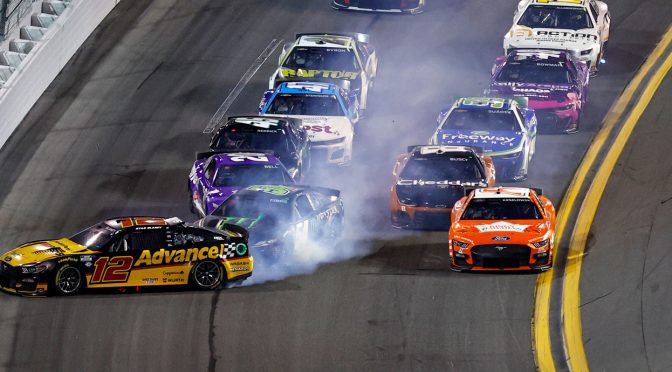
That’s when the No. 54 Toyota of Ty Gibbs, fighting for the stage win, broke loose after a bump from Joe Gibbs Racing teammate Christopher Bell as the cars raced through Turn 4, turned down into the No. 12 Ford of Ryan Blaney and ignited a wreck that involved 16 of the 39 cars that started the race.
Blaney and Gibbs shot side-by-side into the outside wall, and the cars behind them were helpless to avoid the melee. Gibbs’ Camry was eliminated, ruining any outside chance he had of overtaking Bubba Wallace for a playoff spot.
Gibbs took the disappointment philosophically.
“I felt like I was getting a great push,” Gibbs said. “I feel like all of our teammates were working really well together tonight. I may have got a push in a bad spot, but we were going for the stage win. I want to thank Christopher for all of the pushes he gave me — I really do.”
Other casualties of the wreck included AJ Allmendinger, defending race winner Austin Dillon, Austin Cindric and Harrison Burton, all of whom were trying to force their way into the playoffs with a victory.
Elliott, on the other hand, was masterful in weaving his way through the chaos unscathed, finishing the stage seventh behind winner Keselowski. Elliott, however, couldn’t parlay that adroit driving into the victory he needed.
Joey Logano finished fifth, followed by Alex Bowman, Kyle Busch, William Byron, Harvick and Corey LaJoie.
Note: Post-race technical inspection concluded without issues, confirming Buescher as the race winner. The Nos. 10 (chassis evaluation) and 41 (safety evaluation) will be taken back to the NASCAR R&D Center in Concord, North Carolina, for further inspection.
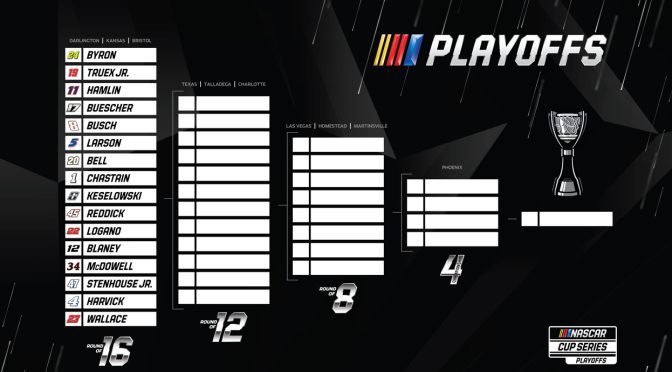
The 2023 NASCAR Cup Series Playoffs field was set Saturday at Daytona International Speedway in the regular-season finale.
Fifteen of 16 spots had been clinched in advance of the Coke Zero Sugar 400, meaning one spot was available. Bubba Wallace earned the final spot based on points when repeat winner Chris Buescher of Roush Fenway Keselowski Racing took the checkered flag.
Wallace of 23XI Racing entered the regular-season finale 32 points ahead of Joe Gibbs Racing’s Ty Gibbs for the final playoff spot.
Below is the official list of drivers for the Round of 16 with seeding and points.
NASCAR CUP SERIES PLAYOFFS FIELD
Rank
Driver
Team
Points
1
William Byron
Hendrick Motorsports
2,036
2
Martin Truex Jr.
Joe Gibbs Racing
2,036
3
Denny Hamlin
Joe Gibbs Racing
2,025
4
Chris Buescher
RFK Racing
2,021
5
Kyle Busch
Richard Childress Racing
2,019
6
Kyle Larson
Hendrick Motorsports
2,017
7
Christopher Bell
Joe Gibbs Racing
2,014
8
Ross Chastain
Trackhouse Racing
2,011
9
Brad Keselowski
RFK Racing
2,010
10
Tyler Reddick
23XI Racing
2,009
11
Joey Logano
Team Penske
2,008
12
Ryan Blaney
Team Penske
2,008
13
Michael McDowell
Front Row Motorsports
2,007
14
Ricky Stenhouse Jr.
JTG Daugherty Racing
2,005
15
Kevin Harvick
Stewart-Haas Racing
2,004
16
Bubba Wallace
23XI Racing
2,000
NEXT UP: The NASCAR Cup Series Playoffs begin next Sunday, Sept. 3, at Darlington Raceway with the Cook Out Southern 500 (6 p.m. ET, USA, MRN, SiriusXM NASCAR Radio, NBC Sports App).
Multiple drivers were eliminated from contention in a multi-car crash exiting Turn 4 coming to the end of Stage 2 during Saturday night’s NASCAR Cup Series race at Daytona International Speedway.
The ‘Big One’ sparked at the front of the field as Ty Gibbs lost control of his No. 54 Toyota in the outside lane at Lap 95 of the Coke Zero Sugar 400 (NBC, MRN, SiriusXM NASCAR Radio, Peacock, NBC Sports App). His car darted left and struck leader Ryan Blaney in the right-rear quarter panel, sending the No. 12 Team Penske Ford head-on into the outside SAFER barrier. Behind them, several cars spun and crashed into the wall.
“I’m alright,” Blaney said. “I don’t know. I guess it kind of seems like the 54 got turned into me. The 20 shoved him and it was kind of just a weird spot I guess and I got right-reared, so not in a fun spot.”
According to NBC Sports, at least 16 cars were collected in the pile-up, including Christopher Bell, Tyler Reddick, Austin Dillon, Ricky Stenhouse Jr., Ross Chastain, Denny Hamlin, Harrison Burton, Riley Herbst, AJ Allmendinger, Brennan Poole, Austin Cindric and others.
“Yeah, I am (OK),” Gibbs said. “I felt like I was getting a great push. I feel like all of our teammates were working really well together tonight. I may have got a push in a bad spot, but we were going for the stage win. I want to thank Christopher (Bell) for all of the pushes he gave me, I really do.”
Brad Keselowski held on to win the stage in NASCAR’s regular-season finale, while teammate Chris Buescher later claimed the victory. Keselowski finished runner-up.
Bubba Wallace claimed the final spot in the NASCAR Playoffs, finishing 12th after avoiding the melee. The postseason berth is the first of Wallace’s career.
DAYTONA BEACH, Fla. — Martin Truex Jr. clinched the Regular Season Championship in the NASCAR Cup Series during Saturday’s race at Daytona International Speedway.
The title is Truex’s second since NASCAR began recognizing the leading points scorer at regular season’s end in 2017, when the New Jersey native claimed the inaugural championship. That momentum carried Truex to his first NASCAR Cup Series Championship through a masterful postseason in which he won four of the final 10 races, including the title race.
“It’s really awesome to get these bonus points,” Truex said. “I’m just really proud of my team and everybody at JGR (Joe Gibbs Racing), TRD, Bass Pro, Auto Owners, Resers — all of our partners for giving us the opportunity to be here and to be able to have the season that we had. Hopefully, we can keep it going.”
Truex, driver of the No. 19 Joe Gibbs Racing Toyota, is a three-time winner in 2023, collecting checkered flags at Dover Motor Speedway, Sonoma Raceway and New Hampshire Motor Speedway. The year is a significant turnaround from 2022, when Truex went winless and missed the playoffs for the first time since 2014.
As the Regular Season Champion, Truex receives a bonus of 15 playoff points that will carry through each round of the NASCAR Playoffs to which he advances.
Kurt Busch’s rapid climb from stocking shelves at his local grocery store to becoming a NASCAR Cup Series-winning driver was a story most would assume came from a movie, but in a span of just four years, the Las Vegas native did just that. Memories of that career came flooding back as Busch announced his retirement from Cup Series racing on Saturday.
Busch’s raw talent took him from winning the Southwest Tour championship as a 21-year-old in 1999 to beating out a handful of other candidates to drive the No. 99 Exide Truck for Jack Roush in 2000. It didn’t take long to realize Busch was a legitimate title candidate with three top-four finishes over the season’s first four races. Busch’s second-place finish in the Truck Series points standings, behind teammate Greg Biffle, launched him into a full-time ride in the No. 97 Cup car starting with the 2001 season.
His rookie campaign didn’t go as planned, but Busch exploded onto the scene in 2002, winning the first four races of his career and finishing third in points. He won another four races in 2003, and the team looked forward to 2004 with eyes set on its first series championship.
The Chase for the Cup, a 10-race playoff system that NASCAR rolled out starting with the 2004 season, was set up well for Busch. Despite driving just two full-time seasons, he had already found success at the 10 tracks on the new playoff schedule.
Busch had kicked off the 2004 campaign with a handful of solid finishes over the first seven races, including a victory at Bristol Motor Speedway. What followed was an unfortunate stretch of growing pains. Between the races at Talladega Superspeedway in April and Chicagoland Speedway in July, Busch finished 31st or worse four times over 10 starts while only notching two top-10 finishes.
Busch led 110 laps at Loudon the following week en route to his second win of the season as the team looked to push through the struggles. As the postseason approached, he capped off the regular season with five top 10s over the final six races, yet still enter the playoffs as an underdog due to the strong crop of drivers vying for the title.
Four-time champion Jeff Gordon entered as the points leader, while his teammate and 2003 runner-up Jimmie Johnson was five points back in second. The two previous drivers to win the championship, Tony Stewart and Matt Kenseth, were not far behind, as each position was separated by five points after the regular-season reset. Busch entered the postseason seventh in the standings, 30 points back of Gordon, right in front of his teammate Mark Martin.
Busch dominated the playoff opener at New Hampshire, leading 155 laps en route to the win. Seven of the 10 playoff drivers had finishes of 13th or better, and Busch left the track tied for the points lead with Dale Earnhardt Jr.
The playoff race at Talladega is where Busch proved he was a legitimate title contender. Busch finished fifth but was the second-best playoff driver that day. He left the track second in points, 13 back of the race-winner Earnhardt Jr., but a penalty to Earnhardt Jr. flipped the grid and instead put Busch up 12 points with seven races remaining on the schedule.
Busch later led a race-high 120 laps at Martinsville Speedway, but Johnson won the race and now had two consecutive victories. Two weeks later, Johnson grabbed his fourth win of the playoffs.
If it shows how strong of a season Busch was having that despite how well Johnson was driving, Busch was still faster. He arrived at Homestead for the season finale with the points lead. Johnson, Gordon, Earnhardt Jr. and Martin were all mathematically eligible for the title.
Busch would need everything to go right for him to leave that weekend with the championship trophy, and the weekend kicked off with him putting the No. 97 Ford on the pole as many of his fellow contenders struggled.
Once the green flag waved, Busch led the first four laps before settling back in the field. It all seemed to come apart on Lap 93 as Busch lost a right-front wheel, somehow keeping his car straight as he attempted to bring it down pit road for service. Thanks to incredible work from his Roush Racing crew, Busch returned to the track on the lead lap, albeit in 28th position.
Trouble didn’t just strike the No. 97 team, though. Shortly afterward, Earnhardt Jr. found trouble after contacting the No. 06 of Travis Kvapil. With just under 40 laps to go, Martin’s chance disappeared after needing to pit for a flat tire under caution.
It all came down to a restart with 10 laps to go, with Gordon, Johnson and Busch all restarting inside the top 10. Busch held a narrow eight-point advantage over Gordon, with Johnson sitting just two points behind his teammate Gordon. Everything seemingly pointed toward Busch wrapping up his first title. If they could just find the checkered flag.
As if the race couldn’t find any more dramatic moments, race leader Ryan Newman blew a tire, bringing out the caution with just three laps remaining, invoking a green-white-checkered finish. At this current moment, Busch held a 16-point advantage over Gordon in the standings.
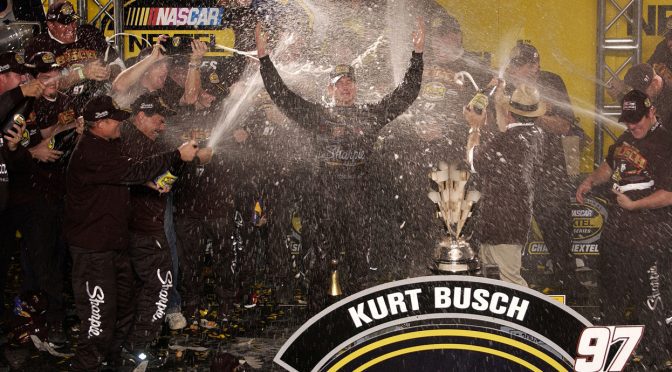
The green flag waved, and despite Johnson and Gordon moving up to second and third, respectively, Busch held on to capture the title. He’s one of just 35 drivers to win a Cup Series championship.
Busch’s talent on the track was a giant piece to that puzzle. He turned midseason growing pains into an incredible 2004 playoff stretch, one where he beat some of the greatest drivers of all time while they were at their best. That season saw 15 of the top 18 in points named as one of the 75 Greatest Drivers in 2023. Out of all those drivers, it was Busch who came out on top, hoisting the elusive Cup Series title.
It didn’t matter the car number, owner, sponsor or manufacturer, Busch always managed to find Victory Lane throughout his career. He hangs up his helmet tied for 25th all-time in Cup Series victories, winning at least one race in 19 different seasons. The driver has visited Victory Lane at 18 different tracks. From the Daytona 500, to the twists and turns at Sonoma Raceway, to the paperclip at Martinsville, no matter the track, he was always a contender.
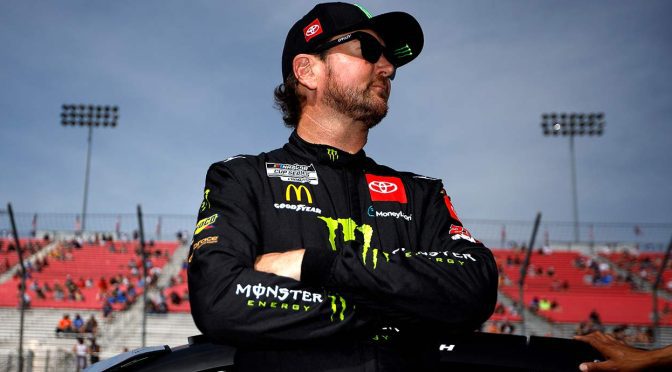
DAYTONA BEACH, Fla. — Kurt Busch, who became the first champion of the NASCAR Cup Series’ playoff era, announced Saturday that he will retire from Cup Series competition, ending a driving career that spanned two decades-plus.
Busch has not returned to racing since suffering a concussion in a crash on July 23, 2022, at Pocono Raceway. He had announced last fall during an emotional press conference at his hometown track of Las Vegas Motor Speedway that he would step away from a full-time driving career in 2023.
Saturday, he said another version of farewell at Daytona International Speedway, in a packed media center attended by NASCAR executives and officials, plus fellow drivers, including his brother, Kyle.
“As I transition out of the driver’s seat, I can’t help but feel incredibly blessed to have spent the amount of time I did as a driver in NASCAR, and I could never have imagined that growing up as a blue-collar kid from Las Vegas,” Busch said. “So many people have been part of my journey. I want to thank the fans, my family, friends, sponsors and team members. Thanks to everyone who has taught me the different things around the motorsports world, and also for those who have had to put up with me. And I want to just thank again, everyone that continues to push me to strive for success in this sport. It’s time for a new journey, and I’m excited to get started.”
The 45-year-old driver has remained with his 23XI Racing team after the accident in a consulting role and as a mentor for current teammates Bubba Wallace and Tyler Reddick, a role he said would continue in the years after his full-time driving days. He has also stayed on as a brand ambassador for Monster Energy, a personal and team sponsor.
In May, Busch was named to the list of NASCAR’s 75 Greatest Drivers in recognition of the sport’s diamond-anniversary season, joining his younger brother, Kyle, as a recipient of the honor. He was further recognized in pre-race ceremonies at Darlington Raceway later that month, and he told reporters that his health was improving and he was still hopeful of being medically cleared to return.
Saturday at Daytona, Busch noted that he was not at 100% of his ability to compete but remained upbeat that he might one day race in some form of motorsport.
“Again, it’s not one moment that’s led to this,” Busch said. “It’s a few different factors, and my body is having a battle with Father Time. I’ve had arthritis ever since I can remember. My gout has flared up so much that I can barely walk on some days. Just pushing to get through physical therapy and to continue the workouts. I remember last summer, I was trying to not show that emotion, and I barely could even walk to the car at Dover because I had to have some shots pre-race just so that I could move my knee and move my feet. Those are those moments where things were starting to add up before things happened at Pocono.
“So, Father Time. I’m 45 years old. I’m very happy, complacent, and there’s nothing that I look back on and regret about having this opportunity at the top level of NASCAR.”
Alejandro Alvarez | NASCAR Studios
Busch’s Hall of Fame-caliber career was marked by dramatic highs and fiery lows, but his driving talent and tendency toward winning were constants. He collected 34 Cup Series victories, a figure that ties current points leader Martin Truex Jr. for 25th on the circuit’s all-time win list.
Among Busch’s wins tally were crown-jewel triumphs that included the Daytona 500 in 2017 and the Coca-Cola 600 and All-Star Race on consecutive weekends seven years earlier. He was also a six-time winner at Bristol Motor Speedway, which was the site of his first Cup Series victory in 2002.
Kurt Busch rose to national prominence after learning his craft racing go-karts and then competing in Dwarf and Legends Cars at the Las Vegas Motor Speedway Bullring. He won the championship in NASCAR’s former Southwest Tour in 1999 and was hired by Hall of Fame team owner Jack Roush for a Craftsman Truck Series ride the following year.
After finishing second in the standings in his lone season in trucks, Busch quickly jumped into the Cup Series as a rookie in 2001. He became a premier-series winner the next year, starting a streak of 10 seasons with at least one victory.
Foremost among those winning campaigns was his title march in 2004, the first year for a new playoff system to determine the Cup Series champion. The inaugural format featured 10 title-eligible drivers in the final 10 races, with the crown awarded to the driver with the most cumulative points. Busch won the opening playoff race at New Hampshire Motor Speedway and headed the points standings nearly the rest of the way. He recovered from a detached wheel in the Homestead-Miami Speedway finale to best Jimmie Johnson by eight points and teammate Jeff Gordon by 16.
“We beat the best of the best over 10 races,” Busch told reporters, “and to have my name along the best names in history, it means so much to me.”
Busch’s winning ways early in his career came with a brash style that rattled fellow drivers, NASCAR officials, the media and his team owners. Multiple altercations led to penalties, probations and severed ties with the team owners who employed him, Roush and Roger Penske. He was also suspended for the first three races of 2015 after a legal ruling on a criminal complaint alleging domestic abuse was filed after his split with former girlfriend Patricia Driscoll.
After two winless seasons (2012-13) with underfunded teams, Busch landed with Stewart-Haas Racing when that organization expanded. He won in each of his five seasons there, and he continued that streak with Chip Ganassi Racing with one victory each year from 2019 to 2021.
Busch’s move to 23XI Racing came as the organization co-owned by Denny Hamlin and NBA legend Michael Jordan grew to a two-car operation last season. He was tapped as the driver of the No. 45 Toyota, and he scored a dominant win in their 13th race together, driving a Jordan Brand-sponsored car to Victory Lane at Kansas Speedway.
“It started when we decided to expand, and for me, it was a year earlier than I thought we would,” said 23XI Racing president Steve Lauletta, “but when somebody like Kurt Busch becomes available, you jump at the chance.”
Eight races after his Kansas win, Busch lost control of his No. 45 Camry during a qualifying attempt at the 2.5-mile Pocono track, and the car made heavy rear-end contact with the third turn’s outside retaining wall. After a medical evaluation in the infield care center, Busch was not cleared to race the next day. Ty Gibbs, then an Xfinity Series regular, filled in for 23XI at Pocono and eventually for the remainder of the season.
Before the postseason began last year, Busch withdrew his request for a waiver that would have kept him playoff-eligible had he been cleared to return. At Las Vegas last October, he announced that he would end his tenure in the Cup Series as a full-time driver, adding that with clearance he had hoped to participate in “a few select races” this season.
“I know I am not 100% in my ability to go out and race at the top level in the NASCAR Cup Series,” Busch said then. “These are the best of the best drivers, and lately, I haven’t felt my best. My long-term health is priority No. 1, and I don’t feel committing at this point to compete for a championship next year is in my best interest or the best interest of the team.”
Reddick took his place in the No. 45 Toyota this season. Busch provided an update before the 2023 season at Daytona in February, saying that he still struggled with balance and eye movement and that physical therapy regularly drained him both from a physical and emotional standpoint.
Busch’s influence remained strong with 23XI, and he was a fixture at the track and the shop. He said Saturday that he would stay with the team “as long as they’ll allow me,” and Lauletta drew parallels with the role that former IndyCar driver Dario Franchitti held during his time at Chip Ganassi Racing.
“I watched what he started doing and talked to Kurt about, ‘Could we do the same thing with you?’ and he was all for it,” Lauletta said. “And so now, since that time, he continues to come to the race shop a lot, he works with drivers on his own, has his direct text exchanges with them, works with the crew chiefs, and then works with our partners. So he’s just a great teammate and brings a lot to what we’re trying to build, which is a championship-caliber organization.”
David Wilson, Toyota Racing Development (TRD) USA president, noted that Busch held the now-rare distinction of winning with four manufacturers — Ford, Dodge, Chevrolet and finally Toyota. He also noted the contributions he made to the many teams he drove for during his career.
“You talk to any one of those organizations, and they’ll all say the same thing: He made us better,” Wilson said. “So again, I love the fact that Kurt is not going anywhere, he’s still going to be around. We’re still going to have a relationship with him as an OEM. He’s going to continue to be an ambassador for Toyota, and so we’re not saying goodbye officially. We’re going to support him through this next chapter.”
Busch said before this season that he still held out hope that he would return to the cockpit to race again one day but added that he had accepted his potential fate if his career was indeed at an end. Saturday, he was able to reflect on his long career at NASCAR’s top level and offer his appreciation.
“There’s plenty of stories and fun and wins and losses,” Busch said. “But thank you to NASCAR for giving me a fair shake at this. There’s a bunch of cool trophies at the house, lots of memories, and I hope to give back in all the ways that I can moving forward.”