DAYTONA BEACH, Fla. – NASCAR’s 75th Anniversary season marks its first on-track competition this weekend with Sunday’s primetime Busch Light Clash at the Coliseum in high-wattage Los Angeles. The annual season-opening Daytona 500 is two weeks later – on Feb. 19 – at the most iconic track on the schedule, Daytona International Speedway.

The two venues are a perfect representation of modern-day NASCAR – the bold move into a famed facility like the Los Angeles Memorial Coliseum that introduces tens of thousands of new fans to the sport in a thrilling, high-energy two days of racing. The other in Daytona Beach is the most famous speedway in the sport hosting an absolute bucket-list weeklong event that has long featured the sport’s legends and provided legendary moments.

The 2023 edition of an ever-evolving NASCAR Cup Series schedule will also mark the debut of a summer street race in downtown Chicago and a return to one of the most iconic and popular venues from its past, North Wilkesboro Speedway for the annual All-Star Race. There is a road course event at Circuit of The Americas in Austin, Texas, where Formula One will race later in the year. And there is the traditional Labor Day event in the heart of stock car country at Darlington Raceway – both fan favorites.

For sure NASCAR in 2023 doesn’t look exactly like NASCAR in 1983, but that’s the point of well-considered progress. And the resounding success thereof.

RELATED: Best active drivers at every age | See the NASCAR 75 logo

“I take a lot of pleasure in celebrating that time frame whether its 50 years or 75 years, as quick as time goes by now,” longtime NASCAR executive Mike Helton said. “It seems like it wasn’t but a couple days ago we were celebrating the 50th anniversary but when you study the history of our sport you see all the evolutions that went into the first 50 years and then the last 25 years, the things we’ve done and gotten done.

“It’s kind of indicative of that going into 2023 – our 75th anniversary – with the uniqueness of the LA Coliseum for the Clash and then the Chicago Grant Park race because it all signals, yeah, we’ve been doing this for 75 years, but one of the ways we figured out how to do it for 75 years was to stay fresh and current.”

Certainly, the flexibility of the schedule in recent years and the openness to bringing NASCAR to the fan, wherever the fan may be is indicative of the sport’s ever-evolving mindset.

The question isn’t ‘why?’ but ‘why not?’ as the sanctioning body embraces trying bold new initiatives from race locales and Playoff formats; from social media and track entertainment that didn’t even exist during the sport’s grand 50th-anniversary celebration.

“I think it starts with the fan,” NASCAR President Steve Phelps said. “Our fans have told us again and again – and again – they want schedule variation. So, whether we’re going to North Wilkesboro for the All-Star race, or to the Chicago street course – in our 75 years we’ve never raced on the street ever – so you’re talking about milestones.

“The Coliseum is 100 years old and for us to go somewhere we’ve never been before and build a racetrack, race on it and then dig it up and put grass back down, that’s big.

“I just think it really comes back to ‘what is going to entertain our fans?’ And we want to put on great racing that will be unique and different and creates visibility for our sport. Last year, 70 percent of the fans that went to the race at the Coliseum had never been to a NASCAR race. … The Chicago street race will probably have a similar number of people having never been to a NASCAR race. And it’s exciting and it’s going to be fun.”

STAY ACTIVE: Fan Rewards launches | Get ahead with tips for Fantasy Live

The willingness to think outside the box and to be open-minded is exactly the kind of approach that has sustained NASCAR through so many challenges from the fuel shortage in the 1970s to the COVID-19 epidemic more recently. And the positive results have given the sport and its leadership reason to feel confident going forward with new ideas and approaches.

“In the early days, NASCAR’s game plan was to try and be as consistent as we could for fans to be able to plan and companies involved in the sport to be able to plan because it took that long to do those plans,” Helton said. “Now in the modern world, people make quick decisions and make changes quicker. So, we can move stuff around and have fun and add pizzazz and the industry and the fans aren’t left out.

“They are actually driving us to do things quicker.”

The mix of tradition and innovation is a delicate balance that NASCAR executives take seriously. The cars, the rules, the venues and the speedways are all vital components of that progress.

Yet, above all, is the commitment to stay true to the most fundamental element of the sport: close, safe, thrilling big-time racing in front of packed grandstands – the fans eager and entertained.

And it’s worked for 75 years.

LEARN MORE: Streamline Hotel meeting attendees

“I think anyone who is involved in this sport at all, whether you work at NASCAR, or you work at a race team or for a racetrack, or our fans, it’s just a moment in time for us to take a step back and really celebrate and honor the past which is what we’re going to do,” Phelps said.

“And I think the unique thing is we also need to celebrate what’s happening today in this sport and then a look forward. That’s what we’re going to do. We’re talking about this our “75th” and we have a tagline, “always forward.” That’s going to represent what we’re going to do.

“For anyone, it’s about being a fan. For me personally, I’m just excited about what the opportunity is for us to celebrate 75 years of NASCAR.”

HUNTERSVILLE, N.C. — Interstate Batteries, one of the most tenured team sponsors in NASCAR history, begins its 32nd season as the founding sponsor of Joe Gibbs Racing (JGR) with an expanded presence that will feature the brand’s iconic green livery across all four of JGR’s NASCAR Cup Series entries.

The introduction of Team Interstate more than doubles the Dallas-based company’s visibility with JGR, as Interstate Batteries will have 13 primary sponsorships in the NASCAR Cup Series in 2023, up from the six primaries it has typically had each year since 2008.

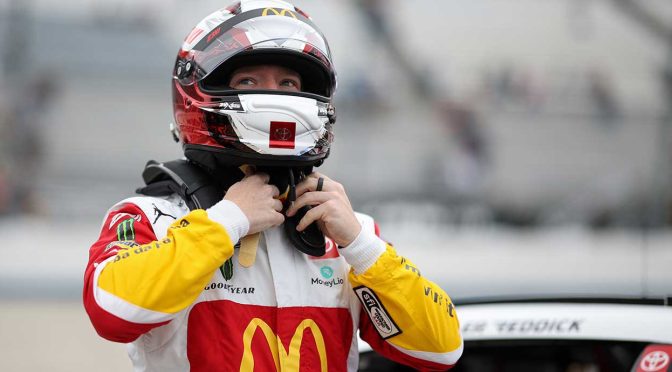
Christopher Bell, driver of the No. 20 Toyota Camry for JGR, kicks off the Team Interstate effort in the Busch Light Clash at the Coliseum Sunday at the Los Angeles Memorial Coliseum (8 p.m. ET, FOX, MRN, SiriusXM). It marks the first time in Bell’s seven-year history with JGR, which dates back to his NASCAR Xfinity Series debut in 2017, that Bell will carry the green-and-white colors of Interstate Batteries, joining such marquee names as Dale Jarrett, Bobby Labonte and Kyle Busch.

RELATED: Buy tickets for the Clash | All of JGR’s wins by driver

Then, for the first time since 2007, Interstate Batteries returns as a co-primary sponsor in the Daytona 500 on Feb. 19 when it adorns the sides of Ty Gibbs’ No. 54 Toyota Camry in the Great American Race. The Daytona 500 will always hold a special place in the respective histories of Interstate Batteries and JGR, as they won their first race together 30 years ago in the 1993 Daytona 500 with Jarrett.

Bell and Ty Gibbs will run the majority of Interstate Batteries’ races, but veteran racers Denny Hamlin and Martin Truex Jr., will each carry a primary Interstate Batteries sponsorship. Hamlin, a winner of 48 NASCAR Cup Series races, will drive the No. 11 Interstate Batteries Toyota Camry March 26 at Circuit of The Americas in Austin, Texas. Truex, the 2017 NASCAR Cup Series champion, will pilot the No. 19 Interstate Batteries Toyota Camry July 23 at Pocono Raceway.

“One of the great strengths of our partnership with Joe Gibbs Racing over the last 31 years is the way the sponsorship with them has evolved and changed as our needs as a company and brand have evolved. The expansion of Team Interstate on all four JGR cars during 2023 is the next step in the evolution of our sponsorship,” said Norm Miller, chairman, Interstate Batteries.

“Working together, we always find new ways to use the JGR and NASCAR assets to set up new accounts and sell more batteries. We believe in our partnership and the sport of NASCAR, so when we saw the opportunity to double the amount of races as a primary sponsor — and be a part of such crown-jewel races as the Daytona 500 and the Coca-Cola 600 again — we knew it made a lot of sense. Since we’ve been with Joe Gibbs and JGR from the beginning, we really feel like all four teams are part of our family, so it’s very exciting for the stars to align and be a primary sponsor with all the JGR teams for the first time ever.”

After racing at the LA Coliseum, Bell returns to Interstate Batteries colors for the NASCAR All-Star Race May 21 at North Wilkesboro Speedway. The four-time Cup Series race winner keeps his Interstate Batteries livery for a second straight week when he competes in the Coca-Cola 600 May 28 at Charlotte Motor Speedway. Bell’s final two Interstate Batteries races are Sept. 24 at Texas Motor Speedway in Fort Worth and Oct. 29 at Martinsville Speedway.

Ty Gibbs continues his slate of Interstate Batteries races with the Food City Dirt Race April 9 at Bristol Motor Speedway, June 25 at Nashville Superspeedway, July 2 in the inaugural Chicago Street Race, Sept. 24 at Texas and Oct. 8 at the Charlotte Motor Speedway Roval.

“Our motto at Interstate Batteries is ‘Outrageously Dependable,’ and this expanded partnership with Joe Gibbs Racing drives home that point. We’re incredibly proud of our association with JGR. It’s a program that for more than three decades has resonated with our dealers, distributors and customers,” said Lain Hancock, Chief Operating Officer, Interstate Batteries.

“It’s a winning combination galvanized by the personalities we’ve been associated with at JGR, and it begins with Joe Gibbs. His vision and his ability to put the right people in the right places have made his team and our program a massive success. Expanding our presence with JGR allows us to reap the benefits of the organization’s entire effort, and we’re blessed to have such a talented group of racers represent Interstate Batteries.”

Interstate Batteries helped launch JGR in 1992. In the 31 years that have followed, JGR has scored 200 Cup Series victories — a number that includes four Daytona 500s — and five Cup Series championships. All of JGR’s firsts — win (Jarrett, 1992 Daytona 500, pole (Bobby Labonte, April 21, 1995 at Martinsville) and championship (Labonte, 2000 Cup Series title) have come with Interstate Batteries as the primary sponsor. When all of JGR’s successes are added up across each of the NASCAR series in which it competes, its race victories total more than doubles to 413 (200 in the Cup Series, 193 in the Xfinity Series and 20 in the ARCA Menards Series) with 12 total championships (five in Cup, six in Xfinity and one in ARCA).

“We’re extremely proud of our partnership with our founding sponsor, Interstate Batteries,” said Joe Gibbs, owner of Joe Gibbs Racing. “They have been such an important part of our team for over three decades now, and it’s exciting to have them on board all four of our cars this season. The best part of our partnership is the relationships we’ve built with everyone there over the years. It all started, of course, with Norm and Tommy Miller, and now includes Lain (Hancock) and his entire team. It’s going to be a great season.”

Gibbs, along with three of the drivers who have raced for JGR since its inception in 1992, have been inducted into the NASCAR Hall of Fame. Jarrett was ushered into the Hall in 2014 while Gibbs, Labonte and Tony Stewart were enshrined together as part of the Class of 2020.

Short-track racing is alive and well in the Arizona desert.

This thanks in part to the existence and excellence of Tucson Speedway, a 0.375-mile paved oval located on the Pima County Fairgrounds about 20 miles southeast of downtown Tucson.

RELATED: Watch the Chilly Willy live on FloRacing

Built in 1968 and having been through multiple renovations over the years, Tucson Speedway became a NASCAR Home Track in 2014. Part of the NASCAR Advance Auto Parts Weekly Series, the venue hosts Super Late Models, Limited Late Models, Pro-Stocks, Modifieds, Hobby Stocks, Mini Stocks, Super Trucks, Hornets, Bandoleros and INEX Legends, almost always featured on Saturday nights.

Tucson Speedway’s flagship event is the Chilly Willy, a Super Late Model race held every January or February to kick off a long season of racing.

Below is everything to know about Tucson Speedway.

Tucson Speedway

Track Profile

Tucson Speedway

Track Tucson Speedway
Location Tucson, Arizona
Opened 1968
Length 0.375 miles
Banking 3-9 degrees (variable banking)
Surface Asphalt

When Tucson Speedway was built in 1968 as Raven Speedway, it was constructed as a clay oval. That changed in 1992, a couple years after Brian France took over operations. France led the charge to convert the track to a paved oval.

The venue then went through a series of ownership changes in the early 2000s. Deery Sports West, Inc. purchased the track from France’s group before selling it to Dan and Joyce Ruth in 2005. The Ruths sold it to Mark Ebert. All ownership groups made their own improvements to the facility.

The track closed in 2010 but quickly re-opened in 2013 after local businessman John Lashley had purchased the lease. Lashley again renovated the facility and re-named it Tucson Speedway.

The next year, Lashley’s oval became an authorized NASCAR Home Track.

FOLLOW TUCSON: Facebook | Twitter | Instagram

In addition to its weekly racing — featuring Super Late Models, Limited Late Models, Pro-Stocks, Modifieds, Hobby Stocks, Mini Stocks, Super Trucks, Hornets, Bandoleros and INEX Legends — Tucson Speedway has hosted multiple NASCAR Camping World Truck Series races, ARCA Menards Series West races and NASCAR Southwest Series events.

Some of the notable NASCAR names who cut their teeth racing on asphalt at Tucson are Kurt Busch, Ron Hornaday Jr., Mike Skinner and Kevin Harvick.

Below are the results from all of the Truck Series, West Series and Southwest Series races at Tucson dating back to 1993.

Tucson Speedway

NASCAR Camping World Truck Series races at Tucson Speedway

Year-Race No. Date Winner
1995-02 4/8/95 Ron Hornaday Jr.
1996-05 5/25/96 Mike Skinner
1997-02 3/1/97 Ron Hornaday Jr.

ARCA Menards Series West races at Tucson Speedway

Year-Race No. Date Winner
1993-05 6/12/93 Dirk Stephens
1994-02 4/30/94 Mike Chase
1994-14 11/27/94 Ron Hornaday Jr.
1995-01 1/22/95 Bill Sedgwick
1995-08 7/22/95 Doug George
1996-01 1/21/96 Ron Hornaday Jr.
1996-07 6/15/96 Mark Krogh
1997-01 1/19/97 Gary Collins
1997-04 5/10/97 Gary Smith
1998-01 1/11/98 Butch Gilliland
1999-01 1/17/99 Sean Woodside
2001-03 3/10/01 Johnny Borneman III
2015-03 5/2/15 Noah Gragson
2016-03 5/7/16 Ryan Partridge
2017-01 3/18/17 Chris Eggleston
2018-02 5/5/18 Kody Vanderwal
2018-03 5/5/18 Kody Vanderwal
2019-03 5/11/19 Derek Kraus
2019-04 5/11/19 Derek Kraus

NASCAR Southwest Series races at Tucson Speedway

Year-Race No. Date Winner
1993-07 5/29/93 Bob Lyon
1993-16 9/25/93 Jim Inglebright
1994-13 9/24/94 Rick Carelli
1995-14 9/23/95 Kevin Harvick
1996-01 1/14/96 Ron Eaton
1996-15 9/21/96 Bryan Germone
1997-01 1/5/97 M.K. Kanke
1997-15 9/20/97 Steve Portenga
1998-01 1/18/98 Derrick Gilchrist
1998-13 9/19/98 M.K. Kanke
1999-01 1/10/99 Tom Sweatman
1999-14 9/18/99 Kurt Busch
2000-04 5/6/00 Auggie Vidovich
2001-16 11/3/01 Joe Benedetti
2003-11 9/20/03 Eddy McKean
2004-13 10/24/04 Jim Pettit II

DAYTONA BEACH, Fla. — The newly announced all-star lineup of drivers for the Garage 56 project was back at Daytona International Speedway on Tuesday, but this time without the fanfare, spotlight and festival atmosphere of the Rolex 24 as a backdrop. Instead, the trio of Jimmie Johnson, Jenson Button and Mike Rockenfeller were down to business at a virtually empty track, trading their team polo shirts for fire suits in their first test as a group.

The three drivers took turns shaking down the Chevrolet Camaro ZL1 test car, getting a feel for the modified Next Gen prototype on the eve of a crucial endurance test Wednesday at the 3.56-mile road course. The two-day session marks the next step in preparations for the project’s expected participation as a showcase entry in the 24 Hours of Le Mans on June 10-11.

RELATED: Daytona test in photos | Garage 56 driver lineup unveiled

“It’s the first time to be in a NASCAR car at Daytona, which is where the car really belongs in a way,” said Rockenfeller, who opened the morning session and has been the Garage 56 project’s primary test driver. “So it was nice to do the first laps. I mean, it’s very different to any other track, as we all know, the combination of the banking and then the infield. So yeah, we’re still trying to work on the setup a little bit, but this test mainly is about getting miles, getting the group together the first time, work on maybe some driver change practice and stuff like that.

“So I think tire testing is one big part as well, one big portion. We started this morning, we will continue, so there’s a lot to come on this test. And yeah, I think it’s another milestone in a way, but then we definitely still need a bit of testing after this.”

Mike Rockenfeller hops into the Garage 56 test car in the Daytona International Speedway garage
James Gilbert | Getty Images

The Garage 56 tester — which shared the track Tuesday with the 2024 Chevrolet Corvette Z06 GT3.R that is scheduled to make its IMSA debut next season – will get a generous share of on-track prep during Wednesday’s durability test. The car is scheduled to run for a 12-hour block of track time (9 a.m. to 9 p.m. ET), stopping only to change drivers or brakes. More endurance testing is scheduled in February at Sebring International Raceway.

The question of whether a NASCAR vehicle could run a 24-hour race was recently broached by Dale Earnhardt Jr. during the 2019 running of the Rolex 24. Earnhardt, in his role as an analyst for NBC Sports, posed that question to engine builder Doug Yates during that year’s broadcast. “But yeah, of course we could do it,” Yates said, noting the balance that teams would have to strike between performance and reliability.

The collaborative team of Hendrick Motorsports, NASCAR, Chevrolet and Goodyear will evaluate that balance during Wednesday’s longer haul.

“From my standpoint, I don’t have really any concerns for the car from a durability point of view,” said Johnson, who had also participated in two previous Garage 56 tests. “I think it’s going to be great for Hendrick and a lot of the folks that are here that have not worked through live pit stops and trying to keep the car running like you do an endurance race. I think that for me, I’m more excited about that, so the whole group understands that aspect because there’s a lot of new faces and a lot of first-timers to an endurance race.”

Tuesday presented the first time for the three drivers to get to work and bond in the Daytona garage, working with four-time IMSA champion and Le Mans regular Jordan Taylor. The always clever Taylor, who has been the point of some lighthearted joking for his new role as driver coach and reserve driver, showed up for Tuesday’s test runs with a T-shirt marked “COACH” in big, block letters.

Button, the 2009 Formula One world champion, turned his first laps in the car, taking over from Rockenfeller and loading in just before lunch. The stints marked his first driving experience at Daytona, plus his first hands-on time behind the wheel of a stock car.

“For me, I’ve only done 20 laps, so it’s very difficult for me to talk about where the car is,” Button told NASCAR.com after completing his last afternoon session. “But for me, it’s getting used to the position in the car. Obviously, there is body roll, it feels like it oversteers, but it’s not oversteering; it’s actually just the car itself taking a set. So the car runs like in the Cup Series, it runs very low at the rear, so on the banking, it’s like sitting on the ground. So it’s a lot to learn, but it’s a race car. And I can work with a race car.”

Button’s first impressions also provided a measure of validation for Johnson, who is returning to the NASCAR Cup Series as a part-time driver this season after spending two years on the IndyCar circuit.

“I obviously went the other direction the last two years driving formula cars, and I’ve been waiting for that confirmation just how different the worlds are,” Johnson said of Button’s feedback, to laughs from his co-drivers. “And I got it today.”

Several other elements took shape in the test car’s next stage of development. Most noticeable was the on-track debut of working headlights in place of the faux-headlight stickers. The twin banks of brightness will help light up the evening hours of Wednesday’s Garage 56 test and eventually are expected to illuminate the car’s path through the French countryside during a 24-hour run.

The opening test day also offered a chance for an over-the-wall crew to practice pit stops in a makeshift stall in Daytona’s Cup Series garage. Though the pace of the pit stops is expected to be slower than on a NASCAR weekend to account for driver swaps, the test drivers still screeched to a stop against a Camaro pit sign for a well-choreographed rapid response of four tires and fuel.

The test car’s unofficial lap times compared to those at the top of the GTD class from last weekend’s IMSA WeatherTech SportsCar Championship opener. Though the Garage 56 team won’t be competing for the overall victory as an invite-only entrant in its own category, the project’s performance goals remain set at a high bar.

“We’re all racers,” Johnson said. “And I think we all want to … we’re all looking at these test sessions as an opportunity to make the car as strong as it can be and competitive as it can be. … We don’t have another car that we’re racing, but we all, I think know where we feel like this car, the pace it can do. We just want to help it get there.”

NASCAR’s 75th anniversary will certainly look to be a monumental occasion for each respective driver and team. Fans will additionally have the opportunity to participate in the spectacle, too.

The introduction of NASCAR Fan Rewards will be a way to show appreciation to the latter. NASCAR Fan Rewards is a free program that rewards fans for participating in the action when they watch races and play NASCAR Fantasy. Be sure to join today.

Here are additional pointers on the program:

WHO IS ELIGIBLE TO PARTICIPATE

Fans must be 18 years or older and legally reside in the United States or Canada to participate in NASCAR Fan Rewards.

WHY JOIN

NASCAR Fan Rewards members will earn points toward rewards and experiences. There is no cost to join.

HOW TO JOIN, EARN POINTS

Fans can link their existing NASCAR.com profile to NASCAR Fan Rewards or create a new account from their desktop or mobile device. Once fans are logged into their NASCAR Fan Rewards account, they will earn points by checking into a race from home or at the track, setting their Fantasy Live lineup, making purchases on the NASCAR.com shop and more. For a full list of earning opportunities, click here.

REDEEMING POINT OPTIONS

The  Fan Rewards Catalog is a one-stop shop for rewards exclusive to NASCAR Fan Rewards members. Rewards include race tickets, merchandise and VIP experiences at the track,  including pace car rides and waiving the green flag at qualifying.

POINT EXPIRATION

All points for U.S. participants will expire on Dec. 31 at midnight PST, beginning in 2023. Points earned in 2022 will roll over into 2023. Points awarded to participants in Canada will expire when and if a participant fails to redeem Reward Points from the participant’s account for a period of 12 months, calculated from either the date of the last Reward Point redemption by that participant or Jan. 1, 2023, whichever is later.

BADGES

Badges act as an opportunity to unlock more earnings. Watch your badges light up as you continue to collect points and achievements. Badges are not redeemable for rewards in the Fan Rewards Catalog.

HOW TO ACHIEVE A HIGHER-TIER STATUS

Earning 3,000 Tier points in a calendar year to reach All-Star status. Earning 6,000 Tier points in a calendar year to reach Champion status. Tier benefits include bonus points, tier graduation gifts and more.

MORE INFORMATION

Click here for full details about NASCAR Fan Rewards. 

NASCAR officials released the schedule for the 2023 Triple Truck Challenge on Tuesday, renewing the incentive program for this year’s Craftsman Truck Series.

The three-race bonus series within the 23-race schedule begins earlier this season than in past years, starting with the May 26 event at Charlotte Motor Speedway, which returns to the Triple Truck Challenge rotation after a one-year absence. From there, the initiative continues to World Wide Technology Raceway at Gateway (June 3) before closing out on June 23 at Nashville Superspeedway.

RELATED: 2023 Truck Series schedule  | 2022 Triple Truck Challenge recap, results

Series officials indicated that drivers who opt to collect championship points in the Cup Series may compete in five Camping World Trucks events in 2023, plus are ineligible to race in Triple Truck Challenge events or the final eight races of the season (the regular-season finale and the seven postseason races).

Drivers who are collecting championship points in the Xfinity Series are ineligible for the Triple Truck Challenge races or the season finale.

RELATED: Dash 4 Cash races revealed

NASCAR officials on Tuesday released the 2023 schedule for the Xfinity Series Dash 4 Cash program, bringing back the four tracks that formed last year’s mix.

Eligible Xfinity Series regulars who are the top finishers at those designated events will pocket cash bonuses. The March 25 race at Circuit of The Americas will determine the four eligible drivers with the first crack at the extra money.

The four events in the 2023 Dash 4 Cash initiative:

  • April 1: Richmond Raceway
  • April 15: Martinsville Speedway
  • April 22: Talladega Superspeedway
  • April 29: Dover Motor Speedway

MORE: Full 2023 Xfinity Series schedule  | 2022 Dash 4 Cash recap, results

The top four eligible Xfinity Series regulars from each event will form the field for the next race’s bonus.

Eligibility requirements for this year will be similar to the 2022 structure. Drivers who have not declared to collect Xfinity Series points may not participate in the series’ playoffs, elimination events, or Dash 4 Cash races. That list of restricted events also includes the Chicago Street Race on July 1.

Additionally, drivers with more than three years’ experience at the Cup Series level remain limited to a maximum of five Xfinity races.

RELATED: Triple Truck Challenge races revealed

The dawn of a new NASCAR season comes with significant procedural modifications on the horizon.

NASCAR announced Tuesday that stage racing at road courses will have a new look in 2023 with no caution flags interrupting the flow of competition. Additionally, the sanctioning body will enforce rules already written in the NASCAR Rule Book to officiate vehicles that employ a similar strategy to the one Ross Chastain used in his “Hail Melon” move at Martinsville Speedway by issuing a time penalty.

MORE: 2023 Cup schedule | Power Rankings: Possible playoff sleepers

The removal of stage cautions at road courses comes following a review of Fan Council Data and industry discussions. Stage points will still be awarded at the stage-ending lap, but the green-checkered flag will not be displayed and there will not be a caution period to interrupt the action.

The move comes in hopes of encouraging and improving pit strategies employed by race teams throughout the course of a road race. This change will be implemented at all NASCAR Cup Series road courses. However, standalone road-course races in the NASCAR Xfinity Series and NASCAR Craftsman Truck Series races (Portland, Mid-Ohio, Road America) will continue to see caution periods separate stages.

“When we introduced stage racing four or five years ago, we took an element of strategy away from the event [at road courses],” said Elton Sawyer, NASCAR’s senior vice president of competition. “So we felt like this is going to bring some new storylines.”

Chastain’s dash around Turns 3 and 4 at Martinsville Speedway last October made for a enthralling finish as the No. 1 Chevrolet gained five positions in one set of corners, earning enough points to advance to the Championship 4.

WATCH: See multiple angles of Chastain’s last-lap effort

While the move was thrilling and largely lauded for its creativity, it also came with an increased safety risk. Therefore, NASCAR will not add new language to the rule book but instead point to rule 10.5.2.6.A, which states: “Safety is a top priority for NASCAR and NEM (NASCAR Event Management). Therefore, any violations deemed to compromise the safety of an Event or otherwise pose a dangerous risk to the safety of Competitors, Officials, spectators, or others are treated with the highest degree of seriousness. Safety violations will be handled on a case-by-case basis.”

Officials stated they will issue a time penalty to any vehicle that attempts an unsafe maneuver like Chastain’s.

“Basically, if there’s an act that we feel that compromises the safety of our competitors, officials, spectators,” Sawyer said, “we’re going to take that seriously. And we will penalize for that act going forward. Basically, what it would be is a lap or time penalty at the end of the race, so that move at Martinsville would be a penalty.”

In the days following his move, Chastain emphasized he was not eager to make that decision again any time soon.

“Why it worked? I don’t know, but I have no ideas or plans to ever do that again because it was not pleasant,” Chastain said on Championship 4 Media Day.

Other drivers like two-time champion Joey Logano and 2020 title winner Chase Elliott voiced both praise and apprehension toward wall-riding, equally aware of how exciting it looks and the danger that lurks.

RELATED: Chastain, others react to daring Martinsville decision

In other competition-related news, competition officials have revised the penalty structure for detached wheels, shifting away from the four-race crew chief suspension that had been in place since 2015.

In the event of a lost wheel that is contained to pit road, the offending team will be subject to a pass-through penalty under green-flag conditions. If the infraction occurs during a caution period, the offending team will restart at the tail end of the field.

If the wheel breaks free outside of pit road, the new rules guidelines mandate a two-lap penalty, plus a two-race suspension for two crew members. Each penalty is series-specific: Violations in one series will not impact those crew members’ eligibility to participate in other series.

Competition officials have also expanded the list of tracks where wet-weather equipment could be used in 2023, adding several tracks of 1 mile or less to the mix of road courses. Those events include races at: the Los Angeles Memorial Coliseum, Martinsville Speedway, New Hampshire Motor Speedway, North Wilkesboro Speedway for All-Star weekend, Phoenix Raceway, Richmond Raceway, The Milwaukee Mile and Lucas Oil Indianapolis Raceway Park.

Officials initially tested a wet-weather package for shorter ovals at Martinsville’s 0.526-mile circuit in the spring of 2021. Rain tires and windshield wipers have been available for use at road courses in recent years during inclement weather for all three national series.

Windshield wipers will not be required to be on the vehicles for the start of the Clash but will be mandated on the cars for the March 12 race at Phoenix Raceway.

Rules for playoff eligibility have been updated in all three NASCAR national series. The requirement that drivers must be among the top 30 (in the Cup Series) or top 20 (in Xfinity and Craftsman Trucks) to retain postseason eligibility has been removed. Drivers will still need to participate in every event to keep playoff eligibility, unless a waiver has been granted and approved by NASCAR.

Below are additional updates coming for the 2023 season:

  • The “choose rule” for determining the restart order has been expanded for the 2023 season, with superspeedway and dirt-track events adopting the procedure.
  • The restart zone for the first five events of the season will be increased by 50% in length. Officials indicated they would assess after the Atlanta event whether the larger restart zone would be used in subsequent races.
  • NASCAR officials adjusted the damaged vehicle policy (DVP), establishing a seven-minute repair clock for work performed on pit road. As was the case last year, no specialized repair tools are allowed. Toe links are allowed to be replaced on pit road during the allotted time.
  • Competition officials also updated its event procedure rules regarding vehicle interference with crews during pit stops. Vehicles encroaching on other pit stalls when coming in for service may result in a penalty. Stalls will be highlighted with new orange markings on pit road to assist officials in making those calls.

NASCAR returns to Circuit of The Americas on March 26, marking the first road course of the season that won’t feature stage cautions.

The first green flag of 2023 waves Sunday, Feb. 5 for the exhibition Busch Light Clash at the Coliseum at 8 p.m. ET (FOX, MRN, SiriusXM NASCAR Radio).

Contributing: Zack Albert


Editor’s Note: Today’s RFK Racing preview continues NASCAR.com’s countdown of team previews for the 2023 Cup Series season, ranked in reverse order of best finish in last year’s owner standings.

RFK RACING

Manufacturer: Ford
Engine: Roush-Yates
Driver-crew chief pairings: Brad Keselowski-Matt McCall (No. 6), Chris Buescher-Scott Graves (No. 17)

Team outlook: After a historic move to partial ownership of formerly-named Roush Fenway Motorsports, Brad Keselowski helped usher newly-named RFK Racing into the Next Gen era with championship aspirations. Though the team started on a special note, sweeping the Duel races at Daytona International Speedway, it struggled with consistency through the early part of the season. However, patience paid off, and the organization started to find its stride toward the end of the season, highlighted by Chris Buescher’s impressive victory in the Bristol Night Race.

That momentum should carry over to the 2023 season, with Keselowski aiming to find his way to Victory Lane again after only his second winless season in 13 full-time seasons. Though they are a two-car operation battling many strong three- and four-car teams, Keselowski and Buescher certainly have the prowess to each hang a crooked number in the win column. They rarely found any consistent speed at 1.5-mile tracks, but they should be among the short list of favorites at short tracks and even road courses a handful of times this season. Each of Buescher’s three top-five finishes came at short ovals and road circuits, while Keselowski flashed a much-improved run with a fifth-place finish (his best finish of the season) at Homestead-Miami Speedway. Both should be well in contention for one of the 16 Cup Series Playoffs spots after missing the cut in 2022.

BRAD KESELOWSKI, NO. 6 FORD

Experience: 13 full-time seasons in NASCAR Cup Series.
2022 stats: 0 wins, 1 top five, 6 top 10s
2023 championship odds (BetMGM): 66-1

Outlook: Keselowski should be more eager to return to the winner’s circle than ever after a dry spell in 2022, the first calendar year he did not have a victory in over a decade. The RFK Racing driver-owner should be much more settled into his new role and start a new path to regaining his championship-winning form with his new organization. A solid season for the No. 6 would be one or two wins during the regular season, and based on a handful of stellar runs in 2022, that is certainly a reasonable expectation. The veteran’s numbers were down across the board after switching to RFK, so expect him to set personal records for his organizational statistics in top fives and top 10s by a large margin after a disappointing 2022.

CHRIS BUESCHER, NO. 17 FORD

Experience: Seven full-time seasons in NASCAR Cup Series.
2022 stats: 1 win, three top fives, 10 top 10s, 1 Busch Light Pole Award
2023 championship odds (BetMGM): 100-1

Outlook: Leading an exceptional 169 laps in the Bristol Night Race, Buescher proved he can not only win a race but dominate one. His first Cup Series victory came in his first full-time season (2016) and was followed by five empty seasons, so expect the now-experienced veteran to have a better follow-up season this year than in years past. Though he won a race last season, the win came in the playoffs, where he was not eligible to fight for the Bill France Cup. If he can’t find Victory Lane during the regular season, Buescher should be in the middle of the bubble battle for one of the 16 playoff spots if his consistency improves even slightly. His best chances for wins will be at superspeedways and short tracks and could be a top dark horse pick at any of the road courses based on surprisingly impressive showings last year.

RELATED: Opening championship odds | 2023 schedule

NASCAR.com 2023 team previews schedule

Jan. 23: Non-chartered and teams outside the top 30
Jan. 24: Spire Motorsports
Jan. 25: Wood Brothers Racing
Jan. 26: JTG Daugherty Racing
Jan. 27: Front Row Motorsports
Jan. 30: Kaulig Racing
Jan. 31: RFK Racing
Feb. 1: Legacy Motor Club
Feb. 2: Richard Childress Racing
Feb. 7: 23XI Racing
Feb. 8: Stewart-Haas Racing
Feb. 9: Joe Gibbs Racing
Feb. 10: Hendrick Motorsports
Feb. 13: Trackhouse Racing
Feb. 14: Team Penske

Yes, there will be plenty of action on a 0.25-mile track packed inside one of the world’s most iconic venues. The bold new move to host the Busch Light Clash inside the Los Angeles Memorial Coliseum paid off in 2022 with an incredible atmosphere, extraordinary racing — and don’t forget plenty of passing.

During the inaugural Clash at the Coliseum, there were 384 total passes for position in the main event alone, spotlighted by Joey Logano’s maneuver around Kyle Busch for the race lead and eventual historic victory. Including Logano and Kyle Busch, only four drivers ran the entire 150-lap feature inside the top 10 and even fewer remained inside the top five.

BUSCH LIGHT CLASH: Buy tickets | Full event schedule

Though they qualified poorly based on their results in the heat races, Erik Jones and AJ Allmendinger rallied their way through the field in imposing fashion. Jones started 16th, eight rows deep in the field, and impressively finished fourth. Allmendinger started even further back in 21st and fought his way through the commotion for a ninth-place result.

By gaining 12 positions in the main event, the pair shared the hypothetical ‘hard-charger’ award, given to the driver(s) who gains the most positions during the race.

Take a look at the chart below of last year’s top-10 finishers.

Driver Start Finish Laps inside top 10 Laps inside top five Average running position
Joey Logano 4 1 150 150 2.50
Kyle Busch 1 2 150 150 1.64
Austin Dillon 10 3 147 36 6.93
Erik Jones 16 4 113 16 8.24
Kyle Larson 8 5 150 117 4.27
William Byron 7 6 150 89 5.45
Cole Custer 14 7 66 0 10.91
Christopher Bell 11 8 94 0 10.33
AJ Allmendinger 21 9 63 0 12.75
Kevin Harvick 19 10 34 0 13.13

Drivers outside the top 10 finishing positions of the 23-driver field combined to run 383 laps inside the top 10, led by Justin Haley’s 116, and 192 laps inside the top five. Seven of 10 drivers finishing inside the top 10 produced a better result than where they ran the race on average.

The ability to pass was prominent throughout the race, whether drivers took advantage of the iconic bump-and-run tactic made famous in short-track racing or dove down onto the rumble strips for an angled exit through the corner.

It wouldn’t be surprising to see this trend continue, or even grow, during this year’s season-opening exhibition race (Feb. 5 at 8 p.m. ET on FOX, MRN and SiriusXM NASCAR Radio), with most drivers and teams having a better handle on the Next Gen race cars. The 2023 event is also expanding the feature field from 23 to 27 drivers, adding to close-quarters, door-to-door racing inside the famed Coliseum.

RELATED: Drivers to watch at the 2023 Busch Light Clash

So there is plenty of reason to tune in, even if your favorite driver may not qualify up front. Precedent shows that we will see multiple drivers putting on an impressive show as they work their way through the field in hopes of capturing the second-ever Clash at the Coliseum trophy in Los Angeles.

Passing statistics provided by Racing Insights.