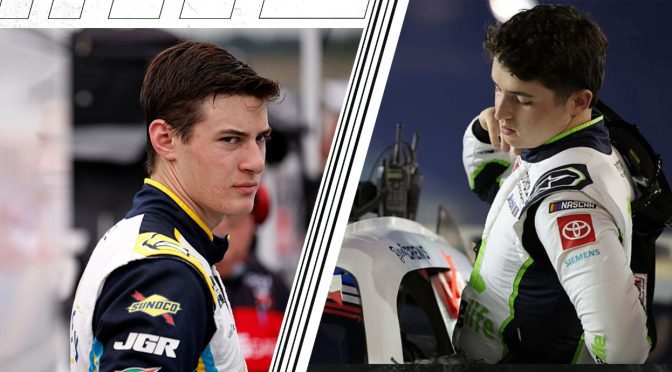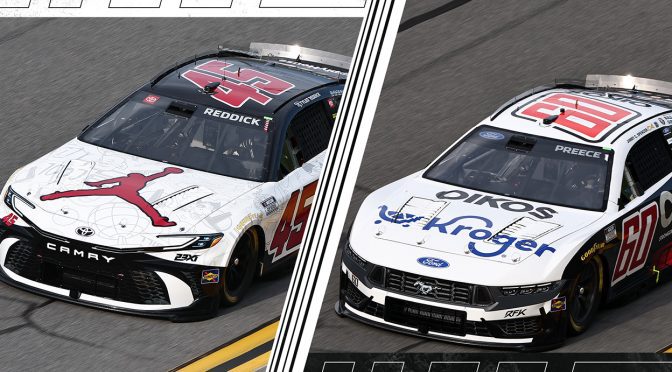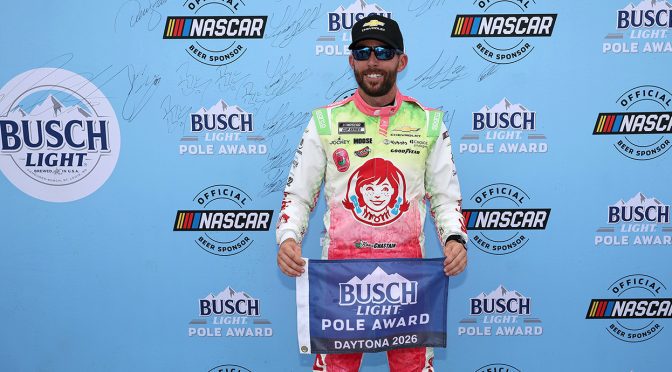
It’s time for NASCAR to make history! The Cup Series, O’Reilly Auto Parts Series and Craftsman Truck Series head to Naval Base Coronado in San Diego this weekend for an all-timer of a tripleheader weekend. See how cars will roll off for qualifying sessions in all three series ahead of the race-day festivities.

MORE: Weekend schedule | How to watch NASCAR on TV

Cup Series
Group qualifying will occur at 2:30 p.m. ET on Saturday (Prime Video). Practice is Friday at 5 p.m. ET (Prime Video).

POSITIONNUMBERDRIVERMETRICGROUP
191* Kevin Magnussen58.71
284* Jimmie Johnson42.51
367* Corey Heim(i)39.81
44Noah Gragson33.81
538Zane Smith33.11
621Josh Berry32.71
710Ty Dillon32.31
851Cody Ware31.81
96Brad Keselowski31.71
1022Joey Logano29.51
1148Alex Bowman27.91
1241Cole Custer27.01
1388Connor Zilisch #26.61
143Austin Dillon26.21
1597Shane van Gisbergen25.91
1660Ryan Preece25.01
1716AJ Allmendinger21.71
1820Christopher Bell21.21
1934Todd Gilliland20.81
2033Austin Hill(i)20.71
2135Riley Herbst19.62
2223Bubba Wallace18.62
2371Michael McDowell17.92
2447Ricky Stenhouse Jr.17.12
2577Carson Hocevar16.72
262Austin Cindric14.62
271Ross Chastain12.52
2819Chase Briscoe12.02
297Daniel Suárez11.52
3042John Hunter Nemechek10.62
319Chase Elliott8.92
3243Erik Jones8.72
3312Ryan Blaney7.92
3454Ty Gibbs7.82
3517Chris Buescher7.02
3624William Byron5.42
375Kyle Larson5.32
3845Tyler Reddick1.72
3911Denny Hamlin1.32

O’Reilly Auto Parts Series
Group qualifying will occur at 1 p.m. ET on Saturday (The CW). Practice is Friday at 3:30 p.m. ET (The CW App).

POSITIONNUMBERDRIVERMETRICGROUP
150Preston Pardus41.61
255Brad Perez36.01
342Baltazar Leguizamón34.71
453Joey Gase34.31
592Leland Honeyman Jr.(i)32.71
628Kyle Sieg31.71
735Dawson Cram31.21
891Jesse Iwuji29.41
945Lavar Scott #29.31
1017Corey Day28.11
112Jesse Love27.11
1202Ryan Ellis26.71
1327Jeb Burton26.21
1448Patrick Staropoli #25.31
1587Austin Green24.21
1607Josh Bilicki24.11
1739Ryan Sieg22.71
1831Blaine Perkins20.91
1918William Sawalich18.61
2044Brennan Poole18.02
2151Jeremy Clements17.52
228Sammy Smith16.32
2354Taylor Gray16.12
240Alex Labbe15.92
2524Harrison Burton14.92
2626Dean Thompson14.82
2799Parker Retzlaff14.12
2821Austin Hill12.52
2996Anthony Alfredo10.22
3032Andrew Patterson10.02
3120Brandon Jones7.72
321Carson Kvapil7.22
3341Sam Mayer6.12
3400Sheldon Creed5.32
3519Brent Crews #3.82
3688Rajah Caruth2.72
377Justin Allgaier1.02

Craftsman Truck Series
Group qualifying will occur at 2 p.m. ET on Friday, with practices earlier in the day at Noon ET and 1 p.m. ET (FS2).

POSITIONNUMBERDRIVERMETRICGROUP
175Parker Kligerman41.91
276Nathan Nicholson33.41
326Dawson Sutton33.01
413Cole Butcher #31.81
522Austin Varco31.21
681Kris Wright31.01
72Jackson Lee28.11
888Ty Majeski28.11
910Corey LaJoie26.01
1016Justin Haley25.91
1133Frankie Muniz25.11
1291Christian Eckes24.51
1314Mini Tyrrell #22.11
1420Brendan Gaughan21.91
155Adam Andretti21.61
1652Stewart Friesen20.51
1744Andrés Pérez19.91
1815Tanner Gray19.51
1925Jamie McMurray18.42
2099Ben Rhodes18.02
2112Brenden Queen #15.82
2245Landen Lewis14.32
2319Daniel Hemric13.32
249Grant Enfinger13.12
2542Tyler Reif12.42
2618Tyler Ankrum10.92
2798Jake Garcia10.82
2817Gio Ruggiero10.22
2962Kaz Grala7.22
307Connor Mosack6.82
3138Chandler Smith5.02
3277Justin Marks4.82
3334Layne Riggs3.12
3411Kaden Honeycutt2.02
351Jimmie Johnson(i)1.62

* Required to qualify on time
# denotes series rookie
(i) denotes ineligible for driver points

Jesse Love will join Wood Brothers Racing to drive its historic No. 21 Ford in the NASCAR Cup Series beginning in 2027, the team announced Wednesday.

Love is the 2025 NASCAR O’Reilly Auto Parts Series champion and still competes full-time in that series. With seven Cup starts on his resume, the 21-year-old will make the full-time jump to NASCAR’s highest level next season.

MORE: Cup standings | O’Reilly Auto Parts Series standings

“Words can’t describe what it means to me to realize this dream I’ve had for as long as I can remember,” Love shared in a social media post. “I am so grateful to every single person who has had a hand in my journey from the time I was 5 years old to now. This is for those people who have pushed me and helped me. Thank you to the Wood Brothers, Team Penske, and Ford for their belief in me starting in 2027.”

Love will replace Josh Berry in the No. 21 car. Berry, a winner in March 2025 at Las Vegas Motor Speedway, announced in a Zoom on June 10 he would not return to Wood Brothers Racing after this season.

The No. 21 entry from Wood Brothers is iconic, featuring motorsports greats like David Pearson, Cale Yarborough, A.J. Foyt, Neil Bonnett and Dale Jarrett as drivers who have helped the team amass 101 wins across its many decades in the sport. With assistance from Team Penske, which has a long-standing alliance with the Wood Brothers team, Love will have his chance to add his name to the long list of winners beginning next season.

“Driving the No. 21 for Wood Brothers Racing is truly an honor,” Love said in a release. “This team has played such an important role in NASCAR history, and the drivers who have sat behind the wheel of this car are some of the greatest our sport has ever seen. I’m incredibly grateful to everyone at Wood Brothers Racing, Team Penske and Ford Racing for believing in me – I’m excited to get to work, continue learning from the people around me and compete at the highest level.”

“Jesse has accomplished a lot at a young age,” Jon Wood, president of Wood Brothers Racing, said in a release. “He’s demonstrated the ability to win races, compete for championships and handle the expectations that come with racing at a high level. We’re looking forward to giving him the opportunity to take the next step in his career with the No. 21 team.”

A native of Menlo Park, California, Love earned the ARCA Menards Series West championship in 2020 at age 16 and again in 2021 before earning the national ARCA championship in 2023. Love has competed full-time in the O’Reilly Auto Parts Series for Richard Childress Racing since the beginning of 2024, earning the Rookie of the Year title that season before claiming the title last season. Love has made seven Cup Series starts for RCR as well, earning a best finish of 24th in the 2025 Brickyard 400 at Indianapolis Motor Speedway.

Love currently sits second in the O’Reilly Auto Parts Series standings, trailing series leader Justin Allgaier by 250 points.

“Richard Childress Racing is appreciative of Jesse Love’s contributions during his three seasons with our organization and wishes him nothing but success in the future,” a statement from RCR read on X. “Jesse is a talented racer, and we are proud to have played a role in his development into a NASCAR champion. All parties remain aligned and committed to defending the NASCAR O’Reilly Auto Parts Series championship in 2026.

Additional details regarding the No. 21 team’s plans for the 2027 Cup Series season will be announced at a later date, the team stated.

NASCAR’s first visit to Naval Base Coronado in San Diego comes during a nationwide celebration of the United States’ 250th anniversary, marking a historic tie-in between stock-car racing and the American military.

RELATED: San Diego weekend schedule | All about Coronado

This weekend’s NASCAR tripleheader strengthens the already powerful connections between sports and the armed forces, which have hosted college and professional events in tandem for years. To prepare for another unique partnership, let’s review a selection of previous sports and military crossovers, including one from the past in NASCAR’s biggest race.

U.S. military cars in the 1991 Daytona 500

With the United States in the grips of Operation Desert Storm, five teams paid tribute to the five branches of the military with special paint schemes in the “Great American Race” in 1991. With sponsorship bills offset by series sponsor RJ Reynolds, the cars were driven by Mickey Gibbs (No. 24 Air Force), Greg Sacks (No. 18 Navy), Alan Kulwicki (No. 7 Army), Buddy Baker (No. 88 Marines) and Dave Marcis (No. 71 Coast Guard).

Alan Kulwicki and the No. 7 Army Ford that he drove in the 1991 Daytona 500.
NASCAR Research & Archives Center | Getty Images

Sacks, whose father was a radio operator in the United States Navy during World War II, prompted the campaign with a call to Reynolds’ sports marketing executives. “I’ve been watching the reports on television every night, and I saw how the troops reacted to the Super Bowl,” Sacks said before the 1991 event. “Now, I’m going to be part of a sporting event that I consider just as big as the Super Bowl, and those troops are going to know that we’re thinking about them.”

All five cars qualified for the race, and Kulwicki managed the best finish — eighth in his desert-camouflage No. 7 Ford.

MORE: A history of patriotic paint schemes | Watch: 1991 Daytona 500

Armed Forces Classic

College basketball broke new ground in 2012 with the first Armed Forces Classic, pitting Connecticut against Michigan State in front of 3,288 spectators at Rammstein Air Base in Germany. A total of nine men’s basketball games were held under the Armed Forces Classic banner, most recently in 2022 at the USS Abraham Lincoln in San Diego. The event was revived last year with the first women’s classic, with UConn topping Louisville in Annapolis, Maryland.

Major League Baseball at Fort Bragg

When the Miami Marlins and Atlanta Braves locked horns for a midsummer tilt in 2016 outside of Fayetteville, North Carolina, it marked the first regular-season pro sports event held on an active military base. The Marlins prevailed 5-2 on the eve of Independence Day, with 12,582 taking in the sights from a temporary stadium built on a defunct golf course.

Carrier Classic

A series of college hoops games in 2011 and 2012 were held on aircraft carriers, with North Carolina and Michigan State tipping off for the first edition in front of 8,111 on the flight deck of the USS Carl Vinson. (The USS Carl Vinson will be present at Naval Base Coronado for the tripleheader race weekend.) The Tar Heels held on for a 67-55 victory, and the USS Yorktown and Midway joined in as host locations for Carrier Classic events the next year.

Army/Navy Game

Though not held on a military site, one of college football’s most revered and longest-running rivalries needs its own special mention alongside other armed forces sports traditions. Army’s Black Knights and the Navy Midshipmen have met 126 times since their first matchup in 1890, with the most games hosted at a neutral site in Philadelphia, Pennsylvania. Navy carries a two-game winning streak into this year’s annual showdown, which is scheduled Dec. 12 in East Rutherford, New Jersey.

WWE Tribute to the Troops

Professional wrestling cards stemmed from a collaboration between WWE and Armed Forces Entertainment, which hosted a series of events on or near military installations both stateside and abroad. The first seven episodes (2003-2009) were held either in Iraq or Afghanistan, before a move in 2010 to Fort Hood in Killeen, Texas.

UFL at Fort Hood

The United Football League staged the first pro football game on an active U.S. military base earlier this year, with the Orlando Storm defeating the Dallas Renegades 31-24 in the “Hats off to Heroes” event on May 15 at Fort Hood’s Phantom Warrior Stadium. Attendance was restricted to military personnel, their families and those with base access, with free admission.

The pressure was on to reach the West Coast when the green flag for Sunday’s NASCAR Cup Series race at Pocono Raceway was moved two hours ahead to 1 p.m. ET.

On the latest episode of the “Hauler Talk” podcast, Mike Forde, NASCAR vice president of racing communications, said the call was made Saturday morning to start earlier because of a significant chance of rain at 5 p.m. ET.

RELATED: Pocono results | Naval Base Coronado weekend schedule

“With a 3 p.m. start time, you’re looking at maybe getting through Stage 2,” Forde said. “The average time of the race is about three hours, so if we moved it up only an hour, we’re probably not going to get in all 160 laps.”

The race finished before a torrential downpour with lightning later that afternoon.

Because of the logistics to move the broadcast compound and other setup equipment to Naval Base Coronado, Forde said the contingency plan was 8 a.m. ET start if the Pocono race had been postponed to Monday.

“We really, really needed to get that race in on Sunday,” Forde said. “There were a lot of things working against us if we had a rain situation. So I think everyone was pretty eager and had a lot of angst to get that race going by any means possible, and everyone worked together.

“I want to give a shoutout to Nick Igdalsky and Ben May, the CEO and president of Pocono Raceway. They probably had the most to lose by moving that race up. They had a sold-out crowd, a sold-out infield, and throwing that curveball to fans with a little more than 24 hours’ notice was a big ask, and they really were great partners. So everything worked out beautifully.”

The decision was also made easier because the broadcast was on a streaming platform that wasn’t beholden to the demands of juggling a network schedule.

“It is a pretty simple yes,” Forde said. “But the later you go, and the closer into primetime you go, the better for ratings. And so they were cognizant that moving two hours earlier was going to probably hurt their ratings, but I think they realized what we’re up against, too. So I think Prime looked at the big picture there and were, as usual, great partners and agreed to the move up.”

Other topics covered by Forde and senior director of racing communications Amanda Ellis during the 58th episode of “Hauler Talk,” which explores competition issues in NASCAR:

— The process that allowed Kyle Larson to slide back to the last attempt in the qualifying order at Pocono.

— Why NASCAR took six cars after the race for wind tunnel testing.

— A streak of four consecutive sellouts for Cup Series races.

— Nuggets about the construction and ground rules for the Qualcomm Circuit at Naval Base Coronado.

Click on the embed below to listen or search for “Hauler Talk” wherever you download podcasts to hear it on your phone, tablet or mobile device.

Nate Ryan has written about NASCAR since 1996 while working at the San Bernardino Sun, Richmond Times-Dispatch, USA Today Co. and, for the past 10 years, at NBC Sports Digital. He is a contributor to the “Hauler Talk” show on the NASCAR Podcast Network. He has also covered various other motorsports, including the IndyCar and IMSA series.

NASCAR officials have issued a penalty to the No. 62 Beard Motorsports team in the NASCAR Cup Series following last weekend’s action at Pocono Raceway, the sanctioning body announced Tuesday.

RELATED: Naval Base Coronado weekend schedule | Pocono results 

Crew members Garrett Crall and Caison Dillon have been suspended for the next two events, running through Sonoma Raceway on June 28, after the detachment of Casey Mears’ right-front wheel on Lap 105 in Sunday’s Great American Getaway 400 presented by VISITPA, causing a caution and violating Sections 8.8.10.4.A&D in the NASCAR Rule Book.

The Cup Series next races at Naval Base Coronado on Sunday (4 p.m. ET, Prime Video, HBO Max, MRN Radio, SiriusXM NASCAR Radio).

Fans rise to their feet before every NASCAR Cup Series race for the national anthem. Afterward, stunning aircraft whizz by at high speeds and low altitudes, giving thousands of spectators — and even competitors — an adrenaline rush moments before the best drivers in the world prepare to race.

Many of these flyovers are performed by military aircraft from bases near local markets. But NASCAR’s roots with the armed forces date back to the sport’s genesis.

RELATED: Cup Series schedule | Buy San Diego tickets now!

Some of NASCAR’s pioneers served during World War II, before the sport’s inception in 1948. In the late 1950s, the United States Air Force Thunderbirds completed a Daytona flyover — a tradition that still exists before each “Great American Race.” Soon after, NASCAR began racing annually on Independence Day.

The sport’s patriotism ratcheted even higher in 1991, when five drivers donned military-themed paint schemes during Operation Desert Storm (part of the Gulf War) in the Daytona 500.

In the modern era, ties between NASCAR and the armed forces are stronger than ever. Cars don patriotic schemes multiple times a year. Teams honor fallen service members, culminating with the 600 Miles of Remembrance over Memorial Day weekend at Charlotte Motor Speedway. Drivers immerse themselves in military experiences, including Charlotte’s Mission 600.

And when the stars of the Cup Series head to Naval Base Coronado to “Race the Base” on Sunday (4 p.m. ET, Prime Video, HBO Max, MRN Radio, SiriusXM NASCAR Radio), it’ll take those ties to even greater heights as the United States celebrates its 250th anniversary.

The early years

NASCAR’s first champion — Hall of Famer Red Byron — served in the U.S. Army before the sport was even founded.

Serving as an engineer on the Army’s Air Corps B-24 Liberator bomber, he suffered severe leg injuries during a WWII run over the Aleutian Islands. A bomb detonated when it wasn’t supposed to. Byron recognized the impending problem and cut the bomb away, but it exploded while he was still exposed in the fuselage. He spent 27 months recovering in a Colorado hospital.

“That last bomb got hung up in the plane,” team owner Raymond Parks said, as recalled in a 2012 ESPN article. “It was Red’s job to get it loose.”

Byron drove for Parks — another Hall of Famer who also served in the Army — in NASCAR’s inaugural season. Parks fought in the Battle of the Bulge, the last major land battle in WWII. Together, they won the 1948 Modified Division (now the Whelen Modified Tour) and the 1949 Strictly Stock Division (now the Cup Series).

“[Byron] just thought about everything different than most folks,” Parks said. “You might look at something and think, ‘Wow, isn’t that pretty,’ but Red, he was thinking, ‘How in the world did they make that?’ Like an engineer, you know. That’s what made him such a great race car driver.”

Bud Moore, who began fielding NASCAR entries in 1961, was drafted into the Army in 1943. He participated in D-Day as a member of the 4th Infantry Division, and fought in Germany through the winter of 1944 into 1945. He nearly drowned at 19, moments after landing on Utah Beach in Normandy, France. But several years later, as a NASCAR owner, he won back-to-back titles with Joe Weatherly in 1962-63 (another Hall of Famer who previously served), and his cars won 63 times in Cup competition. Moore also served as a champion crew chief for Buck Baker and was inducted into the Hall in 2011, where his two Bronze Stars and five Purple Heart awards are displayed.

Arguably the greatest crew chief of all time, Dale Inman served as an ordnance specialist in the Army from 1959 to 1961. Just three years removed from service, he started working for some 26-year-old named Richard Petty. They won seven championships together, with Inman further cementing his legacy with a 1984 title with Terry Labonte. Petty, of course, became the winningest driver in Cup Series history.

But that’s to name a few. Industry legends Smokey Yunick, Cotton Owens, Junie Donlavey and Leonard Wood all served. Other drivers did as well, including Hall of Famer Tim Flock, Marshall Teague, Roy Mayne, Tiny Lund, George “Sarge” Green and Bugs Stevens. Most recently, U.S. Navy officer Jesse Iwuji competed in NASCAR, racing as recently as last year in the O’Reilly Auto Parts Series.

Building patriotism

Kicking off each Cup Series race with a flyover before the green flag is a normal practice these days. That wasn’t always the case.

The first known flyover before a race came in February 1957, with the Thunderbirds whizzing over Daytona Beach in the years before Daytona International Speedway completed construction. They returned over Daytona Beach in 1958, the final year of racing the dunes before the inaugural Daytona 500 a year later. Fast forward to the modern era, and the Thunderbirds — one of the most iconic flight groups in aviation, comprised of the top Airmen in the country — completed their 16th consecutive flyover this February to commence the Daytona 500. The Thunderbirds have piloted variations of the F-16 aircraft since the early 1980s.

The US Air Force Thunderbirds complete a Daytona 500 flyover.
Jeff Curry | Getty Images

In 1961, the U.S. Navy Blue Angels appeared on the program cover of the Southern 500 at Darlington Raceway, celebrating the 50th anniversary of Naval aviation.

Those moments helped lead to the weekly tradition on the Cup Series circuit, as well as in other sports and racing disciplines.

When Daytona International Speedway finished construction in 1959, NASCAR scheduled its summer Daytona race around the Independence Day holiday. From that year until 1987, the Cup Series raced every summer on July 4 — no matter what day of the week it fell on. Beginning in 1988, the race shifted to the Saturday of Fourth of July weekend, running every year until 2019 — a mid-summer classic fans yearned for.

But for the 2020 season, NASCAR moved the second Daytona race to late August, marking the Cup Series regular-season finale — a literal bookend from February’s 500-miler. It made for high-stakes racing with opportunities for competitors to make or break their championship hopes.

Despite the schedule change, NASCAR continued to make Independence Day weekend racing a ritual. The Cup Series visited the famed Indianapolis Motor Speedway in 2020’s pandemic season, before two consecutive seasons in the Elkhart Lake, Wisconsin, countryside of Road America. I mean, it quite literally has America in the name, and the 4.048-mile road course blended old-school tradition with a northern flair. Nowadays, it’s a trip to one of the largest cities in the country — Chicago — which started with three seasons on a first-of-a-kind street course before moving back to the Joliet, Illinois, intermediate for this year’s holiday rendition.

And the Independence Day tradition that stemmed from Daytona — celebrating the anniversary of the United States — continues to strengthen the parallels between NASCAR and patriotism that comes with it.

Operation Desert Support

When five Cup Series cars rolled into the 1991 Daytona 500 with military-themed paint schemes, it was rather unprecedented.

NASCAR launched Operation Desert Support on Feb. 5, 1991, one of the sanctioning body’s first-ever initiatives in support of the armed forces. The joint effort between the sport, Daytona, and RJ Reynolds Tobacco led to five cars for Speedweeks, each backing one of the five military branches fighting in the Persian Gulf.

Greg Sacks spearheaded the idea and represented the Navy. Alan Kulwicki represented the Army. Mickey Gibbs represented the Air Force. Dave Marcis represented the U.S. Coast Guard. Buddy Baker represented the U.S. Marines.

Operation Desert Support for the 1991 Daytona 500 paint schemes.
NASCAR Research & Archives Center | Getty Images

“We felt the racing community would like the idea of paying tribute to the hundreds of thousands of Americans who are involved in the Gulf War and their families,” RJ Reynolds executive T. Wayne Robertson said in a press release. “We felt having five cars on the track representing the Army, Navy, Marines, Air Force and Coast Guard would be a dramatic and fitting tribute.

“NASCAR and Daytona International Speedway officials quickly embraced the idea and it became a cooperative effort by all of us.”

Color guards from each of the five branches participated in pre-race festivities. The first 100,000 spectators inside the Daytona grandstands received American flags. Each car donned special decals. Jim Sasser, a U.S. senator from Tennessee, served as the Grand Marshal.

Those bold moves are much more common nowadays.

Most teams don patriotic paint schemes multiple times a year, specifically the Coca-Cola 600 over Memorial Day weekend and the Fourth of July weekend races. Many are planning to run them at Naval Base Coronado, too, including Chase Elliott — who recently revealed a special NAPA Gold Filters Chevrolet for the inaugural San Diego race. Color guards preside over pre-race festivities weekly. Government officials regularly visit tracks, and in 2004, George W. Bush became the first sitting president to attend the Daytona 500. Donald Trump followed suit in 2020 and 2025.

Ultimately, Operation Desert Support elevated that patriotism even further as NASCAR backed the military in a time of need.

The modern era

The traditions we see today were built over decades of patriotism shared by the industry, fans and military. But as the sport continues to evolve, so do those ties.

Much of it focuses around the Coca-Cola 600. For over a decade, each car entered in the 400-lap race — as well as other on-track vehicles — has honored a fallen service member by carrying that service member’s name above the windshield in the 600 Miles of Remembrance. Prime Video also honors those service members on the television broadcast. Gold Star Families come to the track and spend time with drivers on the pre-race grid.

Charlotte Motor Speedway completed its ninth year of the Mission 600 program in 2026, where drivers visit regional military bases for immersive, hands-on experiences about day-to-day life in service. Elliott visited Marine Corps Air Station Beaufort, Austin Dillon visited Fort Bragg and Daniel Suárez visited Seymour Johnson Air Force Base.

“Honoring those who have served our country and our veterans, the Gold Star Families that are on our cars, it’s always special to me because America is really represented there and the patriotism behind it, and then all of our military branches coming out and just giving them some love that they deserve,” Dillon told NASCAR.com in May. “We always make connections, and then we go see each other [pre-race], and that’s a big part of Mission 600.”

Austin Dillon visits Fort Bragg during Charlotte Motor Speedway's Mission 600.
Nathan Solomon | NASCAR Digital Media

One of the most solemn traditions? Each Coca-Cola 600 winner lays a wreath at the Tomb of the Unknown Soldier in Arlington, Virginia. Ross Chastain, the 2025 victor, visited this spring, and Suárez, this year’s winner, will have the honor in 2027.

“To walk down those steps and to hear ‘Taps,’ it’s emotional. It’s really, really emotional,” Trackhouse Racing owner Justin Marks told NASCAR.com in April. “It’s heavy, but it’s an honor and it’s just really humbling. I had this moment there thinking it’s amazing that we’re here because of race cars, because of something so inconsequential and meaningless as a race car. We’re meaningful in that we’re entertaining people, we’re inspiring people and we’re supporting our families by finding lines of work that we’re good at and passionate about. It was just a great, humbling moment.”

And starting this year, NASCAR and Coca-Cola introduced a Heroes Pass, where fans could nominate any service member or veteran in May for lifetime access to races.

Indeed, the connection between NASCAR and the military is stronger than ever, with much of that bond going all the way back to the sport’s earliest years. The next chapter will be written Sunday, when the stars of the Cup Series “Race the Base” in San Diego to celebrate America’s 250th birthday.

Chris Buescher signed a multiyear contract to remain with RFK Racing in the NASCAR Cup Series, the team announced Tuesday.

Originally from Prosper, Texas, Buescher has been a member of RFK since 2009 as a development driver and ultimately won the 2015 O’Reilly Auto Parts Series championship for the organization. He also made his Cup Series debut that season for Front Row Motorsports on a lease and embarked on a full-time campaign with the organization in 2016, winning as a rookie at Pocono Raceway. Beginning in 2017, Buescher spent the next three years at JTG-Daugherty Racing before returning to an RFK house car and the No. 17 Ford for 2020 and beyond.

RELATED: Cup Series standings | RFK website

“RFK Racing has been home for most of my racing career, and that’s something I don’t take for granted,” Buescher said in a team release. “I’ve grown up with this organization, and I’m incredibly proud of what we’ve built together over the last several years. The direction we’re heading, the people we have in place and the commitment throughout the company make me excited about the future. I’m grateful to Mr. Jack (Roush), Brad (Keselowski), Fenway Sports Group and everyone at RFK Racing for their belief in me. I’m looking forward to continuing to chase wins and championships together.”

Buescher finished 21st and 19th in the Cup Series standings over his first two full seasons back in-house. Ahead of 2022, Brad Keselowski bought into the organization, a moment when the Jack Roush-founded team began returning to prominence at NASCAR’s highest level. Buescher won the Bristol Night Race that fall, RFK’s first Cup Series victory in five years.

“Chris is everything you want in a race car driver and teammate,” co-owner Keselowski, who also drives the team’s No. 6 Ford, said. “His talent behind the wheel speaks for itself, but what really separates him is his professionalism, preparation and commitment to making everyone around him better. He’s been instrumental in the progress we’ve made as an organization, and we’re excited to continue building toward our goals together.”

MORE: Chris Buescher driver page

The now 33-year-old turned in his best season to date in 2023, winning three times over the span of five races that summer and qualifying for the playoffs for the second time. Buescher qualified for the Round of 8 and missed the Championship 4 by 58 points, finishing seventh in the series ranks — the highest finish of his career.

In 2024, Buescher missed the playoffs following a winless regular season, but beat Shane van Gisbergen that fall at Watkins Glen International in one of the most memorable finishes in recent Cup Series history. He again missed the playoffs in 2025, but not for a lack of consistency — averaging a finish of 14.3 both seasons.

“Chris has been part of this organization for most of his professional career, and there is a tremendous amount of pride in seeing what he has become,” Roush said. “He is an exceptional driver, but just as importantly, he is the kind of person who makes our organization stronger. His work ethic, intelligence and commitment to our success have earned the respect of everyone at RFK Racing, and we’re proud that his story with us will continue.”

Through 16 races this season, Buescher has eight top 10s and sits seventh in Cup Series points. He’s 110 points above the cutline.

Steve Waid, an authoritative voice and storyteller in stock-car racing journalism across multiple eras of the sport, has died. He was 77.

Waid’s longtime colleague Rick Houston said that the veteran writer had died Monday afternoon after a lengthy battle with cancer. Waid was a recipient of the NASCAR Hall of Fame’s Squier-Hall Award for NASCAR Media Excellence, and was elected as a member of the National Motorsports Press Association (NMPA) Hall of Fame in 2014.

“For decades, Steve Waid was one of the most respected and trusted voices in NASCAR journalism,” NASCAR released in a statement. “He chronicled the sport with passion, integrity and an unmatched appreciation for its people, history and traditions. Through his work at NASCAR Scene, NASCAR Illustrated and several other outlets, Steve’s storytelling helped generations of fans better understand NASCAR and the personalities who shaped it. Deservedly, Steve was recognized for his exemplary work in 2019 as the recipient of the NASCAR Hall of Fame’s Squier-Hall Award for NASCAR Media Excellence, the culmination of a career that garnered him the admiration of competitors, industry members and fellow media professionals alike. NASCAR extends its deepest condolences to Steve’s family, friends and longtime readers.”

Waid’s career launched as a freshly minted Old Dominion University graduate in 1970, when he marched into the office of the Martinsville (Va.) Bulletin wearing a T-shirt and jeans to ask, “Do you guys need a sportswriter?” The answer was a yes from the paper’s managing editor, Waid recalled to The Roanoke (Va.) Times in 2019, and he was hired in 20 minutes’ time.

Waid covered a variety of sports, but his brief Martinsville tenure quickly introduced him to activities at Martinsville Speedway during some of NASCAR’s golden years. Longtime track public-relations director Dick Thompson helped Waid get his footing, and soon, he was accepted as a regular in the garage.

Waid later spent a decade with the Roanoke Times & World News, covering the stock-car circuit during the season and the town’s minor-league hockey team in the winter. In the early 1980s, he made a calculated risk with his career by joining Grand National Scene, then a fledgling outfit in Concord, North Carolina, with a circulation of about 9,000 readers.

“I walked into what was the converted country store of an office,” Waid told the Roanoke Times. “I had a metal desk, a chicken-wire in-basket and a Royal typewriter. That was my workspace, and I had left a newspaper with company cars, a marble building, expense accounts — everything like that. I said, ‘What the heck have I done?’ ”

But the management at Scene made good on their promise of growth, and Waid was a key contributor to the publication’s rise to a subscriber count that eventually reached six figures. If the sport was gospel, Scene served as the biblical texts — impressively delivered weekly in an era when sports-news saturation was far from the rampant digital heights of today.

Waid helped spread that gospel for nearly 30 years until his retirement from full-time reporting when Scene ceased publication in 2010. During that time, he served as NMPA president for 12 years and was honored with the association’s George Cunningham Writer of the Year Award in 1989, the same year he received the American Motorsports Media Award of Excellence. He also co-authored — with fellow legend Tom Higgins — a brilliant biography about the life and career of Hall of Famer Junior Johnson in 1999.

Waid was recognized as the eighth recipient of the NASCAR Hall’s Squier-Hall Award in 2019. The previous summer, he was informed of his selection by NASCAR vice chairman Mike Helton.

“I was so stunned that I asked him to repeat it, and he did!” Waid said. “It was almost overwhelming, you know? I’ve put 40 years into this, and a little bit more, and all I ever wanted to do was retire. But now this.”

After a week off, the NASCAR Craftsman Truck Series returns to action with an inaugural visit to Naval Base Coronado for a race on Friday (7 p.m. ET, FS1, NASCAR Racing Network Radio).

The event will be the 13th points-paying race of the 2026 Truck Series season and the second street-course contest of the campaign. Layne Riggs won the first street-course race of the season, doing so at St. Petersburg in February.

ENTRY LISTS: Cup Series | O’Reilly Auto Parts Series | Craftsman Truck Series

Seven-time NASCAR Cup Series champion and NASCAR Hall of Famer Jimmie Johnson will pilot the No. 1 Tricon Garage Toyota in this weekend’s Truck contest. The Truck race will be the El Cajon, California, native’s second career Truck race and first since 2008 at Bristol Motor Speedway.

Thirty-five trucks are entered into this weekend’s event.

MORE: Weekend schedule | How to watch NASCAR on FS1

View the full entry list here: