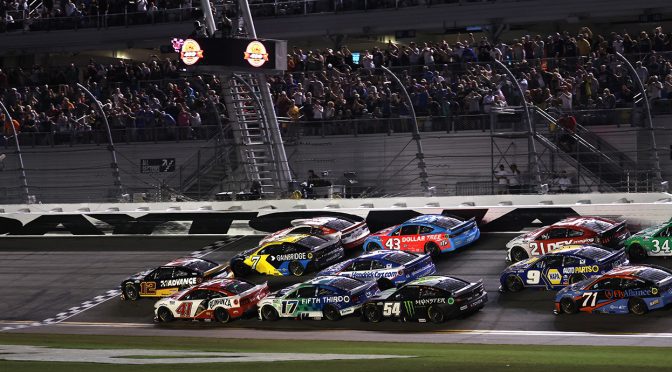
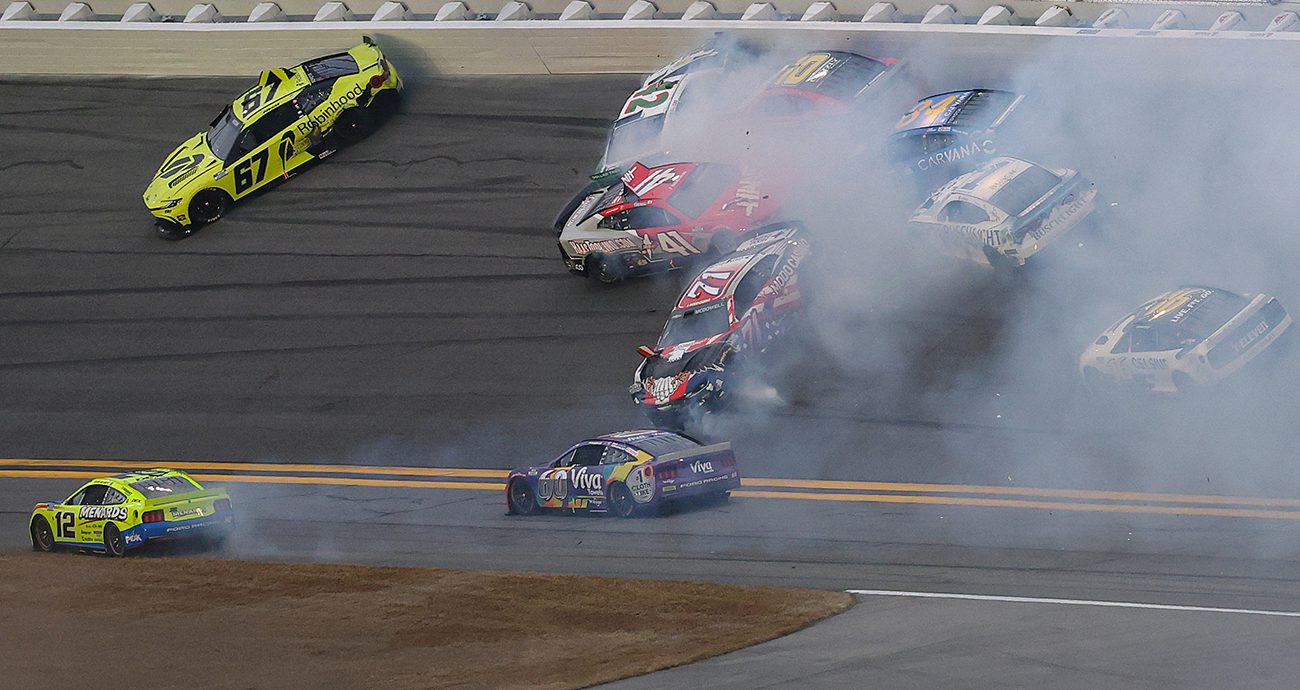
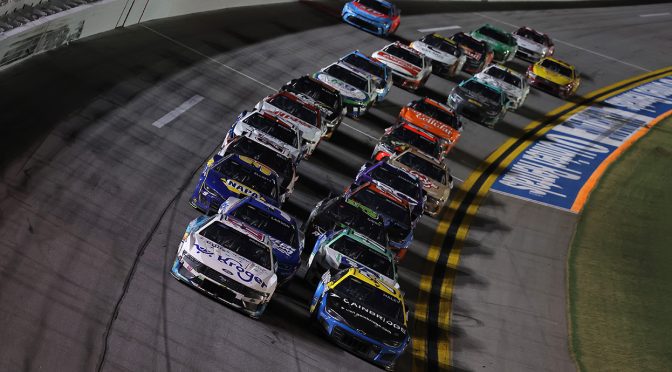
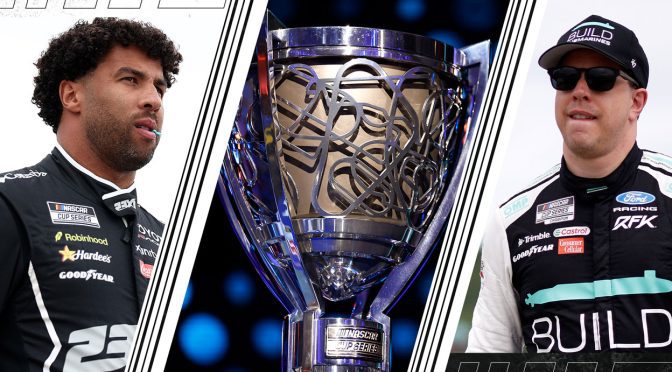
After 25 races, five drivers are fighting for the final three spots inside The Chase for the NASCAR Cup Series Championship.
The battle will reach a fever pitch on Saturday at Daytona International Speedway in the Coke Zero Sugar 400 (7:30 p.m. ET, NBC, HBO Max, MRN Radio, SiriusXM NASCAR Radio). Before the green flag waves, here is a look at the five contenders who have a chance to advance to the 16-driver contest for a 10-race journey toward their title hopes with help from Racing Insights. Three of these drivers will leave Daytona Beach with an opportunity to chase a championship; two will be left fighting for 17th place in the points standings through the end of the season.
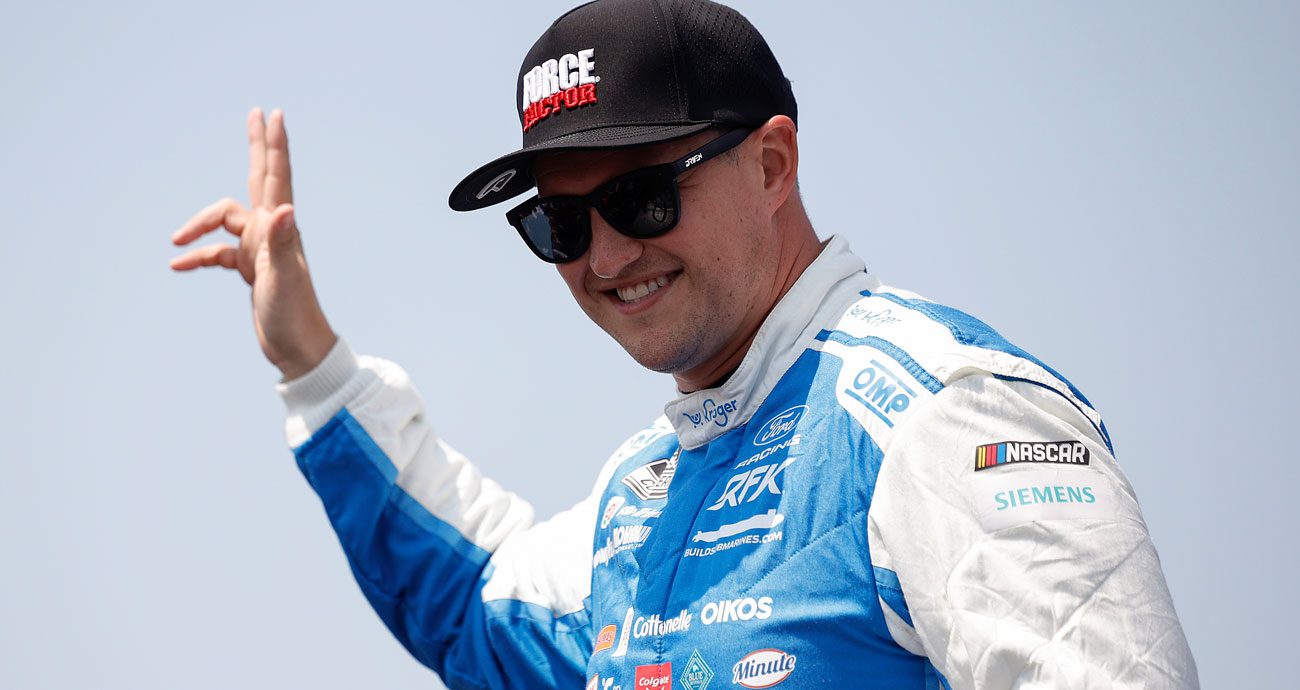
Points to the cutline: +75 Points needed to clinch: 2 Best Daytona result: 2nd (three times) Highest seed possible: 9th Average points per race: 25.2 Most points earned in a 2026 race: 48 (EchoPark Speedway, February)
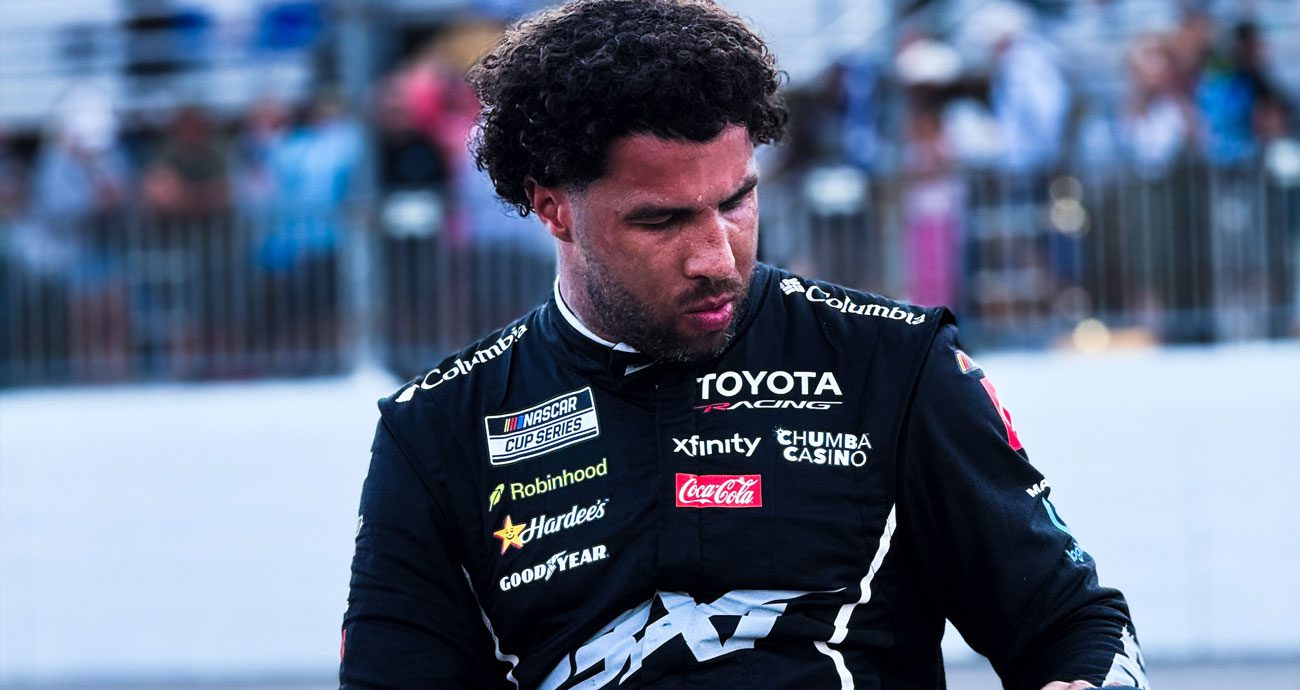
Details: In need of just two points to advance to The Chase, Bubba Wallace realistically just needs to finish 35th or better on Saturday night at Daytona, even if he doesn’t score any stage points. That’s not always so straightforward, of course: Wallace was at the forefront of a crash at Lap 27 of last year’s summer race at the “World Center of Racing” and finished 37th, only earning one point. But Wallace has a strong track record at Daytona, and those behind him would need near-perfect days to oust the No. 23 Toyota from The Chase grid. In other words, Wallace is a near-certain lock to advance.
Points to the cutline: +44 Points needed to clinch: 33 Best Daytona result: 1 win (2022 Daytona 500) Highest seed possible: 11th Average points per race: 23.96 Most points earned in a 2026 race: 48 (Richmond Raceway)
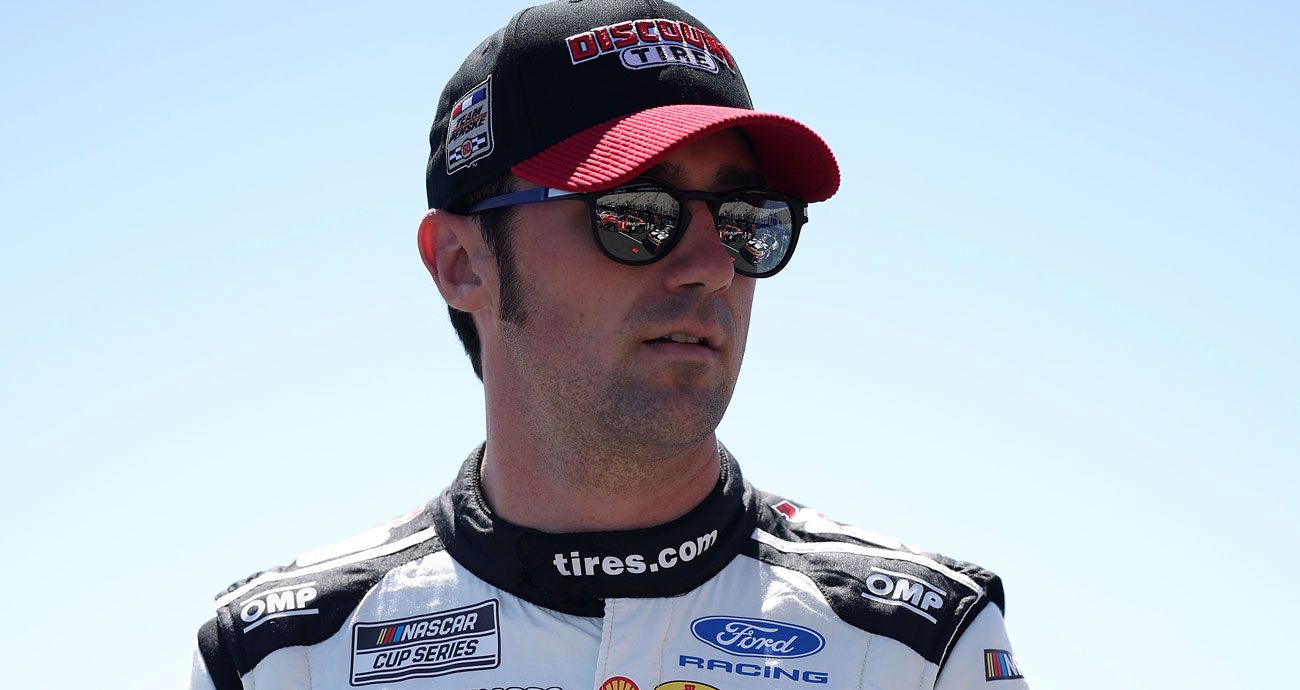
Details: Cindric bolstered his chances of making The Chase with his best points day of the season just two weeks ago at Richmond. With a 44-point buffer to the cutline, Cindric’s spot in the 16-driver grid is fairly secure. Cindric typically keeps his No. 2 Team Penske Ford toward the front of the field on superspeedways, leading a combined 92 laps in his last five Daytona starts specifically. With such great superspeedway racers as teammates — Joey Logano and Ryan Blaney — Cindric should have help around him to bolster his odds. There is a question regarding what his team’s strategy should be — be aggressive and fight for stage points, or survive until the end and gain ground late? But either should yield a promising result for the fifth-year driver.
16. Shane van Gisbergen
Sean Gardner | Getty Images
Points to the cutline: +31 Points needed to clinch: 45 Best Daytona result: 16th (2025 summer) Highest seed possible: 12th Average points per race: 23.44 Most points earned in a 2026 race: 68 (Watkins Glen)
Details: Dominant days for van Gisbergen at Watkins Glen International and Sonoma Raceway led to two fantastic victories with critical points earned, placing him into position to qualify for The Chase on points. But a shout is deserved for SVG’s improvement on ovals, which has proven dire to his current cutline predicament, including top-five runs at North Wilkesboro Speedway and Nashville Superspeedway and dual sixth-place finishes this year at EchoPark Speedway. A 31-point buffer to the cutline is decent but not totally comfortable for the No. 97 Trackhouse Racing team, particularly with two strong drafters at RFK Racing lurking behind in the standings.
17. Ryan Preece
Sean Gardner | Getty Images
Points to the cutline: -31 Points needed to clinch: Can only clinch with help Best Daytona result: 4th (2021 summer) Highest seed possible: 14th Average points per race: 22.2 Most points earned in a 2026 race: 45 (Naval Base Coronado)
Details: Ryan Preece has had a summer of seemingly missed opportunities. A career short-track ace, Preece had a couple of middling performances at Iowa Speedway (20th) and Richmond Raceway (17th) that didn’t quite yield the number of points expected for the No. 60 RFK Racing team. Daytona has been hit or miss — or take-off — for Preece over the years, with seven DNFs in 13 Daytona starts. But Preece promised “a heavyweight match” to SVG for that final position following last week’s top-10 run at New Hampshire with a hearty dose of confidence planted in his right foot. The uphill climb is obvious, but it’s also doable on the unpredictable high banks of Daytona.
18. Brad Keselowski
Sen Gardner | Getty Images
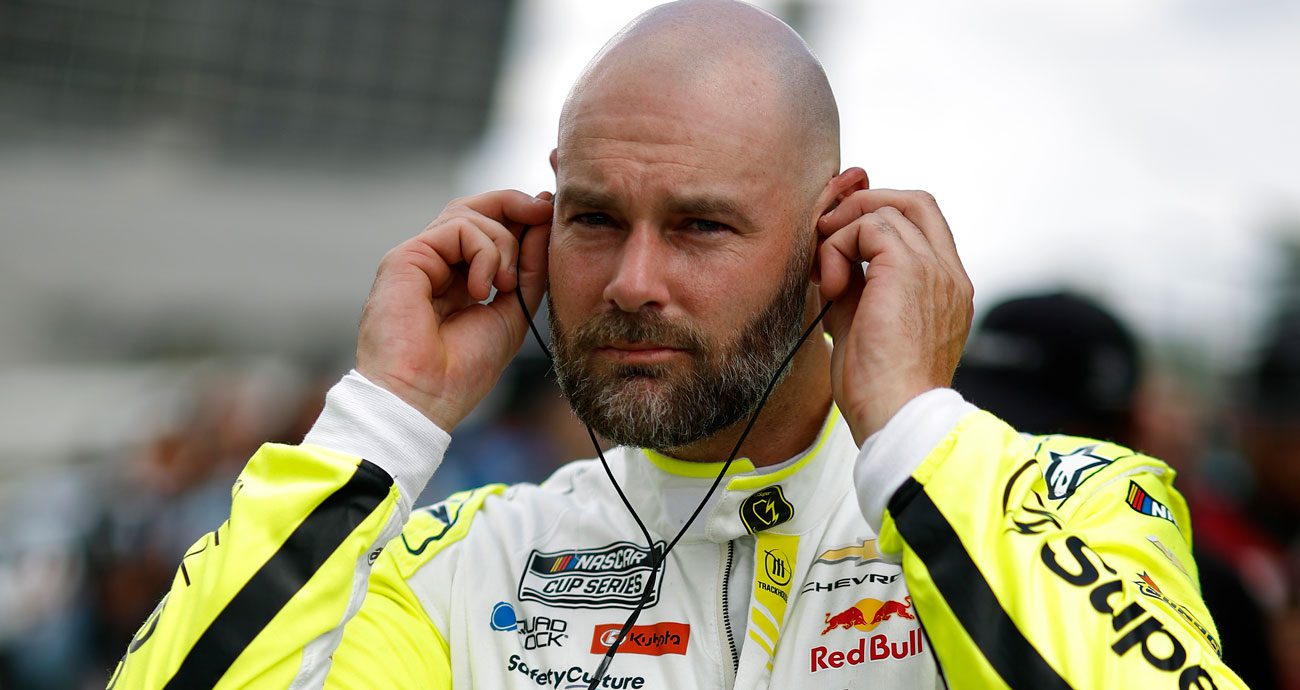
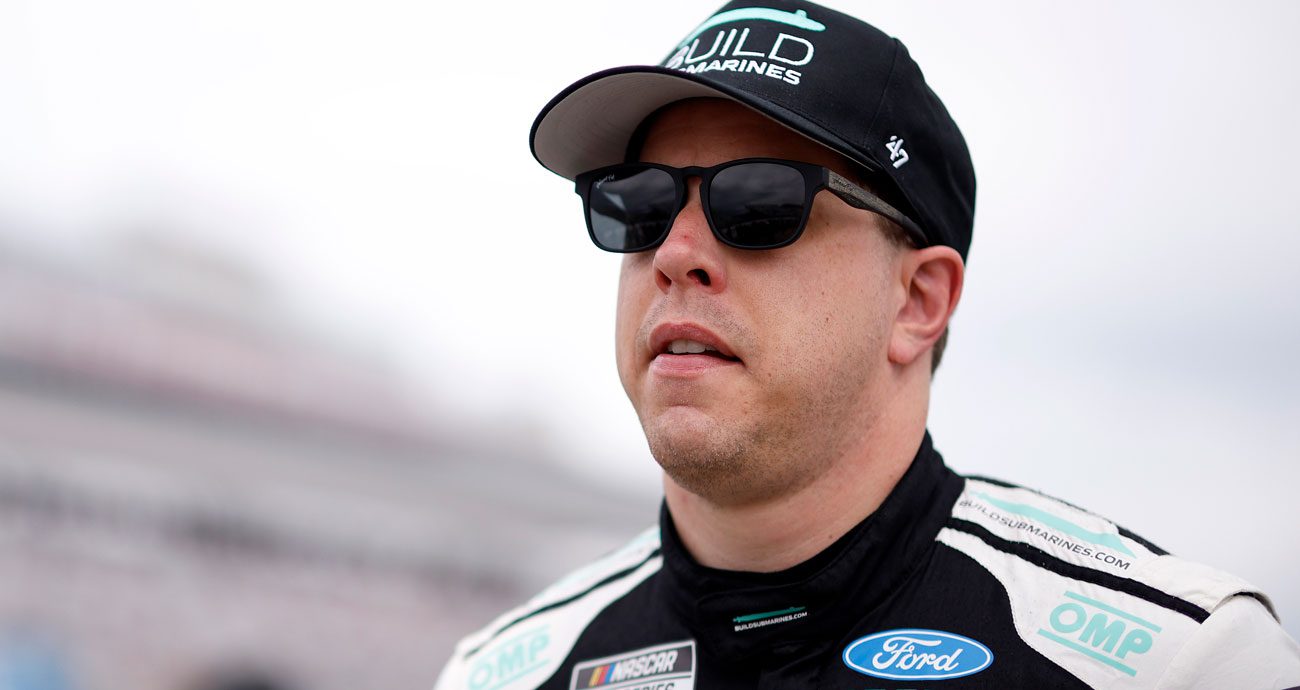
Points to the cutline: -66 Points needed to clinch: Can only clinch with help Best Daytona result: Win (2016 summer) Highest seed possible: 16th Average points per race: 20.8 Most points earned in a 2026 race: 55 (Darlington)
Details: For as many laps as Keselowski has led at Daytona International Speedway (356 total), the 2012 Cup Series champion only has one win to show for it. That win came a decade ago in the summer race on the Florida high banks, but he nearly scored his first Daytona 500 victory back in February as well before placing fifth. In order to control his own destiny Saturday, Keselowski will need to win the Coke Zero Sugar 400 and score significant stage points in the process. He’s proven he can excel in must-win moments before, but erasing a 66-point deficit in one race will be a unique challenge for the RFK Racing co-owner and driver.
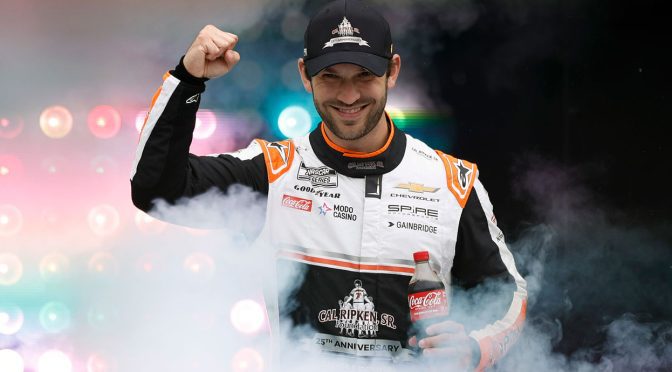
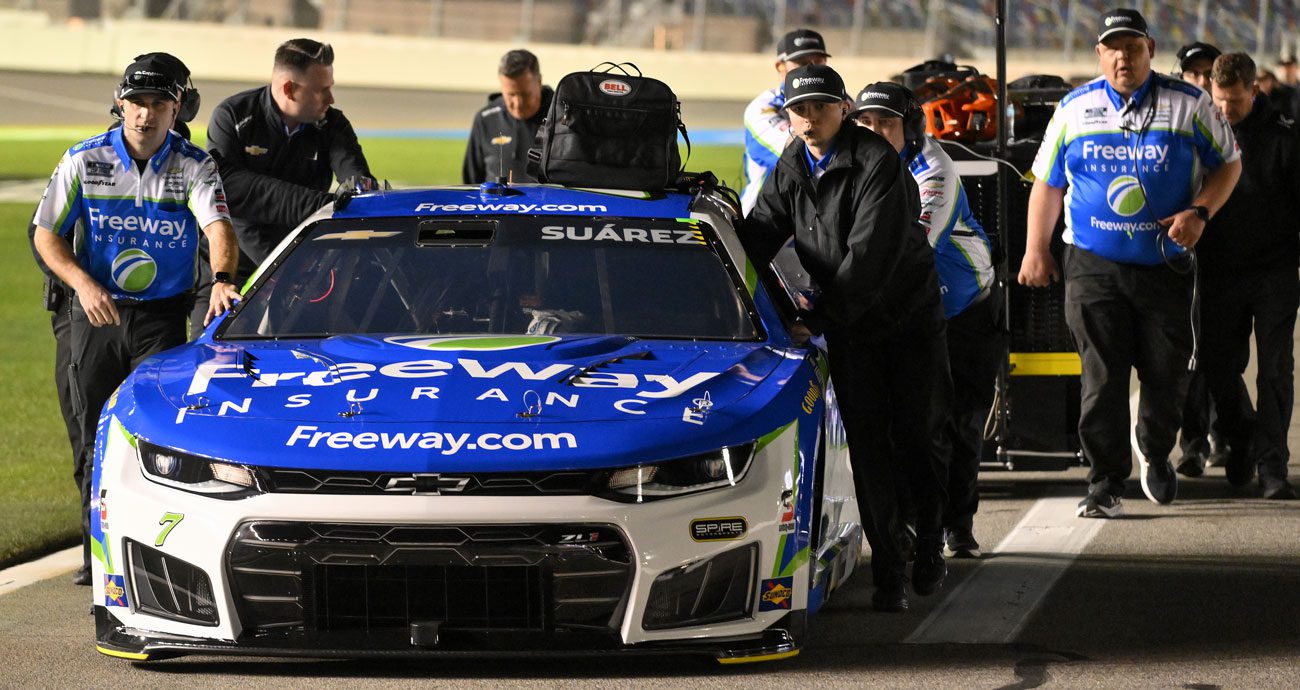
Daniel Suárez, crew chief Ryan Sparks and lead engineer Jonathan Branzelle are entering Daytona International Speedway knowing their No. 7 Spire Motorsports team is locked into The Chase for the NASCAR Cup Series Championship before the green flag waves for the regular-season finale.
What a difference a year makes for all parties involved.
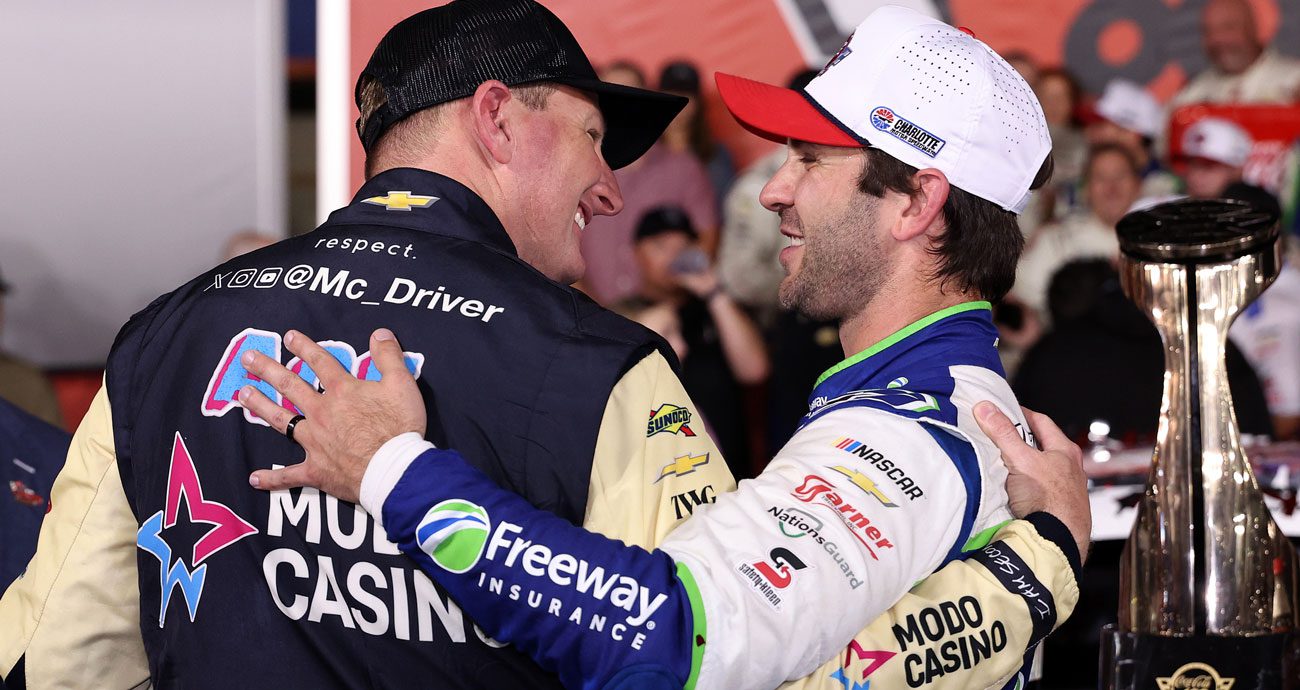
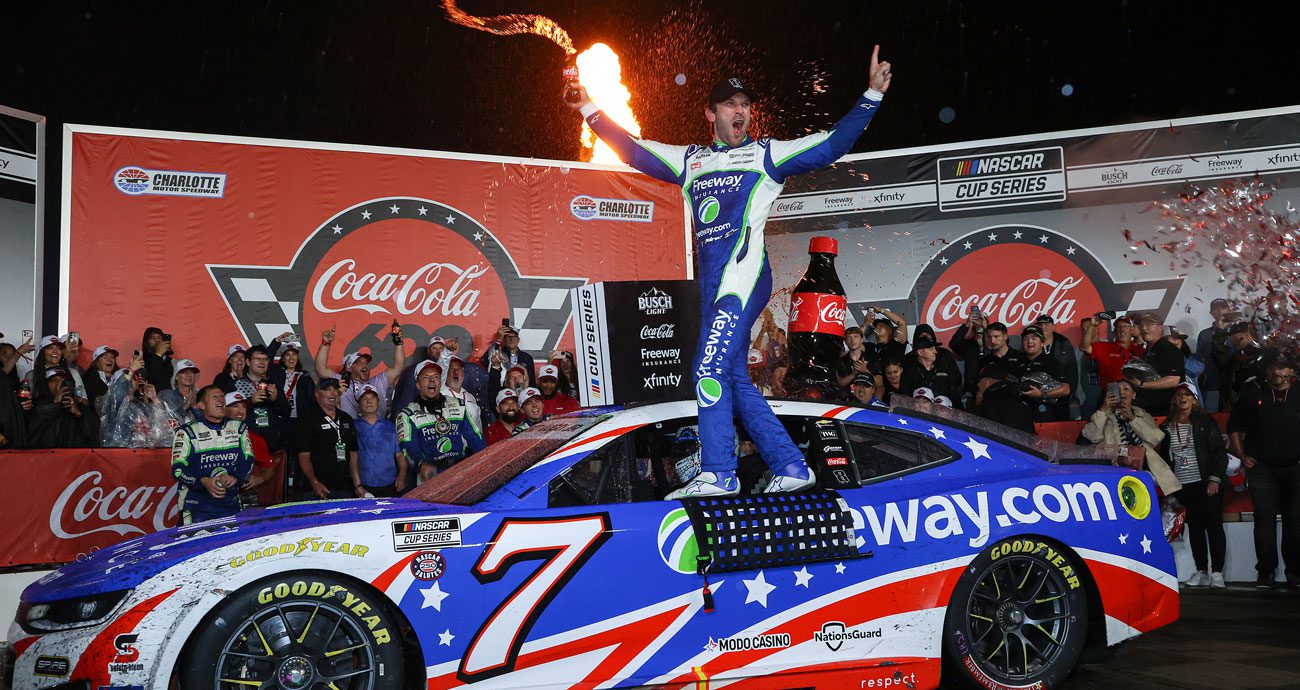
The 2026 Coca-Cola 600 winners couldn’t rely on that Charlotte Motor Speedway victory to dictate their postseason entry. Instead, the full body of work over the season’s first 26 races had to be good enough to secure a spot in the 16-driver postseason field. Turns out they only needed 25 to do so instead, clinching a spot before Saturday’s Coke Zero Sugar 400 at Daytona International Speedway (7:30 p.m. ET, NBC, HBO Max, MRN Radio, SiriusXM NASCAR Radio).
Considering how the 2025 campaign ended for both Suárez and Spire’s No. 7 team, it’s fair to say few people saw this outcome ahead. Suárez ended 29th in points in 2025, his final year driving the No. 99 Chevrolet at Trackhouse Racing. The No. 7 Spire Motorsports Chevrolet landed 31st in points after a campaign that began pairing driver Justin Haley with title-winning crew chief Rodney Childers on the pit box lasting just nine races, ending the full season with two top 10s, an average finish of 22.2 and 23 lead-lap finishes after Sparks returned to the pit box for the final 27 races in addition to his role as competition director.
How do two parties, each at their own respective crossroads, match for a run and lock into championship contention so quickly?
Suárez joined Spire Motorsports after his five-year tenure with Trackhouse came to a disheartened end — a period that also produced his first two Cup Series wins.
And while Suárez was navigating his journey, so too was Spire Motorsports’ No. 7 program. While Michael McDowell and Carson Hocevar respectively brought their Nos. 71 and 77 teams toward the front of the field, the No. 7 team struggled to find the same results.
That process happened at an off-site event during the offseason through a company called UHP — Unlock Human Potential — which served as the team’s primary sponsor at Richmond Raceway on Aug. 15.
Branzelle, formerly an engineer on the No. 6 RFK Racing car with then-crew chief Matt McCall, said that time spent was pivotal toward the team’s early-season success.
“Thatreallyhelpedusfigureouteachother’spersonalitieswithpersonalitytests,seewhateachperson’sstrengthsareandweaknessesandareas andhowtocommunicatebetter,” Branzelle said. “SoIthinkthatwasabigthingforus,especiallyhavingDaniel (in his)firstyearhere,gettingaheadstartonthat.SowhenwegottoDaytona,it’slikewe’dbeentogetherforalittlebitlongerthanweactuallyhadbeen.”
“It saved us a quarter of a season of learning each other,” Suárez added. The proof became evident through results, collecting Spire’s first non-superspeedway victory in addition to three other top-10 finishes in the first 13 races of the season, maintaining a spot inside the top 16 in points for all but one of 25 weeks so far this season.
“Honestly,Ibelievethatithelpedtheentireorganization,” Suárez said of his experience with UHP. “ButIbelievethatithelpedthe7themostbecauseessentiallythe7teamwasacouplestepsbehindthe71andthe77justbecausewe’renew.Beforeayearandahalfago,Ihadnevercrossedmorethanthreewordswith (team owner) JeffDickersonor (president)BillAnthony orRyanSparksorMattMcCall (now the competition director).LikeIhaveknownthem,sure.ButIhavejustsaid ‘hi, how’sitgoing?’That’sit.
Suárez and the No. 7 team have given Spire Motorsports a full house of relevant data to contribute to the whole of the team’s success. As the No. 7 team lagged behind its housemates with McDowell and Hocevar at the wheel, its data wasn’t proving as valuable as its counterparts’. Now, the No. 7 team can effectively contribute to the conversation to improve the overall speed of Spire’s Chevrolets, especially as Hocevar and the No. 77 team enter The Chase alongside Suárez’s group.
That energy has permeated the shop, too. McDowell is a longtime veteran of the sport, but after seven years at Front Row Motorsports and his first year at Spire in 2025, he was used to being the leader everyone turned to. He doesn’t have to carry that burden at Spire any longer, he said.
What McDowell sees now is a “rejuvenated” version of Sparks with a palpable change both at the shop and at the track. That turnaround impacts the whole team. Part of that credit, McDowell said, is due to Suárez’s level of preparation.
“IthinkwhentheyfirstannouncedthatDanielwascoming, it waslikeeverybodywasalittledownonhimbecausehewashavingabadyearandhewas30th inpointsandjustgotletgo,right?” McDowell said. “Butweallknowintheindustryhe’sgotalotoffightinhim.He’sgotalotofdoginhim,right?AndsoIknewhewasgoingtobringthatlevelofintensity,andhehas.”
Suárez’s competitive drive has long been evident. But even in the process of clinching a spot in The Chase one week early, Suárez isn’t taking a victory lap to spite anybody.
“Thereality is thatIhaveneverwantedtoproveanyonewrong,” Suárez said. “Maybethathashappenedbyaccident,butIjustwantedtoprovemyself,right, becauseobviouslyIneverstoppedbelievinginmyself. Andyeah, I’m justhappythewaythatthingshavegonesofar.Notsatisfied.Wewanttowinmore,andwewanttobeevenfaster,butdefinitelywehaveshownwhatwecando.”
Suárez added this season has been “like a relief to me,” a reminder not just of how good he is behind the wheel but how well he can lead a team if given the opportunity.
Entering Saturday’s 400-mile regular-season finale as the provisional No. 13 seed in The Chase, what’s left to gain for the No. 7 Spire Motorsports team?
Editor’s Note: Keep tabs on this page for lineup advice following qualifying, including changes you should consider.
For a handful of drivers, their 2026 fate comes down to the regular-season finale at Daytona International Speedway. With a significant rule change that will see the rear spoiler shortened to 4 inches — the same height used at intermediate tracks — and horsepower reduced to 465, nobody in the Cup Series garage truly knows what to expect. Some believe the racing will resemble the cutthroat action at EchoPark Speedway, while others expect utter chaos. When it comes to fantasy, you might as well put all 40 numbers in a blender and see what comes out.
Returning to Fastlane this year is my weekly NASCAR 36 for 36 pick, where you can come play along. It’s a season-long points battle introduced in 2024 where strategy is the primary emphasis. With 36 chartered cars and 36 races on the 2026 schedule, players can choose each car once for the duration of the season.
Driver: Tyler Reddick, No. 45 23XI Racing Toyota Selections remaining: 3 Comment: The last three months have been unkind to Reddick, but he returns to Daytona aiming to be the first driver to sweep both races in a single season since Jimmie Johnson in 2013. Reddick’s 199 points earned at drafting tracks in 2026 are the most in the series, and he has a league-best 6.0 average finishing position.
Driver:Carson Hocevar, No. 77 Spire Motorsports Chevrolet Selections remaining: 5 Comment: Second on the list of 2026 average results at drafting tracks is Hocevar (6.5). He was leading at the white flag of the Daytona 500 and won at Talladega Superspeedway. He also scored top fives in both EchoPark events. Since the start of 2025, his seven top-10 finishes at drafting tracks rank best of all drivers.
Driver: Chris Buescher, No. 17 RFK Racing Ford Selections remaining: 5 Comment: It was three short years ago when Buescher soared to Victory Lane at Daytona, winning a third consecutive oval race. He enters this weekend with four straight Daytona top 10s, the longest active streak.
Sean Gardner | Getty Images
DRIVERS TO AVOID
Driver: Denny Hamlin, No. 11 Joe Gibbs Racing Toyota Selections remaining: 0 Comment: Locking up the No. 1 Chase seed last weekend at New Hampshire Motor Speedway, Hamlin can take it easy this weekend. That might be his best bet, as his Daytona numbers are ugly in the Next Gen era with an average finish of 26.9. He doesn’t have a top five in the last 16 drafting races.
Driver: Kyle Larson, No. 5 Hendrick Motorsports Chevrolet Selections remaining: 3 Comment: Larson’s current winless streak is getting dangerously close to his losing streak at superspeedways. He has only four top-five finishes in 57 drafting track starts, with a best Daytona result of sixth (twice).
Chris Graythen | Getty Images
SLEEPERS OF THE WEEK
Driver:Erik Jones, No. 43 Legacy Motor Club Toyota Selections remaining: 9 Comment: Despite being eliminated from Chase contention last weekend, Jones has plenty to race for in 2026. He is among the most underrated superspeedway competitors in the garage, scoring his first Cup victory here in 2018. The No. 43 team has three top-five efforts in the last seven drafting track events.
Driver:Zane Smith, No. 38 Front Row Motorsports Ford Selections remaining: 10 Comment: Four of the last eight summer races at Daytona have featured a first-time winner. Don’t be surprised if Smith is next on the list to break through. He won Stage 1 of this year’s Daytona 500 en route to a sixth-place result. He has five top 10s in the last seven drafting track races.
David Jensen | Getty Images
FEATURED MATCHUPS
Tyler Reddick vs. Chase Elliott
Pick: Reddick Comment: Elliott was within a couple hundred yards of winning “The Great American Race” in February. His 19.7 average finish at Daytona ranks as his worst among all tracks, though respectable compared to his competition. Reddick has upped his game at superspeedways the last couple of seasons, tabulating the most points in 2025 and on pace to do so again in 2026.
Ryan Blaney vs. Bubba Wallace
Pick: Wallace Comment: It could be easily argued that both drivers are in must-start territory this weekend. Blaney has won the summer Daytona race in two of the last five years but has four finishes of 27th or worse in the last six trips to Central Florida. Meanwhile, Wallace has five top-five and seven top-10 finishes here, his most at any circuit.
Shane van Gisbergen vs. Ryan Preece
Pick: Van Gisbergen Comment: All eyes will be on the bubble drivers this weekend, and while a toss-up, the advantage should go to SVG. Preece needs every point he can muster, which could put him in the danger zone at the end of stages. He has finished 23rd or worse in six of the last seven Daytona races.
Carson Hocevar vs. Connor Zilisch
Pick: Hocevar Comment: Superspeedways have been where Hocevar has shined in 2026, scoring 168 of his 672 points in those four races (25%), only trailing Reddick. His fearlessness has paid off big in the draft, though he hasn’t made many companions along the way. Zilisch’s inexperience hurts him in this battle.
Pick: Cody Ware, No. 51 Rick Ware Racing Chevrolet Comment: With the uncertainty surrounding Daytona, it would be wise to avoid going big-game hunting this weekend. Ware is a solid choice, with both of his top-10 finishes in 167 career starts coming in the summer race. He owns a 19.1 average finish at the World Center of Racing, including six top-20 finishes in his last seven starts.
Daytona International Speedway has long been considered one of the most dramatic, high-action venues in all of auto racing, and come Friday night, it’s likely to live up to the hype, hosting the NASCAR O’Reilly Auto Parts Series regular-season finale, the Winn-Dixie 250 Powered by Coca-Cola (7:30 p.m. ET, The CW, ESPN Unlimited, MRN Radio, SiriusXM NASCAR Radio).
Eight drivers have clinched a position in the 12-driver Chase field, with six drivers vying for the final four spots to race for a title.
And in one of the most compelling subplots of this regular-season finale, positions 11th through 13th are covered by a single point — and all three drivers currently occupying those positions compete for Joe Gibbs Racing.
Viking Motorsports driver Parker Retzlaff needs to earn just 10 points in Friday night’s race, and he’d clinch a Chase berth to make his first career championship run. Haas Factory Team’s Sam Mayer, a perennial title contender, sits 10th in the points and holds a 33-point advantage over 14th-place Rajah Caruth.
That tight tussle features JGR teammates William Sawalich, Brent Crews and Taylor Gray.
None of the six drivers — Retzlaff, Mayer, Sawalich, Crews, Gray or Caruth — has ever won an O’Reilly Auto Parts Series race at Daytona. Among them, Caruth earned the best finish (10th) in February’s first visit to the speedway.
The 2024 series champion, JR Motorsports’ Justin Allgaier, has turned in one of the most dominant seasons in recent memory, earning a career-high and series-best six wins and holding a massive 238-point advantage over second-place Carson Kvapil, a JRM teammate, heading into Daytona. This will be Allgaier’s record 11th title run.
Kvapil, reigning series champion Jesse Love of Richard Childress Racing, Haas’ Sheldon Creed, Hendrick Motorsports rookie Corey Day, JGR’s Brandon Jones, RCR’s Austin Hill and JRM’s Sammy Smith have all clinched Chase positions.
Daytona has traditionally been a place where Hill shines, and he arrives this week after being named to drive full time in the NASCAR Cup Series in 2027 for RCR.
He is a four-time Daytona winner, including this February. Love (2025) and Allgaier (2023) have also visited Daytona’s famed Victory Lane.
The last two Daytona O’Reilly Series races have been won from pole position. Kennametal Pole Qualifying is set for Friday at 3 p.m. ET with coverage on ESPN Unlimited.
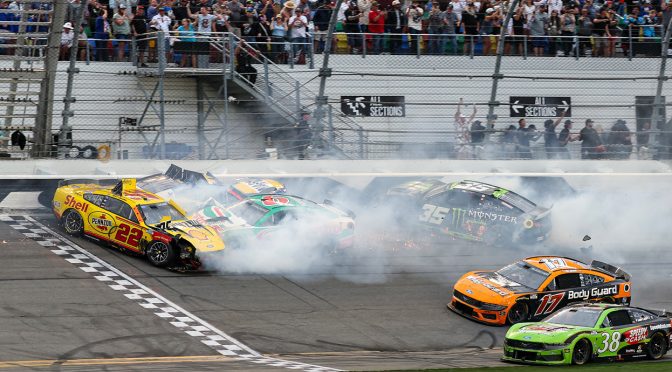
If it seems like NASCAR has been short on its trademark late-race chaos recently, you’re not imagining things.
On Sunday at New Hampshire, Ryan Blaney drove a masterclass in overcoming a mid-race problem on pit road (what else is new?) to hold off rivals on varying tire strategies. Crew chief Jonathan Hassler made the inspired call for two tires when the No. 12 came to pit road with around 75 laps to go. But Blaney had the chance to flex his car’s long-run quality because the final run went, well, long. The last 63 laps of the race were run under green-flag conditions, and Blaney led every single one of them.
As it turns out, that’s been the new abnormal this Cup Series summer. But be warned: It’s also about to change, with Chase spots — and everything else — on the line in the regular-season finale Saturday at Daytona (7:30 p.m. ET, NBC, HBO Max, MRN Radio, SiriusXM NASCAR Radio).
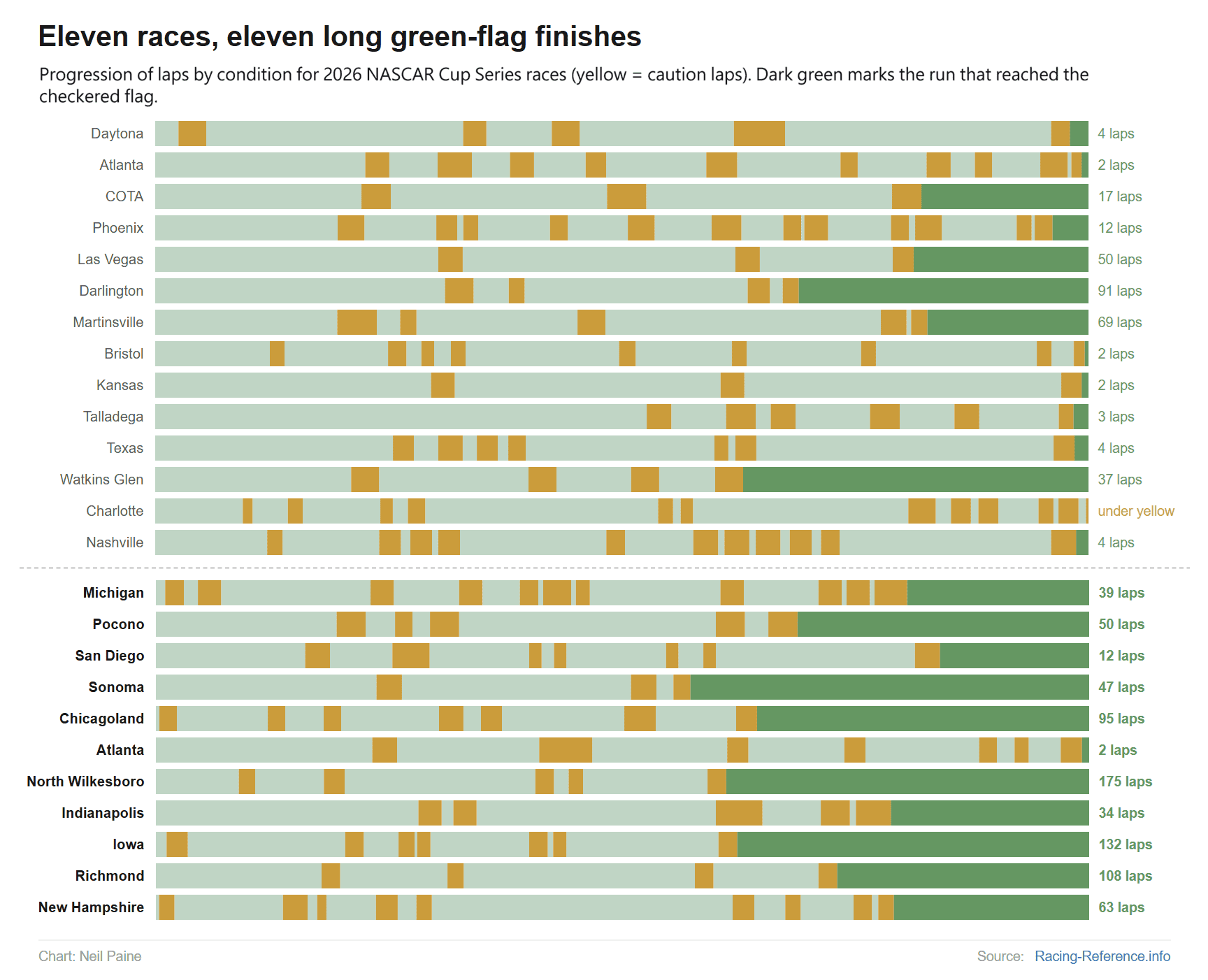
Those 63 closing green-flag laps at Loudon represented 20.9% of the 301-lap race, and somehow that was actually a short closing stint by recent standards. The week before at Richmond, the final 108 laps — or 27.0% of the race — were conducted under green, with winner Joey Logano leading the last 25 laps. A week before that, at Iowa, the final 132 laps (37.7%) ran under green as well, with winner Ty Gibbs leading the last 20.
All told, only one of the past 11 races — EchoPark in Round 20 — had a final green-flag stint shorter than 16% of the total race distance, and the average final-stint share under green in that span was 26.5% of the full race:
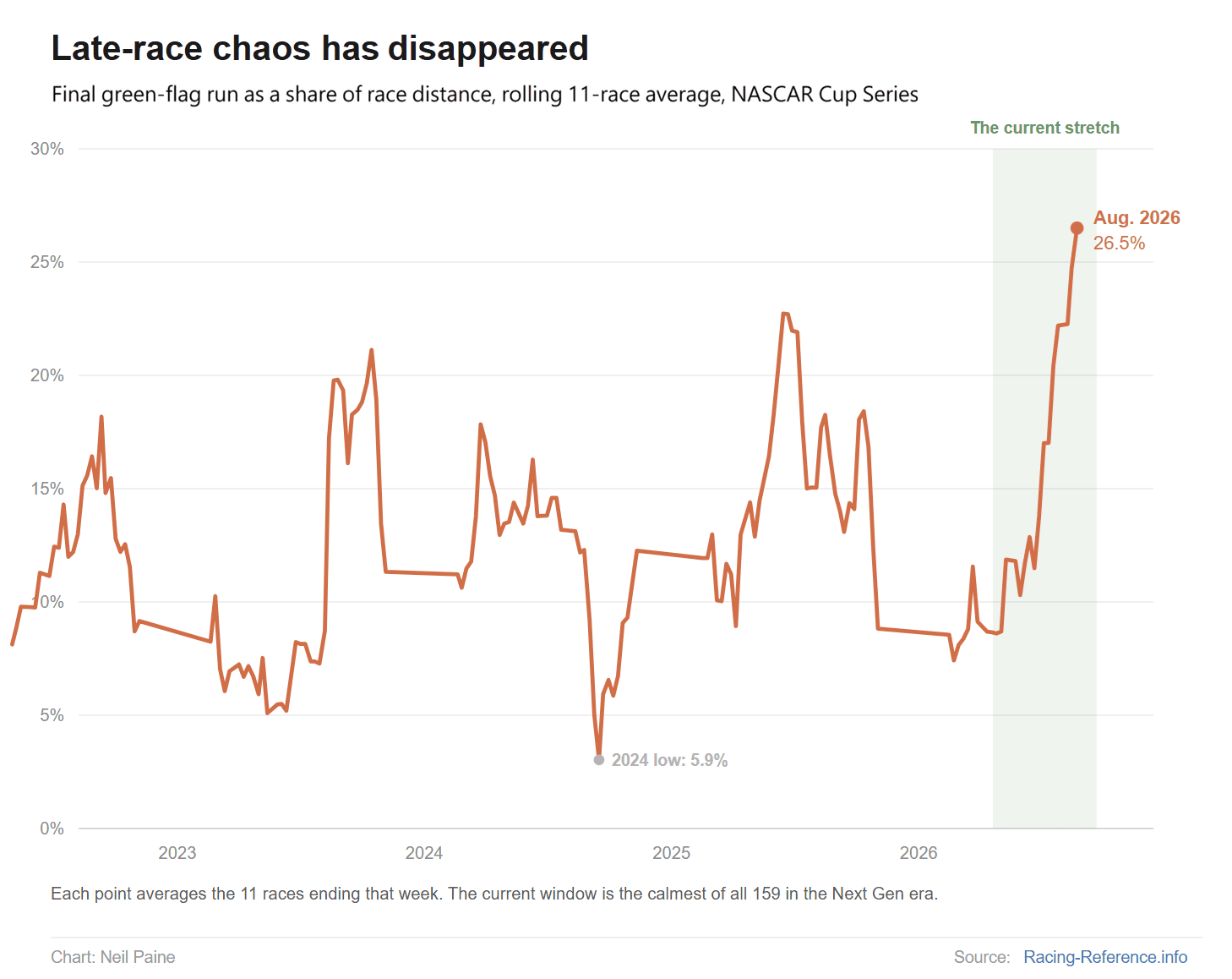
Needless to say, that’s not what we typically see over such an extended period. In fact, during the Next Gen era (since 2022), this is the highest average share for closing green-flag stint lengths in any 11-race period, beating out late March to mid-June of last year (22.7%): As you might expect, this trend has favored the best drivers — or at least the most dominant teams of the day.
Thus far in the Next Gen era, when a race has finished under yellow and/or the final green-flag stint has accounted for less than 2% of its total length (a sample that includes many overtime finishes), the eventual winner has led the most laps just 21.2% of the time and averaged a laps-led share of just 15.4%. But when the final green-flag stint has accounted for more than 2% of the race’s total length, the winner has led the most laps 48.9% of the time, and the winner’s average share of total laps led has jumped to 32.2%.
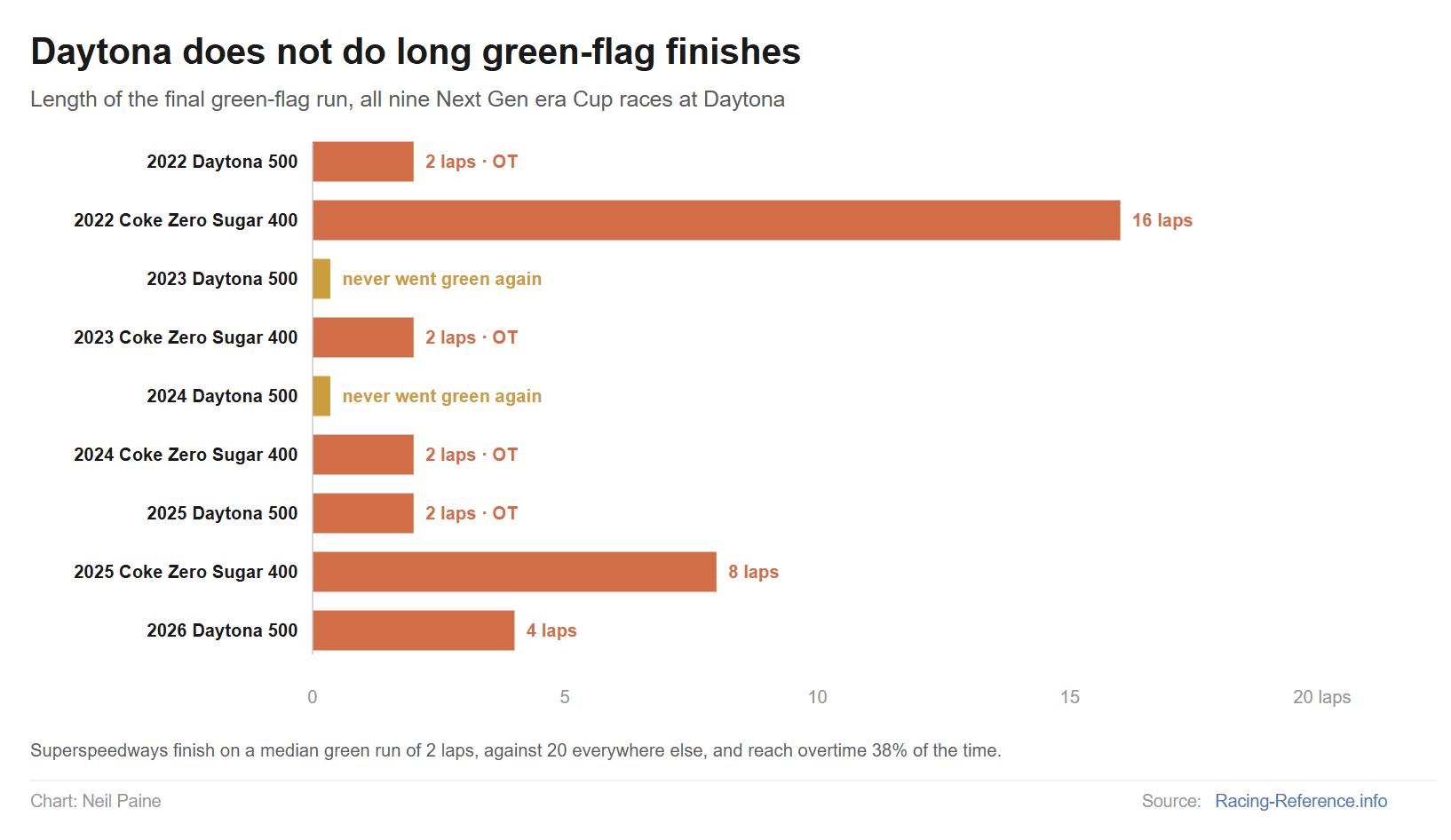
That’s been good news for teams and drivers with great equipment, speed and strategy — and it has fundamentally reshaped The Chase standings compared with where things stood before the summer calm. However, the Daytona storm is here to shatter that sense of stability. If we look at all Next Gen-era Cup races at Daytona, the average final-stint share is just 2.4% of the race, including two that finished under yellow and only two that went longer than 2% of the total race laps under green at the end — the 2022 Coke Zero Sugar 400 (10%; won by Austin Dillon) and the 2025 Coke Zero Sugar 400 (5%; won by Blaney): And what a time for things to get scrambled, because a lot will be at stake Saturday. (It’s almost like the schedule-makers knew what they were doing!)
For one thing, five drivers remain eligible for three unclaimed spots in The Chase. The central cutline battle, though, is between Shane van Gisbergen and Ryan Preece. SVG has a 31-point cushion in the standings, so he is a strong favorite to grab the last spot — particularly considering he has a much higher average Driver Rating on drafting tracks this season (80.9) than Preece does (66.3). But given Daytona’s potential for chaos, even a 31-point lead is not completely safe.
Beyond that, the fight will be all about seeding. Denny Hamlin already clinched the most important seed, No. 1 overall, before even rolling out on the track this weekend, which is a relief for the No. 11 team considering his surprisingly poor form at the “World Center of Racing” in the Next Gen era: In nine starts there since 2022, Hamlin has finished 24th or worse in seven of them.
Below Denny, though, the closest gaps in the standings belong to No. 7 Kyle Larson over No. 8 Chase Elliott (one point), No. 10 Chris Buescher over No. 11 Carson Hocevar (four points), No. 9 Joey Logano over Buescher (six points) and No. 12 William Byron over No. 13 Daniel Suárez (six points). Given what we know about how final regular-season seedings lead to eventual Chase rankings, the most important of those battles in terms of the championship might be over Larson’s current spot in the pecking order.
Otherwise, the closest fights among the top six drivers in the current standings are No. 5 Christopher Bell’s 11-point edge over No. 6 Chase Briscoe, and No. 3 Ty Gibbs’ 20-point gap to No. 4 Tyler Reddick. Those battles may prove every bit as important as the fight to be in the top seven — likely the very edge of where the eventual champion might emerge from — or the SVG-Preece scrap to make The Chase at all.
But that’s the catch with taking all these carefully accumulated advantages to Daytona for the regular-season finale: They can disappear in an instant.
For most of the summer, NASCAR has rewarded the drivers who were fastest and smartest over long, uninterrupted closing runs under green-flag conditions. But now, with The Chase field and its final seeding order ready to be set at last, the end of the regular season may come down to something we’ve barely seen in the past three months or so — one late restart and a couple of laps of pure chaos, with everything on the line.
NASCAR’s regular-season bookend is poised to deliver another memorable finish.
One hundred and ninety-five days after commencing the 2026 campaign with the Daytona 500, the Cup Series returns to the Floridian high banks, with drivers hungry to make one last push toward the postseason.
But this regular-season finale looks different than others. For starters, series officials are implementing a new package headlined by a shorter spoiler and reduced horsepower, all intended to increase passing opportunities amid the draft and reduce fuel savings. The points implications, while still crucial for teams at both ends of the spectrum, aren’t as conspicuous with the reintroduction of The Chase format — which eliminates the last-ditch win-and-you’re-in scenario offered by the previous playoff format.
That said, this is still superspeedway racing. Unpredictability clashes with skill and controlled chaos. The aura and spectacle remain unparalleled as drivers search for career-altering victories amid the humid ocean breeze. And when Cup Series stars hit the track Saturday night at Daytona International Speedway (7:30 ET, NBC, HBO Max, MRN Radio, SiriusXM NASCAR Radio), it’ll remain anyone’s game.
New postseason format, same Daytona.
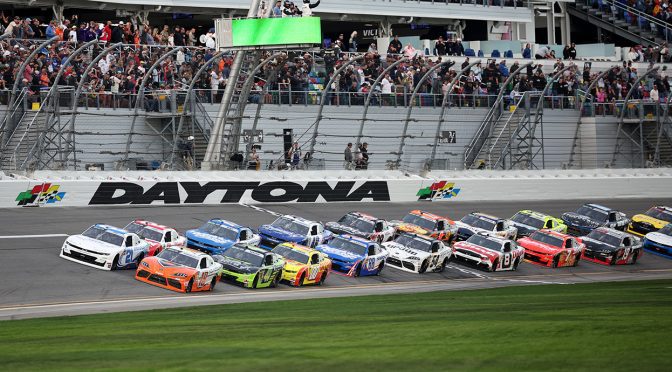
It doesn’t matter what the stakes are — expect a late caution. Just one of the last 18 Daytona races has ended with a green-flag stretch longer than eight laps. In nine of the last 11 races here, the eventual winner led 10 or fewer laps, with three leading only the final lap. Each of the last four races at the track has resulted in a last-lap pass, including Tyler Reddick’s thrilling victory in the “Great American Race” in February. Narrowing it down to the summer race alone, no stage winner has ever gone on to win the 160-lap event. Twelve of the last 18 summer Daytona races required overtime, including four of the last six.
The last time the Coke Zero Sugar 400 went into overtime? 2024, when Harrison Burton became the fourth driver since 2018 to score his first career Cup win in that race, earning the 100th victory for famed Wood Brothers Racing in the No. 21 Ford. The triumph secured Burton a postseason spot just weeks after learning he wouldn’t return to the organization in 2025.
And coincidentally, the current Wood Brothers driver faces similar circumstances. Josh Berry revealed in June that he won’t return to the team next season, with his NASCAR future uncertain. He enters Daytona on a career-best four-race top-10 streak, maintaining an average finish of 5.5 in that stretch and improving his points position from 33rd to 29th. Last weekend at New Hampshire, Berry arguably had the best car, leading a career-high 73 laps before finishing on the Loudon podium for the second consecutive year.
Unlike Burton, Berry is a previous Cup Series winner with a Las Vegas triumph in his pocket last year. The industry notion is that winning takes care of problems, so with career pressure ratcheting up, an opportunity for a life-changing win still exists — even without a postseason pathway.
New format, same Daytona.
Kevin C. Cox | Getty Images
But yes, even without win-and-you’re-in stakes to stir the playoff pot, a few final Chase spots remain up for grabs. Five drivers remain mathematically eligible for three remaining postseason positions: Bubba Wallace (plus-75), Austin Cindric (plus-44), Shane van Gisbergen (plus-31), Ryan Preece (minus-31) and Brad Keselowski (minus-66).
Notably, Preece is among nine full-time drivers without a win at NASCAR’s highest level. Daytona will mark his 249th start in the Cup Series, spread across five different organizations, and his 34 drafting-track starts without a win are the sixth most among entered drivers. Preece finished ninth last weekend at Loudon, shaving 19 points off his deficit to SVG. To make The Chase, his simplest path is outscoring van Gisbergen by 32 markers, something he’s done twice this season: Las Vegas (32) and Naval Base Coronado (44). He’s earned the 10th-most stage points on drafting tracks this year, a number that plays into the No. 60 RFK Racing driver’s favor.
Of course, winning would be most beneficial. He proved his prowess with an exhibition triumph at Bowman Gray Stadium in the spring, and with victories paying an additional 15 points compared to the playoff format, a Daytona dub would heighten the tension for SVG while allowing Preece to finally break through at the sport’s grandest arena.
New format, same Daytona.
Further up the standings, several key micro-battles exist, which will determine final Chase seeding. It’s pretty straightforward: the higher a driver finishes in the regular season, the greater the advantage they will receive over the field for the 10-race postseason run. Denny Hamlin clinched the No. 1 seed with a seventh-place Loudon effort, guaranteeing he’ll start The Chase with 2,100 points — 25 more than the No. 2 seed.
But the other 15 seeds aren’t set in stone, even with 13 drivers already locked into The Chase. The potential points swings are endless, and really quite remarkable. Fifth to eighth in the standings are separated by just 31 points, while ninth to 14th are 52 points apart.
Kyle Larson, currently seventh in the series ranks after crucial consecutive top-six efforts at Richmond and Loudon, could surge as high as fifth but also drop as low as 12th after Daytona. That’s a 35-point difference in seeding — 2,055 points to 2,020 points. His Hendrick Motorsports teammate William Byron, 12th in points, could improve to seventh or could fall as low as 16th. That’s a 45-point difference in seeding — 2,045 points to 2,000. Cindric, who’s fighting for his Chase life, could start the postseason as high as 12th or could plummet as low as 20th — far out of the championship equation.
These battles carried less weight during the playoff era, when accumulating playoff points was paramount. The Chase opens a Pandora’s box of key Daytona battles — primarily among drivers with true championship aspirations, not just last-ditch winners. And the aggression level will remain unrivaled as drivers jockey for crucial postseason positioning.
New format, same Daytona.
Just think about all the stakes … and, oh, yeah … they’ll unfold with a never-before-run superspeedway package and precisely zero minutes of practice. Talk about another wrinkle to an already wild-card event. Handling will be at a premium as cars hit the high-speed draft for the first time in race conditions. Drivers won’t know how their cars balance until actually making moves when it counts, forcing trust in their machines and their talent.
That new package could create even more parity than past Daytona races. The 2.5-mile oval has delivered more first-time winners than any track (24), nearly doubling the total at Talladega Superspeedway, a comparable track. Daytona also leads the way in overtime finishes with 25.
And all of that’s to say 400 miles under the Daytona Beach lights could ultimately become a microcosm of the 2026 season so far. Twenty different drivers have won stages. The season’s 587 lead changes are the fifth-most all time through 25 races. Three 23-year-olds won their first races: Ty Gibbs (Bristol), Carson Hocevar (Talladega) and Corey Heim (Naval Base Coronado), matching the number of first-time winners from the previous three years combined. The winning pass came in the final eight laps in eight of the last 17 races.
Surely, the implications are different this Saturday when the Cup Series returns to the “World Center of Racing,” but the pressure remains just as high.
Both the NASCAR Cup Series and O’Reilly Auto Parts Series host their regular-season finales at the famed Daytona International Speedway. There will be one DNQ from both series, as Cup has 41 entries for 40 spots and O’Reilly has 39 entries for 38 spots. There will be two rounds in both qualifying sessions, with the top 10 speeds in Round 1 advancing to compete for the pole. See qualifying orders for both series this weekend.
Through the years, some of the best and brightest Modified racers have called Stafford Speedway home.
Legends like Bugsy Stevens, Richie Evans, Fred DeSarro, Geoff Bodine, Reggie Ruggiero, Charlie Jarzombek, Mike Stefanik and Ted Christopher are among those who have claimed track championships at the historic half-mile oval located in Stafford Springs, Connecticut.
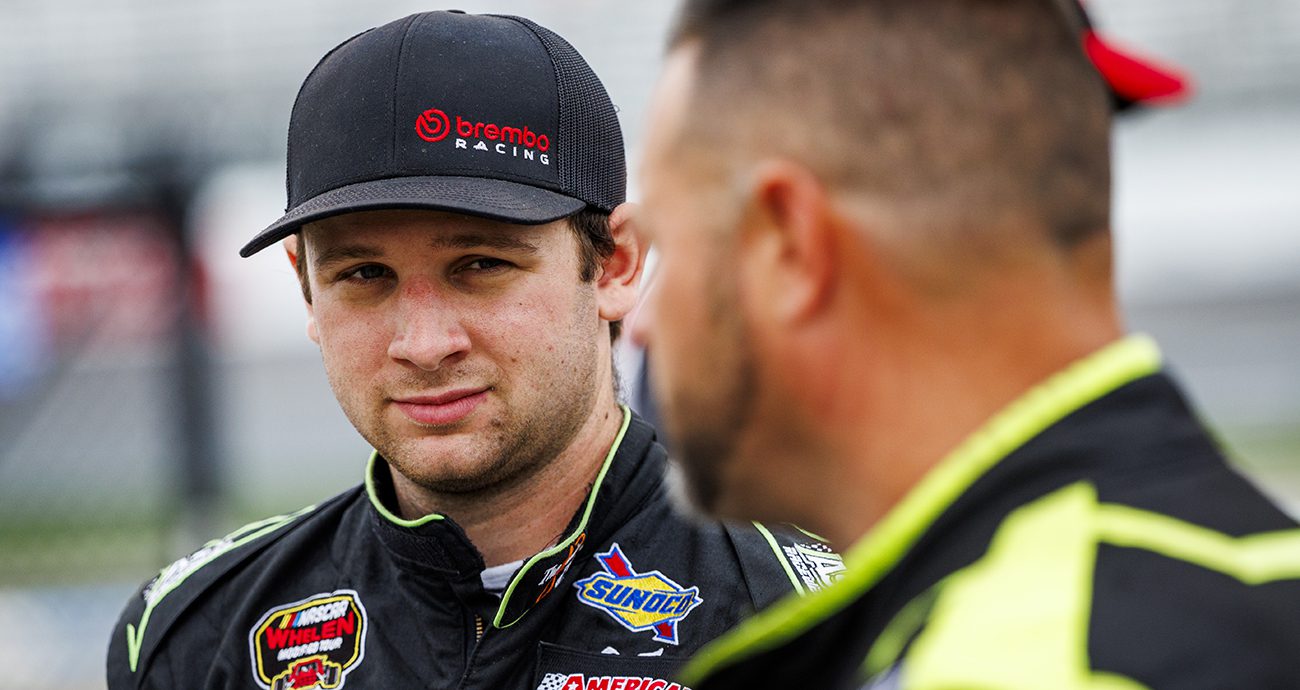
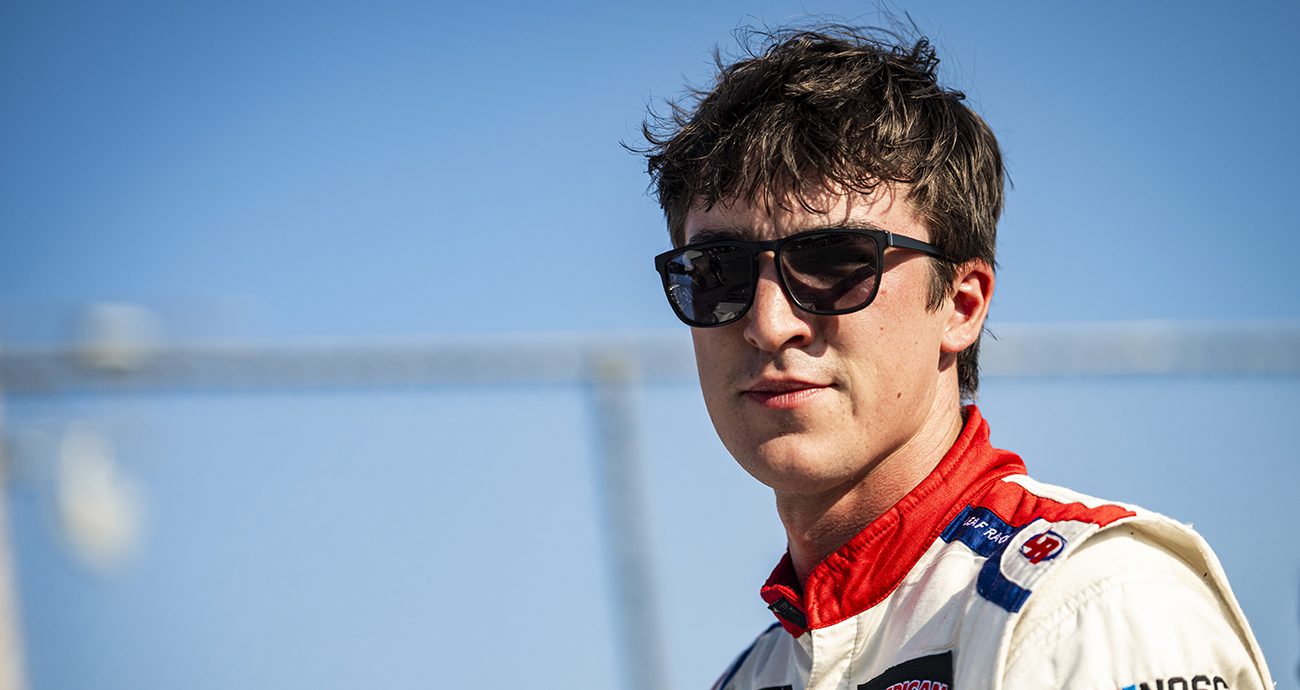
Fast-forward to today, and Stafford continues to be a proving ground for future NASCAR Whelen Modified Tour stars. Many of the series’ current crop of competitors have honed their skills at Stafford before hitting the road with the Modified Tour.
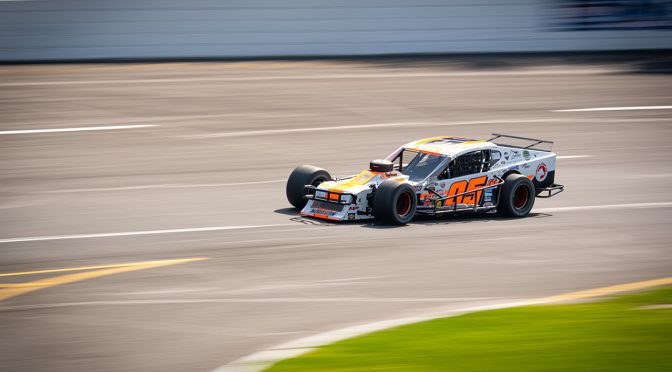
As NASCAR’s oldest division prepares to return to Stafford for the first time since 2021 this Friday night for the running of the GAF 150 (8:45 p.m. ET on FloRacing and the NASCAR Channel), several modern stars will hope to turn their experience into a trip to Victory Lane.
Take Stephen Kopcik for example. The Newtown, Connecticut native is an 18-time feature winner at Stafford. Amongst his successes is a victory in one of the track’s marquee events, the 2025 Spring Sizzler. Ten years earlier, he captured the SK Light track championship at Stafford.
Another prime example is six-time Modified Tour champion Doug Coby. He’s a two-time track champion at Stafford in the Late Model and Pro Stock divisions and a 12-time Modified Tour winner at the track. He’s also a four-time Spring Sizzler champion.
Mike Christopher Jr. practically grew up racing at Stafford. Following in the footsteps of his late uncle Ted and his father Mike, the newest member of the Christopher racing clan is a 28-time Stafford winner across multiple classes.
Two of the Modified Tour’s newest stars can also include their names on the list of Stafford Speedway champions. Andrew Molleur conquered Stafford’s SK Modified division in 2024, and Teddy Hodgdon collected the SK Light Modified championship in 2019.
Ronnie Williams, a part-time Modified Tour competitor, is another driver who is no stranger to Stafford. He collected consecutive SK Modified championships in 2018-19 at Stafford.
Of the 25 drivers entered in Friday’s GAF 150, 16 have visited Victory Lane at some point at Stafford. It further supports the notion that if you can win at Stafford, you can win anywhere.
Austin Beers now finds himself tied with Patrick Emerling at the top of the NASCAR Whelen Modified Tour standings with four races left in the season. (Photo: Adam Glanzman/NASCAR)
Championship battle heats up with four races left
Following an unpredictable Mohegan Sun 100 at New Hampshire Motor Speedway last weekend, the race for the Modified Tour championship is as close as could be.
Following an early crash that resulted in a last-place finish for Patrick Emerling, he is now tied with defending series champion Austin Beers at the top of the standings entering Friday’s GAF 150 at Stafford.
Beers seems to have found his stride in the last few events. He finished second at White Mountain Motorsports Park after leading 80 laps, which he backed up with a third-place effort at Monadnock Speedway after leading 50 laps.
Beers finishes second at Thompson Speedway Motorsports Park after starting from the pole and leading 29 circuits. He then won the pole again at New Hampshire and led 32 laps before a late spin dropped him to 19th.
Emerling has equaled his career high with three victories this year and has led a series-best 348 laps through the first dozen races. Also in the conversation is Jon McKennedy, who finds himself only 24 points behind the leaders thanks to his third victory of the year last weekend at New Hampshire.
With events at Stafford, Oswego Speedway, Riverhead Raceway and Thompson remaining on the schedule, anything can happen as the battle for the series championship comes down to the wire.
Mike Christopher Jr. is one of many Modified Tour drivers with ample experience at Stafford Speedway. (Photo: Jaiden Tripi/NASCAR)
Christopher eyes continued family success at Stafford
When you look at the list of all-time winners at Stafford Speedway, the Christopher family is well represented.
Sitting at the top of the record books is Ted Christopher, a 131-time winner at Stafford across all divisions. The late Modified Tour legend is also a nine-time champion in the track’s SK Modified, with his first title coming in 1987 and his final championship coming in 2014.
Then there’s his twin brother Mike, who captured Stafford’s SK Modified championship three times between 1989 and 1993 and is a 28-time feature winner at the half-mile asphalt oval.
Now there’s Mike’s son, Mike Christopher Jr. The driver of the No. 31 Elite Racing Modified on the Modified Tour is also a 28-time winner at Stafford during his young career, with his most recent win coming just a few weeks ago.
If you’re looking for a favorite ahead of Friday’s GAF 150, it would be hard to bet against Mike Christopher Jr. After all, he’s been looking forward to this race all year.
“The Tour deserves to be at Stafford. It’s what it’s known for,” Mike Christopher Jr. said. “You think of the Tour, you think of the Northeast and New England, and when you think of Modified racing, you think of Stafford.”
The most powerful website in NASCAR during the nascent days of the Internet was operated out of a tiny yellow and orange bedroom near the Jersey Shore.
It started as a side project in a college computer lab.
Its mysteriously unusual but extremely catchy name was derived from its founder, who wrangled carts while loading C-5s as a crew chief in the U.S. Air Force.
Jayski.com
Jay Adamczyk kept correcting a tech sergeant’s pronunciation of his last name to “A-DAM-sick” from “A-DAM-ski” when being summoned on the base radio.
“He was like, ‘Hell, we’re going to call you ‘Jayski’ then,’ ” Adamczyk said with a laugh. “All I heard was, ‘Hey Jayski, we need a cart.’ Then it kind of just laid dormant until I started the site. Who would have known?”
The nickname morphed into a moniker that became omnipresent in stock-car racing during the late 1990s and early 2000s.
At its peak, Jayski’s Silly Season Site drew close to 100 million page views annually and became the indispensable best source for NASCAR information. It was a favorite of the late Kyle Busch, who gleefully checked daily in the offseason for paint scheme releases.
“I used to pull up Jayski every day,” Kevin Harvick said in 2019. “That was really where I went to get all my racing news.”
The site’s improbable success story is hard to fully comprehend without having lived in the moment when NASCAR champions, reporters and die-hard fans spent a significant portion of their days constantly refreshing a spartan website sporting yellow-and-black overtones and an emphasis on goofy clip art-style smiley faces.
“Jay just caught lightning in a bottle for some reason,” said Scott Page, who joined Jayski in 2006 and now oversees its daily operations. “None of it makes sense. How he started it, how it got traffic, how somebody decided to email him. It was really organic the way it developed, although the site had everything you could ever want in it. It was overwhelming.
“But how he did it, I don’t know that you could ever explain it.”
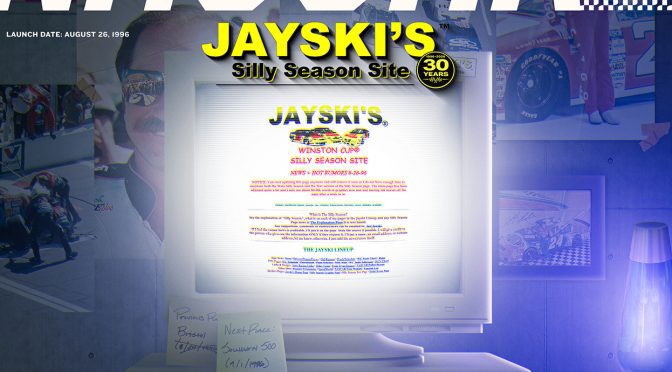
Jayski celebrates its 30th anniversary today after surviving its rockiest decade.
The rise of digital and social media and the decline of traditional media fundamentally affected some of the core attractions of Jayski, which blended a heavy dose of rumormongering with well-curated links to stories by the best beat journalists covering NASCAR.
Bought by ESPN 20 years ago, Jayski went dark in January 2019 for four months. ESPN soon returned the site and its URL to Adamczyk (whose request to reclaim ownership was granted at no charge).
The resurrected Jayski aligned with NASCAR Digital Media in May 2019 and has enjoyed a seven-year renaissance.
Once known as the place where fans flocked to read hourly rumors (often unverified) about which drivers were getting fired and hired, Jayski is now a trusted repository for recalling the paint schemes and headlines of bygone eras.
Its voluminous archives are housed across more than 100,000 posts, pages and images, and the site still churns out more than 2,000 news items annually.
“It’s kind of crazy,” Adamczyk said. “I never expected it to last 30 years.”
Simplicity that even a mother could love
Adamczyk launched Jayski as a basic tribute to favorite driver Ernie Irvan, fulfilling a class assignment to create a webpage as he learned HTML coding. Fans emailed him with questions about the status of other drivers, so he created a team chart to track their movement and rechristened the site as “Jayski’s Silly Season” on Aug. 26, 1996.
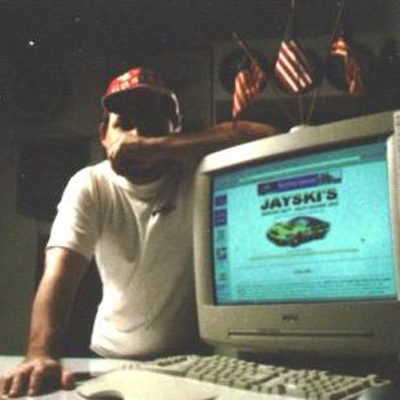
Shortly before starting the site, Adamczyk had moved back in with his parents near Atlantic City, New Jersey, where he worked as a contractor for the FAA on Y2K computer programming. Until he moved to Mooresville, North Carolina, in 2004, Adamczyk ran Jayski out of his little sister’s former bedroom, which was barely large enough for a computer and TV amid its garish 12- by 18-foot walls.
“I eventually had to paint it,” he said. “I couldn’t work in that.”
Adamczyk loves Internet searching (AltaVista was his web crawler of choice in the early days) and falling down rabbit holes while researching arcane trivia. His curiosity sparked Jayski’s first big traffic win.
He stumbled across a page on the University of Nebraska website about sponsoring the Melling Racing car driven by Lake Speed. The link was posted on Jayski and drew an unheard-of 10,000 views within a month (as well as an email from Speed).
“That was probably the first thing I put up that no one else really knew about,” Adamczyk said. “I just happened to be hunting around, and that was the fun part: Searching around the Internet trying to find stuff you didn’t see anyplace else.”
He built readership traction by sharing Jayski’s unique content in the newsgroup message boards that were ubiquitous in the pre-Google era.
His posting methods are considered primitive now. There was no content management system, and Adamczyk posted everything through HTML (which he still uses when working on the site, even though Jayski is now operated through WordPress). Because of its limited bandwidth, the site consisted mainly of easy-to-load links and headers.
Page was told that the design was geared toward Adamczyk’s mother, who read the site daily (and often informed her son of his spelling errors).
“He wanted simplicity because he wanted his mother to be able to know where to find information,” Page said. “You don’t want to bury things under three sublinks. There may have been a hundred links on the old main Jayski page, but you knew it was all there. We’ve tried to keep that as best as we can. ‘Keep it simple, stupid’ is still kind of the theory.”
As traffic grew beyond Adamczyk’s immediate family, so did the tips with news and nuggets.
He estimated getting 100 daily emails from NASCAR sources (and laments having lost access to most of the messages after changing servers so many times).
He tried to respond to and verify as many as possible amid 15-hour workdays, seven days a week.
“It was totally by the seat of my pants every day,” he said. “I sort of had a little bit of a schedule, but nothing written down.”
Until Page was hired as his right-hand man (and the “designated survivor” for ESPN, which worried what would become of Jayski if anything happened to its workaholic founder), Adamczyk never took a full day off while running the site as a one-man band from 1996-2005.
His laptop accompanied him on ski vacations to the Italian Alps or sightseeing tours to the San Francisco Bay. He built many of the site’s team pages during a trans-Atlantic flight (“back then, you could work offline”).
Adamczyk focused heavily on updating the “Article/Story Links” page, which was inspired by the “Law and Order” show (“I heard, ‘Here are their stories’ and thought that was cool.’ ”).
The comprehensive list of breaking news and feature stories by NASCAR beat reporters at newspapers around the country was an agenda-setter. Reporters emailed Adamczyk to highlight their work and then stayed up until midnight as their stories made the site’s last refresh of the day. (He usually worked until 2 a.m.)
“I would just try to get some kind of news up every day,” he said. “I’d save some things so people had something to read.”
When Adamczyk quit his job to work on the site full time in 1999, he briefly considered buying a new domain name to rebrand the site.
“I put a poll out there and Jayski.com won overwhelmingly,” he said. “After that, I never really thought about changing it.”
Give me the paint schemes, not the spotlight
During a mid-2000s induction ceremony for the North Carolina Auto Racing Hall of Fame that was emceed by Benny Parsons, the spotlight suddenly shifted onto a surprised Adamczyk.
“There’s someone in the house that you all might know,” Parsons said. “Here’s Jayski!”
Adamczyk was briefly mortified.
“I”m like, ‘Oh crap,’ ” he said. “And then everyone gave me a big ovation.”
The rest of the evening was spent taking photos with fans and meeting with NASCAR industry members. The extended family of Wood Brothers Racing were among his biggest admirers. Darrell Waltrip greeted him with a big hug.
“He’s like, ‘I read your stuff every day before I get on the air, so I know what the hell I’m doing,’ ” Adamczyk said. “All that was kind of cool.”
It was a rare instance of personal interaction with the people that he devoted his life to detailing.
The race track was the least likely place you’d find Adamczyk, who hasn’t attended a NASCAR event in 15 years.
When he went, it was usually as a dignitary — a fan Q&A with Ricky Rudd at Las Vegas Motor Speedway or the Grand Marshal of an ARCA race at Charlotte Motor Speedway.
The main appeal of being at the track was taking photos of cars and their liveries from multiple angles. He tried working a few times in media centers but was discouraged by unreliable Wi-Fi and hours that weren’t conducive to a night owl.
Plus, there was the awkward feeling of being surrounded by laptops all open to Jayski and being checked constantly for news.
“It was surreal,” he said. “A lot of people would come up and talk to me. ‘Are you really Jayski?’ I’m like, ‘Yep.’ ”
Some big scoops were owned by Jayski, which appeared annually in early 2000s on the Charlotte Observer’s list of the 25 most influential people, places and things in NASCAR.
After being announced to head Dodge’s entry to Cup in 2001, Ray Evernham joked with reporters, “I’m going to do a lot of things. Don’t you read Jayski?”
But there were also some huge misses. When Jayski reported that Budweiser was considering a sponsor reunion with Waltrip, the driver’s business manager sent a categorical denial.
On July 5, 1999, Jayski cited sources at Richard Childress Racing confirming the impending release of Mike Skinner. The next day, the team said Skinner was expected to be re-signed.
“Richard Childress wanted to kill me at one time,” said Adamczyk, who eventually made peace with the team owner in a chance meeting at his winery.
Those dynamics have changed in the age of teams controlling the message through social media channels.
“Most of the teams want to work with you now, especially our site,” he said. “You’re not going to get the rumors like you used to because the teams will put them out before then.”
Page, who staffs Jayski with Dustin Albino and Amanda Brooks, said the goal is emphasizing its historical treasure troves while staying true to its roots as a focal point for modern-day information.
“Jayski was known as a rumor site, but now I consider it through all those years to have been more of a clearinghouse,” Page said. “It took all this information from other sites, and all those sites have gone away. So, we’ve at least got the mention of what was posted. The links are bad, but there’s still that record of history.”
Adamczyk, who will turn 65 later this year, has downshifted his involvement but still works on Jayski’s stats section.
“Stats aren’t a big draw. I pretty much do it because I enjoy it and want to keep it updated,” he said. “That’s kind of the point of the site: Helping people find info.”

 Needless to say, that’s not what we typically see over such an extended period. In fact, during the Next Gen era (since 2022), this is the highest average share for closing green-flag stint lengths in any 11-race period, beating out late March to mid-June of last year (22.7%):
 As you might expect, this trend has favored the best drivers — or at least the most dominant teams of the day.
 And what a time for things to get scrambled, because a lot will be at stake Saturday. (It’s almost like the schedule-makers knew what they were doing!)