LEBANON, Tenn. – Layne Riggs was not going to be denied at Nashville Superspeedway.
But both Rajah Caruth and Riggs’ Front Row Motorsports teammate Chandler Smith made the No. 34 truck earn it in the closing laps of the Craftsman Truck Series Allegiance 200.
After racing NASCAR’s equivalent of a perfect game through the opening two stages, Riggs plummeted to 16th in the running order with an ill-handling truck early in the final stage. It was Caruth who was in position to capitalize late in the event.
On fresher tires, Riggs restarted 10th with 15 laps remaining and drove to third in quick order, a distant 3.5 seconds behind Caruth’s No. 7 truck with less than 10 laps remaining. With three laps remaining, though, Riggs overtook Smith for the runner-up spot and immediately was in the catbird seat.
Caruth weaved back and forth down the backstretch with two laps remaining, attempting to break Riggs’ draft. The newer tires proved beneficial, however, as Riggs dove deep into Turn 3, getting to the outside of Caruth through Turns 3 and 4 as the duo traded paint.
“It was super bold looking back,” Riggs said of his pass on Caruth. “I didn’t lift until I got to his outside, and I was like, ‘I’ll just figure the exit out later.’”
With a push from Smith, Riggs escaped with the lead and quickly put nearly a half-second on Caruth to win consecutive races for the second time in his Truck Series career.
“I blacked out those last 10 or 15 laps just to get to the front,” Riggs said in his post-race press conference. “Those guys gave me such a good truck in the first two stages; they gave me a shot at the end to win it back and claw back to the front. I knew I couldn’t leave here without that guitar.”
Caruth was largely powerless to prevent the winning pass.
“The tire advantage was super strong,” Caruth told reporters after the race. “I gave up my right side and thought I ran him high enough, but he had a lot of grip and stayed there. He had me hooked and I said, ‘Man, I can’t turn myself to take us both out.’
“I was hoping I could run it in there and slide up, but he was nose up and I wasn’t going to take a guy running for points out of the race, and these 7 guys are running for [the owner’s championship]. I took my losses and came home second.”
The only way Caruth could have kept the lead was by putting himself in a position that likely would have ended in a crash. That’s something he wasn’t willing to do with Spire Motorsports chasing a title.
“You tell yourself in these situations that you want to come show up and win and come home with nothing but the trophy,” he stated. “But these guys are racing for owners’ points. I didn’t get all the way there in [Turns] 3 and 4 to shut it off, and I was like, ‘I can’t take them out of a finish.’
“They were teammates, obviously, so they weren’t going to give each other much of a battle. I had a lot of fun and definitely things I could have done better at the end.”
Smith had a front-row seat for the Riggs and Caruth battle. The Daytona winner from February was hoping to be in position should the two leaders tangle.
“Once [Riggs] got to [Caruth], I was trying to position myself if they have an incident on the frontstretch to try to capitalize to where I could possibly get the win myself,” Smith stated. “I was able to push the 34 out and let him get clear to the lead. Happy for those guys and happy for our 38 team as well.”
By sweeping all three stages and recording the Xfinity Fastest Lap, Riggs became the second driver in the series this season to score a maximum 76-point day. He leaped Kaden Honeycutt to take the regular-season championship lead.
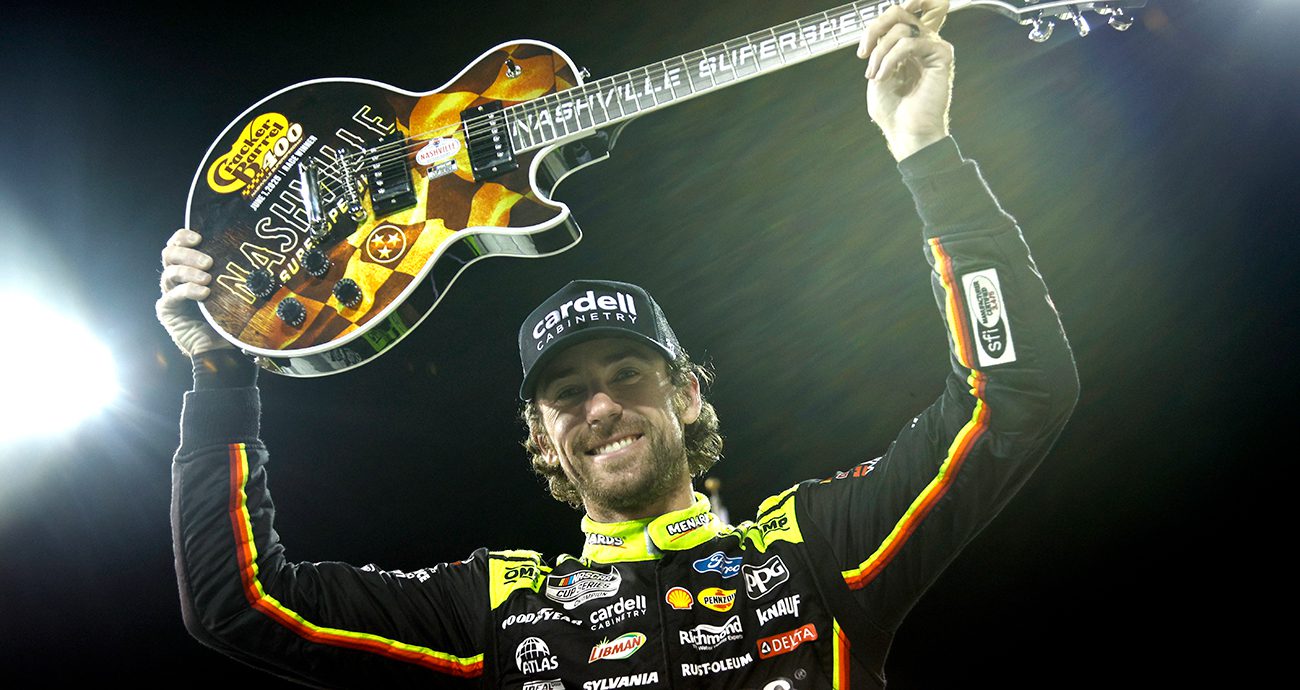
LEBANON, Tenn. — Layne Riggs set the pace early in Friday night’s rain-delayed NASCAR Craftsman Truck Series race at Nashville Superspeedway, then rallied to a dramatic final-lap pass when it mattered most to claim the track’s iconic “Victory Guitar” trophy in the Allegiance 200.
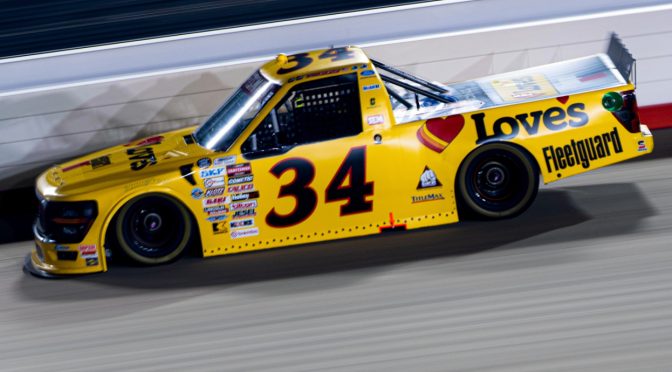
Riggs, who started sixth on the race’s eighth and final restart with 16 laps to go, passed the defending race winner Rajah Caruth coming off Turn 2 on the last lap after getting a strong push forward from his Front Row Motorsports teammate Chandler Smith to hold the front position and take his second consecutive — and third — win of the 2026 season in the No. 34 Front Row Motorsports Ford.
After leading all of the opening 90 laps and claiming victories in both Stage 1 and Stage 2 of the race, Riggs restarted the final stage from the fifth row, losing positions after the competition’s varying pit strategies. His move forward afterward, however, was an exhilarating ending to a long night.
Ultimately, the 23-year-old North Carolina native and second-generation NASCAR driver took the checkered flag by a slight 0.468 seconds over Caruth, who drove the No. 7 Spire Motorsports Chevrolet originally intended to be raced by Kyle Busch, who passed away at the age of 41 from sepsis last Thursday.
It was an emotional win for Riggs, who dedicated the victory to Busch and an equally emotional outing for Caruth, who honored Busch with his own outstanding run toward the trophy, too.
“Not till I passed him and cleared him,” Riggs said of feeling confident in his dramatic comeback and energized by his triumph at a track where his father Scott Riggs won the series’ inaugural Truck race back in 2001 and two other O’Reilly Auto Parts Series races (2002-03).
“That’s how you win a NASCAR Truck race there, boys and girls. I hope I put on a show for you. I didn’t want to fall back, but I don’t know what happened with that set of tires. It was literally undrivable.
“[Crew chief] Dylan [Capello] made the right adjustments there, got me the tires, got me the motivation and drove to the front,” he said of a late race pit stop gamble for an adjustment and new tires with 32 laps remaining.
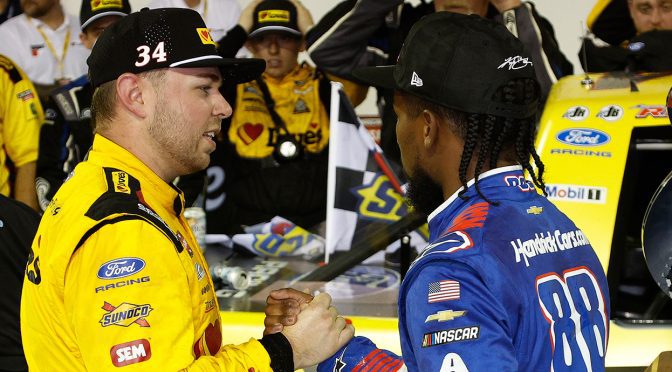
“So proud of the awesome finish there with the 38 truck (Smith), he gave me the push for the win and good racing there with Chandler tonight,’’ he added of his teammate, who finished third.
Caruth, who led 44 laps, was second only to Riggs’ effort, looked to become only the second driver in history to earn back-to-back wins on the 1.33-mile Nashville concrete oval, and certainly the talented and well-liked young driver had the emotional support of millions of NASCAR fans who would have loved to see Busch’s truck return to Victory Lane.
“I was trying to make this thing as wide as possible,’’ Caruth said of trying to hold off Riggs, whose car was on fresher tires. “But that was a great call by Brian. We were strong, but starting at the back because of qualifying [being rained out] kind of impacted our night. We got the car really strong there and probably some things I could have done better.
“Glad to give these guys a good result. … really wanted to get that one obviously for everybody that was at KBM [Kyle Busch Motorsports], especially KB’s family. Close. I just didn’t close it out.’’
“Wanted to get a trophy tonight. So close. But proud of the effort and the team.’’
Cup Series regular Ross Chastain finished fourth in the Niece Motorsports Chevrolet, followed by Tyler Ankrum in the No. 18 McAnally-Hilgemann Chevy.
Stewart Friesen, Grant Enfinger, 2024 Nashville winner Christian Eckes, Gio Ruggiero and Daniel Dye rounded out the top 10.
With his victory and a rare laps-down finish for Tricon Garage’s Kaden Honeycutt, Riggs took over the championship lead by 37 points over Honeycutt.
The Craftsman Truck Series returns to action next Saturday at the Michigan International Speedway 2-mile oval with the DQS Solutions & Staffing 250 at 1:30 p.m. ET (FS1, NRN Radio, SiriusXM NASCAR Radio). Stewart Friesen is the defending race winner.
NOTE: Post-race inspection in the Craftsman Truck Series garage was completed without issue, confirming Riggs as the race winner.
Friday night’s NASCAR Craftsman Truck Series race at Nashville Superspeedway has been delayed due to inclement weather.
The Allegiance 200 was originally scheduled for an 8 p.m. ET green flag (FS1, NRN Radio, SiriusXM NASCAR Radio) at the 1.33-mile concrete Tennessee track.
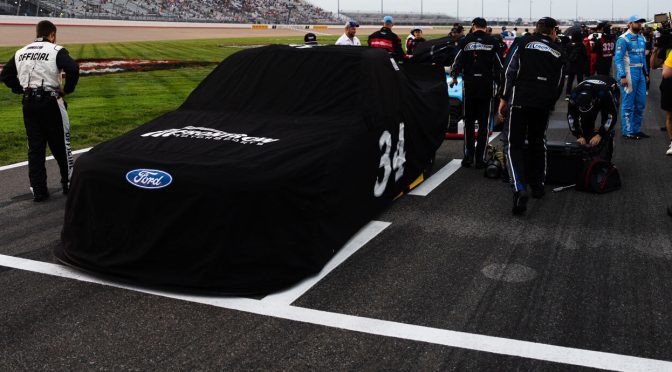
Earlier in the day, Front Row Motorsports driver Layne Riggs topped the charts in practice at 164.034 mph. Over half of the trucks entered had turned a qualifying lap before rain halted the remainder of the session. As a result, Riggs will lead the field to green in his No. 34 Ford.
Toni Breidinger and Jonathan Shafer were the two drivers who failed to qualify, with the starting lineup set per the NASCAR Rule Book.
As part of NASCAR’s ongoing commitment to creating career pathways and expanding opportunities through NASCAR Impact, the league partnered with DraftKings to host the inaugural Veteran Tech Accelerator during the 2026 Coca-Cola 600 weekend at Charlotte Motor Speedway.
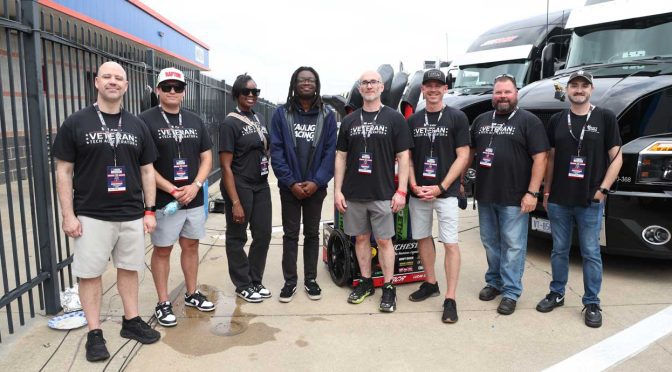
The pilot program welcomed seven veterans transitioning to civilian life for an immersive, behind-the-scenes experience focused on motorsports technology, broadcast production and live event operations during one of NASCAR’s most iconic and patriotic race weekends.
The Veteran Tech Accelerator was created in collaboration with DraftKings SERVES, which reflects the company’s commitment to investing in people, strengthening local communities and providing support to people where it’s needed most.
“Through DraftKings SERVES, we are committed to supporting veterans by advancing long-term opportunity, career development and mentorship,” said Senior Vice President of Global Communications and Corporate Social Responsibility at DraftKings. “We’re proud to collaborate with NASCAR Impact on the Veteran Tech Accelerator to provide transitioning service members with firsthand exposure to careers in technology and sports entertainment while recognizing the leadership, adaptability, and technical expertise veterans bring to these industries.”
The multi-day experience began with a full-day visit to the NASCAR Research & Development Center and NASCAR Productions facilities in Concord, North Carolina, where participants connected directly with engineers, production personnel and competition leaders to learn more about careers across the sport.
Veterans participated in two specialized learning tracks — Competition Technology and Productions — allowing them to shadow professionals aligned with their backgrounds and career interests. Throughout the program, participants observed race-week operations, explored the technology powering NASCAR competition and gained firsthand insight into the collaboration required to execute a major sporting event.
“Seeing companies, especially NASCAR, get involved in Career Skills Programs to help veterans transition is great, and I do hope to see veterans in the future working at places like this,” said Melissa Mitchell, United States Army veteran and program participant.
The program also included networking opportunities with NASCAR leadership and members of NASCAR’s Veteran Employee Resource Group, providing participants with mentorship, career guidance and feedback focused around how to translate military experience into opportunities within sports and entertainment.
The program culminated with the Coca-Cola 600 on Sunday, May 24, where participants received exclusive garage access, observed team operations, attended a meet-and-greet with NASCAR Cup Series Driver Ty Dillon and experienced NASCAR’s premier Memorial Day Weekend event firsthand.
The initiative was developed with input from NASCAR employees who are military veterans currently working in competition technology and production roles, helping ensure the experience reflected authentic career journeys and meaningful mentorship opportunities.
Editor’s note: Keep tabs on this page for lineup advice following qualifying, including changes you should consider.
Fantasy Update: Toyota largely ruled practice at Nashville Superspeedway in preparation for Sunday’s Cracker Barrel 400, holding four of the top-five spots on single-lap averages. With qualifying getting canceled due to rain, Toyota will have four of the opening six spots at the green flag. The biggest surprise was former Nashville winner Ross Chastain and the No. 1 Trackhouse Racing team, which led the way on 15-, 20- and 25-lap averages, as he slid into my 36 for 36 grid. Aside from that, the normal contenders are filled throughout my lineup.
My lineup: Denny Hamlin, Tyler Reddick, Christopher Bell, Ryan Blaney, Kyle Larson. Garage: Carson Hocevar.
The second half of the NASCAR Cup Series regular season begins Sunday at Nashville Superspeedway (7 p.m. ET, Prime Video, HBO Max, PRN Radio, SiriusXM NASCAR Radio). Recent Nashville races have been unpredictable, with each of the last three years featuring drivers who seemingly popped out of the blue to score their first win of the season. Toyota has been dominant at intermediate venues in 2026, with Nashville fitting somewhere in the middle as a 1.33-mile hybrid intermediate.
Returning to Fastlane this year is my weekly NASCAR 36 for 36 pick, where you can come play along. It’s a season-long points battle introduced in 2024 where strategy is the primary emphasis. With 36 chartered cars and 36 races on the 2026 schedule, players can choose each car once for the duration of the season.
Driver:Kyle Larson, No. 5 Hendrick Motorsports Chevrolet Selections remaining: 6 Comment: While Larson has just one Nashville win — a dominant outing in which he led 264 laps in the inaugural 2021 event — he is always at the front. The two-time Cup champion has never finished worse than eighth in all five starts. He leads the series with an average finish of 5.2 at Nashville.
Driver:Ryan Blaney, No. 12 Team Penske Ford Selections remaining: 5 Comment: It was Blaney who played the field like a fiddle last year at Nashville, leading a race-high 139 laps en route to victory. The 2023 Cup champion has been feast or famine in “Music City,” with three finishes of sixth or better and a pair of finishes of 36th or worse due to accidents. But it’s very possible that the long-run speed of the No. 12 team pays dividends again this weekend.
Driver:Denny Hamlin, No. 11 Joe Gibbs Racing Toyota Selections remaining: 4 Comment: As you can see, I’m running low on starts with Hamlin, but as he stated after winning the All-Star Race two weeks ago, anytime the series visits an oval, he expects to win. Hamlin has been snakebitten at Nashville, yet to score a win despite leading all drivers with 344 laps led and owning the best average running position at 4.98. He’s also scored stage points in all 10 Nashville stages.
Sean Gardner | Getty Images
DRIVERS TO AVOID
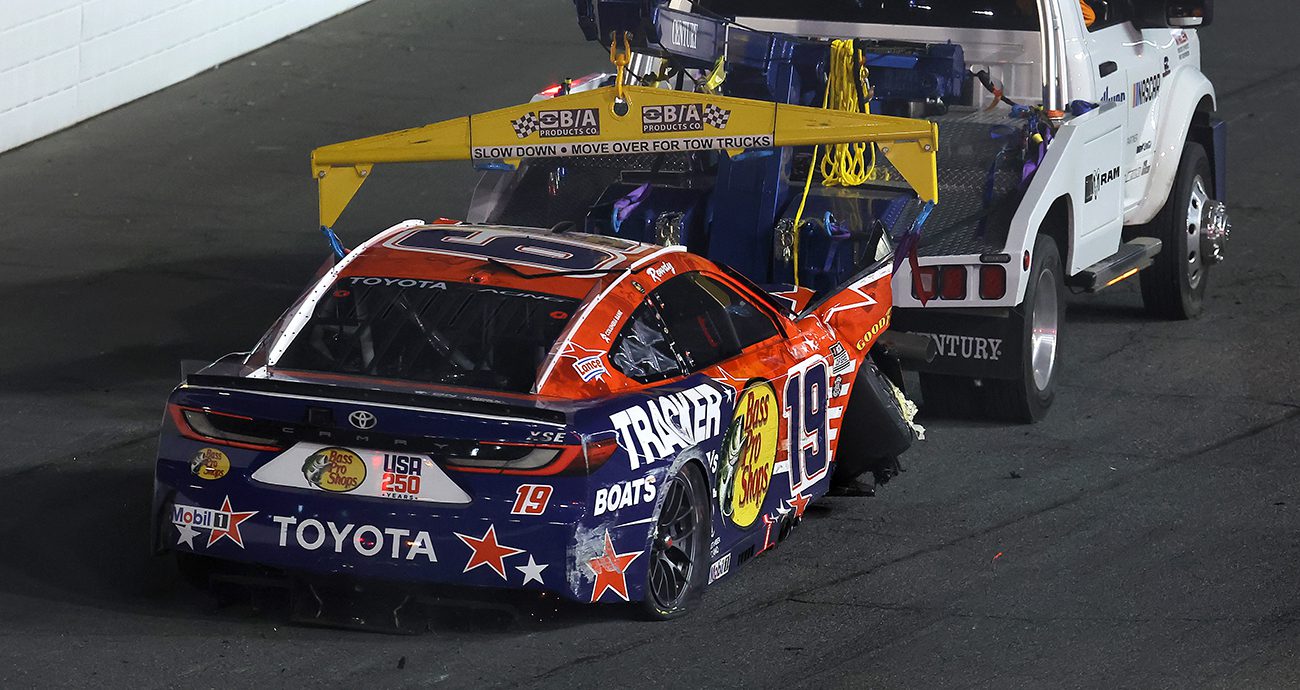
Driver:Chase Briscoe, No. 19 Joe Gibbs Racing Toyota Selections remaining: 7 Comment: Briscoe should have speed this weekend, as Joe Gibbs Racing has led more than twice as many laps as the next-closest team through five Nashville races. Still, Briscoe has a best finish of 17th at Nashville, and his 26.8 average finish is his worst among all tracks, with three finishes of 31st or worse.
Driver:Brad Keselowski, No. 6 RFK Racing Ford Selections remaining: 7 Comment: Keselowski is a two-time Nashville winner in the O’Reilly Auto Parts Series, but that success has stalled on Sundays. He has a best finish of 11th in five starts at Nashville, which is his only oval without a top 10. An average finish of 22.2 is Keselowski’s worst among all Cup ovals.
Jonathan Bachman | Getty Images
SLEEPERS OF THE WEEK
Driver:Carson Hocevar, No. 77 Spire Motorsports Chevrolet Selections remaining: 7 Comment: Even after tangling with Ricky Stenhouse Jr. last year at Nashville, Hocevar found himself in contention for the win and finished runner-up. Spire’s stock rises weekly, and this is the type of track where Hocevar excels. He has an average finish of 9.0 here, best among all venues.
Driver:Zane Smith, No. 38 Front Row Motorsports Ford Selections remaining: 10 Comment: Smith led a career-high 31 laps at the Coca-Cola 600 and had legitimate pace to contend up front. He finished second to Joey Logano in a five-overtime thriller here in 2024, and he ranks second among all drivers with an average finish of 7.5.
Matt Kelley | Getty Images
FEATURED MATCHUPS
Daniel Suárez vs. Zane Smith Pick: Smith Comment: Never has Suárez been higher in points through 13 races than he is in his first season with Spire. His 14.4 average finish at Nashville is also respectable. But Smith is leading the way for Front Row Motorsports most weeks and has shown flashes at intermediate venues.
Shane van Gisbergen vs. Ricky Stenhouse Jr. Pick: Van Gisbergen Comment: Both drivers were strong last weekend at Charlotte Motor Speedway, scoring stage points in all three stages. It was undoubtedly the best career oval performance from van Gisbergen. Nashville is a place where Trackhouse Racing tends to turn up the wick, with Ross Chastain winning in 2023.
Chase Elliott vs. Joey Logano Pick: Elliott Comment: Each driver has a Gibson guitar from winning at Nashville. Logano has a quartet of top 10s and showed potential on intermediates at Charlotte. I’m still favoring Elliott, however, given the week-to-week uncertainty around the No. 22 team.
Ryan Blaney vs. Ty Gibbs Pick: Blaney Comment: While Toyota has ruled intermediates in many key categories in 2026, Gibbs has yet to crack the top 10 in the final rundown through three Nashville attempts. Blaney is the defending winner of this event and consistently hovers around the top five here.
Pick: Zane Smith, No. 38 Front Row Motorsports Ford Comment: When going out on a limb, you need to think of where underdogs excel. Nashville is arguably Smith’s best track on the circuit, despite only having a pair of starts. Through 13 races, Smith has averaged 18.8 points per race, so if he can top that, it’s a victory.
Championship points leader Justin Allgaier returns to Nashville as the defending winner of Saturday night’s Sports Illustrated Resorts 250 (7:30 p.m. ET, The CW, PRN Radio, SiriusXM NASCAR Radio).
The 2024 series champ has been so strong this season that his points lead (145 points) over second place, reigning series champion Jesse Love, is greater than the margin between Love and eighth place Carson Kvapil. And the veteran Allgaier, a two-time Nashville winner (2022 and 2025), is the only former winner in Saturday’s race.
On the other side of the experience metric, this will mark Hendrick Motorsports’ Corey Day’s second Nashville start. The talented 20-year-old Californian earned his career-first wins at Talladega Superspeedway and Dover Motor Speedway in just the last month.
Richard Childress Racing teammates Love and Austin Hill finished second and third last week at Charlotte, marking the first time they’ve both been in the top five in a race since February at Austin’s Circuit of The Americas road course.
Their teammate this weekend at RCR is popular YouTube personality and ARCA Menards Series regular Cleetus McFarland, who will make his second career series start and first race ever on the Nashville oval, driving the No. 33 RCR Chevrolet.
Reigning NASCAR Cup Series champ Larson will be competing Saturday night, driving the JR Motorsports No. 88 Chevrolet. He’s already won two of his four previous O’Reilly Auto Parts Series starts — at Las Vegas and Texas — this season and has earned top-10 finishes in his last 10 starts in the series.
An interesting note about Nashville … the Stage 2 winner has gone on to win the race four of the last five years.
Practice is at 2 p.m. on Saturday, followed immediately by Kennametal Pole Qualifying at 3:05 p.m. ET (The CW App). Joe Gibbs Racing’s William Sawalich is the defending pole winner.
At first glance, the 2026 NASCAR Cup Series season has felt a little tough to pin down.
Spire Motorsports has become a weekly factor, with the latest evidence coming Sunday night in the organization’s first crown-jewel victory after Daniel Suárez’s impressive, emotional Coca-Cola 600 win. Tyler Reddick has piled up trophies at a historic pace. Former champions are hanging around the playoff cutline deeper into the season than they’d prefer. A few races have flipped late on strategy or restarts, while the standings entering the second half remain packed tightly enough to keep everything feeling unsettled.
Look a little closer, though, and the season starts making a lot more sense as we reach the halfway point of the 26-race regular season with Sunday’s Cracker Barrel 400 at Nashville Superspeedway (7 p.m. ET, Prime Video, HBO Max, PRN Radio, SiriusXM NASCAR Radio).
The numbers through 13 races suggest this has quietly become one of the most efficiency-driven seasons of the Next Gen era — one where consistency, clean execution and organizational depth have carried more weight than raw speed alone.
Only 83 cautions have flown through the opening half of the regular season, the fewest through 13 races since 2012. Chevrolet has won four straight races … but Toyota drivers have led the most laps in nine of the first 13 events. Team Penske’s Ryan Blaney has felt like one of the fastest drivers in 2026, backed up by NASCAR Insights rankings in the top four in both speed and passing. But an absolutely woeful pit-road experience for the No. 12 team, ranked 32nd overall, has left him with one win — though it feels like it should be more — and it’s the lone victory for Ford.
That’s not randomness, but instead structure and execution. In a way, it’s always been the name of the game, but it feels heavier this year — avoid mistakes and capitalize on your speed, and you can expect a solid points day.
One small screw-up? Tough luck.
Long green-flag runs expose things: pit-road mistakes linger longer, balance matters more deeply into a run and recovery drives become harder to manufacture when races stay clean. (That honestly makes Blaney’s many comebacks this year even more impressive.) Over time, what we’ve seen this season is that the organizations capable of putting complete afternoons together keep resurfacing near the front, even if the finishing order itself still seems shaken up week to week.
No driver has embodied that better than Reddick.
The five wins naturally jump off the page, but the broader shape of the No. 45 team’s season may be even more impressive. Reddick has finished inside the top five in nine of the first 13 races and owns a staggering 5.54 average finish — the best by any driver through 13 races since Ernie Irvan in 1994. The No. 45 group has been exceptionally difficult to knock off rhythm. Bad days have rarely snowballed, and good days almost always turn into meaningful point hauls … and there have been a lot of good days. In a season — and revamped Chase format — where races are increasingly rewarding stability and execution above all, Reddick and 23XI Racing have become the clearest example of what operational control looks like right now.
And while Reddick sits at the center of the title talk entering the summer stretch, the bigger story may be how many organizations suddenly look capable of sustaining championship-level speed over the long haul.
For years, the Cup garage has largely revolved around a familiar axis: Hendrick Motorsports, Team Penske and Joe Gibbs Racing setting the pace for each respective manufacturer, while everyone else tried to close the gap.
Halfway through 2026, that picture feels a little less static.
For starters, look no further than the fact that the points leader for literally the entire season doesn’t drive for any of ’em.
David Jensen | Getty Images
But beyond that, Spire already owns as many wins this season as Hendrick and Gibbs each have, and it’s clear the team’s speed and shots at race wins are no longer isolated to a handful of tracks while hoping for a sprinkling of luck. Suárez enters Nashville 10th in points after delivering a trophy amid tears and rainfall Sunday night. Carson Hocevar has remained inside the top 10 in the standings despite still being unrefined and early in his Cup development curve, sealing the deal on Cup win No. 1 in memorable fashion at Talladega. Michael McDowell has begun steadying things after a rough stretch in the spring, and he’s the lynchpin leader in the team’s clubhouse, tying it all together with his veteran presence. The organization still has room to grow, certainly, but it also no longer feels like a fledgling team surviving on intermittent flashes or strategy days.
That’s a meaningful shift inside this garage, and it doesn’t extend to just that organization. RFK Racing has undergone a similar evolution, just with a little less noise around it — partly because it’s an organization with long-running championship aspirations, even after a decade-plus rebuild as the other powerhouses tightened their grip. Still, RFK drivers have compiled a 14.3 average finish through 13 races, which is their best at this stage of a season since 2012 — so, process complete, perhaps?
Either way, it’s all coming together. Chris Buescher is posting the best average finish of his Cup career through 13 races and Ryan Preece finished on the lead lap in every race until Charlotte. Team co-owner Brad Keselowski, meanwhile, keeps hovering near the top 10 in points despite still searching for a breakthrough finish, and he’s clearly as close as he’s been under the RFK banner.
Naturally, as fresh challengers establish themselves, the powers that be invite a little closer inspection. That doesn’t mean they should resort to panic, and we’ve seen them respond judiciously in recent years; any time one of the big-three teams has a slow spring, it often feels as if it’s closely followed by a dominant summer.
Hendrick still possesses arguably the highest collective ceiling in the series, and one of its sleeping titans — Chase Elliott — has awoken, off to his best start in years with a pair of wins, already matching his highest output since 2022. Kyle Larson has led 513 laps, second only to Denny Hamlin, and appears poised to pour on a few wins at some point (perhaps as soon as this weekend), and William Byron remains comfortably inside the playoff picture. Alex Bowman is likely out of the Chase picture, but you can almost count on him to snag a win at some point. If he’s held winless this year, it’d be the first time in Hendrick equipment that he’s failed to capture a victory two seasons in a row. Not likely.
Still, the week-to-week stranglehold Hendrick has often maintained over stretches of previous seasons — particularly in the spring — hasn’t felt quite as firm through the opening half of 2026. The Chevrolet powerhouse is still searching for its first pole through 13 races, and Larson’s speed, while elite, hasn’t yet translated into a victory … in more than a year. Byron has alternated between top-10 finishes and runs of 30th or worse over the last six races, and Elliott’s two worst finishes of the season have come in the last two events. The team is incredible, but not infallible.
But none of that removes Hendrick from the championship picture. Some of these trends generally apply to JGR, too, but even that team, despite some hiccups, still has three cars in the top eight in the standings and its lone 2025 Championship 4 driver picking up steam behind them — and, notably, still on the right side of the bubble. If anything, it speaks to the level of competition around them right now. The speed and resources are still there, but the margin for incomplete weekends just looks smaller than it did a year ago — and it’s ever-shrinking.
Team Penske has lived in a similar space. Blaney has quietly put together one of his most impressive seasons to date and sits third in points, which almost feels criminal — one could argue he’s been one of the most valuable drivers of the year, despite Reddick’s monumental win total. Joey Logano spent much of the spring digging out from uneven finishes before finally snapping a lengthy top-10 drought at Charlotte, but he shouldn’t lay down the shovel yet, and Austin Cindric dropped below the playoff cutline after his Charlotte DNF. If Blaney wasn’t carrying the speed that he is, the alarm bells would be ringing here. But this is Penske, and do we really think the three-time champ Logano and crew chief Paul Wolfe won’t figure it out?
David Jensen | Getty Images
That dynamic around the cut line will become one of the defining stories of the second half, though, because my goodness, there will be some names left out of The Chase.
Cindric enters Nashville 15 points below the cutoff. Logano is 29 back. Ross Chastain, despite collecting three stage wins this season, remains 65 points outside and is no longer even the Trackhouse Racing driver in the strongest Chase position.
There is still enough calendar left for dramatic swings, and one win can rekindle an entire season (see: Suárez, Daniel). But halfway through the regular season, the deeper indicators increasingly favor teams that have thus far avoided major losses. That may become the defining on-track characteristic of 2026 and beyond, rather than the weekly volatility we saw under the previous playoff system.
The standings are still crowded enough to preserve uncertainty, and the summer schedule offers plenty of room for surprises. The sport’s established organizations still have too much speed and experience to fade quietly, but 13 races in, the season has already begun to reveal its shape — and it has taken on a different look than we’ve gotten accustomed to.
The organizations executing cleanly every week — 23XI Racing, RFK Racing, portions of Joe Gibbs Racing and an increasingly credible Spire Motorsports lineup — are no longer simply building momentum. They’re building insulation and a cushion of points.
And in a season where consistency has quietly become the garage’s most valuable currency, that may matter more than any single Sunday trophy.
“This one is for Kyle,” Daniel Suárez said through the rain and tears as he celebrated winning the Coca-Cola 600 on Sunday. “If it wasn’t for Kyle, I wasn’t going to be an [O’Reilly Auto Parts Series] champion. I wasn’t going to have my shot in the Cup Series, and to be able to win this race for him is unbelievable.”
Suárez can trace back many connections to Busch, who died at age 41 last week. Not only were the two friends and former teammates at Joe Gibbs Racing, but Suárez’s first full season in a NASCAR national series, 2015, was spent driving for JGR in the O’Reilly Auto Parts Series and Kyle Busch Motorsports in the Craftsman Truck Series.
After winning at Charlotte, Suárez credited the mentorship he received from Busch with making him a better driver. “Back in 2015, Kyle and I used to be on the phone every single week,” he said. “Because he was helping me, trying to understand what I needed to look for, trying to understand the race track.”
“He didn’t have to help me. … He didn’t have to help this Mexican kid who could barely speak English,” Suárez said. “He was a real legend of the sport, and he took the time every single week to help me. For me, that spoke very highly of not who he is as a driver, [but] who he is as a person. And most people didn’t know that side of him. I got to know that side of him.”
Among those in the current Cup Series garage, though, Suárez wasn’t alone in seeing that side of Busch.
In the days since his death, much has (rightly) been made about Kyle Busch’s greatness as a driver. All of the wins — 63 in Cup (ninth-most all-time) and 234 across all national series (by far the most in history) — and the talent, the run-ins and the hilarious quotes. Busch was a one-of-a-kind, larger-than-life personality and performer whose individual impact will be irreplaceable.
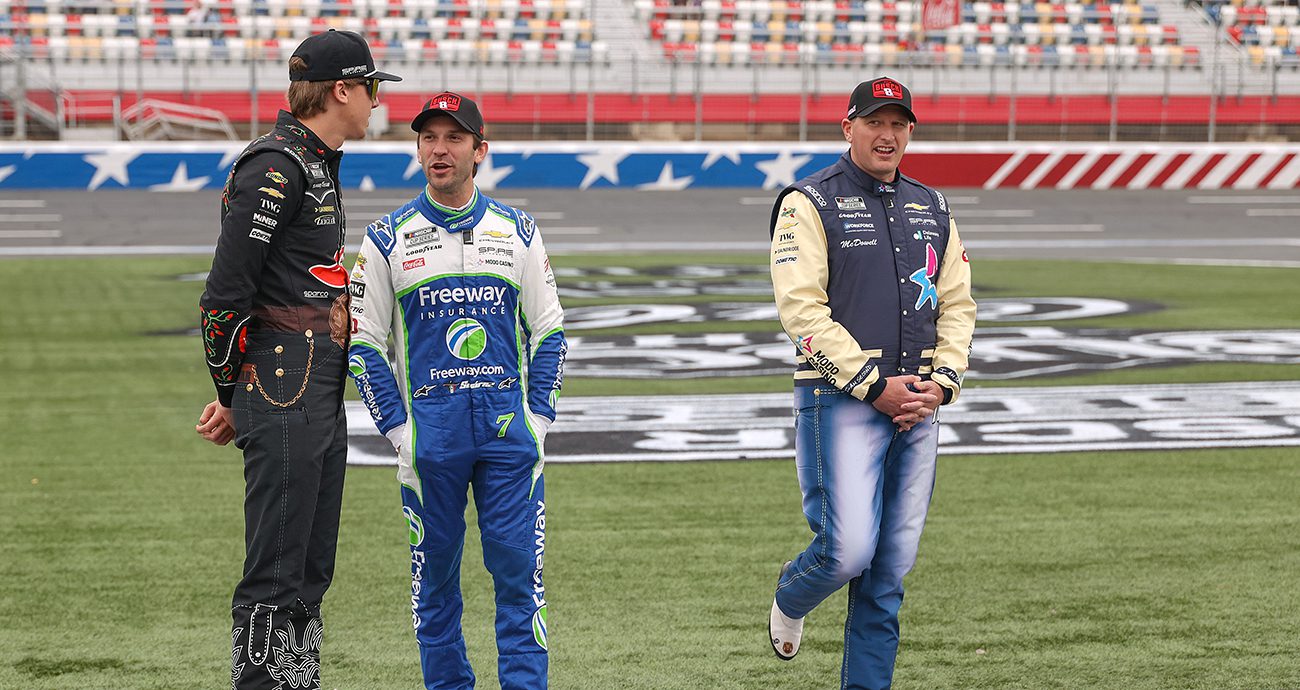
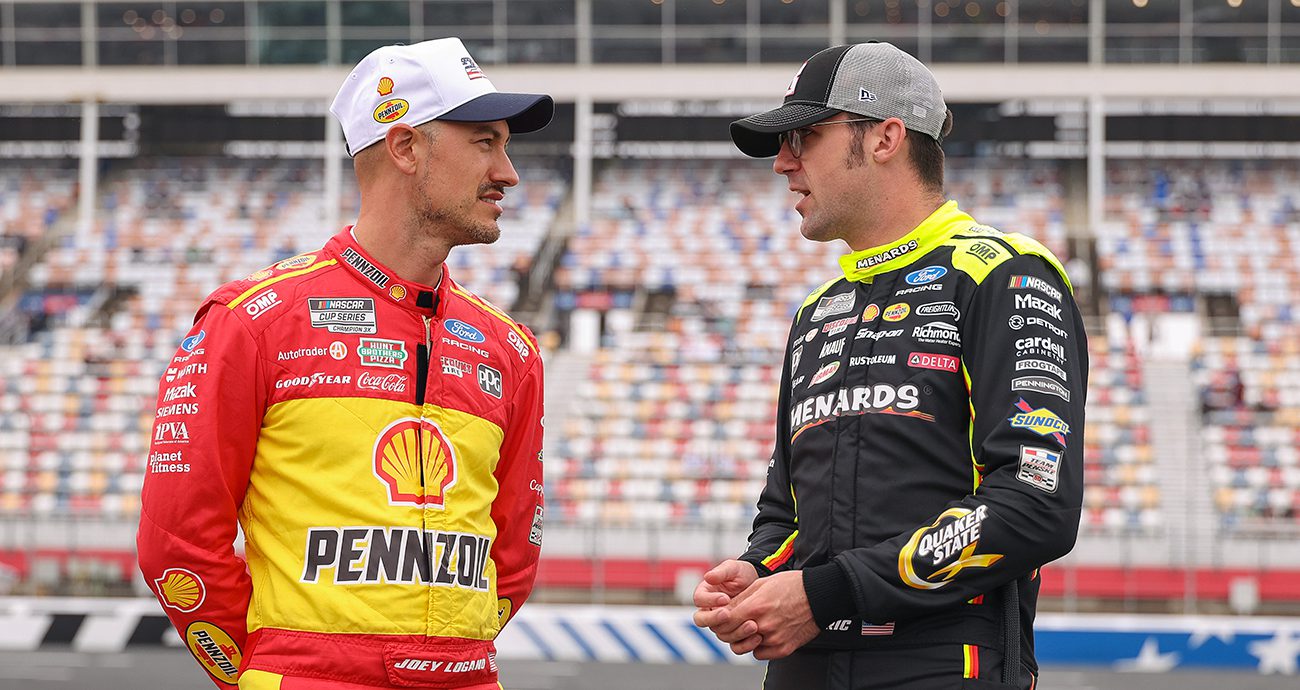
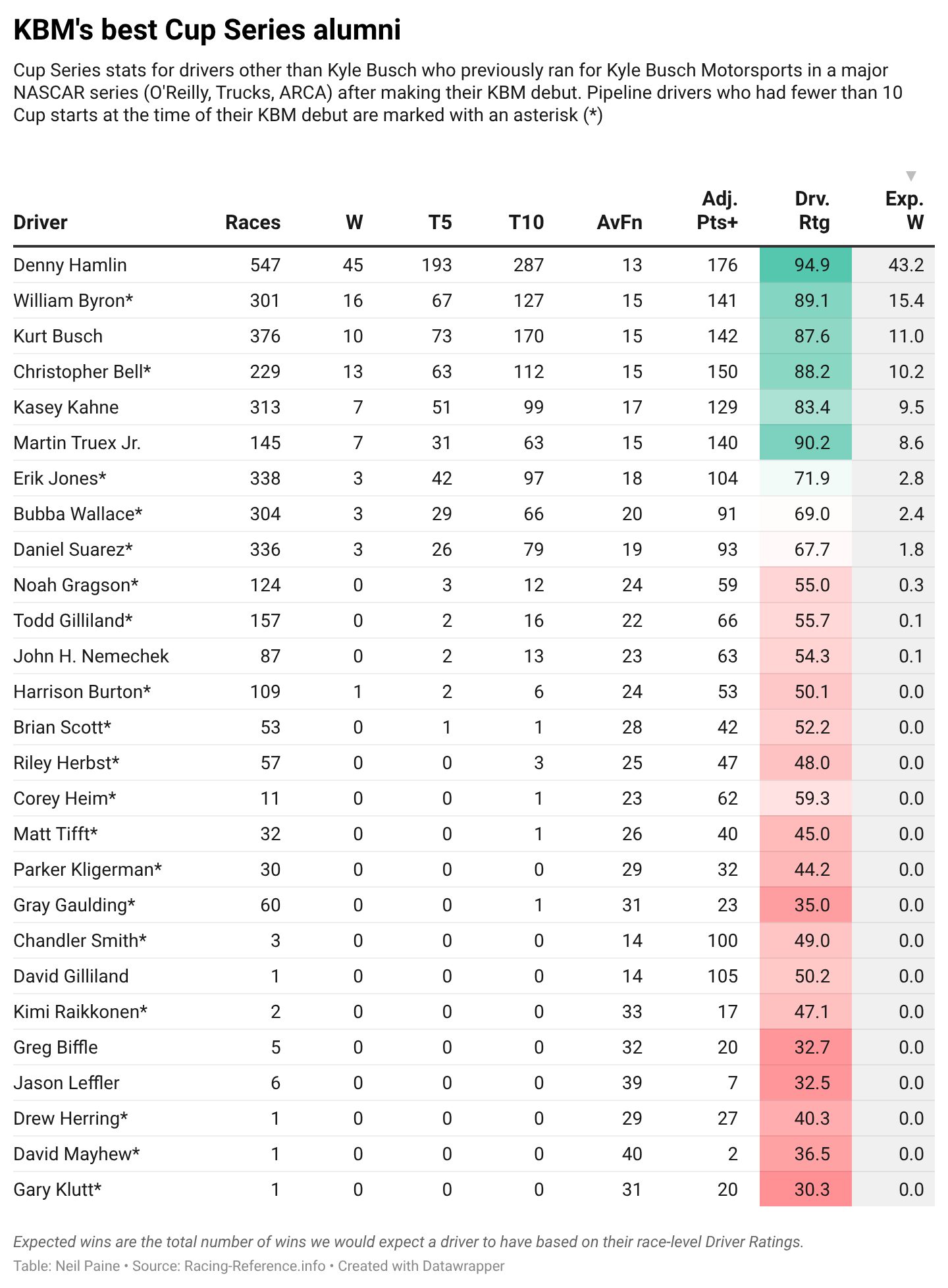
But just as irreplaceable as part of Busch’s legacy is what he did as a team owner. It was clear from the number of KBM hats worn in tribute around the garage this past weekend at Charlotte that Busch’s team left its fingerprints all over the modern Cup Series. And the numbers make that fact even clearer.
From its start in the Truck Series during the early 2010s, Kyle Busch Motorsports has seen the influence of its alumni base grow by leaps and bounds over the past 15-plus years. So far this season, 27.2% of all Cup Series starts have been made by drivers (other than Kyle Busch) who drove for KBM in either the O’Reilly, Trucks or ARCA Menards Series, including 22% by drivers who effectively broke through after driving for KBM — those who’d made fewer than 10 career Cup starts before their KBM debut. And while the share of wins for KBM alumni and pipeline drivers is down to start 2026 — Tyler Reddick (a non-KBM alumnus) winning so many races will do that — last season saw 38.9% (!) of all Cup Series wins belong to former KBM drivers, including 22.2% for pipeline alumni for the fourth consecutive season. (That was an average of eight wins per season in a 36-race schedule, for four years running.)
Suárez provided the latest entry in that category this season, while last year saw additions by William Byron, Christopher Bell and Bubba Wallace. (The overall total was also padded by plenty of wins by Denny Hamlin via his five career KBM starts in the Trucks.) Before that, the KBM tally saw contributions from Harrison Burton, Erik Jones, Kasey Kahne, and even other all-time greats like Martin Truex Jr., Greg Biffle and Kyle’s brother, Hall of Famer Kurt Busch.
And remember, these stats all exclude Kyle Busch himself — so nothing is boosted by his own 47 wins since 2010, which rank third-most in Cup behind only Hamlin and Kevin Harvick.
Overall, the best post-KBM career in Cup belongs to Hamlin, which makes sense — he’s one of the defining drivers of the 2010s and 2020s. (Though, in a testament to Busch’s greatness, Hamlin hasn’t quite passed Busch yet on the all-time Cup wins list even after posting some of his best seasons recently amidst Busch’s late-career slump.) But among those who came up in the KBM pipeline, Byron and Bell have established themselves as perennial title contenders — we flagged both as potential first-time champs in preseason — while Jones, Wallace, Suárez, Noah Gragson, Todd Gilliland and many more (including the talented Corey Heim) have either tasted success in Cup or could find the winner’s circle someday. Obviously, Busch will (and should) always be remembered first for what he did behind the wheel, because few drivers in NASCAR history ever did more. But KBM ensured that his impact didn’t stop when he climbed out of the car. Even now that he is gone, Busch’s legacy will keep showing up in the drivers he taught, the careers he launched and the Cup Series garage he helped shape — with roughly a third of all cars in the field in any given week, and nearly half of all winners, like Suárez on Sunday, being able to say they trace back some part of their story to the team that Rowdy built.
NASCAR officials issued a pair of penalties Wednesday evening — one in the Cup Series and one in the O’Reilly Auto Parts Series — the sanctioning body announced following this weekend’s races at Charlotte Motor Speedway.
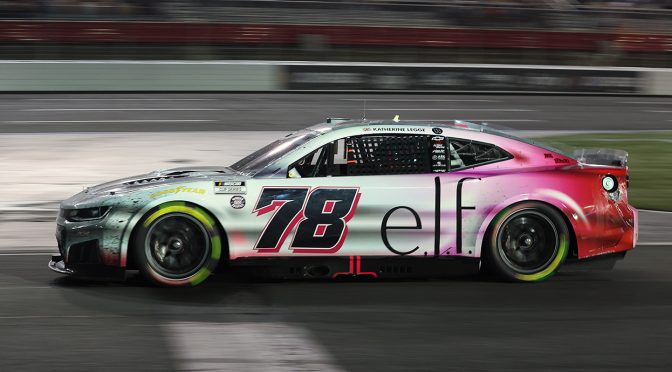
In the Cup Series, No. 78 Chevrolet crew members Ian Schulz and Deiontae Jones have been banned for the next two championship events, running through Michigan International Speedway, after the detachment of Katherine Legge’s right-front wheel in the Coca-Cola 600. The wheel fell off at the beginning of Stage 3, causing a caution and violating Sections 8.8.10.4.A&D of the NASCAR Rule Book.
Additionally, Ross Chastain’s winning No. 9 Chevrolet in the O’Reilly Auto Parts Series was found to have multiple lug nuts not safe and secure, resulting in a one-race suspension for crew member Michael Roberts and a $5,000 fine for the team. It violated Sections 8.8.10.4a & 10.5.2.5g of the NASCAR Rule Book.
After inclement weather impacted the top three national series last weekend at Charlotte Motor Speedway, NASCAR addressed its decisions and policies on the latest “Hauler Talk” podcast.
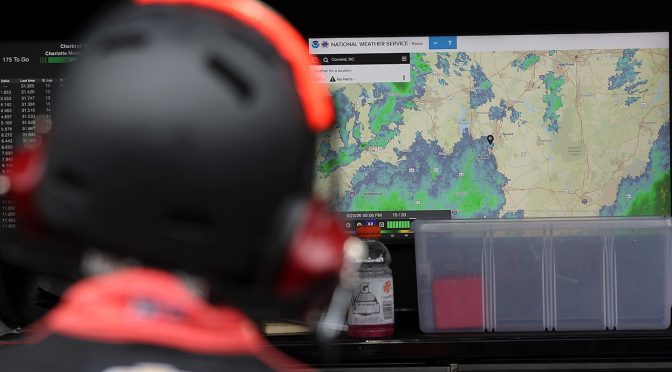
NASCAR Vice President of Racing Communications Mike Forde explained why lightning strikes don’t always result in 30-minute holds. NASCAR kept a yellow flag for lightning toward the end of the Coca-Cola 600 out for only a few minutes after officials determined the storm was moving away from the region.
Forde said NASCAR race control receives text messages for lightning strikes within 20 miles of the track and typically stops races for a 30-minute hold when there’s a strike within eight miles.
“There is a caveat there, however,” Forde said. “More often than not, the lightning is either coming toward us or kind of hovering in that eight miles. But there are times, and typically it kind of happens in the background even before it gets to eight miles, we’re on the phone with our weather partners. And if our meteorologist partners say, ‘Hey, look, the lightning did hit within eight miles, however, it is moving away from the race track. There is no danger to any of the fans in the stands, the officials on the ground, the crew members, the television partners,’ then we can continue racing.”
Forde said NASCAR threw the yellow during that conversation with the meteorological experts.
“Better safe than sorry,” he said. “After a pretty quick conversation, our partners at The Weather Company said, ‘No, this is moving northwest, away from the race track. You’re not going to have to worry about this lightning strike.’ We were able to get back to green-flag racing. So, certainly a unique situation, but not a rule change for the Coca-Cola 600. It has happened before, maybe not to this extent where there was a caution, and then we immediately have gone back to green, but it has happened in the background.”
NASCAR has used the lightning hold policy since a fan died at Pocono Raceway in 2012. Forde said tweaks were made a few years ago to account for lightning moving out of the area. During their weekly Tuesday debrief, NASCAR officials discussed whether there were better ways to walk the line between throwing a caution and waiting to assess the situation.
After weather delayed the Craftsman Truck Series race at Charlotte from Friday night to Sunday morning, NASCAR put the race under an adverse conditions policy that made noon the race’s end time. Senior Director of Racing Communications Amanda Ellis explained during “Hauler Talk” that NASCAR based the decision on the preparation required for the pre-race ceremonies and concert before the Coca-Cola 600, which started around 6:30 p.m.
“There are also just a lot of elements from the military side because of the significance of the weekend,” Ellis said. “And so ultimately, with everything that was in play and knowing what needed to be done, we wanted to make sure that the fans received all the things that they were essentially promised when they purchased those tickets.”
In the event of a postponement to Sunday, FOX had already agreed earlier in the week to move up the start time from 10:30 to 10 a.m. Forde said the network didn’t request a noon end time for the truck race on FS1 because the Indy 500 started at 12:45 p.m. on FOX.
“They were supportive of whatever we wanted to do,” Forde said. “They did not put their thumb on the scale.”
On Saturday night, NASCAR called the delayed O’Reilly Auto Parts Series race just past halfway after the field ran the final 18 laps under caution. Forde said that was partly because an oil cleanup after an earlier crash delayed crews from clearing the track.
“We kind of burned probably five laps during that cleanup session,” he said. “That was pretty unnecessary. We probably would have been back to green a little bit faster. When we finally got the track cleaned up and were ready to go, rain started. It was Murphy’s Law.”
Forde said a grim weather forecast over the holiday weekend demanded that NASCAR try to complete at least one race Saturday.
“We couldn’t go into Sunday with three races not complete,” he said. “We weren’t going to be able to run a tripleheader on Sunday. Running a doubleheader was kind of a tall task.”
Other topics covered by Forde and Ellis during the 55th episode of “Hauler Talk,” which explores competition issues in NASCAR:
— The backstory of the Kyle Busch tributes before the Coca-Cola 600
— The status of Busch’s NASCAR Hall of Fame candidacy
— Why Christopher Bell drew a penalty in the pits for a misplaced tire
— An update on the Ryan Preece penalty appeal hearing
— A preview of Nashville Superspeedway
Click on the embed below to listen, or search for “Hauler Talk” wherever you download podcasts to hear it on your phone, tablet or mobile device.
Nate Ryan has written about NASCAR since 1996 while working at the San Bernardino Sun, Richmond Times-Dispatch, USA TODAY and for the past 10 years at NBC Sports Digital. He is a contributor to the “Hauler Talk” show on the NASCAR Podcast Network. He also has covered various other motorsports, including the IndyCar and IMSA series.
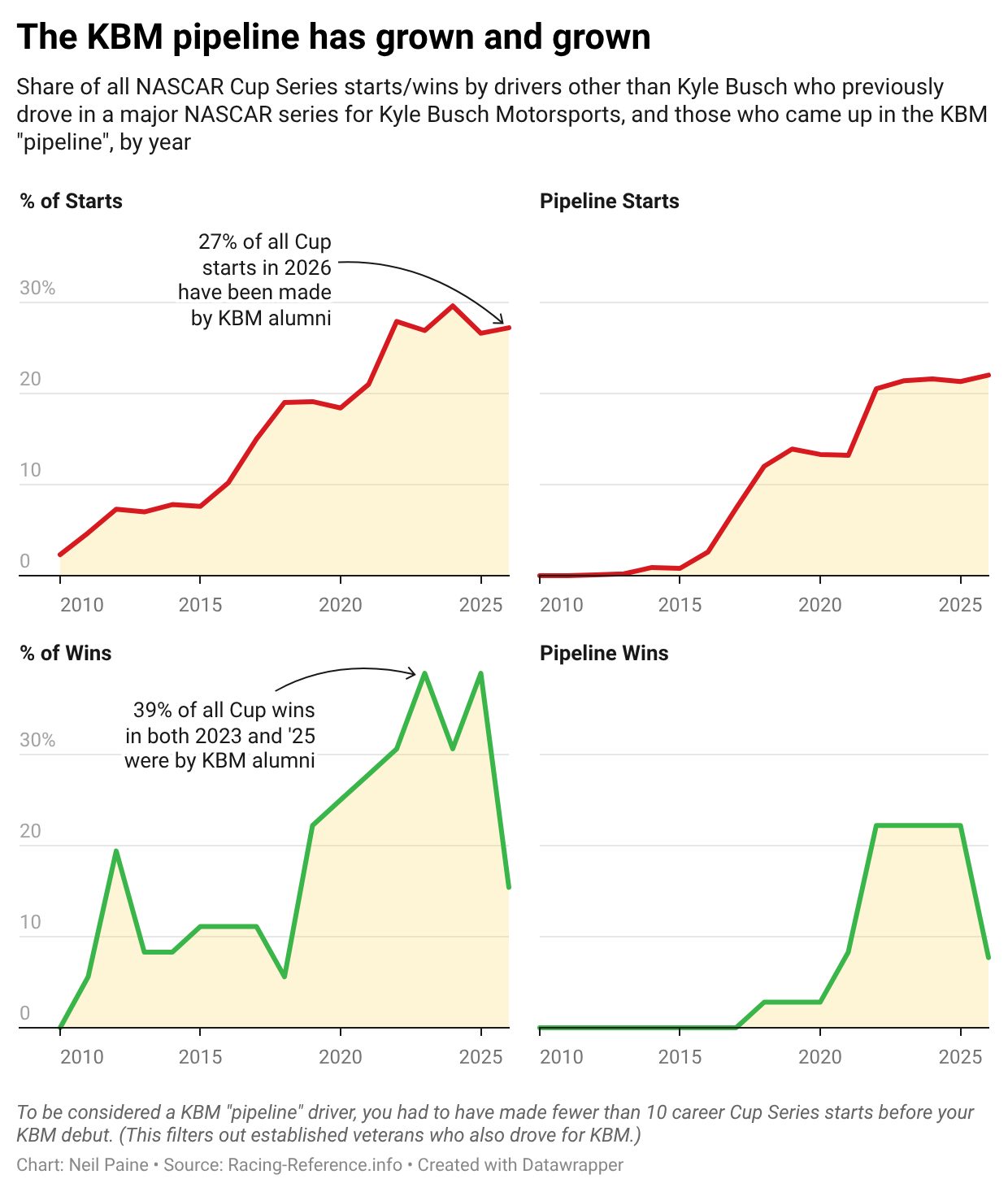 And while the share of wins for KBM alumni and pipeline drivers is down to start 2026 — Tyler Reddick (a non-KBM alumnus) winning so many races will do that — last season saw 38.9% (!) of all Cup Series wins belong to former KBM drivers, including 22.2% for pipeline alumni for the fourth consecutive season. (That was an average of eight wins per season in a 36-race schedule, for four years running.)
 Obviously, Busch will (and should) always be remembered first for what he did behind the wheel, because few drivers in NASCAR history ever did more. But KBM ensured that his impact didn’t stop when he climbed out of the car. Even now that he is gone, Busch’s legacy will keep showing up in the drivers he taught, the careers he launched and the Cup Series garage he helped shape — with roughly a third of all cars in the field in any given week, and nearly half of all winners, like Suárez on Sunday, being able to say they trace back some part of their story to the team that Rowdy built.