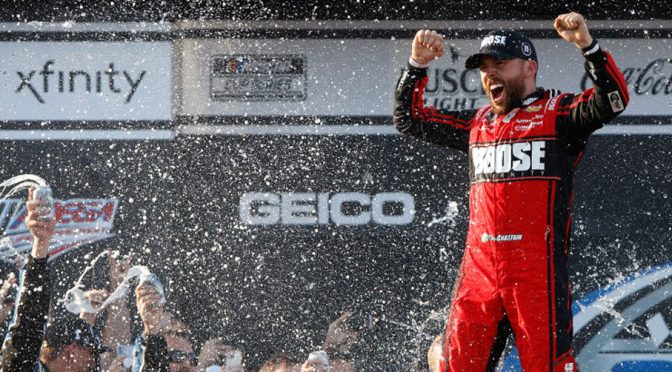
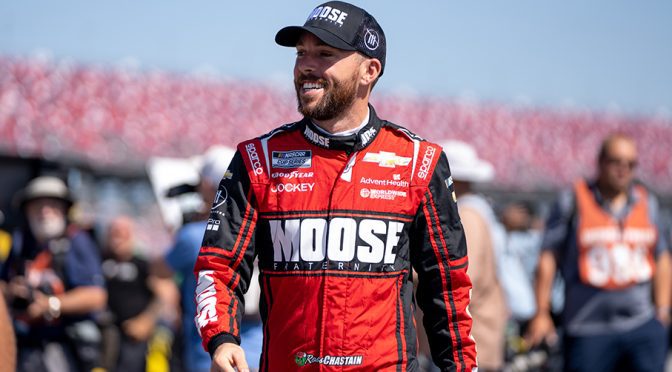
Ross Chastain has won two of the last five races, including a last-lap pass to win Sunday at Talladega Superspeedway, posted five top-three finishes in 10 races in 2022 and is part of Trackhouse Racing — the season’s most surprising NASCAR Cup Series team led by owner and former driver Justin Marks.
His team’s business partner Pitbull aka “Mr. Worldwide” has noticed the success and is giving Trackhouse Racing a shout-out in his new single “Can’t Stop Us Now” with country-rock superstar Zac Brown out on all platforms Friday.
In addition to Pitbull’s 89 million social media followers, the song will be heard billions of times by his music fans in Asia, the Middle East, Australia, Latin America and the United States.
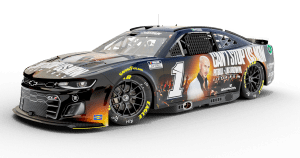
NASCAR fans attending or watching Sunday’s Cup Series race at Dover Motor Speedway will see Chastain’s No. 1 Chevrolet Camaro carrying the “Can’t Stop Us Now” logos promoting both the song and Pitbull’s 50-event “Can’t Stop Us Now” North America concert tour that begins in July.
For Chastain, the 29-year-old Alva, Florida, native who is an eighth-generation watermelon farmer, it’s been one of those overnight success stories that took a lifetime to achieve.
After his traditional smashing of a watermelon after the victory Sunday, he’s spent the week doing media including national television and radio appearances. Now he’s helping one of the most popular entertainers on the planet promote his song and concert tour.
“How cool is all of this right now,” asked Chastain who said he texted with Pitbull on Monday because he was unable to come to the phone when Pitbull called victory lane in Talladega on Sunday. “Justin got to talk with him, but I was too busy jumping around hugging everyone and doing the victory lane stuff. I really want him here in victory lane with us someday soon.”
Chastain’s remarkable success in 2022 has him second in points if the playoffs were to start today. He’d like to climb one spot higher in the standings by winning Sunday in Dover.
If he does, this time he vows to take Pitbull’s phone call.
Ross Chastain makes a bigger splash with every watermelon smash.
The Florida man has now won two NASCAR Cup Series races in 2022, just 10 races into the 36-race season. He claimed his first-ever checkered flag at NASCAR’s top level back in March at Circuit of The Americas and then followed up with another capture last Sunday at Talladega Superspeedway. That makes him one of only two multi-time winners in 2022, joining William Byron.
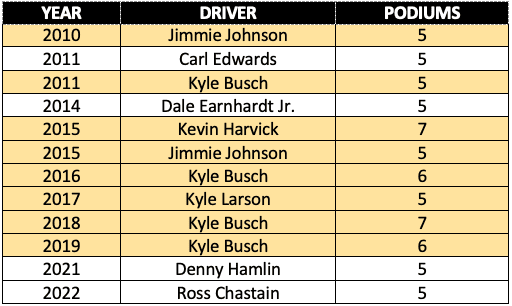
While that’s impressive, what’s even more: Chastain has five podium finishes — third at Las Vegas Motor Speedway, second at Phoenix Raceway, second at Atlanta Motor Speedway, first at COTA and first at ‘Dega — which puts him among some rather notable names. Take a look below at other drivers who have had at least five top-three results through 10 races.
Of those 12 instances, a Cup Series champion is involved in eight cases (highlighted) regardless of whether the title came before or after the feat. Jimmie Johnson’s 2010 and Kyle Busch’s 2019 fast starts also led to their championships.
The end is a ways away for Chastain, but for the first time in his Cup Series career, he’s guaranteed a spot in the NASCAR Playoffs by virtue of a win. Granted, it’s also only his fourth full-time season, second consecutive.
In total, Chastain owns the two wins, nine top fives and 15 top 10s. Obviously the two wins came in 2022, but so did six of the top fives and six of the top 10s — already making this a career season. Overall, he’s averaging a 23.9 finish. This year, he’s at a 13.5 average.
Chastain, 29, is ranked ninth in the standings — 76 points off leader Chase Elliott.
Up next for the field is Dover Motor Speedway (Sunday, 3 p.m. ET on FS1, MRN and SiriusXM). Chastain has seven starts at the 1-mile Delaware track, with his best run (15th) coming last year with Chip Ganassi Racing. All his other races there were with Premium Motorsports.
BetMGM lists Chastain at 14-1 odds to win Sunday — the fifth-best mark. Surely he has a watermelon ripe and ready.
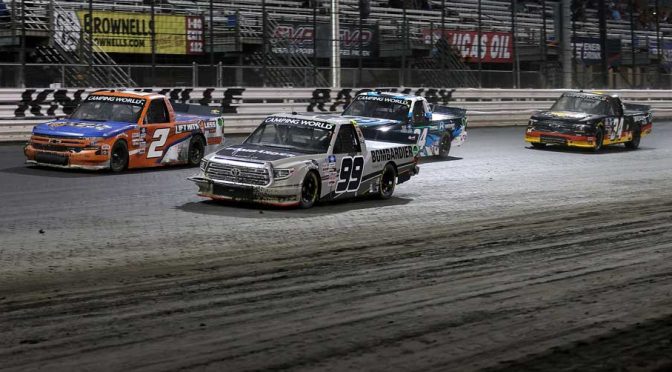
KNOXVILLE, Iowa (April 29, 2022) – The NASCAR Camping World Truck Series will be back in Knoxville, Iowa, for the second straight season but the famed half-mile dirt track will seem much cleaner this year with Clean Harbors as the race sponsor.
The Clean Harbors 150 will be run on June 18 as NASCAR and Knoxville Raceway continue to showcase the legendary history of dirt racing across America.
Delivering a broad range of recycling services, hazardous waste management, emergency spill response and industrial cleaning, Clean Harbors boasts one of the 20 largest private motor carrier fleets in North America.
“Given this legendary dirt track, this is shaping up to be one of the most exciting truck races on the schedule,” said Clean Harbors Chief Operating Officer Eric Gerstenberg. “We are dedicating this race to the thousands of Clean Harbors truck drivers out on the road every day in the United States and Canada helping to keep the environment clean and make the world a better place. We simply couldn’t do it without them.”
Founded in 1980 with hundreds of service locations across the country, Clean Harbors is North America’s leader in environmental and industrial services. As the largest COVID-19 decontaminator in the county, Clean Harbors helped NASCAR return to racing early in the pandemic and subsequently deep cleaned all tracks. Along with decontamination efforts around Ground Zero following 9/11, the company is noted for aiding in the Deepwater Horizon and other major oil spills.
Through its subsidiary Safety-Kleen, Clean Harbors has been a decades-long partner of NASCAR. As the official environmental services supplier and green partner of NASCAR, Safety-Kleen collects all used oil, lubricants and liquid waste at the tracks, and then recycles, responsibly disposes of or re-refines those fluids. As the largest oil recycler in North America, the company is also the official environmental company of all the tracks where the NASCAR Cup Series competes.
“Across the country, Safety-Kleen has been keeping NASCAR tracks clean and maximizing recycling of waste oil and other fluids for decades. We’re the sustainability solution for more than 300,000 customers with NASCAR among our most visible. By sponsoring this race, we intend to bring sustainability to the forefront even more,” said Gerstenberg.
NASCAR announced in October the Camping World Truck Series would return to the “Sprint Car Capital of the World” for a second year as the American motorsports icon harkens back to its formidable years of racing on dirt ovals across America.
Winston, Ga.’s Austin Hill won the inaugural event, which was extended by 29 extra laps from its originally scheduled 150-lap distance, to complete a green-white-checkered flag finish, giving the Knoxville faithful both a spectacular and historic conclusion.
The event will be promoted in cooperation with North Carolina-based Spire Holdings.
“Clean Harbors is a great partner to the most prestigious dirt track in the world,” said Spire Holdings VP of Strategic Initiatives Joey Dennewitz. “Knoxville Raceway and the entire town of Knoxville are thrilled to host Clean Harbors and their truck drivers for the excitement and fun the NASCAR Camping World Truck Series is best known for.”
Tickets are now available to purchase online or by calling the ticket office at 641-842-5431. Practice Night information will be released at a later date. Camping and parking information can be found via the track’s website, Facebook, Twitter and Instagram platforms as it becomes available. To receive up-to-date information about the NASCAR Camping World Truck Series race at Knoxville Raceway, visit our website.
The Clean Harbors 150 from Knoxville Raceway will be televised live on FS1 Saturday, June 18 beginning at 9 p.m. EDT. The race will also be broadcast live on the Motor Racing Network and SiriusXM NASCAR Radio Channel 90.
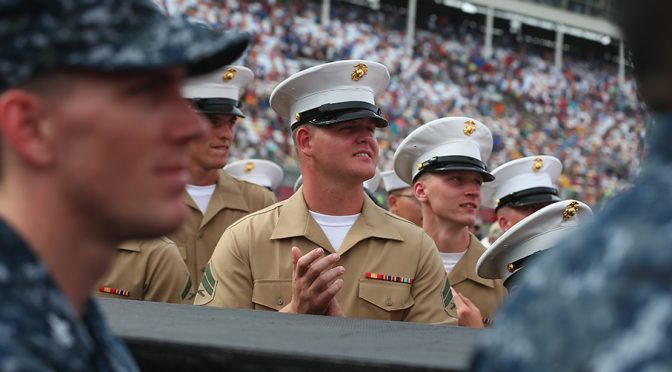
DAYTONA BEACH, Fla. – This Military Appreciation Month, the NASCAR community comes together to honor and recognize the United States Armed Forces through the annual NASCAR Salutes Together with Coca-Cola program.
NASCAR Salutes Together with Coca-Cola returns for its eighth season, celebrating the service and sacrifice of U.S. service members and their families. Tributes will take place beginning this weekend at Dover Motor Speedway and will conclude with the 600 Miles of Remembrance during the Coca-Cola 600 at Charlotte Motor Speedway on Memorial Day weekend. Fans can follow and engage on social media using #NASCARSalutes.
“In partnership with NASCAR, Coca-Cola is proud to honor our nation’s Armed Forces during The Coca-Cola 600 on Memorial Day weekend,” said Sue Lynne Cha, the vice president of integrated marketing experiences for Coca-Cola North America. “The Coca-Cola 600 brings racing fans together to recognize the service and sacrifices made by our U.S. military members and their families.”
Unique to the program this year, the NASCAR Salutes Wall of Honor will make its debut at each NASCAR race weekend in May. The mural wall will be located in track midways and allow fans to write messages to the military on individual magnets. Each magnet will then be added to the mural to create a giant mosaic unique to each track that will later be donated to a military base.
“It’s always incredible to see the NASCAR industry and our fans unite to celebrate our military service members and their families through NASCAR Salutes Together with Coca-Cola,” said Michelle Byron, NASCAR’s vice president of partnership marketing. “Through the support of Coca-Cola, the month of May has become a time when together as an industry, we can reflect on our nation’s heroes and honor the sacrifices they make every day to keep our country and its communities safe.”
To conclude NASCAR Salutes Together with Coca-Cola, NASCAR and Coca-Cola will again host Gold Star Families during Memorial Day weekend at Charlotte Motor Speedway with all 40 NASCAR Cup Series cars featuring the name of a fallen service member on the windshield during the Coca-Cola 600.
In addition, several other NASCAR Salutes activities will take place, including:
During the GEICO 500 at Talladega Superpseedway on FOX, NASCAR premiered this year’s NASCAR Salutes brand spot. The creative runs through May and showcases the unique ties that NASCAR and Coca-Cola have with the military.
Discounted grandstand tickets are available to military members throughout NASCAR Salutes and all season long with NASCAR MILTIX Presented by GEICO Military. Active military and veterans can verify their status through SheerID and purchase tickets by visiting NASCAR.com/miltix.
At each NASCAR event during the month of May, service members from local bases will have access to complimentary grandstand tickets and unique VIP experiences made possible by Vet Tix and the NASCAR Troops to the Track Program.
Charlotte Motor Speedway continues its annual Mission 600, pairing the Coca-Cola Racing Family and other drivers with military bases to educate the NASCAR community about the day-to-day lives of the men and women who serve.
Xfinity, a Proud Premier Partner, will display red, white and blue Xfinity windshield headers on their race cars during the NASCAR Xfinity Series Alsco Uniforms 300 at Charlotte Motor Speedway to showcase their company’s commitment to hiring 21,000 veterans, National Guard and reserve service members and also military spouses who bring unique skills and experiences to Comcast NBCUniversal.
Camping World will celebrate with red, white and blue windshield decals on all trucks racing in the North Carolina Education Lottery 200 at Charlotte Motor Speedway. Camping World is a strong supporter of all military branches and proudly displays 3,200-square-foot American flags at its nationwide retail locations.
AMR, the “Official Emergency Medical Services Partner of NASCAR,” will feature the NASCAR Salutes Together with Coca-Cola branding on its NASCAR safety trucks and safety team helmets throughout the program.
For a fifth season, Mack Trucks, the “Official Hauler of NASCAR,” will wrap one of its NASCAR haulers in support of NASCAR Salutes leading into Memorial Day weekend. The final design was selected by fan votes with the voting period closing this week.
Continuing its tradition, Goodyear will replace its iconic “Eagle” sidewall design with “Honor and Remember” during the Coca-Cola 600 in recognition of the organization working closely with the industry to honor gold star families who have lost family members as a result of serving.
During the broadcast of the Coca-Cola 600, FOX will display the name of every U.S. Armed Forces member who lost his or her life since last year’s Memorial Day weekend race as part of a special tribute titled “FOX Sports Remembers,” an initiative begun in 2009. FOX’s scroll will begin running during its pre-race show at 5 p.m. ET.
The NASCAR Whelen Modified Tour, with the help of JDV Productions and Operation Vet Now Inc., will feature roof decals on all race cars honoring fallen service members during the Jennerstown Salutes 150 at Jennerstown Speedway on May 28.
Following Noah Gragson’s victory in a dramatic overtime finish at the NASCAR Xfinity Series’ biggest track last weekend, the series moves to the always exciting Dover Motor Speedway for a test on the “Monster Mile” this week.
Saturday afternoon’s A-GAME 200 at Dover (1:30 p.m. ET on FS1, MRN, SiriusXM NASCAR Radio) presents a unique challenge to the Xfinity Series championship, with only one of the series’ full-time competitors having ever won this race previously.
Two-time Dover winner Justin Allgaier is hopeful that his track record will push him forward in the points and into an already tightly-grouped trio atop the championship.
Veteran AJ Allmendinger, who finished third last weekend in a typically frantic Talladega Superspeedway rush to the checkered flag, leads the Xfinity Series championship by 40 points over Gragson and 45 points over Ty Gibbs – the two swapping positions in the standings following Gragson’s win and Gibbs’ rough superspeedway outing.
Allmendinger has top-10 finishes in every race this season topped with a victory at the Circuit of The Americas last month. The driver of the No. 16 Kaulig Racing Chevrolet has only a pair of Xfinity starts at Dover – with a best finish of fourth-place last year – and has never led a lap there.
Gragson’s Talladega victory was his second of the season. His first came at the other 1-mile track, Phoenix Raceway, which gives him plenty of momentum as the series arrives in Dover.
Gragson has never won on the “Monster Mile,” but the driver of the JR Motorsports No. 9 Chevrolet does have four top-10 finishes in six starts with a best showing of fourth place in 2020. He’s led only 38 laps at Dover during that time – but neither of his other closest championship challengers – Allmendinger or Gibbs – have led even a single lap at the track.
This will be only the second Dover start for Gibbs, who will be looking to regain momentum after a tough Talladega race. Involved in an accident on the big track, Gibbs finished 35th suffering only the second DNF in 27 career Xfinity Series races to date. Gibbs’ three wins and 330 laps led in 2022 are most in the series. The driver of the No. 54 Joe Gibbs Racing Toyota finished fifth in his only Dover race, last year.
Bringing us to Allgaier, who boasts a top-five finish in nearly half of his 21 Dover starts, including wins in 2018 and 2020 and three runner-up showings. In the last 12 Dover races, the driver of the No. 7 JR Motorsports Chevrolet has 11 top-10 and nine top-five finishes – including the two victories. His 447 career laps led is most among Xfinity Series regulars and twice he’s led 100 or more laps in a Dover race.
It all speaks well for a potential Dover rebound to Allgaier’s 2022 season. He’s currently ranked sixth in the championship, 121-points behind Allmendinger, but has finished 22nd or worse in four of the last five races. His best finish of the year is fifth (at Daytona International Speedway and Las Vegas Motor Speedway). His last win came almost exactly a year ago – May 8 at Darlington Raceway.
“I can’t wait to get to Dover this weekend with our No. 7 team,” Allgaier said. “We’ve been really strong there the last couple of years and I feel extremely confident that we are going to pick up right where we left off when we hit the track for practice on Friday. Hopefully, we can have a solid, smooth weekend and be right where we need to be, come race time, to fight for the win.
“I’m ready to go.”
The Dover race marks the Dash 4 Cash program’s 2022 finale. Gragson, Landon Cassill, Allmendinger and Ryan Sieg are qualified to win the $100,000 bonus check this week following their work last week at Talladega. The highest finisher among them earns the bonus cash from sponsor Comcast Xfinity. Allmendinger has won two of the three Dash 4 Cash prizes this season.
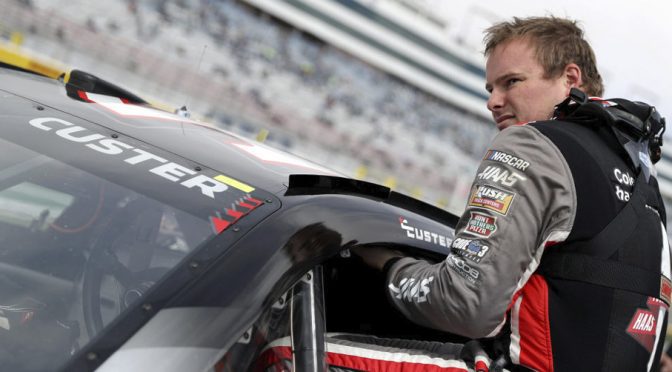
In the midst of his third full-time Cup Series season driving the No. 41 for Stewart-Haas Racing, Cole Custer is feeling like the third time’s the charm.
Still searching for his first top 10 of the season, Custer is optimistic that could change in Sunday’s race at Dover Motor Speedway (3 p.m. ET, FS1, MRN, SiriusXM NASCAR Radio), where he has never finished worse than 11th.
“Honestly, it’s been a really frustrating year from the standpoint of having some really fast cars,” Custer told NASCAR.com. “We’ve shown we can run top five in the stages and get a pole and have top-10 cars. It’s just a matter of putting it all together. We’ve just had something happen on pit road, a motor blow. I think we’ve gotten wrecked a few times. So, it’s just little things that keep happening that we really haven’t gotten the finishes we deserve. If we can clean some things up a little bit and hopefully some luck turns around, I think we can get ourselves right where we need to be.”
As the season is progressing, the No. 41 team is beginning to show front-running speed — qualifying top three in three of the last five races, including earning the Bristol Motor Speedway (dirt) pole, the first in his 85-race Cup Series career.
One of the younger drivers in the garage, only 24 years old, the return of practice and qualifying is paying dividends, especially with the Next Gen car. And it’s also led to an increased comfort level and positive mindset heading into race weekends.
“You get a lot more comfortable with things,” Custer said. “When you’re a rookie, you don’t know what to expect. Everything is new every single weekend and there’s a lot of pressure ’cause it’s your first Cup season. Once you’ve done it a couple years, you know what to expect, all the nerves drop down a bit and you’re able to relax and find a groove.
“I think that’s one of the craziest things about Cup racing — that the packages and the cars, everything pretty much changes every single year. You have to get used to change, get used to adapting to different things. Where in Xfinity, they’ve run the same car for the last five years or so. There, you kind of get a feel for that one car but in the Cup Series, you get a lot of different things thrown at you.”
It was also his third season in the Xfinity Series (2019) that was his breakout year. Driving the No. 00 for SHR, Custer blazed his way to seven victories, 17 top fives and 24 top 10s in just 33 races. Returning to the series for a part-time stint in 2022, he flashed his dominance again with a triple-overtime win at Auto Club Speedway, where he led 80 laps.
Now, he’s hoping the familiarity of success can continue to carry over to the Cup side. His next challenge: the “Monster Mile.”
Heading to Dover, the site of his 2020 Next Gen test experience, Custer is combining all of the knowledge to make a strong push Sunday.
“It’s hard to take a lot from that test,” Custer said. “A lot of things were different from the last time we were there. But at the same time, I think it was nice to get an idea of what the car felt like and how it was honestly fairly similar to what we drove in the past. But obviously, a lot of things have changed since then. So, it’s going to be kind of a reset and making sure you’ve taken everything you’ve learned this season into this weekend.”
The Next Gen car makes its first trip to the “Monster Mile” this weekend.
NASCAR’s Cup Series rolls into Dover Motor Speedway for the DuraMAX Drydene 400 on Sunday (3 p.m. ET, FS1, MRN, SiriusXM NASCAR Radio).
With 400 laps around the concrete oval ahead, get prepped for the weekend here:
QUICK TIME
Cup teams will be broken into Groups A and B for practice and qualifying at Dover this weekend. Their Saturday begins with practice at 10:30 a.m. ET (FS1), where each group will be allotted 15 minutes. Once practice is complete, the groups will partake in single-car qualifying in which each driver will be allowed two timed laps. The five fastest drivers from each group will advance to the second round of qualifying, where the 10 competitors will fire off for single-car laps once again. The fastest of those 10 drivers will earn the Busch Light Pole Award.
— Dover Motor Speedway opened as Dover Downs International Speedway in 1969 as a unique dual-purpose facility designed to accommodate both harness racing and motorsports events.
— Richard Petty won the first NASCAR race at the facility, a 300-lap event on an asphalt track.
— Kyle Petty, Richard’s son, won the first concrete race at the Monster Mile on June 4, 1995 after starting 37th.
— In 2002, Dover Downs International Speedway became Dover International Speedway as the gaming side of the company split off and Dover Motorsports, Inc., was created to exclusively oversee racing.
— Dover Motorsports at one time owned and operated Memphis Motorsports Park, Gateway International Raceway, Nashville Superspeedway and the Long Beach CA Grand Prix in addition to Dover.
— The track, which features 24 degrees of banking in its concrete corners and 9 degrees on its straightaways, debuted its 46-foot tall sculpture of Miles The Monster at Victory Plaza in 2008.
— Dover Motorsports still held rights to Nashville Superspeedway heading into the 2021 season and shifted one of its two Cup dates at Dover to Nashville last season, the series’ first trip to Nashville Superspeedway and the track’s first NASCAR event since Xfinity and Camping World Truck series racing in 2011.
— In December 2021, Speedway Motorsports completed its purchase of Dover, renaming the facility Dover Motor Speedway.
Source: Racing Insights
GOODYEAR TIRES
With its high banks and high speeds, Dover offers a unique challenge for the Next Gen car due to the heavy loads that will be placed on the vehicles in the corners. Those loads will lead to significant stress on the right-front tire.
“Dover obviously presents many challenges for Goodyear as it relates to NASCAR Cup racing,” said Greg Stucker, Goodyear’s director of racing. “First, and most important for the teams, are the stresses put on the tires because of the high banking and relatively tight turn radii. The right-front sees a lot of load entering the corners as the car gets into the banking and tries to get to the center and back on the throttle. With this Next Gen car, we have definitely seen a higher concentration of loading on that position. Observing our minimum recommended pressures is vitally important at Dover.”
The tannish white of the concrete will also take on plenty of rubber throughout the race weekend, which will be evident both at the track and on television.
“Second, and this is something the fans will notice, is how the track changes color during the course of the race,” Stucker said. “At speed, the track will progressively turn black as the cars lay rubber on the concrete surface and then turn back white under the caution flag as the tires pick back much of that rubber. Keeping pace with that transition is an important element of the race strategy.”
DOVER STORY LINES
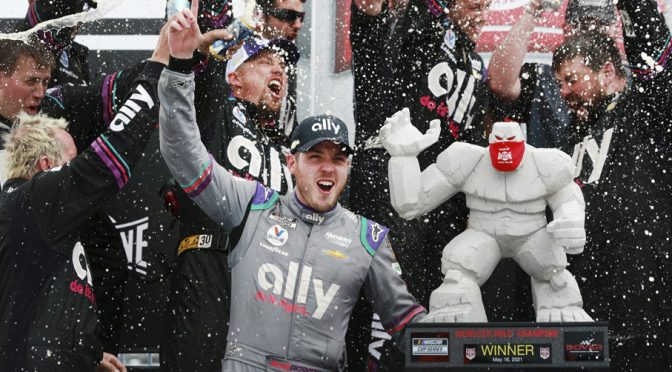
— The last six Dover races have been won by six different drivers: Chase Elliott, Martin Truex Jr., Kyle Larson, Denny Hamlin, Kevin Harvick and Alex Bowman.
— Truex, who remains winless in 2022, has finished inside the top two in four of the last five Dover races.
— Kyle Larson’s 7.0 average finish in 13 Dover starts is the best of anyone with at least three starts, besting David Pearson (8.0) for the honor.
— Kevin Harvick’s last stage victory came in August 2020 at Dover, 58 races ago.
— Hendrick Motorsports drivers finished 1-2-3-4 in this race last year, the only four-car team to have all four cars finish in the top four in a Cup race.
— HMS has won 21 Cup races at Dover, 12 more than any other team.
— Richard Childress Racing drivers Austin Dillon and Tyler Reddick have yet to win in 2022 but have finished runner-up three times, including in each of the last two races (Reddick, Bristol Dirt; Dillon, Talladega).
Source: Racing Insights
CASHING IN ON CONCRETE
Kyle Larson enters the weekend as the 9-2 favorite according to BetMGM, and for good reason. Larson has finished inside the top three in each of his last three starts at Dover, including a win in 2019.
Not far behind are his Hendrick teammates Chase Elliott and William Byron, both of whom are listed at 8-1 while defending race winner Alex Bowman is posted at 12-1. Truex interrupts the Hendrick hoard at 10-1 odds.
The play this week would appear to be Kevin Harvick at 14-1 odds. The 2014 series champion has three wins at the Monster Mile and is slowly finding his way back to the top of the leaderboard. It seems a bit of a stretch considering the No. 4 team’s lack of prolonged consistency, but Harvick shouldn’t be overlooked this weekend.
Want to manage a team and race your way to the top of the leaderboards? Check out NASCAR Fantasy Live. The free-to-play game lets you choose your drivers each week and show off your crew-chief instincts by garaging a driver by the end of Stage 2, and there is a $25,000 prize for the winner.
The 2022 Fantasy Live points leaders are Chase Elliott (362), Ryan Blaney (339) and William Byron (334).
Get additional camera views by logging on to NASCAR Drive, where each week a select number of in-car cameras will be available — as well as a battle cam and an overhead look.
NASCAR has partnered with LiveLike to add fan engagement in the NASCAR Mobile App. Log in to the mobile app during the race for polls, quizzes, the cheer meter and more — and see instant results from NASCAR fans like you.
Jimmie Johnson’s crash on the 127th lap of the 2005 Ford 400 may have cost him a championship and may have prevented a top-four sweep from Roush Fenway Racing at Homestead-Miami Speedway.
Johnson won a championship a year later – and six more in his career – but in 686 career NASCAR Cup Series races he never led a top-four sweep for Hendrick Motorsports, one of the rarest team feats in NASCAR history.
So it felt appropriate, if not sentimental, when his former team did accomplish the feat at the 2021 Drydene 400, the No. 48 Chevrolet was in front. And even though Alex Bowman was behind the wheel at Dover Motor Speedway, Johnson was still a factor in recording the fourth top-four sweep of all time and just the second since the 1950s.
“I asked [Johnson] what he does, how he approaches this place, what kind of lines he runs,” Bowman said after last year’s win, recalling a conversation with Johnson a few years ago when he was struggling at The Monster Mile. “I just stuck to that, and tried to run like Jimmie did, run the Jimmie Johnson line, and just be tight against the black, be super disciplined, super patient.”
Bowman grabbed the lead from teammate Kyle Larson midway through the final stage and led the final 98 laps en route to his first win in 11 career Cup Series starts at Dover. And if Bowman wins the newly named DuraMAX Drydene 400 presented by RelaDyne in consecutive years – something Johnson accomplished three separate times – he’ll do so as the Hendrick driver with the worst odds in NASCAR betting at BetMGM.
As of Wednesday, Bowman is +1200 to win the race, well behind Larson (second-place in 2021) at +450, Chase Elliott (third) at +800, and William Byron (fourth) at +800. Martin Truex Jr. is the lone non-Hendrick driver in the top five for race-winner odds.
William Byron will be one of the least-experienced drivers on Sunday – his seven Cup Series starts at Dover ranks 21st in the field – but he ranks sixth in average driver rating at Dover since 2019 and has back-to-back fourth-place finishes, including last year’s race when he registered 21 of Hendrick’s 382 total laps led.
Byron is currently less popular than Bowman with BetMGM bettors in race-winner betting – 3.4% of tickets and 5.3% of the handle to Bowman’s 8.4% and 9.8%, respectively – but Byron has 57% of the handle in their featured matchup.
Chase Elliott (-185) vs. Tyler Reddick (+140)
Through the first two stages last May, it appeared Chase Elliott had the best chance of catching teammate Kyle Larson before he ultimately finished third.
It was his eighth top-five Cup Series finish and a nice rebound after a crash in the Drydene 311 nine months earlier. And only Bowman, Truex, and Kevin Harvick have more top-5 finishes than Elliott (three) at Dover since 2019.
But the public is more interested in Tyler Reddick; Reddick and the BetMGM-sponsored No. 8 Chevy are tied with Bowman for the highest ticket share (8.4%) in race-winner betting and have 100% of the handle against Elliott in featured matchup betting.
Kyle Larson (-200) vs. Ross Chastain (+155)
No active driver has a better career average finish (seventh) at Dover than Kyle Larson, who has failed to finish in the top 10 of a Dover race only three times in 13 starts. He dominated most of the first 300 laps – leading 263 – last year before Bowman beat his No. 5 Chevy off pit road and never looked back.
Larson now returns to Dover one week removed from a “near-perfect” race at Talladega that ended with a fourth-place finish after a wild final lap. And he’s a massive favorite over last week’s winner, Ross Chastain, who now has a top-5 finish in eight of the last 10 races after starting the season 40th at Daytona and 29th at Fontana.
The public is buying redemption for Larson this weekend; the 29-year-old 17-time winner has a field-leading 13.4% of the handle to win at Dover. And he has 67% of the tickets and 70% of the handle over Chastain in this head-to-head.
Martin Truex Jr. (-145) vs. Kevin Harvick (+115)
Kevin Harvick leads all active drivers in starts at Dover (41), along with wins (three, tied with two others, including Truex), top-10 finishes (22), top-20 finishes (34), and laps led (1,631). And he has just one DNF in those 41 starts.
Nonetheless, Harvick is buried at 10th in race-winner odds and an underdog to Truex in featured matchup betting as he struggles for consistency this season. And bettors are proceeding with caution on both drivers; Harvick and Truex rank eighth and 13th in race-winner ticket share, respectively, and 10th and 16th in handle share.
In the head-to-head matchup, Truex is dominating the action with 97% of tickets and 95% of the handle.
You can view updated DuraMAX Drydene 400 odds and more online sports betting opportunities at BetMGM.
NASCAR officials penalized the Live Fast Motorsports team Wednesday after a wheel detached from the No. 78 Ford during Sunday’s Cup Series race at Talladega Superspeedway.
Driver and team co-owner BJ McLeod spun in Turn 2 during Sunday’s GEICO 500, prompting a caution period on the 87th of 188 laps. As the car looped down the banking, the right-rear wheel detached and rolled to a stop on the apron as he drove away. McLeod, who led two laps Sunday, continued to post a 26th-place finish.
As a result of the violation of Section 10.5.2.6 in the NASCAR Rule Book, competition officials issued four-race suspensions to Live Fast crew chief Lee Leslie and crew members Alpha Lamin (jack) and Kevin Teaf (rear-tire changer).
Christopher Stanley, who was listed as an engineer on the team roster for Talladega, was designated on an updated entry list as the No. 78 team’s crew chief for this Sunday’s race at Dover Motor Speedway.
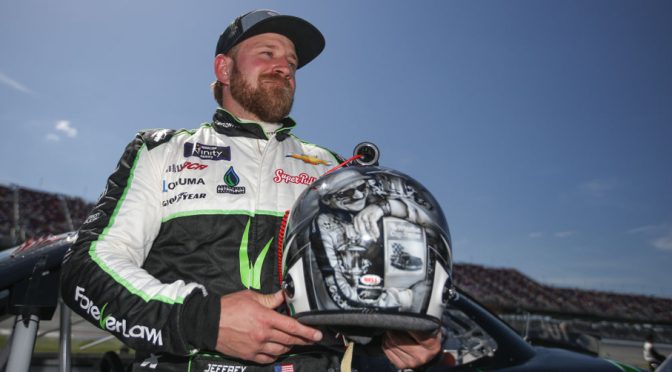
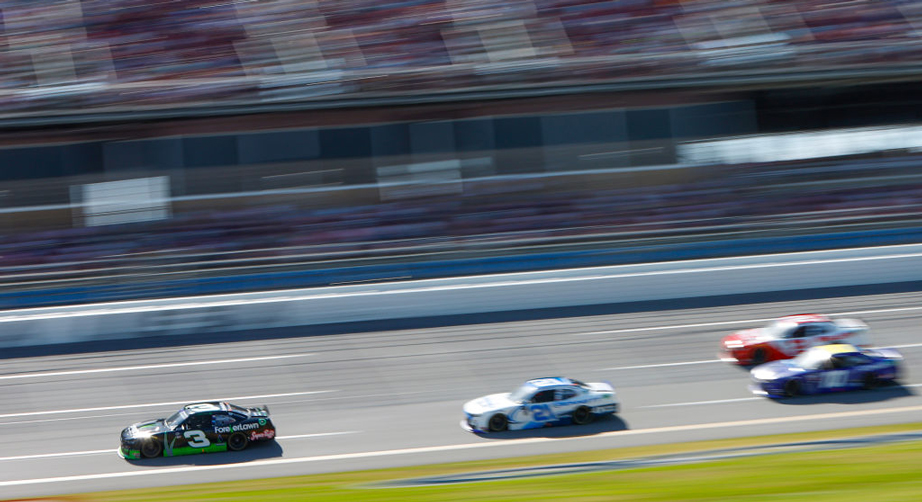
All eyes were on Jeffrey Earnhardt last weekend at Talladega. And why wouldn’t they be? An Earnhardt was driving the No. 3 Chevrolet for Richard Childress Racing in the NASCAR Xfinity Series.
For the first time at any level in his career, Earnhardt would finally drive a No. 3 car.
“We’ve been trying to make it happen for many years, but it’s never come together, whether it be sponsorship, financially, whatever,” Earnhardt told NASCAR.com ahead of last week’s race weekend at Talladega. “It always seemed to never come together until now.”
He also got to work with Larry McReynolds, who was making his return to the pit box after 22 years.
“To have him as a crew chief, someone who crew chiefed my grandfather and won the Daytona 500 with, is pretty darn special,” Earnhardt said. “Knowing the history and how long he’s been in our sport, his dedication to our sport. And the history he has with my grandfather, it makes all of this that much more special.”
After the 2021 Xfinity season, Earnhardt chose not to return to JD Motorsports, the place he called home for the previous two seasons, his second stint with the team. Racing on a tighter budget, Earnhardt’s breakthrough days were cracking the top 15, something he did just five times between the 2020 and 2021 seasons.
Though forever thankful for his time with Johnny Davis, Earnhardt needed to take his funding elsewhere.
“I’m not getting any younger,” Earnhardt, 32, said. “You look at the ages of people in our sport, I’m old. It’s time to either make it happen or not.”
For the 2022 season, Earnhardt’s goal was simple: Look to see where he could get the best results. And even though that would require a partial schedule, his overall goal is to impress enough to get a full-time ride in a competitive car for the 2023 season.
In January, Sam Hunt Racing inked a seven-race deal with Earnhardt, which began in the season opener at Daytona.
“It’s just a matter of getting better equipment and better people,” Earnhardt said. “When you do that, your funds get eaten up really quick. You’ll pay more money for those races to be competitive and that’s the route that we saw fit to take this year.
Earnhardt’s presence around the Sam Hunt Racing shop has helped the team grow, too. He’s one of the first drivers in team history, along with John Hunter Nemechek and Ryan Truex, who isn’t a rookie while competing for Hunt.
“I think he’s a guy that doesn’t get quite enough credit for how much talent he has,” Hunt said. “More than anything, he’s the kind of person our team loves to have around, which is really important to me. He’s motivated, friendly, humble and above everything, he’s the ultimate team player.”
At Daytona, driving a second car for Sam Hunt Racing, Earnhardt finished 15th. He took over the reins of the No. 26 Toyota at Auto Club, where he finished 29th because of a battery issue late in the race.
At Phoenix, Earnhardt made a one-off start in the No. 35 car for Emerling-Gase Motorsports, as he had additional funding and wanted to compete with a team that fielded Toyotas. The following week at Atlanta, another superspeedway-style race, he finished 13th for Sam Hunt.
Sean Gardner | Getty Images
And over the weekend, Earnhardt fulfilled his lifelong dream of driving the No. 3 Chevrolet — the same car number his grandfather and uncle drove — for RCR. The deal happened via a conversation between Brian Karmie, owner of ForeverLawn, and Childress.
Believing he would have a car that could compete for the pole and win, Earnhardt wanted to maximize his weekend and take in the moment. He went out and won his first pole award, and brought the No. 3 car home runner-up to Noah Gragson. The second-place outing was his best finish in 136 Xfinity starts.
“I really can’t complain about the year we’ve had,” Earnhardt said.
Earnhardt noted there was a lot of interest in his announcement to drive the No. 3 car at Talladega, and he’s hoping it springboards into “bigger and better things” in the near future.
Admittedly, Earnhardt would race every day of the week if he could, noting “it’s never fun when you’re doing a partial season.” In his down time, he’s been maintaining his physical fitness while chasing the almighty dollar, hoping to piece together more races. It’s something that “never stops” and “24/7.” Noodling season is also quickly approaching.
Should Earnhardt impress enough, such as his second-place finish from last Saturday, he’s hoping to have his 2023 plans complete far in advance from when they’re typically announced.
That, though, is in a perfect world.
“Our main thing is to make it a full season in a really competitive ride next year,” Earnhardt added. “That’s been our focus and our goal to try to accomplish and, hopefully, we’re able to nail something down by the end of this race season because it’s always stressful when you have to go through the holidays not knowing what you’re doing racing-wise the next year.
“I’m pretty confident with our group at (Jeffrey Earnhardt Inc.), the guys at ForeverLawn. They work just as hard as I do to try to find more sponsorship for us to go run more races. I think we’ll be able to accomplish that.”
And if Earnhardt were to get that opportunity more than 14 years since he first competed in a NASCAR national touring event and now in his early 30s, he’s shooting for the stars.
“My goal is to win an Xfinity Series championship,” he said. “I want to try to make that happen within the next couple of years. I think I’m capable of it given the right opportunity.”

 Unique to the program this year, the NASCAR Salutes Wall of Honor will make its debut at each NASCAR race weekend in May. The mural wall will be located in track midways and allow fans to write messages to the military on individual magnets. Each magnet will then be added to the mural to create a giant mosaic unique to each track that will later be donated to a military base.