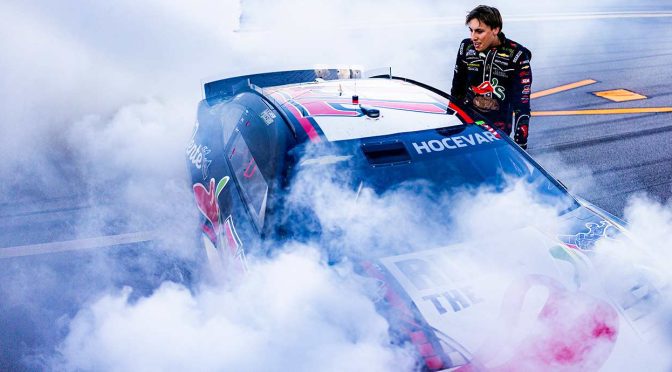
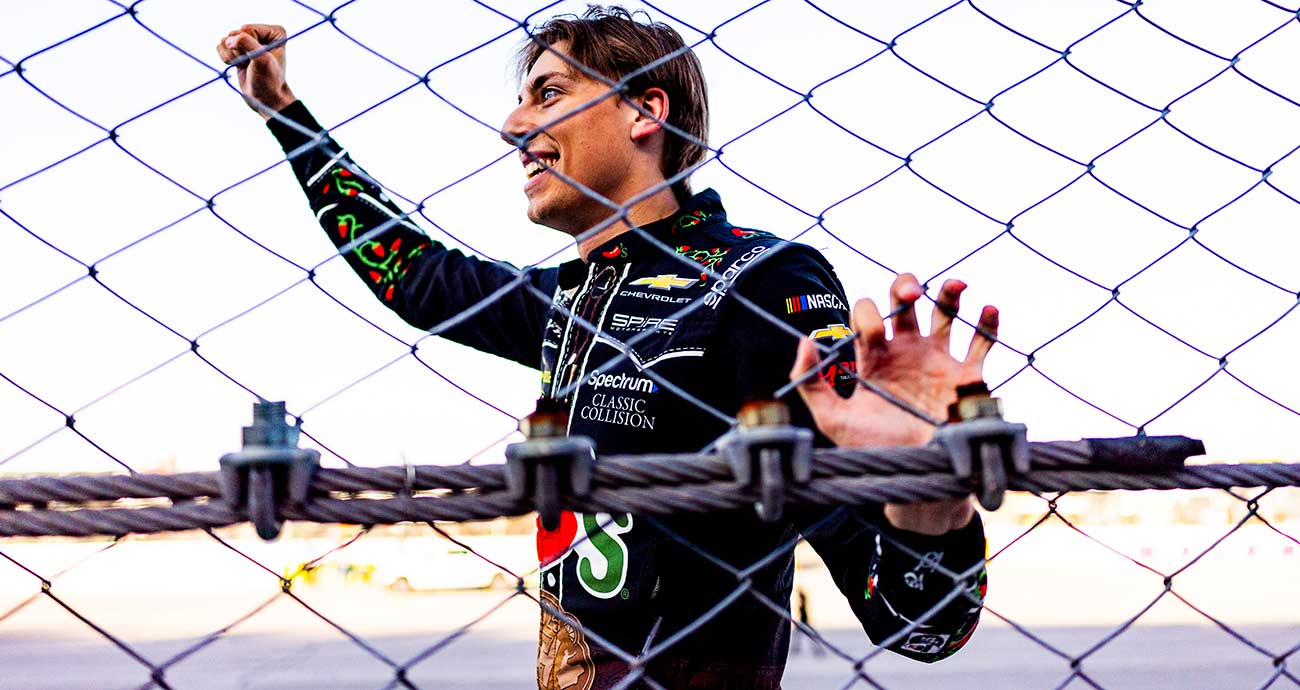
Everyone knew the first NASCAR Cup Series win for Carson Hocevar would be cause for a big celebration.
We should have known Chili’s would be the site of the party.
The restaurant’s logos were plastered across the No. 77 Spire Motorsports Chevrolet as Hocevar took the checkered flag first Sunday at Talladega Superspeedway, leading to a Victory Lane bash for the entire Spire team.
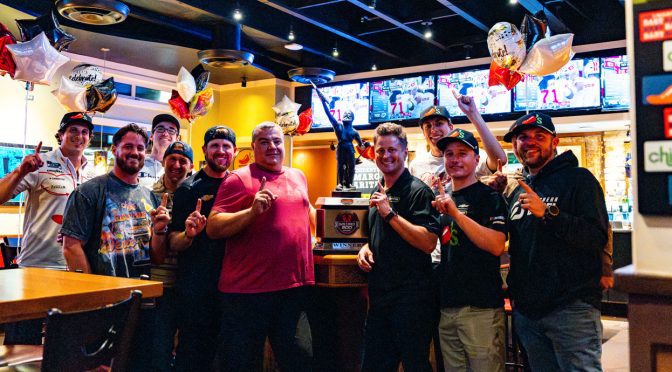
That winner’s circle jubilee in Alabama — which featured drivers, crewmen and sponsored guests of all three Spire teams — was quickly going to need a new home. Some 350-plus miles away in Mooresville, North Carolina, one Chili’s restaurant became just the place.
Mel Beckham, general manager of the Mooresville Chili’s, has effectively become a de facto member of Spire, given how often the team’s employees flock to her location. She made it home from her Sunday shift just in time to watch Hocevar earn the win. And once confetti started flying, phones started buzzing.
“All of us are texting with each other, just excited for the win, and super happy for him, and then it just went from there,” Beckham told NASCAR.com in a phone interview. “I got a phone call from my (director of operations) Rachel, who said, ‘Hey, they want to come celebrate at your restaurant.’ So I said, ‘Absolutely, let’s do it.’ And I got dressed and came back to the restaurant. We made it happen from there.”
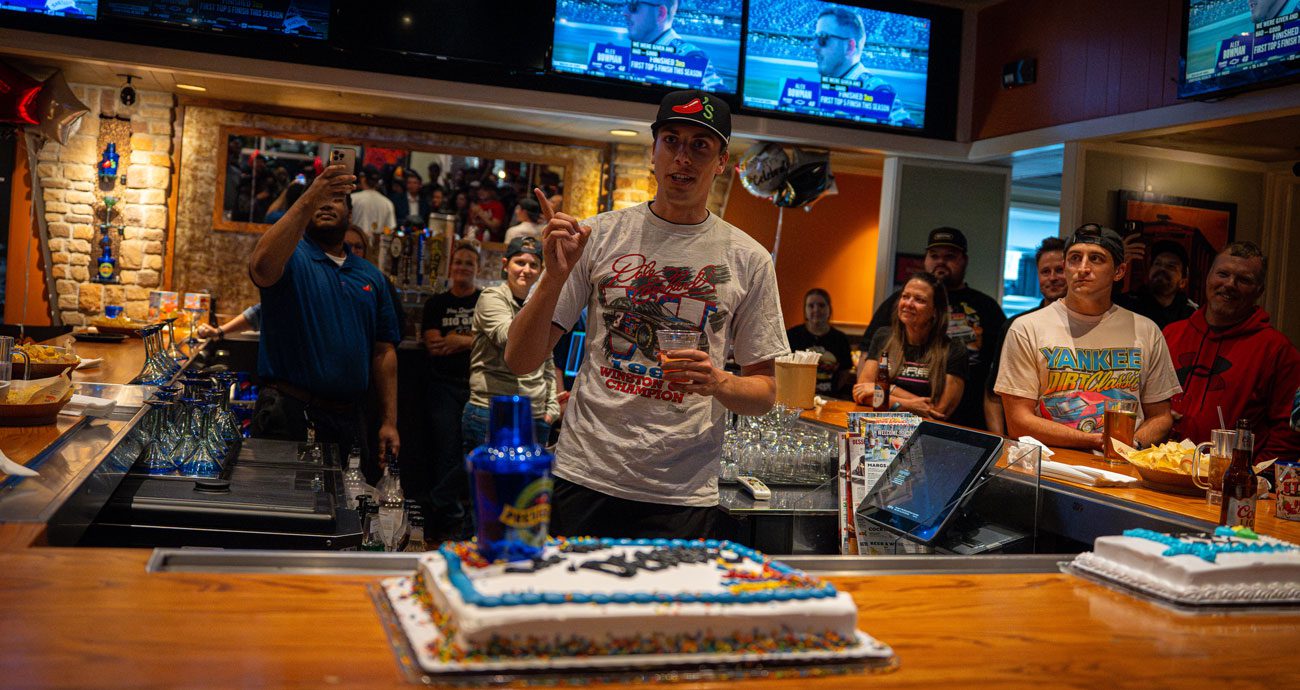
Beckham’s staff jumped into action immediately for the impromptu party, even purchasing balloons and cakes to decorate before Spire diners began arriving at 8:30 p.m. ET, not even two hours after the checkered flag. The restaurant was opened specifically for a late-night Spire party at 10:30 p.m. with the chain’s signature “Triple Dipper” appetizers and Presidente margaritas flowing until 2:30 a.m. Monday.
Beckham — whose name was on Sunday’s winning race car along with the 1,100-plus Chili’s GMs — said she didn’t need to try hard to convince her staff to stay late for the last-minute bash. They were just as invested in the fun.
Courtesy of Spire Motorsports
“They are so pumped about this partnership, too. They love it,” Beckham said. “Not a single one of them turned their nose up. They were like, ‘What do you need me to do? What do I need to do? Tell me what you need me to do. I’m here for you, and I’ll do it.’ And that’s what they did.”
Those traveling from the track landed back in North Carolina at 11:15 p.m. By the time the at-track travelers walked in the door, at least 75 people from all Spire departments were there to welcome the freshly crowned winners with a warm, jubilant reception.
In the words of Sunday’s winning crew chief, Luke Lambert: “There’s no better place to celebrate than Chili’s.”
With race replays covering every TV, Lambert and Hocevar finally joined the party around midnight, walking through the front door of the restaurant with the cast-iron, near-100-pound Vulcan Trophy that has become synonymous with Talladega. Outside waiting for them was the “Marg Machine,” the No. 77 Chili’s Pontiac Grand Prix donned in Dale Earnhardt’s Wrangler scheme colors, which was driven to the restaurant by a fellow team member.
Lambert’s elation matched that of his team’s, basking in the celebratory atmosphere after helping guide his 23-year-old driver to victory.
“I was shocked to be standing in a Chili’s at 1:30 in the morning, and all the employees who had probably worked the entire day at that location were all just as happy as us and happy to serve us,” Lambert laughed in a phone interview with NASCAR.com. “It was really special and remarkable. I can’t really describe the moment. It couldn’t have been more perfect. It’s awesome.”
After the Chili’s festivities trickled to a close at 2:30 a.m., roughly 25 team members trundled their way to Lambert’s house, where the party rolled into Monday’s sunrise after a few more drinks and some late-night swims. Hocevar, hydrated by energy drinks instead of alcohol, played the role of designated driver to help transport partygoers.
The victory was a definitive arrival for Hocevar and the No. 77 team. But the celebration that ensued was widespread at Spire.
“It did not feel like a 77-specific win. It felt like a Spire victory,” Lambert said. “And I think that that bond and unity that we have as a team is our biggest strength, and I think it is something that I believe other folks in the sport probably are envious of — or they should be.”
TEMPERANCE, Mich. — A unique, same-day doubleheader for the ARCA Menards Series East and West will be shared with fans nationwide as FloRacing and the NASCAR Channel combine for ARCA Night in America presented by Menards.
ARCA Night in America presented by Menards will start with ARCA Menards Series East Cook Out Music City 150 at the historic Nashville Fairgrounds Speedway at 9 p.m. ET/6 p.m. PT. The ARCA Menards Series West Bill Schmitt 173 will follow with the green flag expected at 11:30 p.m. ET / 8:30 p.m. PT.
Charles Krall, the voice of the ARCA Menards Series East and West, will call the action for both races. He will be joined by veteran MRN Radio and track public address announcer Nathan Prouty. They will be joined by ASA STARS National Tour announcer Jonathan Ramos on pit road at Nashville and veteran West Coast announcer Steven Blakesley patrolling the pits at Shasta.
“This is going to be one of the marquee nights of racing for the ARCA Menards Series platform all season long,” said ARCA president Ron Drager. “Our two regional tours, the ARCA Menards Series East and West, have both started the 2026 season with excellent fields of race cars and some really thrilling races, and it’s going to be a big deal to have them both in action on the same night.”
“The ARCA Menards East and West have both delivered really strong audiences on both FloRacing and the NASCAR Channel in 2026,” said Dan Barker, Senior Managing Director, Content Strategy and Distribution for NASCAR. “The East race at Hickory saw its largest viewership in over 10 years, and Rockingham was similarly strong. The ARCA Menards platform has a tremendously loyal audience, and we look forward to giving everyone a great night of racing on both sides of the country.”
On track activity at Nashville will begin with practice at noon ET/11 a.m. CT, followed by Sioux Chief PowerPEX Pole Qualifying at 5 p.m. ET/4 p.m. CT. The Cook Out Music City 150 will follow at 9 p.m. ET/8 p.m. CT.
Activity will begin at Shasta with practice at 6:30 p.m. ET/3:30 p.m. PT followed by Sioux Chief PowerPEX Pole Qualifying at 8:20 p.m. ET/5:20 p.m. PT. The race will follow with the estimated green flag time of 11:30 p.m. ET/8:30 p.m. PT.
Both races will be streamed live on FloRacing and simulcast on the NASCAR Channel. Live timing and scoring data will be available on ARCARacing.com. For up-to-the-minute updates, follow @ARCA_Racing on X (formerly Twitter).
Tickets for the ARCA Menards Series East Music City 150 at Nashville Fairgrounds Speedway are available at TrackEnterprises.com. Ticket information for the ARCA Menards West Bill Schmitt 173 is available at ShastaSpeedway.com.
Goodyear will bring a semi-familiar tire setup for the upcoming race weekend in the Lone Star State — familiar to the NASCAR Cup Series, but new to Texas Motor Speedway.
The Fort Worth-area track will host all three national series this weekend, with the NASCAR O’Reilly Auto Parts Series and NASCAR Craftsman Truck Series joining the tripleheader. Those events lead up to the Cup Series’ Würth 400 presented by Liqui Moly on Sunday (3:30 p.m. ET, FS1, PRN Radio, SiriusXM NASCAR Radio).
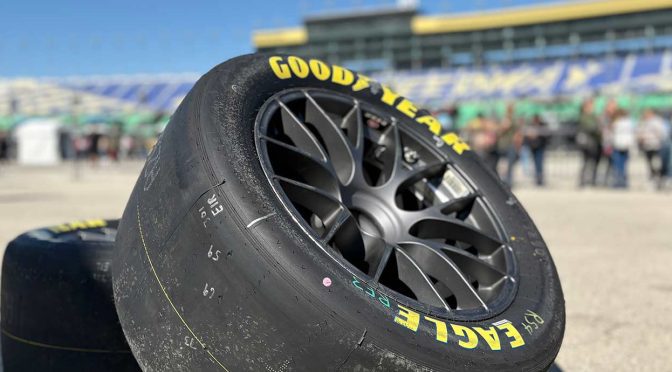
Sunday’s Cup Series race will be the third this year on a true 1.5-mile oval, not counting the same-sized but superspeedway-style layout at EchoPark Speedway. This same tire setup was used earlier this season at Las Vegas Motor Speedway, Kansas Speedway and the 1.366-mile Darlington Raceway. The left-side tire has been in Goodyear’s rotation since last year’s Coca-Cola 600 at Charlotte Motor Speedway, where it debuted with an updated compound. The right-side rubber made its first Cup appearance last September at Kansas.
“The Goodyear Racing Eagle tire setup we have selected for Texas Motor Speedway represents the next step in the consolidation of our intermediate track tire package,” said Justin Fantozzi, Goodyear Director of Racing for the Americas. “Teams are already familiar with the combination, having run it three times this year, and we are happy with its performance at similar 1.5-mile tracks.”
The O’Reilly Auto Parts Series also competed with this tire configuration at Las Vegas and Kansas earlier this season. The Craftsman Truck Series’ setup is also a familiar one, but it makes its first appearance of the year at the season’s first intermediate-sized track for the tailgate tour.
The tire allotments for each team competing this week:
Cup Series: 10 total sets — 8 new sets for the race, 1 for practice and 1 from qualifying that transfers to the race.
O’Reilly Auto Parts Series: 6 total sets — 4 new sets for the race, 1 for practice and 1 from qualifying that transfers to the race.
Craftsman Truck Series: 5 total sets — 3 new sets for the race, 1 for practice and 1 from qualifying that transfers to the race.
Mark Martin’s words to live by were handed down from one generation to another. Julian Martin — his father, an Arkansas trucking magnate — lived by the adage of “never lift,” and though he never raced, his enthusiasm for cars and speed made him a local legend on the lawless back roads of home. It became a family tradition.
Julian Martin’s son is quick to recite the interpretation: “Never lift: ‘To keep one’s foot firmly planted on the accelerator pedal with complete disregard to the possible outcome can often end in catastrophic results, but with proper execution has been known to create legends,'” Mark Martin says. “That’s my dad.”
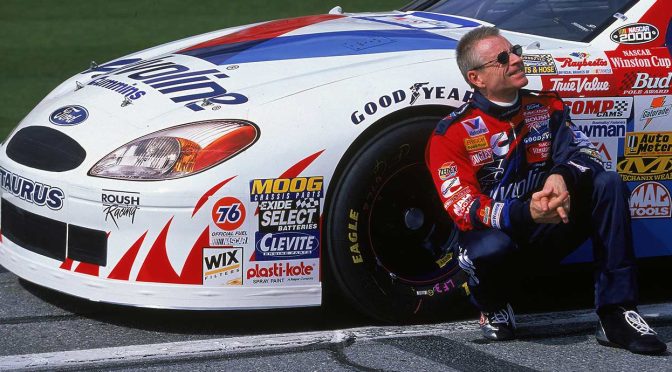
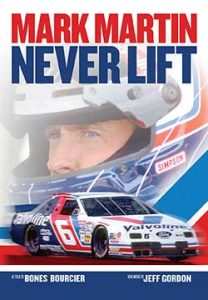
So when Martin sat down to put pen to paper and tell his life story, with all the unlikely undulations of his Hall of Fame racing career, there was really only one potential title. That autobiography is now available for pre-order, with “Mark Martin: Never Lift” scheduled for publication in August from Octane Press.
The hardcover book, co-written with veteran journalist Mark “Bones” Bourcier, weighs in at a hefty 544 pages, full of the detail that’s come from living through several decades of racing in different eras until his eventual retirement after the 2013 season. The 67-year-old veteran also points out that his story is now unfettered by obligations or restrictions – from team owners, sponsors or any sanctioning body. “Beholden to no one,” Martin says, promising an unflinching view of how it was.
“The stories are fun to tell because the older we get, the more it sounds like the Wild West, racing in the ’70s,” Martin says. “You can’t believe the stories, because you couldn’t do it like that, or act like that now. This world was so different, and so there’s just a lot of interesting stuff. But it was not so much a reflection, it’s just being able to get it all out there.”
While many fans and observers connect more closely with Martin’s time in NASCAR’s Cup Series — especially his long-running association with fellow Hall of Famer Jack Roush — there’s a wealth of grassroots experience and success on the ASA circuit before his arrival in the iconic No. 6 Ford. Those tales are all there, from his three ASA championships before age 22, his self-propelled first Cup Series venture in the early 1980s, to a rocky bottoming out before rebuilding his career with a fourth ASA title and eventually fulfilling his big-league aspirations.
Once connected with Roush, Martin began shaping a NASCAR résumé that’s the envy of most mortals — 40 Cup wins, 56 poles and 882 starts.
“Of course I’m biased, but I think Dad has a really inspiring story,” says his son, Matt Martin. “He’s got a great comeback story, and even a lot of his diehard fans, they’re not even really aware of it. There’s basically a book’s length before you even get to the 6 car.”
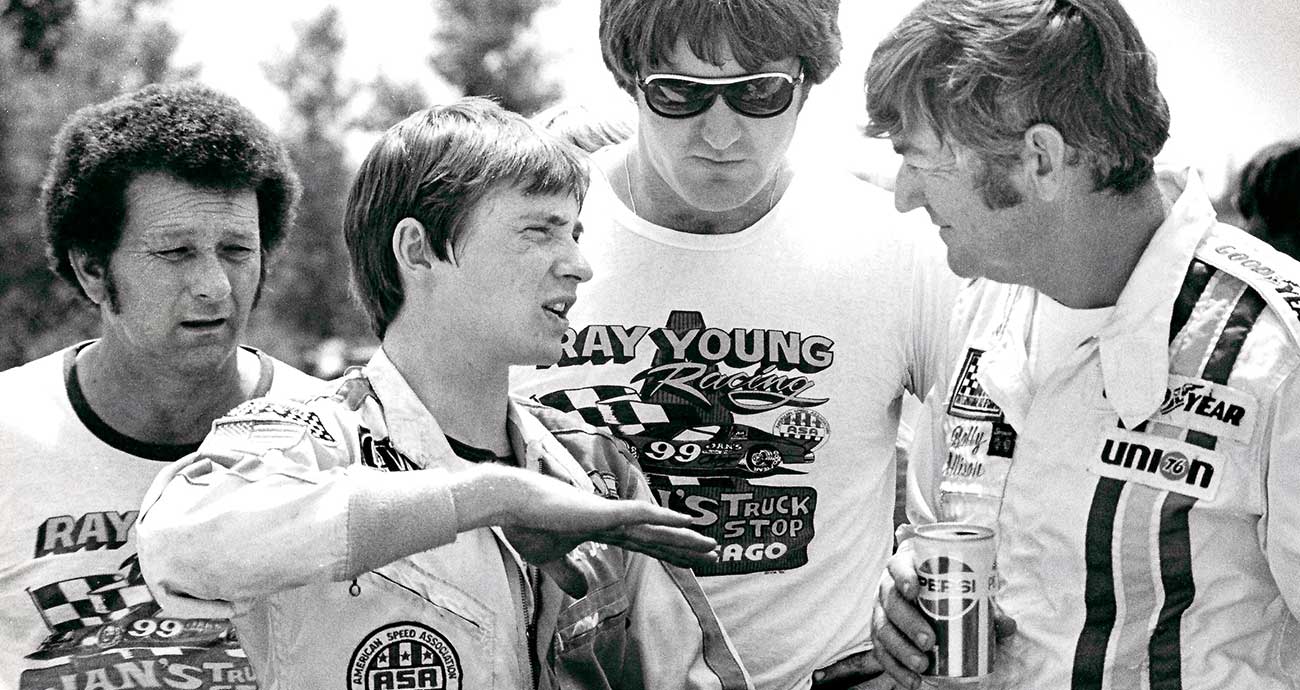
Mark Martin offers some feedback to Bobby Allison, in town at Madison for an ARTGO event, while driving for Ray Young, at left. | Courtesy: Mark Martin Archive
Many of those sections are sprinkled with the sharp detail and impressive recall that Martin has been known for. Show Martin a black-and-white photo of one of his former race cars on social media, and odds are that he’ll rattle off chassis info, setup numbers and the team owner without a hitch.
That sort of precision was a hallmark of Martin’s career, and it’s served him well in this retelling of his story.
“That’s my life,” Mark Martin says. “That was my hands on my car before I raced NASCAR, those cars were my cars, and my hands were all over them, and so I like to talk about that. That was my world, and that’s how I beat the best of the best. I didn’t outdrive them; I made my car faster. It worked for me at the local dirt track when I started, all the way to Dale Earnhardt.”
Matt Martin interjects with a laugh: “You might have outdrove ’em a little bit, too.”
“Maybe,” his father concedes. “But you know, I didn’t have to worry about outdriving Dale Earnhardt if I made my car faster. Fast enough, I’d win. So there’s a lot of that in there. That was real important to me, and I was always a car guy. I don’t have great memory of normal things. You know, it’s not like everything. I’m not like a savant. I just can tell you what the setup was in 1977 at Anderson for the Redbud 400. I can tell you what tire compounds I had at the Snowball Derby in ’79. Those things, I can tell you.”
Besides the goal of documenting one of the sport’s most storied careers, one of Martin’s objectives in writing this book is to share his experience with a younger generation of racers. He recalled how in the first phase of his NASCAR career, Martin crossed paths several times with stock-car pioneer Tim Flock, a 2014 Hall of Fame inductee. A lasting regret, Martin said, is not asking Flock about racing with a monkey in his car or what the barnstorming early days were like before the sport took flight.
“He was so much fun, and he was a character, but all I was worried about is, ‘how’s it gonna make my car go faster so I could win me a NASCAR race,'” Martin said. “So I think about that, and I think, ‘man, I hope some young people will take the time to learn about what came before them.’ I messed up. I didn’t. I mean, I know how it would have made him feel if I would have been interested in his career and what he did.”
That’s what Martin hopes to pass along to current-day and aspiring racers, the “never lift” ethos that’s carried him through his professional and personal life.
“I live my life wide open,” Martin says. “Everything I do, I go. … I don’t sit very still, so it is real fitting.”
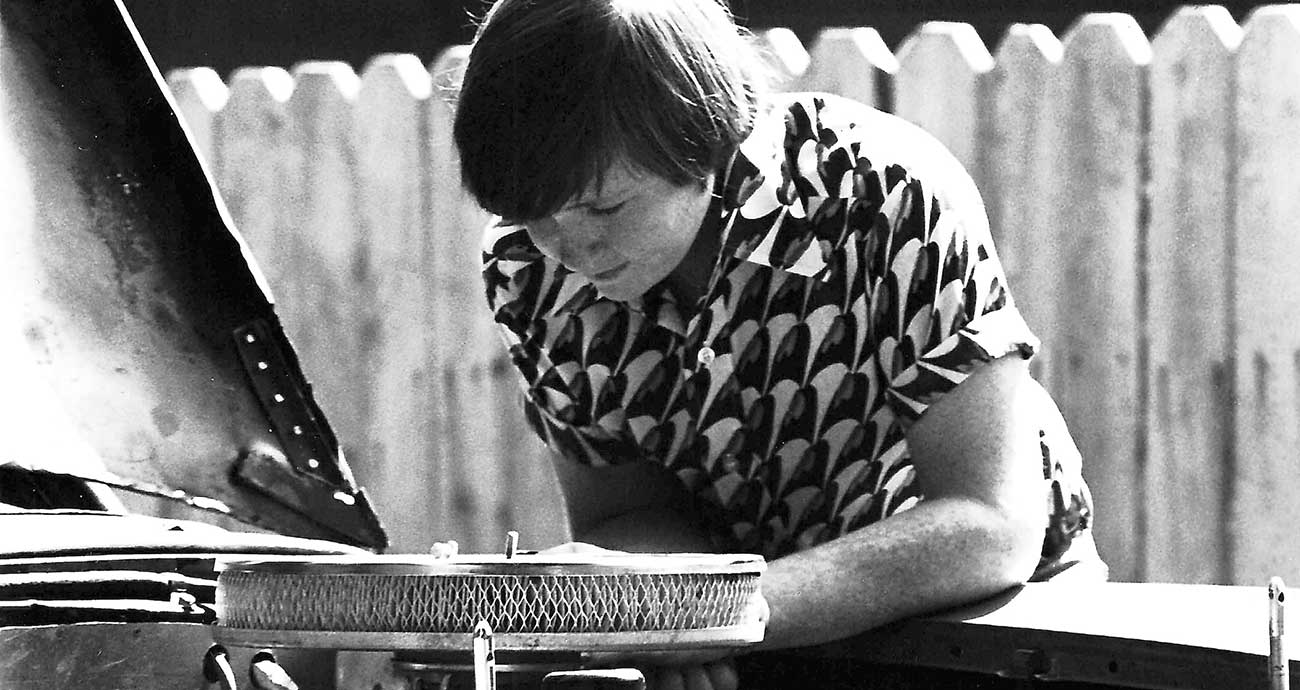
A young Mark Martin looks under the hood in an Arkansas scene from 1974 | Courtesy: Mark Martin Archive
PHILADELPHIA (April 27, 2026) — Comcast today announced that nominations are now open for the 2026 Comcast Community Champion of the Year. Since its founding in 2015, the award has celebrated individuals across the NASCAR community who go above and beyond to give back. Nominations are being accepted now through June 15 at ComcastCommunityChampion.com.
Each year, Comcast reviews the nominations and selects three finalists, sharing their inspiring stories with the public. A committee of NASCAR and Comcast executives then names the 2026 Comcast Community Champion of the Year. The champion’s affiliated charity receives a $60,000 donation, while the charities chosen by the two finalists each receive $30,000 later this year.
Any individual with a 2026 annual credential or NASCAR full-season license from any of NASCAR’s top three national series is eligible to be nominated as a 2026 finalist, including:
Team owners, drivers and all NASCAR Cup Series, NASCAR O’Reilly Auto Parts Series and NASCAR Craftsman Truck Series employees
Full-time employees of tracks that are currently on the schedule for NASCAR’s three series
NASCAR Media members who have a Print, Broadcast or Photography Hard Card
NASCAR Officials
NASCAR Partners/Sponsors
Family members of drivers and crew members
Driver and team employees (motorhome drivers, agents, and managers, etc.)
Support industry personnel (engine builders, parts and service providers, etc.)
“Driving meaningful, lasting impact in the communities we serve is fundamental to Comcast’s mission. We are proud to recognize the outstanding individuals within the NASCAR community whose generosity, leadership, and commitment continue to make a real difference, strengthening and uplifting communities across the country,” said Matt Lederer, vice president of Brand Partnerships and Engagement, Comcast.
Over the past 11 years, the Comcast Community Champion of the Year program has supported more than 30 nonprofit organizations, a testament to the philanthropic spirit found throughout the NASCAR community. To date, Comcast has contributed more than $1 million to deserving organizations connected to members of the NASCAR family, deepening its commitment to the sport while extending its impact beyond the track. More than a program, this initiative is a movement grounded in compassion, community, and a shared commitment to making a difference where it matters most.
Past champions include:
World Wide Technology Raceway Owner, Curtis Francois, representing Raceway Gives Foundation
Chip Ganassi Racing’s pit crew department representing Ronald McDonald House
Dover Motor Speedway President, Mike Tatoian, representing USO Delaware
OnPoint Motorsports Driver, Ryan Vargas representing FACES: The National Craniofacial Association
NASCAR driver, Bubba Wallace, representing the Live To Be Different Foundation
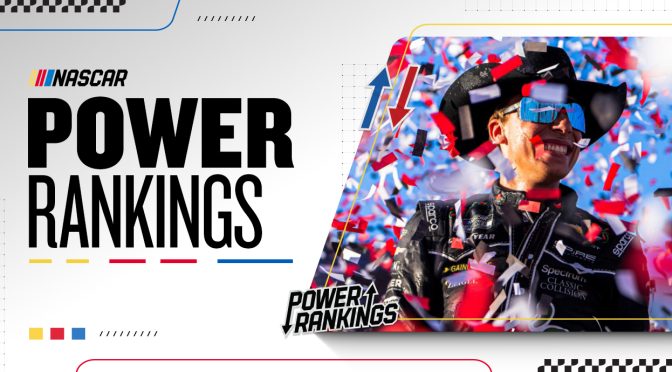
NASCAR.com’s Pat DeCola ranks the top 20 Cup Series drivers competing for the 2026 championship after Carson Hocevar’s win at Talladega Superspeedway and before Sunday’s Würth 400 presented by LIQUI MOLY at Texas Motor Speedway (3:30 p.m. ET, FS1, HBO Max, PRN Radio, SiriusXM NASCAR Radio). Joey Logano enters as the defending winner.
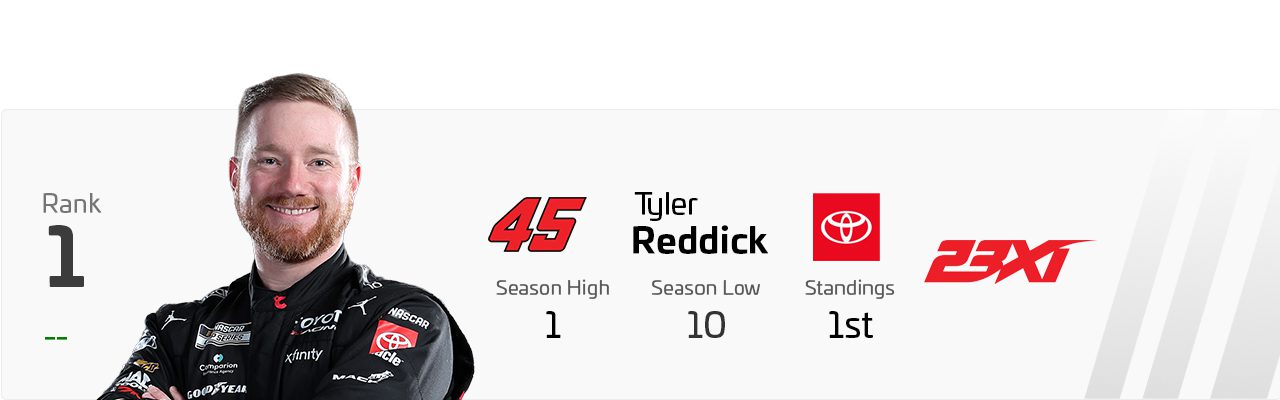
Analysis: Reddick started from the pole and briefly flashed early control, but never truly dictated the race after the opening green-flag cycle and led just two laps before settling into the pack. He stayed mostly clean through the Lap 115 wreck that wiped out much of the field but never re-emerged as a late-race factor, ultimately fading into a quiet 14th-place finish but still holding a commanding edge atop the standings. Texas should be a different story — a track where he owns a win, four top 10s in seven starts and a 13.1 average finish and very likely will be in the mix for victory No. 6 of the year.
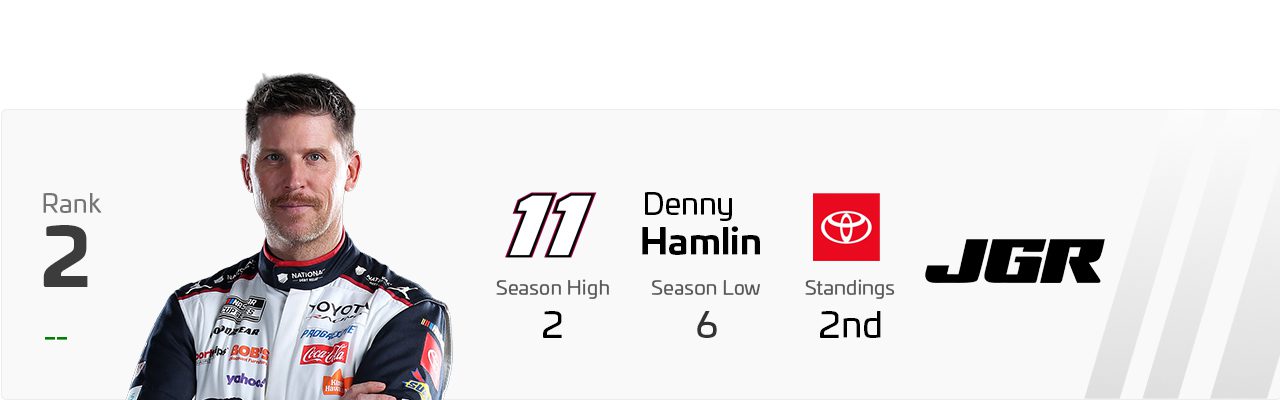
Analysis: Hamlin wasted no time asserting himself at ‘Dega, charging to the lead on the opening lap and controlling long stretches early to pace the field for 28 laps before pit road issues unraveled his afternoon. A speeding penalty ultimately paved the way to a 15th-place finish, but the result hardly reflects the speed, as Hamlin once again showed race-controlling ability before execution got in the way. That becomes especially relevant at Texas — where he’s a three-time winner with 16 top 10s and a 12.5 average finish — a track that tends to reward the exact kind of long-run control he displayed early Sunday.
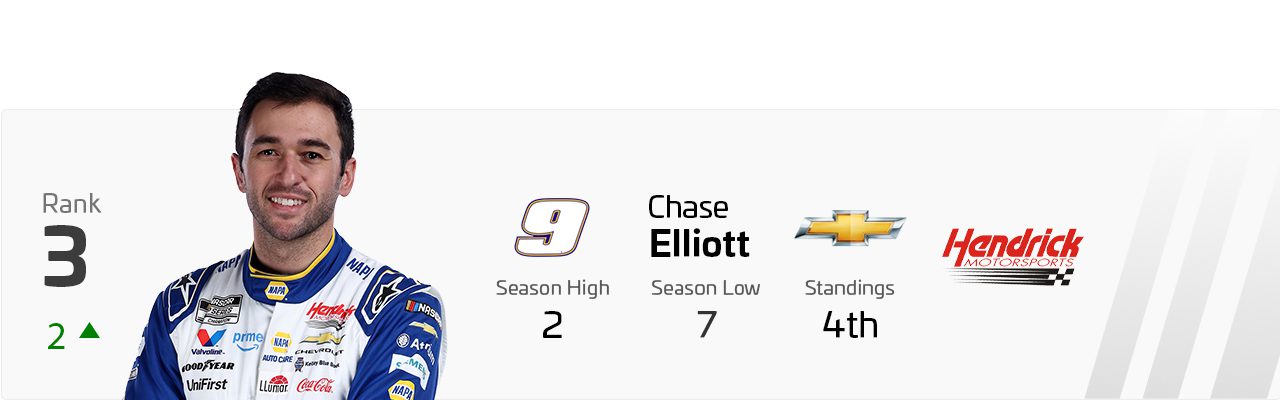
Analysis: Elliott was largely invisible for much of the race — often a counterintuitive key to Talladega success — keeping himself out of trouble while others were caught up in the “Big One” before positioning himself well in the closing laps to secure a fourth-place finish. He never led but also never made a mistake; the kind of clean execution that continues to define his season, with six top 10s through 10 races keeping him firmly in the title mix. Texas should suit that approach as well; Elliott owns a win and seven top 10s there with a 12.5 average finish, reinforcing his profile as one of the most efficient and reliable performers entering the weekend.
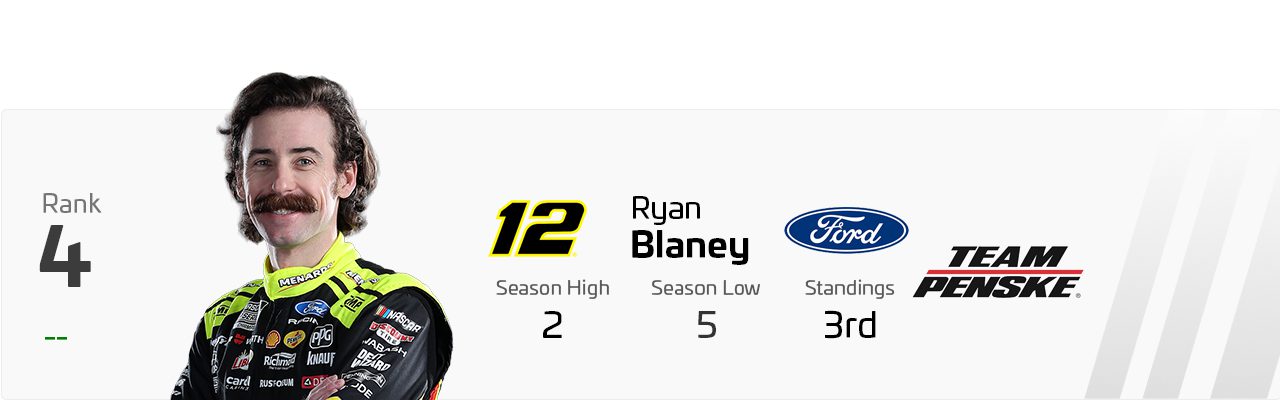
Analysis: Blaney’s ‘Dega day ended prematurely in the Lap 115 crash, but he had positioned himself among the leaders before the incident and was very much in the mix before the race flipped on its head. Given his season-long speed and ability to move through the field, Texas should set up as a perfect rebound spot. The Fort Worth track has been one of No. 12’s strongest statistically, with 451 laps led (finding the front of the field in eight of the past 13 races there) and nine top 10s, even if those runs haven’t yet converted into wins — a trend that feels correctable this weekend.
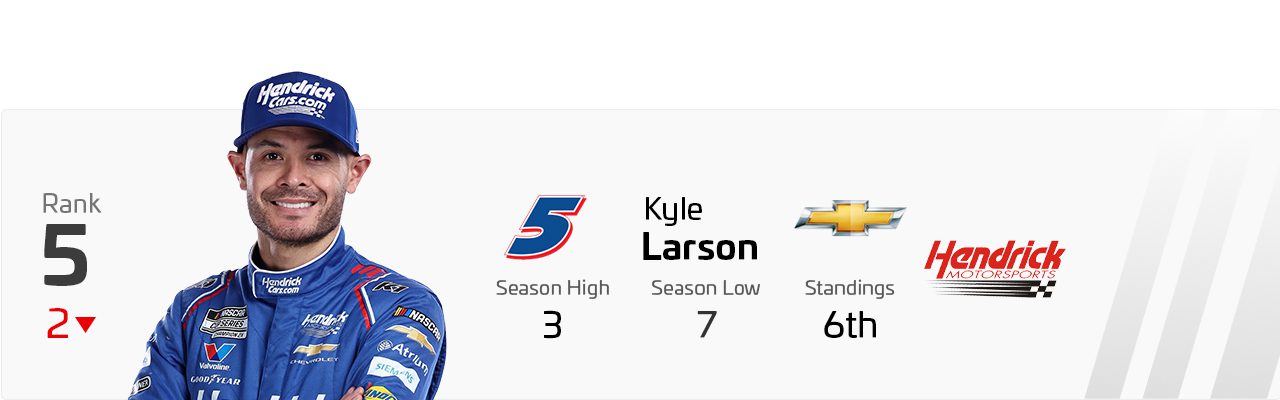
Analysis: Larson started on the front row and ran among the leaders early before becoming another victim of the mid-race crash, exiting with a 40th-place finish and little to show for the weekend. Like Blaney, this is a pure throwaway result for one of the fastest cars in the field week-to-week. Texas should represent a much better barometer of where the No. 5 team stands come Sunday night, as Larson has led 615 laps there with a win and seven top 10s, with certainly one of the highest ceilings of anyone entering the race.
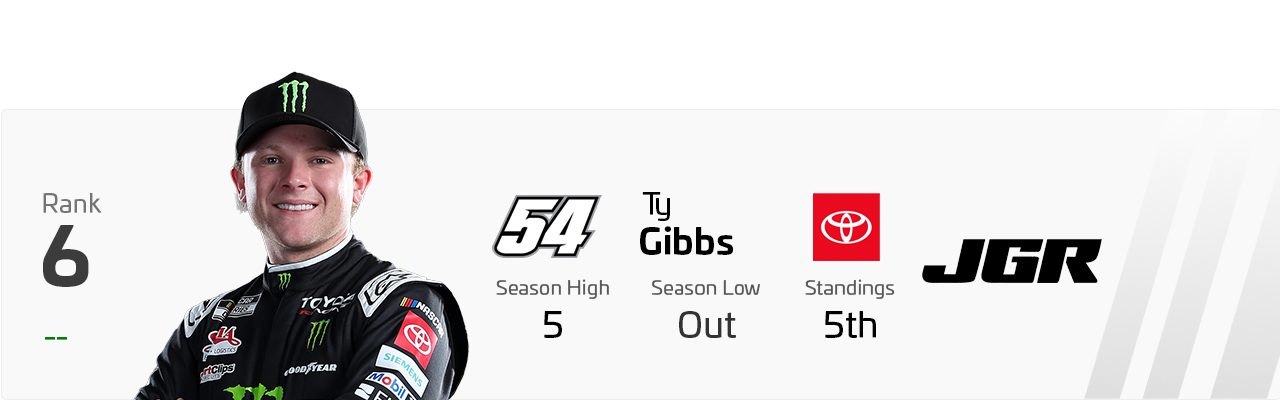
Analysis: Gibbs was one of the most impressive drivers early on Sunday, consistently running inside the top five and leading 17 laps across multiple stretches before his day, you guessed it … ended in the Lap 115 wreck. Texas is less proven territory for him and should offer a good chance to really show what he’s made of this year, with a rough 22.3 average finish there so far. Given his current form, though, he remains one of the more intriguing upside drivers in the field.
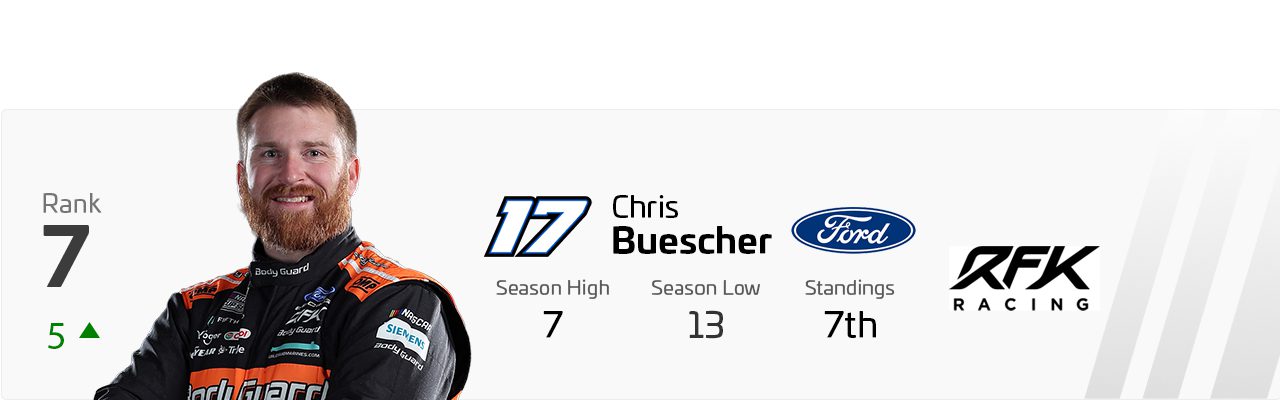
Analysis: Buescher, as expected, spent much of the final stage in contention, trading the lead multiple times with Hocevar before ultimately finishing second, as No. 17 continues to be a force on superspeedways. The transition to Texas could be a rough homecoming for the Prosper native, unfortunately. Buescher has yet to record a top-10 finish across his 16 starts there and carries an average finish north of 21, making this a likely regression spot despite the recent momentum.
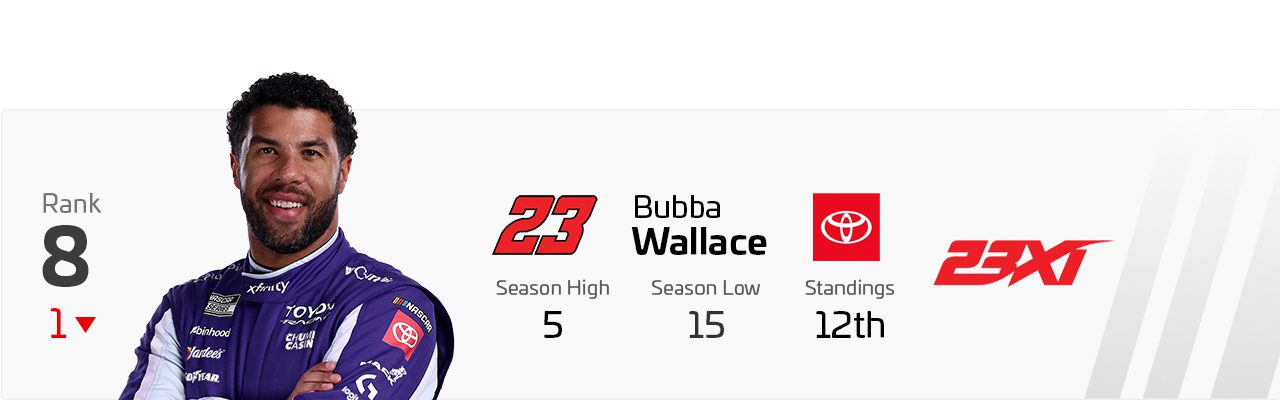
Analysis: Wallace worked his way into strong track position through pit strategy and ran inside the lead group before his afternoon unraveled at one of his best tracks, getting bumped and spinning from the front of the field to trigger the multi-car crash that eliminated much of the competition, including himself. Texas offers a slightly more stable environment, and recent strong runs there indicate he’s better than the three top-10s and 118 laps led he’s earned at the 1.5-mile facility across 11 starts.
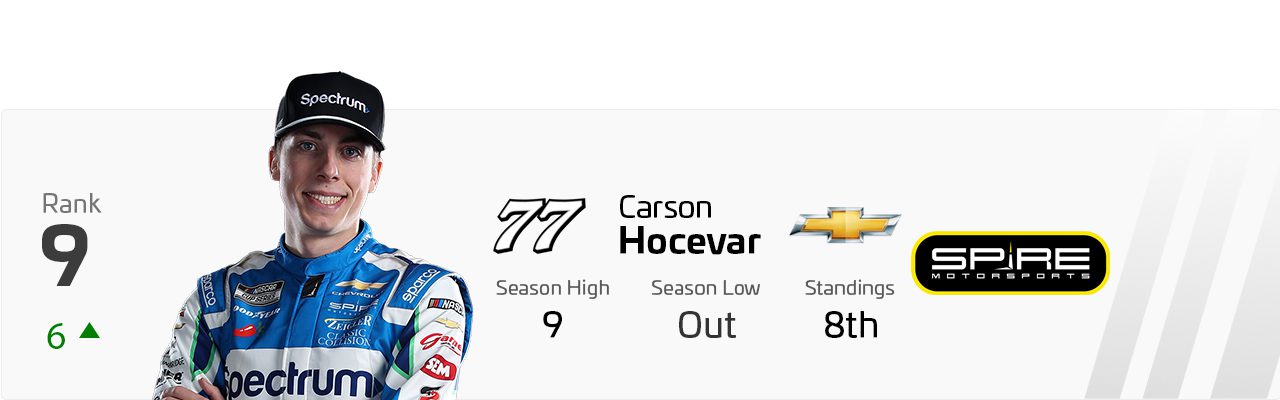
Analysis: Aaaaand we’re off. Hocevar’s first career win came not through domination, but precision and timing, hovering outside the top 10 for much of the race before executing perfectly in the closing laps, leading just 19 total circuits en route to the victory and one heck of a post-race celebration. It’s a significant milestone and moment for the sport, but also important context: he’s probably just getting started, and the rest of the garage should be on notice. Texas presents a different yet achievable challenge, where he’ll be looking for just his second top 10 at the track. Or perhaps another cowboy hat for his growing collection, and the trophy that comes along with it.
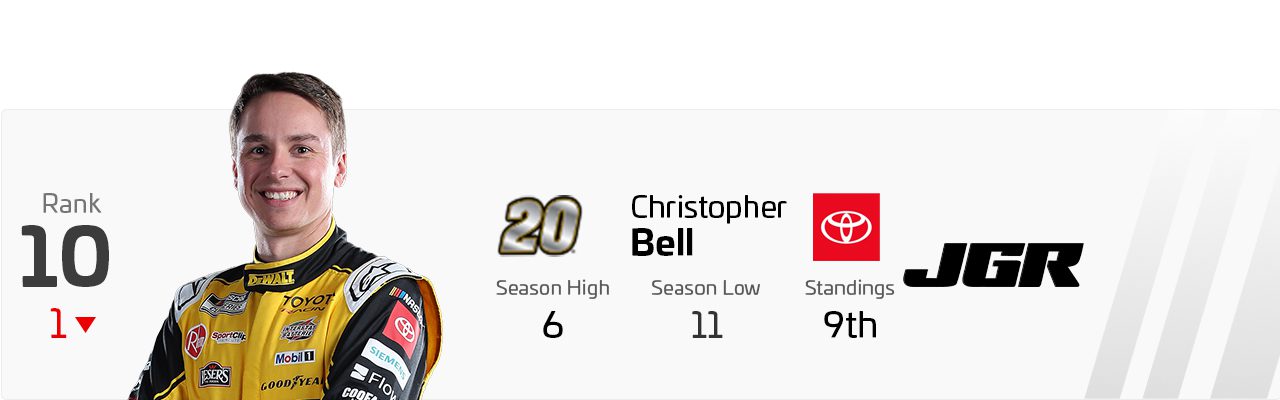
Analysis: Bell was one of the most dominant drivers throughout the race, leading a race-high 31 laps and controlling multiple segments before fading late to a 17th-place finish that doesn’t quite reflect his performance. His speed should carry on to Texas, one of the fastest intermediate tracks, where Bell has quietly been one of the most consistent with four top 10s in seven starts, a 13.0 average finish — and a real shot at the win Sunday.
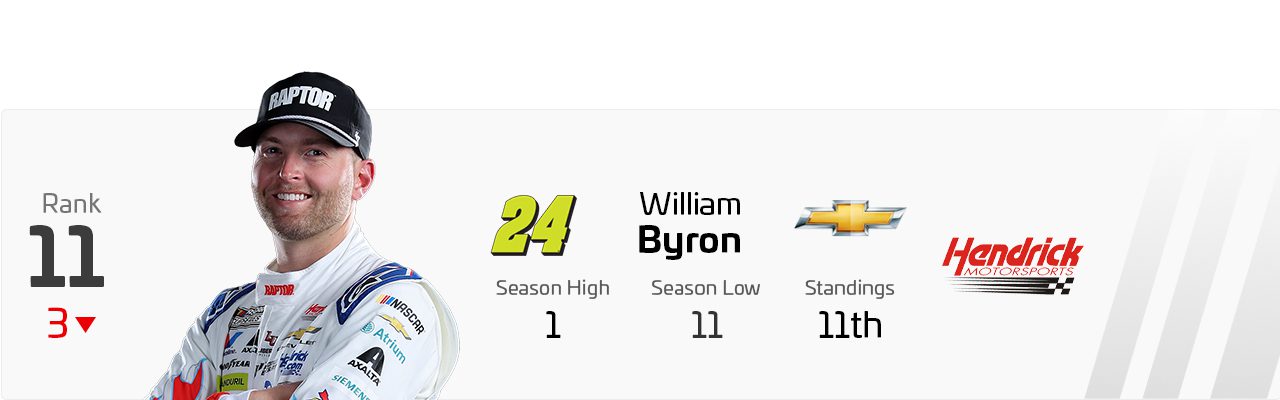
Analysis: Byron never established himself as much of a factor at Talladega — which seems to be happening more often this year than usual — and was swept up in the Lap 115 crash, resulting in a 35th-place finish that the No. 24 team will want to move on quickly from. Texas, however, has consistently been one of his better tracks, highlighted by a win, six top 10s and an 11.4 average finish, making him a prime bounce-back candidate this weekend in a campaign that needs a bit of rejuvenation.
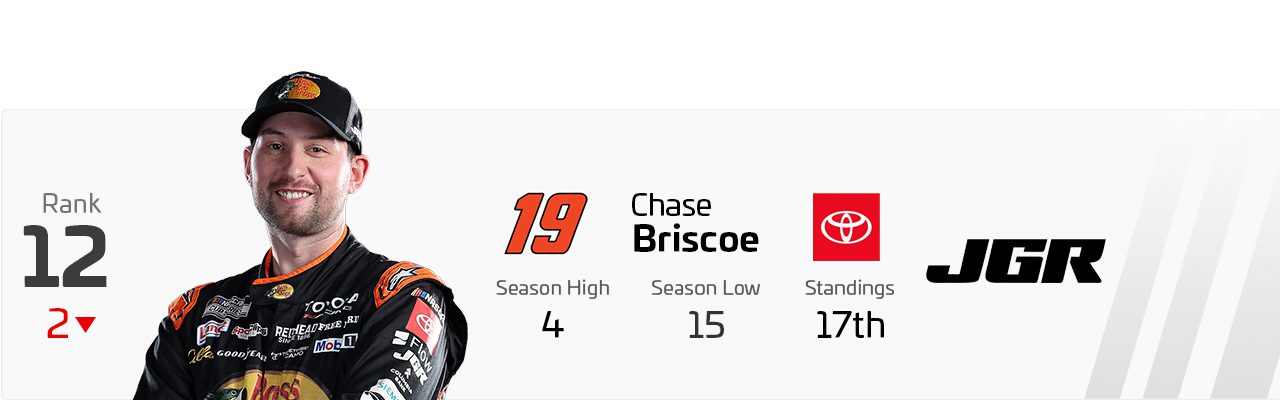
Analysis: Recent ‘Dega winner Briscoe once again showed early promise, leading laps in the opening portion of the race before pit-road miscues and a loss of the draft dropped him off the lead lap and ultimately to a 29th-place finish. The encouraging piece is the speed, which he’ll hope to carry into this weekend to pair with a favorable Texas profile. In five starts there, Briscoe has three top 10s and a 12.6 average finish, suggesting a much stronger showing could be on the horizon.
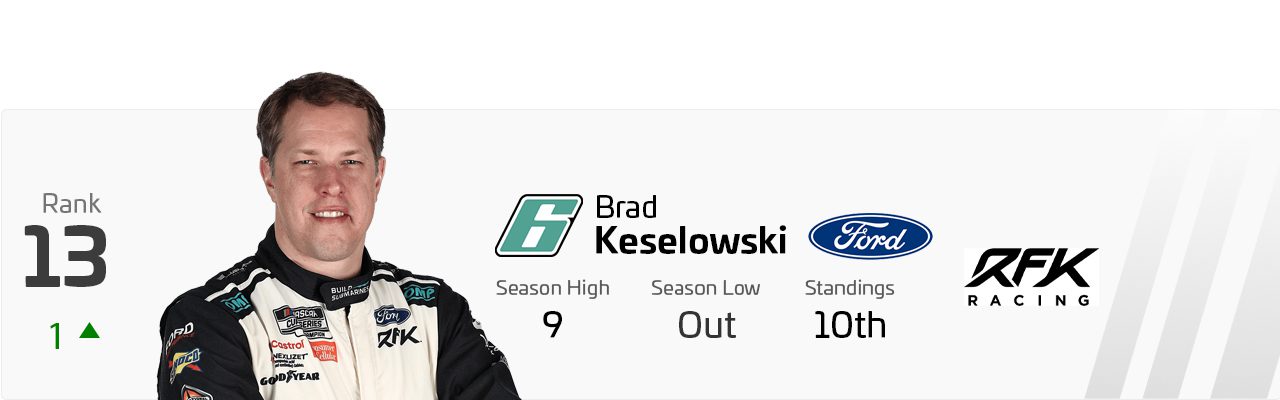
Analysis: The Talladega maven ran inside the top five early and looked poised for a solid day before being collected in the mid-race crash, ending his afternoon well before it could develop. With RFK showing consistent speed, though, Texas presents a strong opportunity to rebound. The 2012 champ’s 14 career top 10s and 685 laps led at the track underscore his long-term success there, which has continued even after his Penske days.
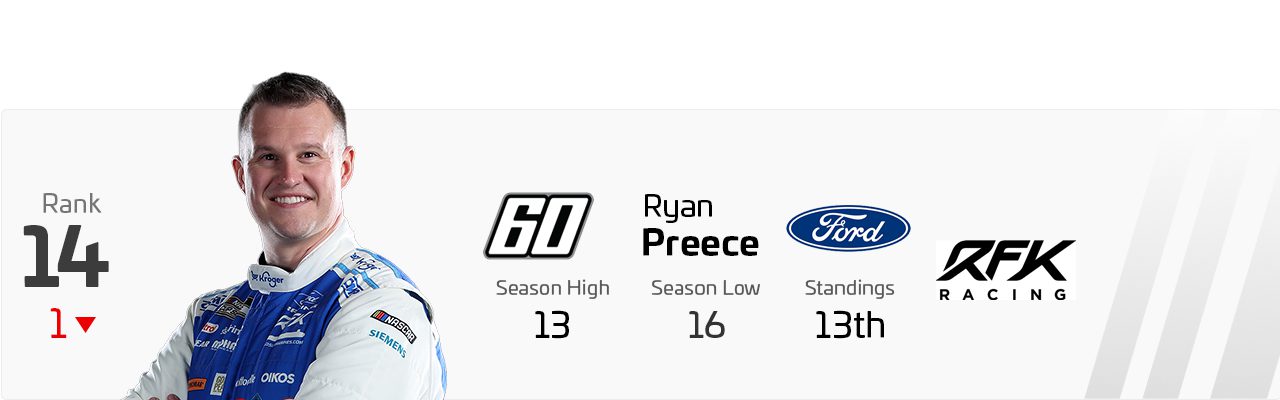
Analysis: Preece was one of the most impressive drivers early, winning Stage 1 and controlling stretches of the race, but faded as the race progressed, ultimately finishing 18th. While the speed was notable, Texas has historically not been kind to him. He has yet to record a top-10 finish there and carries a 26.6 average finish, making this a difficult spot to sustain that momentum.
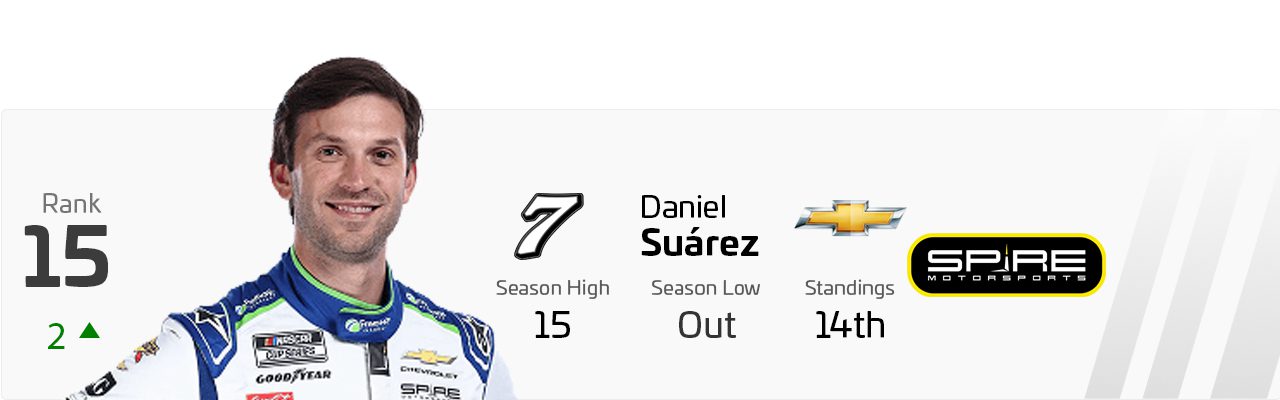
Analysis: Suárez kept his race clean and relatively uneventful, avoiding trouble and capitalizing late to secure a 12th-place finish — and then getting to celebrate in Victory Lane with his teammate. That approach has served him well at times this season as he gets his feet wet with Spire, and Texas could see this momentum build further. Three of his 25 career top fives came there, and each of his last five starts has yielded a finish of 12th or better.
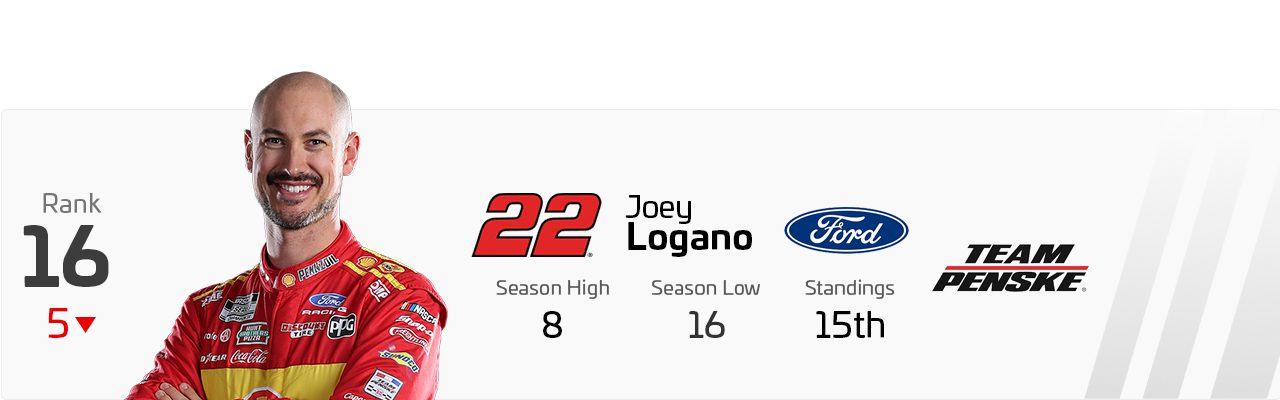
Analysis: Logano had positioned himself as a contender before being swept up in the Lap 115 crash and ending his day prematurely, but with an already deep 250-point hole to standings leader Tyler Reddick, it’s fair to question whether this might not be the year Logano secures title No. 4. Texas, at least, offers a favorable outlook, as he enters as the defending winner with plenty of other success there, but he’ll likely need to rattle off several wins from here on out to get back into the title picture.
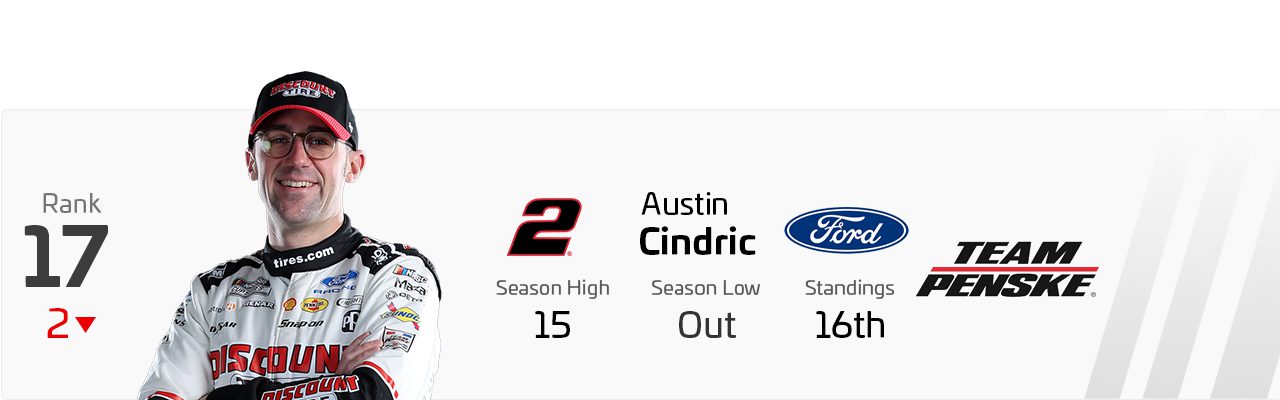
Analysis: Cindric overcame an early pit-road mistake — missing his stall and losing track position — to recover and finish eighth, largely by staying clean through the race’s most chaotic moments as he continues to flex on superspeedways. That result may perhaps be long forgotten come this weekend at Texas, where he has yet to record a top 10 and holds a 23.0 average finish across four starts.
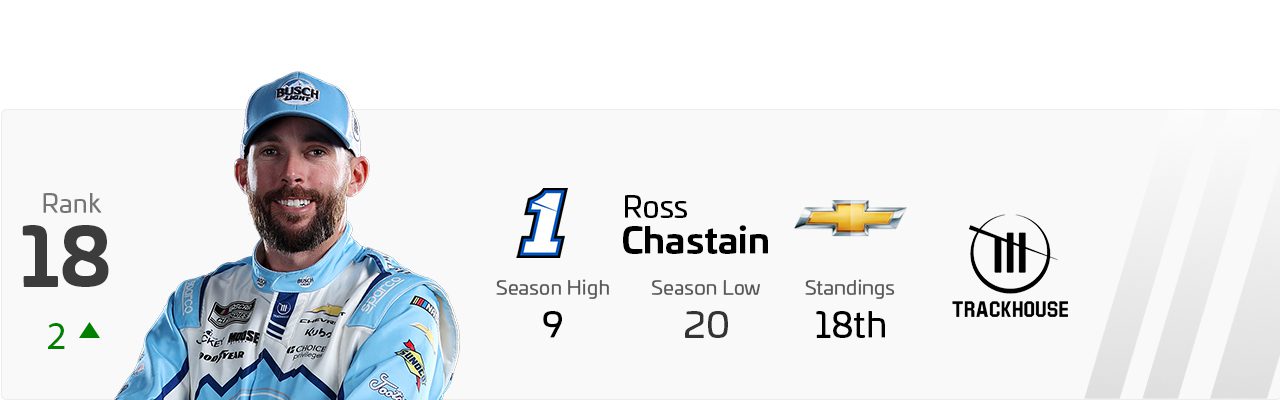
Analysis: Chastain charged forward from mid-pack, leading 22 laps and winning Stage 2 while showing some of the strongest race control of anyone in the field before fading slightly to finish seventh — a very, very much needed day for this No. 1 team. Texas has been less consistent for him historically, with just two top fives and an average finish above 20, so it may fizzle away in the Fort Worth heat. (That said, those finishes were each runner-ups and came in the past three races, so we’ll see.)
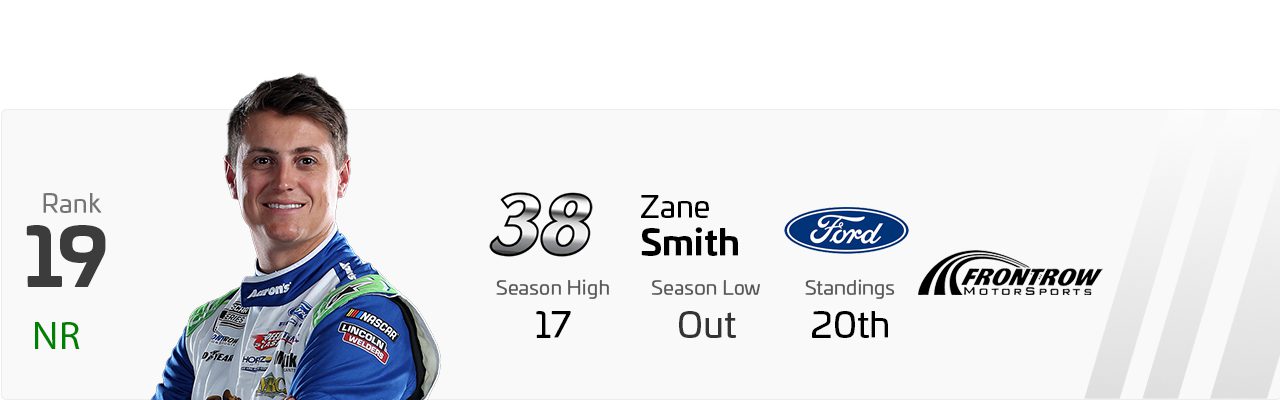
Analysis: Smith hung around within the draft successfully throughout the race, avoiding trouble and capitalizing late to secure a fifth-place finish without ever leading a lap. Texas could present a different challenge for Smith, however, where he has limited experience and an average finish above 22, though he was 17th last year.
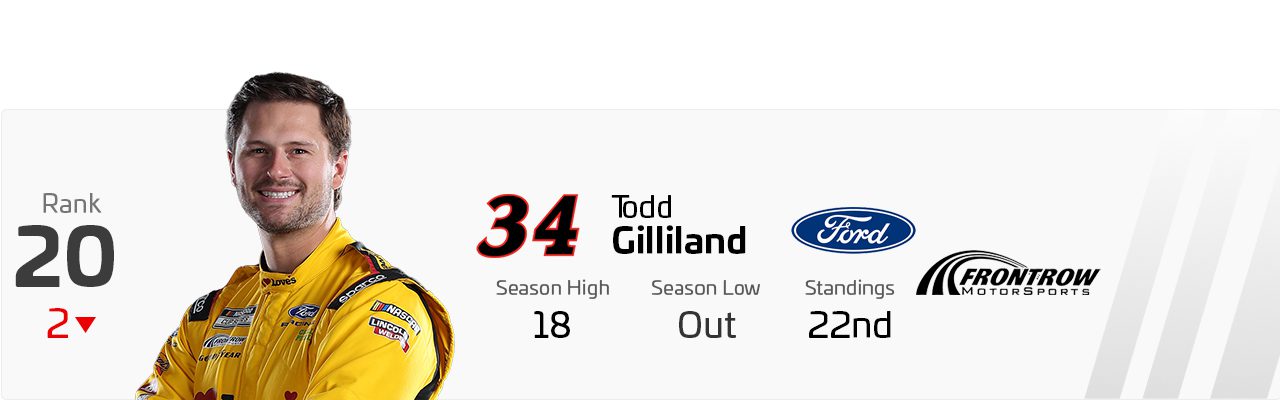
Analysis: Gilliland ran as high as the top three during portions of the race but never led and gradually faded as the race progressed, ultimately finishing a still-respectable 11th. The ability to maintain position was encouraging, but the lack of closing speed is the next piece of the puzzle to figure out and he certainly hasn’t yet at Texas, where Gilliland has yet to record a top-10 finish and holds a 26.3 average finish.
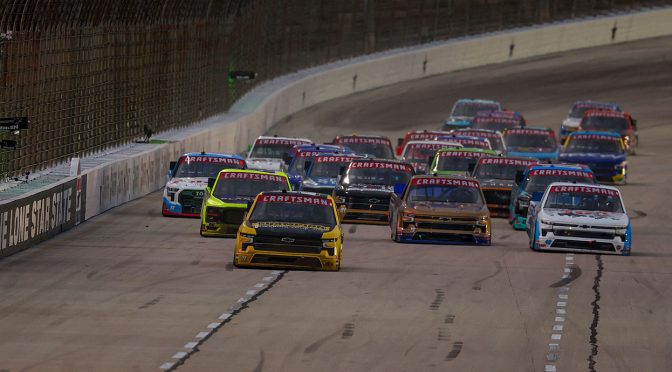
The NASCAR Craftsman Truck Series returns from a three-week hiatus to do battle at Texas Motor Speedway on Friday (8 p.m. ET, FS1, NASCAR Racing Network Radio, SiriusXM NASCAR Radio).
The event is the seventh points-paying race of the 2026 season.
Carson Hocevar, who won the NASCAR Cup Series race at Talladega Superspeedway on Sunday, will be one of three Cup regulars competing in the Truck contest, doing so in the No. 77 Spire Motorsports Chevrolet. Joining him will be Kyle Busch racing in the No. 7 Spire Motorsports Chevrolet, and Ross Chastain in the No. 45 Niece Motorsports Chevy.
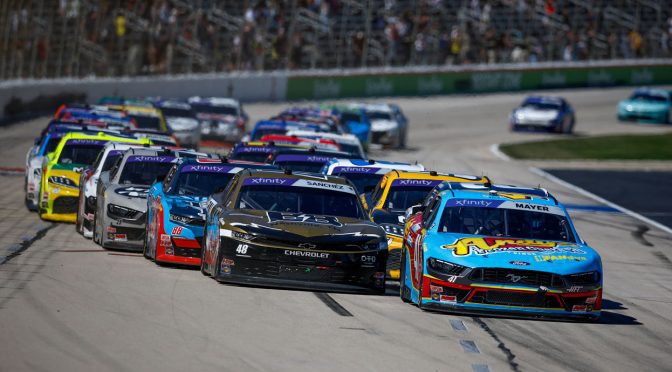
The NASCAR O’Reilly Auto Parts Series next treks from Talladega Superspeedway to Texas Motor Speedway for a Saturday contest (3:30 p.m. ET, The CW, PRN Radio, SiriusXM NASCAR Radio).
The race is the 12th points-paying race of the 2026 campaign. The race additionally acts as the final Dash 4 Cash bout this season; Sheldon Creed, who has won two consecutive Dash 4 Cash prizes, will look to collect another $100,000 this weekend at the 1.5-miler.
Three NASCAR Cup Series regulars — Connor Zilisch in the No. 1 JR Motorsports Chevrolet, Austin Dillon in the No. 3 Richard Childress Racing Chevrolet and Kyle Larson in the No. 88 JR Motorsports Chevrolet — will race in the O’Reilly Series this weekend.
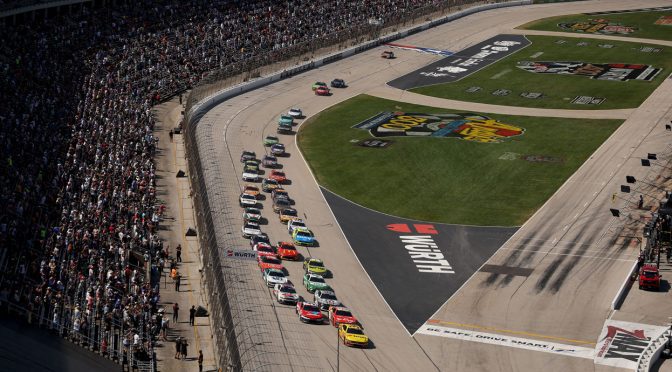
After Talladega Superspeedway resulted in Carson Hocevar capturing his first career NASCAR Cup Series victory, the field next heads westward for a contest on Sunday at Texas Motor Speedway (3:30 p.m. ET, FS1, HBO Max, PRN Radio, SiriusXM NASCAR Radio).
Joey Logano is the defending winner. The contest is the 11th points-paying race of the 2026 season.
Corey Heim will participate in his third Cup race of 2026 as driver of the No. 67 23XI Racing Toyota. Chad Finchum, who led laps for the first time in his Cup Series career at Talladega, will return as pilot of the No. 66 Garage 66 Ford.
TALLADEGA, Ala. — Carson Hocevar had just finished the cool-down lap after a crowd-pleasing breakthrough NASCAR Cup Series win, easing off the throttle as the emotions washed over him. “The start/finish line’s all yours,” his jubilant Spire Motorsports No. 77 team told him over the radio, and the 23-year-old Michigander made the most of one of the longest homestretches the sport has.
There’s a distinctive list of the all-time memorable NASCAR victory celebrations, each deserving of its own place in stock-car lore. The Kyle Busch bow. Alan Kulwicki’s Polish victory lap. Carl Edwards’ backflip. What Hocevar had in store stoked the already rabid Talladega Superspeedway throng into a frenzy, reaching instant-classic status and making a strong case for inclusion on that famed list.
Turns out, being the tallest driver in the NASCAR garage has its advantages. After breezing past the main grandstand facing the fans, he decided to get a better look. Hocevar pulled to the apron and positioned his 6-foot-4 frame where he could sit on the edge of the driver door. From there, he was able to remove the steering wheel, drop the clutch, quickly reattach the wheel and reach the throttle, ultimately making a slow pass with his No. 77 Chevrolet along the main straight in full, helmet-off view of the Talladega faithful. The crowd pop was palpable, but here again, Hocevar’s execution — on a day when so many things went right — ended up nearly flawless, all by design.
“I just wanted them to get as loud as possible. I felt like they would if they could see me seeing them,” Hocevar said after making his 91st Cup Series start a triumphant one. “Yeah, I mean, ultimately, I just wanted to make sure I soaked every bit of it in. I think I could tell you what everybody was wearing, where every seat was, where every 77 shirt was. I think I could have pointed it all out to you because I remember it so clearly right now. That means more than anything else to me, just that I know this has been a blur. I could tell you exactly just off Turn 4, it was like, I have it, to right now, I could tell you every second.”
Hocevar relished every moment that followed at Talladega, blocking out both the beer spray and the waning daylight in Victory Lane with wraparound shades and a cowboy hat after a sterling Sunday drive in the Jack Link’s 500. Joining him were country music artist Zac Brown, Miss Alabama and a sponsor-provided Sasquatch, but with plenty of extra company to share in the spoils. Deep rows of fans flanked both sides of the winner’s circle, where virtually every Spire employee who made the trip south participated in the fanfare.
Hocevar had already made a name for himself as a disruptor who quickly and confidently forged his own path into the sport’s top ranks, earning his “Hurricane” nickname. Though some of his peers in the Cup Series field have kept him at arm’s length — especially those who have found the business end of his front bumper — his arrival as the circuit’s newest winner and a budding star earned Talladega’s full embrace.
“It’s pretty odd, right?” said Spire co-owner Jeff Dickerson. “To see some of the reactions inside the garage versus the whole grandstand going essentially ape-(expletive) up there, right? So it’s quite the juxtaposition, but that’s our guy, man. That’s our guy. We built the whole place around him now. We’re pot committed.”
The Midwestern kid’s journey to the center of the Talladega universe took him through a familiar career path — a late model prodigy who became a NASCAR Craftsman Truck Series upstart. The gobs of natural talent put him on the radar of several team owners, and Dickerson made a major push to snap Hocevar up as his organization grew into its next phase. When full-time driver Corey LaJoie jumped to make a spot start in Hendrick Motorsports’ No. 9 Chevrolet for a suspended Chase Elliott in 2023, Hocevar was promoted to make his Cup Series debut in Spire’s No. 7 Chevy at Worldwide Technology Raceway at Gateway. He won Rookie of the Year the next season under Spire’s watch.
To be sure, that talent needed some refinement, which would come with lessons learned the hard way and much-needed experience. Dickerson was willing to wait through both.
“The hardest part is finding guys that just stand on the gas and aren’t scared of the moment, and once you get to the Cup Series, you look beside you, those are all your heroes,” Dickerson said. “We’ve been saying to Carson all the time, it’s like, you’re in the video game now, right? So there is something about his je ne sais quoi that just lets him not really care what anybody else is saying or thinking and all that. Look, when he was running our [O’Reilly Auto Parts Series] car there and was running in the top five, we’re just like, ‘Who is this guy?’ We put him in the car at Gateway, as you guys remember, and it was right then and there, we’re just like, ‘we’ve got to get this kid in the car.’ I mean, we’ll put up with growing pains, we’ll put up with everything we can, and hopefully it’ll pay off. And I mean, sure as hell today it did.”
Ethan Smith | for NASCAR Digital Media
Fitting for the springtime bloom, NASCAR’s month of April rounds out with a pair of 23-year-old first-time winners, with Hocevar’s moment following Ty Gibbs’ Bristol Motor Speedway breakout two weeks earlier. Hocevar had inched closer to contending in the days since his rookie campaign, with a pair of runner-up finishes in 2025 and a near-miss in this year’s Daytona 500. In the “Great American Race,” he led at the start of the white-flag lap before his No. 77 was rooted out of line, a moment he said he’d replayed a thousand times in his head in the season opener’s wake.
His control of Sunday’s situation — staving off the attacks from a hungry pack behind him — showed some of the poise that Hocevar is starting to incorporate into his craft. For crew chief Luke Lambert, that might be the once-missing piece to becoming a more complete racer.
“Being consistent with higher expectations is a bigger challenge, but what Carson has really done tremendously and made a huge step with this year is beginning to look like a veteran on the race track,” Lambert says. “He’s always looked like an amazing talent. He’s always had amazing car control, and he’s always been super-fast, but now he’s starting to look like a veteran, and when you combine his skill set and his talents with some experience and a mental approach to the race that considers that experience and putting in the work using that experience from the past, it becomes a dangerous combination for your competition.”
As for Hocevar’s no-hands post-race handling of the car that his crew so meticulously prepared for Sunday’s 500-miler, Lambert could only smile and shrug.
“He’s one of a kind, right?” Lambert said. “So I think that it’s fitting for him to have a celebration that we’ve never seen before.”
Hocevar hasn’t lacked for confidence on his rise to Cup Series relevance, and his approach to the late stages of Sunday’s race carried the same self-assurance. The No. 77 radio’s discussion of lane choice for the next-to-last restart had turned thorough. Tyler Green — an 18th-year veteran atop the spotters’ stand — recalled a recent Bristol race when the team opted against a front-row slot, with the goal of protecting their position. This time, Hocevar stopped the conversation short: “Winners choose front row,” he said, and Green knew then that his driver would be on offense.
Funny enough, during the last caution period and with one of the most crucial three-lap runs of his life about to unspool, Hocevar was the one telling Green to keep calm, take a breath — all before finishing things off with his trademark ferocity.
“We always joke: I always tell him to be easier, be smart, and usually he does the opposite, but he knows what he’s doing,” Green said. “He forces the issue a lot, but with his talent level, his 90% is a lot of guys’ 100% or 110%, so some of the things that people think are aggressive are under his control, and he’s able to take advantage of it and have a good time doing it at the same time.”
No one was having a better time of it Sunday than Hocevar, his dozens of Spire colleagues and his newest adoring friends in the Talladega bleachers. Plenty of racing careers have launched into the stratosphere from wins here, but for every springboard, there have been plenty of one-hit wonders who once tamed the biggest track on the circuit, then never won again.
Hocevar seems more likely to fall into the former category. The youngster rocketed to eighth place in the Cup Series standings Sunday, and he’s that much closer to realizing Dickerson’s vision for him as a championship contender in the next couple of years. Make the postseason, maybe catch a wave, and there’s the potential for more noise to be made, Dickerson says.
Sunday, he was left to marvel at the wonder of it all — the performance, the promise and the sight of his young buck half-hanging from his car and stirring the Talladega crowd into joyous, madcap commotion.
“No, I’ve never seen anything like it,” Dickerson said. “We’re looking for him because we can’t find him, and then the guy’s out on the track acting like it’s Sea World out here, hanging out the (expletive) door. Man, these first ones. … I’ll remember this one till the day I die. That’s doing it in style. Awesome.”