Daytona International Speedway is a crown-jewel facility in modern-day sports, and part of its mystique is its ability to elicit upsets. For all of the moments like Richard Petty’s showdown with Cale Yarbrough in 1984 and Dale Earnhardt’s long-awaited victory in 1998, there are instances in which drivers faced with long odds avoid attrition and take advantage of the misfortune of others, earning surprising wins.
Might we see another upset victory in this weekend’s race? If so, the race must break in the driver’s favor similar to how it did in previous races that yielded outlier results.
RELATED: Full schedule for Daytona | Every summer race winner at Daytona
Positioning for success while wishing for the bizarre
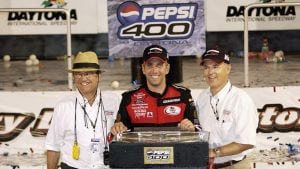
Greg Biffle’s only restrictor plate race win came in 2003 when he outlasted the Coke Zero Sugar 400 field in a contest of fuel mileage, a rare turn for a Daytona race. Dave Blaney was nearly awarded the Daytona 500 win in 2012 when a jet dryer exploded on the backstretch. Though Daytona has provided a worthy theater to the absurd, a driver and team can’t prepare for the seemingly impossible. They can, however, game plan around what could be a high-attrition event.
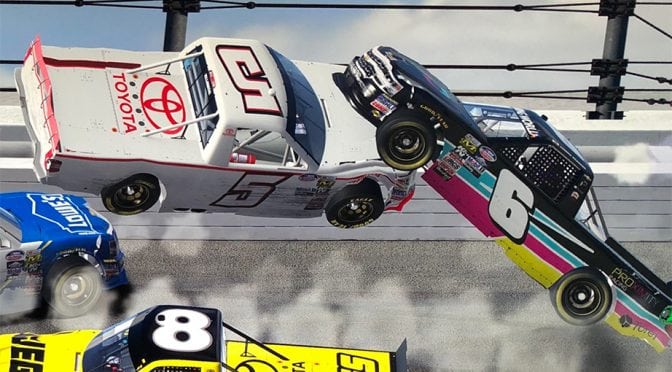
You’ll hear chatter about “The Big One” this weekend, and while large multi-car crashes have impacted races that indeed provided upset winners — two crashes consisting of more than 15 cars occurred in David Ragan’s 2011 victory and 2014’s rain-shortened Aric Almirola win — attrition doesn’t have to occur in clusters. Ward Burton won the 2002 Daytona 500 after favorites were systematically eliminated — Tony Stewart with a blown engine, Dale Earnhardt, Jr. in a single-car accident and Sterling Marlin via penalty for exiting his car in order to remove debris during a red flag — leaving him to fend off Elliott Sadler and Geoffrey Bodine for the shocking win. Trevor Bayne was the victor in the 2011 Daytona 500, a race that saw 16 caution flags with the final two involving Earnhardt, Ryan Newman (who led a race-high 37 laps) and Clint Bowyer (led 31 laps).
RELATED: Five key story lines to watch for heading into the Coke Zero Sugar 400
How does a driver best take advantage of high attrition? The answer is easy to identify, but difficult to execute.
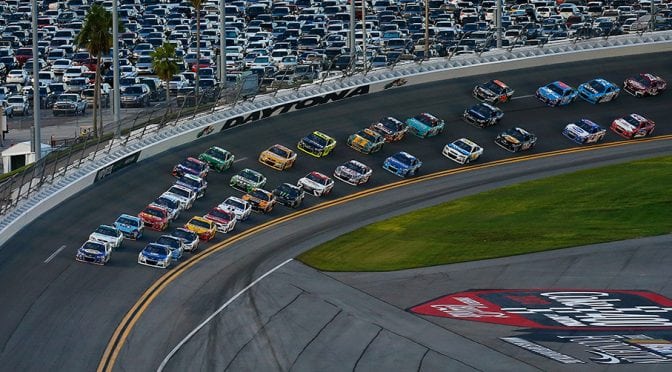
According to a study by Motorsports Analytics, the safest running whereabouts at Daytona dating back to the 2017 Daytona 500 and based on 11 accidents involving at least four cars, is 21st to 30th. In that range, 21st, 25th and 26th each held crash inclusion rates of 18.18 percent, while all other positions were included in just 9 percent of those crashes. Second through ninth in the running order topped out at 45 percent inclusion in big crashes, a recent trend; from 2013 to 2016, the lead group served as a safe space, as no position inside the top 6 held a higher inclusion rate than 15.79 percent. That’s no longer the case, as the front of the field has devolved into a feisty, uninhabitable place for its occupants.
In the instance a team is able to avoid mistakes and hold down one of the ideal running positions, it’ll also need some fortune during the moment when track position is its most vulnerable.
Location is everything on late-race restarts
Nine of the last 10 Daytona races included a restart in the final one-tenth of the event and upsets by Bayne, Ragan, Almirola and Austin Dillon all saw restarts inside of five laps from the race’s conclusion, but that common denominator isn’t enough. Location may matter more than execution on late-race restarts.
Last February’s Daytona 500 gave us relatively even restarting grooves, with cars restarting from the inside retaining their positions 62 percent of the time and those in the outside doing so at a 57 percent clip. This weekend’s race in Daytona will feature higher temperatures and a slicker surface, meaning those retention numbers likely won’t hold.
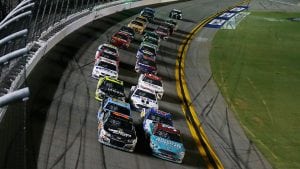
A 50-percent retention in disparity, with the inside acting as the preferred among the first three rows and outside serving as the preferred for the rest of the field beginning with the fourth row, highlighted the 2017 Coke Zero Sugar 400. Four of the top five finishers, including winner Ricky Stenhouse Jr., restarted from a preferred spot for the two-lap race-deciding shootout.
It’s near impossible to game track position prior to a restart, so lane assignment mostly falls on luck. That’s a tough reality to swallow on most other tracks, but at Daytona, the close proximity offered by the draft can allow drivers in the non-preferred groove to take actions into their own hands when restarting near the front; Dillon didn’t land a preferred restarting spot on the overtime restart in February, but he was slotted directly behind leader Almirola, in perfect position to deploy his race-winning bump-and-run maneuver.
Being in the right place in the right time is a staple of upsets and a linchpin for some of the most memorable moments in recent Daytona history.
David Smith is the Founder of MotorsportsAnalytics.com. Follow him on Twitter at @DavidSmithMA.