When food connoisseurs discuss fine wines, meats and cheeses, they will use the phrase “aged to perfection” to indicate the very best choices. With NASCAR drivers, the same can be said to describe a race track that has gained some character in its surface over the years, a condition that typically heightens the overall racing experience.
In such situations, searching for the right groove and controlling a sliding car are challenges drivers look forward to trying to master. Meanwhile, finding the right tire combination and strategies as tire wear comes into play are things to which Goodyear and the teams pay close attention.
Atlanta Motor Speedway is a favorite among drivers because its track has been aged to perfection, and it usually means exciting racing for the fans, too. And with a tripleheader in the NASCAR national series set for Atlanta this weekend, it’s the perfect time to discuss how NASCAR measures the surface texture of the tracks that host its events.
Joining us to help explain the procedure is David Groseclose, the director of tire systems and unified testing at the NASCAR R&D Center in Concord, North Carolina. A tire engineer for much of his professional career, Groseclose’s Twitter handle is appropriately @nascartireguy.
Groseclose is part of a team that travels to NASCAR-sanctioned tracks for tire tests, and during that time they also measure the track surface. He says their system includes checks at eight points around the track. Richmond Raceway was the example Groseclose shared with us, and there the team scanned for three-dimensional images on the frontstretch, the backstretch, in each of the four corners and at both apexes of the corners.
At each of those eight spots, three different grooves are measured, six images are taken per groove to represent the high line, the low line and the line in the middle — for a total of 144 images from the spots shown in the diagram:
Then once those images are collected, NASCAR measures in micrometers from the highest peaks in the surface to the lowest valleys. These differences are very subtle to the naked eye, but on the 3-D images on computers (as in the Michigan and Atlanta photos below), an exact number is calculated for each track.
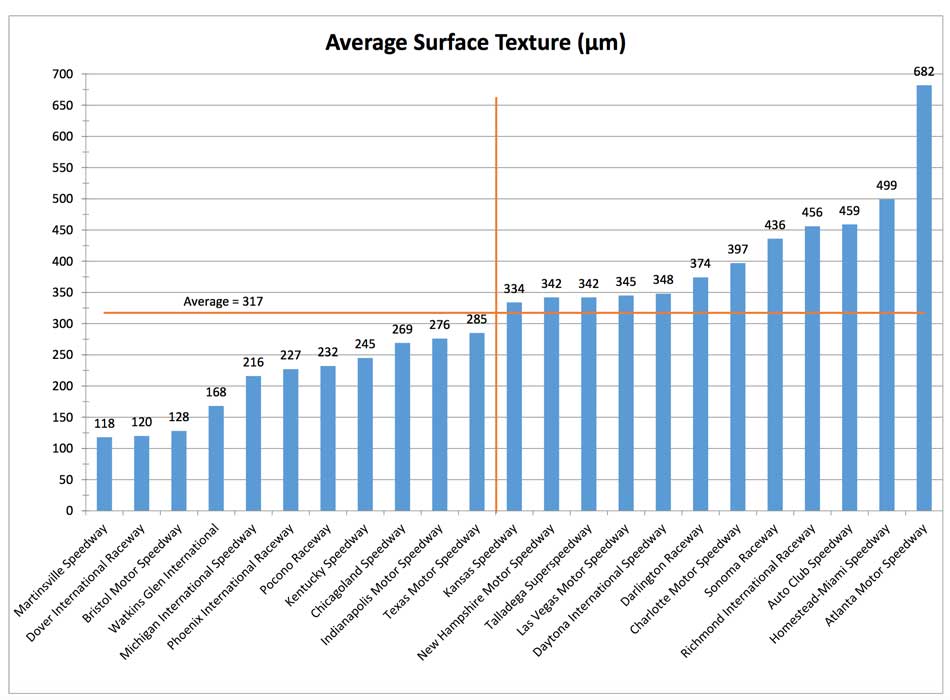
NASCAR collects the information together on a graph (below) where it’s easy to see where tracks fall on a continuum of smoothest to roughest. The lower the variance, the smoother the track, and thus the lower the number. You will see the concrete tracks to the left or the lower end in surface variance (as would be expected) and some of the aged asphalt surfaces to the right.
The smoother the track, and thus the lower the number in average surface texture..Then NASCAR gets this information out to the tracks so it can be part of their decision-making process on when to resurface a track. The information also goes to Goodyear, the sport’s official tire provider, to aid in determining the right tire combination for each track.
But for fans who have ever wanted to put context behind whether a track is smooth, rough, or in the middle, it’s fascinating to look at the numbers, and it should be celebrated that each track surface has its own special characteristics and feel for the drivers. To use a different sport’s analogy, it’s like reveling in the differences in stadiums in the major leagues. Whether you prefer Fenway Park with its Green Monster protecting left field or Yankee Stadium with its short porch to right field, the differences are part of what make the game great, and the athletes that make the best adjustments to the changing landscape put themselves in a better spot for success.
Same for NASCAR and its tracks. The drivers and teams that do their homework will be the ones fighting for the win at the finish. Now when you hear the competitors discussing the adjustments they are making, you will know what goes behind those decisions.
Austin Dillon saw him in the distance wearing a white Ford hat.
It was the day before the Advance Auto Parts Clash, the non-points race one week prior to the Daytona 500, and Dillon was signing autographs.
The boy approached him, big-eyed.
“I told him, ‘Look, man, if you ain’t got a favorite driver, I’ll give you my hat if you choose me as your favorite,’ ” Dillon recalled to NASCAR.com while touring New York City this week as Daytona 500 champion.
The terms were agreeable. Dillon whipped the hat off his head, signed it and handed it over. The boy thanked him and pledged his allegiance.
The interaction was over. Until it wasn’t.
Jordan Wade surprised Austin Dillon with a visit to the RCR shop on Wednesday. | Photo via RCR
• • •
The boy came back to Daytona the next day, and Dillon spotted him. It was easy — 11-year-old Jordan Wade was wearing his hat.
Jordan yelled Dillon’s name and motioned him over. Dillon ran over.
“Hey man, I have this for you,” Jordan said. He flashed a penny.
“He gave me the hat, and I had to think of something to give him back in return,” Jordan said. “Most people wouldn’t pick up a penny, you know, but they’d pick up a quarter or a nickel. But I gave it to him for good luck.”
Dillon’s mind immediately began churning, working its way backward to 20 years prior in 1998. The Intimidator. Wessa Miller. A lucky penny affixed to the dashboard of that No. 3 Chevrolet, which Earnhardt would famously steer into Victory Lane for the first time in his career in the Daytona 500.
As Earnhardt posed for photo upon photo in Victory Lane that day, two little fellas joined him — Austin, then 7, and his brother Ty, then 5. It was a seminal moment in Austin Dillon’s life. He saw up-close Dale Earnhardt’s celebration, the joy exuding from his grandfather and team owner Richard Childress. It set his course on becoming a race car driver.
That’s Ty Dillon (far left) and brother Austin in Victory Lane. | RacingOne
Twenty years later, Austin Dillon drives the No. 3 Chevrolet for Richard Childress Racing.
This clicked through his mind at perhaps a quarter-of-a-second when Jordan offered the penny.
“I was like, ‘Hey man, that’s good karma’ because of Dale having the penny in the car,” Dillon said. “We had it in the Clash car, and it ran well and avoided the wrecks.”
The Clash car, with the penny still inside, was sent back to Welcome, North Carolina, following the race. It had done its duty, stayed out of trouble and finished fifth. The No. 3 team had additional cars in Daytona Beach for the ensuing Can-Am Duel qualifying races and the Daytona 500 itself.
But then the green flag dropped on the Can-Am Duel races, and there was Dillon navigating through wreckage and debris, avoiding it as best he could but not altogether, not liking the feel of the machine underneath as much as he did the previous race.
He wanted his Clash car. He wanted the penny with it.
“The car actually went home, and I wanted to bring the Clash car back. I said to make sure we have the penny in the car,” Dillon said. “The guy I asked to do it was my underneath guy, Kevin Gladman. I was like, ‘Guys, we have to get that penny back. They were like, ‘It’s in North Carolina.’ I told them it doesn’t matter.”
The team made it happen, loading the hauler with the Clash car back up and driving down to Daytona in time for the weekend practices.
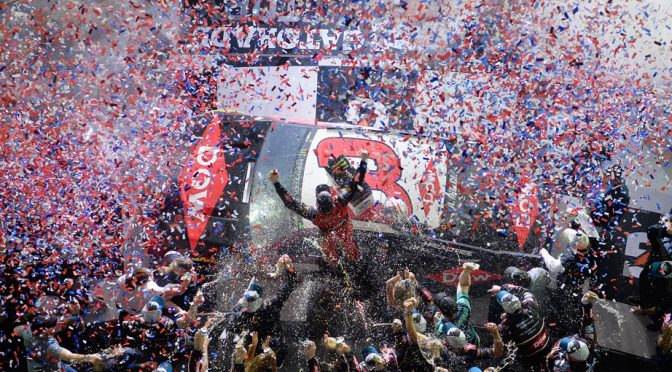
Austin Dillon, with a penny affixed to his No. 3 Richard Childress Racing Chevrolet, won the 2018 Daytona 500. He did so with a last-lap pass on race leader Aric Almirola, although “pass” is probably one of several words you could use to describe his move.
“Turn” would work. Some might say “punt,” although the aggressive move which ended up sending Almirola into the outside retaining wall caused no ill will with the Stewart-Haas Racing driver.
“We were both trying to win the Daytona 500,” Almirola would say after the race.
After the race, Dillon cut donuts into the infield, with some of the marks left behind looking like a “3,” perhaps the most iconic number in all of NASCAR. It holds extra special meaning to the Childress family, and to Dillon and fans of Earnhardt Nation, many of whom still hold up three fingers on the third lap of every race.
Brian Lawdermilk | Getty Images
That famous No. 3 Chevrolet from 1998 sits inside the RCR Museum to this day, the penny still glued on. One day, this No. 3 will join it with its penny still attached.
“The penny’s going to live in that Daytona 500 car,” Dillon said. “I think it deserves it. It has a home. Most pennies that you find don’t have a home. That one has a home, you know what I mean?”
With Dillon’s Daytona 500 win came a champion’s tour to New York City, where Austin and wife Whitney did their best to take in the sites of the city while also making the talk-show rounds.
Dillon’s mind, on the rare bit of downtime it had to wander, invariably made its way back to Jordan.
“There was something about this kid,” Dillon said. “I felt something good about him.”
Dillon explained in detail how he wanted to get Jordan to the RCR shop, show him around. He likely had never seen the inside of a race car. Dillon wanted to pick him up and put him inside one, let him grab the steering wheel and cinch up.
Unbeknownst to Dillon, his team was working behind the scenes to make that happen.
On Wednesday, when Dillon and the No. 3 team were honored at Richard Childress Racing for their Daytona 500 win the day after touring New York City, Jordan was there. He was wearing a familiar hat.
“We were all hoping that he was going to win,” Jordan said from the RCR shop. “Then, with the luck I gave him, he won.”
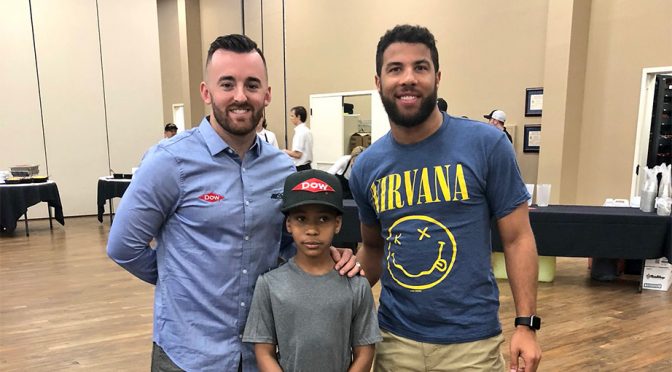
Dillon gave Jordan that shop tour, with the two posing for pictures with fellow driver Darrell Wallace Jr., who finished second. Wallace Jr., who drives the No. 43 Chevrolet for Richard Petty Motorsports, is the first African-American driver with a full-time ride in the Monster Energy NASCAR Cup Series since 1971.
His runner-up finish in the “Great American Race” is the best ever for a driver of color. Richard Petty Motorsports and Richard Childress Racing announced an alliance over the summer, with RPM relocating its shop to be closer to RCR. The two teams celebrated the 1-2 finish together.
Wednesday was a good day in Welcome.
“As far as fan engagement, it’s special,” Dillon said. “It’s cool. I feel like I made a kid who didn’t know if he liked NASCAR, and he was just kind of learning about it, I feel like I made him love it. Because I gave him something, and he gave me something. We’ll be tied together for a long time.”
It’s not unlike Dillon to want to give back, his wife, Whitney, chimed in. She’d been listening to the interview with NASCAR.com and couldn’t hold back this thought any longer.
“One of my favorite things about Austin is that he is so caring and giving to every person that he comes into contact with,” Whitney said. “He has touched so many lives, and the impact that he has at RCR — he would never tell you this–– with all of the employees. He knows most of them by names, he knows their backgrounds. He takes time to go there almost every single day. Half of his pit crew, they lived with him for a while so they could get on their feet and get going. It’s just cool. When you give, it just comes back.”
“I just try to give back a little to the fans who give us so much each and every weekend,” Austin Dillon added. “I just want ’em to love me.”
• • •
Dillon, 27, remains a part of NASCAR’s youth movement, although he’s a veteran of that group. Sunday was the second-youngest Daytona 500 field ever, so while being 27 is young, it’s not young in this current era of NASCAR.
Certainly Dillon still remembers traipsing through the garage as a child, collecting cards and looking up to his heroes to sign them. It wasn’t that long ago.
It’s those memories that linger now that Dillon is a driver himself. Every interaction he has with a child has meaning. Perhaps he simply makes a child’s day. Or perhaps he makes such an impact that the next Jordan he signs for is the next driver of the No. 3 Chevrolet.
The impact on Jordan is clear. That boy who never experienced a NASCAR race before last weekend? Ask him what he wants to be when he grows up.
“I want to be a NASCAR driver, now,” he said.
That’s how Dillon felt when he was a kid, too. And guess what? Now, he’s a NASCAR driver.
“I want people to experience what I’ve experienced since I was a kid, and be able to enjoy races and enjoy experiences,” Dillon said. “There’s a lot of good role models in NASCAR. When I was growing up, every driver would sign what I asked them to sign. My grandfather still does that.
“The biggest thing is, you have to give back to the sport that’s given you what you’ve got. If I can create experiences for kids that will bring their kids here, the Daytona 500 will live on forever.”
“I think it’s awesome to see what his involvement in NASCAR could be like,” Dillon continued. “Could he be the next president of a race team? An engineer? A crew chief? A driver? You never know what you’re creating when you meet a young kid that has everything in front of him.”
In the middle of this discussion, Dillon paused when returning to the anecdote from the Clash. The hat on his head wasn’t the only thing he’d given away, and suddenly the driver made a connection.
He gave the hat on his head to Jordan. Later, a young girl wearing a Chase Elliott hat walked by. Dillon good-naturedly teased her and asked if she’d consider becoming his fan, upping the ante with another hat his father had just purchased that day.
That interaction drew a crowd. To be fair, Dillon said he’d give the hat away to whoever answered a trivia question correctly. The little girl didn’t get the question right. Another boy did, and he earned the hat.
The girl wearing the Chase Elliott hat was saddened to see that second hat going to someone else, so the boy who received it kindly gave it to her. Moved, Dillon asked the boy to walk back to his golf cart. En route, Dillon took the shirt he was wearing, slipped it off over his head, signed it and gave it to that boy. He rode away in a golf cart, shirtless.
It suddenly dawned on Dillon the number of items he gave away. Two hats. One shirt. Three, total.
“Numbers are so weird,” he said, after a pause. “I gave away three things that night. That’s all I had to give away. Three.”
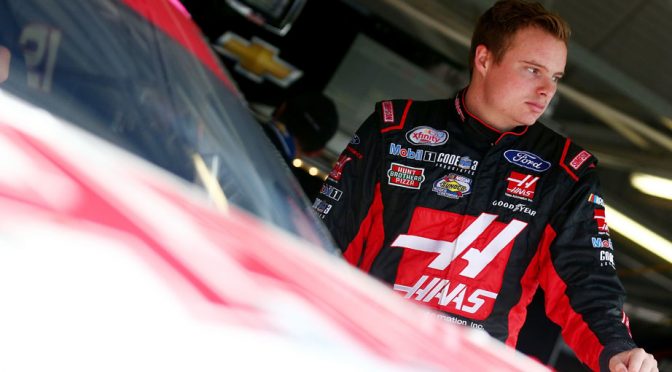
Officials from Rick Ware Racing (RWR) confirmed today that NASCAR Next alumnus Cole Custer will make his Monster Energy NASCAR Cup Series (MENCS) debut March 2-4 at Las Vegas Motor Speedway.
Custer, a native of Ladera Ranch, California, will drive the team’s No. 51 Ford Fusion while also competing in the NASCAR Xfinity Series race for Stewart-Haas Racing.
Haas Automation, Inc., America’s leading builder of CNC machine tools, will continue its support of Custer and serve as the primary sponsor of RWR’s No. 51 Ford in the March 4 race.
Starting his racing career at the age of four, Custer has been successful in every form of motorsports competition. From quarter midgets to Late Models to the NASCAR Camping World Truck Series and Xfinity Series, the 20-year-old has proven himself as a winner.
Some of Custer’s NASCAR accolades including becoming the youngest Truck Series pole winner ever at Gateway (Ill.) Motorsports Park. Five events later, he became the youngest winner in the history of NASCAR’s national touring series at 16 years, 7 months and 28 days when he won at New Hampshire Motor Speedway in Loudon.
Custer also scored his first-career Xfinity Series win with a dominating performance in the 2017 season finale at Homestead-Miami Speedway, leading 182 of the event’s 200 circuits in his 38th career series start.
“This is a dream come true to compete in the Cup Series,” said Custer. “I can’t thank Rick Ware Racing and Haas Automation enough for the opportunity to race at Las Vegas. It’s going to be a new experience for me, but I feel that we can have a productive day by completing all the laps and seeing the checkered flag.”
Ware, a mainstay in motorsports competition for 27 years, says Custer is a superstar in the making and is grateful for the opportunity to work with him.
“I’ve been watching Cole a long time and he’s a fine young man,” Ware said. “I’ve been friends with the Custer family for a while now and they are truly are amazing people. Over the last couple years Cole has grown into a stout race car driver with a fine finesse for speed and rhythm.
“The Monster Energy NASCAR Cup Series is home of someone of the greatest race car drivers in the world and Cole definitely fits into that category. I think our expectations as a team are realistic and achievable. Getting Cole to the checkered flag is our top priority as a race team.”
Custer has two career starts at Las Vegas – one in the Truck Series and one in the Xfinity Series. He finished third in the 2016 Truck Series race and 11th in the 2018 Xfinity Series race.
To commemorate Custer’s Cup debut, RWR through Lionel will offer a die-cast of the No. 51 Haas Automation Ford Fusion available for purchase to the general public in the coming weeks.
In December, RWR announced that they had secured a charter from Richard Petty Motorsports securing the team a berth not only into the Daytona 500 but the remaining 35 Monster Energy NASCAR Cup Series events in 2018 as well.
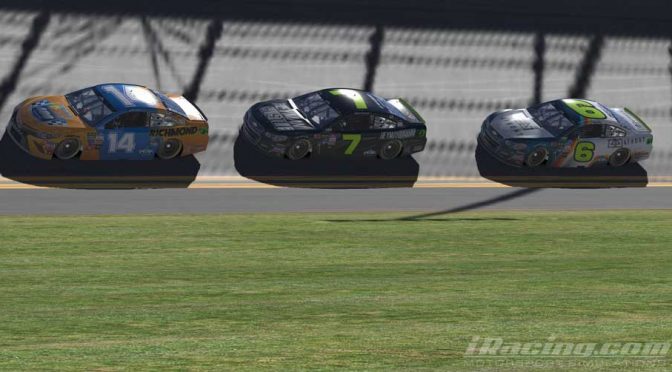
Nick Ottinger claimed victory in the opening round of the NASCAR PEAK Antifreeze iRacing Series on Tuesday night at Daytona International Speedway. The premier NASCAR online racing series features the world’s fastest drivers racing virtual Chevrolets, Toyotas and Fords on tracks all around the United States — competing for a NASCAR championship and a $10,000 prize. The race was broadcast on NASCAR.com, FansChoice.tv, iRacingLive, Facebook and YouTube.
After suffering through a winless 2017, Ottinger found Victory Lane in the season opener, holding off Brian Schoenburg in a five-lap shootout. Schoenburg, who was seeking his first NASCAR PEAK Antifreeze iRacing Series win, made a bid for the victory coming off Turn 4 on the final lap, but came up short despite getting a push from Michael Conti.
Schoenburg wound up .07 seconds short at the checkered flag, but was thrilled to get his season off on a positive note. Christian Challiner came from 34th on the grid to edge Conti for third. Keegan Leahy rounded out the top five after leading 13 laps.
Ottinger led a race-high 40 of 100 laps and he, along with Schoenburg and Conti, used pit strategy to gain control of the race on a night where passing was more difficult than in years past. The trio, along with most of the lead-lap cars, headed to pit road for tires and fuel under caution on Lap 43. A handful of drivers, including Leahy and 2017 champion Ryan Luza opted to stay out for track position.
Chris Overland (#37) and Jimmy Mullis (#11) lead the field to the first green flag.
However, the next 43 laps ran without a yellow flag, forcing the drivers who stayed out to the pits earlier than the rest of the field. Some of the drivers who pitted under yellow came with the group that stayed out but needed less fuel, gaining them time.
Ottinger, on the other hand, decided to stretch the run longer since he and the rest of the cars yet to pit, including Conti and Schoenburg, caught the pack exiting the pits. This allowed them to turn fast laps and keep their track position, but on Lap 86 they finally headed to the pits for a splash of fuel.
Both Ottinger and Schoenburg had great pit stops, coming out nose-to-tail, well ahead of the pack. The two were able to hook up and stay in front of the field, but a caution with 10 laps to go for Casey Kirwan’s spin set up the dash to the finish.
Four crashes slowed the field for 11 laps and eliminated several drivers from contention. The biggest incident occurred on the last lap in Turn 2 when the field stacked up behind the leaders. Zack Novak was the first to slide sideways and the rest of the field piled in, including Luza, polesitter Chris Overland and 2017 playoff contender Logan Clampitt.
With Daytona, the only restrictor-plate race on the schedule, in the rearview mirror, the NASCAR PEAK Antifreeze iRacing Series heads to Phoenix’s IMS Raceway for Week 2 of the season. Fresh off his win, Ottinger will look to keep the momentum going in the Valley of the Sun, but Luza and three-time champion Ray Alfalla are the favorites. The pair accounted for half of the victories in the series one year ago and looks to break into the win column in 2018.
Has the field closed the gap over the offseason? Find out in three weeks on iRacing Live when the NASCAR PEAK Antifreeze iRacing Series returns to action!
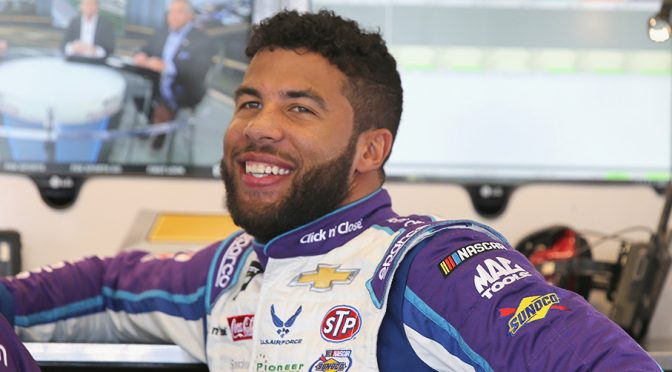
DAYTONA BEACH, Fla. — A dramatic, runner-up finish in the 2018 DAYTONA 500 by the first full-time African-American driver in the Monster Energy NASCAR Cup Series since 1971 will be chronicled in the final two episodes of “Behind the Wall: Bubba Wallace,” the new docu-series on Facebook Watch.
The final episodes in the original series will post at 12 p.m. ET (Episode 7) and 2 p.m. ET (Episode 8) on Thursday, February 22, and can be viewed by following the Behind the Wall: Bubba Wallace show Page. The first six episodes, which premiered last week, are available now on demand.
In his first start in the Great American Race, Wallace edged out 2016 DAYTONA 500 champion Denny Hamlin to take second place in the sport’s most prestigious event, which was won by driver Austin Dillon. The result marks the best-ever finish by an African-American driver in the DAYTONA 500.
Both the lead-up to Wallace’s debut in the Monster Energy NASCAR Cup Series, including a third-place finish in his Can-Am Duel qualifying race, and his emotional press conference after the DAYTONA 500 will be featured in the series’ final episodes on Facebook Watch.
“The whole experience of my first DAYTONA 500 was amazing,” said Wallace. “Through Facebook Watch, fans are going to be able to see what I went through leading into Sunday’s race and after it. It’s really cool to be able to share those moments and emotion with all our fans. Everyone needs to check it out.”
The first six episodes of “Behind the Wall: Bubba Wallace,” produced by NASCAR Productions, follow Wallace’s road to Daytona International Speedway — from his earliest racing days to his debut as the new full-time driver of the No. 43 Click n’ Close Chevrolet Camaro ZL1 for Richard Petty Motorsports.
The series follows Wallace in the months and weeks leading up to the 2018 season, including encounters with team owner and NASCAR Hall of Fame driver Richard Petty, Charlotte Hornets rookie Malik Monk and close friend and fellow NASCAR driver Ryan Blaney.
In the final episodes, the cameras capture Wallace as the clock ticks down to the biggest race of his life, including a surprise, pre-race phone call from pro baseball legend and fellow Alabama native Hank Aaron.
Following the dramatic final lap and Wallace’s second-place finish, the series documents a teary-eyed reunion between the driver and his mother as she interrupts his press conference to congratulate him.
“For years to come, fans will remember Bubba Wallace’s performance in the 60th running of the DAYTONA 500,” said Evan Parker, NASCAR managing director, content strategy. “On Facebook Watch, we’re giving fans unfiltered access to a NASCAR star in the making — straight from the perspective of Bubba himself.”
Before graduating to NASCAR’s top series, Wallace competed in the NASCAR Xfinity Series. In October 2013, he won the NASCAR Camping World Truck Series race at Martinsville Speedway to become the first African-American driver to win a NASCAR national series race since NASCAR Hall of Fame driver Wendell Scott in 1963.
In 2012, Wallace became the first graduate of the NASCAR Drive for Diversity development program to compete in a NASCAR national series race. Since then, he’s won six NASCAR Camping World Truck Series races.
Facebook Watch is a video platform created to bring episodic content, community and conversation together on Facebook. The platform is home to a wide variety of sports shows, including reality, documentary and live sports.
En route to South Korea to cover the Winter Olympics for NBC Sports, Dale Earnhardt Jr. used a layover in Atlanta to produce his weekly “Dale Jr. Download” podcast on Dirty Mo Radio.
Fresh off his duties as Grand Marshal for the 60th annual Daytona 500, Earnhardt reflected on his experience at the “Great American Race” as a newly retired driver. Spending a good portion of his time atop the No. 88 Hendrick Motorsport pit box cheering on Alex Bowman, Earnhardt was impressed with how well the younger drivers of the sport were able to hold their own against veterans.
Among the fleet of competitors who fall under the youth movement category in the Monster Energy NASCAR Cup Series, it was Darrell “Bubba” Wallace Jr. who stole the headlines following a second-place finish in Sunday’s race.
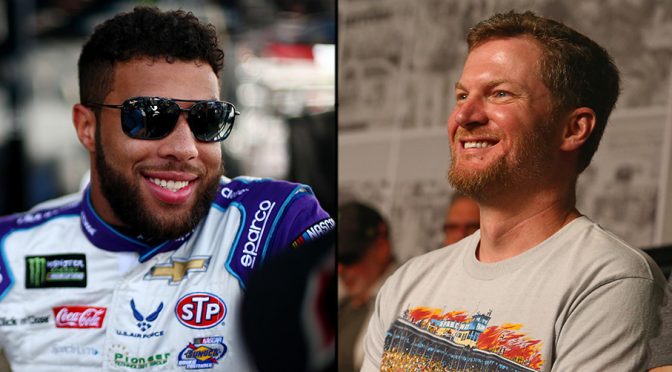
After Bubba became the highest-finishing African-American driver in Daytona 500 history, he caught the attention of many — including Earnhardt.
“A lot of people kind of wondered if he had done enough, I guess, to get this opportunity. I never felt that at all or felt like he didn’t deserve the chance,” Earnhardt said in his podcast. “And he went out and proved it on Sunday by driving like a veteran and driving with his head on his shoulders.”
On top of his on-track performance, Earnhardt also noted how well Wallace was able to handle all the pressure on NASCAR’s biggest stage.
“I was watching him all of Speedweeks and he had so many media responsibilities and commitments, more than any other driver by far … multiple times more than any other driver by far,” Earnhardt added. “He was feeling that pressure, man. I think it was probably the most pressure I’ve ever seen any driver deal with. I think he set a new high for handling that type of pressure.”
DAYTONA BEACH, Fla. – Richard Petty walked onto pit road Sunday evening after the Daytona 500 just like he raced: fast and focused.
As the cars began pulling off the Daytona International Speedway surface following the dramatic season opener, the NASCAR Hall of Famer was in full pursuit – looking for his No. 43 Click n’ Close Chevrolet and its driver, Darrell “Bubba” Wallace Jr., who had just finished runner-up in his first Daytona 500.
A sizable crowd of reporters surrounded Petty, who walked up and down pit road, and into the pits looking for his driver. He didn’t have time to stop and talk though. He was in search of Wallace – for a handshake, hug and congratulations.
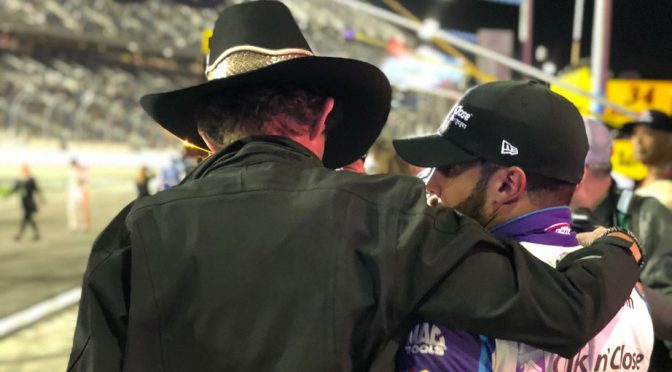
Some last-lap contact near the finish line with Denny Hamlin left Wallace’s Chevy damaged and meant a quick trip to the infield medical center for the “all clear,” so Petty quickly headed that way to check on the 24-year-old driver.
After a few minutes inside, NASCAR’s “King” emerged wearing a huge grin topped by his trademark cowboy hat — and sunglasses, even in the night sky. It absolutely appeared as if Wallace’s Daytona effort gave his beloved team owner a healthy dose of 200-mph rejuvenation.
“They were checking his blood pressure and I walked in, I asked him, ‘What was the last thing I told you,'” Petty said, smiling.
“He said, ‘I don’t know.’ I said, ‘I told you don’t mess up my car.’… I think his blood pressure went to 330. I wasn’t going to blame him, that’s for dang sure.”
Petty continued, “That’s a heckuva start. … They’d make pit stops and he’d run himself back up to sixth or seventh, he probably passed more cars than anybody, but he was in the race all day long.”
A few minutes later, Wallace made his way to the track’s media center to formally address his record-worthy rookie performance. And it was clear the young Alabama native was dealing with some hefty emotions. He is now the top-finishing African-American ever in the Daytona 500, and the impact of his hard work was not only a great season kickoff, it was a significant moment for him and for his sport.
Just as Wallace sat down in front of the microphone, his mother approached – full of emotion and intent for a hug – for the first time they had seen each other since the race began four hours earlier.
Wallace asked the room of reporters to give him a moment to compose himself. His eyes were red and still filled with tears when he began taking questions.
When it came to his relationship with the 80-year-old Petty, Wallace wiped his eyes and shared a story.
He spoke about going to dinner with the 200-time winner the night before the 500. Wallace joked that he was Petty’s “Uber driver” and conceded he was completely enthralled listening to the legend retell stories of Daytona racing — on the beach pre-dating the Daytona 500 and then all the fascinating tales of close calls and fantastic triumphs in the sport’s greatest race – which Petty won a record seven times.
But Wallace confirmed that after the race, as he sat in the infield care center, he wasn’t sure, at first, how to read Petty.
“I’m pissed off about the finish, obviously, and he walks in livid, and I’m like, yes, he’s mad, let’s go do something,” Wallace said. “He walks in, and the first thing he said is, ‘What’s the first thing I told you?’ with a very stern attitude.”
Wallace turned to Petty and said, “Ummmm.”
“I told you not to wreck the car,” Petty said.
“I didn’t do it!” Wallace retorted.
“So we shared a good laugh, and he came in and gave me a big hug after that,” Wallace said. “To see the smile on his face, I think you had to be there to experience that moment. All the liaisons in there were pretty nervous for me, too, until he cracked the joke.
“But just a great day, a great week, seeing him after the Duels, how pumped up he was and just the same amount of emotion, if not more, right here after the race.”
The result of the pairing – and its most promising start – has already resulted in big news for the team less than 24 hours after the Daytona 500 checkered flag flew. Driving 101 and it’s “NASCAR Racing Experience” brand signed on as a primary sponsor of Wallace’s Chevrolet Camaro ZL1 for this weekend’s race at Atlanta.
Fans and sponsors alike – ready to embrace and support the pairing of NASCAR’s most legendary driver guiding a young talent full of unlimited potential.
The ninth season of the NASCAR Peak Antifreeze iRacing Series kicks off Tuesday evening with a live stream of action from the virtual Daytona International Speedway.
The race begins at 9 p.m. ET and will be streamed live here on NASCAR.com and on FansChoice.tv.
Eighteen races make up the 2018 season, which includes virtual tracks such as Charlotte Motor Speedway, Sonoma Raceway and Bristol Motor Speedway and culminates in a four-race playoff. The championship race takes place Oct. 23 at Homestead-Miami Speedway.
More than $17,000 in cash and prizes is on the line in the competitive NASCAR eSports racing series.
View the livestream below or on YouTube and FansChoice. Full scoring can be found here.
Austin Dillon enjoyed one of the many perks that comes with being the newest Daytona 500 champion — making media rounds in New York City.
Fresh off taking the No. 3 back to Victory Lane for the first time at Daytona since Dale Earnhardt accomplished the feat in 1998, Dillon kicked off the day at 7:30 a.m. with an appearance on FS1’s “First Things First.”
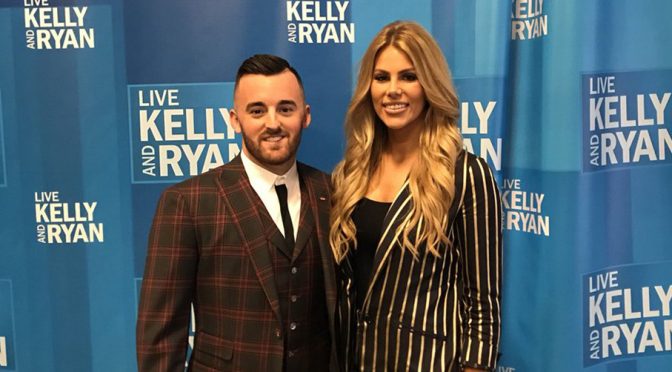
Dillon also dropped by “Live with Kelly and Ryan,” SiriusXM’s “The Morning Mashup,” and the New York Stock Exchange on Wall Street to ring the closing bell.
Each year, the Daytona 500 lives up to the hype, and 2018 was no exception. The race had a last-lap pass, new faces up front, Peyton Manning — you know, the usual stuff. We’re just happy to see race cars again.
Thumbs Up: Dale Jr.’s command to start engines
In his first race not as a full-time driver, Dale Earnhardt Jr. took on a role as the Daytona 500’s Grand Marshal. The Grand Marshal seems like a pretty sweet deal, doesn’t it? The duties include telling drivers to start their cars, and probably not too much more. Like, it sounds easy, but you wield a ton of power.
Maybe that’s why Dale Jr. so vividly shouted the most famous words in racing Sunday. You be the judge.
Third — and this is the unfortunate one — Blaney seemed to find himself in the middle of each of the big, multi-car crashes Sunday. First, on the final lap of Stage 1, Blaney’s car connected with Ricky Stenhouse Jr., triggering a nine-car pile-up. Then, with 19 laps to go in Stage 2, while Blaney led the race, Chase Elliott and Brad Keselowski made a charge to pass the No. 12, ultimately tangling and crashing. Finally, with two laps to go in the race, Kurt Busch lost his car just in front of Blaney, taking a total of 12 cars with him.
While Blaney managed to salvage a seventh-place finish after the final crash, thumbs down for being in the wrong place at the wrong time — three times over.
Thumbs Up: Underdogs
Restrictor-plate racing is fun because anything can happen. The draft pack makes most cars virtually equal, plus there’s an element of luck (maybe that’s why race winner Austin Dillon carried a lucky penny in his car).
Unpredictability means strong finishes for teams that don’t typically run up front.
Chris Buescher finished fifth, his first top five since Bristol in 2016.
Justin Marks finished an unlikely 12th driving Rick Ware’s No. 51.
David Gilliland, in his grand return, finished 14th racing for Ricky Benton — in a backup car.
Thumbs up for the unlikely heroes of restrictor-plate racing.
Thumbs Down: An unfortunate end for Danica
Danica Patrick ran her final NASCAR race Sunday, driving the No. 7 for Premium Motorsports, reunited with longtime sponsor GoDaddy, but the first leg of the “Danica Double” ended abruptly when she found herself caught up in a crash triggered by contact at the front of the pack between Brad Keselowski and Chase Elliott.
The crash also ended her former teammate Kevin Harvick’s shot at a Daytona 500 win.
Thumbs down for the bad luck that ended Danica’s final NASCAR race prematurely — but a thumbs up for a forward-looking, positive attitude on her stock car career.
Biggest Thumbs Up of the Week: Legendary Car Numbers
Have you heard? Austin Dillon won the Daytona 500, in case you somehow missed the news. Oh, and Darrell Wallace Jr. finished second. Yep, the Nos. 3 and 43 atop the scoring pylon, just like in the good old days.
It’s been a little while since the Nos. 3 and 43 cars finished 1-2 — over 30 years, in fact.
Last 2 times 3 and 43 finished 1-2 in a premier series race.
Nov. 2, 1986, Dale Earnhardt beat Richard Petty by 1 lap and 3 seconds to win Atlanta Journal 500 at @amsupdates
On April 12, 1987 Earnhardt beat Petty by 0.78 seconds to win Valleydale Meats 500 at @BMSupdates
Interestingly, with Denny Hamlin’s third-place finish, the three winningest numbers in NASCAR — No. 11, No. 43, and No. 3 — all finished in the top three.
Thumbs up for reliving the old days a bit, from the RCR No. 3 in Victory Lane at Daytona, to Richard Petty’s famous No. 43 right there, too.