DAYTONA BEACH, Fla. — If Austin Dillon’s No. 3 Richard Childress Racing team decided to steal a page from the 1979 Pittsburgh Pirates, it would be entirely appropriate.
The theme song of the world champion Pirates was “We Are Family,” a contemporaneous hit by Sister Sledge. In 1979, the close-knit underdog Pittsburgh team upset the Baltimore Orioles to win the World Series.
Coincidentally, 1979 also marked the first appearance of a rookie named Dale Earnhardt in the Daytona 500. The seven-time champion and NASCAR Hall of Famer would spend 19 years — with team owners Rod Osterlund, Bud Moore and Richard Childress — trying in vain to win the Great American Race.
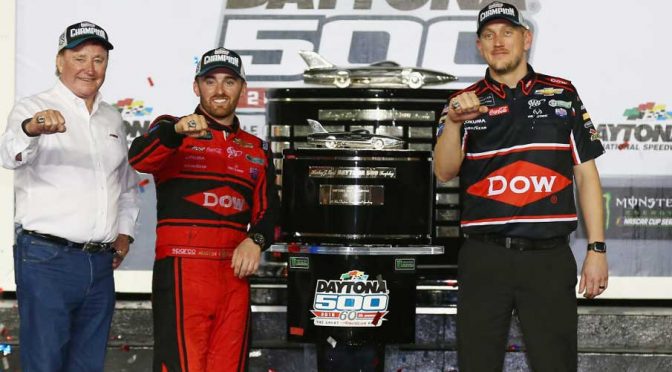
Earnhardt’s breakthrough victory finally came in 1998, and when he celebrated in Victory Lane after the emotional win, Childress and his two grandsons, Austin and Ty Dillon, were there with him. Austin was seven years old at the time. Ty was five.
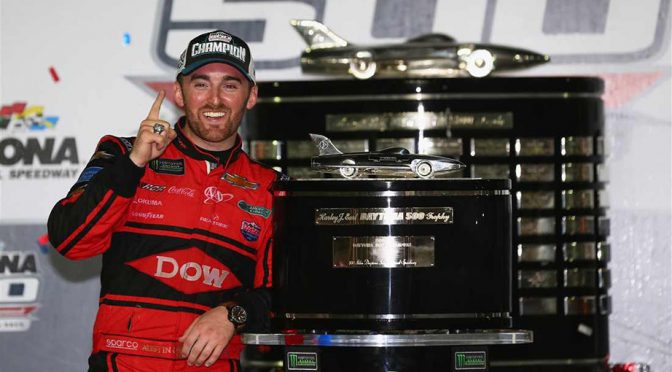
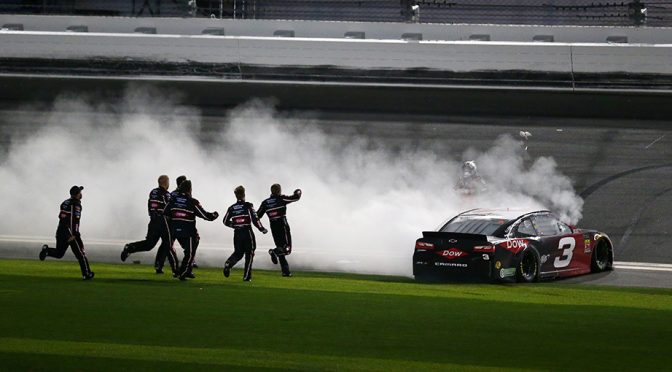
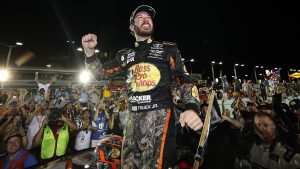
Twenty years and three days after Earnhardt triumphed at the 2.5-mile superspeedway, Austin Dillon returned to Victory Lane as the winner of a rough-and-tumble Daytona 500.
Dillon started from the rear of the field in a backup car and drove a patient race — until he tagged then-leader Aric Almirola on the final lap — sacrificing points for a chance to win the most important and prestigious prize, the Harley J. Earl trophy.
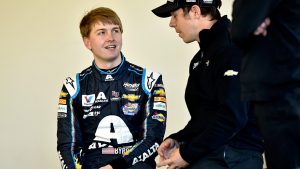
Childress and Earnhardt were best friends, but Dillon is flesh and blood, the son of Mike Dillon and Childress’ daughter Tina.
For Childress, comparing the two victories was difficult.
“They’re both so different,” Childress told the NASCAR Wire Service at the Daytona 500 Champion’s Breakfast at the speedway on Monday morning. “I knew how important ’98 was for Dale to win the Daytona 500. We had been so close so many times, and it wouldn’t have been right if he didn’t have it on his resume.
“That was one of the most special wins I’ve ever been involved with. And then last night, to see my grandson come across there 20 years later and win the Daytona 500, it’s hard to beat blood. …”
With a catch in his voice, Childress let the words hang and put his arm around Dillon’s shoulders.
But this Daytona 500 was not simply about immediate family. Dillon is the first champion in recent memory to sit in the winner’s chair in the Bill France Room at the speedway and single out each of his team members by name and recite their specific racing histories. And make no mistake, they are all racers.
Rear tire changer Jake Lind, for example, is the son of Will Lind, the rear tire changer for the “Flying Aces” crew that dominated the sport with Earnhardt in the 1980s and 1990s.
As racers are wont to do, Dillon’s crew celebrated the Daytona 500 victory into the wee hours at Tijuana Flats, an establishment owned by one of Dillon’s friends. The large “extended family” of Dillon’s cohorts is called the “Wolfpack,” and after the party died down at Tijuana Flats, the entourage paid a visit to Daytona Hardcore Tattoo to get inked with the image of a wolf howling at the moon.
“I got a tattoo last night,” Dillon acknowledged. “It says ‘Daytona 500 Champ’ on it—it’s pretty cool, and you’ll never be able to see it either. …
“It hurt. It feels OK this morning, but one of the boys smacked me on the butt when I came over here, and I said, ‘Easy, guys.’ ”
Crew chief Justin Alexander opted out of a tattoo but made a promise.
“If we win a championship, I’ll get one on my face, if you want,” Alexander told Dillon.
Given the momentum Dillon and his team carry out of Daytona, and given the cohesiveness of this tight-knit racing “family,” don’t be surprised if you see a crew chief on pit road with a “3” on his cheek when next year’s Daytona 500 rolls around.
Ryan Blaney is quickly establishing himself a favorite to win on the track — and a fan favorite off it.
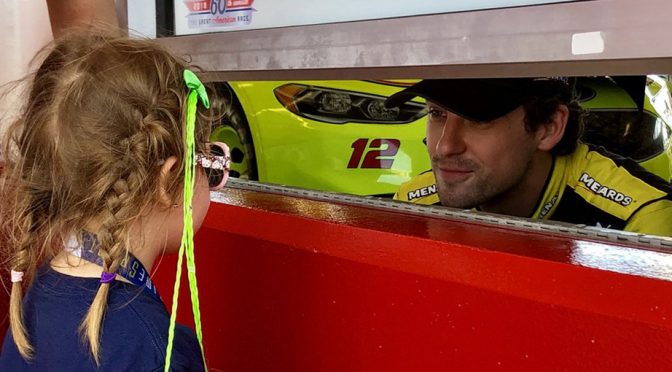
The newest member of Team Penske was captured in a truly memorable photo on Sunday at Daytona International Speedway before he led a race-high 118 laps and finished seventh in the Daytona 500.
This isn’t the first time we’ve seen the 24-year-old going above and beyond for fans this year, either.
Last month during a test at Texas Motor Speedway, Blaney made good on a promise to fans attending the event that he’d hang out with them during a pizza party thrown by track president Eddie Gossage.
Earlier during Speedweeks, he met up with a young fan at Hollywood Studios during an off-day who tweeted at him in a throwback shirt from his Wood Brothers Racing days.
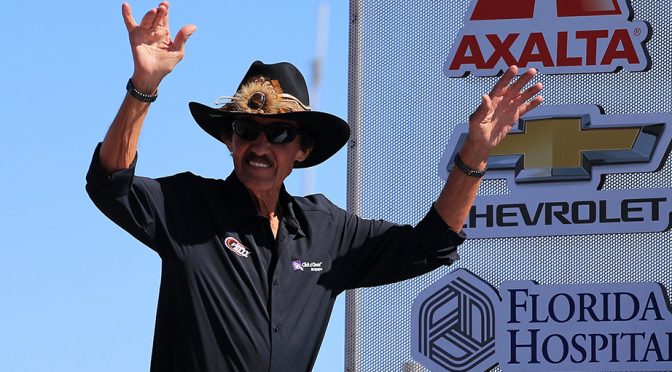
DAYTONA BEACH, Fla. — Richard Petty, who ascended to the role of NASCAR’s King through his engaging personality and his 200 career victories, did something Sunday he rarely ever does: Turned down an autograph request. Multiples, actually.
“Not right now, buddy,” he repeated as the 80-year-old stock-car legend rode a purposeful gait from pit road through the NASCAR garage. His trademark curlicued signature would have to wait. The King was in a hurry to find his driver, Darrell “Bubba” Wallace Jr., who handed Richard Petty Motorsports its best finish since 2016, and in the sport’s biggest race.
“Getting some exercise,” Petty said as he briskly made his way.
Petty finally found Wallace in the infield care center at Daytona International Speedway after a second-place finish in his first Daytona 500. His stride was interrupted only by a wrecker towing Wallace’s scraped-up No. 43 Chevrolet back to the garage across his path.
Wallace was unhurt, but the trip was mandatory after his car screeched to a halt after the checkered flag in a broadside battle with Denny Hamlin’s No. 11. But Petty’s initial reaction might’ve made more treatment for Wallace a necessity.
“They were checking his blood pressure, and I walked in and said, ‘What was the last thing I told you?'” Petty recalled. ” ‘I don’t know’ … I said, ‘don’t tear up my car’ and there the car is, bringing it in. He just went out. I think his blood pressure went to 330. I wasn’t going to blame him, that’s for dang sure.”
“So we shared a good laugh,” Wallace said, “and he came in and gave me a big hug after that. To see the smile on his face, I think you had to be there to experience that moment. All the liaisons in there were pretty nervous for me, too, until he cracked the joke.”
Wallace’s runner-up result in Sunday’s Great American Race helped cap the build-up to his rookie season with a steady yet adventurous career-best in NASCAR’s big leagues. In doing so, he helped firm up his place in the RPM organization beyond his four-race audition last season.
“I’ve said it a lot in the last 10 minutes: We’ve had him five weeks, and in five weeks, we’ve ended the race saying, ‘This kid can do it,’ ” said crew chief Drew Blickensderfer. “He does everything right when we have him in the race car, and this is another example of it. He took when he needed to take, and he gave when he needed to give. He’s done a great job, so he continues to impress us.”
Which is why Petty was so eager to be reunited with Wallace after 500-plus miles of racing. The two shared a special post-race moment after a third-place effort in a Thursday qualifying race, with Petty throwing his arm around the young driver’s shoulder. Sunday was primed to be an even bigger repeat celebration.
So Petty whisked past the well-wishers to toast Wallace’s day, with a speed that most octogenarians lack. Wallace’s arrival may have rejuvenated Petty’s outlook, but the NASCAR Hall of Famer suggested that the opposite force may be in play.
“I’m trying to give him energy,” Petty said. “I’ve got plenty.”
CHARLOTTE — Motorsports’ leading fan driving experience partners – Driving 101, which operates NASCAR Racing Experience, Richard Petty Driving Experience and Mario Andretti Racing Experience – announced today it will become the primary sponsor for the No. 43 Chevrolet Camaro ZL1 driven by Darrell “Bubba” Wallace, Jr., for Richard Petty Motorsports at the Folds of Honor Quiktrip 500 at Atlanta Motor Speedway.
For the first time, the NASCAR Racing Experience badge and racing graphics will be featured on the hood and body of a race car in the Monster Energy NASCAR Cup Series, bringing to life the experience the NASCAR Racing Experience offers thousands of fans at tracks around the country.
“We’re proud to see the NASCAR Racing Experience featured on the car of Bubba Wallace as he makes his debut in the Monster Energy NASCAR Cup Series in Atlanta,” said Robert Lutz, CEO of Driving 101. “It’s an honor to race with NASCAR legend Richard Petty’s team. He’s been an incredible partner in our driving experience, and we look forward to seeing the No. 43 NASCAR Racing Experience Chevrolet Camaro ZL1 and Bubba Wallace on the track and hopefully in Victory Lane.”
“It’s great to see partners coming on board to support us,” said Wallace. “I’m all about getting fans involved in racing, and nobody does that better than the NASCAR Racing Experience. They allow fans to race the cars we drive. It’s the best way to get on the same track and in the same cars we race. That’s really cool and I’m pumped they are on our car this weekend.”
Winning the Daytona 500 brings with it great prestige in the sport of NASCAR. For Austin Dillon, it also brought a round of congratulations from the President of the United States’ son, Donald Trump Jr.
Austin Dillon’s celebration after winning his first Daytona 500 in the 60th annual running of the “Great American Race” was pretty epic — butt wait, there’s more.
The Richard Childress Racing driver and members of his No. 3 Chevrolet team got (presumably matching) posterior tattoos to commemorate the legendary win.
“Pretty cool-looking tattoo,” Dillon told reporters during a press conference Monday morning. “(My wife) Whitney’s probably the only one that’s going to see it for awhile. Pretty cool. Actually a lot of the guys got tattoos last night. Everybody was lined up. It was cool.”
Jackman Paul Swan shared some additional details with NASCAR.com on Monday morning.
“Originally we came here three years ago on an off-weekend trip,” Swan said. “I think there was like seven of us who got the original ‘Wolfpack’ tattoos. Last night, we obviously won the (Daytona) 500, so we took a bunch of the other crew guys and took them to the same tattoo parlor.
” … Bunch of them got the tattoos and me and Austin and some other guys got some new tattoos in an undisclosed location on our bodies celebrating the 500 win. It’s just awesome. Good camaraderie. Fun time with the boys and some good tattoos.”
However, not everybody partook in adding some body art.
Crew chief Justin Alexander didn’t partake, but offered to get one “on (his) face” should the 3 team meet another milestone.
“He chickened out,” Dillon said. “He’ll get one. He said I have to win a championship, so I’ll hold it to him.”
Darrell Wallace Jr. finished second in his debut as the full-time driver of the Richard Petty Motorsports No. 43 Chevrolet, helped push the No. 3 Chevrolet of Austin Dillon to victory and then had an emotional breakdown in his post-race interview.
What a night.
It wasn’t quite over when Wallace left Daytona International Speedway, though.
His push helped Dillon land in Victory Lane on the 17-year anniversary of Dale Earnhardt’s death, and 20 years after “The Intimidator” won his lone Daytona 500.
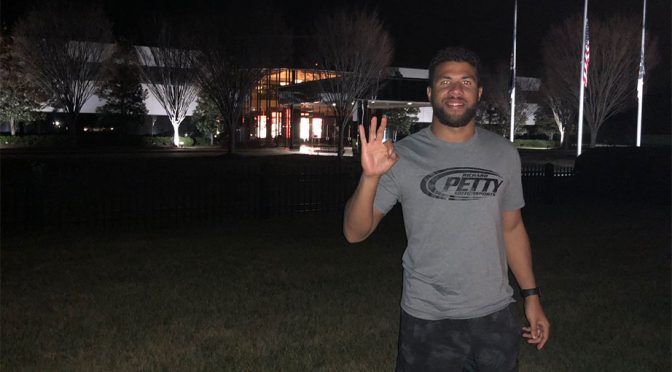
There’s something special about Wallace Jr. motioning the “3” to honor both Dale and Dillon (and likely team owner Richard Childress, too) while wearing a Richard Petty Motorsports T-shirt.
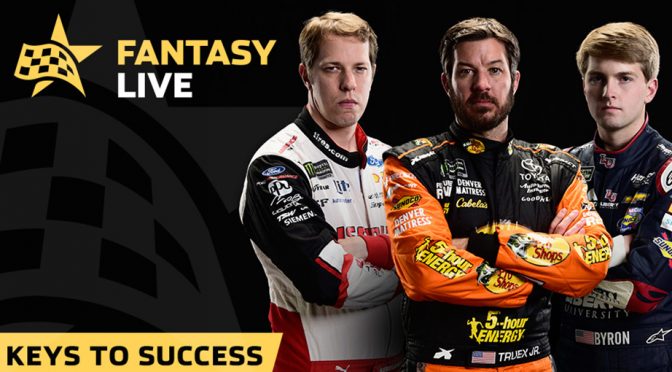
NASCAR.com fantasy expert RJ Kraft has some guidelines for you to keep in mind while setting your fantasy roster on a weekly basis. Will these guidelines guarantee you league superiority? Hopefully, but not every situation is as cut and dried as “leave the gun, take the cannolis.”
On a weekly basis, Fantasy Fastlane will provide insight into each race weekend. But before we get into that, having a code or guidelines can be helpful in building out a roster, especially at the start of the year, so here are 10 helpful nuggets for playing.
1. Have a routineand stick with it
When I am plotting out my fantasy roster for the week, I typically set it initially on Tuesday when the week changes over. And then circle back after qualifying and practices while evaluating 10-lap averages to set my final roster and bonus picks. You don’t have to do it that way, but the point is to get into a pattern — based on that weekend’s particular schedule — where setting your roster and making changes becomes a habit. Also of note, rosters do not carry over week to week, so it’s important to get into the game to set it.
Chris Graythen | Getty Images
2. Scripting out certain driver’s usage is highly advisable With a cap on using drivers for 10 races, owners need to be judicious about how certain drivers — namely the big point scorers are used. For example, you want to devise your strategy around making sure that 1.5-mile beast (and defending series champ) Martin Truex Jr. is available to you for all tracks of that particular length in the first 26 races — FYI, that’s seven races (eight if you want to throw Darlington in there, which is close enough in length). Following that logic, you’d want to make sure to have Kyle Larson at the three 2-mile races. And in the case of Kyle Busch who’s good nearly everywhere, it’s advisable to know which tracks to shy away from with him — Talladega, Michigan and Daytona.
3. Be prepared to veer from the script
While we like scripting out driver usage, sometimes life is like a Bruce Springsteen concert where the set list changes on the fly and ad-libbing and audibles are called for. A driver might start to get on a roll and you need to adjust to take advantage of that. With the number of young drivers coming into the Monster Energy NASCAR Cup Series ranks in the past few years, it will be difficult to rely on track history. Owners will need to rely on the eye test, lap times, speeds and more. Doing that will require being willing to drop the script like it’s hot in favor of who looks particularly strong over a consistent stretch.
4. Restrictor-plate races are unpredictable
The draft is known as the great equalizer and could really jumble up the fields at Daytona International Speedway and Talladega Superspeedway. In addition to that, pack racing tends to lead to sizable wrecks that wreak havoc on your lineup (thankfully in 2018 you will have a garage driver – more on that in a bit). Parity abounds in these races: Twenty-four different drivers notched top 10s in the four plate races in 2017. Among the drivers not to use: Martin Truex Jr., Chase Elliott and Kyle Larson. The point being — while there are exceptions to this rule (Brad Keselowski) — it is prudent not to burn one of the expected top drivers’ races on a restrictor-plate event.
5. Ford power needs to be a priority at Daytona and Talladega
Ford swept the restrictor-plate races with Ricky Stenhouse Jr. winning twice, while Kurt Busch and Brad Keselowski each won once. Going back to the summer Daytona race, Fords have won 11 of the past 14 plate races. The numbers illustrate just how strong the blue oval was at plate tracks in 2017. Ford teams scored 19 of a possible 40 top 10s in these races (47.5 percent); Chevrolet had 16 while Toyota had five. A similar tale can be told with laps led as Ford teams led 353 of a possible 742 circuits (47.5 percent), while Toyota led 198 laps and Chevrolet led 191 laps. Stacking your Daytona and Talladega lineups with Ford drivers has a strong likelihood of paying off so load up on Keselowski, Stenhouse, Joey Logano, Ryan Blaney, Kevin Harvick, Clint Bowyer and more for these races. Michael McDowell and David Ragan are ideal sleepers for those races.
David Becker | Getty Images
6. Get ready to go to the garage This season’s Fantasy Live game features a garage driver. If you play other fantasy sports, consider this your bench for the given race. However, unlike other sports you can dip into the garage mid-race to make a change if you so desire due to performance or if an incident/wreck by one of your starters requires you to make a change to try and gain more points. Given the wealth of young talent with plenty of upside but not much history in the sport’s top series, I am going to plan my garage strategy early on around drivers in that classification since you just don’t what to expect. Think along the lines of Erik Jones, Darrell Wallace Jr., Daniel Suarez, Alex Bowman or William Byron. There is something to be said for going the steady-hand route with a veteran in the garage like Jamie McMurray or Jimmie Johnson. Utilizing the garage play means having your finger on the pulse of what is happening in a race. This is an application that can pay big dividends on your roster over the course of the season.
7. Scoring stage points should be a priority
With the scoring shifting to exactly how drivers earn points in races, stage points should be something fantasy owners target. Stage points were a part of the game last year, but so were laps led, fast laps and place differential. The latter three are no longer part of the scoring, placing an extra premium on getting stage points. Strategy plays can shake up the order in a race, especially at short tracks and plate tracks, but using last year’s stage points totals can also serve as a guide early on in the season.
8. Recent results really do matter
The phrase “What have you done for me lately” comes to mind here. I tend to be a bigger believer in what a driver has done in the last three years over career numbers. A great example of this is Martin Truex Jr., especially since that time period coincides with being paired up with crew chief Cole Pearn. A similar example would be Kyle Busch as he has been paired with crew chief Adam Stevens during that same stretch. Two tracks that Busch has been strong at in the past three years — Kansas (one win, 5.2 average finish) and Martinsville (two wins, 2.8 average finish) — are not ones he has necessarily been good at over his whole career. At Martinsville, 813 of his 1,300 laps led have come in the last five races at the short track. Before his last five races at Kansas, Busch’s average finish there was 21.4 and his overall finish is 17.4. If you looked at the overall body of work, you might dismiss the idea. Yet, a closer look at the recent numbers proves why “Rowdy” would be a good play there.
9. Going bonkers for bonus points
There are added ways to get bonus points in this year’s game. In addition to selecting the race winner (30 points for correct pick) and winning manufacturer (10 points for correct pick), players can now select a pole winner (five points for correct pick) and Stage 1 and 2 winners (10 points for correct pick). When qualifying is held on Friday of a race weekend, teams typically do a run in qualifying trim at some point in the Friday practice session. Qualifying picks have to be set ahead of the qualifying session as picks should lock about five minutes before it starts. Selecting Stage 1 and Stage 2 winners is far from an exact science, but it’s usually solid reasoning that the cars that look strongest in practice can be expected to be up front in the end.
10. The not-so secret sauce
It’s one thing to look at speeds from practice, but those do not tell the full story for the race weekend. 10-lap averages paint a more complete picture of what could be in store for the race. The 10-lap averages are an invaluable fantasy tool to measure longer run speed over 10 consecutive laps of practice. These stats are more frequent for the last two practices and give a solid indication of who are the drivers that should have the speed to be factors in the race. These numbers tend to have little importance at restrictor-plate tracks and carry major value at the intermediate tracks.
No driver has won back-to-back Daytona 500s since Sterling Marlin accomplished the feat in 1994-1995, but Kurt Busch was close enough to taste it on Sunday afternoon at Daytona International Speedway.
After a restart on Lap 194 of a scheduled 200, Busch bulled his way into the lead, thanks in part to a shove from Aric Almirola.
“I was feeling the magic,” acknowledged Busch, who held the top spot on laps 195 and 196.
But Ryan Blaney surged back into the lead on Lap 197, only to surrender it to Denny Hamlin on Lap 198. Busch had a run on Hamlin in Turns 1 and 2, but Hamlin moved up the track to block, breaking the momentum of Busch’s No. 41 Ford.
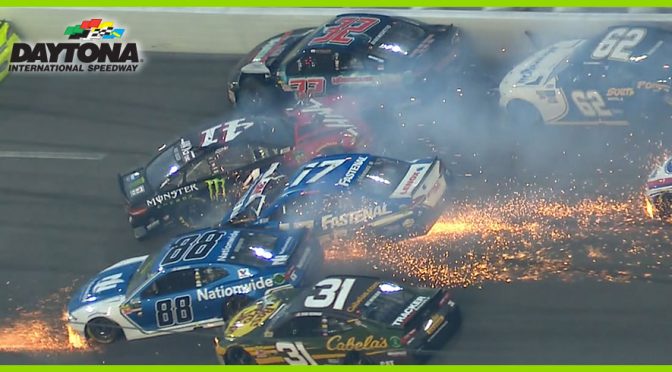
Running behind Busch, Blaney couldn’t check up quickly enough, and contact between his car and Busch’s turned Busch into the wall, igniting a 13-car wreck that eliminated the No. 41 and left Busch wistful about what might have been.
“I thought we could do it again back-to-back and win the Daytona 500,” Busch said. “We found the right drafting lanes, and I was making good moves. I just got caught in a Bermuda Triangle, it seemed like, when Hamlin blocked us. I hit him pretty hard and that killed a lot of my momentum.
“Maybe I should have just flung the 11 (Hamlin), but you have to treat guys with respect, and you’ve also got to throw your elbows out and you have to hold the hits when you get hit. We were close to going back-to-back in the Daytona 500, but I don’t have anything to show for it.”
DAYTONA BEACH, Fla. – Leading a race-high 118 laps, Ryan Blaney’s No. 12 Team Penske Ford seemed like the one to beat throughout Sunday’s season-opening Daytona 500 at Daytona International Speedway.
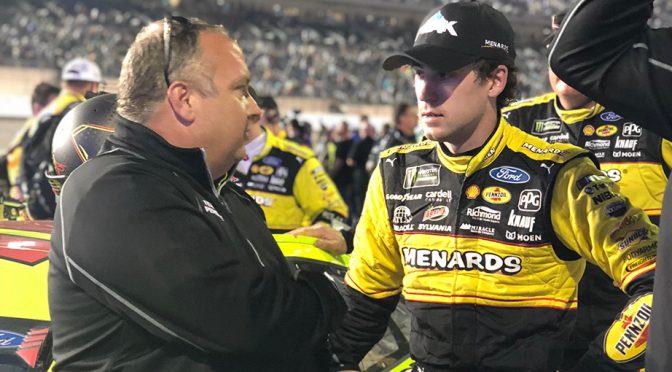
But the nature of Daytona dictates that nothing is guaranteed — that’s what Blaney found out Sunday. As the checkered flag flew and race winner Austin Dillon celebrated on the front stretch, Blaney debriefed with crew chief Jeremy Bullins on pit road following a seventh-place finish, getting fist bumps from crew members and No. 21 driver Paul Menard.
He may not have won, but he sure put on a show.
“You can have the best car in the world and not win the race,” Blaney said. “I thought we had a good car today but you just try to figure out what you can do better for next time and it’s a shame it didn’t work out for us, but you try to live and learn and live and move on.
“Yeah, you’re disappointed, you dominate a good race, but that’s the way it goes.”
Blaney’s No. 12 made contact with Kurt Busch’s No. 41 Ford at Lap 198, triggering a multi-car pileup that collected 10 additional cars. Blaney’s No. 12 sustained damage and was forced to pit for repairs.
“It was just hard racing,” he said. “You say it all day. I was trying to be aggressive blocking the lead and kind of fell back and got a good run back up towards it. Man, the 11 blocked the 41 and the 41 kind of went high last minute and I was on his left rear and I turned him. I feel bad about that. He kinda changed lanes last minute and I couldn’t react quick enough. It stinks. We led a lot of laps.
Showing speed throughout the entire weekend, the 24-year-old also won the first Can-Am Duel on Thursday night. Sunday, he paced the field five times after starting from the third position and won Stage 2, gathering valuable points. The showing was enough to crown Blaney the Monster Energy NASCAR Cup Series points leader heading into the rest of the 2018 season.
Apart from the finish, their day was something to be pleased about, Bullins said.
“To be honest with you, it’s absolutely the day we wanted,” he told NASCAR.com. “We were able to win a stage and get a lot of points, led a lot of laps and felt like we were in a really good position until that last caution came out.
“It’s everything you can ever hope for, is to be up front towards the end of these things, obviously the way it ended was not what we wanted, but the day itself was very good; we had a great car, Ryan did a good job managing the lead for a long time.”
Sunday’s race also marked Blaney’s first points race behind the wheel of the Team Penske’s newly added No. 12 Ford; he previously drove the No. 21 Wood Brothers Racing Ford, an affiliate of Team Penske.
A near-win at Daytona is a good start to the season for the new No. 12 team.
“We worked a lot this winter to be in this position and it’s unfortunate that one of our cars didn’t win the race because I felt like Speedweeks definitely showed the hard work that everybody put in and we definitely had the best cars all week,” Bullins said. “I think it bodes well for the speedway program for us for the rest of the year because we’ve got a really good place to learn from.
“Starting off with this 12 team, I feel like we’ve got good momentum and we’re looking forward to going to Atlanta.”
 For the first time, the NASCAR Racing Experience badge and racing graphics will be featured on the hood and body of a race car in the Monster Energy NASCAR Cup Series, bringing to life the experience the NASCAR Racing Experience offers thousands of fans at tracks around the country.