RELATED: Championship 4 scenarios for Phoenix | Chase Grid

The inaugural NASCAR XFINITY Chase still has some business to settle, namely determining which four drivers will square off Nov. 19 for the championship in the Homestead-Miami Speedway finale.


With all four berths available heading toward the season’s penultimate event, it’s a wide-open race.


The XFINITY Series will figure out its Championship 4 contenders in Saturday’s Round of 8 finale, the Ticket Galaxy 200 (7:30 p.m. ET, NBCSN, MRN, SiriusXM) at Phoenix International Raceway. Put simply, four drivers will advance and four will be eliminated from the postseason field.


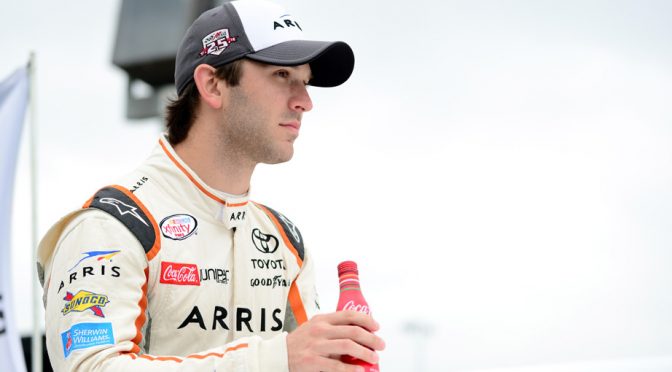
Since Sprint Cup Series regulars won the first two events in the three-race round, no XFINITY Series contender has a free pass to the final before Saturday’s 200-miler. Daniel Suarez — driver of Joe Gibbs Racing‘s No. 19 Arris Toyota — has the favorable perch as the leader in series standings, 17 points clear of the cut-off line.


But even with the momentum of nine straight top-10 finishes on his side, last season’s Sunoco Rookie of the Year said he knows it’s a delicate grip.


“With this Chase format you are never in a real comfortable place,” Suarez said, “but if we continue to do what we’ve been doing the last few weeks as a team, I feel like we will be OK. I really enjoy racing at Phoenix and think the track really suits my driving style. We always have such tremendous fan support when we go out there, it’s really great to see.”


Elliott Sadler, Erik Jones and Blake Koch sit behind Suarez in the Chase pecking order, in position to transfer should they maintain their standing in the points. The remaining four — (in order) Justin Allgaier, Ryan Reed, Darrell Wallace Jr. and Brendan Gaughan — have ground to make up.


Allgaier sits the closest, just one point behind Koch at the cut-off line. It’s four more points back to Reed, another 15 back to Wallace and 13 more back to Gaughan.


With a certain degree of spacing among the bottom four, any points gains would have to come in sizable chunks. The other, more preferred method of advancing involves a trip to Victory Lane to nix any number-crunching.


“I’m not going to worry about the points situation,” said Wallace, driver of Roush Fenway Racing‘s Leidos No. 6 Ford, repeating a familiar personal refrain. “We just need to go out there and go after the win and then hopefully have a chance at that championship at Homestead. Either way, we are going to have some fun this weekend and give it everything we have.”


Sealing a Championship 4 spot in style with a win will mean denying one of seven Sprint Cup regulars in the field. Kyle Busch is a nine-time Phoenix winner who has won five of the last seven XFINITY events on the 1-mile track. And Ricky Stenhouse Jr., a two-time XFINITY champ, will make his first start in the series since 2013, driving Roush Fenway’s No. 60 Ford.

RELATED: Truck Series Chase Grid | Driver standings


With two races left in the NASCAR Camping World Truck Series season, only Johnny Sauter has a sure-fire berth in the championship finale at Homestead-Miami Speedway. The rest of the title-hopeful roster is a five-driver pour into a three-driver funnel.

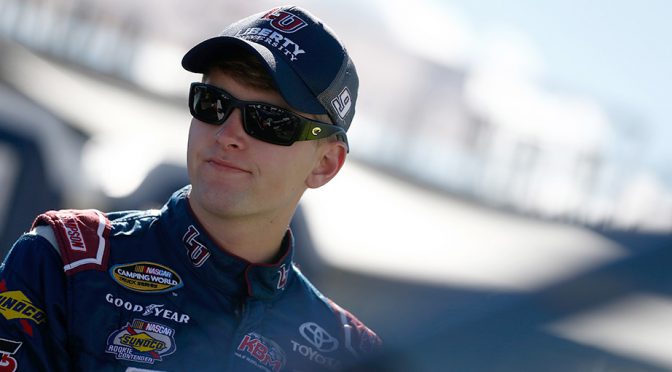
The Championship 4 field for the series’ inaugural Chase finale will get clarity after Friday night’s Lucas Oil 150 (10 p.m. ET, FS1, MRN, SiriusXM) at Phoenix International Raceway. William Byron, Christopher Bell, Matt Crafton, Timothy Peters and Ben Kennedy will aim to join Sauter in the Championship 4, but two drivers will be eliminated in Friday’s Round of 6 finale.

Sauter clinched his spot with a victory at Martinsville Speedway two weeks ago, then blocked anyone else from an automatic berth with a back-to-back win at Texas Motor Speedway last weekend. He’s the only driver who can afford to be conservative at Phoenix.

“We’re peaking at the right time but we need to peak in a few weeks when it really counts at Homestead,” Sauter said.

Byron and Bell, two Kyle Busch Motorsports teammates with limited experience on the Arizona oval, may be in the best position to join him. Byron is the top points-earner among the five remaining drivers hoping to transfer, with Bell just one point behind him.

Their KBM organization also has solid footing at Phoenix. The Kyle Busch-owned group won four straight races at the 1-mile track from 2011-14. Plus, the 18-year-old Byron has some level of confidence by competing in a race-winning chassis — the same one that he drove to a triumph in the Chase opener at New Hampshire and that Erik Jones powered to Victory Lane at Phoenix in 2014.

“It’s a little bit of pressure for everyone who is not locked in,” Byron said. “Hopefully we can capitalize on that and have the finish we need in order to get to Homestead. I think we’re going to have a really good shot at a win, so if we can do that, it would be the easiest way to ensure we are in the Championship 4 next weekend.”

Bell, 21, will also be at the controls of proven equipment, driving the same KBM truck that spurred him to victory at Gateway Motorsports Park. He also finished second to Byron using the same chassis in the Chase opener at New Hampshire.

“I expect that we’ll be really fast again this week,” Bell said. “I feel we are in a good enough position points-wise that if we just go out and have a solid day and not make any mistakes then we should advance.”

Not much distance separates the three drivers behind the Kyle Busch Motorsports duo in the standings. Two-time series champ Crafton sits three points behind Bell, with Peters — the defending race winner – another point back. Kennedy, smarting from a pair of mid-pack finishes in the round’s other events, is just 13 points behind Crafton’s grasp on the provisional final transfer spot.

Of the six, only Peters is seeking his first win of the season. A repeat of his late-race surge to victory in Phoenix’s 150-miler last year would be well-timed.

“I’d say we have momentum on our side, we’ve been strong through the Chase and at short tracks this season,” Peters said. “I think we have a good Toyota Tundra this weekend and this team has the heart to come back and go for the win.”

RELATED: Driver moves and team changes for 2017


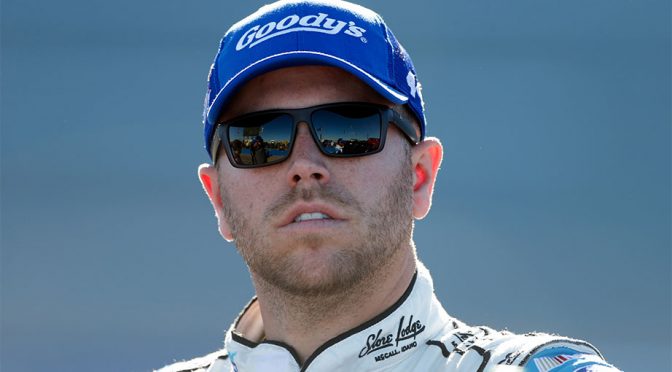
Richard Petty Motorsports announced Thursday that NASCAR Sprint Cup Series driver Brian Scott will retire from full-time auto racing competition at season’s end.

Scott, 28, began his NASCAR national series career in 2007. He is currently a Sunoco Rookie of the Year candidate in his first year driving team owner Richard Petty’s No. 44 Ford.

In a release provided by the Petty team, Scott indicated that the decision was a personal one.

“This was a difficult decision, but one that I made myself for my family,” Scott said. “Racing and specifically NASCAR has been and will always be in my heart, but right now, I want to turn all my attention to my family and to be able to spend more time with them. Racing has blessed me with great opportunities, and I’m very grateful for everything that it has allowed me to do, but for me, it’s time to move on.

“I can’t thank everyone enough who helped me in my career. I would not have made it to where I am at today without their trust and commitment.”

In a separate release provided by the team, Albertsons Companies announced Thursday that it would cease its sponsorship. The Boise, Idaho-based grocery retailer has been a featured sponsor for eight of the 34 Sprint Cup races this year. Scott, a Boise native, is the great-grandson of Albertsons’ founders.


WATCH: Scott gives a tour of his hometown of McCall, Idaho

In 51 starts in NASCAR’s premier series, Scott has one Coors Light Pole Award and one top-five finish — both coming at Talladega Superspeedway. But this season has been marked by struggles, with five crash-related DNFs feeding a 32nd-place ranking in the Sprint Cup standings.

After posting his career-best second-place effort last month in Talladega’s Hellmann’s 500, Scott acknowledged the adversity in a trying first season at the Sprint Cup level.

“Just trying to get any bit of a bright spot in this year has been difficult,” Scott said Oct. 23 at the Alabama track. “I think that this is by far the brightest spot that we’ve had in a really challenging 2016 for Richard Petty Motorsports. I don’t know, I guess the results and what this does for us going forward is yet to be determined.”

The Petty-owned team indicated that it would field the No. 44 Ford in 2017 with “further announcements” at a later date. The organization underwent significant changes on Aug. 31, temporarily assigning Philippe Lopez and Scott McDougall oversight of the competition department in place of Sammy Johns.

Scott ends his full-time driving days as a two-time winner in the NASCAR Camping World Truck Series. He prevailed on the mile-long layouts of Dover (2009) and Phoenix (2012).

Scott also competed in six full seasons in what is now the NASCAR XFINITY Series, spending two of those years with Joe Gibbs Racing and three with Richard Childress Racing. He netted 20 top-five finishes and five pole positions over 208 career starts.


“Brian made it to and competed at a level that very few do in NASCAR,” said Brian Moffitt, RPM’s Chief Executive Officer said in the team release. “Brian became part of the Petty family this year, and he committed himself to making our organization better. We feel fortunate to have had the opportunity to get to know Brian and wish him nothing but the best for him and his family.”

RELATED: See the pre-Phoenix Chase Grid


Dry spells happen with regularity in the Arizona desert, where rain typically falls a thimble at a time.

For NASCAR Sprint Cup Series hopefuls competing at Phoenix International Raceway against Kevin Harvick in recent years, it’s been positively arid.

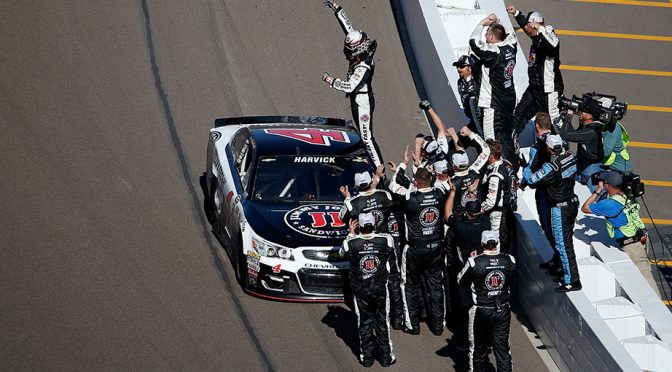
Harvick’s torrid tear at the 1-mile track includes a dominant stretch of five wins in the last six Phoenix races, part of his series-best eight victories on the Southwestern oval. That run of success bridges the end of his long tenure with Richard Childress Racing to his current home as driver of the Stewart-Haas Racing No. 4 Chevrolet.

The former series champion returns to Phoenix for Sunday’s Can-Am 500 (2:30 p.m. ET, NBC, MRN, SiriusXM NASCAR Radio) in need of another stellar performance to clinch his spot among the Championship 4 in next weekend’s Chase for the NASCAR Sprint Cup finale at Homestead-Miami Speedway. History might suggest a Harvick cinch, but the 40-year-old driver says he’s leaving nothing to chance.

“I feel like that can be gone at any point,” Harvick said about any potential Phoenix advantage. “That’s the hardest thing about having success. You have to have an open mind to try new things to keep moving forward. If you don’t have an open mind or are not willing to try a fresh approach, then it will get stagnant. You’re going to become stale and get left behind.”

Harvick has found himself with challenging Chase scenarios before, but in each instance since the current postseason format debuted in 2014, he has found ways to advance. Two years ago, Harvick converted a must-win in the penultimate race at Phoenix by leading 264 of 312 laps to clinch a spot in the final. He won the finale the following week for his first series crown.

Harvick has managed similar escape acts this season. In the previous pair of three-race stages in this year’s Chase, Harvick has overcome a shaky start in the round-opening event with a victory to stave off elimination. Heading to the Round of 8 curtain-closer this weekend, Harvick is in need of another clutch outing, ranked seventh out of the eight remaining title hopefuls and 18 points behind a jumbled cut-off line for advancement.

The favorite’s role seems to apply, but Harvick said plenty of factors — weather, track conditions, handling characteristics — remain in play.

“There are all kinds of things to navigate through once you get there,” Harvick said in a release provided by his team. “There are a lot of good race car drivers and lots of circumstances that could play out to have things go wrong. You go there with a fresh start like you’ve never won there before and try to get the car dialed in.”

One different factor heading to Phoenix this season — fewer spots in the Championship 4 final field up for grabs. Victories by Chase-eligible drivers Jimmie Johnson (two weeks ago at Martinsville) and Carl Edwards (last weekend at Texas) have gobbled up two berths in the Nov. 20 season finale. In 2014, all four spots were open before the Phoenix race; last year, three of the four slots were unclaimed.

It’s a cozy contest along the cut-off point. Four drivers — Joey Logano, Kyle Busch, Matt Kenseth and Denny Hamlin — are separated by just a two-point margin, with Logano and Busch in a deadlock for the final two spots. It’s 18 points off the cut line for Harvick with a sizable 34-point deficit for his Stewart-Haas Racing teammate Kurt Busch.

Of those remaining six title hopefuls, four have been included in the Championship 4 in past seasons. If Kenseth and Kurt Busch were able to advance and join Johnson and Edwards in the final, the field would be full of drivers making their first appearances in the Homestead-Miami title race under the current Chase format.

Four of the six drivers still in limbo are former series champions — Harvick, Kenseth, Kyle Busch and Kurt Busch. Like finalist Edwards, Hamlin and Logano are still seeking their first Sprint Cup championship.


RELATED: An inside look at Dale Jr. joining the NBC team in the booth

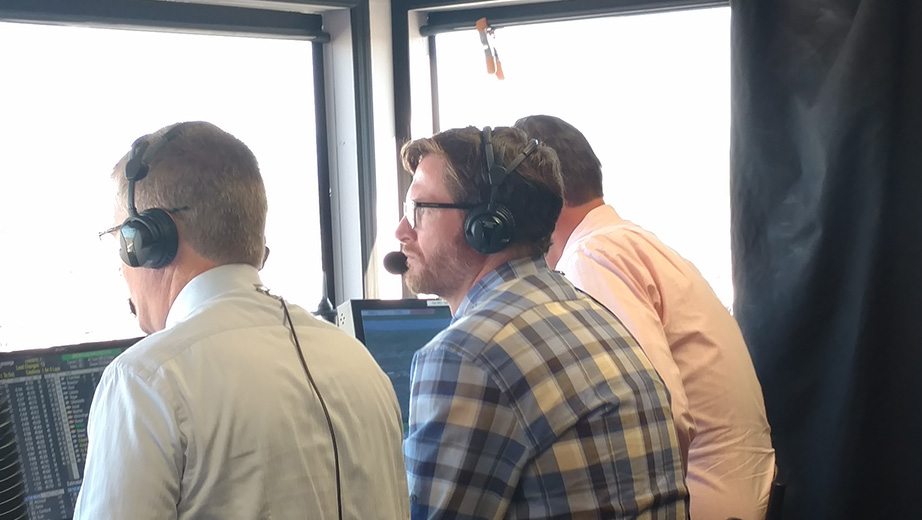
A black Suburban pulls into the NBC TV compound just outside of Turn 3 at Talladega Superspeedway. Pit reporters Dave Burns, Marty Snider, Kelli Stavast and Mike Massaro jump out into the brisk, fall morning.

“All right, we can get started, now that we’re here,” Burns jokes as he fake yawns theatrically. It is 9:42 a.m. local time, more than three hours before the green flag will drop on this Sunday in mid-October.

Someone standing nearby offers helpful advice: “Don’t screw it up.”

“We’ll try not to,” Burns replies.

The pit reporters file into a portable trailer nearby called BP’s Place. “BP” stands for Benny Parsons, the late and beloved NASCAR broadcaster who will be inducted into the NASCAR Hall of Fame early next year. Around the table sit analyst Steve Letarte; lead race announcer Rick Allen; Jeff Behnke, NBC’s vice president of NASCAR production; Matt Marvin, the race producer; Mike Wells, the director; Rene Hatlelid, the pit road producer; the pit road reporters; and other NBC personnel.

They represent a small fraction of the 230 people required to broadcast the race. The topic at hand is what stories they will cover during today’s race. There are many to choose from. It’s Talladega, so there’s always the chance of a big wreck. It’s a cutoff race in the Round of 12 in the Chase for the NASCAR Sprint Cup, so four drivers will be eliminated from the postseason. The table discusses the many different strategies drivers could use throughout the race. Some drivers will try to run up front. Others will hang out in the back. They will form and disband packs throughout the day. Keeping track of all of it all day will be a difficult but important task. 

“This could make for some very exciting things for the viewer all the way through,” Behnke says in words that seem prophetic after the checkered flag falls late that afternoon.

NBC Sports No. 1 goal in all of its programming is to tell stories, and the team of analysts and reporters finds them on this day before, during and after the race; on the track and off. Indeed, so much happens in the hours ahead that the challenge is not finding stories but deciding which ones to tell. 

Most of the key players on NBC’s NASCAR broadcast team have televised other sports, and they unanimously say NASCAR is the most complicated and difficult to cover.

“For three and a half to four hours, it’s a real mental workout,” Marvin says. “It just doesn’t stop. Which, to be honest, is also the best part about it.”

Over and over again, they say broadcasting a NASCAR race is like broadcasting the Super Bowl week after week. If you set aside the world-wide viewership that the Super Bowl attracts as a factor, they are correct.

A case can be made that a cutoff race at Talladega is the single most complicated sporting event broadcast in the United States this year. Start with the fact it’s an important race in the Chase and for points: When the race starts, there are 12 drivers still alive in the Chase; when it ends, four will be eliminated. The drivers who are in and the drivers who are out changes from lap to lap. 

Yes, there are other cutoff races—at Richmond, Dover and Phoenix and then the championship race at Homestead-Miami — and those are complicated, too. But none of those has the draft and the ever-present tension of drivers straddling the line between danger and daring. 

If all of that wasn’t complicated enough, the technical, geographic and personnel scope of the Hellmann’s 500 is staggering. For this race, NBC uses 115 cameras, 150 microphones and 25 miles of cable to go along with the 230 production personnel. The track is 2.66 miles around and 48 feet wide. That’s 674,150 square feet—or more than 11 times the size of a football field (57,600 square feet). 

Factor in additional space on pit road, the garage area and the drivers’ motor coach lot—which pit reporter Marty Snider visits to interview Brad Keselowski after a blown engine eliminates him from the postseason—and the total ground covered is unprecedented.

RELATED: Engine woes end Keselowski’s Chase

And even that fails to adequately address the challenges a NASCAR broadcast team faces. The play on a football field happens in one spot and moves at foot speed. There are breaks after every play. In a NASCAR race, the action happens in 40 places, moves at 200 mph and stops only for red flags.

It’s a few minutes before 1 p.m. local time and the drop of the green flag is fast approaching. Pit reporter Mike Massaro and his spotter, Brian Cox, work the scene on the starting grid.


Shiny racecars sit silently, awaiting the command that will roar them to life. Hundreds of people mill about. When security orders pit road cleared, millionaire car owners who arrived this morning in private jets walk alongside fans who slept in rickety RVs in the infield last night as they both retreat to their favorite spots to watch the race.


NASCAR is a sport of extremes. Started by moonshiners, it is now dominated by massive corporate sponsors. The sport’s drivers have transformed themselves from greasy-knuckled brawlers (who made sponsors happy if they had to) to polished corporate spokesmen (who still sometimes brawl). The cars are engineered to fractions of inches, yet, as driver Carl Edwards put it during qualifying, “With all this technology, you can still bang on something with a Stanley hammer to fix it.”


That tension between extremes exists even in the way the broadcast team reports on the race. The simple and the complicated exist side by side, and each needs the other. 


Let’s say a pit reporter wants to know if a crew chief thinks his team has enough fuel to get to the finish. The crew chief, having just crunched the numbers, thinks unholy expletives but merely shakes his head. That’s literally the simplest form of communication humans use. The pit reporter uses his radio to tell his pit road producer, Rene Hatlelid. Hatlelid tells Marvin. Marvin uses his radio to tell Allen. Allen reports the news, and his comments fly to outer space, hit a satellite, and bounce back to your cable provider, which sends Allen’s report to your TV (or whatever device you watch on). 


All of that happens in a matter of seconds … and then your team runs out of gas on the last lap and you scream unholy expletives.


Even the way pit reporters gather information carries whiffs of these extremes. Cox, Massaro’s spotter, writes longhand notes on a tablet. Massaro is old school—he uses a pen to write on a piece of cardboard. “It’s worked since 1999,” he says, laughing, “and I’m not changing.”


Massaro and Cox are responsible for 10 cars. Massaro unfolds his cardboard to show what he has prepared for today’s broadcast. In small, legible print, he has outlined stories he might tell about each of his teams, including the No. 19 of Edwards. For that team his notes say simply this: “JGR car draft? diff. Agenda.”


JGR refers to Joe Gibbs Racing (Edwards, Kyle Busch, Matt Kenseth and Denny Hamlin) and diff. means different. Massaro’s notes are based on a conversation he had that morning with Dave Rogers, Edwards’ crew chief. Rogers told Massaro that the four Joe Gibbs Racing drivers might drive in a pack together. But he wasn’t sure, because Edwards, Busch and Kenseth were relatively comfortable points-wise while Hamlin was not, so Hamlin might have a “diff. Agenda.” 


Massaro’s little note tells a story that goes on to become one of the biggest of the race. He first reports it on-air at 1:32 p.m. local time, and the broadcast re-tells it, in varied forms, throughout the day, as Edwards, Busch and Kenseth spend the entire race in the back of the pack, trying to avoid trouble. They tell it again when Hamlin, after racing among the leaders all day without help from teammates, makes the cutoff via a tiebreaker. The other three drivers’ decision to stay in the back becomes a hotly debated topic throughout the week. 

RELATED: Bold strategy pays off for JGR at Talladega


And Massaro’s five-word jot and title predicted it before the race even started.
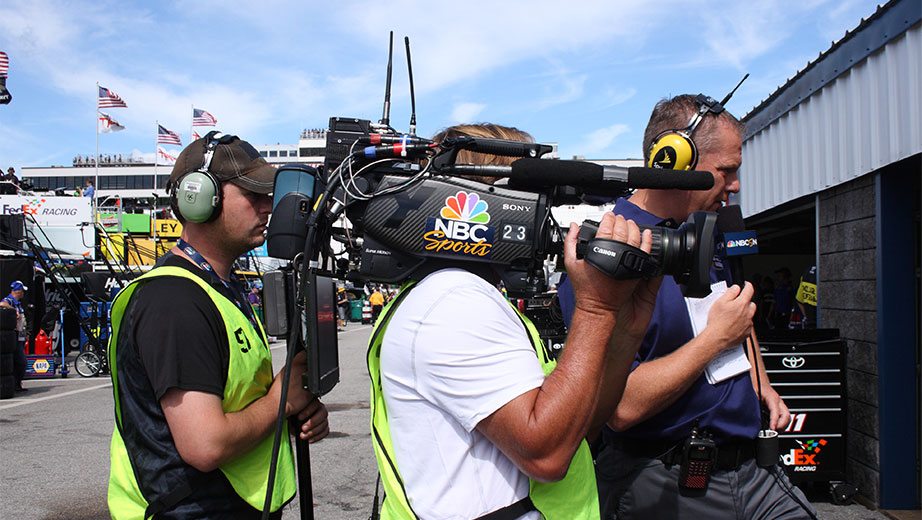
 
Marty Snider is among the NBC reporters who works the garage, looking for interviews.

The roar of the engines explodes as drivers mash their throttles near the start/finish line. In the booth, lead race announcer Rick Allen declares that the green flag is in the air. In NBC’s production truck, director Mike Wells yells, “Here we go, baby!”

Wells, a skinny man with straight brown hair that hangs to his collar, sits in the center of the first of two rows of seats. A bank of screens spreads to his right and left, reaching high above his head. He concentrates much of his attention on the two big ones directly in front of him. The one on his left shows what fans at home see. The screen on his right shows what they will see next. 

He calls out instructions to the assistant director seated to his right. “Ready camera 22,” he says, and the screen to the right shows camera 22. Watching both, Wells waits … waits … waits. Then he snaps his fingers, which signals the assistant director to make the scene captured by 22 appear on the screen on his left.

Soon Wells calls for another camera to be ready, waits, and snaps again. Over and over this happens. In one two-minute span early in the race, he snaps his fingers 17 times.

Wells snaps his fingers because directing requires precision, and the snap provides it. He has directed every sport, and racing is his favorite because it’s so complicated — and therefore challenging. “I still learn something every race,” he says.

Behnke and Marvin stand and/or sit to Wells’ left. Behnke is like the owner, Marvin the coach and Wells the quarterback. They work as a team. If Marvin wants someone in the booth or on pit road to tell a story, he asks Wells to call up the appropriate camera angle. Throughout the race, Marvin also orders pre-packaged stories to be shown. 

During live racing action, Behnke and Marvin trust Wells’ timing and judgment completely. The most common suggestion comes when Marvin says, “Ghost me when you can, Mikey.” That means Marvin wants Wells to display the “points as they run” graphic that runs down the left side of the screen, which is used increasingly as the cutoff approaches. 

Behnke and Marvin marvel out loud multiple times during the race at how Wells directs the race with precision equal to the most exacting driver executing a perfect lap. “The director’s job in any sport is to capture the moment,” Wells says, and he has captured so many he has an incredible sense of when one moment is about to end and the next to begin.

Wells has directed so many races he couldn’t count them if he tried. His first NASCAR Sprint Cup race was in the early 1980s for ESPN, and he has directed numerous other racing series as well.

Considering Wells has decided what images fans see over hundreds of races in the last 30-plus years, there aren’t many people who have done more to shape NASCAR storytelling than he has. He shrugs off that notion. “I’m just so fortunate to be able to have the opportunity to be able to bring it to the people,” he says.

Everyone in the production truck is a NASCAR fan now. Pit road producer Rene Hatlelid was probably the biggest before she started covering the sport. She sits directly behind Wells. It’s her job to sift through the stories the pit road reporters want to tell as well as assign others. She pitches the best ones to Marvin, who has the final say of what makes it on air.

Wearing a metal-studded bracelet on her right wrist, Hatlelid works the radio buttons in front of her like a concert pianist. She holds one and talks to Massaro, holds others and talks to Burns, Snyder, Stavast and more.


Sometimes she sits, sometimes she hovers over her seat, and when something really big is happening — which is often — she bursts up and stands. Pit stops start, and the production truck explodes in organized chaos. “I need the 3 first, and then the 78,” Hatlelid says. “3 first, then the 78,” she repeats, shouting now.

She appears to be talking to Marvin, Wells and the pit road reporters at the same time, telling them all the order she wants reports to be filed. Working live, the pit reporters tell their stories—about tire changes, chassis adjustments, the quality of the car so far—which last only a few seconds each.

Pit stops are frenetic, but at least they are (usually) predictable and come at (usually) expected times. But NASCAR on NBC often has to crank out unpredictable, unexpected stories on the fly, which is what makes working in live TV fun, exhilarating and exhausting. 

As a round of pit stops ends, NBC’s cameras catch Joey Logano’s car completing an entire lap with a jack wedged under his car. At the snap of a finger, Wells’ direction beams those images into TVs. He snaps again and the cameras follow Logano as he swerves back and forth, trying to dislodge it.

There is little time to laugh. Using an off-air radio, Allen asks Marvin if the fact Logano returned to his pit stall mean that will serve as his penalty for leaving pit road with equipment.

Marvin calls the NASCAR tower to ask NASCAR official Christy May that question directly. May says yes, returning to pit road to remove the jack covers Logano’s penalty. Marvin tells Allen, and soon Allen reports this on air. And another story, albeit one nobody in the production meeting this morning could have dreamed up, gets told.

RELATED: Why Logano’s jack stuck to his car

Guests in the booth are more of a staple in radio than TV. Listen to almost any NASCAR race on the radio and you’ll hear a few minutes of forced banter with the leading regional salesman from the Poughkeepsie office of whatever company bought the rights to tout its wares on that particular day.


The TV booth hosts guests relatively infrequently. But when your name is Dale Earnhardt Jr., space is always available. And so Junior joins the booth on this day, and the result is pure TV magic. The analysis he provides in the hour-plus he spends in the booth is widely lauded. 


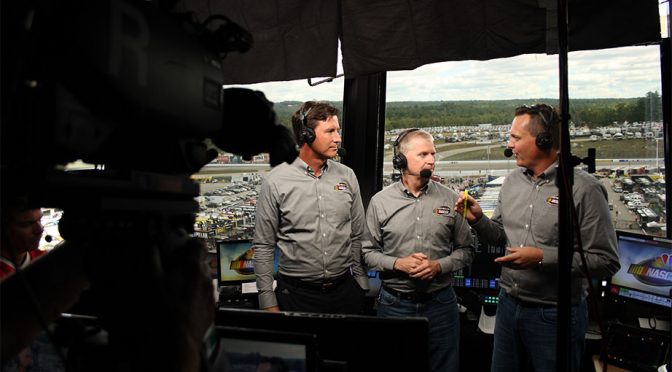
A couple of surprising things about the booth and the guys in it—former driver Jeff Burton, Letarte and Allen: The view of Alabama is beautiful. The view of the track is limited. The backstretch is so far away—roughly 3,000 feet—that it’s almost impossible to tell one car from the next. They watch the TV monitors at least as much as they watch the track.


Their collective sock game is strong; Letarte’s have what appear to be penguins on them. Allen’s voice is immediately recognizable, and then he introduces himself and he’s like 8 feet tall and distressingly handsome. He’s also friendly and a big fan of Nutter Butters.


Burton, Letarte and Allen drive the storytelling throughout not just the broadcast but the weekend. At the production meeting this morning, Letarte dominated the conversation. On Friday, Burton drove NBC’s Toyota on-track car around the track and recorded several stories that were used throughout the weekend, and it appeared they were largely his ideas.


Many of the stories that come up during the race are first proposed off the air by the guys in the booth. Allen’s questioning of the Logano situation is one example. Junior provided another when he said off the air that the lead car in the high line during a single-file run always gets debris on his grille. When that happened twice during the race, a pit reporter lobbed him a question about the topic. 


With 10 laps to go, it’s not yet clear who will qualify for the next round and who won’t. But seconds after the race ends, the pit reporters and the booth quickly tell a succession of stories. Hamlin is in, Austin Dillon is out on a tiebreaker, JGR’s passive strategy worked, and Kevin Harvick might have punched teammate Kurt Busch. That story remains half told. The video isn’t conclusive, Kurt Busch’s interview is as clear as mud, and Harvick’s contains no useful information.

RELATED: SHR teammates got physical post-race | Logano wins at Talladega

Oh, and there is one more tale to tell. It’s about a runaway jack, a bizarre race and a coveted checkered flag. “Win and you advance,” Allen says. “That’s what Joey Logano did today.”


The final story of the day is as simple, and complicated, as that. 
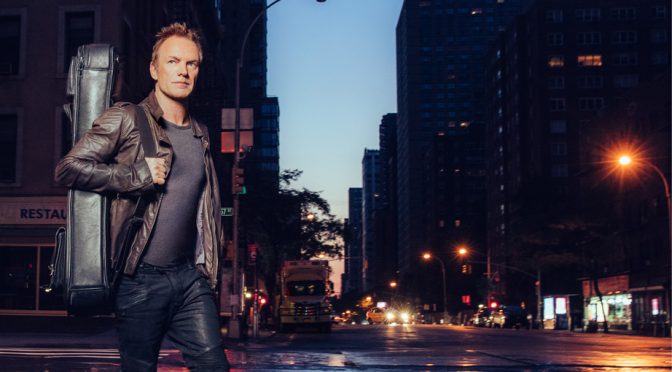
DAYTONA BEACH, Fla. — Grammy Award-winning artist Sting will perform at the NASCAR Sprint Cup Series Awards on Friday, Dec. 2, at Wynn Las Vegas. The finale of NASCAR Champion’s Week festivities, the annual awards show brings together some of the greatest names in sports and entertainment to celebrate the 2016 NASCAR Sprint Cup Series Champion, team owner and 16 Chase drivers.

Sting will headline the event, performing both a classic hit and a selection from his new album, 57th & 9th, released November 11 on A&M/Interscope Records. His 12th studio album and first rock/pop project in more than a decade, the 10-song collection represents a wide range of Sting’s musical and songwriting styles, including the raucous first single “I Can’t Stop Thinking About You,” the anthemic, “50,000” and the ferocious, Road Warrior style imagery of, “Petrol Head.” The latter is also the aptly named anthem of NASCAR’s latest video release designed to build anticipation for the final two races of the season and ultimately the crowning of a new champion.

NBCSN presents complete coverage from Wynn Las Vegas beginning at 7 p.m. ET with “NASCAR America,” followed by red carpet coverage at 8 p.m. ET and subsequent coverage of the 2016 NASCAR Sprint Cup Series Awards at 9 p.m. ET. Motor Racing Network and SiriusXM NASCAR Radio Channel 90 will carry the show live at 8 p.m. ET.

Sting released five studio albums as a member of The Police alongside Stewart Copeland and Andy Summers, earning six Grammy Awards, two Brits and induction into The Rock and Roll Hall of Fame in 2003. As one of the world’s most distinctive solo artists, he has earned an additional 10 Grammy Awards, two Brits, a Golden Globe, an Emmy, three Oscar nominations, a TONY nomination, Billboard Magazine’s Century Award, and MusiCares 2004 Person of the Year. Later this month, the American Music Awards will bestow him with their “Award of Merit.”

Sting joins a star-studded group of musicians who have previously performed at NASCAR’s championship celebration, including Andy Grammar, Sam Hunt, Lady Antebellum, Sara Bareilles, John Mellencamp, Aloe Blacc, and Kid Rock. Please visit ChampionsWeek.NASCAR.com to view the full NASCAR Sprint Cup Series Champion’s Week schedule.

Tune in to watch as the Chase drivers vie to make the Championship 4 in the Can-Am 500 at Phoenix International Raceway this Sunday, Nov. 13, at 2:30 p.m. ET on NBC, Motor Racing Network and SiriusXM NASCAR Radio. 

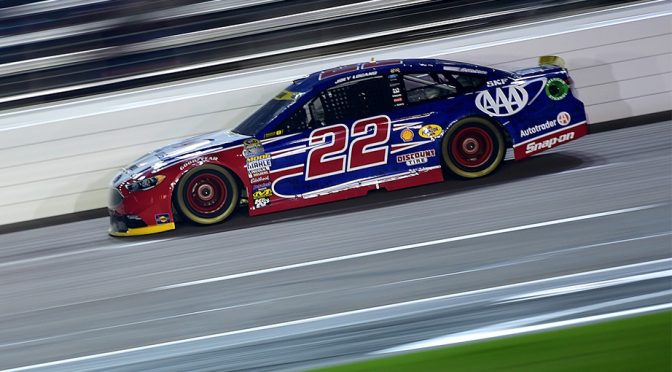
Todd Gordon, crew chief for NASCAR Sprint Cup Series driver Joey Logano, has been fined $10,000 for a lug nut infraction following the completion of Sunday night’s AAA Texas 500 at Texas Motor Speedway.
 
The No. 22 Team Penske group was one of several Sprint Cup Series teams to receive either penalties or warnings, according to the NASCAR penalty report issued Wednesday. Meanwhile, NASCAR XFINITY Series driver Brendan Gaughan‘s task of advancing to the title round of the series’ inaugural Chase suffered another setback with the loss of 10 championship driver and owner points for a body height violation at Texas, which the penalty report referred to as an “encumbered finish.”
 
Gaughan enters this weekend’s race at Phoenix International Raceway eighth in points among the eight Chase drivers still in title contention. The points loss leaves him now trailing fourth-place Blake Koch by 33 points. Only the top four advance to the Championship 4 to compete for the series title Nov. 19 at Homestead-Miami Speedway.
 
Shane Wilson, crew chief of the No. 62 Richard Childress Racing Chevrolet, was fined $10,000 for the violation.
 
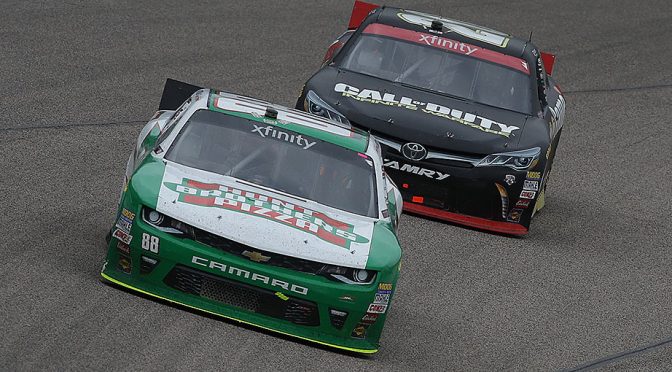
Gaughan’s team wasn’t the only one to lose 10 points for a violation at Texas. The No. 88 Chevrolet fielded by JR Motorsports, and driven at Texas by Sprint Cup Series regular Kevin Harvick, was also penalized 10 championship owner points and crew chief Dave Elenz was fined $10,000. The No. 88 team appealed its penalty today at the R&D Center, but was denied. The team can now appeal to the National Motorsports Final Appeals Officer.

Because the finishing positions are considered “encumbered,” they would not be factored into any potential tie-breaker scenarios.
 
No driver points were deducted because Harvick does not earn points in any series other than Sprint Cup. The No. 88 teams remains seventh in the owner points standings.
 
For Logano, his No. 22 Ford was found to have only 19 of 20 lug nuts secured following his runner-up finish to Carl Edwards (Joe Gibbs Racing) on Sunday. He is one of six drivers vying for a berth in the championship-determining Chase for the Sprint Cup.
 
Edwards and six-time series champion Jimmie Johnson (Hendrick Motorsports) have already secured berths in the Nov. 20 finale.
 
Gordon is the fourth crew chief to be fined $10,000 for a lug nut violation, joining Greg Ives (Hendrick Motorsports No. 88), Drew Blickensderfer (Richard Petty Motorsports No. 43) and Brian Pattie (Roush Fenway Racing No. 16).
 
Previous lug nut infractions carried a heftier fine and included suspension before NASCAR officials adjusted the penalty.
 
In addition to the penalty on the No. 22 team, 14 other teams received written warnings for failing laser or template inspection.
 
• Because their teams failed pre-qualifying template inspection three times, drivers Kevin Harvick, Tony Stewart, Edwards and Martin Truex Jr. will lose 15 minutes of practice time this week at Phoenix International Raceway.
 
• The teams of Trevor Bayne, Denny Hamlin, Kyle Busch, Matt Kenseth, Kurt Busch and Matt DiBenedetto received written warnings for failing template inspection twice during the pre-qualifying inspection process. Bayne and Hamlin served penalties at Texas for having four written warnings.
 
• Failing the laser inspection three times in pre-qualifying inspection will cost driver AJ Allmendinger 15 minutes of practice at Phoenix as well.
 
• Written warnings, with no loss of practice time, were given to the teams of Austin Dillon (LIS, pre-race and pre-qualifying), Greg Biffle (LIS, pre-qualifying) and David Ragan (LIS, pre-race).
 
• Additional XFINITY Series penalties from Texas were a $5,000 fine for crew chief Kevin Meendering (JR Motorsports) for a lug nut violation; and a 15-minute loss of practice time for the No. 18 Joe Gibbs Racing entry at Phoenix. Kyle Busch is scheduled to compete for the team this weekend.
 
Four other teams received written warnings for inspection issues with no loss of practice time.

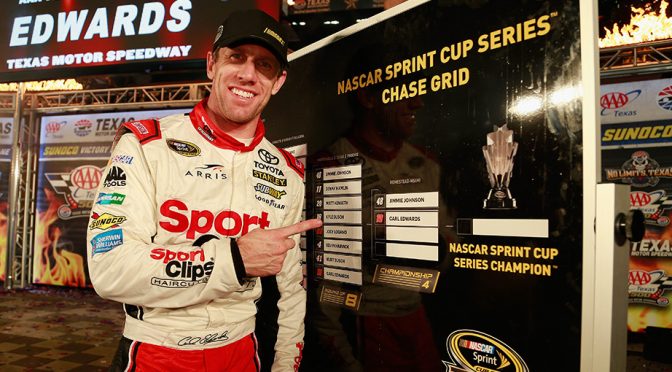
I’ll admit it. I didn’t necessarily pick Carl Edwards to be one of the Championship 4 drivers challenging for the NASCAR Sprint Cup Series trophy at Homestead-Miami Speedway on Nov. 20.

But now that Sunday’s Texas Motor Speedway race winner is officially in the mix, he can no longer be anyone’s “sleeper pick” for the sport’s biggest trophy.

Credit to Edwards for securing one of the four title race positions when other “sure-bets” might have given that first nod to his Joe Gibbs Racing teammate, defending Sprint Cup champion Kyle Busch or this year’s Daytona 500 winner, Denny Hamlin, or even former champ Matt Kenseth.

Edwards earned this.

And his demeanor from that of very hopeful long shot to confident contender transformed in one lengthy day in Texas. He entered the race ranked last among the eight Chase contenders, a whopping 32 points out, but finished the night celebrating in Victory Lane.

From body language to just plain language, Edwards seemed to morph before our very eyes in the minutes following his win.

He was not a driver content with the opportunity to contend, but someone who absolutely feels he could — and should — be hoisting the big hardware in two weeks.

“When we made it to this round, I was very certain, I felt very confident,” said Edwards, driver of the No. 19 Toyota. “We talked about it.  We felt like we could win at Martinsville. We could win Texas. We could win Phoenix.

“I know when the trouble happened at Martinsville, a lot of people probably thought, ‘That’s it for them.’ But we really did have a lot of confidence. That’s easy to say now because we won the race, but it’s the truth, we really did.

“It’s nice to be able to pull through, make that happen. Now we just got to dig in and do it again.”

Edwards is not the kind of guy for the competition to ever take lightly. And this shot at the title is significant on many levels.

He will quickly remind you that he tied Tony Stewart in the 2011 Cup championship point standings, losing out on the title to Smoke on a technicality. Stewart won the championship via tiebreaker with his five wins compared to Edwards’ one.

Last year, Edwards looked like he would earn a shot at redemption. But in the penultimate race at Phoenix, he got caught up in a bad position as the race was called for rain with 93 laps remaining. Edwards’ Toyota had been a top-five mainstay all day only to be caught 12th (after a green flag pit stop) when the race was declared over for rain. His title hopes drowned out, as well.

“One of the first things my dad told my about racing, ‘There’s a thousand ways to lose a race,'” Edwards said. “None of those thousand things can happen. You have to have everything go well.

“Those disappointments like Martinsville or Phoenix last year or 2011, that battle, that’s just part of the sport. That’s what makes victories and days like this and championships so special. You have to do everything right.”

Edwards, who has a pair of wins at Phoenix, redeemed himself already this year finishing runner-up to Kevin Harvick in a dramatic, door-slamming chase to the checkered there.

It’s what he expects this week and what he expects the following week in the championship big show at Homestead.

“I will not be relaxed,” Edwards said, allowing a smile.

“This is the part that I love,” he continued. “I mean, next week, we want to go win the race (at Phoenix). Really, starting right now, in Victory Lane, (crew chief) Dave (Rogers) was actually trying to shut me up. I started talking about Homestead already.

“Everything we do now will be geared to making sure that that Homestead weekend, we do it perfectly. So, yeah, I relish the opportunity to go focus for the next 14 days on trying to give a championship effort.”

Edwards’ track record at the 1.5-mile Miami track is worth noting.

He has a pair of victories (2008 and 2010) and finished in the top 10 for seven consecutive years from 2005 through his runner-up showing to Stewart in 2011.

And he returns there next week already smiling and feeling good about his chances.

“It’s so much fun, you guys,” Edwards said. “Just the idea of getting to race for a championship, getting that opportunity. 

“It’s not just going there like we did in 2011 to race against one guy in championship form. We’re going to go there and race against three guys, one of which is a sixtime champion, top of his game. I know whoever else in there is going to be tough as nails.

“It’s cool. If we’re able to win that, stand here 14 days from now with that championship trophy, we’re going to have earned it. And that’s as good as it gets.”

RELATED: Series standings | Chase grid | Texas penalties


A three-member panel upheld a P2-grade penalty to the JR Motorsports No. 88 team in the NASCAR XFINITY Series at the conclusion of an expedited appeals hearing Wednesday.


Kevin Harvick drove the No. 88 Chevrolet to a third-place finish last weekend at Texas Motor Speedway, but the JRM entry did not meet the proper height requirement in the rear during a post-race inspection, a violation of Sections 12.1; 20.17.3.2.2 in the 2016 NASCAR Rule Book.


The team — with Rick Hendrick the car owner of record for the Dale Earnhardt Jr.-owned organization — was docked 10 points in the XFINITY team owner standings. Crew chief David Elinz was fined $10,000.


The penalties were affirmed Wednesday by the National Motorsports Appeals Panel. The team had the option of a final appeal to Bryan Moss, the National Motorsports Final Appeals Officer, but it declined.


The panel members who heard Wednesday’s appeal were: Dale Pinilis, longtime operator of NASCAR-affiliated Bowman Gray Stadium; former premier series driver Lake Speed; and Kevin Whitaker, owner of Greenville-Pickens Speedway, another historic weekly NASCAR track.