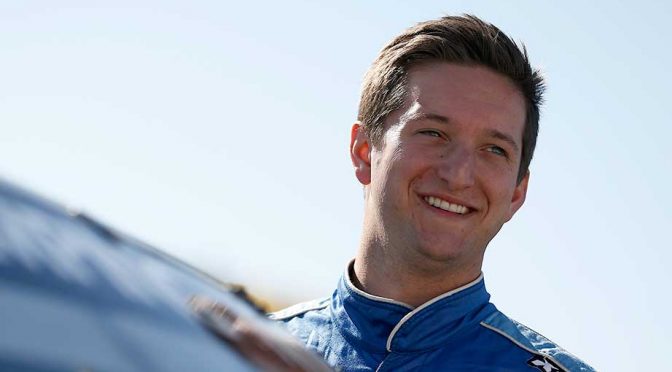
COLUMBIA, S.C. (Wednesday, Jan. 27) — The Columbia Metropolitan CVB and the Columbia Regional Sports Council are pleased to announce a partnership with Bolen Motorsports and Jordan Anderson, a NASCAR Camping World Truck Series driver and Columbia, SC native. Anderson finished 19th in points last year in his first year within the Camping World Truck Series.


The announcement was made on Wednesday, Jan. 27 at the NASCAR Hall of Fame in Charlotte, NC.


Anderson’s approach to his career reflects the culture and hallmark traits of his hometown. Like Columbia, SC, Anderson has shown a tremendous amount of grit and determination to get to where he is today.


“Growing up as a kid in Columbia, my dream was to always compete in the upper ranks of NASCAR,” says Anderson. “From turning my first laps in a Go-Kart around my elementary school to working on my Dirt Late Model in my parents backyard — the reason I’ve had the opportunities to progress through the ranks from the dirt tracks to Daytona is thanks to the support of the people in Columbia and the everyday life lessons learned there.”


Unlike most racing teams who have a robust crew, Anderson’s team was made up of himself, a crew chief and one other person in 2015. He has procured his own sponsorships, managed his own public relations, worked on his truck and hauled it to and from races each week.


Last season saw no shortage of obstacles to overcome, from his trailer breaking down en route to Chicagoland Speedway to a last-minute opportunity to race in Canada which meant an expedited passport via Atlanta, a 17-hour solo drive to Canada and a lengthy delay at the border with customs. Nothing came easy for Anderson in 2015, but the hard work and personal perseverance made the season all the more rewarding.


“His story, coupled with his professional demeanor and Columbia being his hometown, really made us stop and consider the possibility of a partnership,” says Bill Ellen, president and CEO of the Midlands Authority for Conventions, Sports & Tourism, the umbrella organization for the CVB and Sports Council. “The more we talked with him and the more we came to understand the loyalty of his fans, the more we wanted to link forces.”


Kelly Barbrey, VP of sales and marketing for the Authority, agrees. “Jordan has an impressive number of engaged social media followers across the country. His fans, along with the NASCAR Camping World Truck Series fan base, overlap with our geographical target market. Partnering with Jordan and Bolen Motorsports allows us to capture a diverse and niche market of racing enthusiasts while championing our homegrown talent at the same time,” says Barbrey. “The truck and team’s racing suits will prominently feature our brand. He’s truly a moving billboard that intersects several of our key markets.”


Jordan’s determination garnered team owner Jeff Bolen’s attention several years ago. They had a common passion for the sport and both were raised in Columbia, a city that holds a special place in NASCAR history.


“We knew from the beginning that we had an opportunity to grow Columbia’s NASCAR legacy with Jordan,” says Bolen.


Their passion for Columbia happened to align perfectly with the CVB and Sports Council’s goals.


“The fact that we both call Columbia our hometown creates the perfect opportunity to promote the city and culture that we love. It is very humbling to have the support of the CVB and Sports Council,” remarks Bolen. “It allows all of us the ability to embark on a truly authentic and genuine partnership.”


Anderson agrees, “We want to help continue fostering the growth and development of local business in Columbia while giving residents and visitors an emotional connection to a sport that has such deep roots within the city.”


In addition, Ellen and Barbrey see several opportunities to collaborate with Bolen Motorsports and Anderson to help increase convention and sporting event business in Columbia.


“This is an industry based on relationships. People plan meetings and conventions with destination representatives that they know and trust. Many of our target planners live and work in the same geographic area as our leisure visitor, which happens to overlap with NASCAR country,” states Ellen.


“Entertaining potential and existing clients is a key component of our sales strategy. Now we’re able to do that at the track, giving the clients a new and memorable experience. Not to mention, the duration of the race gives us the time to have longer, more meaningful conversations than we would at say, an industry tradeshow.”


“This is more than a traditional sales and marketing campaign,” adds Barbrey. “You couldn’t dream up a more perfect fit between Jordan and our organization. Columbia is flourishing. New restaurants and shops are opening every month in districts throughout the region. This didn’t just happen. It was the result of coordinated and purposeful efforts by both the private and public sector. And, frankly, a lot of perseverance and hard work. That is Jordan’s career, too. He is smart, well-spoken and very business-savvy. He makes thoughtful, intentional decisions in both his sponsorship procurement and racing strategies. But make no mistake, he has the grit and tenacity to overcome hardships and achieve great success, which mirrors his hometown perfectly. We couldn’t be more proud to be a part of this with him.”
RELATED: See the rings, jackets for the Class of 2016

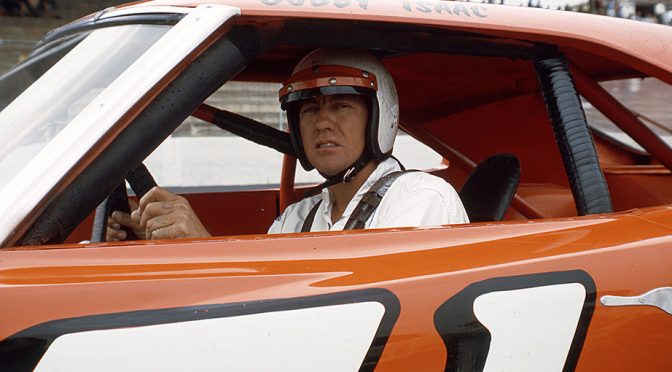
Of the five newest members inducted into the NASCAR Hall of Fame, the career of the late Bobby Isaac was perhaps the most unusual.
 
Isaac was inducted Saturday, along with fellow drivers Terry Labonte, Jerry Cook, Curtis Turner and track owner Bruton Smith.
 
Isaac, who died in 1977 after suffering a heart attack, won the NASCAR premier series championship in 1970, driving for team owner Nord Krauskopf and with the help of noted crew chief Harry Hyde.
 
It was a perfect combination of talent and ingenuity — the team won 31 races during a three-year span from 1968-70.
 
Isaac wound up with 37 victories in a career that spanned just 15 years at the top level. He won 49 poles, a mark that today remains 10th best for the series.

WATCH THE SPEECHES: Isaac’s family | Jerry Cook | Curtis Turner’s daughter | Bruton Smith | Labonte’s speech

According to reports, he also abruptly quit racing for a time when, in the middle of an event, he heard a voice tell him to get out of the car.
 
It’s an often-told story, particularly when NASCAR’s top series prepares to head to Talladega Superspeedway, site of Isaac’s early departure.
 
“Well, obviously I wasn’t there with him in the car when that happened,” Patsy Isaac, who was married to the driver at the time, said Saturday following his induction into the NASCAR Hall of Fame. “But I will tell you that as soon as he got out of the car and was able to get to a telephone, because we didn’t have cell phones then, he called me and he repeated to me exactly what happened to him in the car.
 
“And he said, a voice told him that he needed to get out of the car, and so he radioed to (owner) Bud Moore. He said, ‘find somebody to fill in the car. I’ve got to get out.'”
 
The race was the Talladega 500, the 20th stop of the ’73 season and the second of two annual races at the 2.66-mile superspeedway. Isaac was three years removed from his championship, and had been hired to drive owner Moore’s No. 15 Ford. He had finished second to Richard Petty in that year’s Daytona 500, and placed in the top 10 in five other races.
 
The race seemed cursed from the outset — fellow Catawba County native Larry Smith was killed when his Mercury struck the wall barely 15 laps into the event.
 
With the race nearly halfway complete, Isaac pulled into the pits during a caution period and unexpectedly climbed out of the car. Coo Coo Marlin, father of two-time Daytona 500 winner Sterling Marlin, relieved Isaac and eventually finished 13th.
 
Dick Brooks won the race. It was the only premier series victory of Brooks’ career.
 
“I don’t know what that experience was,” Patsy Isaac said of her husband’s incident. “I don’t know if he felt it, it was an intuition or if it was actually a verbal voice. I don’t know that, but I know that it impacted him enough that he was not going to stay in the race car.”
 
What she does know, though, is what she told Isaac when he called.
 
“I said, ‘come home.’ That was fine with me,” she said.
 
“He had always said that it was not because someone had gotten killed earlier in the race, and that person was from Catawba County, and he knew them. That’s all I can tell you is what he told me.”
 
Isaac attempted to resume his racing career the following year although he made just 19 premier series starts during the next three seasons.
 
Eventually, he turned his attention to the local short tracks where he had begun his racing career. On August 13, 1977, he was competing in a Late Model Sportsman event at Hickory Speedway when he pulled into the pits, climbed from his car and collapsed.
 
Transported to a local hospital, Isaac, 45, died the following morning.

NASCAR officials don’t expect any changes in the way restart zones are policed this season, saying that they felt comfortable with the process that was put into place during the latter portion of 2015.

It will, however, be the first use of the new larger zones for the majority of the facilities.

Fourteen tracks hosting NASCAR Sprint Cup Series races this season are expected to have the larger restart zones in place for the first time, including Daytona International Speedway, site of the season-opening Daytona 500 scheduled for Feb. 21.

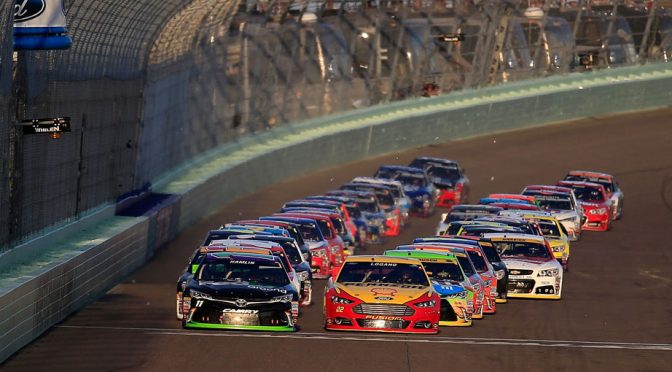
Restart zones are located prior to the start/finish line and indicate where the race leader, or control car, is allowed to accelerate when the race is either beginning or coming out of a caution period.

Officials lengthened the zones last season at several tracks following complaints and concerns from competitors about the “gamesmanship” being played in the areas.

By extending the zone, the race leader enjoyed a larger window of opportunity to control the start or restart of the race and lessened the likelihood of another driver gaining an advantage.

Beginning with the opening race of last year’s Chase for the NASCAR Sprint Cup at Chicagoland Speedway, NASCAR stationed an official inside the track near the zone, and added a high definition camera to provide evidence should a start or restart be called into question.

Two weeks after that move, officials announced that restart zone areas would be expanded for the remaining Chase events, beginning at Dover International Speedway where the restart zone at the 1-mile facility was increased from 70 feet to 140 feet.

“The cameras that we did employ there (in the restart zones), those were monitored in the PRO System as well as up in the tower,” Sprint Cup Series Managing Director Richard Buck said. “We were pretty pleased towards the last part of the year with the (changes). In checking with the drivers, they felt it got to the point where it was a level playing field for everybody.”

The rules concerning starts and restarts were not impacted by the changes. The race leader, or control car, still must maintain caution car speed and cannot exceed that speed before passing the double red lines that mark the beginning of the restart zone.

If the leader has not accelerated by the time he or she reaches the single red line, designating the end of the zone, the starter in the flagstand will start the race.

A driver other than the race leader can be the first to the start/finish line, as long as the initial pass did not occur within the restart zone.

The majority of the areas that were expanded last season were extended from the original area forward, toward the start/finish line. Buck said the only track to expand the zone back toward the fourth turn was Phoenix.

“If we had moved it (toward the start/finish line) at Phoenix, the drivers almost wouldn’t be able to look out of the race car to see the green flag (wave),” Buck said.

“We’ll physically go take a look at the race track, take a look at the logistics and see what makes sense. The majority of them, (extending) toward the start/finish line, doubling it, worked out very well so I expect that’s what you’ll see.”

RELATED: Barney Hall passes away at age 83 | Hall honored prior to final race

Legendary NASCAR broadcaster Barney Hall passed away Tuesday at the age of 83 from complications after a recent medical operation. Hall was known as “The Voice of NASCAR” and was a fixture for Motor Racing Network’s coverage of the sport.

His unique brand of storytelling earned Hall a place in the NASCAR Hall of Fame in 2012, when the shrine created the annual Squier-Hall Award for NASCAR Media Excellence, honoring Hall alongside legendary TV broadcaster Ken Squier.

MORE: The story behind the Squier-Hall Award | Squier, Hall recognized for media excellence

Shortly after news of Hall’s passing surfaced, drivers such as Dale Earnhardt Jr., Brad Keselowski, Chase Elliott and many more took to Twitter to pay tribute.

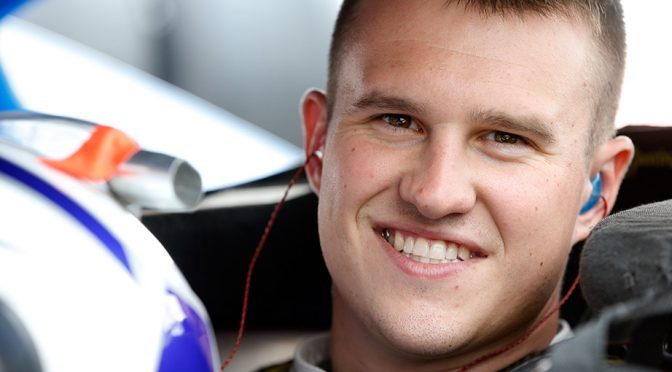
JD Motorsports announced its plans for a three-car effort in the NASCAR XFINITY Series this season, bringing Modified standout Ryan Preece into the fold to join Ross Chastain on its full-time driver roster.


Preece, a NASCAR Next alum who has finished either first or second in the Whelen Modified Tour standings the last four years, will take over the No. 01 Chevrolet. Preece, 25, has three career XFINITY starts and five Sprint Cup Series appearances. Landon Cassill was the primary driver of the No. 01 last year.


Chastain, 23, returns to the JD Motorsports No. 4 Chevrolet for his second XFINITY season. In his rookie campaign last year, Chastain wound up 15th in the driver standings with four top-10 finishes.


Eric McClure will take the wheel of the third JDM entry — the No. 0 Chevrolet — for the season-opening PowerShares QQQ 300 (3:30 p.m. ET, FS1, MRN/SiriusXM) at Daytona International Speedway with sponsorship from longtime backer Reynolds Wrap. McClure, 37, drove for team owner Johnny Davis in his first full XFINITY season in 2007.


According to a release provided by the team, the team is seeking driver/sponsor combinations for the No. 0 car beyond Daytona. Harrison Rhodes was the team’s primary driver of the No. 0 last season.


“Everything is lining up well,” Davis said in the team release. “We expect to have three strong teams when we get things started next month in Daytona. We should be astronomically better than last year. We’re better prepared, and we have more resources.”


The team also announced its crew chief lineup for 2016. Bryan Berry will work with Chastain, Zach McGowan will pair with Preece, and Todd Myers will call the shots for McClure and the remaining drivers in the No. 0.

First, let’s get something straight. Yes, we know that taking the new 2016 postseason format and applying it to the 2015 NASCAR XFINITY Series results to show who would have been the champion last year in an elimination format isn’t scientific. Obviously, drivers — namely Chris Buescher, who had a large points lead late in the season — would have raced differently.
 
We get it. This isn’t exact. It is, however, fun.
 
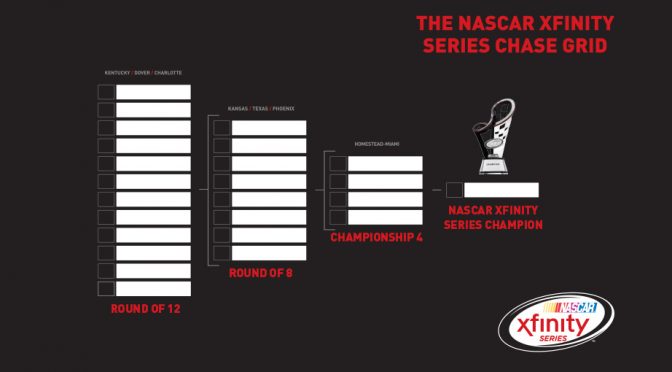
Starting in 2016 the NASCAR XFINITY Series Chase will send 12 drivers into a seven-race postseason, and the field will get whittled from 12 to eight and then eight to four for the season finale at Homestead.
 
If you need a refresher on the rules, go here.
 
For the purpose of this exercise, we did not take into consideration the Dash 4 Cash winners getting a Chase berth, because there weren’t heat races last year, and that’s a game-changer.
 
So, who would have won the championship last year if the new format was in place? So glad you asked.


RELATED: How Truck Series title would have been | Who benefits?

THE FIELD
 
Four drivers would have clinched berths with victories in the 26 regular-season races — Ryan Reed (Daytona-1), Chris Buescher (Iowa-1, Dover-1), Regan Smith (Mid-Ohio) and Chase Elliott (Richmond-2).
 
Eight drivers would have clinched their berths by virtue of points: Ty Dillon, Elliott Sadler, Darrell Wallace Jr., Daniel Suarez, Brian Scott, Brendan Gaughan, Jeremy Clements and Ross Chastain. Chastain would have earned the 12th and final spot by two points over J.J. Yeley. Ryan Blaney, who ran for XFINITY points in 2015, would not be eligible for the postseason despite his win (Iowa-2) since he did not attempt to qualify for all the races.
 
The points heading into the first postseason race at Kentucky would have looked like this:

Initial postseason standings

Rank Driver Points
1 Chris Buescher 2,006
t-2. Chase Elliott 2,003
t-2. Regan Smith 2,003
t-2. Ryan Reed 2,003
t-5. Ty Dillon 2,000
t-5. Elliott Sadler 2,000
t-5. Darrell Wallace Jr. 2,000
t-5. Daniel Suarez 2,000
t-5. Brian Scott 2,000
t-5. Brendan Gaughan 2,000
t-5. Jeremy Clements 2,000
t-5. Ross Chastain 2,000

ROUND OF 12

The four drivers eliminated after the opening three races (Kentucky, Dover, Charlotte) would have been Brian Scott, Ryan Reed, Jeremy Clements and Ross Chastain.
 
Regan Smith‘s win at Dover would’ve automatically clinched a spot in the Round of 8.
 
Gaughan would have finished in eighth place, finishing the round 10 points ahead of Reed for the final transfer spot.
 
ROUND OF 8

The four drivers eliminated after the round’s three races (Kansas, Texas, Phoenix) would have been Chris Buescher (real 2015 champion), Elliott Sadler, Darrell Wallace Jr. and Brendan Gaughan.
 
Ty Dillon would have finished the round with the most points. Chase Elliott would have been the final driver to advance to the championship race at Homestead.
 
CHAMPIONSHIP ROUND

With a title field of Ty Dillon, Chase Elliott, Regan Smith and Daniel Suarez, Suarez finished in sixth-place at Homestead-Miami Speedway.
 
That was the highest finish among the championship-eligible drivers, so Daniel Suarez would have been the 2015 NASCAR XFINITY Series champion.

RELATED: NASCAR reveals race start times for 2016 season


PRINTABLE SCHEDULES: Cup | NXS | NCWTS


NASCAR released the start times and TV/radio schedule for the 2016 season in all three national series on Tuesday, the culmination of a large-scale cooperative effort between the sanctioning body and its broadcast partners.
 
The release comes with relatively few alterations from 2015. The NASCAR Sprint Cup and XFINITY Series schedules remain split between FOX and its family of networks from February through June, with NBC and its affiliates taking over from July to season’s end. The Camping World Truck Series will be broadcast almost exclusively on FOX Sports 1, with the annual race at Talladega Superspeedway again airing on FOX.
 
The broadcast schedule deviates in August because of NBC’s coverage of the Summer Olympics in Rio de Janeiro. Watkins Glen’s Sprint Cup race Aug. 7 is set to shift to USA Network, with the previous day’s XFINITY event moving to CNBC. Two other XFINITY races (Mid-Ohio, Bristol) will also transfer to USA Network.
 
Among the other highlights:
 
— The season-opening Daytona 500 (Feb. 21, 1 p.m. ET, FOX, MRN, SiriusXM) keeps the same start time as last year for The Great American Race.
 
— The season-ending Ford Ecoboost 400 Sprint Cup finale on Nov. 20 will move its start time up a half-hour to 2:30 p.m. ET. The 300-mile XFINITY finale the previous day will start 45 minutes later, at 3:30 p.m. ET.
 
Richmond International Raceway will switch to a daytime event for its April 23-24 race weekend. The Saturday XFINITY event will start at 12:30 p.m. ET, and the Sunday Sprint Cup race will start at 1 p.m. ET.
 
— The Oct. 1 race for the Camping World Truck Series at Las Vegas Motor Speedway moves up 90 minutes from last year to 8:30 p.m. ET.
 
Atlanta Motor Speedway has rearranged the start times for its Feb. 27 XFINITY/Truck doubleheader. The XFINITY race is scheduled to start at 1:30 p.m. ET, a half-hour earlier than 2015. The Camping World Truck Series event at the 1.54-mile track will follow at 4:30 p.m. ET, an hour earlier than last year’s start.

RELATED: See full slate of schedule times for 2016 season

RELATED: NASCAR community reacts to Barney Hall’s passing

Barney Hall, whose soothing voice delivered stock-car racing broadcasts over radio airwaves for 54 years, died Tuesday from complications after a recent medical operation. He was 83.

Hall was a fixture with Motor Racing Network (MRN) since its inception in 1970. His longevity and connection to racing fans with his unique brand of storytelling earned Hall a place in the NASCAR Hall of Fame in 2012, when the shrine created the annual Squier-Hall Award for NASCAR Media Excellence, honoring Hall alongside legendary TV broadcaster Ken Squier.

MORE: The story behind the Squier-Hall Award | Squier, Hall recognized

 
“I learned a long time ago, listen to the fans,” Hall told NASCAR.com in the days before his final broadcast in 2014. “If you do what makes them happy, you’re pretty much OK. If not, ain’t nobody happy.”
 
NASCAR Chairman and CEO Brian France said of Hall following news of his passing: “The entire NASCAR family extends its condolences to the family, friends and fans of Barney Hall, a NASCAR broadcasting giant for more than 50 years. Barney’s impeccable delivery and incredible storytelling skills left an indelible mark on the sport that he so clearly loved. His legacy remains through an honor that rightly carries his name — the Squier-Hall Award for NASCAR Media Excellence. It will remain a constant reminder of the skill and passion that Barney brought to his work.”

Seven-time NASCAR champion Richard Petty said this about Hall: “He defined calling the races over the radio and he was the best at what he did in his field for a long, long time. He was there loudly during some of our greatest times and there silently during others. He was our voice and our friend. He will be missed.
 
“Our thoughts and prayers are with Barney and his family at this time.” 

Hall’s radio career began during his four years of active duty in the United States Navy. After his military service, he returned to his hometown of Elkin, North Carolina, as a disc jockey for local station WIFM.

RELATED: Barney Hall through the years

 
Hall transitioned to calling on-track action, joining his first broadcast of the Daytona 500 in 1960 and was the first public address announcer at Bristol Motor Speedway when it opened one year later.
 
Hall began his career with MRN as a reporter calling the action from the turns. As NASCAR grew from a regional sport to having a wider national reach, Hall moved to the booth and his recognizable voice resonated with a larger audience.
 
“Whether you met him or not, you felt like you knew him,” said Winston Kelley, executive director of the NASCAR Hall of Fame and a colleague of Hall’s at MRN. “His easy, conversational delivery made you feel like you were listening to one of your closest friends or relatives tell you a story — the story of the very NASCAR race he was describing. He could paint a picture that would make Picasso or Rembrandt proud and tell a story that would awe Hemingway or Twain.
 
“He was not just a trusted voice to listeners and race fans, he became what many believe is the most trusted journalist in NASCAR by the sport’s competitors for decades.”
 
Hall made his final broadcast in July 2014 at Daytona International Speedway, calling Aric Almirola‘s first NASCAR Sprint Cup Series victory in the track’s rain-shortened summer race. He received a standing ovation in the pre-race drivers’ and crew chiefs’ meeting.
 
“To have been in this stuff for 54 years, I’ve gotten to know everybody at one time or another,” said Hall, who received the Bill France Award of Excellence in 2007. “It’s a pretty good feeling to go in that garage and hear somebody at some point go, ‘Hey, Barney Hall, how you doing?’ That makes you feel good. It really, really does.”
 
Hall is survived by his companion of 35 years, Karen Carrier, who was by Hall’s side as he passed away.

Editor’s note: This story was published in 2016.


TULSA, Okla. — Justin Allgaier drove his race car to his hauler after being eliminated at the Chili Bowl one Saturday years ago and was met by his questioning father. His dad wanted to know what had happened out on the race track. Justin had driven a conservative race, never challenging for position, and allowing, it appeared, other cars to pass him without putting up much of a fight. He had missed transferring to the next race by one spot. With even a little bit of aggression, Justin would have certainly finished higher and gone on to the next race. What, his dad wanted to know, had happened?

Still in the cockpit, Justin explained to his dad that the steering was out. To prove it, he spun the wheel. The tires stayed locked, pointed straight ahead. His dad was baffled then, and he remains so today. The question changed from why had Justin driven such a timid race to how had he driven at all?

The Allgaiers set up their midget car to drive in a circle if he holds the wheel straight. They hang the body closer to the left-side tires and use smaller tires on the left than on the right — a configuration for the Chili Bowl’s quarter-mile banked track.

In the 10-lap race, Allgaier was involved in an accident on the first lap. As he pulled away from the wreck, he realized the steering was broken. He also discovered that if he feathered the brake and the throttle just right, he could circumnavigate the track anyway.

For the final nine laps, Allgaier did exactly that. He didn’t do well, not by a long shot. But he did well enough that his dad did not know he had no steering until he said so. All of which leaves still one more question — why did Allgaier stay in a race in which the steering didn’t work?

“Because it’s the Chili Bowl,” Allgaier said.

• • •

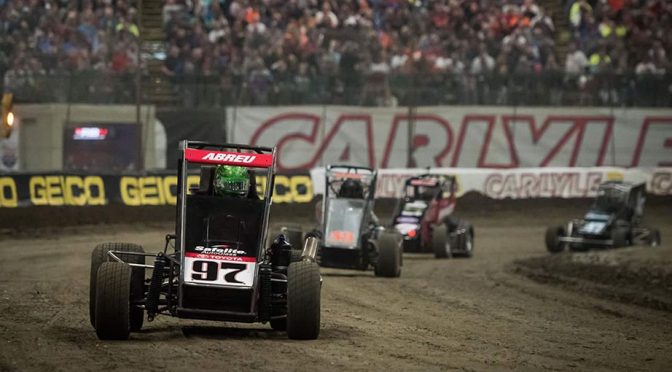
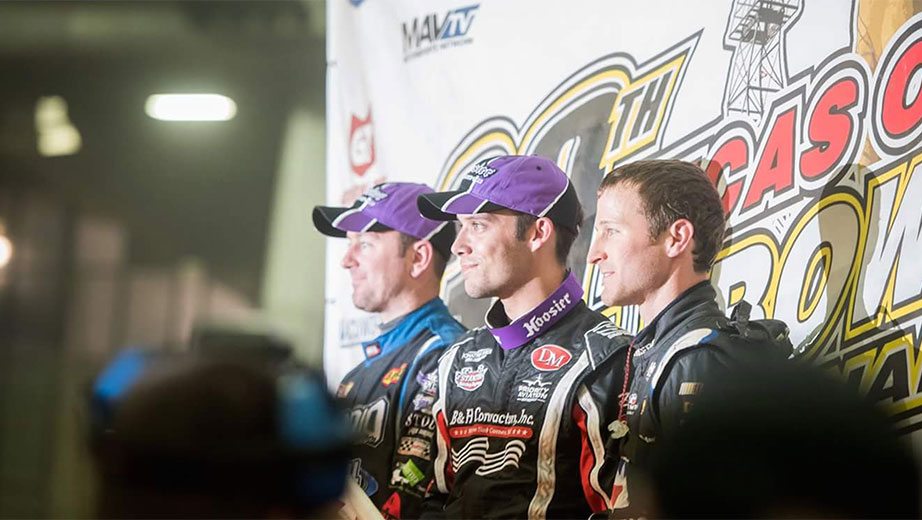
Ah, the Chili Bowl, a mud-spitting, temper-raising, white-knuckled thrill ride, a weeklong racing extravaganza unlike anything else in the motorsports world, an event so chock full of Americana weirdness from the green flag to the checkered flag that people who have been attending and racing in it for years struggle to conjure the words necessary to describe it. “You can’t even explain it to someone who has never been here,” said Rico Abreu, who has won the event two years in a row. “It’s something the naked eye has to see.”

With races at night (as God intended), on dirt (same) and indoors (not so much), the Chili Bowl is the Super Bowl, Lollapalooza, a carnival and a frat party all held at once inside a jet engine that spits out a fine mist of Oklahoma mud.

The Chili Bowl is simultaneously the best-kept secret in racing while having thousands of rabid fans and hundreds of drivers who swear they will never miss the annual pilgrimage to Tulsa. Allgaier and Abreu were among at least seven full-time drivers from NASCAR’s top three series to race in this year’s Chili Bowl. I attended the event intent on finding out why so many NASCAR drivers would travel to Tulsa, Oklahoma, in the middle of January to race indoors on a dirt track for a paycheck that would not cover the cost of the trip.

I came away wondering why so few NASCAR drivers were there.

• • •

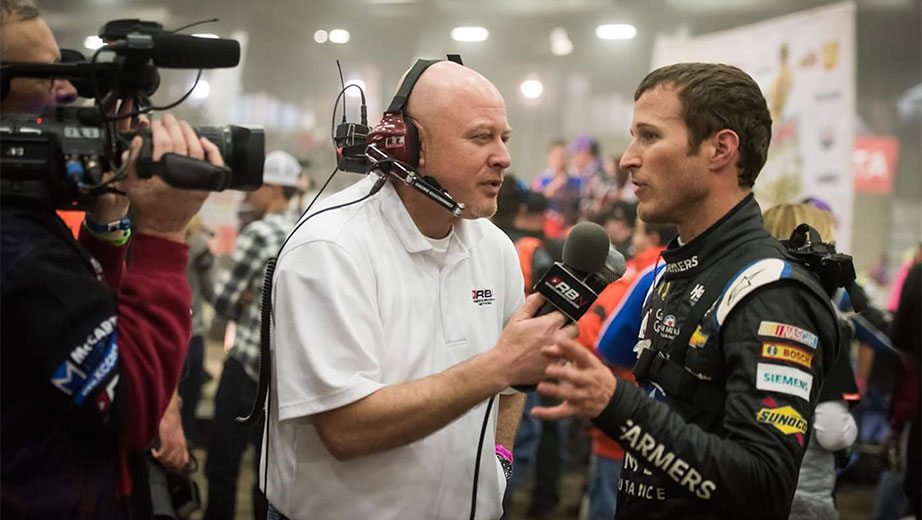
When Kasey Kahne was 12, he was a huge dirt racing fan who was trying, with no success, to talk his parents into letting him race. He fared better talking them into taking him to races. After a year of Kahne’s pleading, his dad relented and took him to the Chili Bowl in 1994. “It was the best vacation you could have as a 12-year-old who wanted to race,” Kahne said.

Kahne’s strongest memories are of walking around the pit area staring at the cars. He was too shy to talk to any of the drivers, but he imagined himself climbing into one of their cars and wheeling it around the track. He cheered as Andy Hillenburg, one of his favorite drivers, won. Hillenburg took the checkered flag after a thrilling three-wide battle that remains one of the event’s iconic moments, in part because Hillenburg is from nearby Broken Arrow, Oklahoma, and in part because the track is really not wide enough to accommodate three-wide racing.

As Kahne told this story at this year’s Chili Bowl (Jan. 12-16), he looked around the 448,400-square foot Tulsa Expo Center. Dozens of kids, with the same looks on their faces Kahne described having in 1994, wandered from car to car. Fifty feet to Kahne’s right stood the grandstands, and beyond that the race track. To his left was the garage area, which looks like a NASCAR garage area, only smaller and indoors.

Also, there was a bulldog wearing a tutu and a ribbon in her hair and posing for pictures.

Among the many reasons NASCAR drivers return to the Chili Bowl year after year is a yearning for the simpler racing days of their youth. That’s particularly true of Tony Stewart , who loves the Chili Bowl like a kindergarten teacher loves children. A two-time winner of the event, Stewart has spent the last two years working track maintenance. And while that role landed him in controversy this year, his love for the event has not waned.

Don’t mistake the fondness for days gone by for indifference about modern-day Chili Bowl results. The drivers have neither moved on from the event nor outgrown it. This year’s Chili Bowl featured a record 335 drivers from 34 states and five countries. And they all wanted to win the “the Golden Driller,” the trophy modeled after the 76-foot tall, 43,500-pound statue of an oil man that stands outside the Expo Center.

J.J. Yeley has competed in 21 of the 30 Chili Bowls and attended seven more as a fan. He holds the record for passes in a single day and has finished second, third, fifth and ninth but never first. “Getting close is one of those things that keeps you coming back,” he said. “Having a bad week, like I’m having now, is one of those things that keeps you coming back.”

Asked if he’d rather win a Sprint Cup race or a Golden Driller, Allgaier paused for a long time and finally said they were equally difficult to win. Stewart said in a pre-race press conference that winning the Chili Bowl was bigger than winning the IndyCar championship. Abreu, who will drive full-time for ThorSport Racing this season in the NASCAR Camping World Truck Series, said that until he wins either the Daytona 500 or the Indianapolis 500, his two Chili Bowl wins will be the biggest of his career.

Kasey Kahne on the Chili Bowl: “It was the best vacation you could have as a 12-year-old.”  (Photo: Dylan Duvall)

On Saturday, Allgaier spent several minutes affixing a GoPro camera to his car. He loves racing video and wanted to get his just right, so he moved the camera around until he found the perfect vantage point. When he finally found an angle he liked — from up and to the right of where his head would be — he accidentally dropped the camera into his cockpit. It landed near his foot pedals. To retrieve it, he crawled headfirst through the opening at the top of his car.

His feet shot out of the top as he reached toward the brake and gas. Considering Allgaier once drove the car with no steering, I half-wondered if he was practicing for his next trick. A fan watching this unlikely scene apparently thought the same thing. Channeling what he would be thinking if he were Allgaier, the man said, “Hold my beer: Watch this.”

Allgaier couldn’t hear that, but he would have been proud to become part of the spectacle because the spectacle is part of what he loves about the Chili Bowl. “You can start at 7 in the morning, and end at 6 in the morning, and still not see everything there is to see,” he said.

As if on cue, a man wearing a red and green checkered suit, with Christmas trees in the checkers, walked by. He looked ridiculous, which is to say, he fit right in.

“Why would you wear that?” I asked.

“Why wouldn’t you wear that?” Allgaier answered.

Allgaier favors racing shirts. He estimates he has owned 100 different Chili Bowl driver T-shirts over the years and wore an Abreu shirt earlier in the week.

A few haulers down from Allgaier, a boy sat in the back of a racing trailer on Thursday and played with a fishing pole. At the end of his line he affixed a $100 bill. He cast it into the walkway and let it sit there. Every minute or two, somebody bent over to try to pick it up, at which point the boy yanked it away.

A previous fisherman apparently landed the big one: “I may have (fallen for it) the first time I saw it,” Kahne said with a smile. “It’s pretty funny to watch throughout an afternoon when people are doing that.”

I heard a story about a driver who kept a prosthetic arm in his car and threw it out when he needed a caution (that was years ago). I heard about drivers’ girlfriends getting in a bar fight (that was this year). I watched as a NASCAR driver’s wife and a former NASCAR-driver-turned-team-owner shouted f-bombs at each other (that was Wednesday.)

Three men walked around together posing for pictures. One was dressed as the Stay Puft marshmallow man from the movie “Ghostbusters.” Another was dressed as a Ghostbuster. The third was dressed as Cousin Eddie from Christmas Vacation, recreating the scene in which he bids Chevy Chase’s character good morning and points out that the bathroom of his RV is full.

During a somber rendition of the national anthem, played by a trombonist wearing the Chili Bowl’s trademark (by which I mean garish) red, white and blue shirt, a pickup truck circled the track. In the bed of the pickup was Abreu. He was holding an American flag and surrounded by Hooters girls.

• • •

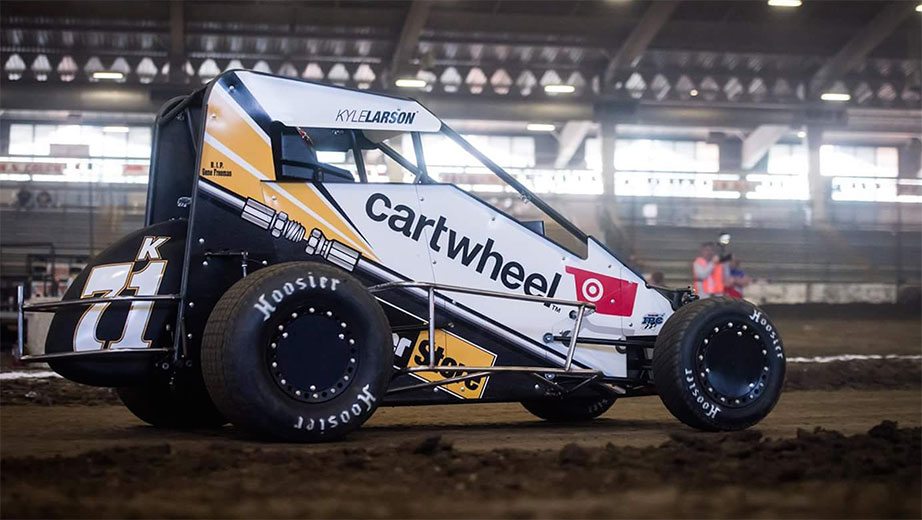
Some consider midget cars more fun to drive than stock cars, in large part because the driver matters more. The combination of a short track and the way the cars slide on dirt means a good driver can manhandle a bad car to the front. At the Chili Bowl, there are two distinct grooves: the bottom, which rewards precision, and the top, which rewards aggression.

Kyle Larson’s fondest racing memory at the Chili Bowl came when he spun out in the middle of a race in 2013. That’s an odd thing to remember so proudly, but then again, the Chili Bowl is an odd race.

Larson simply drove too hard and lost control of the car, and thus ended a heated battle with Sammy and Kevin Swindell, the father-son duo who have won the event a combined nine times. Larson had traded the lead with Kevin before spinning. “I remember when I spun out, looking to the crowd,” Larson said. “The place gave me a standing ovation, which was something I’ll never forget. The place went crazy.”

The Swindells’ success makes them hated, of course, because race fans root like crazy for their drivers to be successful and then turn on them when they are. On Saturday this year, Allgaier accidentally ran into the back of Sammy Swindell’s car on the final lap of the D main, which caused Swindell to spin to a stop and then watch helplessly as the rest of the field zoomed by. The crowd roared its approval, even though Allgaier hadn’t done it on purpose, as he had nothing to gain and everything to lose by hitting Swindell. Allgaier was already comfortably in a transfer position, and making contact with another driver would only put himself in danger of spinning himself out.

But fans never let the facts dissuade them when fisticuffs might be in the offing. Within minutes, dozens of fans crowded around Allgaier’s hauler in anticipation that Swindell would confront him there. The area was so crowded with people hoping to see a fight that they might have prevented one — Swindell could not have gotten there even if he wanted to. Instead, Allgaier went to Swindell’s trailer to apologize.

• • •

The greatest sign of NASCAR drivers’ affinity for the Chili Bowl is that they all keep coming back, even though the race makes them sick — literally. The illness that besets drivers and fans the week after the event is so common that it has a name: the Chili Bowl Flu. Symptoms include headaches, nausea and a general feeling of terribleness. “It’s worse than the flu,” Ricky Stenhouse Jr. said.

If the symptoms of the “Chili Bowl Flu” sound suspiciously like the symptoms of a hangover, well, yeah. But it’s not only the alcohol. The three basic food groups during the Chili Bowl are deep-fried this, deep-fried that and deep-fried everything else. Yeley’s ears ring for three days after the Chili Bowl ends, the result of endless laps turned by cars that sound like Flight of the Bumblebee played by Metallica in an echo chamber. And there are nearly 700 dump trucks worth of clay on the racetrack. On Sunday morning, I felt like I had aspirated 699 of them.

The Chili Bowl Flu is such a predictable staple of the experience that drivers have concocted ways to try to avoid it. Larson stuffs himself full of vitamins. Abreu takes vitamins, too, and washes his hands obsessively. Stenhouse drank so much DayQuil and NyQuil during the week that he joked the medicine should be one of his sponsors.

And all of that misery is part of the fun. Only with the Chili Bowl can the fact that attending it makes you sick be viewed as a marketing tool.

“It’s virtually a party with a race,” Yeley said. “Not the other way around.”

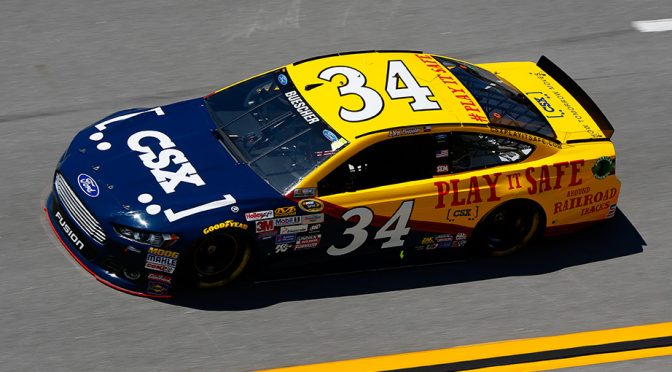
STATESVILLE, N.C. (Jan. 26, 2016) – NASCAR Sprint Cup Series rookie Chris Buescher will promote railroad safety with CSX in 2016, with the transportation company returning its “Play It Safe” messaging to the Front Row Motorsports No. 34 Ford Fusion for a fourth consecutive season.
 
The 2015 XFINITY Series Champion and 2016 Sprint Cup Series Rookie of the Year candidate will serve as an ambassador to 18- to 34-year-old males among NASCAR’s fan base, the demographic mostly likely to be involved in a train collision and the targeted audience of CSX’s safety campaign. Buescher will drive the CSX “Play It Safe” Ford for eight races, including events at Atlanta Motor Speedway, Watkins Glen International and the fall race at Richmond International Raceway.
 
“I got to work with CSX a little bit last year when I drove the No. 34, and I really respect what they’re doing with their NASCAR program,” the 23-year-old driver said. “It’s all about safety and spreading the message to race fans. If we can reach people and prevent even one collision, it’ll be a successful campaign.”
 
CSX, a Jacksonville, Florida-based railroad, has partnered with Front Row Motorsports for the past three Sprint Cup Series seasons to spread the message to “Play It Safe” around railroad tracks and to “Brake for Trains.”

“We are thrilled to have a champion driver like Chris Buescher in the CSX ‘Play It Safe’ car in our fourth season with Front Row Motorsports,” said John Claybrooks, CSX Director, Brand and Marketing Communications. “They both understand our cause and safety message as we strive to keep people safe around railroad tracks.”
 
As one of the nation’s leading transportation suppliers, with a network covering 21,000 miles of railroad tracks in 23 states, CSX is committed to educating the public on railroad safety in the communities it serves. 
 
“At CSX, safety is a way of life, and our NASCAR sponsorship continues to help CSX promote railroad safety education across our network,” says Jim Marks, CSX Vice President of Safety. “We can reach a large, key demographic to remind race fans to not stop, walk or play on the tracks or near crossings and encourage them to use safe driving practices at railroad crossings.”

Buescher and the Sprint Cup Series field will first hit the track for the Can-Am Duels, the qualifying races for the Daytona 500, on Thursday, Feb. 18, at Daytona International Speedway. The “Great American Race” is scheduled for Sunday, Feb. 21, at 1 p.m. ET and will air on FOX.