Editor’s note: The following content was provided by Goodyear and may not reflect the opinions of the editorial staff.

As an elimination race in the NASCAR Chase for the Sprint Cup, Talladega Superspeedway holds the key to advancing to the next round. For the 12 drivers still in contention for a championship, that’s not a comforting fact. Although Talladega is a fan favorite, it will likely be one of the most unpredictable races of the Chase. That’s because 500 miles of high speed “pack racing” at the superspeedway can sometimes make luck a serious factor in a driver’s finishing position.

For Goodyear, however, the variables affecting tire performance are well known. As one of only two superspeedways on the NASCAR schedule, Talladega is synonymous with speed. The 2.66-mile tri-oval carries drivers to average speeds of more than 200 mph — which are limited with restrictor plates, used to reduce the engine’s power output. The surface is also more aggressive than Daytona, with rougher asphalt translating to a higher rate of tire wear.

These factors make endurance a major consideration in Goodyear’s tire development at Talladega. Higher speeds place more load on the tires, while the dynamics of pack racing (cars bunched up in a pack because of the limited top speed) often lead to drivers sliding in and out of the corners.

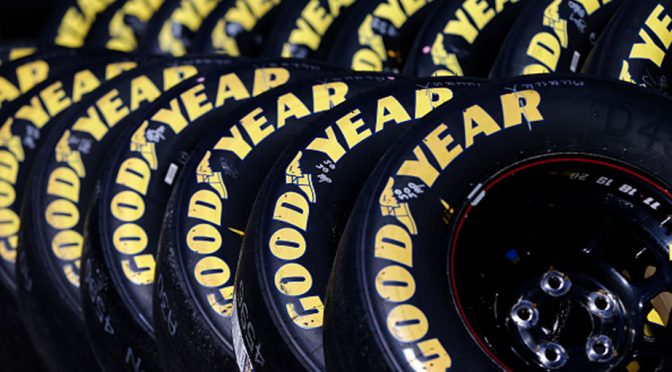
To deliver superior performance in these extreme conditions, Goodyear has developed a tire combination unique to Talladega. The left side tire was engineered specifically for use at superspeedways (Daytona and Talladega), and features a softer compound to give drivers the grip they need at sustained high speeds. The right side tire features a harder compound than what’s used at Daytona, to handle the wear of the more aggressive surface. Both use tire constructions that have been reinforced for use at sustained high speeds.

Heading into the NASCAR race at Talladega, fans will be on edge of their seats as they witness cars racing up to four wide. Add in high speeds, tensions of championship hopes on the line, the possibility of “the big one,” and it’s easy to see how many variables could impact the race outcome. Luckily, one thing drivers can count on is the expert engineering behind their Goodyear Eagle race tires which will carry them to the finish line.

RELATED: HMS welcomes new class of pit crew members


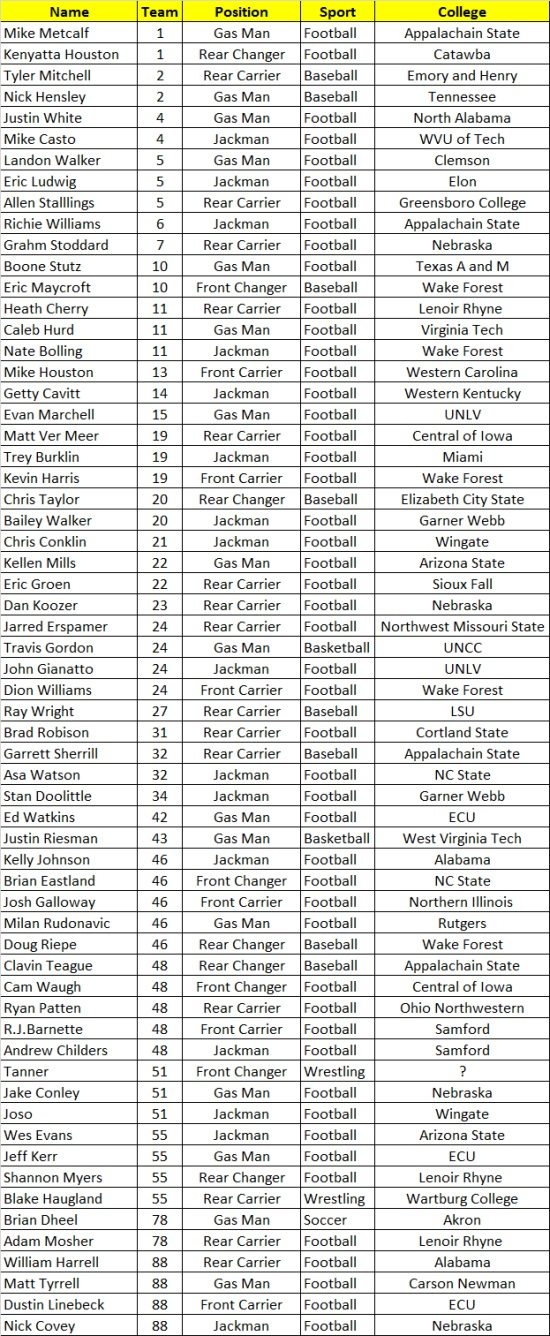
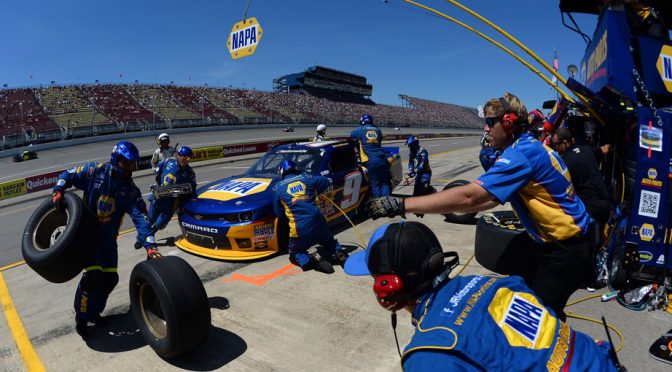
As pit crews evolve so do the athletes that join the roster. The influx of college athletes that join the crews has been a topic of conversation over the past few years. Getting the exact names and numbers of the guys on the teams is an extremely hard statistic to get. The turnover rate is high, thus it is next to impossible to attain 100 percent accuracy, but we have tried our best to get it right. So here you go … the most in-depth article you’ll find on former college athletes on pit road circa fall 2015.


We based our stats off of 39 full-time running Sprint Cup Series teams, giving us a total of 234 crewmen. Out of that number, 62 of them, or 26 percent, played college athletics. For the developmental crewmen that statistic would be closer to 80 percent. 


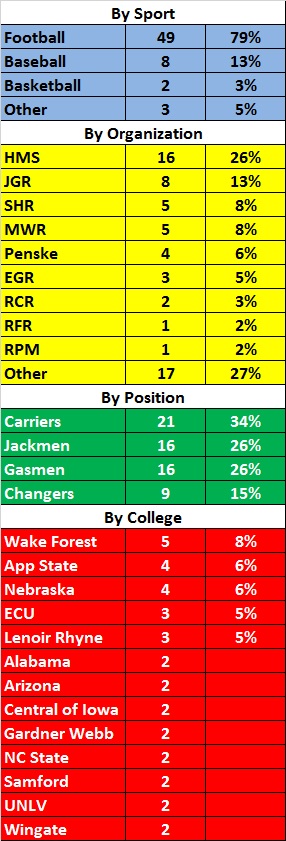
Taking the same 62 pit crew members and breaking them down into what position they pit looks like this:

— Carriers: 21 (34 percent)

— Jackmen: 16 (26 percent) 

— Gasmen: 16 (26 percent)

— Changers: 8 (15 percent)

Looking into these stats even more we find that 49 (79 percent) played football followed by baseball with eight (13 percent). Basketball, wrestling and soccer make up the remaining 8 percent.


As far as where these athletes pit, the breakdowns look like this:

— Hendrick Motorsports: 16 (26 percent) 

— Joe Gibbs Racing: 8 (13 percent)

— Stewart-Haas Racing: 5 (8 percent)

— Michael Waltrip Racing: 5 (8 percent) 

Here is a list of the schools these former college athletes studied at:

— Wake Forest University: 5 (8 percent) 

— Appalachian State University: 4 (6 percent)

— University of Nebraska-Lincoln: 4 (6 percent)

— Lenoir-Rhyne University: 3 (5 percent)

— East Carolina University: 3 (5 percent)


Out of the 16 teams that started the Chase this year, 33 (53 percent) of the pit crew members were college athletes. 


For full list of the pit crew statistics, check out the charts below. Enjoy.

athletes


The following are team press releases previewing the CampingWorld.com 500 at Talladega Superspeedway (2:30 p.m. ET, Sunday, NBCSN, MRN, SiriusXM).

Joe Gibbs Racing:
Kyle Busch | Team preview
Carl Edwards | Team preview
Denny Hamlin | Team preview
Matt Kenseth | Team preview


Stewart-Haas Racing:
Kevin Harvick | Team preview
Kurt Busch | Team preview

Hendrick Motorsports:
Jeff GordonTeam preview
Dale Earnhardt Jr. | Team preview

Team Penske:
Brad Keselowski and Joey Logano | Team preview

Richard Childress Racing:
Ryan Newman | Team preview

Furniture Row Racing:
Martin Truex Jr. | Team preview

The following are team press releases previewing the Hollywood Casino 400 at Kansas Speedway (2:15 p.m. ET, Sunday, NBC, MRN, SiriusXM).

Joe Gibbs Racing:
Kyle Busch | Team preview
Carl Edwards | Team preview
Denny Hamlin | Team preview
Matt Kenseth | Team preview


Stewart-Haas Racing:
Kevin Harvick | Team preview
Kurt Busch | Team preview

Hendrick Motorsports:
Jeff GordonTeam preview
Dale Earnhardt Jr. | Team preview

Team Penske:
Brad Keselowski and Joey Logano | Team preview

Richard Childress Racing:
Ryan Newman | Team preview

Furniture Row Racing:
Martin Truex Jr. | Team preview

Editor’s note: During each week of the Chase for the NASCAR Sprint Cup, The Joey Logano Foundation will provide grants to a non-profit in each of the race markets in a program called “Chasing Second Chances.” Each week, Logano will detail those plans for NASCAR.com.


Hey, everyone! 

Another win for the No. 22! I couldn’t be happier with this team and the way we are running. Our Shell-Pennzoil Ford was great this weekend. It’s definitely nice going into Talladega knowing we advance to the next round. 

This Week’s Cause: Domestic Violence


My blog post from last week discussed the ideas behind preventing domestic violence — mainly through education. For this post, I want to highlight some of the effects domestic violence can have, especially on children. 

As adults, we can tend to overlook the effects our actions have on children who are watching us. Each time I am asked a question in an interview or am in public at an event, I try to stay aware of the young eyes that may be watching me. Don’t get me wrong, it’s not always easy. It can be a little frustrating on track at times. 

For a family living in an abusive situation, the children who watch a parent being abused or watch a parent committing acts of abuse take in what they see and it can lead to many issues well into adulthood. 

Domestic violence poses a threat to children’s psychological and physical well-being. In the report Behind Closed Doors: The Impact of Domestic Violence on Children (UNICEF 2006) it states…

Children who are exposed to violence in the home may have difficulty learning and limited social skills, exhibit violent, risky or delinquent behavior, or suffer from depression or severe anxiety.


Children can also experience short term effects such as sleeplessness, anxiety, nightmares, high activity levels and intense worry about their safety or the safety of their parent. Long term the effects can produce physical health problems, depression, PTSD, alcoholism and substance abuse. 

I found this video that shares, from the perspective of a child, what domestic violence looks like. If you have two minutes, check it out here.

This Week’s Joey Logano Foundation Chasing Second Chances Partner


This week’s charity partner is 2nd Chance, Inc.  Founded in 1988, 2nd Chance, Inc. is a non-profit 501 c 3 organization that provides safe shelter and supportive services to victims of domestic and sexual violence and offers educational outreach to the communities served to create awareness of and strengthen the movement to end this violence.


2nd Chance serves Calhoun, Cherokee, Cleburne, Etowah, Randolph and Talladega Counties in Northeast Alabama providing emergency shelter, transitional housing, assistance with permanent housing, court and legal advocacy, counseling, lethality assessment, community referrals, thrift store vouchers, training and presentations on the dynamics of domestic and sexual violence, dating violence and abuse in later life.


The Joey Logano Foundation is providing a donation to complete a backyard play area makeover. The yard will receive some needed attention along with updates to the 15-year-old play equipment. We wanted to focus on something that would provide children staying there a safe place to play where they can focus on being a kid while mom heals from the abuse she has experienced. We are proud to support 2nd Chance, Inc. and the support services they provide. This non-profit saves lives and makes their community a better place to live. What’s more important than that?   

Chris Buescher (Roush Fenway Racing), Chase Elliott (Hendrick Motorsports) and Erik Jones (Joe Gibbs Racing) took part in NASCAR’s low downforce test Tuesday at Michigan International Speedway as NASCAR and Goodyear officials began looking for an aerodynamic answer to the 2-mile track located in the Irish Hills region.

This year’s August race at MIS, as well as the Sprint Cup race at Indianapolis Motor Speedway, featured a high drag configuration that failed to live up to officials’ expectations. Aero changes in place for that package included a 9-inch spoiler (an increase of three inches) with a 1-inch wicker bill; a 2-inch leading edge on the splitter and 43-inch splitter extension panel (radiator pan); and a rear fascia extension panel similar to those used for superspeedway events.

The package appeared to increase the impact of the draft, but had little or no effect on allowing trailing cars to make passes.

For the MIS test on Tuesday, cars were outfitted with smaller splitters and radiator pans and a shorter three-and-a-half inch spoiler, much like the configuration used at Kentucky and Darlington this season.

“(It’s) definitely different than the XFINITY car,” Buescher said during a break in the test. “… If you asked Cup guys that were here earlier this year with the high drag package, drivability probably wasn’t an issue. It was probably pretty easy to drive, whereas now it’s a bit of a handful. We’re lifting out of the throttle a little more than what data shows from earlier this year. …

“It’s a big difference and I think the race is going to show a pretty big change as well.”

While none of the three drivers at the test compete full-time in NASCAR’s Sprint Cup Series, all three have experience in the cars. Buescher, the XFINITY Series points leader, had six Sprint Cup starts earlier this year in the Front Row Motorsports No. 34 Ford, and did extensive testing for Roush Fenway before private testing was banned after 2014.

Elliott, who will move from the XFINITY Series to Sprint Cup full-time next season when he takes over the ride being vacated by four-time Sprint Cup champion Jeff Gordon, made five starts this season in a fifth entry for Hendrick Motorsports to prepare him for 2016.

Jones, the Camping World Truck Series points leader, was pressed into service after JGR driver Kyle Busch was injured in a season-opening crash at Daytona. While the bulk of his additional duties came in the XFINITY Series, Jones does have one Sprint Cup start, at Kansas, filling in for Busch in the organization’s No. 18 Toyota.

Elliott ran the low downforce package at Darlington and said he hopes “this is a small step and it continues down this path.

“I don’t think it needs to stop here with this low downforce package,” he said. “I think it needs to continue if that’s the direction that we need to go in and not get satisfied too soon.”

All three drivers said there seemed to be more off-throttle time with the new package in part due to the faster lap times — Elliott said he wasn’t sure of the top speeds but guessed they were somewhere in the 210-mph range.

“A little bit more challenging to drive, more driver input which is nice,” noted Jones, who was called upon as a replacement for JGR regular Denny Hamlin. “Overall for the Cup Series, I think this is probably a step in the right direction. I definitely think this is a pretty good change.”

Jones said it made sense for him to take part in the test since he was already in the area — he hails from Byron, Michigan.

“I’m sure Denny wants to get rested up and be at 100 percent for the Chase,” he said. “For me, it’s pretty cool deal to get in a Cup car and get that experience, feel out the new package. Anytime I can get laps in these cars is beneficial.”

Hamlin is one of 12 drivers competing in this year’s Chase for the NASCAR Sprint Cup.

Shorter Valve Stems

Some Sprint Cup Series teams began using shorter valve stems in their tires two weeks ago at Charlotte Motor Speedway, a move that they hope will lessen the likelihood of suffering a flat tire caused by contact with lug nuts.

There have been several instances of flat tires shortly after pit stops this year, and at least one crew chief has said lug nuts hitting the valve stems during tire changes have been the culprit.

The shorter stems, it is believed, are less likely to be struck in the rush of a pit stop.

“It’s not a new design; we just shortened it as much as we can to allow the same core to be inside the valve stem,” Greg Stucker, Director of Race Tire Sales for Goodyear, said. “It just gets it out of the way a little bit more.

“It’s not going to be a fix; but that’s all we can do right now. It’s a reaction to the people wanting us to do something so we did it as quickly as we could.”
Texas Motor Speedway is nearing the finish line on installing 2,866 feet of additional SAFER barrier ahead of the NASCAR tripleheader scheduled to be at the 1.5-mile track Nov. 5-8, the track announced on Wednesday.

In adding the energy-absorbing barrier system, the focus is primarily on the interior walls as well as three exterior sections of the dogleg on the frontstretch of the track. The track is also adding SAFER barrier segments on the entire inside wall of the backstretch, inside entry wall in Turn 3 and the interior wall at both the entry and exit of pit road.

The project, which also includes re-painting various logos on the walls, is scheduled to be completed by Thursday.

Factoring in the track’s existing SAFER barriers, the entire inside wall of the backstretch from Turn 2 to Turn 3 will have SAFER, according to a release from the track.

This is just the first of three prioritized phases to have SAFER barriers on all interior and exterior walls of the track. The second phase, which will see 2,103 feet of SAFER barrier installed, will be completed ahead of the Duck Commander 500 NASCAR doubleheader weekend in April 2016. No details were given about the third phase at this time.

Next month, Texas Motor Speedway hosts the second race of the Eliminator Round of the Chase for the NASCAR Sprint Cup, the AAA Texas 500 (Nov. 8, 2 p.m. ET, NBC, PRN, SiriusXM) as well as the NASCAR XFINITY Series O’Reilly Auto Parts Challenge (Nov. 7, 3:30 p.m. ET, NBC, PRN, SiriusXM) and the NASCAR Camping World Truck Series WinStar World Casino & Resort 350 (Nov. 6, 8:30 p.m. ET, FS1, MRN, SiriusXM).

Four NASCAR Sprint Cup Series teams received warnings after post-race inspections for the Hollywood Casino 400 at Kansas Speedway, including the No. 88 Hendrick Motorsports team.


The No. 88 team with Dale Earnhardt Jr. received a warning for failing pre-race inspection twice.


The No. 7 Tommy Baldwin Racing team with Alex Bowman also received a warning for the same reason.

The No. 83 BK Racing team with Matt DiBenedetto received a warning for failing pre-qualifying inspection twice.


The No. 21 Wood Brothers Racing team with Ryan Blaney received a warning for the following infraction: Section 10.7.2.b.


Blaney finished seventh at Kansas, while Earnhardt Jr. was 21st, DiBenedetto was 30th and Bowman was 31st.


If any team or person accumulates six or more warnings in a six-month period from the first warning, a P2 penalty could be issued by NASCAR. P2 penalties can include point deductions, fines and suspensions that can carry over into the next season.

In honor of Hispanic Heritage Month, NASCAR has teamed up with Chevrolet to provide four (4) scholarships worth a total of $20,000 plus an exclusive VIP trip to the NASCAR Sprint Cup race at Texas Motor Speedway in November.


The scholarship presents a unique opportunity for engineering students pursuing careers in STEM who may also have a career interest in motorsports.


Students interested in the scholarship should create a ninety (90) second video, describing a technology in NASCAR and how STEM professionals came to its design. Examples of science and technology in NASCAR include but are not limited to: track banking and construction, race car design, SAFER barrier walls, drafting, gas mileage, tire wear, ethanol fuel, and solar energy. Student videos will be judged on their creativity and technical accuracy. 


The deadline to enter is Friday, October 23, 2015. To be eligible, students must be currently enrolled at least part-time in an accredited college or university within the United States, be between the ages of 18 and 25 at time of entry and submit a YouTube video link through the scholarship website.


Four winners will be selected to receive one of four scholarships available. Each finalist and a guest will also be flown to Texas Motor Speedway for an exclusive VIP experience at a NASCAR Sprint Cup race. While there, students will be introduced to NASCAR and Chevrolet drivers, officials and executives and receive a full immersion.


Submit scholarship video here. Click here for official rules.

RELATED: Buy 2016 tickets


NASCAR has not released the official 2016 schedule yet, but some tracks have released their race dates for next year.

The latest was Dover International Speedway, which will host its Sprint Cup races on May 15 and Oct. 2.

The list below contains dates in which tracks have confirmed they will hold NASCAR Sprint Cup Series races.

2016 Sprint Cup schedule glance

Date Event
Feb. 13 Sprint Unlimited
Feb. 18 Can-Am Duel at Daytona
Feb. 21 Daytona 500
Feb. 28 Atlanta
March 6 Las Vegas
March 13 Phoenix
March 20 Auto Club
April 9 Texas
May 15 Dover
June 5 Pocono
June 12 Michigan
July 31 Pocono
Aug. 28 Michigan
Sept. 18 Chicagoland
Oct. 2 Dover
Nov. 6 Texas

In announcing its race dates, Chicagoland Speedway also revealed it was again the opening race in the Chase for the NASCAR Sprint Cup.

Texas officials said the Nov. 6 race again fell in the Eliminator Round of the postseason, a three-race stretch that again included Martinsville and Phoenix, according to the track.


Pocono Raceway officials said upon its schedule release that the NASCAR XFINITY Series would host a race June 4 at the Tricky Triangle. It would be the first XFINITY Series race ever at the venue.