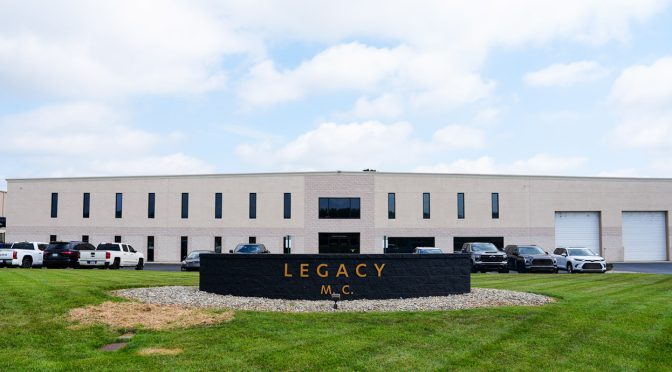
STATESVILLE, N.C. — Thin cardboard boxes are strewn throughout the upper levels of Legacy Motor Club. Soon-to-be-completed desks and workspaces are slowly unpackaged and assembled — not by outside installers, but by the same hands that piece together the Nos. 42 and 43 Toyotas driven each weekend by John Hunter Nemechek and Erik Jones.

Downstairs on the shop floor where those men and women perform their day jobs sit roughly a dozen Next Gen chassis, ranging in stages from fully completed race cars to shells of bare-bone chassis clips. Alongside them in one corner are pallets of furniture, couches wrapped in the plastic they arrived in, waiting to be placed in their future locations.

“We don’t have furniture installers,” shop foreman Tony Cardamone tells NASCAR.com. “It’s our guys, so we have to break away from a car to do this stuff. It’s just stuff that we have to do that people don’t see. But we’re all doing it for the right reason.”

Why? To drive Legacy Motor Club forward together as one, an intentional deviation from past years that those within the shop have witnessed over the last 12 months.

MORE: Cup standings

Collectively, those who don the black and gold of Legacy Motor Club have bought into the visions implemented and set forth by Jimmie Johnson, the seven-time NASCAR Cup Series champion and majority owner of Legacy. And after years of struggling to find its footing, Legacy is reaping the rewards as Jones and Nemechek begin to bring their cars to prominence.

“Jimmie’s vision is to make it a club where everyone feels a part of it, everyone wants to work hard,” Nemechek told NASCAR.com. “And everyone wants to do that at every race team, right? But there are some that are strictly business, per se, and there are some that feel like one big family. And I think that that’s kind of the vision that Jimmie has, is to make it one big family and to make it a club that everyone is a part of — and when there are successes, that everyone feels that.”

Seemingly everything at Legacy has changed over the past two years — and more is anticipated as the team continues to grow both figuratively and literally.

A wave of leadership hires started in July 2023 when former race-team owner Cal Wells III joined as the team’s CEO, helping oversee the program’s shift from Chevrolet in 2023 to Toyota in 2024. Amid admittedly considerable struggles as the organization adapted to its new manufacturer partner, Jacob Canter was hired in August 2024 as the team’s director of competition after spending nearly 16 years at Joe Gibbs Racing, first as a race engineer and lastly as its Research and Development Team Manager. His hiring coincided with Bobby Kennedy’s as the program’s general manager, which was then a new position at Legacy. Former Hendrick Motorsports and Team Penske employee Brian Campe was then added to the team’s roster in October 2024 as Legacy’s technical director.

Those moves all culminated in January, when Johnson became the majority owner of Legacy Motor Club in a partnership with Knighthead Capital Management, LLC. Former team co-owner Maury Gallagher stepped back as part of the deal after 12 years heading GMS Racing, a title-winning organization across the Craftsman Truck Series and ARCA Menards Series before acquiring Richard Petty Motorsports in 2021 to forge Petty GMS in 2022.
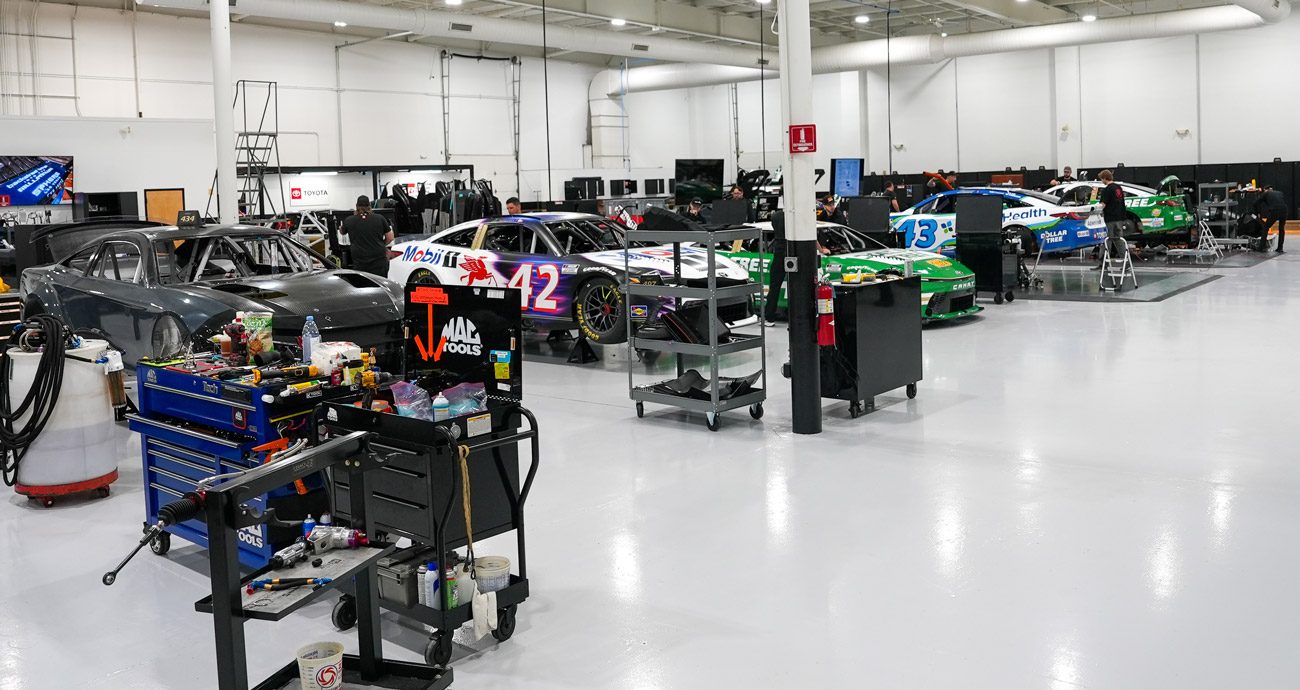
Inside Legacy Motor Club and its race shop.
James Thomas | NASCAR Digital Media

The 2025 statistics prove the changes are paying off, even if those results didn’t come immediately. Through 19 races, the team has racked up 10 top-10 finishes — seven of which came in the last nine races. At least one of the program’s drivers has finished inside the top 10 in six of the last nine races; Legacy only ended with a driver inside the top 10 in two of the first 10 this season.

Results are the ultimate measuring tool in a hypercompetitive sport. The measuring sticks, so far, are in the team’s favor. The inaugural In-Season Challenge highlights both Jones (the No. 20 seed) and Nemechek (No. 12) as they have advanced to the third round, where they will face off against each other Sunday at Sonoma Raceway (3:30 p.m. ET, TNT Sports/truTV, HBO Max, PRN Radio, SiriusXM NASCAR Radio) as two of just eight drivers remaining for a $1 million prize.

Legacy Motor Club

20242025 (through 19 races)
Top fives14
Top 10s610
Average finish24.919
No. 42 points position34th20th
No. 43 points position28th17th

The goal was always to compete for race wins — something Jones did in 2022, winning the Southern 500 at Darlington Raceway for then-Petty GMS. But Jones said the ability to drive further forward was hindered.

“There was, for a while, just a lack of leadership,” Jones said. “Especially in racing, you need to have an engineering group, an engineering flow chart. People need to have positions, people to report to. And we lacked that structure in our company until Brian and Jacob came around and they were able to set that up. We had some good people, like I said, but we had to give them positions and places to go and people to report (to). Once that was in place is when we started to see things improve.”

Upon his arrival and taking in the lay of the land, Canter made solving that disorganization one of his immediate focuses.

“The way it was laid out prior, there was a lot of silos, per se,” said Canter. “Physical division becomes more real and hurts communication. So we’ve tried to really open it up and open up our workflow to encourage communication. When you put people together closer together physically, then it forces more of that communication. And then it starts to become more organic and more natural. Then you start to bear fruit from it because the guys know who to go to. They know who to talk to.”

But for as much work was needed, so too was patience. While Canter saw things to change — like physically changing the layout of the building to enhance communication — he and the team’s leaders recognized they couldn’t implement every new idea overnight, and that it instead needed to be a process.

“This offseason, we had a real big line in the sand: ‘Hey, let’s start fresh,’ ” Canter said.

Such a pivot, he and Campe recognized, can be difficult for longtime employees to accept immediately.

“It’s hard when you’re working somewhere and everyone comes down and like, ‘We’re starting fresh tomorrow! Whole new program!’ ” Canter said. “That can feel like a slap in the face. Our group, collectively, everyone bought in and was like, ‘How can we be better?’ And that ‘how can we be better?’ is still present today.”
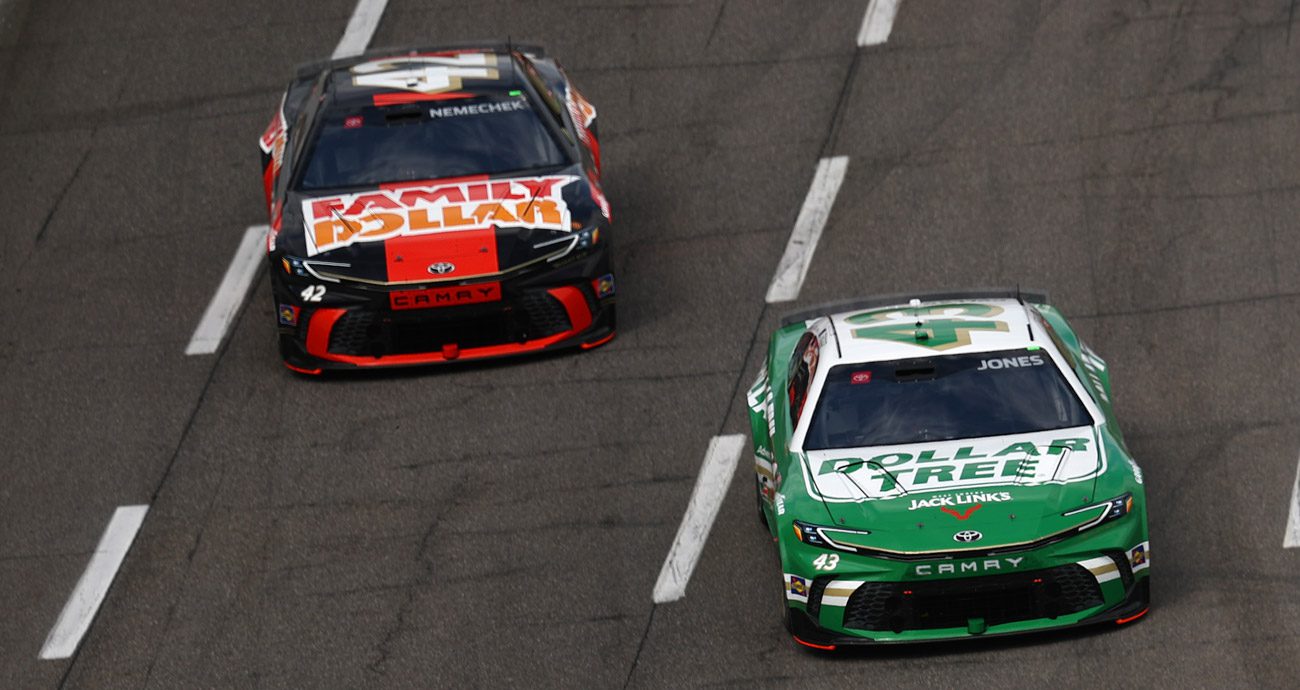
Legacy teammates Erik Jones and John Hunter Nemechek race against each other.
Jared C. Tilton | Getty Images

A keen example came in April. Nemechek finished 30th, one lap down at Talladega Superspeedway after the season’s lone off week. The No. 42 team’s single biggest hiccup came at Lap 112, when Nemechek spun exiting pit road under green-flag conditions.

“We had a miserable race,” Campe recalled. “The cars didn’t have speed. We missed on the execution side. We made mistakes on pit road, and I think that was right after the Easter break. And we had a lot of hard conversations in small groups with ownership to individually within our groups of, ‘OK, hey, this isn’t working. What needs to change?’ We laid this stuff bare on the table. And we said, ‘OK, there are 30 things. Here’s the five we’re gonna go do to get better.’

“And I felt so confident that the team — and that’s everyone here — had made those right decisions. After the race, I went up to John Hunter, and I said, ‘You’ll have a better car in Texas.’ ”

Nemechek remembers the moment well, in large part because he was incredulous at Campe’s promise.

“To be honest, I didn’t believe him,” Nemechek said. “When he said, ‘Hey, we’re gonna have way better race cars when we come back,’ well, how does that happen? Right? Like, what is that?”

Flash forward to the following week at Texas Motor Speedway: Lining up for the race’s final overtime restart, Jones and Nemechek were both inside the top 10, with Jones fourth and Nemechek ninth, a chance to win in hand.

“That was the moment for me,” Campe said. “I was like, OK, we have the right people. We’re trusting the process. Everyone’s bought into this. Now it’s my job, Jacob’s job, Bobby’s job, Cal, Jimmie’s to build the 43 feet of road ahead to make sure we just continue on down that path.”

“I think it was a lot of small things,” Nemechek said. “But I also think it’s the buy-in from everyone that works at the shop and everyone that works on both the 42 and 43.”
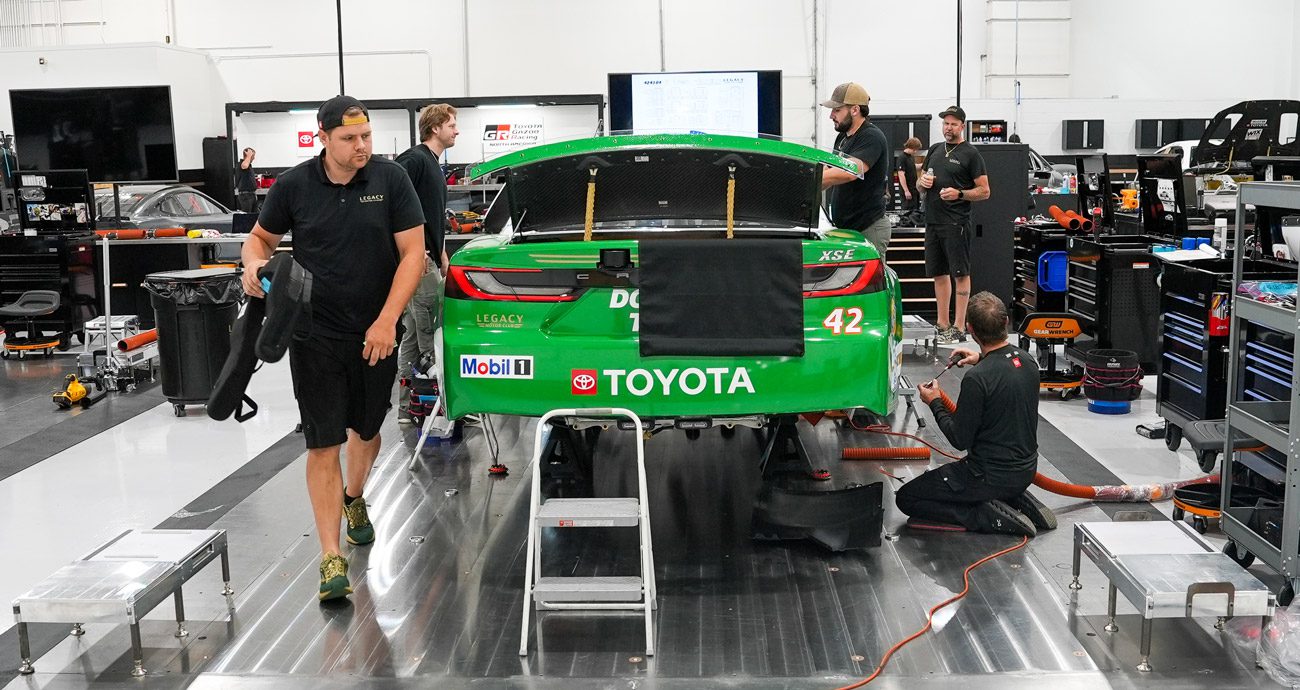
Legacy Motor Club members work on John Hunter Nemechek's race car.
James Thomas | NASCAR Digital Media

The collective jostling around Legacy centered on the common vision laid out by Johnson, a seven-time series champion who has climbed into a No. 84 Legacy Toyota to compete in a handful of races for the past three seasons. Nine different team members — ranging from drivers to crew chiefs to crew members and directors — mentioned Johnson’s leadership as a key guide toward their willingness to buy into Legacy’s future and ultimate uptick in performance.

In the nine races from Talladega through Atlanta Motor Speedway on June 28, Jones tallied the sixth-most points in the Cup Series while posting two top fives, three top 10s and eight top-20 finishes in that span.

“It’s just kind of a mentality of it was time to turn it around,” Jones said. “I felt like we had good tracks coming up. We had been putting more and more speed in our cars. I would say right around Charlotte is probably the time things started to go good. I kind of reset on my own and said, ‘All right, I need to do the things that I do well again and just focus on what I can control and try to make it work.’ And about that time, cars started getting better, (and) I felt like I started making good decisions. And since then, it’s worked out really well.

“We haven’t always got the finishes, I think, that we’ve been capable of, but we’ve ran well in stages and got a ton of points. So it’s all going to come together more and more. The more you bring top-10 cars, that’s going to come your way more consistently. But the points rally has been probably the biggest, I think, in my career.”

There are no delusions held within the shop. Their work isn’t done, and they are not yet where they would like to be. But they know where they’d like to be.

“The next realistic step is to win a race in the next [eight],” Campe said. “That’s everybody’s goal is to get into the playoffs. It’s tangible. It’s not just a ‘roll your eyes after the technical director says it in a meeting.’ … I hope everyone here believes that it’s possible.”

On the shop floor is where much of the magic happens to make those once-lofty goals possible. There is a camaraderie throughout the expansive garage — lighthearted as Nemechek rolls past on his scooter and laughs with crewmen but diligent as tasks are completed. On the back wall stands a quote from Johnson himself: “A Legacy is more than what you leave behind; it’s something you build every day.”

What is being built now is an opportunity. What was once improbable is now not just possible — it lies within the grasp of a club trying to build its legacy.
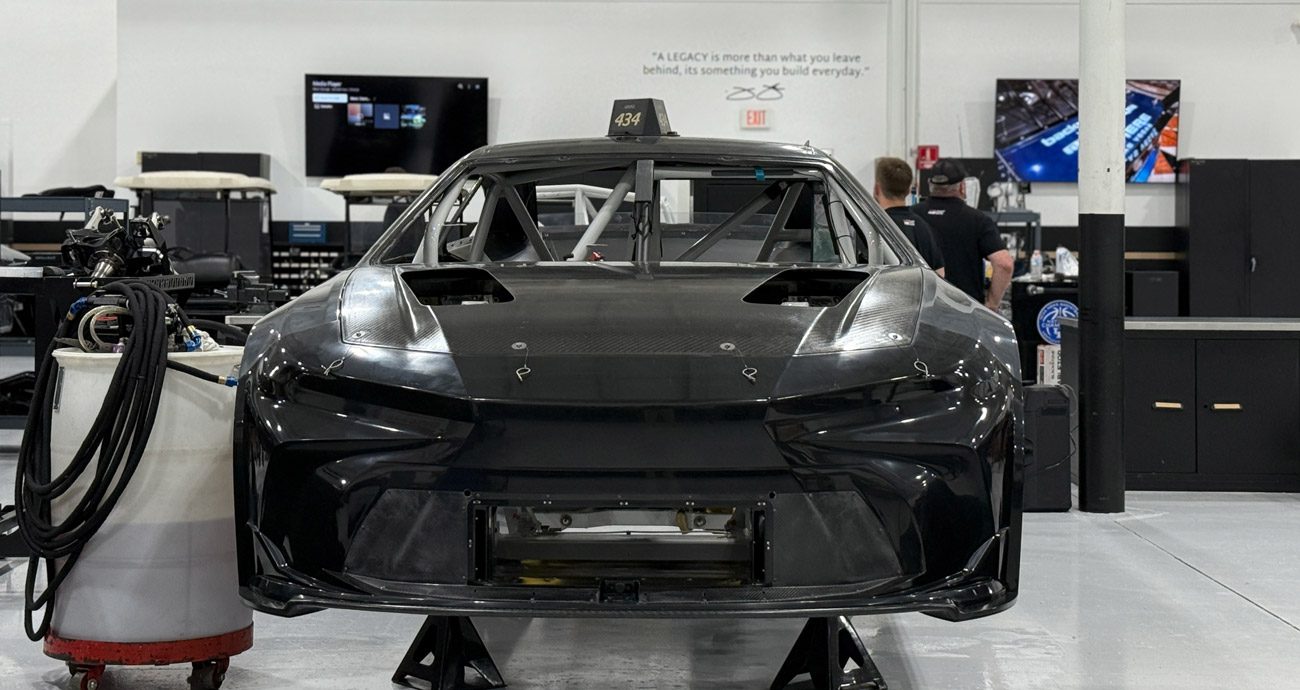
Legacy Motor Club's shop featuring a Jimmie Johnson quote on the back wall.
Zach Sturniolo | NASCAR Digital Media

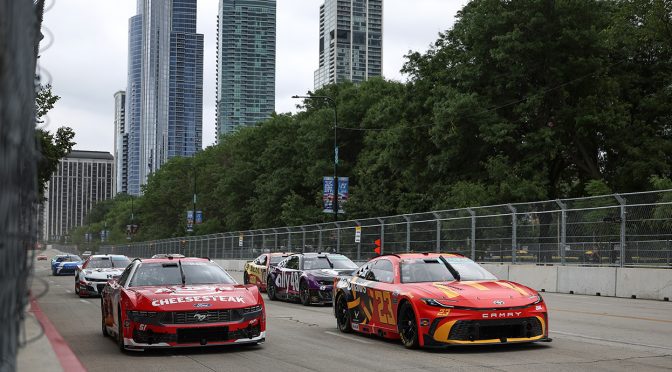
Seven races remain in the Cup Series regular season, and the final laps of the Chicago Street Race last weekend saw a massive swing in the playoff standings.

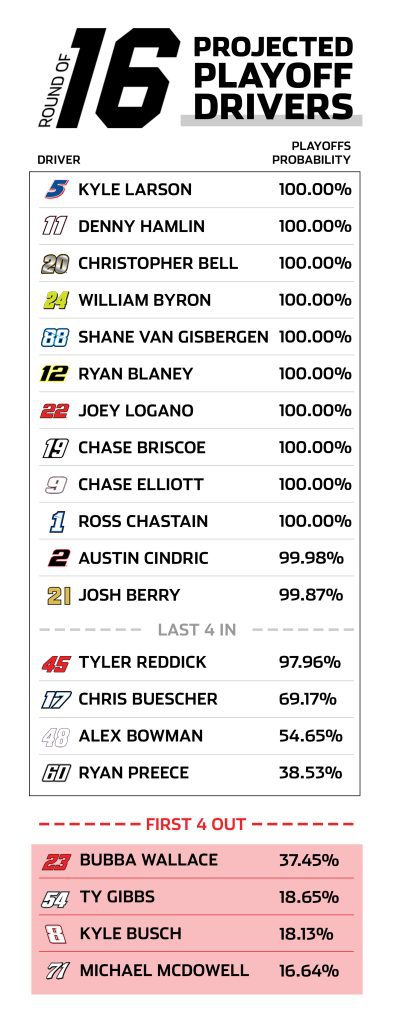
Playoff Probabilities provided by Racing Insights (entering Sonoma)

Instead of fighting for another day and taking an important top-10 points day, Bubba Wallace played a little too rough with Alex Bowman through the tight confines of the 2.2-mile track and spun off Turn 2 after trying to clear ahead of the No. 48 Hendrick Motorsports Chevrolet. What would’ve been a top 10 faded to a 28th-place result for Wallace and the 23XI Racing team and now the eight-year veteran finds himself just two points above the elimination line with Ryan Preece on the move.

Two more road courses still loom before the playoffs, and Sonoma Raceway on Sunday (3:30 p.m. ET, TNT Sports/truTV, HBO Max, PRN Radio, SiriusXM NASCAR Radio) will likely see another major shift in how the picture looks at the bubble. With stats and probabilities provided by Racing Insights, see who’s trending in the right direction and who is on the back foot with another road course looming.

RELATED: Sonoma schedule | Cup Series standings

GREEN FLAG [Who’s in a great spot for Sonoma]

Preece has found the treasure as those above him in the playoff picture continue to make mistakes and bleed points away. It’s been a relatively quiet summer for the No. 60 RFK Racing driver, but the numbers should not go overlooked as he has finished inside the top 15 in seven of the last eight races, including five top 10s in that span. Preece fought through the final-stage calamity in the “Windy City” and brought home a massive seventh-place result, proving his talent extends far beyond the short-track scene. He also saw the highest jump in his playoff probability, up to 38.53% from just above 20% before Chicago.

Another driver to keep tabs on, and still seeking his maiden Cup win, is Ty Gibbs (18.65% playoff probability). He was runner-up to Shane van Gisbergen at Chicago and was matching the Kiwi on pace and strategy in Mexico City before an untimely Carson Hocevar caution nipped the No. 54 Joe Gibbs Racing team’s plan. He currently sits 66 points below the elimination line, and while not impossible to make up with just under two months left, a win will surely put a lot of noise and pressure to rest for the third-year veteran who has found a knack for road courses at the national level.

YELLOW FLAG [Who’s on the fringe for Sonoma]

I’m only slotting Chris Buescher here because the No. 17 RFK team left a lot of points on the table after a mechanical issue ruined what otherwise could’ve been a day where Buescher really built his cushion to the elimination line. However, the stats for the Prosper, Texas native in Northern California are mind-blowing. He hasn’t finished worse than fourth in the three Next Gen races at Sonoma and led 32 laps in last year’s event. As long as the No. 17 car is at full song Sunday afternoon, look for Buescher to be in the mix for his first Cup win since Watkins Glen last season.

RACING INSIGHTS: Full race projections for Sonoma

RED FLAG [Who I’m concerned about heading to Sonoma]

Back to the No. 23 team. If you are out of contention for the race win and running well, you have to pick and choose your battles. Yes, Bowman and Wallace were battling to advance in the In-Season Challenge, but there needed to be a balance between that and the big picture of trying to make the postseason. Wallace has certainly improved on road courses over the years, but a two-point buffer won’t make even the biggest No. 23 supporters confident going into Sonoma.

The numbers don’t bode well at Sonoma either for Wallace, as he does not own a top 10 in six starts at the track and has a best finish of just 14th (2021).

After an eye-opening experience on the streets of Chicago, Connor Zilisch knows what to expect from JR Motorsports teammate Shane van Gisbergen in Saturday’s Pit Boss/FoodMaxx 250 at Sonoma Raceway (4:30 p.m. ET, The CW, PRN Radio, SiriusXM NASCAR Radio).

Zilisch led the field to green with two laps left in Chicago, only to have van Gisbergen dive to his inside entering Turn 1, run him wide in the corner to take the lead and pull away to win the race.

“I was clear there, just barely, on the front straight, and I just let him get to my inside, and he took advantage of it,” Zilisch said after the race. “I should have been a little more aggressive there. I just thought he was going to race me a little cleaner.

“I’ve just got to be better and not let that stuff happen. I’ll learn from it and move on.”

As they were in Chicago, SVG and Zilisch are the top two choices to win on Saturday, by a wide margin. Van Gisbergen won last year’s NASCAR Xfinity Series race in his only start at the 1.99-mile circuit.

RELATED: Sonoma schedule | Xfinity Series qualifying order

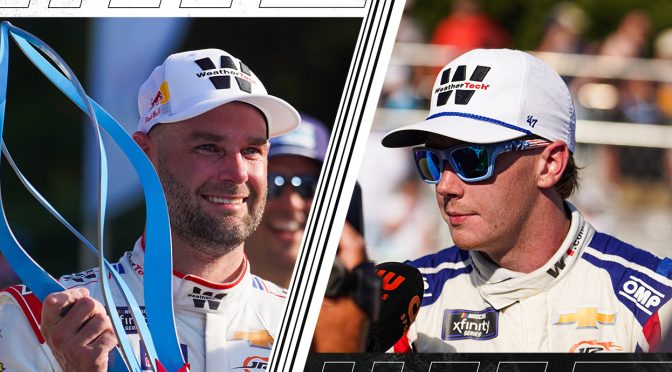
The 36-year-old New Zealander is coming off a weekend sweep at Chicago, where he won both races from the pole.

“Last weekend was epic,” van Gisbergen said. “JRM built me a rocket, and I’m glad our strategy ended up working out and we were able to get the win. I’m a lucky guy to be able to drive some fast Chevrolets.

“Looking forward to Sonoma this weekend. It’s an awesome track and I had a blast racing there last season and even brought home the win. Hoping to do it again this weekend for my No. 9 JRM team.”

SVG won last year’s Chicago and Sonoma races in the No. 97 Kaulig Racing Chevrolet. This year, he’s driving for JRM, which has won all three road-course races this season with three different drivers and the last five (dating to last year) with four different drivers.

Though SVG and Zilisch are the most likely winners, their battle won’t be the only one of significance at Sonoma. There are eight races left in the Xfinity Series regular season, and five playoff spots remain open.

Taylor Gray and Harrison Burton are just eight points apart on either side of the current elimination line, with Gray holding the final playoff berth after the Chicago Street Race.

In that event, Burton finished 13th to Gray’s 34th and trimmed 20 points off Gray’s advantage entering the race.

When Austin Beers became a regular competitor on the NASCAR Whelen Modified Tour, he didn’t have much experience racing at the tracks throughout the Northeast that make up the bulk of the series schedule.

His competition — drivers like Justin Bonsignore and Ron Silk — grew up competing at places like Thompson Speedway Motorsports Park or Riverhead Raceway, staples on the schedule for decades. If there is one track where Beers has the upper hand in terms of experience, though, it’s Lancaster Motorplex outside of Buffalo, New York.

“When I go to Thompson or Riverhead, Justin (Bonsignore) and Ron (Silk) and all those Connecticut or Riverhead guys have all those laps,” Beers said. “Lancaster was one of the first tracks that, when I started to travel with the RoC Modified Series, it was one of the first tracks I went to.

“So, I kind of have an advantage on them more so than when we go to Thompson or Riverhead when they have thousands of more laps than me.”

Beers, from Northampton, Pennsylvania, ran his first full Modified Tour season in 2022 when he was 19. He has quickly become one of the series’ fastest rising stars.

Austin Beers
Austin Beers in action during the World Series 150 at Thompson Speedway Motorsports Park on Oct. 13, 2024. (Photo: Rob Branning/NASCAR)

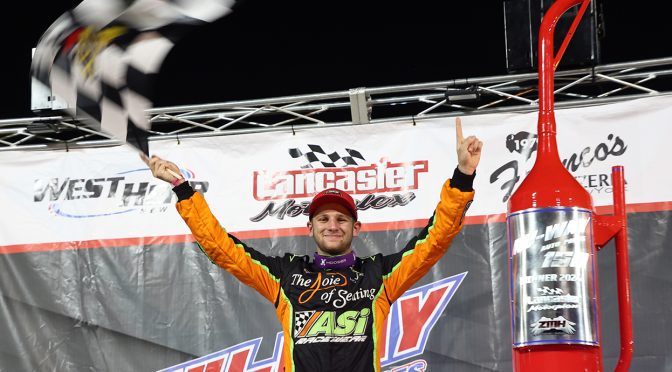
Beers scored his first victory in 2023 at Richmond Raceway, which he followed with another win later that season at Lancaster. He won once last season at — you guessed it — Lancaster.

So what makes Beers, who is younger by at least a decade than most of his competition, so good at Lancaster?

“There is nothing that really suits me,” Beers explained. “It’s more of an experience thing. I just have a lot of laps (there).”

Lancaster is one of the most unique tracks on the Modified Tour schedule. The multi-purpose facility features a drag strip that is integrated into the frontstretch portion of the oval on which Beers and the rest of the Modified Tour field will compete Saturday night.

As a result, Beers says, drivers must attack the frontstretch different than the rest of the track. One wrong move could cost a competitor the entire race.

“It’s definitely unique. The increase in grip (on the frontstretch) is crazy,” Beers explained. “You almost have to set your car up to be straight going onto it, because if you’re turned sideways getting onto the grip, once it grips up and you’re turning right, you’re going right into the fence.

“It’s pretty tricky. It takes some getting used to at the exit (of Turn 4). Out of (Turn) 4 the top groove kind of tapers off over to the drag strip even more, so if you catch it early, then it upsets the car, as well.

“It’s all little nitpick things you have to figure out the longer you run there.”

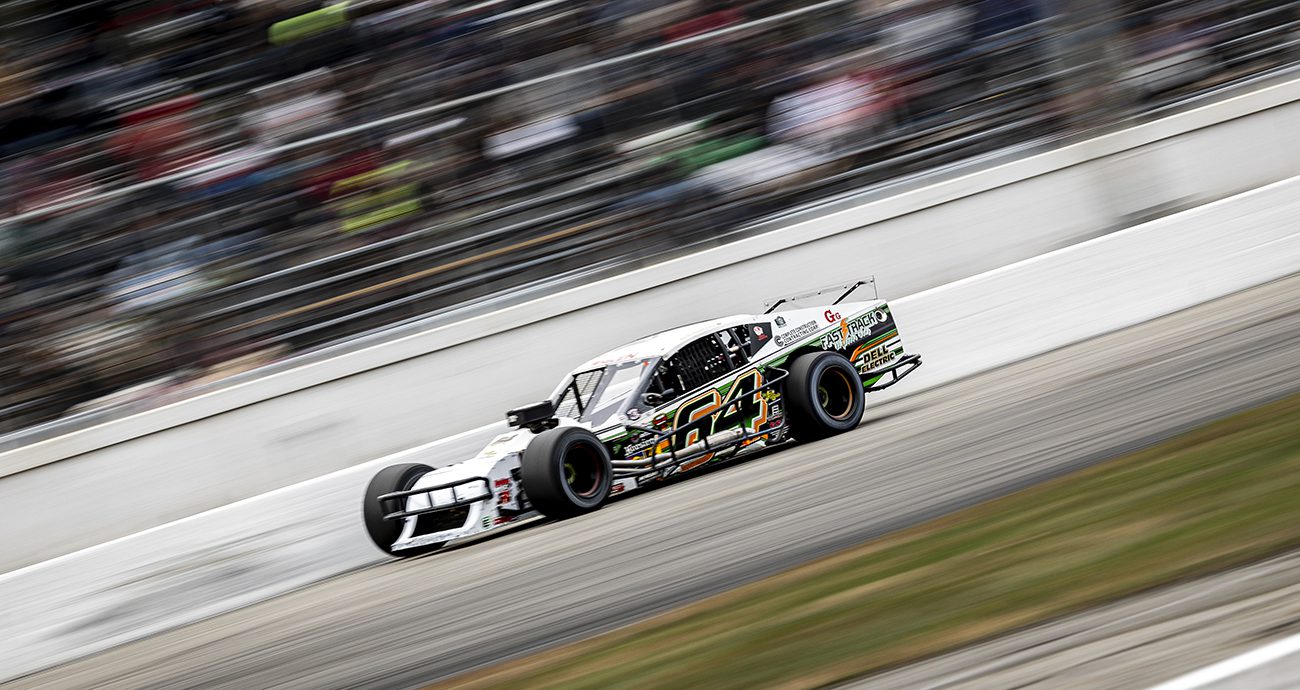
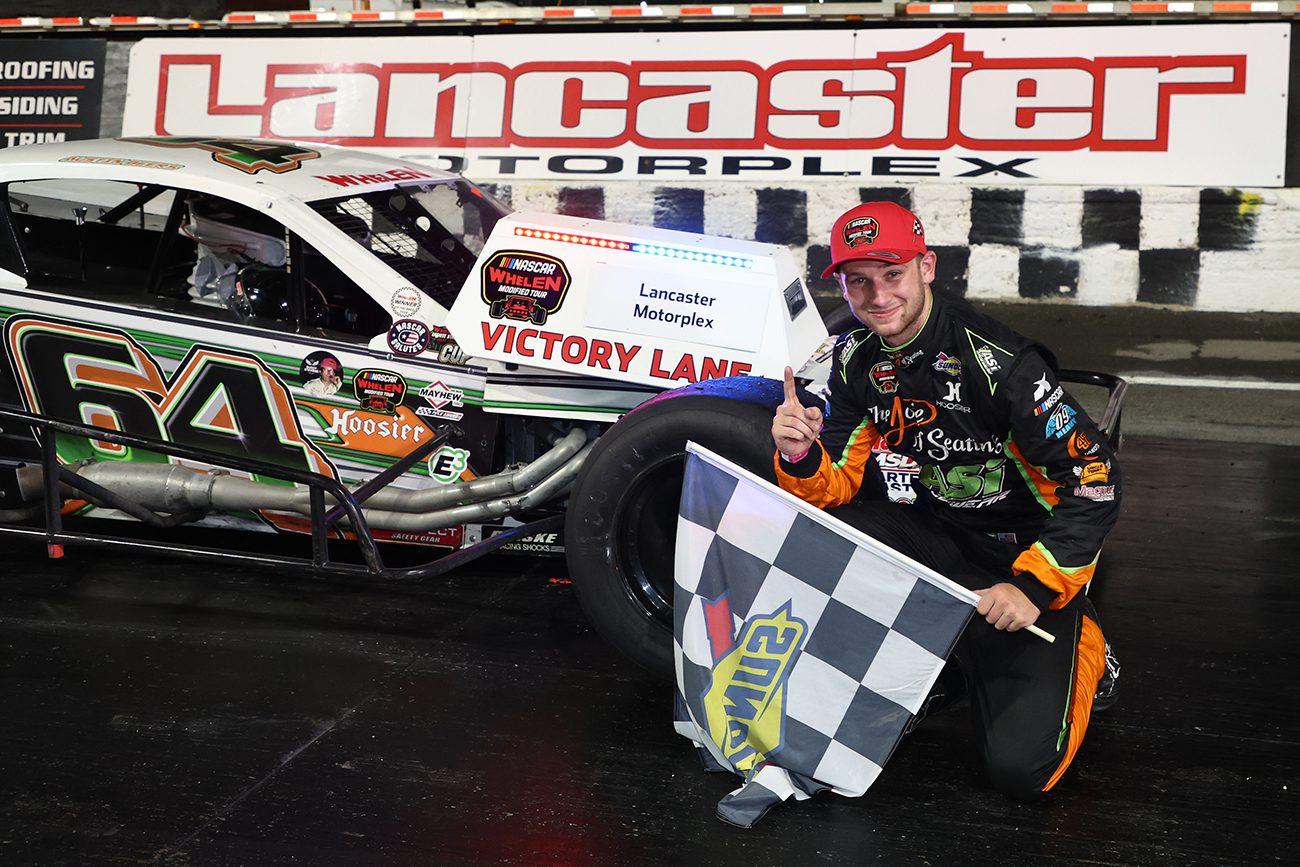
Beers, who drives the No. 64 KLM Motorsports Modified for team owner Mike Murphy, used different methods to win at Lancaster each of the last two seasons.

In 2023, a fast pit stop catapulted Beers to the lead, and he held off Matt Hirschman to win. One year later, a storm before the race created tricky track conditions, which Beers figured out the best.

“Hopefully this season we can win by more than a car length, because I feel like it’s been just about a car length each time we’ve won,” Beers said. “I’d like to have a bit of a gap coming to the checkered flag.”

Austin Beers
Austin Beers celebrates his victory in the Nu-Way Auto Parts 150 at Lancaster Motorplex on Aug. 3, 2024. (Photo: Jeffrey Barnes/NASCAR)

Saturday’s race marks the seventh event of the 2025 Modified Tour season, a year in which the series has seen six different winners through the first six races. The record, seven, was set in 1999.

Despite being the most consistent driver on Tour so far this year, Beers has not yet found Victory Lane. As the two-time and defending winner at Lancaster, he’s the obvious favorite to not only win, but also match that series record of different winners to start a season.

Beers knows winning again at Lancaster won’t be a cakewalk, but based on experience, the odds do appear to be in his favor.

“I think it shows how competitive the Tour actually is,” Beers said, “Six different winners in six races is pretty incredible, and there are plenty of other guys that can win. Obviously Trevor Catalano got a win last year; he’s a contender. Tommy (Catalano) is still looking for that first win, and I think Lancaster is a place he can win. There are plenty of other guys that can still win.

“We just need to keep doing what we’re doing. The team is doing a great job bringing great race cars to the track. The pit crew is doing a hell of a job. It’s very comforting coming down pit road knowing we’re probably going to gain a few spots on pit road because out pit crew has been amazing and very consistent. I know when we make the right adjustments we can go forward.”

With a little more than two months left in the NASCAR Advance Auto Parts Weekly Series points season, Jacob Goede has taken command of the Division I national championship standings.

This year’s national title chase, though, is up in the air. Goede has multiple competitors on his tail as the midwest racer pursues what would be his second Weekly Series national championship.

Below are the Division I standings as of the morning of July 10.

Advance Auto Parts Weekly Series national standings

1. Jacob Goede – 346 points

Goede, the 2019 NASCAR Advance Auto Parts Weekly Series Division I national champion, has 344 points on the strength of four wins in 13 starts at Minnesota’s Elko Speedway, Wisconsin’s Dells Raceway Park and LaCrosse Fairgrounds Speedway, also in Wisconsin.

2. Chase Johnson – 344 points

Goede’s closest pursuer is Division I rookie Chase Johnson, a regular at Virginia’s Dominion Raceway. Competing in the American Racer Late Model class, Johnson has won nine times in 13 starts and sits just two points behind Goede in the battle for the Division I championship.

3. Brandon Ward – 316 points

Brandon Ward, the 2023 Bowman Gray Stadium Modified champion, is third in the Division I standings thanks to a strong season at the Winston-Salem, North Carolina track. He has scored two wins in 12 starts to go along with 11 top fives and 12 top 10s, giving him a point total of 316.

4. Trevor Ward – 288 points

Fourth in the standings is 2023 Virginia Triple Crown champion Trevor Ward. The current South Boston Speedway championship points leader has scored four wins this year while competing at South Boston in addition to starts at Ace Speedway and Langley Speedway. Through 15 starts this season, his point total is 288.

5. Tim Brown – 286 points

Tim Brown, a record 12-time Modified track champion at historic Bowman Gray Stadium, finds himself fifth in the Division I standings. Despite being winless this season at Bowman Gray, his nine top fives and 12 top 10s in 13 features have him near the top of the national championship standings.

Complete NASCAR Advance Auto Parts Weekly Series standings can be found on MyRacePass.

Below are updates on the championship battles in Divisions II-V.

  • In Division II, Chase Robertson leads four other Bowman Gray Stadium competitors in the battle for the national championship. Through 14 starts this season at Bowman Gray in the Sportsman class, Robertson has won four times and leads defending Division II national champion Zack Ore by 86 points.
  • The battle for the Division III National championship appears to go through Berlin Raceway. Brian Thome, with three wins, leads his Sportsman division rival Josh Frye, who has scored two wins, by 18 points.
  • Another Berlin Raceway competitor leads the Division IV standings. Justin Roelofs, who competes in the 4 Cylinder class at Berlin, has secured six wins and leads defending Division IV national champion A.J. Sanders by 38 points through early July.
  • In Division V, New Smyrna Speedway Bomber B competitor Zach Curtis holds a two-point advantage on Evergreen Speedway Hornet class racer Damon Claibourn. Curtis has scored eight wins to Claibourn’s one, but Claibourn’s strength of field is keeping him in the championship hunt. Christian Miller, another Evergreen Speedway competitor, is also in the battle, only four points behind Curtis.

With a bunch of his trademark road and/or street courses coming up on the NASCAR Cup Series calendar, we had a hunch that Shane van Gisbergen was about to go on a sizzling summer hot streak. But even against those lofty expectations, what SVG has done on the twisty tracks has been shockingly dominant. In addition to winning from the pole by a margin of 16.6 seconds at Mexico City in mid-June, van Gisbergen fended off a crowded field of would-be challengers to once again claim victory from pole position on the streets of Chicago this past Sunday.

If you’re keeping track, that means SVG has a two-race winning streak on road courses, to go with five consecutive finishes of seventh or higher dating back to Watkins Glen International last September. In three career Cup starts at Chicago specifically, he has two wins, leading 44 of the 177 laps he’s run (24.9%, the highest of any driver) with a series-high average Driver Rating of 118.7. If we also include his Xfinity Series starts at Chicago — where he also won last week — SVG has now won four of the five races he’s entered there, with three poles and an average start of 2.2. Outside of Joey Chestnut at a hot dog-eating contest, it’s hard to think of someone in sports who’s dominated more than SVG on the streets of the “Windy City.”

That, in turn, has the NASCAR world buzzing this week about whether SVG is already the greatest road-course driver in Cup Series history, with another road course on the way at Sonoma Raceway this Sunday (3:30 p.m. ET, TNT Sports/truTV, HBO Max, PRN Radio, SiriusXM NASCAR Radio). There’s certainly a case to be made, though there are plenty of other contenders worth highlighting. (Especially as we head to what was Jeff Gordon’s playground for so many years.) So let’s run through each potential candidate for the crown of best road-course ace in the Cup Series’ modern era (since 1972), along with the metric(s) that give them the strongest case.

Shane van Gisbergen

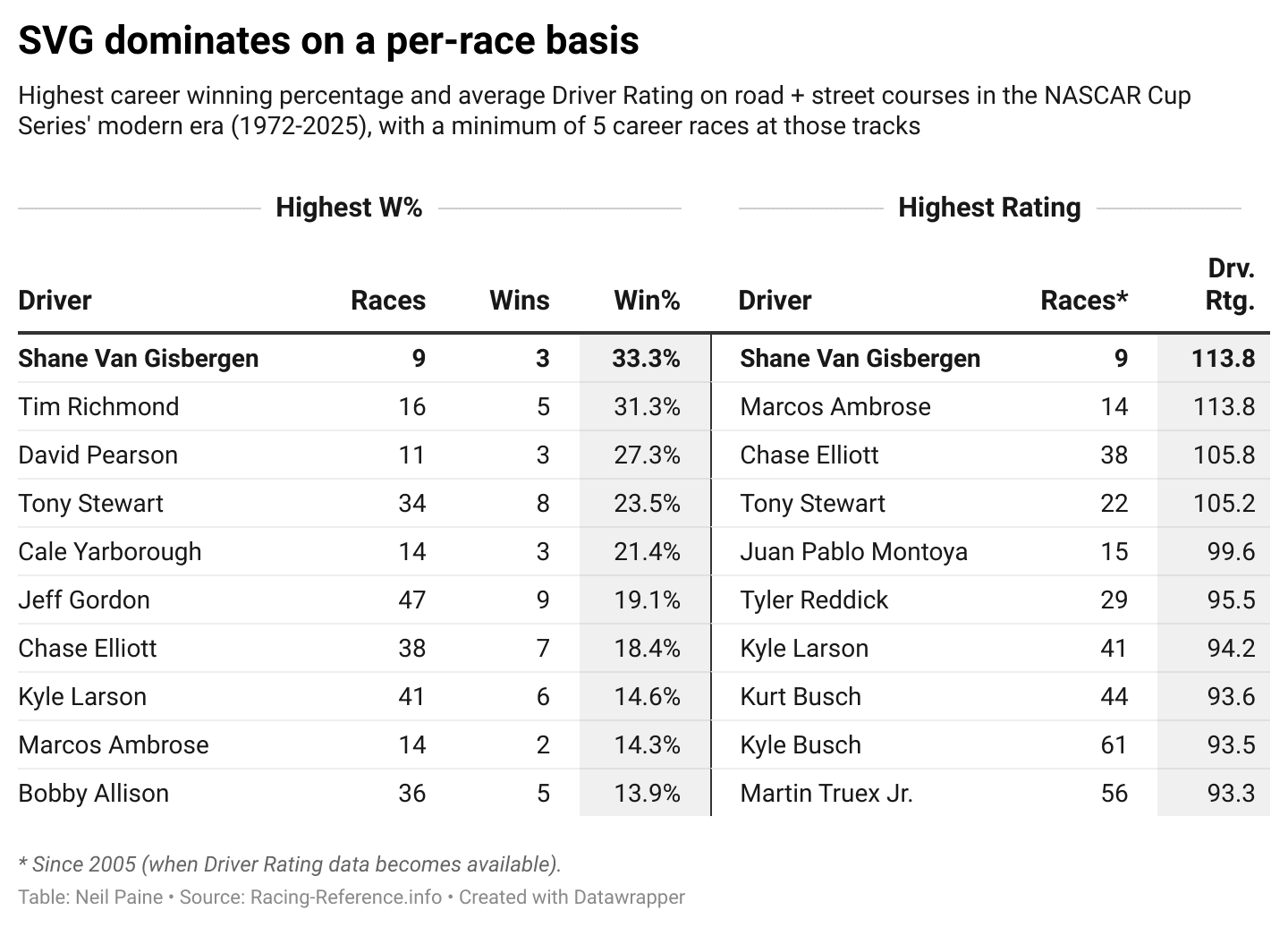
Metrics: Highest winning percentage (33.3%) and average Driver Rating (113.8) on road courses in Cup Series history*

(* – Driver Rating only available since 2005.)

If you want a driver who maximizes his chances of winning each time out, it’s hard to go against van Gisbergen’s road-course record … at least on a per-race basis. SVG has won a third of the time on tracks with both left and right turns, better than double the success rate of Kyle Larson or even his mentor Marcos Ambrose, who is widely regarded as one of the best road-course ringers in Cup history. Only the late, great Tim Richmond (at 31.3%) was even close to SVG in terms of winning percentage. And it hasn’t been a fluke, either: Going back to 2005, SVG has been the most consistently dominant driver in the series on road courses, with an average Driver Rating that narrowly edges out Ambrose and is far above the mark of Chase Elliott, previously the clear top road-course racer in Cup before his losing streak on those tracks in recent years.

SHOP: Best SVG gear

Jeff Gordon

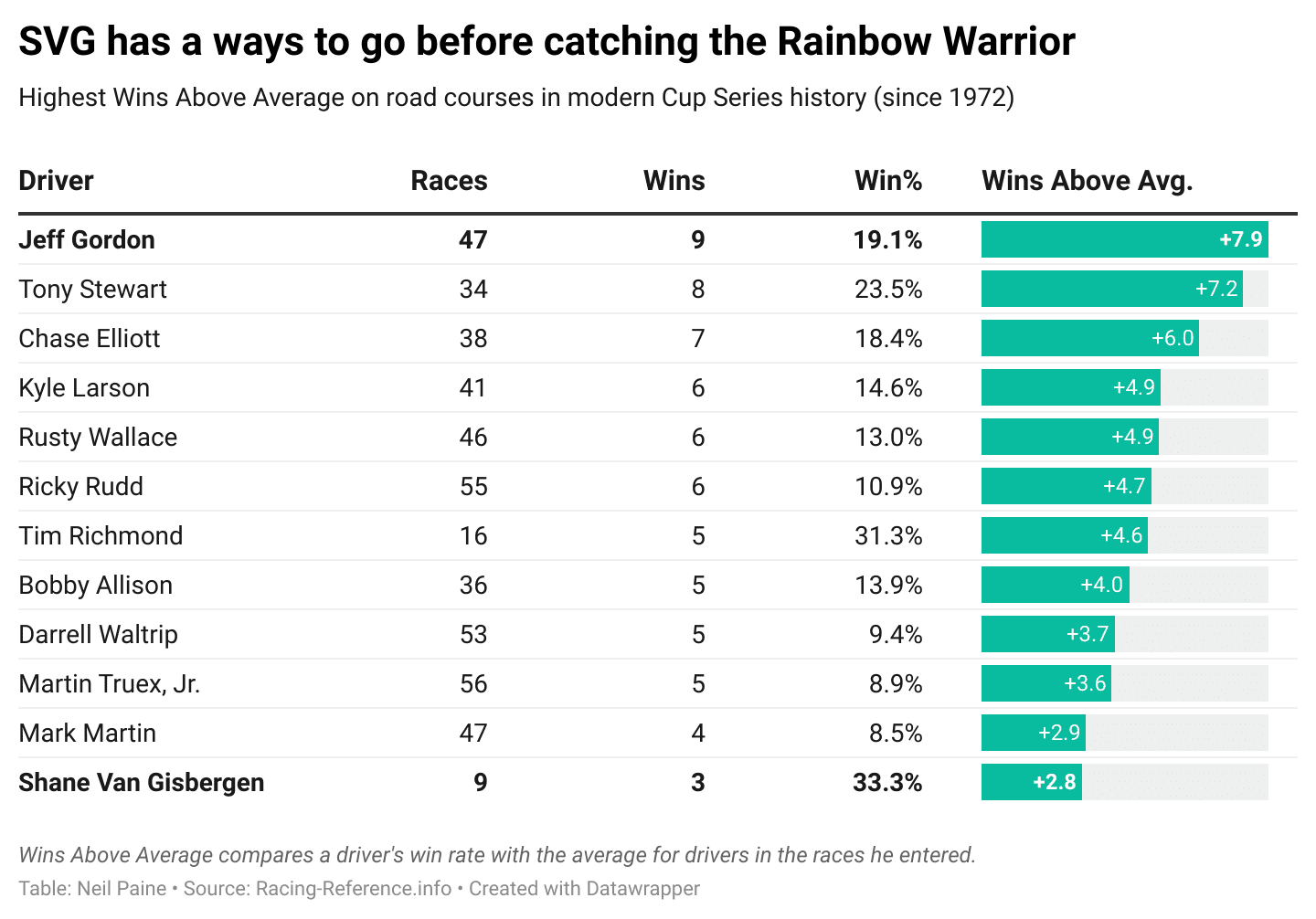
Metrics: Highest Wins Above Average (+7.9) on road courses in Cup Series history

A major case against SVG is simply one of sample size: He hasn’t sustained his dominance over anywhere near as many races as his rivals for the crown of road-course GOAT. That’s where this metric — Wins Above Average — comes in, as it compares a driver’s actual wins with the number we’d expect from a driver who won at an average rate for the fields he drove against. And by that standard, van Gisbergen still has a fair amount of ground to make up on Gordon, who won nearly eight more races in his career than an average driver would have in the same opportunities. Gordon is, of course, the all-time career leader in total road-course wins as well, sustaining a career full of podium finishes on turning circuits that spanned from a third-place finish at Sonoma in May 1995 to a runner-up at the same track in June 2014, nearly 20 years later. We’ll see where van Gisbergen is in two decades.

Cale Yarborough

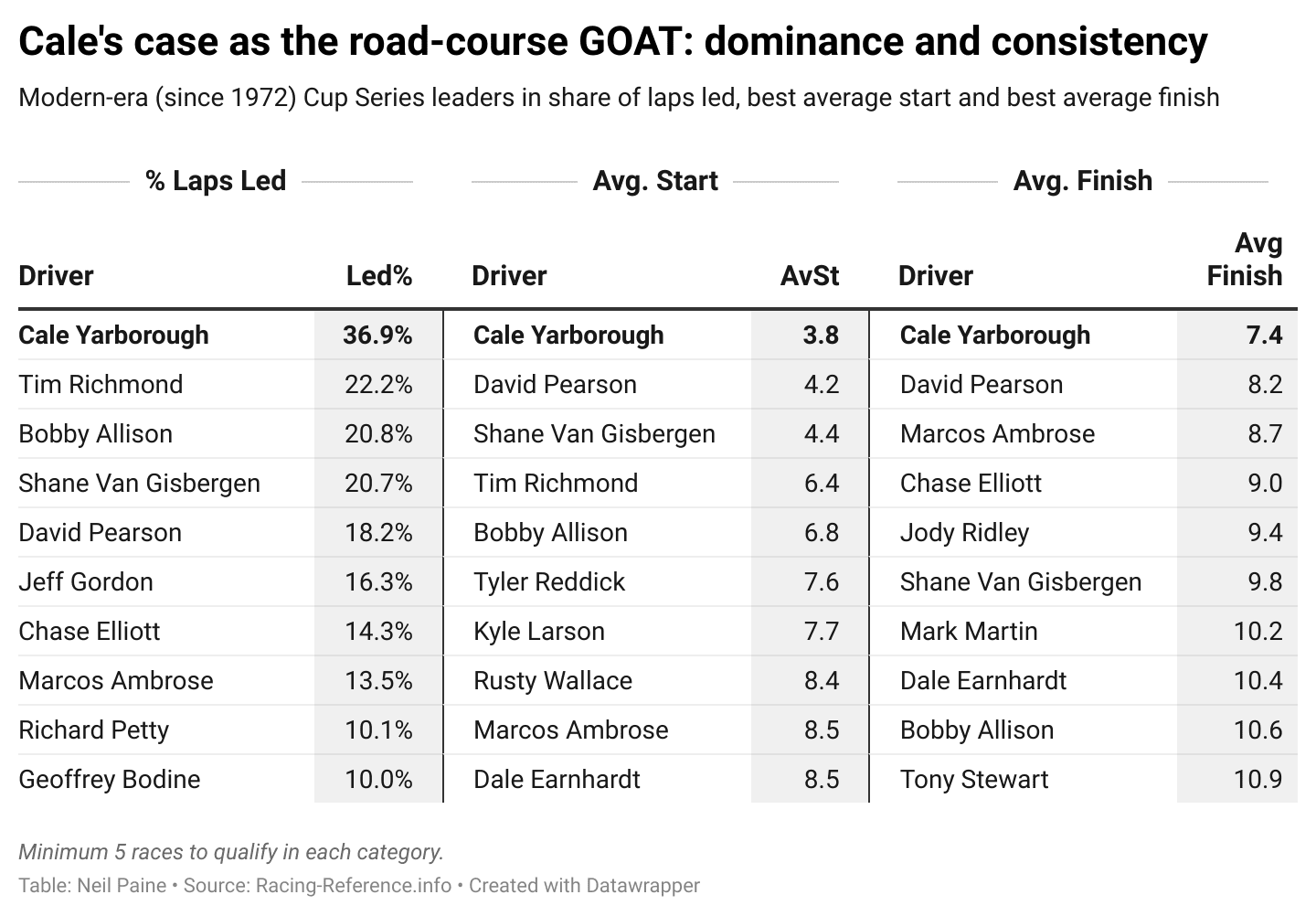
Metrics: Highest share of laps led (36.9%), best average finish (7.4) and average start (3.8) on road courses in Cup Series history

As remarkable as SVG’s Cup Series career on road circuits has been, he can’t really hold a candle to Cale Yarborough’s combination of dominance and consistency at those tracks. Though his winning percentage was slightly lower — he won three times in 14 tries, or 21.4% of the time —  Yarborough led 609 of a possible 1,649 laps (entirely at Riverside) in the 1970s and early 1980s, good for an all-time record rate of nearly 37%, roughly 15 percentage points higher than the next-highest (Richmond at 22%). Put another way: The gap in percentage points between Yarborough and Richmond was nearly as high as Gordon’s career share of laps led on road courses. Add in Yarborough’s all-time records for highest average start and finish — Yarborough was the king of absurdly low average start and finish stats in that era — and there’s a good case to be made that the driver of the iconic Junior Johnson No. 11 was also NASCAR history’s top statistical road-racer.

Marcos Ambrose

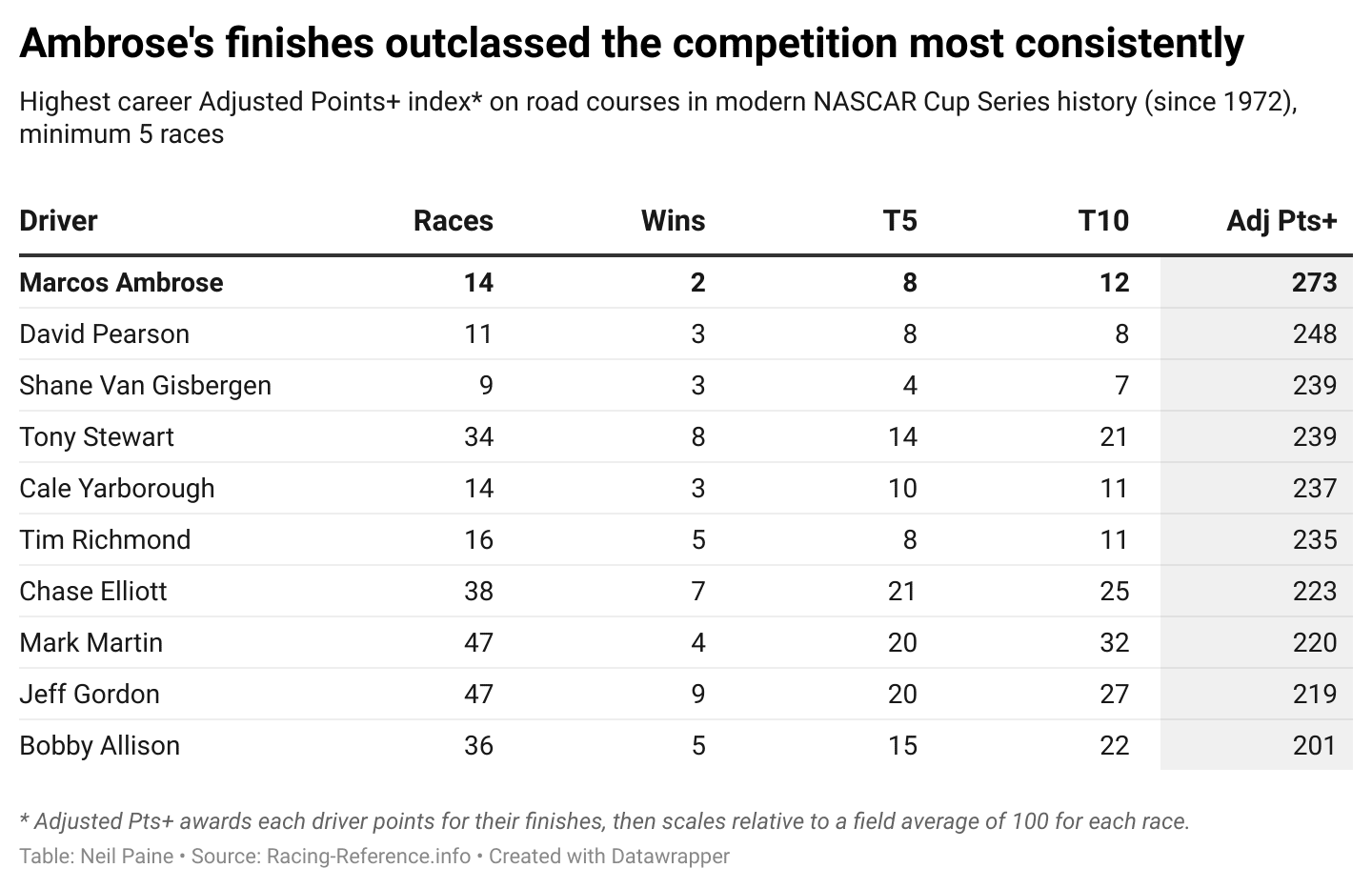
Metric: Highest Adjusted Points+ index (273) on road courses in Cup Series history

Longtime readers will know that one of my favorite metrics to use when judging a driver’s results is Adjusted Points+ index, which awards points for a driver’s finishes — with more emphasis on wins/high finishes than standard Cup scoring — and then scales that relative to a field average of 100. And when we look at the career leaders in that metric for road courses, nobody comes out looking better than Ambrose. After running a disappointing 42nd in his first career Cup race at Sonoma, the ringer-turned-regular finished eighth or better in 12 of his next 13 road races, a stretch of performances that was better relative to the competition than even SVG in the current era. (Let that sink in!) In the last golden era of true road-course ringers, from Boris Said to Scott Pruett and Jacques Villeneuve, Ambrose rose far above the rest.

Mark Martin

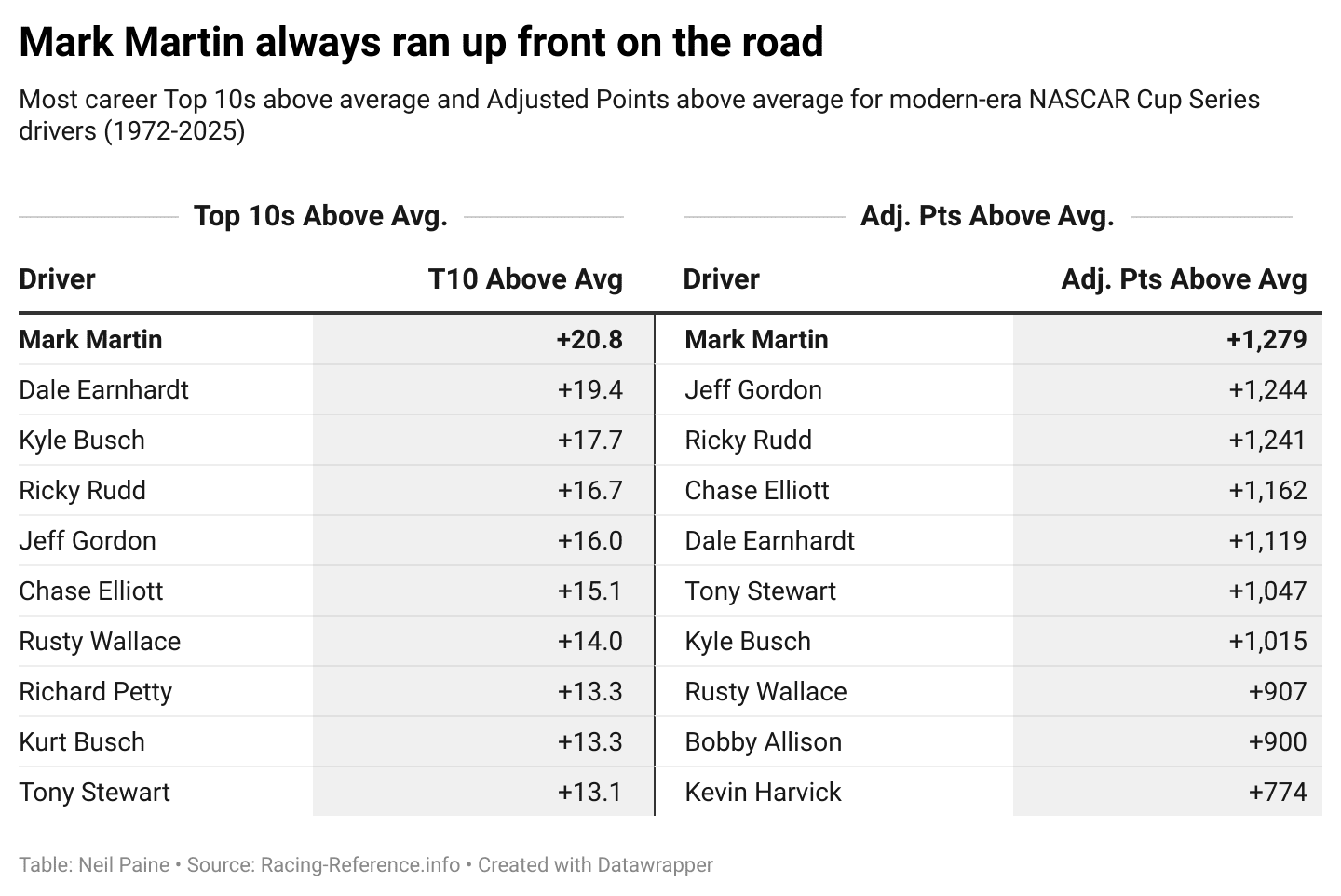
Metrics: Most Adjusted Points above average (+1,278.6) and top 10s above average (+20.8) on road courses in Cup Series history

In addition to being one of the most underrated drivers in Cup history, period, Martin was also one of the best road racers of his era. While his winning percentage of 8.5% lagged behind Gordon, Tony Stewart, Rusty Wallace and other contemporaries, he made up for it with consistently strong finishes across a sample of nearly 50 career road-course outings. No driver in history beat his average opponents in top 10s and total Adjusted Points more than the pride of Batesville, Arkansas — a testament to his talent, adaptability and longevity. During his most iconic era, driving the No. 6 car for Jack Roush from 1988-2006, Martin only had one subpar road-racing season by Adjusted Pts+ (2006) in a 19-year stretch.

Others to Consider

Though he didn’t lead the historical drivers in any of our major categories, Chase Elliott was the only name to rank among the top 10 in all of the stats we mentioned above (aside from average start). No, he hasn’t won at a twisty track since July 2021, 23 road races ago, but Elliott is still shy of his 30th birthday and will have plenty of chances to keep adding to a win tally just two behind Gordon’s all-time record. Also, Ricky Rudd deserves a shout-out here; the longtime driver of the Tide Ride (among many others) is actually the modern Cup leader in top fives above average (+19.3), though he didn’t fare as well in some of the other metrics we tracked. We already mentioned Tim Richmond’s stellar win rate, but it bears repeating as a point in favor of his GOAT case. Likewise, Tony Stewart’s No. 2 ranking in Wins Above Average (+7.2), just behind Gordon, works in concert with being one of only four drivers since 2005 with a triple-digit average Driver Rating on road courses — joining van Gisbergen, Ambrose and Elliott — to bolster his all-time argument. Similar to Martin and Rudd, Kyle Busch should get name-dropped for consistency and longevity; he leads all modern drivers in road course top 10s (33) and is second in top fives (22). Last but not least, Bobby Allison’s penchant for leading road-course laps (he did it 20.8% of the time, third behind Yarborough and Richmond) speaks to his dominance. And all of this is without even getting into pre-modern ringers like Dan Gurney, who won five times at Riverside in the 1960s.

The Verdict

So, who’s the GOAT of NASCAR road racing? As is often the case in these debates, it all depends on what you value the most: If you want the driver with the highest odds to win each time he gets behind the wheel, SVG is already the best. If you still want to see him prove it over a larger sample, Gordon remains the guy to beat, with Stewart not far behind. If you prize leading laps and running high from wire to wire, Yarborough or Allison can make a case — though their road races mostly came at one track, in a very different era. If a nice mix of consistency and dominance is your thing, Ambrose or even Elliott make a strong bid for No. 1. And for longevity, look to Martin, Rudd or Busch.

There’s not really a wrong answer, though some answers clearly have more evidence backing them than others, and van Gisbergen already has the resume to be taken seriously in that conversation, just a few years (and fewer than 10 road races) into his Cup career.

CONCORD, N.C. — While eliminated drivers (and fans who filled out a bracket) ponder what-ifs, Ty Dillon is taking the In-Season Challenge in stride, and for good reason.

After entering the inaugural bracket-style bout as the No. 32 seed, the No. 10 Kaulig Racing Chevrolet has been on a Cinderella run. The lowest-seeded Dillon kick-started the push by eliminating top-seeded Denny Hamlin at EchoPark Speedway (formerly Atlanta Motor Speedway) in the opening round after the Joe Gibbs Racing driver got caught up in an early wreck. In Round 2, the 33-year-old North Carolina native followed up the upset with an additional dub, knocking off No. 17 seed Brad Keselowski at the Chicago Street Course.

RELATED: Chicago results | In-Season Challenge hub

“It’s been a fun adjustment to our year,” Dillon said Wednesday at the NASCAR Research & Development Center in Concord, North Carolina, regarding the five-race tourney stretch. “I think you look at this point of year in past years, and the focus is so forward on the top 16 guys in points and maybe the top guys in points, where they’re going to end up as the (playoffs) start, and the focus on the broadcast, a lot of the news is more on that and not on the guys that are kind of battling from 18 to 25th in points and in that area, and just the life that’s given our race team.

“In that sense, we came in as the 32nd seed, which I think was a little bit undervalued. We had probably our three worst races in a row in the seeding portion of the season, which is fine because it’s given us a lot of (publicity) going into it and taking down Denny and Brad, the last two. For us, it’s been good momentum. We’ve ran pretty decent.”

Decent indeed, thanks in part to eighth- and 20th-place results at Atlanta and Chicago, respectively. Dillon’s momentum will look to continue at Sonoma Raceway on Sunday for Round 3 (3:30 p.m. ET, TNT Sports/truTV, HBO Max, PRN Radio, SiriusXM NASCAR Radio), where he will challenge eighth-seeded Alex Bowman, a strong competitor on road courses.

While besting Bowman will be tricky — both in racing and in thinking of colorful banter aimed at the No. 48 driver should Dillon prevail over him — Dillon has enjoyed the battle for the $1 million prize. To Dillon, the In-Season Challenge has also served the purpose of highlighting drivers up and down the points standings. Legacy Motor Club teammates John Hunter Nemechek and Erik Jones will battle in Round 3, while Front Row Motorsports’ Zane Smith will challenge Joe Gibbs Racing’s Ty Gibbs on the opposite end of the bracket.

“There’s some underdog stories here that are getting a lot of attention, and it’s made it a lot of fun for the drivers, the teams and the media and the fans,” Dillon said. “It’s given us a chance at this point in the season to show personality where, usually at this point of the season, it gets real quiet for teams like us, and even though we’re grinding hard and the stories are just as fascinating, we don’t get talked about as much. So I’m a fan of what it’s done, obviously living it firsthand, and I’m looking forward to the continuation of it.”

MORE: Cup Series standings | Cup Series schedule

Dillon, in his first full-time Cup Series campaign since 2023, earned his first and only top 10 of the season thus far two weeks ago at EchoPark and currently ranks 32nd in points. Although the on-track results might not yet reflect in terms of marquee finishes, Dillon is optimistic that, by the 2025 season’s end, momentum will still be pointing in the upward direction.

“I think there’s still a lot of good results that need to come to have the ultimate respect, but I’ve heard it more than I’ve ever heard [it in] my career, that we’re overachieving and we’re doing a great job and it’s nice to hear, but there’s a lot more to go,” Dillon said. “Hopefully that continues that narrative. I think it’s been the best that it’s ever been for my career. I feel like the attention is starting to match up with the work that I’ve been putting in and the race team has been putting in, and now it’s time to double down on that and take ourselves to a team that’s running consistently [from] 15th to 20th, to 15th to eighth. I think if we get to that spot, we’re going to have a lot of opportunity to capitalize on wins.”

Here’s what’s happening in NASCAR with the Grant Park 165 at the Chicago Street Course in the rearview and the Toyota/Save Mart 350 at Sonoma Raceway up next.

MORE: Sonoma entry list | In-Season Challenge hub

1. How realistic is an SVG title run in 2025?

Shane van Gisbergen looks entirely unbeatable on road courses at the moment, but there’s only one of those in the 10-race playoffs. Will his oval acumen improve enough by then to carry him deep in the postseason?

Shane van Gisbergen completed his weekend sweep of the Chicago Street Course on Sunday with methodical precision, claiming his second Cup Series win of 2025.

That’s not the surprising part.

What has caught many off guard, however, is that the Cup Series may have a legitimate problem on its hands for years to come in the form of the New Zealand product; an unstoppable force of nature on the sport’s growing list of road courses and steadfast in his dedication to improving on all the other ones.

The three-time Supercars champ is now a three-time Cup Series winner, and in extremely short order, becoming the most successful foreign-born driver in series history a mere 33 starts into his dang career.

It’s why he’s here, of course. Trackhouse Racing didn’t sign a driver with limited stock-car experience in his mid-30s and force him to move halfway around the world to not win races. It also didn’t sign him to just hold the occasional trophy in Victory Lane and hope for the best come playoff time. There’s a legitimate path to a championship run here; the only question is when?

Van Gisbergen’s current positioning is the most unique we’ve seen in the history of this playoff format — No. 88 sits a dismal 27th in the overall Cup Series standings with just 308 points, but is essentially almost expected to tie for the series lead in wins this weekend with another road course on tap. Already claiming two of the three such events in 2025, including a staggering 16.567-second victory margin in Mexico City — the largest winning margin on a road course since Riverside in 1979 — barring catastrophe, a third feels inevitable.

RELATED: Cup Series standings | 2025 schedule

A driver that good, and willing to make that kind of career move, isn’t going to let a steep learning curve on oval tracks weigh him down and keep him from actually seeing this thing through to the end. With all the applicable tools at his disposal and a burning desire to accomplish what is an abundantly obvious goal, who in their right mind would bet against this guy?

At this point, until proven otherwise and as long as multiple road courses still exist in the regular season, you can essentially pencil in SVG to every playoff field moving forward for the foreseeable future. What remains is just how far he’ll be able to take that berth, because of his — completely understandable — “niche” skillset.

SVG’s 22.947 average finish through 19 races reflects the rookie’s consistent struggles on NASCAR’s traditional venues, yet to finish better than 14th on a non-road course in 2025. With the playoffs just a handful of weeks away and nine of the 10 playoff races contested on ovals, including the championship finale at Phoenix on November 2, it’s obviously a bit of a stretch to think a title run could happen this year. But it’s not impossible in the least, and SVG is quite capable of making things interesting — he’s just gotta escape the Round of 16.

“Yeah, that first round is going to be very difficult,” van Gisbergen said after his Chicago win. “It’s got one track I haven’t been to, Gateway. It’s got my favorite oval in it, Darlington. I love that place. And then Bristol, which is what I’ve found (to be) the most difficult track. I feel like I may as well be driving the other way there. It’s so hard. It’s some pretty difficult places for me. But I feel like we’re still making massive leaps on the oval, and there’s still a few weeks left to keep getting better.”

The 36-year-old has accrued 11 playoff points to date — nearly half that of Kyle Larson, who has the most — and it’s conceivable he’ll pad that at least a bit more by September. That could mark the difference between advancing or not into the next three-race round of the playoffs. The Charlotte Roval then potentially awaits him in the Round of 12, and he’ll be favored to win there whether he’s still in title contention or not. Assuming a win there, a ludicrously difficult Round of 8 against NASCAR’s elite remains, but this is absolutely a “never say never” kind of sport — after all, who had him winning his literal first NASCAR start at Chicago in 2023?

There’s no denying SVG is going to improve on ovals over time, but it’s not a given that anybody matches his road-course prowess at any point in his NASCAR tenure.

If the oval ascension comes sooner than later, we could be seeing a non-stop flurry of rugby balls being punted from Victory Lane over the next half-decade-plus.

And one of them might just be after taking the checkered for the Bill France Cup.

MORE: Shane van Gisbergen has raised the bar in NASCAR road racing

James Gilbert | Getty Images

2. How concerning is William Byron’s summer slump?

William Byron, for the second year in a row, clinched a playoff spot before anybody else and raced for months like the title was his to lose. No. 24 also hasn’t won since February, and is suddenly mired in a career-worst stretch at the moment. What gives?

Fresh off his first two Championship 4 appearances, William Byron stormed out of the gate in 2025 by winning his second straight Daytona 500 and proceeding through the first several months looking like he’d easily be racing for the title once again come November.

The wins have dried up since the Daytona triumph, but at first it was no biggie — No. 24 was still manhandling the field, holding the first or second spot in the standings literally every week this season by virtue of a steadily increasing points cushion.

That dominance has evaporated, however, and Byron suddenly finds himself ensnared in an eight-race stretch with five finishes of 24th or worse, the worst duo of which coming the past two weeks.

What once seemed an insurmountable standings lead has shrunk to just 13 points over teammate Chase Elliott after a catastrophic 40th-place finish (and overall weekend) at Chicago, where mechanical issues ended his day after completing just one lap. The summer slide has transformed NASCAR’s early-season favorite into a driver fighting to maintain momentum as the playoffs approach.

Byron’s midseason struggles aren’t new, either. For whatever reason, Byron has made summer inconsistency an annual tradition. Is it a concerning one, though?

Perhaps not.

In 2023, Byron managed just six top-10 finishes in the second half of the regular season with a rough stretch of five races finishing 14th or worse baked in (albeit bookended with victories) — yet still advanced to the Championship 4. Last season, the Charlotte native posted just five top 10s in the second half, this time with no victories … and again reached Phoenix as a title contender.

Perhaps, with a playoff spot clinched, he and crew chief Rudy Fugle utilize summer races as experimental sessions to a degree, while focusing resources on championship-critical races. If so, this strategy has historically worked — Byron has posted 16 top-10 finishes and 11 top fives in his last 20 playoff races, clearly able to turn on the jets come crunch time.

Despite his struggles, Byron remains well-positioned for the playoffs, with his 12 playoff points ranking fourth among race winners. It’s hard not to think he should have a good deal more than that, though, with several near wins wiping the chances of a first-round walk-in-the-park all but away.  Larson’s 23 playoff points and Denny Hamlin’s 19 — with more wins feeling imminent for both — represent significant advantages heading into the elimination rounds.

The concern extends even beyond points to momentum, though. Byron’s early-season performance proved his speed remains elite, but his summer slide — even with past history on his side — raises questions about whether the No. 24 team can recapture that form when elimination pressure mounts, as these past few weeks have displayed an uncharacteristic outward display of frustration for Byron.

There are few drivers generally more unshakeable in the series, however, and his track record suggests optimism. But the margin for error has narrowed considerably.

While history suggests he’ll rebound in the playoffs, the championship landscape has shifted around him with the field feeling significantly more wide open than even a month ago. The next seven races and beyond will determine whether his struggles represent strategic patience or championship-killing complacency.

The points leader’s early season crown may be slipping, but it hasn’t fallen off completely just yet.

Perhaps all it needs is an adjustment, and we’ll once again be toasting the king-in-waiting this weekend in Wine Country.

David Jensen | Getty Images

3. SVG dices up ‘difficult’ first round of playoffs

2025 Chicago Street Race winner Shane van Gisbergen gives his thoughts on the Cup Series Playoffs and how challenging the first-round gauntlet will be.

4. NASCAR Insights: Road-course edition

You won’t be surprised to see who’s at the top of the list for a handful of categories here, but there are some interesting names in the mix — some of whom are still looking for a playoff berth. (Credit: Racing Insights)

RankSpeedLong runPassingDefenseRestarts
1Shane van GisbergenShane van GisbergenShane van GisbergenJoey LoganoRyan Preece
2Kyle BuschChristopher BellChase BriscoeDenny HamlinChristopher Bell
3Chase BriscoeWilliam ByronKyle BuschBrad KeselowskiKyle Busch
4Michael McDowellChase ElliottRyan BlaneyBubba WallaceAJ Allmendinger
5Christopher BellAlex BowmanAJ AllmendingerRoss ChastainAlex Bowman
6William ByronMichael McDowellTyler ReddickWilliam ByronShane van Gisbergen
7Tyler ReddickKyle BuschChristopher BellTy GibbsRyan Blaney
8AJ AllmendingerTyler ReddickWilliam ByronRyan PreeceWilliam Byron
9Kyle LarsonChris BuescherTy GibbsAustin DillonTy Gibbs
10Chase ElliottChase BriscoeBubba WallaceChase BriscoeTyler Reddick

5. Catch the pack — news and notes from around the garage

Paint Scheme Preview: 2025 Sonoma Raceway weekend

Playoff standings: How national series fields shake up heading into Sonoma

Power Rankings: Is Allmendinger the next road ace to shake up playoff field?

NASCAR’s Moran breaks down caution on final lap at Chicago

Happy returns: ‘Epic’ grit from No. 88 crewman helps muscle SVG to Chicago triumph again

Bubba Wallace, Alex Bowman collide in Chicago scrap; cooler heads prevail

In-Season Challenge: Update after Round 2 at Chicago

Ty Dillon on messing with Brad Keselowski: ‘It flowed pretty well’

Ross Chastain, Joey Logano confront each other after Chicago run-in

How mechanical issues plagued McDowell’s Chicago run

Reddick, No. 45 team turn late strategy gamble into third-place finish at Chicago

Trackhouse owner Marks comments on Suárez’s departure: ‘It was time to move on’

@nascarcasm: Fake texts to Chicago winner SVG

Meg Oliphant | Getty Images

After a 32-second lag in calling a caution for the heaviest front-end impact in the Next Gen era, NASCAR is re-evaluating its camera coverage for future street course races.

During the latest episode of the “Hauler Talk” podcast, NASCAR managing director of racing communications Mike Forde confirmed Cody Ware’s crash into the Turn 6 tire barrier on the penultimate lap of the Chicago Street Race was the heaviest recorded since the debut of the Next Gen car in 2021. The yellow flew on the last lap after Shane van Gisbergen had taken the white flag, negating the possibility of an overtime finish.

Forde said NASCAR officials weren’t immediately privy to the footage that showed Ware approaching the tire barrier at full speed. Race director Jusan Hamilton waited before triggering the caution because Cup drivers previously have been able to wriggle out after having their cars buried deep in a tire pack. Forde said the yellow began when Ware dropped his window net after being unable to reverse out of the tires.

Ware’s in-car camera showed the full-speed collision with the barrier, and Forde said if NASCAR officials had seen that angle, “a caution would have been immediately thrown, but all we saw at that moment in time was the car in the barrier.”

MORE: Caution flies in closing Chicago moments, SVG wins

Although NASCAR has access to all 40 in-car cameras, they aren’t monitored in real-time by race control. In the Turn 6 area where Ware’s collision occurred, there are two cameras to capture cars entering and exiting the corner. Forde said that because the No. 51 Ford was off line entering the turn, Ware was in a blind spot for the fixed camera (which is focused on the racing groove). The cameras monitored in real-time by race control picked up the car only after it had impacted the barrier.

Forde said NASCAR would evaluate improving coverage of Turn 6 by adding cameras in that area if NASCAR returns to the Chicago circuit next year. NASCAR also is building out an off-site race control in Concord, North Carolina, that could offer more support (such as increasing real-time monitoring of in-car cameras) in the future.

“When we say, ‘We missed it,’ it wasn’t that they weren’t watching that particular screen at the time,” Forde said. “When (Cup Series director) Brad Moran says we need to have that footage in the future, what he means is that coverage area needs to be expanded. If we come back to Chicago, the solution there is more cameras in different positions. That’s absolutely something that we need to keep our drivers safe, and something that will be put into place in the future.”

Forde said he confirmed with Hamilton that the timing of the caution for Ware’s wreck was unrelated to an approaching storm that might have caused major delays if the race had entered overtime.

“We have a system where if a lightning strike is within a certain number of miles, we’ll start getting text messages,” Forde said. “We started getting lightning alerts that the strikes were about 27 miles away but approaching us. So I asked (Hamilton) if we held that caution because it was going to be touch and go with a restart, and then we’d have to have a 30-minute hold or more. He said, ‘No, weather was not in my mind whatsoever in this decision at all. It strictly was, let’s see if the 51 can back out.”

Other topics covered by Forde and NASCAR senior director of racing communications Amanda Ellis during the 22nd episode of “Hauler Talk,” which explores competition issues in NASCAR:

— The pause before throwing a yellow flag after Josh Berry’s impact with the wall

— The battle between Alex Bowman and Bubba Wallace and whether NASCAR officiates differently for cars facing off during the In-Season Challenge

— Whether there would be penalties from the incident involving Joey Logano and Ross Chastain

— The details of a caution being called for a spectator medical emergency

— The future of the Chicago Street Race

Click on the embed above to listen or search for “Hauler Talk” wherever you download podcasts to hear it on your phone, tablet or mobile device.

Nate Ryan has written about NASCAR since 1996 while working at the San Bernardino Sun, Richmond Times-Dispatch, USA TODAY and for the past 10 years at NBC Sports Digital. He is a contributor to the “Hauler Talk” show on the NASCAR Podcast Network. He also has covered various other motorsports, including the IndyCar and IMSA series.

WINSTON-SALEM, N.C. – Bowman Gray Stadium is back in action this Saturday night with its second Double Points Night this season, and a lot of money up for grabs.

The Brad’s Golf Cars Modified Series drivers will face a $9,000 Fans’ Challenge in the July 12 Traffic Control Safety Services 100.

One driver expected to take the Fans’ Challenge is Chris Fleming, who just won his first race this season on June 28, but now is looking to pad his wallet this weekend.

“Look, we’re not running for points,” Fleming said. “We’re here for our fans, and they deserve a good show.

“We finally cashed in on the speed we’ve been gaining, so I think we can cash that Fans’ Challenge check (on Saturday).”

Meanwhile, Burt Myers and Tim Brown will look to break their tie on top of the all-time Brad’s Golf Cars Modified Series wins list. Both had chances to get win No. 102 on June 28, but ran out of time to make a winning pass.

“That’s part of it,” Myers says, “you’re not going to win them all, but we’ve definitely had chances to win every race we’ve been in this year.”

Fans will also be treated to a parachute jump from the Special Forces Parachute Team, and one lucky fan will win a John Deere lawn mower.

Gates open at 6 p.m. Saturday night, with racing action to start at 8 p.m. Fans can get tickets online right now at www.bowmangrayracing.com. Tickets are $12 for adults and $2 for kids ages 6 to 11.