NASCAR and Rev Racing select six promising drivers for academy-style program

RELATED: NASCAR Home Tracks

DAYTONA BEACH, Fla. (Jan. 30, 2014) – NASCAR Drive for Diversity (D4D), the leading youth development program for multicultural and female drivers, will head into the 2014 season with one of the most well-rounded and accomplished rosters in program history.

The 2014 class is led by Daniel Suarez, who contended for two NASCAR touring series championships last year, and Ryan Gifford, who is coming off a successful 2013 that saw him earn his first NASCAR win and make his NASCAR national series debut. They will be joined by a group of talented newcomers looking to make their mark in the NASCAR K&N Pro Series and NASCAR Whelen All-American Series.

"NASCAR is committed to providing training, competition experience and mentoring to drivers who without a doubt demonstrate the potential to compete at the highest levels of our sport through the academy-style program," said Marcus Jadotte, NASCAR vice president of public affairs and multicultural development. "We look forward to another successful racing season with the Drive for Diversity team."

In addition to Suarez and Gifford, Sergio Peña returns to the program in which he earned three wins and finished fifth in NASCAR K&N Pro Series East points in 2011. They’ll be joined in the K&N Pro Series ranks by Jay Beasley. Beasley won the 2013 NASCAR Whelen All-American Series Super Late Model track championship at The Bullring at Las Vegas Motor Speedway and the series’ Nevada championship.

Devon Amos, who drove with Rev Racing’s Legends program last year, and Paige Decker will compete for the team in Late Models in the NASCAR Whelen All-American Series.

"Our goal is to keep building upon our successes with every new class we select," said Max Siegel, CEO of Rev Racing. "We are excited with the momentum built in 2013 with several D4D career milestones. This year’s class has a tough job ahead of them and we look forward to providing them with all the tools necessary to reach individual and collective successes across the board."

D4D saw one the strongest pool of applicants the program has ever seen this year. Nearly 100 drivers, representing 14 states and Mexico, applied for an opportunity to try out for a spot with Rev Racing at the annual Combine – a three-day tryout where drivers’ undergo physical assessments and are evaluated on on-track abilities by executives across the industry.

In 2013, D4D saw the impressive rise of graduates Kyle Larson and Darrell Wallace Jr.

Wallace became the first African-American to win a national series victory in nearly 50 years at Martinsville in the NASCAR Camping World Truck Series. And Larson, whose meteoric rise through the ranks solidified D4D as a driving powerhouse for developmental athletes at NASCAR, earned the Sunoco Rookie of the Year Award in the NASCAR Nationwide Series as well as became the first D4D participant to secure a full-time ride in the NASCAR Sprint Cup Series for Chip Ganassi Racing with Felix Sabates. Larson was also the first D4D driver to secure a national series victory.

Rev Racing drivers in the NASCAR K&N Pro Series include:

Daniel Suárez: The Monterrey, Mexico, native is a member of the NASCAR Next program and joins Rev Racing for the second season. The 22-year-old finished third in the 2013 NASCAR K&N Pro Series East championship standings and was the championship runner-up in the NASCAR Mexico Toyota Series in 2013. He recorded his first NASCAR K&N Pro Series East win last July at Columbus (Ohio) Motor Speedway.

Ryan Gifford: Another member of the NASCAR Next program, the 24-year-old from Winchester, Tenn., garnered his first NASCAR K&N Pro Series East win last season at Richmond (Va.) International Raceway. In 2010 at Martinsville (Va.) Speedway, he became the first African-American driver to win a NASCAR K&N Pro Series East pole position. Additionally, he made his NASCAR Nationwide Series debut last August at Iowa Speedway, finishing ninth driving for Richard Childress Racing.

Jay Beasley: This 21-year-old from Las Vegas won the NASCAR Whelen All-American Series Super Late Model track championship at The Bullring at Las Vegas Motor Speedway and the series’ Nevada championship on the strength of eight victories in 14 starts. He also earned the 2013 Wendell Scott Trailblazer Award as a result of his early success on the track.

Sergio Peña: With three career NASCAR K&N Pro Series East wins to his credit, the 21-year-old from Winchester, Va., has a pair of top-10 finishes in points for 2011-12 while collecting 19 top 10s in 39 NASCAR K&N Pro Series East career starts.

Drivers competing in the NASCAR Whelen All-American Series include:

Paige Decker: From Eagle River, Wis., the 20-year-old driver competed in her Super Late Model at tracks throughout the Midwest.

Devon Amos: Competing mostly in a Legends car in 2013, the 22-year-old from Rio Rancho, N.M., scored a seventh-place finish in his stock car debut last summer at Hickory (N.C.) Motor Speedway.

The NASCAR K&N Pro Series East kicks off its 2014 season at New Smyrna (Fla.) Speedway on Sunday, Feb. 16. Two days later, on Tuesday, Feb. 18, the UNOH Battle At The Beach will take place on the .37-mile short track situated on the Superstretch at Daytona International Speedway. The NASCAR Whelen All-American Series drivers will compete primarily at Hickory Motor Speedway, where the season is scheduled to get underway on March 8.

MORE:

WATCH: NASCAR ’14 trailer:
Stewart’s comeback

READ: Kurt Busch compares
new, old teams

READ: Twitter crew:
Favorite NASCAR follows

READ: Top 10
rookie campaigns

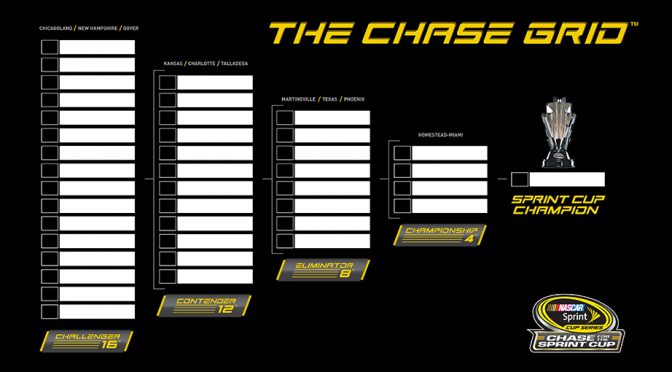
Round-by-Round and Chase for the NASCAR Sprint Cup Grid explanations

RELATED: Full coverage of the Chase for the NASCAR Sprint Cup format change

Q. Does this new Chase format emphasize winning?

A. Absolutely. The easiest way to make the new Chase for the NASCAR Sprint Cup is to win. And winning is also the fastest way to advance in the Chase and become one of the four drivers competing in the NASCAR Sprint Cup Championship at Homestead-Miami Speedway.

Q. How will the Chase Grid drivers be selected?

A. Positions 1-15 on the Chase Grid will be determined by the drivers with the greatest number of NASCAR Sprint Cup Series wins after the first 26 races. The 16th position is reserved for the points leader if he/she does not have a win.

Q. How will the Chase Grid be seeded?

A. All drivers will have their points total reset to 2,000 points. Drivers receive 3 additional bonus points for each win during the first 26 races.

Q. Is there a minimum points standing that a driver who records a win during the first 26 races must achieve to make the Chase Grid?

A. Yes. A driver must be in the Top 30 in the NASCAR Sprint Cup Series points following the first 26 races AND have attempted to qualify for all of the first 26 races.

Q. What if a driver is prevented from competing in one or more of the first 26 races due to injury or illness?

A. NASCAR, for rare instances, can waive the requirement of attempting to qualify for all of the first 26 races as long as the driver is in the Top 30 in points.

Q. Which races are the "advancement" races?

A. Once the field is reset after the 26th event, there are "advancement" races following the 29th event (Dover); 32nd event (Talladega); and 35th event (Phoenix). There will be four drivers competing for the NASCAR Sprint Cup Championship at Homestead-Miami Speedway.

Q. Will lap leader bonus points still be applied?

A. In all but the final race, bonus points for laps led will still be awarded in the Challenger, Contender and Eliminator Rounds. However, at the NASCAR Sprint Cup Championship, the four drivers will start the race tied and there will be no bonus points for laps led, etc. The highest finisher among that group will be the champion.

Q. What happens to a Chase Grid driver’s points if he/she doesn’t advance to the next round of the Chase?

A. Drivers who don’t advance to the next round will have their point totals reset to the Chase-start base of 2,000 (with any regular-season wins bonus points), plus the additional points they’ve earned during the Chase. 

MORE:

WATCH: NASCAR ’14 trailer:
Stewart’s comeback

READ: Kurt Busch compares
new, old teams

READ: Twitter crew:
Favorite NASCAR follows

READ: Top 10
rookie campaign

s

16-driver Chase Grid introduced; four-driver first-to-the-finish finale unveiled

MORE: Full coverage of the Chase for the NASCAR Sprint Cup format change

DAYTONA BEACH, Fla. (Jan. 30, 2014) – NASCAR announced a new championship format today that will put greater emphasis on winning races all season long, expands the current Chase for the NASCAR Sprint Cup field to 16 drivers, and implements a new round-by-round advancement format that ultimately will reward a battle-tested, worthy champion.

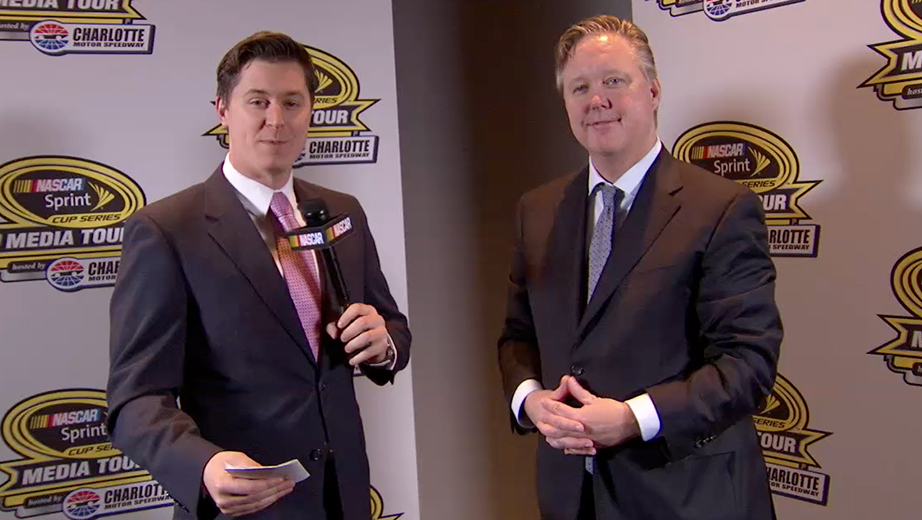
“We have arrived at a format that makes every race matter even more, diminishes points racing, puts a premium on winning races and concludes with a best-of-the-best, first-to-the-finish line showdown race – all of which is exactly what fans want,” said Brian France, NASCAR chairman and CEO. “We have looked at a number of concepts for the last three years through fan research, models and simulations, and also maintained extensive dialogue with our drivers, teams and partners. The new Chase for the NASCAR Sprint Cup will be thrilling, easy to understand and help drive our sport’s competition to a whole new level.”

Changes announced by France to the championship format include:
–    A victory in the first 26 races likely will guarantee a driver a berth in the 10-race Chase for the NASCAR Sprint Cup — a change that will put an unprecedented premium on winning a NASCAR Sprint Cup Series race all season long
–    Expanding the Chase field from 12 to 16 drivers, with those drivers advancing to what now will be known as the NASCAR Sprint Cup Series Chase Grid
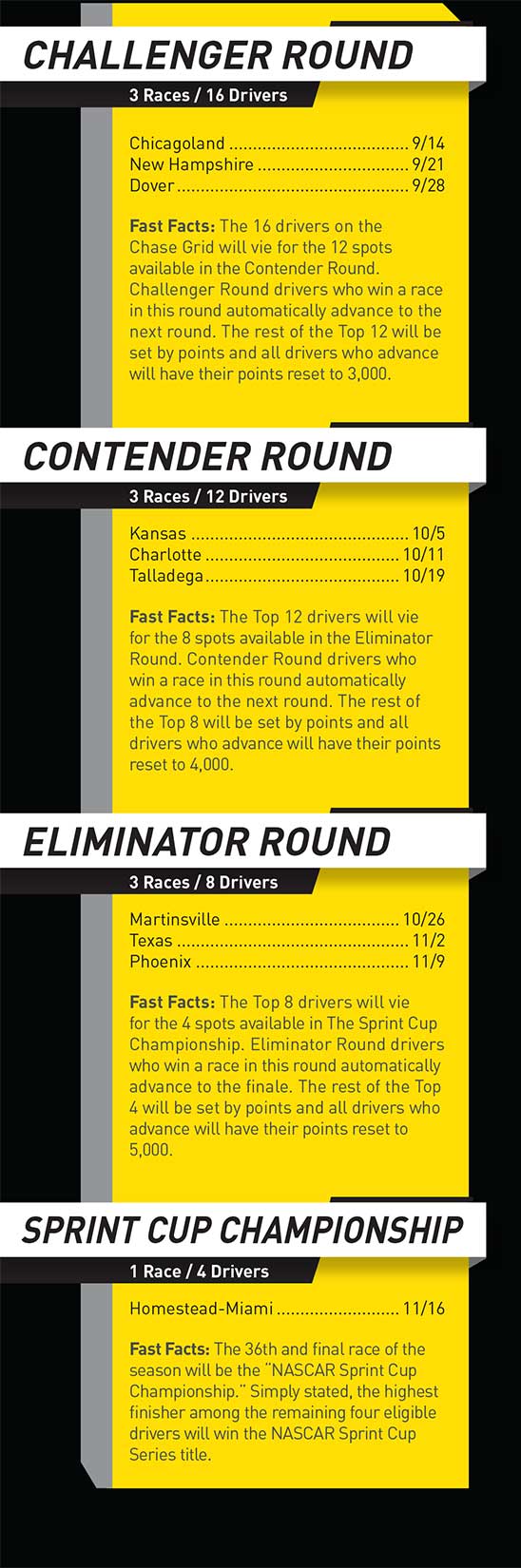
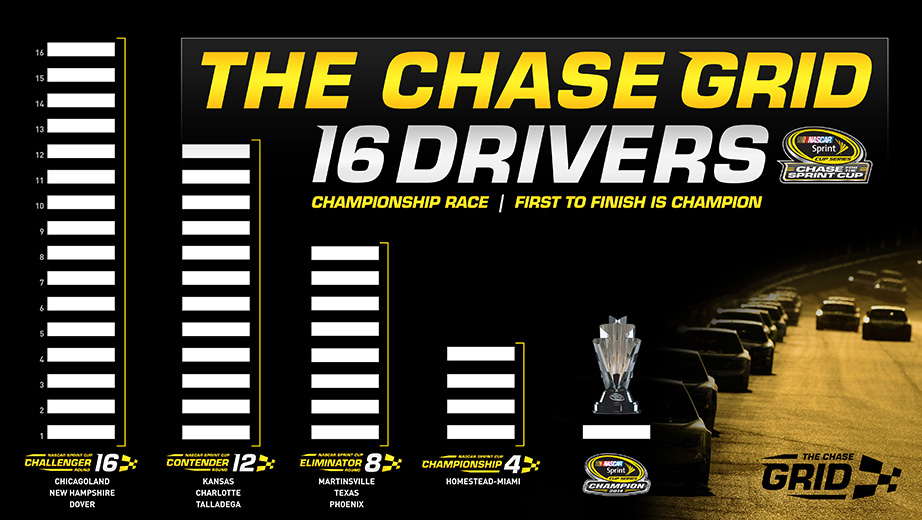
–    The number of championship drivers in contention for the NASCAR Sprint Cup championship will decrease after every three Chase races, from 16 to start in the Chase Grid; 12 after Chase race No. 3; eight after Chase race No. 6; and four after Chase race No. 9
–    The first three races of the Chase (27-29) will be known as the Challenger Round; races 30-32 will be known as the Contender Round; races 33-35 will be the Eliminator Round and race No. 36 will be the NASCAR Sprint Cup Championship
–    A win by a championship-eligible driver in any Chase race automatically clinches the winning driver a spot in the next Chase round
–    Four drivers will enter the NASCAR Sprint Cup Championship with a chance for the Cup, with the highest finisher among those four capturing the prestigious NASCAR Sprint Cup Series title.

Eligibility for the Chase for the NASCAR Sprint Cup

The top 15 drivers with the most wins over the first 26 races will earn a spot in the Chase Grid — provided they have finished in the top 30 in points and attempted to qualify for every race (except in rare instances). The 16th Chase position will go to the points leader after race No. 26, if he/she does not have victory. In the event that there are 16 or more different winners over 26 races, the only winless driver who can earn a Chase Grid spot would be the points leader after 26 races.

If there are fewer than 16 different winners in the first 26 races, the remaining Chase Grid positions will go to those winless drivers highest in points. If there are 16 or more different winners in the first 26 races, the ties will first be broken by number of wins, followed by NASCAR Sprint Cup Series driver points.

As was implemented in 2011, prior to the start of the Chase, all Chase Grid drivers will have their points adjusted to 2,000, with three additional bonus points added to their total for each win in the first 26 races.

Advancement Model during Chase for the NASCAR Sprint Cup
After the third Chase race, the Chase Grid will be left with 12 drivers. After the sixth Chase race, the field will drop to eight drivers, and following the ninth Chase race, only four drivers will remain in championship contention for the NASCAR Sprint Cup championship.

The first round (races 27-29) will be called the "Challenger Round." If a driver in the Chase Grid wins a Challenger Round race, the driver automatically advances and his/her points will be reset to 3,000. Only the top 12 in points after the Challenger Round remain in championship contention, and all will then have their points reset to 3,000.

The second round (races 30-32) will be called the "Contender Round." Likewise, if a driver in the top 12 in points wins a race in the Contender Round, the driver automatically advances and his/her points will reset to 4,000. Only the top eight in points after the Contender Round remain in championship contention, and all then will have their points reset to 4,000.

The third round (races 33-35) will be called the "Eliminator Round." If a driver in the top eight in points wins a race in the Eliminator Round, the driver automatically advances and his/her points will reset to 5,000. The top four in points after the Eliminator Round remain in championship contention, and all then will have their points reset to 5,000.

Additionally, as drivers are eliminated from the Rounds, their points total will be readjusted to the normal points format in sync with all other drivers in the field no longer in contention for the championship. This will allow all drivers not in contention for the NASCAR Sprint Cup championship to continue to race for the best possible season-long standing, with fifth place ultimately still up for grabs at the season finale.

Four-Driver, First-to-the-Finish Championship Finale

The 36th and final race of the season will be the "NASCAR Sprint Cup Championship." Simply stated, the highest finisher in the Championship race among the remaining four eligible drivers will win the NASCAR Sprint Cup Series title.

Bonus points for laps led or previous race wins will not apply in the season finale, so the official finishing position alone will decide the champion.

Note: All rules outlined above also apply to the NASCAR Sprint Cup Series owner championship structure.

For more details on the new championship format, please visit NASCARMedia.com for a Fact Sheet / FAQs or visit NASCAR.com.

MORE:

WATCH: NASCAR ’14 trailer:
Stewart’s comeback

READ: Kurt Busch compares
new, old teams

READ: Twitter crew:
Favorite NASCAR follows

READ: Top 10
rookie campaigns

The latest news from NASCAR’s announcement detailing changes to the Chase format

Featured Story

France announces format changes to the Chase

NASCAR Chairman and CEO Brian France announced several changes to the Chase for the NASCAR Sprint Cup on Thursday. The new format includes an expanded field of 16 drivers and three elimination rounds. The champion will be determined in a first-to-the-finish finale at Homestead. | Read the full story | Video: France announces the changes | France breaks down the changes

MORE NEWS
NASCAR announces Chase for the Sprint Cup format change
Chase for the NASCAR Sprint Cup Facts & FAQ
Chase changes create excitement, competition
Video: Explaning the changes to the Chase
Gordon, Hendrick discuss Chase changes
Medical exemption marks ‘new day’ for NASCAR
Small teams could benefit the most
Mapping the plan for future Chase drivers
Last three Chases under new championship format
Social Buzz: Social media reacts to big announcement
Helton: ‘The timing was right’ | Helton: As an avid fan, ‘I’m excited’

MORE:

WATCH: NASCAR ’14 trailer:
Stewart’s comeback

READ: Kurt Busch compares
new, old teams

READ: Twitter crew:
Favorite NASCAR follows

READ: Top 10
rookie campaigns

Skittles brand returns to NASCAR after more than 10-year absence 

Will Skittles rain down on Kyle Busch in Victory Lane someday? We shall see after Joe Gibbs Racing added Skittles as a sponsor for its NASCAR team. 

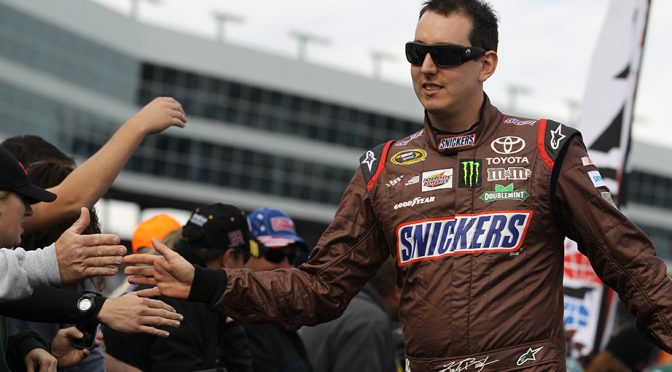
For the first time in more than 10 years the iconic bite-sized candy will make its return to the NASCAR Sprint Cup Series to adorn Kyle Busch’s No. 18 Toyota Camry.

JGR already has a longstanding relationship with Mars, Inc., featuring the M&M’s, Doublemint and Snickers logos on its cars.

The Skittles brand made its first appearance in NASCAR in 1998 as it partnered with MB2 Motorsports with the No. 36 Pontiac and driver Derrike Cope. 

"We’re proud to bring one of America’s most iconic candy brands back to NASCAR and eager to see what victories ‘The Rainbow’ brings this season as Kyle Busch takes the wheel of the Skittles No. 18 Camry," John Starkey, Sr. Director of Confections at Wm. Wrigley Co. said. "Sometimes ‘The Rainbow’ likes to mix things up and now seemed like a great time for Skittles to return to the track to have some fun."

MORE:

WATCH: NASCAR ’14 trailer:
Stewart’s comeback

READ: Kurt Busch compares
new, old teams

READ: Twitter crew:
Favorite NASCAR follows

READ: Top 10
rookie campaigns

Reorganized team looks forward to 2014 in wake of Richmond scandal

RELATED: Michael Waltrip Racing team preview

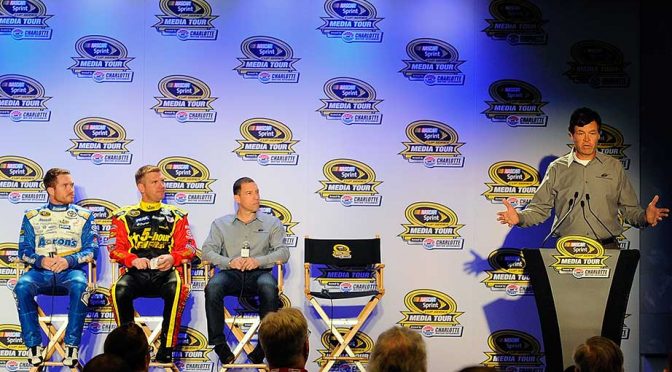
CHARLOTTE, N.C. — Michael Waltrip Racing, even staring at an early wake-up call for Thursday’s SprintMedia Tour, put on its best face to preview the 2014 NASCAR season.
 
The buzzwords of "excited" and "pumped up" made their usual appearances, but there was difficulty avoiding discussion of the haunting memories of the previous season — the manipulation of the regular-season finale’s race results, the resultant heavy penalties, the loss of longtime sponsor NAPA and a scaling back of its three-car operation — all of which severely threatened the team’s outlook.
 
For Waltrip, the team’s patriarch, there’s no looking back.
 
"We’ve closed the book," Waltrip said. "Only a fool would trip over something that’s behind them. So we’re focused on the future and ready to win races."

Michael Waltrip Racing enters a regrouping year, now with a team of two full-time cars and a "research and development" car that will run a part-time slate on the NASCAR Sprint Cup Series with Waltrip and Jeff Burton splitting driving detail.

MWR also announced a partnership with Jay Robinson Racing, allowing the No. 66 Toyota Camry to race in all 2014 NASCAR Sprint Cup events. Waltrip will drive the No. 66 in the Daytona 500 and again in the May Talladega race. Burton will race the No. 66 in six to eight races during the season, including his first race on March 9 at Las Vegas Motor Speedway. Robinson also has named Joe Nemechek as the primary driver for the rest of the 2014 races. 

While the decreased amount of races has also equaled a 15 percent reduction in staffing, the engineering budget has increased by the same percentage year over year, according to team co-owner Rob Kauffman.
 
Part of the closure Waltrip referenced was the reappearance Thursday of Ty Norris, the team’s executive vice president of business development and general manager, one week after his reinstatement by NASCAR. Norris was suspended indefinitely last September for his role in altering the race results, telling driver Brian Vickers over the radio to pit in order to benefit former MWR driver Martin Truex Jr.
 
Norris appeared Thursday to say he would no longer serve as a race-day spotter, but that he was excited with the team’s direction.
 
"I’m really appreciative to have the opportunity to go back to the track and do my job at the level I need to do it for the organization," said Norris, who joined Waltrip’s team in 2005. "So yeah, I’m really excited to be back and with certainly a pretty nice perspective on life. … I’m so focused on ’14 right now. It’s all about our organization coming out strong. The way we’ve reorganized with our test team and being so prepared — 2014 is all I’m really focused on, to be honest with you."
 
The same could be said of Clint Bowyer, Vickers’ teammate who is eager to improve upon his seventh-place finish in last year’s Chase for the NASCAR Sprint Cup after a runner-up placing in 2012. For Bowyer, Norris remains the backbone of the team, even though he had been banned from the race track for five months.
 
"Ty’s always been there," Bowyer said. "That’s what I try to tell Ty all the time, he runs this company. He is the biggest reason that I came over here. He worked hard to sell MWR to me, to my sponsor. He’s always been there."
 
Although the team has undergone its share of turmoil in the last several months, certain key components remain intact. Bowyer is back for his third season, and Vickers returns from part-time duty for his first full-time season with MWR, this time with a solid bill of health after a return of the blood clots in 2013 that nearly curtailed his racing career. The team also locked up or expanded its relationship with existing sponsors while receiving additional commitments from other associate backers.
 
Waltrip said keeping or expanding that level of support was crucial to his time’s livelihood, while admitting that negotiations with sponsors have never been easy. It’s just another step to easing the burden on what could be another crossroads season to rise above adversity.
 
"We’ve got a great story to tell," Waltrip said. "We’ve got great drivers and we’re going to be around for a long time to come."

MORE:

WATCH: NASCAR ’14 trailer:
Stewart’s comeback

READ: Kurt Busch compares
new, old teams

READ: Twitter crew:
Favorite NASCAR follows

READ: Top 10
rookie campaigns

Chase field will begin at 16 drivers; eliminations take place after every three races

MORE: Official news release | Changes explained | Chase Facts and FAQ | Social buzz
RELATED: Full coverage of the Chase for the NASCAR Sprint Cup format changes

CHARLOTTE, N.C. — The Chase for the NASCAR Sprint Cup format has been tweaked and adjusted in the 10 seasons it has been used to determine the sanctioning body’s Sprint Cup champion.
 
Thursday, NASCAR Chairman and CEO Brian France announced a major overhaul for the 10-race format, one that will see the field expand from 12 to 16 teams, with three shootout-style rounds culminating in a single championship-determining event among the final four remaining competitors.
 
"We have arrived at a format that makes every race matter even more, diminishes points racing, plus puts a premium on winning races, and concludes with a best-of-the-best, first-to-the-finish-line showdown race — all of which is exactly what fans want," France said.
 
"We have looked at a number of concepts for the last three years through fan research, models and simulations, and also maintained extensive dialogue with our drivers, teams and partners. The new Chase for the NASCAR Sprint Cup will be thrilling, easy to understand and help drive our sport’s competition to a whole new level."

Under the new format, the 16 available qualifying positions for the Chase will be awarded to those drivers that have at least one victory through the first 26 races, as long as he or she is in the top 30 in points and has attempted to qualify for each of the season’s previous points races. On Thursday, NASCAR officials said that a medical exemption could be given if a driver missed a race during the season for a valid medical reason but still had won a race at some point during the season.

If more than 16 drivers earn at least one win, only those highest in the standings (with at least one win) following the 26th race would advance. However, should the points leader after 26 races be winless, he or she would be awarded the 16th and final Chase position.
 
Only twice in the history of NASCAR have there been more than 15 winners in the first 26 Cup races (1961 and 2003).
 
If fewer than 16 drivers have at least one win, all remaining positions to fill the grid would be determined based on points standings.
 
The 16 drivers qualifying for the Chase will have their points reset to 2,000 points, and will be seeded based on bonus points (three per win) earned prior to the start of the Chase.
 
The nine races leading up to the season-ending event are divided into three individual rounds consisting of three races each.
 
Chase eligible drivers posting at least one win in each of the rounds will continue to advance. Remaining available positions will be determined and seeded based points earned during each round.
 
Points for those in the Chase will be reset prior to the start of each round with all drivers starting the round with the same amount of points.
 
Drivers not in the Chase will continue to earn points under the current non-Chase points format.
 
The Challenger Round — Opens the Chase and consists of races at Chicagoland, New Hampshire and Dover. Twelve of the 16 drivers will advance from this round.
 
A win in any of the three races automatically advances the driver to the next round, with remaining positions to be determined based on points earned during the round.
 
The 12 Chase drivers advancing will be seeded based on points earned through the three previous races and will have his or her points total reset to 3,000 points prior to the start of the next round.
 
The Contender Round — Consists of races at Kansas, Charlotte and Talladega. Eight of the 12 drivers will advance from this round.
 
As in the previous round, a win in any of the three Contender Round races automatically advances the driver to the next round, with remaining positions to be determined based on points earned during the round.
 
Points totals will be reset at 4,000 points for those advancing.
 
The Eliminator Round — Consists of races at Martinsville, Texas and Phoenix. Four of the eight drivers will advance from this round to earn a berth in the season-ending Sprint Cup Championship (final) round.
 
Eliminator Round winners automatically advance, with the remaining position or positions determined by points earned in the three races.
 
The four drivers that advance into the final round will have their points total reset to 5,000 following the Phoenix race.
 
Sprint Cup Championship — The highest finishing driver at Homestead among the four eligible drivers will win the Sprint Cup championship.
 
While bonus points for laps led will be awarded through previous rounds, no bonus points for laps led will be awarded in the final race for the Chase contenders. Finishing position in the final race will determine the champion.
 
For those Chase drivers that fail to advance out of an individual round, their points total will be reset at 2,000 points at the conclusion of that particular segment. They will continue to earn points based on finishes in the remaining races, with no further adjustments. Thus, a driver that fails to advance out of the initial Challenger Round could earn enough points to finish as high as fifth in the final points standings. He or she would finish no worse than 16th based on the initial points reset.

Winning takes on much more importance under the new format, something France said was "the key."

While officials had an elimination format on the drawing board for several years, France said it wasn’t until this format, which "was developed to emphasize the entire season" came together that officials felt the time was right to make the change. 

And, he said, "… we didn’t eliminate points racing by doing this. It will still be playing a role."

While it would be difficult to consider all of the potential scenarios, France said he believes officials covered as many bases as possible.

"The probability is that the best teams down the stretch in the fall … are going to be the best teams (in general)," he said. "Anything is possible, (anything) could happen today, but I think this (format) makes it more probable that teams are going to have to win and be at their best over a longer period of time."

NASCAR President Mike Helton said while it may be a lot to digest in terms of how the champion is determined, the format change will make "every race special."

"I’m an avid fan of this sport, I’ve loved it for 50 years," said Helton. "I grew up in Bristol and you can’t grow up in Bristol and not know NASCAR, and more often than not, you’re going to become a fan of NASCAR. There’s not much more traditional in this sport than Bristol. I’m a fan of Bristol, a fan of Talladega, of Daytona; I like the uniqueness of each one of the facilities. Now each race is going to be more exciting I think. 

"I just ask the fans if they will give this a chance and let it sink in. And that’s why today is such a big day, because now we can tell the world what it is instead of people speculating, and start answering the questions around it."

MORE:

READ: Expansion, eliminations
highlight Chase changes

WATCH: Brian France breaks
down Chase changes

READ: Coors Light qualifying
changes announced

WATCH: Qualifying: One-on-one
with Robin Pemberton

Follow along with social media about the change in the Chase format

RELATED: Full coverage of the Chase for the NASCAR Sprint Cup format change

MORE: Official news release | Changes explained | Chase Facts and FAQ

MORE:

WATCH: NASCAR ’14 trailer:
Stewart’s comeback

READ: Kurt Busch compares
new, old teams

READ: Twitter crew:
Favorite NASCAR follows

READ: Top 10
rookie campaigns

See who would have won the Chase for the NASCAR Sprint Cup in 2013, 2012 and 2011

RELATED: Full coverage of Chase for the NASCAR Sprint Cup format change

2013
Top 16
Wins (11 drivers): Matt Kenseth, Jimmie Johnson, Kyle Busch, Carl Edwards, Kasey Kahne, Kevin Harvick, David Ragan, Greg Biffle, Joey Logano, Martin Truex Jr., Ryan Newman.
Points (5 drivers): Clint Bowyer, Dale Earnhardt Jr., Kurt Busch, Jeff Gordon, Jamie McMurray
 
Top 12
Wins (2 drivers): Matt Kenseth (Chicagoland and New Hampshire), Jimmie Johnson (Dover)
Remainder of Top 12 (10 drivers): Kyle Busch, Jeff Gordon, Greg Biffle, Kevin Harvick, Ryan Newman, Clint Bowyer, Jamie McMurray, Kurt Busch, Dale Earnhardt Jr., Martin Truex Jr.
 
Top 8
Wins (2 drivers): Kevin Harvick (Kansas), Jamie McMurray (Talladega)
Points (6 drivers): Jimmie Johnson, Dale Earnhardt Jr., Jeff Gordon, Matt Kenseth, Clint Bowyer, Kurt Busch
 
Top 4
Wins (3 drivers): Jeff Gordon (Martinsville), Jimmie Johnson (Texas), Kevin Harvick (Phoenix)
Points (1 driver): Dale Earnhardt Jr.
 
Champion: Dale Earnhardt Jr.

2012
Top 16
Wins (14 drivers): Denny Hamlin, Brad Keselowski, Jimmie Johnson, Tony Stewart, Clint Bowyer, Greg Biffle, Kasey Kahne, Dale Earnhardt Jr., Jeff Gordon, Joey Logano, Kyle Busch, Marcos Ambrose, Matt Kenseth, Ryan Newman.
Points (2 drivers): Kevin Harvick and Martin Truex Jr.
 
Top 12
Wins (2 drivers): Brad Keselowski (Chicagoland and Dover), Denny Hamlin (New Hampshire)
Remainder of Top 12 (10 drivers): Jimmie Johnson, Clint Bowyer, Kasey Kahne, Joey Logano, Tony Stewart, Dale Earnhardt Jr., Martin Truex Jr., Kevin Harvick, Kyle Busch, Ryan Newman
 
Top 8
Win (1 driver): Clint Bowyer (Charlotte)
Points (7 drivers): Jimmie Johnson, Kasey Kahne, Brad Keselowski, Martin Truex Jr., Kyle Busch, Joey Logano, Tony Stewart
 
Top 4
Win (1 driver): Jimmie Johnson (Martinsville and Texas)
Points (3 drivers): Kyle Busch, Brad Keselowski, Tony Stewart
 
Champion: Kyle Busch

2011
Top 16
Wins (14 drivers): Kevin Harvick, Kyle Busch, Brad Keselowski, Jeff Gordon, Matt Kenseth, Carl Edwards, David Ragan, Denny Hamlin, Jimmie Johnson, Kurt Busch, Marcos Ambrose, Paul Menard, Regan Smith, Ryan Newman (Note: Trevor Bayne won the Daytona 500, but declared for NNS points.)
Points (2 drivers): Tony Stewart, Dale Earnhardt Jr.
 
Top 12
Wins (2 drivers): Tony Stewart (Chicago and New Hampshire) and Kurt Busch (Dover)
Points (10 drivers): Carl Edwards, Kevin Harvick, Brad Keselowski, Jimmie Johnson, Matt Kenseth, Kyle Busch, David Ragan, Jeff Gordon, Regan Smith, Dale Earnhardt Jr.
 
Top 8
Wins (2 drivers): Jimmie Johnson (Kansas), Matt Kenseth (Charlotte)
Points (6 drivers): Carl Edwards, Brad Keselowski, Tony Stewart, Kyle Busch, Kevin Harvick, Dale Earnhardt Jr.
 
Top 4
Win (1 driver): Tony Stewart (Martinsville and Texas)
Points (3 drivers): Carl Edwards, Jimmie Johnson, Kevin Harvick
 
2011 Champion: Tony Stewart

MORE:

WATCH: NASCAR ’14 trailer:
Stewart’s comeback

READ: Kurt Busch compares
new, old teams

READ: Twitter crew:
Favorite NASCAR follows

READ: Top 10
rookie campaigns

‘Chief’, ‘Iron Man’ part of five-man class to join NASCAR Hall of Fame

MORE: Five inducted into NASCAR Hall | Jarrett’s father-son bond deepens | Flock, Roberts honored

CHARLOTTE, N.C. — One was an engine builder who toiled primarily in a back room of the team shop. The other was a relentless racer who toiled primarily on short tracks. But Wednesday night, Maurice Petty and Jack Ingram both found themselves as new members of the NASCAR Hall of Fame.

On a night headlined by former premier-series champions and Daytona 500 winners, NASCAR’s shrine made room for the "Chief" and the "Iron Man." Petty became the first engine builder to earn the sport’s ultimate honor, while Ingram was the first driver to be inducted after spending the bulk of his career in what is now the Nationwide Series.

Petty didn’t make the list of 25 candidates for enshrinement until last year, and benefited from a strong lobbying effort from his brother, seven-time NASCAR champion Richard. Still, the ultimate call was unexpected.

"I thought it was just reserved for the drivers, and to get in this quick, that was really a total surprise," Maurice said after the ceremony, outfitted in his new blue Hall of Fame blazer. "They told me I had been nominated, and I come over, and they called my name because I figured it would take a year or two to work your way in. But that was quite a surprise."

Ingram has been on the nomination list since 2011, and doesn’t know if any current drivers who primarily compete on the Nationwide Series will follow his path to enshrinement. The then-Busch circuit was much different in Ingram’s day, when more competitors made a career out of the series, and the pool of regulars was deeper than it is now.

"None of them stays in it long enough to accomplish anything," Ingram said. "They drive for huge race teams primarily, huge backing, and every once in a while one of them will make it. But I don’t think that anyone could ever get in this Hall of Fame driving in the Busch Series the way I did it, anyway. When we did it, we had different cars, we had different motors, we had different race tracks, and Darrell Waltrip and (Dale) Earnhardt and all them guys come in and race, and they basically got lapped.  They just could not keep up."

Petty, 74, built the power plants that propelled his brother Richard to all seven championships, and most of his 200 race victories. In an era when engines were built painstakingly by hand, the "Chief" crafted the most potent motors of his day. Lee Petty, Buddy Baker, Jim Paschal, Pete Hamilton — they all won races with the engines of Maurice Petty, who also worked as a truck driver, tire changer, and crew chief over the course of his long career.

But the most famous car to use the engines of the "Chief" was Richard Petty’s No. 43. "There wouldn’t be a Richard Petty, per se, accomplishing the things that he accomplished without a lot of people, but this is one of the main characters of the whole deal," the King said while inducting his brother. Maurice becomes the final member of a powerhouse Petty Enterprise team to earn induction, following father Lee, brother Richard, and cousin and crew chief Dale Inman.

"That’s a full team. Very few Hall of Famers can brag about that," Richard said. "But the big deal is that it’s really the end of Petty Enterprises, because we started in 1949. And now that my brother is in the Hall of Fame, then that pretty well closes the book on it."

Maurice Petty didn’t have a dynamometer until 1969, before which his engines were tested solely on the race track. Despite a flurry of manufacturer and rules changes, his engines continued to power Richard and other drivers to one victory after another, paving his way to eventual Hall of Fame enshrinement.

"This is real great. Who would have ever thought that the whole family could have got into the Hall of Fame together?" Maurice said. "It’s just like what I said out there in the speech. Come out with a little old community, not out in the woods, but it’s pretty well out in the country, and now we’ve got four people in it. Everybody lives within a quarter mile of each other. It’s great, I’m really tickled to death, proud of it."

Ingram, 77, also spent most of his career outside the spotlight. Known around short tracks as "Iron Man" because of a schedule that once included six races in one weekend, Ingram won three titles in the Late Model Sportsman Series that was the forerunner of today’s Nationwide circuit. When that tour was modernized into what at the time was called the Busch Series, Ingram just kept on winning, adding another two crowns to his resume.

"I’m honored to be here tonight beyond words. This is a major lifetime achievement for me," Ingram said during his speech, in which he thanked everyone including his attorney and the guy who painted his race cars. He was introduced by none other than six-time NASCAR Sprint Cup Series champion Jimmie Johnson, who joked he was chosen for "my stellar Nationwide and Busch series career" — which to this point consist of a single race victory.

Not so for Ingram, who won more than 300 NASCAR-sanctioned races in a 30-year career over which he became an icon to the likes of Mark Martin, Jeff Burton, and others. Thirty-one of those victories came in what is now the Nationwide Series, where he finished outside the top five in final points just twice in nine seasons, and held the record for career wins until Martin broke it in 1977. Ingram remains fifth in all-time victories on the Nationwide tour.

And Wednesday night, it was clear he’s still fiercely protective of his accomplishments.

"I didn’t get credit for nothing hardly that I done in most of this news media and the TV people and everybody," Ingram lectured in the press room after the ceremony. "They want to talk about Mark Martin beating my record. Now, I was 45 years old when they’re talking about that record. They think I dropped out of the sky at 45 and started racing?  I won 317 NASCAR point races."

Now everyone will be able to read about it, thanks to the display that will forever honor him in the NASCAR Hall of Fame.

MORE:

WATCH: NASCAR ’14 trailer:
Stewart’s comeback

READ: Kurt Busch compares
new, old teams

READ: Twitter crew:
Favorite NASCAR follows

READ: Top 10
rookie campaigns