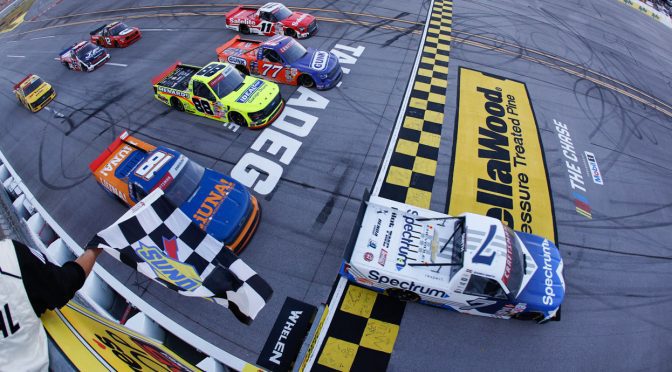
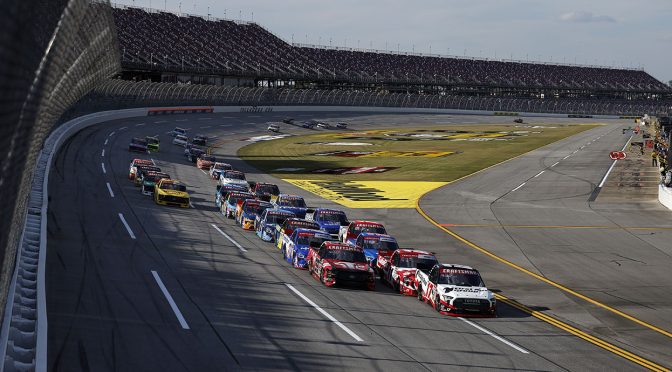
TALLADEGA, Ala. — Only a few hours after announcing he’ll be competing full time in the NASCAR Craftsman Truck Series next year, Sammy Smith went out and delivered a strong message to the competition — leading the final lap of NASCAR Overtime to claim the win in Friday afternoon’s Love’s RV Stop 225 on the famed Talladega Superspeedway high banks.
Smith’s No. 7 Spire Motorsports Chevrolet crossed the finish line a mere 0.091 seconds ahead of a four-wide battle for second place, which ultimately went to McAnally-Hilgemann Racing’s Tyler Ankrum, a scant 0.002 seconds ahead of Smith’s teammate Austin Green, who turned in a tremendous day in his only start of the year. ThorSport’s Ty Majeski and championship leader Kaden Honeycutt joined the dramatic door-to-door rush to the checkered flag.
It marks Smith’s first career win in the series in his 11th start and sends a strong message to the competition that the 22-year-old Iowa native will be a force for the title when he moves from his current full-time job competing in the NASCAR O’Reilly Auto Parts Series for JR Motorsports.
“Just a great team, [crew chief] Brian Pattie and this whole Spire crew,” Smith said, congratulating his team after leading the most laps (21 of 86) and hoisting his first Truck trophy.
“The truck was fast, and I feel like we did a good job putting ourselves in a good spot. Obviously, lost track position (earlier), but thanks to everyone for this opportunity. I’m looking forward to racing trucks next year, I just want to win races. Thank you to everybody.”
Asked what message the victory sends to his competition next year, Smith smiled and replied, “That I am a winner, and I know I can win, and I got another shot tomorrow [in the NASCAR O’Reilly Auto Parts Series] with my [No. 8] boys.”
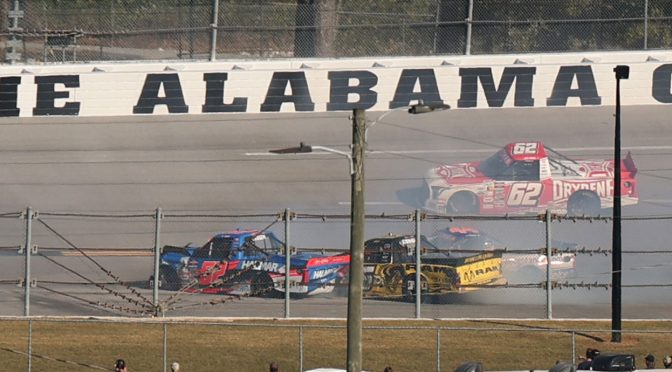
It was a fittingly dramatic ending to a race that included five caution periods and a pair of the Talladega “Big Ones” that have so often characterized racing on this track.
The two Truck Series championship leaders, Tricon Garage’s Honeycutt and Front Row Motorsports’ Layne Riggs, both survived the predictably unpredictable action. Riggs, who lined up alongside Smith on the front row for the overtime restart, finished eighth and now trails Honeycutt by 43 points with two races remaining to settle the 2026 championship. It’s likely a two-man race to the title now, with third-place Ty Majeski now 141 points behind Honeycutt.
“I don’t know if I really can [be satisfied] to be honest with you,” said Honeycutt, who steers the No. 11 Tricon Garage Toyota and led eight laps. “Just didn’t make the right move [on the final restart].
“I thought the bottom was formed up better than it was. … I wanted to finish the race and get there where we needed to. Had a great run on the 34 [Riggs] and was able to shuffle him out. Felt like he left the gap open pretty far when he was trying to get outside of Ty [Majeski]. Just second plate race in a row I’ve been in a great position to win the race and just didn’t capitalize on it.”
As for the points?
“Never say ‘over’ till it’s over, until after [season finale at] Homestead. I’ve seen it in O’Reilly and in Cup, people can make up 90 points in two races. I’m sure it will be the same guys racing for the clock next week [at Martinsville], so winning means a lot, and if we can go and win a clock, it makes it a lot easier for Homestead for sure.”
While the championship leaders were able to keep the title run suspenseful, many of the other eight title contenders suffered various problems throughout the day — from 2025 Talladega winner Gio Ruggiero’s truck getting stuck in reverse on pit road immediately after he won Stage 1 to another former Talladega winner Grant Enfinger having a tire go down early and then being collected in a crash later.
McAnally-Hilgemann’s Christian Eckes, who came into the race ranked third in the points, was the first to suffer an issue and leaves Alabama now fifth, 144 points off the championship pace. His teammate, Daniel Hemric, another Chase driver, was eliminated in a crash.
Landen Lewis, Brenden Queen, Riggs, Spencer Boyd, and 2025 series champion Corey Heim rounded out the top 10. It marks Boyd’s first top 10 in two years.
The first large multitruck crash was early and intense – and it involved two of the race’s biggest names — NASCAR Hall of Famer and former multi-time NASCAR Cup Series champion Tony Stewart, as well as media personality and NASCAR newcomer Cleetus McFarland, who was hoping to collect laps in only his third series start.
Both were collected in the melee that started mid-pack on Lap 17 when Stewart Friesen’s Toyota wiggled in Turns 1 and 2 and received contact from Andrés Pérez, triggering a chain-reaction wreck. Eight trucks were involved, including championship-eligible driver Hemric.
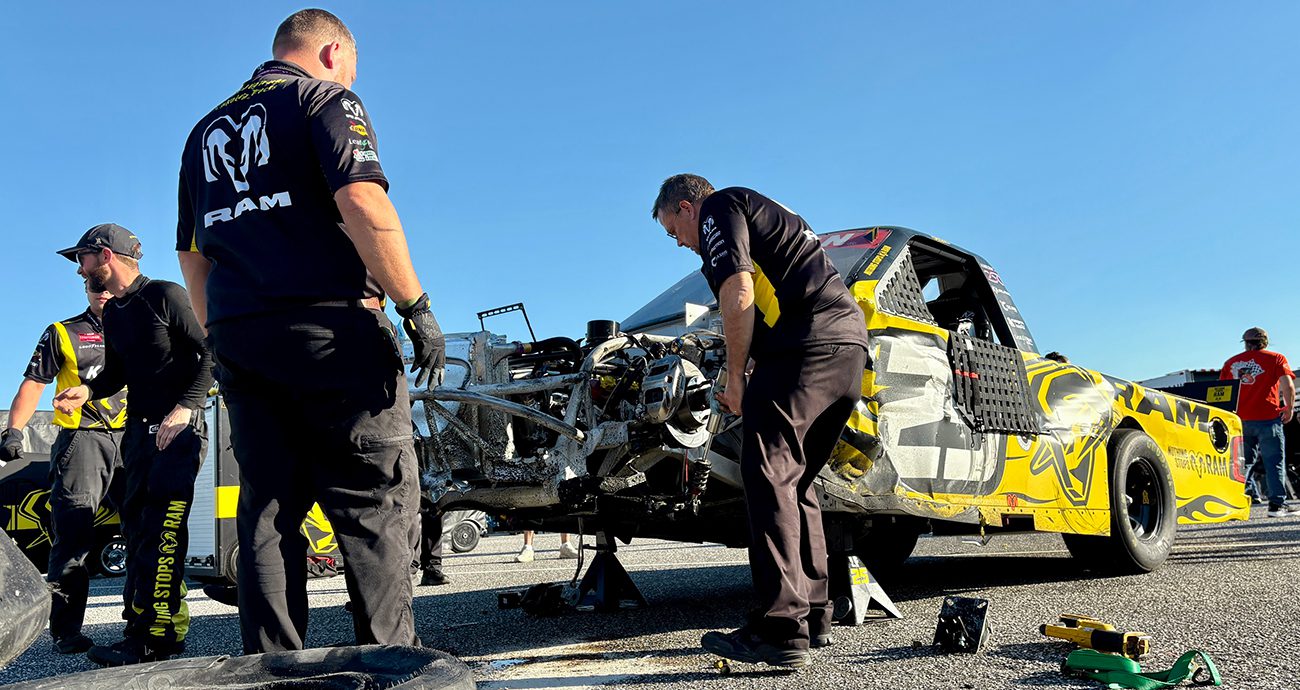
Stewart, who was making his second start of the season in the No. 25 Ram truck, was understandably frustrated to only get 16 laps of racing in.
“Definitely wanted to make it a lot further in the race today than that,” Stewart said. “Everyone started wrecking and they came across the track and got me. That’s just hard restrictor plate racing at Talladega.
“I wanted to get a chance to race, because I really enjoy working with Kaulig Racing and Ram. Kaulig is making progress and Ram is doing a good job marketing this sport.”
McFarland, making his third truck start of the season (and his career), was equally as frustrated. He said earlier Friday he was trying to get some track time in hopes of NASCAR granting him permission for more races in other series. His No. 4 Niece Motorsports Chevy was officially scored last in the 36-truck field.
“It just sucks,” McFarland said. “I just honestly saw the wreck and started slowing down heavily and was getting called down, was trying to get down out of the way, and I don’t know how or where, but I just lightly got tapped in the back left and it sent me on a trajectory that bent up the front of my hot rod, and I was just so pissed. It sucked.
“I felt like my truck was really tight, so I got out of the way, and I was riding, having a great race. I was learning. It was phenomenal. Saw the wreck and got on the brakes and was totally good, and then I just got spun and wrecked. It sucks.”
Chandler Smith entered Friday’s race fourth in the Chase standings but wound up with multiple issues, including a flat right-rear tire, a speeding penalty and getting collected in a Lap 57 crash with Jake Garcia and Conner Jones. Smith ultimately rebounded to finish 14th. Majeski overtook Smith and Eckes for third in points, sitting 141 points behind Honeycutt while Smith remains fourth, 142 points out.
Sitting sixth in points and trailing Honeycutt by 177 points, Ruggiero is officially eliminated from championship contention, as are Hemric (minus-194), two-time champion Ben Rhodes (minus-203), Ankrum (minus-214) and Enfinger (minus-219).
Two races remain in the NASCAR Craftsman Truck Series championship run. Next up is Friday’s Black’s Tire 200 at Martinsville Speedway at 6 p.m. ET (FS1, NASCAR Racing Network Radio, SiriusXM NASCAR Radio).
NOTE: Post-race technical inspection concluded without issue, confirming Smith as the race winner.
Tony Stewart and Cleetus McFarland were among eight drivers involved in a major Stage 1 crash in Friday’s NASCAR Craftsman Truck Series race at Talladega Superspeedway.
On Lap 17, Stewart Friesen wiggled in Turns 1 and 2, receiving contact from behind from Andrés Pérez and veering left into Kris Wright, who shot across the track and hard into the outside SAFER barrier. Stewart, a three-time NASCAR Cup Series champion who made his second start of the season, was in the middle of the melee and had nowhere to go, receiving heavy damage in an incident that also included Cole Butcher, Daniel Hemric and Corey LaJoie.
“It’s just a racing deal. It’s part of it at restrictor plate races,” Stewart told FS1 after being evaluated and released from the infield care center. “Stewart (Friesen) couldn’t go anywhere, I mean he had an issue, he said, and he’s stuck in the middle — he can’t go anywhere, so he’s doing the best he can to hang onto it and just everyone around him got caught up in it.”
McFarland, making his third career Truck Series start, was behind the wreck as it developed and darted low to avoid it as he neared the backstretch. But contact from another truck sent him sideways and into the inside wall, suffering heavy damage to this No. 4 Niece Motorsports Chevrolet.
Speaking to reporters after being evaluated and released from the infield care center, McFarland — a YouTube personality turned part-time NASCAR driver — believed he was at fault for the DNF.
“It was great, feeling it out, and then massive wreck in front of me,” McFarland said. “There’s trucks going everywhere, and I got slowed down. I was woed up, I thought I was good, and then I got tapped in the back left as I was coming down the track. Probably my fault, and I just went over and crunched the nose on my truck, ended my day short.
“I thought for a second I was gonna save it, but then it just had a little too much yaw, and it circled around. I jammed on the brakes to try and get the truck to slide straight, but I was too late. I already screwed myself.”
McFarland’s national series debut ended in similar fashion, crashing on Lap 5 of the season-opening Truck Series race at Daytona International Speedway in a single-car incident. Since then, though, he tallied an additional Truck start at Michigan International Speedway, as well as a pair of O’Reilly Auto Parts Series races and a lengthy springtime test at Rockingham Speedway.
In his most recent visit to Talladega in the spring, McFarland paced 19 laps in April’s ARCA Menards Series race, ultimately finishing second after leading into the tri-oval on the final lap.
“I feel like I was totally in control, and I knew I was tight, so I made the right decisions to put myself on the outside with my spotter,” McFarland said. “Things really did feel good today. I felt like I was finishing, for sure, outside of some crazy thing, and to just end on such a stupid situation, it blows.
“I’m really frustrated because this time, it’s not like I just did a bonehead move in the middle of the race and slammed into the wall like I did in Daytona. I feel like I had so much leeway ahead of me.”
Hemric was the only driver collected who is competing in The Chase presented by Mobil 1, but two postseason competitors had issues before the wreck. Justin Haley suffered a flat tire on Lap 13, forcing most of the field to check up, including Chase driver Chandler Smith, who dropped toward the rear of the field. Christian Eckes, runner-up in each of the last three races, suffered a flat tire on Lap 15 and made an unplanned visit to pit road. He entered Friday’s race fourth in points.
Brian Dheel reflects, and the snapshots from winning NASCAR’s biggest race come into vivid focus.
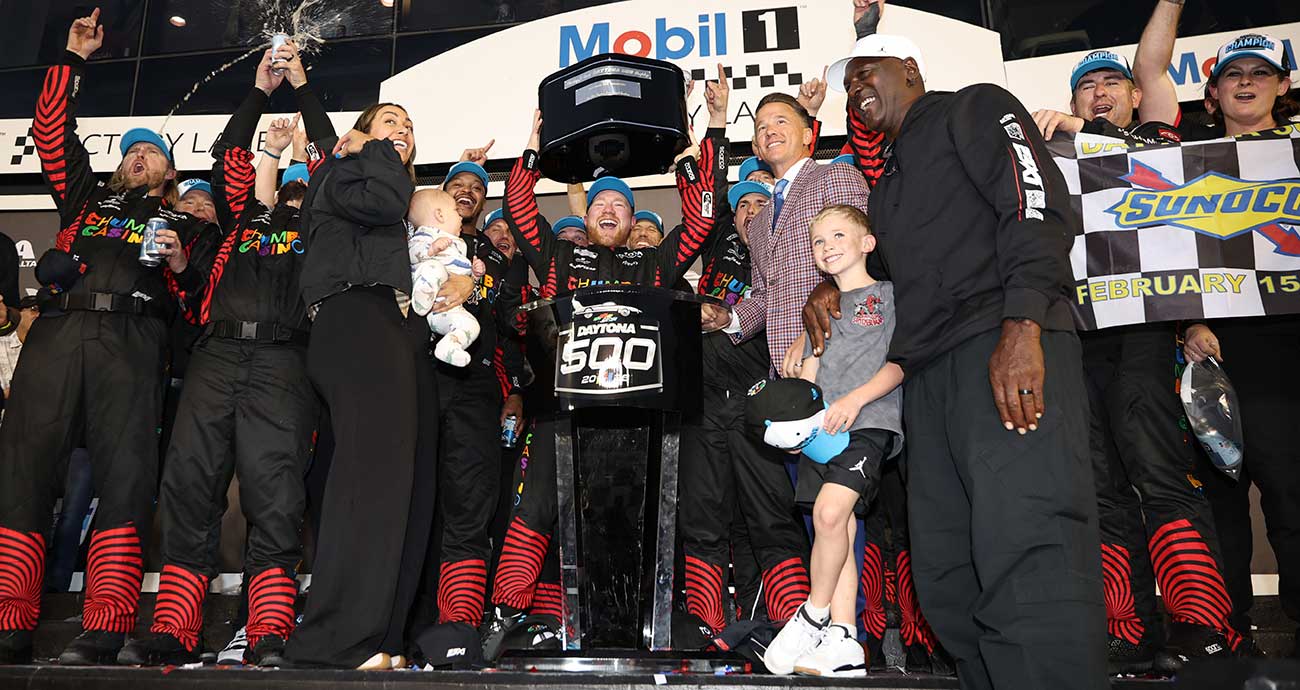
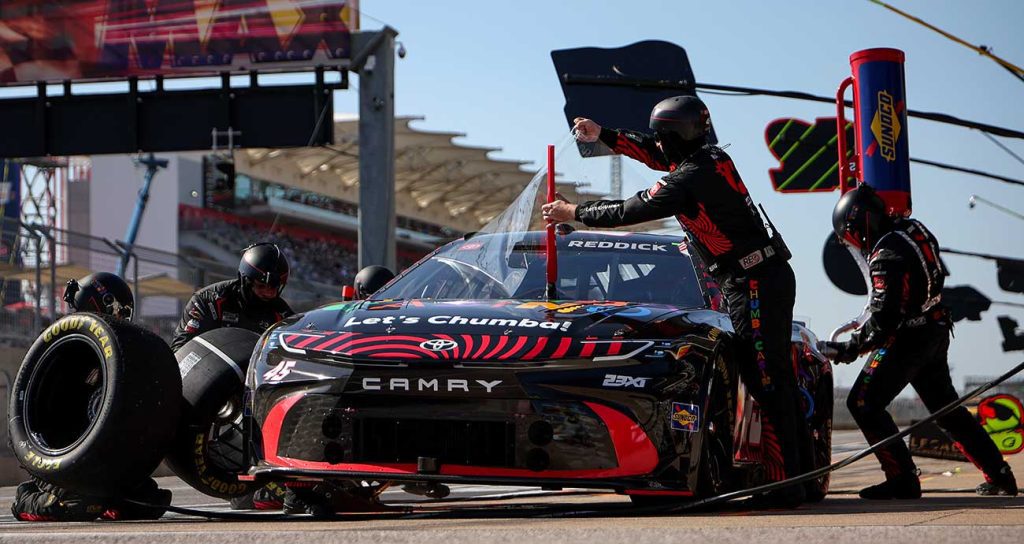
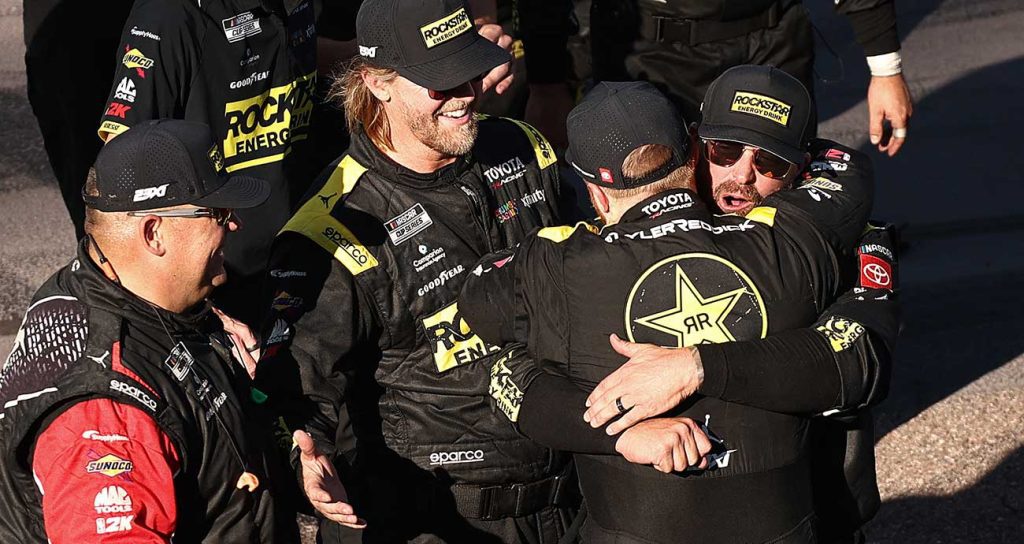
The veteran fueler for 23XI Racing’s No. 45 Toyota remembers Daytona International Speedway’s massive frontstretch grandstand dwarfing him as he ran across the tri-oval grass, where he and his pit-road teammates were waiting to catch Tyler Reddick as he dove from his winning car into their arms.
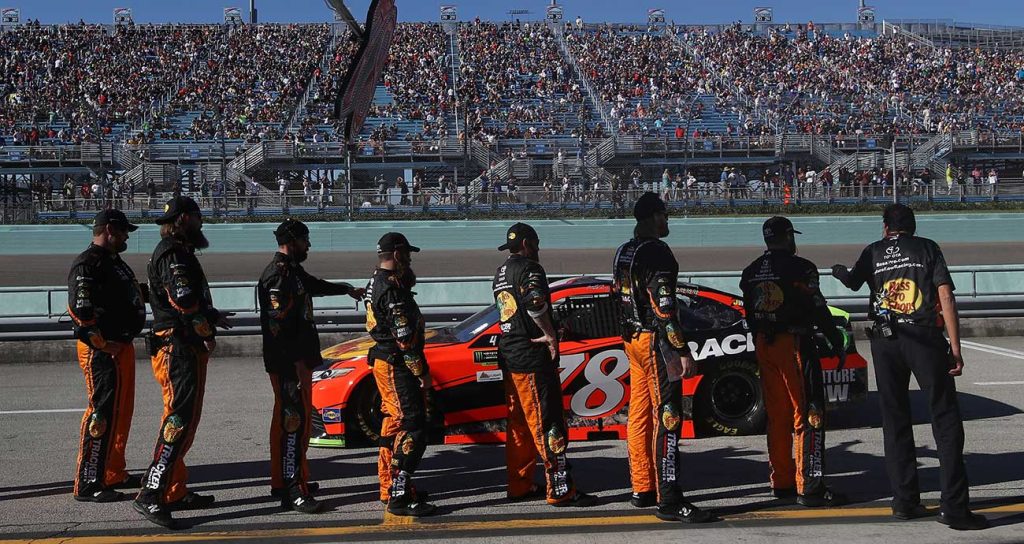
Dheel had come close to Daytona 500 glory before. As a member of Furniture Row Racing’s No. 78 team through its heyday, he watched in 2016 from pit road when Martin Truex Jr. ended up an agonizing 0.010 seconds behind Denny Hamlin in the Great American Race’s closest-ever finish. Ten years later, Dheel made sure to take photos that captured the moment, a long-awaited one that he wasn’t sure would happen again.
In Victory Lane, Dheel and crew converted a joyous double-beer smash and pour that would make wrestling icon “Stone Cold” Steve Austin proud. High-fives with NBA great and 23XI co-owner Michael Jordan gave the celebration a surreal feel, especially for the Ohio native who grew up with allegiances to the Cleveland Cavaliers, a longtime foil to Jordan’s Chicago Bulls dynasty. “As a younger kid, he definitely put a stake in my heart numerous times,” Dheel says. Now their goals align, and the basketball legend easily blends in as just another member of the team. No need to be starstruck, Dheel says, but still, when he hears that voice, the one belonging to the larger-than-life “Be Like Mike” Jumpman persona from his childhood, “it’s just like, holy cow, that’s who that is.”
Dheel’s most gripping moment, though, came in the in-between, as he walked back across Daytona’s ballfield lawn to the celebration’s epicenter. His wife, Mandy, had been on the receiving end of so many of Brian’s phone calls after those triumphant moments in racing, including many of Truex’s Furniture Row victories and the team’s Cup Series championship in 2017 — a year after his Daytona heartbreak. “Oh my God, I can’t believe you guys did this. … It was so exciting, we were screaming at the house!” Brian would recall her saying. The realization hit him on the walk toward Victory Lane. In that moment, it wasn’t who he was sharing the win with, but who he wasn’t.
“We kind of paused and started running back. Like, I can’t call her, right,” Dheel says with a quiver in his voice. “So that made it emotional. I kind of choked up and had to fight the tears there, because I was like, I don’t want people to see me bawl. So that was definitely a hard one, right out of the gate to win that race and not have her there to call or send pictures.”
The Daytona victory came nearly nine months after Mandy Dheel passed away, the toll of a valiant eight-year battle with advanced breast cancer. She was the family’s light, a dedicated companion to Brian and a loving mother to their son Gage, now 18, and daughter Quinn, 14. Brian Dheel noted her generosity, but also her selflessness as she tried to shield the rest of her family from just how much strife the disease had caused.
Work became his release through the most trying of times, his means of focusing on something — anything — else. The camaraderie with his 23XI teammates helped lift him up, but for as much as was made about how difficult a winless 2025 was for Reddick, Dheel’s hardship was exponentially greater. Dheel has been open on social media about how he’s tried to come to terms with grief. “Every day is a cycle of anger, tears and numbness,” he wrote last New Year’s Eve. “I couldn’t wait for Christmas to be over, and I don’t care about 2026 at all. The future feels empty without you. Pretending I’m OK.”
Just six weeks later, Dheel tried to square those feelings with finally reaching a long-sought pinnacle of professional and personal triumph. There was no rest after Daytona, either, and the wins began to flow like a flooding river — Atlanta the next week, Circuit of The Americas the next and a grand total of five victories in a record-setting start through the first nine races. Allowing himself to soak in those jubilant professional moments became a challenge, one that sometimes conflicted with his personal journey.
“Just trying to enjoy the moments with the guys because I know I’ve only got a few years left of probably doing it, but then not forgetting all these years, just like that,” Dheel says, snapping his fingers. “I think that’s my biggest fear. … You get caught up in life, and then you don’t think about that person every day, and that’s what I’m kind of afraid of. I don’t want to not think about her, but I also don’t want to constantly pull myself from constantly crying or being depressed or in that side of it. So it’s definitely a struggle.”
James Gilbert | Getty Images
How Brian Dheel has managed, and how he’s continuing to manage the strains of work-life balance has served as an inspiration for one of the NASCAR Cup Series’ top pit crews and its winningest team this year. He’s done it while balancing the roles of dad to two teenagers, professional athlete in a fast-paced sport, and a leader and recruiter for the next generation of over-the-wall elite — all with a bonkers commute required to check the boxes on all three.
He raps a knuckle on one of the tables in the break room of 23XI’s gleaming Airspeed headquarters as a knock-wood hope for all the years ahead that he intends to compete at this level, even as he inches toward his 50th birthday. Time moves forward, and Dheel is moving with it.
* * *
Racing wasn’t part of Brian Dheel’s immediate family history growing up. His athletic pursuits stretched across all kinds of varsity sports, but his career aspirations centered around soccer. By his later grades of high school, Dheel was playing nearly year-round, and his senior season led to an invitation to play in Europe. He turned down a Division III collegiate opportunity back in the states, but latched on for a stint with a semi-pro club in Germany.
“I’m probably one of maybe a handful of guys that grew up playing soccer competitively that’s in the sport now,” says Dheel, who transitioned to coaching back in the U.S. after his European tour. His introduction to motorsports, though, came through a racing-crazed family he went to church with back in Ohio. That family included Greg Miller, who is now a pit crew coach with Chip Ganassi Racing’s IndyCar operation and was a close friend of one of Dheel’s cousins, who told him, “You need to hit Greg up.”
It was the mid-2000s and Red Bull was entering the sport, and Miller had moved over to start a pit-crew program from scratch for its fledgling two-car team. Dheel had tired of his “real job” of coaching high school soccer and came down for workouts. Two months later, he got the call — catch-can duty with training to come for operating the jack and carrying tires.
That opportunity nearly came to a crashing halt at the end of its first week. “We were playing at the end of the day, doing a little frisbee football, and I jumped up, bumped, and when I landed, I turned my wrist the wrong way and it just popped,” Dheel says, clapping his hands together. “I was like, ‘Ah, crap! This is over before it even starts.’ Fortunately, they didn’t get rid of me, and I was able to recover.”
What Red Bull may have lacked in on-track performance for a Cup Series start-up, it made up for in its fun factor with publicity and activations, including one that allowed Dheel and his colleagues to execute a full-on pit stop in New York’s Times Square. When the organization disbanded, Dheel bounced between a two-year stint at Michael Waltrip Racing and coached soccer for a year at Pfeiffer University before an opportunity that established his full-time course into stock-car racing.
Furniture Row had always stepped to its own beat, especially with far-flung headquarters in Denver, Colorado. Though Dheel was among those based back in NASCAR’s Charlotte-area nerve center, the bonds he formed with his pit-road teammates from those days hold fast today.
“That group. For me, it’s probably like one of the most special groups I’ve been a part of, and it really had nothing to do with winning a championship.” Dheel says. “Every van ride, every dinner, every hotel stay, it’s just a great group of guys. … At the time when we were put together, it was a little bit of, we were kind of, I don’t want to say the castaways from other teams, but it just kind of worked where either guys were coming to the end of their contracts with other teams and weren’t getting brought back. It’s just, it was an awesome group that pulled for one another, and we knew if someone made a mistake, you get a lot of toxic environments where guys will kind of point the fingers. There was none of that. It was like, ‘OK, man. I’m gonna give you 30 seconds, and I’m gonna say something, and we’re gonna get back after it for the next stop.’ ”
Sustained success didn’t come right away for a team that won just once in its first nine years of Cup Series operations. Truex’s first season with the Barney Visser-owned organization was an uneven one, but the group rounded into a steady contender. As it did, the kinship of Furniture Row’s personnel grew stronger.
“There’s some teams that I think when you go through some really rough times, you get really close to one another,” says Lee Cunningham, a teammate of Dheel’s at Furniture Row who now serves as the rear-tire changer for Joe Gibbs Racing’s No. 19 team and driver Chase Briscoe. “Then obviously winning a championship, I mean obviously, that’s the pinnacle of why we’re all here doing this, right. I think when you finally get there, I think the Furniture Row thing was, we weren’t necessarily tier one. We weren’t supposed to beat JGR. We weren’t supposed to … like, all these things kind of add up, and in the back of your mind, like we are the underdog. And when the underdog finally wins one, I don’t know, I think that’s something we’ve always kind of been through, and we still kind of have that mentality today: If you feel like you’ve made it, you’re not trying hard enough.”
Chris Graythen | Getty Images
The spirit of the team included some good-natured razzing. Cunningham said Dheel’s meticulous attention to detail came through in his frantic calculations, with his teammates teasing him as he tried to measure whether he’d fully fueled the No. 78 after each stop. Adding to the math confusion, Dheel says his hands shook from the adrenaline rush of each pit service, and the notes he jotted down on a dry-erase board (in the days before tablets came into fashion) were mocked as barely legible scribbles.
For all the idiosyncrasies, the collective focus worked. Furniture Row won 17 times in a four-year span, operating mostly as a scrappy one-car outfit headquartered outside of NASCAR’s traditional hub.
“It was a special time,” Cunningham recalls. “I think a lot of us didn’t come from winning teams, and then you put us all together, and then to have the success that we did in ’16, ’17, ’18 was just off the charts for most of us. I mean, I think a lot of us went in, I don’t know if any of us had a championship at all. … I think it was all kind of a pinnacle in all of our careers together, where we all felt like we made it. We were the underdogs, and we fought through.”
Says Dheel: “We never felt like there was that separation of road crew and pit crew that some teams have. Yeah, it was the most … it was the best five years that I’ve had in the sport.”
* * *
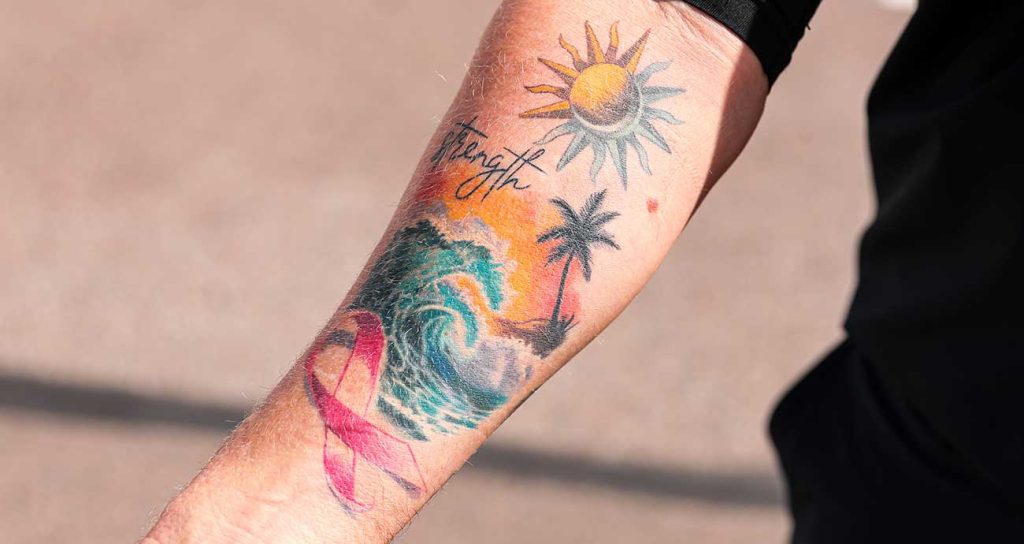
Dheel removes his black 23XI sweatshirt to reveal a colorful tattoo that covers most of his right forearm. Like most good ink, there’s a meaningful story behind it.
On one side, a sunset brightens the dark skies over a palm-lined bay. In the shallows, three ocean rocks peek out with the initials M, G and Q representing his family’s names. More symbolism marks the other side, with another series of crashing waves, a pink ribbon signifying breast cancer awareness and a sun-and-moon image that Mandy also carried on her skin. The couple shared another permanent connection through body art — her forearm was marked with the word “Strength,” and Brian added the same word in the same typeface to his arm, too, the text resting atop a glowing sky.
Strength came to define their relationship, going well beyond the muscular might that Dheel relies on to quickly hoist 110-pound canisters of racing fuel with such dexterity that makes it look simple, like how most folks summon the slightest energy to pour milk into coffee. There’s an inner strength, however, that’s helped the Dheels through so much more.
Brian first met Mandy at a gym in their shared home state of Ohio, and their meet-cute involved him breaking away from his group of buddies to spot for her. The conversation didn’t border on anything close to flirtatious until she asked if she could call him. After shopping and dinner in Cleveland, their relationship launched from there. Mandy was on a two-year plan to get married, Brian said. His thought was more like six. They split the difference at four.
After settling in North Carolina, the Dheels felt drawn to the nearby coast. Virtually all of their vacations involved seaside accommodations, and the tranquility of the ocean provided a contrast and relief for Brian from the bustle of the NASCAR schedule. After Mandy was diagnosed with Stage 2 breast cancer in 2017, the Dheels faced a choice: Stay in North Carolina, move back to Ohio or relocate somewhere coastal. In the early summer of 2023, they intended to look at a condo in the Myrtle Beach area. Instead, they bought a modest house just 10 to 15 minutes from the shore. Brian showed it to Mandy through FaceTime, panning to the view of the lake that backed up to the property. “Yep, that one,” she said.
To make it work with the rigors of Brian’s schedule required a reimagining of his weekly schedule. He starts a typical week in South Carolina on Monday, leaves before dawn for the nearly 200-mile trip to AirSpeed on Tuesday morning for film review, workouts and pit practice. His shop duties typically wrap up by lunchtime Thursday, then it’s back to Myrtle until Saturday evening, when he loads back into Charlotte to get in position to fly out with the rest of the crew on race-day Sunday morning. Post-race, after the team’s return, he drives through the night back to the coast.
“That’s probably the most impressive part is that obviously they went through a really, really tough time. I mean, it was tough for years, honestly, trying to balance all that with home back there,” said No. 45 crew chief Billy Scott. “They moved back there because of her sickness and wanting to be where she wanted to enjoy her time, and still coming to work, still not letting that affect his performance. … With trying to balance being a father and still trying to have this career, I can’t imagine. We’re talking about things he’s needed and tried to help along the way, but at some point it’s just a matter of he just has to make do and find that balance, and he’s done an excellent job.
“You wouldn’t know that he has had the challenges he’s had if you didn’t know his story, right? On the outside looking in, people that have been around him, there probably are people that don’t know all the details of it, just because he is able to maybe compartmentalize that, and when he’s at work, do his work, but also knowing that he’s done a great job with his family. His kids are great. They’re obviously managing the best they can, and just a lot of respect for him for being able to manage both as well as he does.”
Charlie Ramirez | NASCAR Digital Media
Managing became more difficult as the disease progressed in waves. Out hiking with Brian in North Carolina’s high country in 2019, Mandy complained of knee soreness that was slow to go away. Before long, she was using the wall to steady herself as she walked. After an MRI and a consultation with a spinal oncologist in Charlotte, she was whisked to surgery to remove a large tumor from her spinal tissue. Radiation treated other troubling areas, and doctors placed two rods in her back.
The beach provided a respite during some of the hardest of times, but so did the company of his closest friends in the sport.
“When he was going through it, I think you could see it wearing on him, and I didn’t want to be the guy that always asked how things were going because you kind of know how they’re going, right?” said Cunningham, noting how his Joe Gibbs Racing crew typically shared airplane rides with 23XI to and from the track. “There were a few times I’d just sit next to him on the plane, even if there was an open seat, I’d sit next to him anyway, and just talk about anything other than that, just to try to get his mind off it — talk about old times, talk about how he lives part-time down at the beach, talk about that — kind of just anything you could to just try to be there as a friend, be there as a teammate and just give him some time off, even if it was just a one-hour flight to maybe not think about life for a little bit.”
The depths came last season. Mandy started eating less, and warning signs of the disease’s spread grew more pronounced. Brian remembers her staring vacantly at the microwave in the kitchen and being unable to respond when asked what’s wrong. “I think I was always kind of in denial,” Brian says. “Like I think every hurdle my wife faced, I was, ‘Oh, she’ll beat it. We’ll get new medication. There’s trials and all this stuff,’ and she had kept a lot from me, like just how bad it was. And I really didn’t know until the final few months before she passed how bad it was, and had to speak to doctors and some friends, and I don’t know if she kept that from me to just kind of like keep my mind away from that, because we made this big move and we had two kids.”
“Regrettably,” Brian says, he made the trip with the team and the rest of the industry to the inaugural Cup Series race in Mexico City. “I should have stayed home, not realizing how bad she was quickly progressing downhill.” His fretting spiked when his mother called him just an hour before the green flag that Sunday, saying Mandy hadn’t woken up. She followed up with a second call shortly thereafter to say, “She’s up, she’s OK,” but Brian rushed back and took her to the doctor’s office immediately after he returned.
Suspicions that the cancer had reached the brain were soon confirmed, and she was given three weeks to live. She had lost three inches from her already petite 5-foot-1 frame, frail “like an 80-year-old in a 49-year-old’s body,” he said. They arranged for hospice care that Friday morning, and her outlook turned even more bleak. By Saturday morning, she was gone. It was June 21, six days after her 49th birthday and one day after their 21st wedding anniversary.
“So now I’m like,” Brian says, trailing off. “Now just everything changes.”
Management at 23XI Racing told Brian to take as much time off as he needed, and colleagues deterred him from trying to return prematurely as he attempted to find a shred of normalcy amid the grief. “I kind of had to,” Brian says. “Like at that point, it was my escape.”
“It was surprising for people that he was just able to carry on, right?” Scott says. “You don’t even know how you would react because most people haven’t been through something that significant, and you don’t know what they need, either. So that’s why, yeah, I think the company, from the top down, was very accommodating and willing to do whatever we could to make that possible.”
His teammates rallied around him, and he tried to find solace in his two opposite worlds. In one, he focused on leading the pit crew, persevering and performing during each stop for the rest of the year. The other world provided him with the natural, calming sound of the tide. Just two weeks ago, he went for a run in the sand, searching for balance while managing his multiple roles.
“I was thinking, like, gosh, this is what I need,” Brian Dheel says. “Like, I wouldn’t get this if I’m up here (in North Carolina), I think the other week, just a cup of coffee for like 30 minutes, whether it’s just sitting on the sand, just kind of trying to let my mind shut off.”
He has a reminder of that peaceful place on his forearm that he carries from home to shop to track. Above it all is a reminder of the other lasting connection he shared with Mandy — strength.
* * *
What was supposed to be the easiest question of a sometimes emotional interview wound up being the most difficult to answer.
Your age?
“Just say I’m in my late 40s. How about that? Can I lie?” Dheel says, turning to a 23XI publicist, who smiles and shrugs. “Like, no one’s going to fact-check this. I mean …”
We will.
In the meantime, seasoned, veteran and longtime make for more diplomatic descriptors of Dheel as a crew member of a certain age. Going over the wall might be considered a young person’s game, but Dheel’s competitive drive is still scratching the win column for the sport’s graybeards.
“Yeah, I mean, there’s a reason he’s been doing it this long, and there’s a reason that he’s still doing it — and he doesn’t like to talk about it — at the age that he is,” says Josh Shiplett, 23XI’s athletics director and a former colleague of Dheel’s at Furniture Row, Hendrick Motorsports and Joe Gibbs Racing. “It’s because he works really hard, and he stays focused on the things that are important to doing his job, and shows up every year and continues to excel. He gets better, and I think that he’s recognized that, and a lot of our older athletes have. But the older you get, the harder you have to work, and the more focused you have to be, and he sets a good example for that, for what it’ll take some of these younger kids to do to make it that long.”
James Gilbert | Getty Images
Those traits have all translated to leadership, whether it’s through Dheel’s actions in executing at a high level or his words when finding the right spots to pick up teammates who might need a pep-up. Cunningham, his former Furniture Row teammate, says Dheel’s experience also translates to wisdom, that uncanny ability to anticipate the nuances of each pit stop before they happen.
It’s a large part of why Shiplett brought Dheel with him from JGR when 23XI took its own pit-crew operations in-house in 2023. Dheel had almost always played a captain’s role during his soccer-playing years, and his knack for identifying and developing young talent was treated as an asset. Shiplett needed a pit recruiter, and he told Dheel to run with it.
“I love it,” Dheel says. “It’s a bit of a challenge because there’s just such a wide pool to go search. A lot of these athletes have no idea how to get into it. They may have seen it, but are not sure, ‘Well, who do I talk to?’ or even consider it as an option.”
Dheel has made plenty of introductions to NASCAR since then. The measure of a good recruit, though, doesn’t purely rest on a stat sheet. In a similar way that the Furniture Row team helped define him, Dheel looks for the intangibles — dedication, grit, chemistry — to find the right fits.
“He just worked harder, and he finds those same qualities in the guys that we bring in,” Shiplett says. “So somebody that might get taken by an HMS (Hendrick) or a JGR might not make it here, and it’s not because of athleticism. It’s because of the feel that he gets with them. He’ll sit and talk with the strength coaches and kind of the vibe they get from those guys, and if it’s something that we’re not really feeling like we’re aligned on culture-wise and work ethic-wise, doesn’t really matter how good of an athlete they showed on paper or in the gym, we’ll pass.
“He’s really good at picking up those intangibles, and it’s made our development program actually very successful, and very little turnover, and that’s one of our big things. It’s going to take time to develop these guys, but if we have people that buy into the system and are willing to work harder than we’re asking them to work, it goes a long way.”
Chris Graythen | Getty Images
Dheel’s willingness has helped establish him as an anchor of 23XI’s program, some 20 years on from his earliest pit stops. Instead of the natural decline that most veteran athletes endure, Dheel has become faster by almost every metric, down to his coordination, choreography and the quick exchange of fuel cans.
“Anything that you would expect him to drop off on because of age has been the opposite,” Shiplett says. “I love it. I know it’ll catch up to him eventually, but if it’s 10 years from now. …”
Dheel’s mind roams when he considers the possible lengths of his longevity.
“Now I think it’s a challenge,” Dheel says. “I want to do this as long as I can do this.”
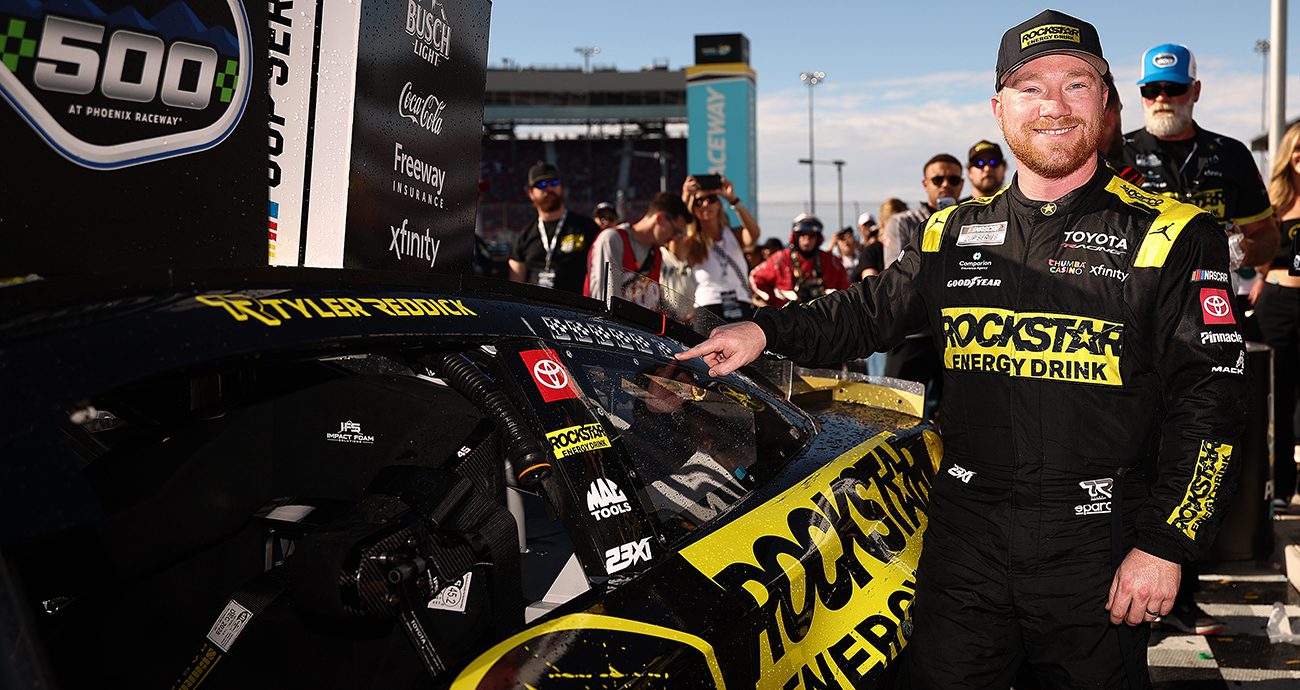
Pitting cars continues to be that rewarding escape, providing a sense of belonging to a group that’s shared high points with the lows this year in its on-track performance. Last Sunday at Phoenix Raceway, Dheel and his group were back in Victory Lane after Reddick’s late-race surge, one that halted a 23-race drought and put him back on the fringes of contention for the Cup Series title.
“I think being able to see him still celebrate after what he’s been through, and also all the success he’s already had, when he’s celebrating something, you’re kind of reassured that it is a big deal,” Scott says. “You don’t ever want to take any of this for granted, and that yeah, you need to enjoy every minute of it.”
Dheel says he’s taking the enjoyment in those moments as they come, but it comes with an acknowledgement that it’s still a strenuous journey. When NASCAR competed for the first time at the Naval Base Coronado course earlier this year, the Cup Series race was held one year to the day after Mandy’s passing. When the emotions washed over him, he consciously reset and locked in. Visor down. Focus forward.
At home, he’s navigated the relatively new role of single parent, all while driving road-weary hours on the sandhills highways that connect the Carolinas, all while making time for his family and carving out those moments of serenity by the crashing sea, all with strength.
“There’s definitely not as much happiness and joy, but trying to find some sort of peace with it,” Dheel says. “Like I said, I do owe it to her.”
The National Motorsports Press Association announced Friday that 2026 Most Popular Driver Award voting has opened — without the eight-time reigning NASCAR Cup Series winner on the ballot. Chase Elliott, driver of the No. 9 Hendrick Motorsports Chevrolet, opted to remove his name from consideration in honor of Kyle Busch, who died in May.
Elliott first won the Most Popular Driver Award in 2018, the year following Dale Earnhardt Jr.’s retirement. Earnhardt Jr. won the award 15 consecutive years until stepping away from full-time competition. Elliott’s father, NASCAR Hall of Famer Bill Elliott, won the award a record 16 times.
Busch, along with the 34 other Cup Series drivers who declared for points in that series and were eligible for championship contention in 2026, is on the ballot and eligible to win. Fans can also cast votes to select Most Popular Driver Award recipients in the O’Reilly Auto Parts Series and the Craftsman Truck Series.
To vote, visit the Most Popular Driver landing page. Fans can vote for one driver per ballot submission with voting being limited to five submissions per day, per email at NASCAR.com/mostpopulardriver or on the NASCAR Mobile App. The five votes per day aren’t limited to a single driver.
Fan Rewards members will earn 25 points on their first vote from the Rewards dashboard.
The polls are open from 9 a.m. ET on Friday, Oct. 23 until Noon ET on Monday, Nov. 9 — the day after the Cup Series season finale at Homestead-Miami Speedway. The winner will be revealed on Nov. 10 at the NASCAR Awards banquet in Miami after Championship Weekend.
Updates for the top 10 and top five drivers in each series will be posted before the winners are announced.
Justin Allgaier has won in the O’Reilly Series three years in a row and six of the last seven times. Rajah Caruth took Truck Series honors the last two seasons.
Picking a fantasy lineup for Talladega Superspeedway is a lot like predicting the 12 teams that will make this year’s College Football Playoff: The numbers only tell part of the story, and surviving the madness is often what matters most. With the Iron Bowl between the University of Alabama and Auburn University serving as a fitting football backdrop a stone’s throw away annually, this weekend’s race at NASCAR’s largest oval could shake up the 2026 championship picture even more.
Returning to Fastlane this year is my weekly NASCAR 36 for 36 pick, where you can come play along. It’s a season-long points battle introduced in 2024 where strategy is the primary emphasis. With 36 chartered cars and 36 races on the 2026 schedule, players can choose each car once for the duration of the season.
Driver:Tyler Reddick, No. 45 23XI Racing Toyota Selections remaining: 1 Comment: After a dismal summer, Reddick is back in the championship fight following his victory at Phoenix Raceway. Two of his six wins in 2026 have come on drafting tracks, and he owns a 2024 Talladega triumph. Reddick leads all drivers with a 5.4 average finish and has earned 64 more points than any other driver across this year’s five superspeedway races. With only a start left, though, I’m stuck saving Reddick for Homestead-Miami Speedway.
Driver:Carson Hocevar, No. 77 Spire Motorsports Chevrolet Selections remaining: 5 Comment: Hocevar ranks second in superspeedway points in 2026 with 169. He’s the only driver with top-10 finishes in the last three Talladega races, highlighted by a memorable celebration after winning in April.
Driver: Ryan Blaney, No. 12 Team Penske Ford Selections remaining: 2 Comment: Blaney, a six-time winner at drafting tracks, sits third in points earned at superspeedways in 2026. Half of those triumphs have come at Talladega, and he has cracked the top two positions in 19% of his drafting starts (11 of 57).
Meg Oliphant | Getty Images
DRIVERS TO AVOID
Driver: Denny Hamlin, No. 11 Joe Gibbs Racing Toyota Selections remaining: 1 Comment: Missed opportunities have hindered Hamlin’s 2026 title bid, but he remains within striking distance of the championship. His Next Gen superspeedway results have been underwhelming, with no top 10s in his last nine starts and 17 races since his last top five. He ranks 12th among the 16 Chasers in superspeedway points earned this season (107).
Driver: Kyle Larson, No. 5 Hendrick Motorsports Chevrolet Selections remaining: 1 Comment: Among championship hopefuls, Larson’s 70 points on drafting tracks this year are tied with Ty Gibbs for the fewest. He has gone 58 starts without a superspeedway win, and his 30.6 average finish on drafting tracks in 2026 is the worst of all 35 full-time starters.
Alejandro Alvarez | NASCAR Digital Media
SLEEPERS OF THE WEEK
Driver:Ricky Stenhouse Jr., No. 47 Hyak Motorsports Chevrolet Selections remaining: 5 Comment: For the second time in three years, Stenhouse will look to play spoiler in the postseason at Talladega. The four-time Cup winner boasts a 15.0 average finish at the track, eighth-best all time among drivers with at least four starts. He also has six finishes of sixth or better in the last 12 drafting races.
Driver:Todd Gilliland, No. 34 Front Row Motorsports Ford Selections remaining: 5 Comment: Gilliland scored a career-best runner-up finish in this race last year. He has four top 10s in nine Talladega tries, and a 12.9 average finish, best among active drivers with four starts minimum.
Sean Gardner | Getty Images
FEATURED MATCHUPS
Joey Logano vs. Ryan Blaney
Pick: Blaney Comment: This Penske showdown looks like a coin flip, but Logano has a habit of piling up stage points before late-race trouble strikes at drafting tracks. He has fared better in 2026, ranking seventh in points earned (147). Still, Blaney gets the nod after leading all drivers with 66 stage points and 184 laps led on drafting tracks this season.
Tyler Reddick vs. Chase Briscoe
Pick: Reddick Comment: Reddick led the league in points earned at superspeedways in 2025 (199) and has put that number to shame with one race remaining this year (233). Briscoe is the defending winner here, but that was his lone top 10 in the last six Talladega races. The No. 19 team has the hot hand, though, gaining 99 points on the championship lead in the last three races.
Carson Hocevar vs. Bubba Wallace
Pick: Hocevar Comment: Both drivers thrive on drafting tracks and earned their first Cup victories at the 2.66-mile behemoth. Wallace is tied with Reddick for the most superspeedway top 10s since 2024 with nine, but Hocevar has also excelled in this style of racing with Spire, where split-second decisions are key.
Kyle Larson vs. Christopher Bell
Pick: Bell Comment: Neither driver boasts a strong track record on drafting tracks, though Bell won at EchoPark Speedway in 2025. He has four top 10s in 13 Talladega starts and led a race-high 31 laps in April. Larson’s outlook has improved, with Cliff Daniels noting last week that the No. 5 team has mastered two-thirds of a Talladega race. Encouragingly, two of Larson’s three Talladega top fives have come in his last four starts.
MY LINEUP
Starting five: Carson Hocevar, Ryan Blaney, Bubba Wallace, Austin Cindric, Ricky Stenhouse Jr. Garage pick: Brad Keselowski.
36 FOR 36
Pick: Noah Gragson, No. 4 Front Row Motorsports Ford Comment: “I Still Haven’t Found What I’m Looking For” by U2 sums up my last two superspeedway picks, with Austin Hill at EchoPark and Cody Ware in the regular-season finale at Daytona International Speedway both missing the mark in the finishing column. This weekend, I’m turning to Gragson, who has shown he’s not afraid to mix it up at the front of the pack at Talladega. In eight starts, he has recorded a pair of top-five finishes and three top 10s, including a personal best finish of third.
Corey Day’s primary goals entering 2026? Win a race and make The Chase.
Those goals were a perfect baseline, especially for a 20-year-old driver heading into his first full-time season in the NASCAR O’Reilly Auto Parts Series. Given his roots in micro sprints, sprint cars and dirt bikes rather than stock cars, expectations were naturally grounded.
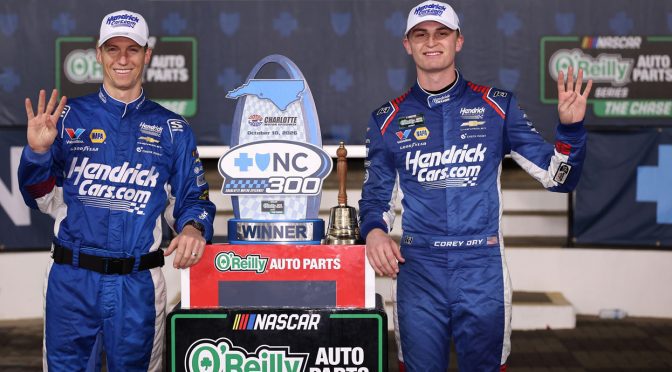
Fast forward to October, the No. 17 Hendrick Motorsports pilot’s expectations have soared. Day has captured four wins, 11 top fives, 20 top 10s and led 394 laps through 30 races. As a bona fide postseason driver, the opportunity to claim a championship crown is possible.
“It’sprettycooltolookbackon,forsure,” Day told NASCAR.com. “To think, atthebeginningoftheyear,Iobviouslyhadn’twonanythingyetandwasstilldoingalotoflearningandstrugglingtokindoffigurethisallout,it’sprettycooltolookback. It’sbeeneightmonths,orhoweverlongit’sbeen,andyeah,wegotfourwins,andwe’reinthehuntforachampionship.”
An 11-race cup of coffee during the 2025 O’Reilly campaign gave Day experience at a range of track types, including short tracks and road courses. That experience has paid dividends, with Day’s first career O’Reilly win coming at Talladega Superspeedway in April. A Dover Motor Speedway victory in May, plus back-to-back Chase wins at Las Vegas Motor Speedway and Charlotte Motor Speedway, has rounded out the Victory Lane portfolio.
History has even been made. Day became the first Hendrick driver to win consecutive O’Reilly races since Kyle Busch in 2004. If Day wins a fifth race, he will join Busch, Greg Biffle and Carl Edwards as drivers to win exactly five O’Reilly races in their first full-time O’Reilly season — tied for third most all time.
“That’ssupercool,” Day said. “… Iguesssevenispossiblenow,withthreeleft?Thatwouldbeobviouslyawesome.Butyouknow,ifweendtheseasonwithonlyfour,I’dstillbesuperhappywiththat,too.”
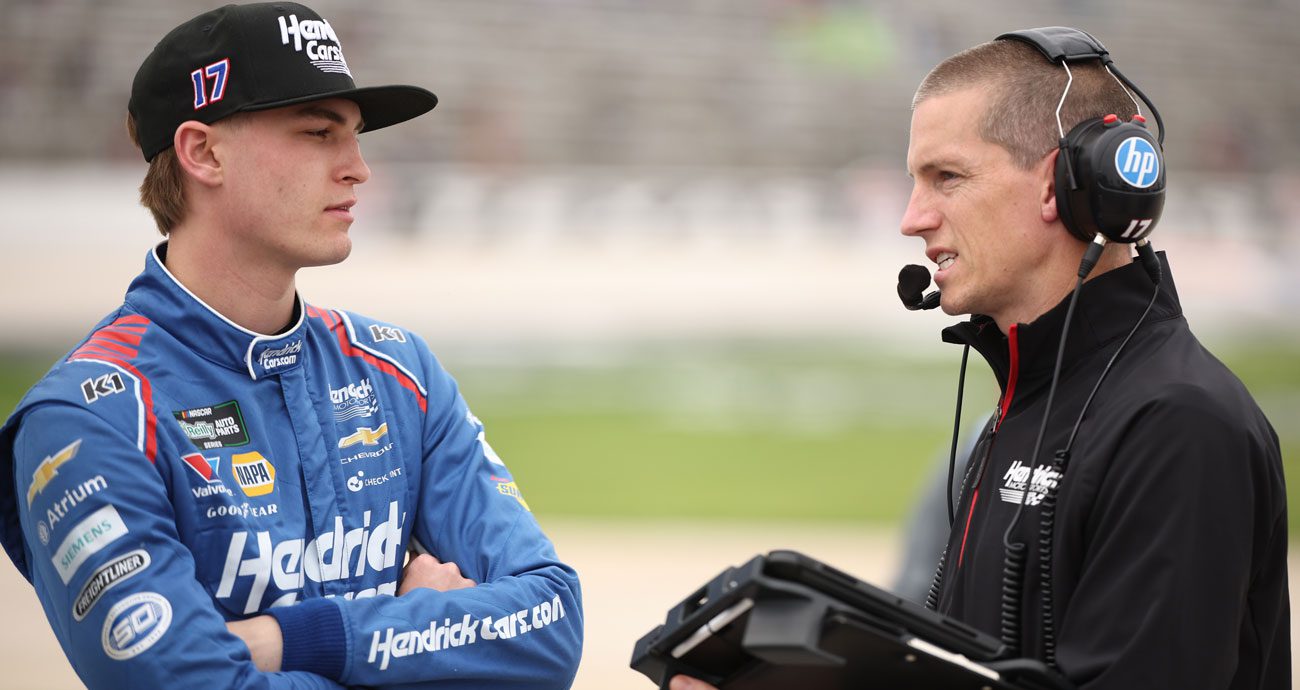
Adam Wall, crew chief of the No. 17, developed a passion for racing at a young age, with that interest culminating in a motorsports engineering degree from the University of North Carolina at Charlotte in 2011. After joining Hendrick Motorsports, the 37-year-old Wall worked his way up the ranks, from sweeping floors in the chassis shop to joining Hendrick and the No. 17 camp in 2025 following a stint calling shots at JR Motorsports.
“Noneofthemhavebeenintentionalbyanymeans.Theyjustallshowedmyinexperienceinstock-carracing,” Day said. “Ithinkoverall,there’sbeenatontolearnfromeachandeveryoneofthem.Obviously,thislastonewasn’tideal,beingin The Chase.Ilookbackonitnowwithwherewe’reatinpoints,andyeah,youlookbackonit,andthingscouldlookawholelotdifferentifthatdoesn’thappen andwehaveagoodruninSt.Louis. I think there’s a lot to learn from each and every one of them, and I definitely have, as my results have shown and my race craft has shown, this last half of the season.”
“Ithinkjusthimtosaythatrightthereisbeingwillingtolearnfromeachoftheseevents,” Wall said. “Imean,no,it’snotwhatwewantfor The Chase.It’snothowwewanttostartthefirstandsecondracesof The Chase,right?Buttostillhaveashotatit,andforhimtorealizethatnow,atthispoint,stillwiththreeracestogo,Ithink aslongashismindsetisinthebigpicturemorethanitwasmaybeatthosetimes,that’sallIcanaskoutofthoseexperiences.”
After entering The Chase presented by Mobil 1 as the No. 7 seed, Day now sits third in the table, 39 points behind Chase leader Jesse Love. According to Wall, the ability to maneuver and find clean air has helped Day excel. From his time with the No. 5 team in the NASCAR Cup Series from 2021-2023, Wall believes Day keeps a straightforward approach, an aspect similar to Kyle Larson.
“Istillgooutthereeveryweekendwithamindsettolearn,” Day said. “NowIknowit’salotmorepossibletowineachtimeI’mouttherethanitwastostarttheseason,andIdon’tbyanymeans goouttherethinkingthatIcan’twin.Ithinkifyougooutonthetrackasaracecardriverwiththemindsetthatyoucan’twin,it’sprettyfoolishofyou.Iknowthateachandeverytimewe’reoutthere,itcouldbeourday,whichisdifferentthanevenoverthesummer.Iobviouslywantedtowinatthestartofthisyear,butIhadalongroadaheadofme.Soyeah,nowIthinkI’mmoreconfidentinmyability.Ithinkourteam’soperatingatahighlevel,soIdon’tthinkthemindsethaschangedaton.ButI’dsaymaybeweexpectalittlemorethanwedidatthebeginningoftheyear.”
Three Chase races remain, with Talladega – the site of Day’s first win – on Saturday (3:30 p.m. ET, The CW, ESPN Unlimited, MRN Radio, SiriusXM NASCAR Radio). Eagerness to clinch a title in Hendrick’s first full-time O’Reilly season since 2006 is evident.
Unlike the other two national series, the NASCAR Craftsman Truck Series championship dance has narrowed to a duet coming into Talladega Superspeedway, the most unpredictable venue remaining in the 2026 season.
Tricon Garage’s Kaden Honeycutt and Front Row Motorsports’ Layne Riggs take a considerable advantage over the field when the green flag falls for Friday afternoon’s Love’s RV Stop 225 (4 p.m. ET, FS1, NASCAR Racing Network, SiriusXM NASCAR Radio).
Heading into the always-thrilling Talladega race, the season’s four-time winner and driver of the No. 11 Toyota, Honeycutt holds his largest advantage of The Chase presented by Mobil 1, a 39-point edge over seven-race winner Riggs – both drivers well in front of third place, McAnally-Hilgemann Racing’s Christian Eckes at 112 points back. None of these drivers have won on the sport’s biggest track, however.
In last year’s postseason race at Talladega, Riggs, driver of the No. 34 FRM Ford, finished fifth, Honeycutt was 10th, and it was actually Honeycutt’s Tricon teammate Gio Ruggiero scoring his first career win – from pole position – leading a race-best 37 of the 90 laps including the final seven in a thrilling overtime triumph.
CR7 Motorsports driver Grant Enfinger is the only Chase-eligible driver with trophies at all the remaining tracks (Talladega, Martinsville, and Homestead-Miami). Neither Honeycutt nor Riggs has won at any of those venues.
Any driver more than 152 points behind the leader following the Talladega race will be mathematically eliminated from championship contention. Three drivers enter the weekend already beyond that margin — Enfinger (-184), two-time series champ Ben Rhodes (-188) and Tyler Ankrum (-201) — while Ruggiero (-151) sits just inside it. All four need strong runs Friday to stay in the hunt.
Of note, Honeycutt boasts the best average finish (3.3) in the opening four Chase races with McAnally-Hilgemann’s Daniel Hemric second best with a 7.3 average finish and his teammate Eckes third best with a 9.0 average. Riggs, who opened the chase with finishes of 32nd (Bristol) and 19th (Kansas), is only seventh best in the Chase with a 13.8 average finish so far.
There have been nine different winners in the last nine Talladega races, including five hoisting their first career trophies. Talladega boasts the series record for most last-lap winning passes (11) – including six of the last eight races.
Kennametal Pole Qualifying is slated for 12:30 p.m. ET on Friday (FS2).
He never earned a Busch Light Pole Award, scored a stage point or made The Chase. You won’t find his name on the Harley J. Earl Trophy as a Daytona 500 winner, nor are there any barroom arguments about his Hall of Fame credentials, or even a page for him on Racing Reference to pull up some numbers to help sway your opponent.
He might as well have.
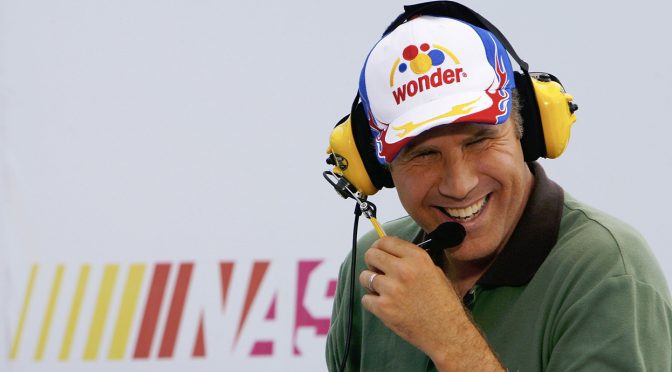
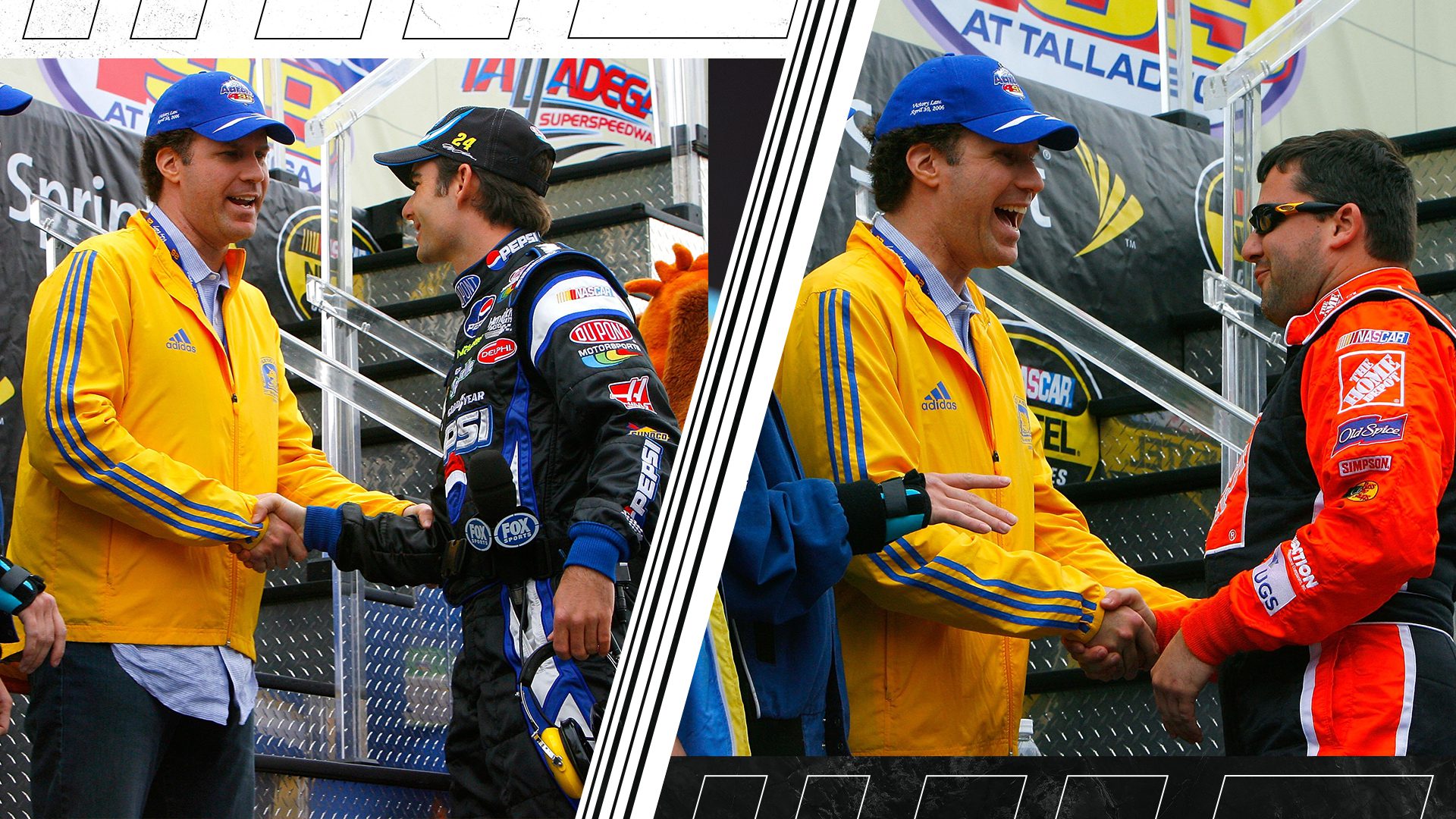
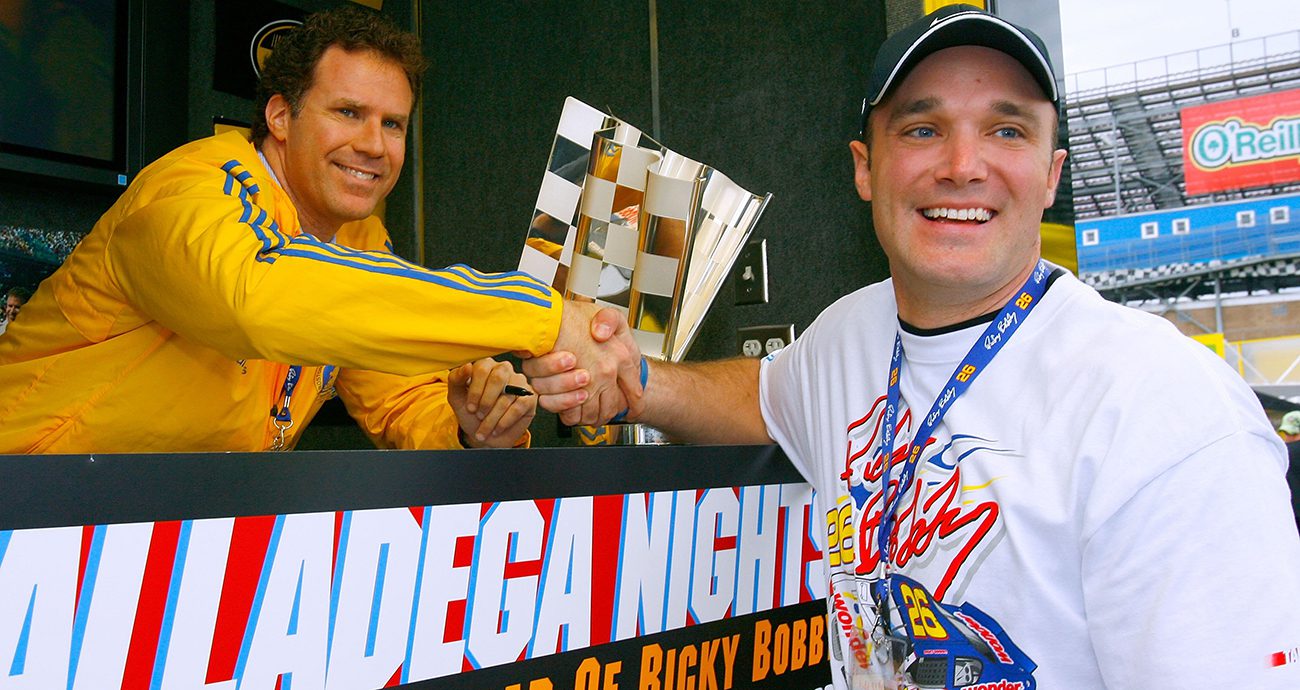
Twenty years after “Talladega Nights: The Ballad of Ricky Bobby” introduced him, Ricky Bobby feels as real as ever, somehow a stock-car racing institution and NASCAR legend in his own right, embodying everything about this sport that makes it the spectacle that it is, and also so personal to so many of us.
Deep down? We all just wanna go fast.
His Wonder Bread colors have competed in actual Cup Series races. His movie car has been on display at the NASCAR Hall. The sport has made room for him in places that usually require far more than a screenplay and a few hours of laughs.
It’s hard to believe it’s been two decades, but it’s easy to see why the ballad is still being sung.
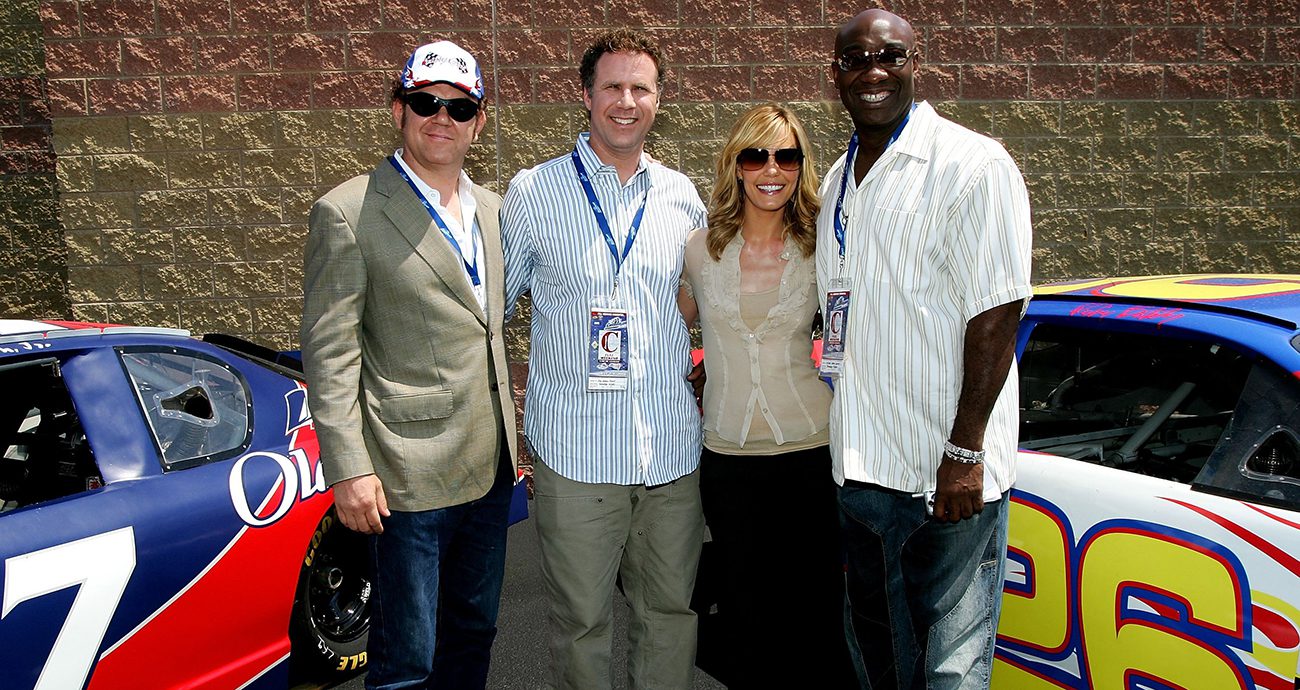
Some of the cast who helped bring Ricky Bobby’s world to life are returning to Talladega Superspeedway for Dega-Con this weekend, an anniversary celebration during the Chase weekend tripleheader that will culminate with Sunday’s crucial YellaWood 500 NASCAR Cup Series race (2 p.m. ET, NBC, HBO Max, MRN Radio, SiriusXM NASCAR Radio). The festivities include a film screening, a cast reunion Q&A and an attempt to set a Guinness World Record for the largest gathering of Ricky Bobbys.
Yes, you read that right.
Ricky Bobby has no official statistics. His fans are trying to get him into the history books anyway.
It’s a remarkable second act for a character whose entire racing career, in theory, should’ve just unfolded on a movie screen and that was that. Plenty of comedies remain quotable decades later. Far fewer become so thoroughly embedded in the culture they portray that the line between fiction and reality starts to look like a minor technicality.
Yet that’s where Ricky Bobby finds himself in 2026: still deeply woven into NASCAR’s colloquialisms, imagery and sense of humor, with fans dressed as him in the stands every Sunday while remaining a familiar entry point for people who might otherwise know little about the sport.
And somewhat fittingly, some of the people who brought his world to life needed an introduction to it themselves.
David Koechner, for one, had to learn how to work the jack. He then quickly learned it, uh, wasn’t for him.
Koechner arrived in Alabama for filming in October 2005 to play Hershell, one of Bobby’s pit crew members, with a racing background largely consisting of seeing some sprint cars at the Missouri State Fair and the occasional demolition derby. Football was his sport. The immediate draw of “Talladega Nights” was mostly another chance to work with his buddies Will Ferrell and director Adam McKay, whom he’d just collaborated with on “Anchorman.” NASCAR? Hell, why not?
Then came the education.
“The fascinating thing for me was getting into the science of NASCAR because, you know, the perception is just a bunch of good old boys getting out there and getting a good time and racing, racking up with each other,” Koechner, who once portrayed NASCAR’s founder, told NASCAR.com. “No, it’s a science. It’s a science.”
He remembers being taken through the precision of pit stops, the specialized responsibilities assigned to each crew member and the athletic backgrounds teams sought when filling those roles. Teams recruited former college football players and other athletes for positions that required particular combinations of speed, strength and coordination. And they weren’t all alike.
“Each member of the pit crew is recruited from specific sports positions, from college athletes,” Koechner recalled. “I’m like, ‘Are you kidding me?’ A shortstop does one thing, a linebacker does another thing, a defensive end or tight end does another thing. And that’s what was fascinating to me and makes complete sense.”
His surprise wasn’t that NASCAR required talented people. It was how thoroughly each person’s talents had been matched to a particular task.
“Oh, good Lord, just like anything that gets to this level, this is a high-precision sport, and there’s not a detail that is left to chance,” he said.
What looked from the outside like a group of people changing tires in a hurry was, he discovered, an operation with little room for improvisation or failure. The actors trained for their respective assignments, and Koechner recalls initially being designated the jackman because of his height.
This proved an insufficient qualification.
“So the jackman is going to be a defensive end, right? Because he’s long, lean, got strength. So originally I was supposed to be a jackman. So we’re rehearsing, I guess, basically, or we’re training to play our parts.
“So, you know, I’m taller, so that’s why they gave me jackman. Now that is a very hard job. And at the time, I probably weighed 195. Jackman’s got to be 225. He’s got to be 23 years old and pop that thing. So I tried a couple times. I said, ‘Nope.’ I grabbed a clipboard and said, ‘This is what I’m gonna do.’”
Koechner’s introduction to Talladega itself was hardly less memorable.
He recalls the cast and crew flying to Alabama aboard a chartered Hooters Air plane – an entirely appropriate mode of transportation for a movie that would eventually feature a cougar-sponsored race car. Getting into the speedway proved considerably less efficient. Koechner remembers spending roughly three and a half hours in a vehicle with fellow actors Jack McBrayer and Ian Roberts before finally reaching the track. A helicopter ride out with Ferrell, McKay, John C. Reilly and others was substantially quicker.
But what happened between those two very different commutes is what made the deeper impression.
The production needed an actual pit stall to film its crew scenes during a real race. Koechner expected a lengthy wait before one became available. Instead, he remembers the opportunity arriving almost immediately.
“Because I’m thinking we’re gonna wait here for a couple hours,” he recalled. But then a car pulled off, and it was time to go. “It’s immediate. There’s a pit open, we take over.”
Suddenly, the sport the cast had been studying was unfolding all around them in real time, with Koechner experiencing the fury of a NASCAR field at speed from pit road.
“And just the raw horsepower, the feel of raw horsepower. That was the most awesome. I tell you, that moment was the most awesome. Like, my dear God. It’s a bit harrowing, but also thrilling. And then the adrenaline pumping. But now we’ve got to do dialogue. Like, are you kidding me?”
The noise presented a problem that doesn’t typically arise on a comedy set: nobody could reasonably expect to hear the actors, with 40-something machines roaring by at pace.
Koechner recalls McKay instructing them to carefully articulate their words – to “chew” the dialogue – so their performances could be matched with replacement audio later.
“We know that we’re gonna match this in post,” Koechner said. “Because there’s no way they’re gonna be able to hear us.”
That commitment to authenticity was central to the production. NASCAR cooperated with Ferrell and McKay, helping provide access to real tracks, crowds, teams and racing environments. Dale Earnhardt Jr. and Jamie McMurray appeared as themselves, while familiar broadcast voices helped make the fictional races sound like the real thing.
“In life, you get to have experiences for whatever reason, and because you’re an actor, you have probably so many wonderful, unexpected experiences, and that was certainly one of them.”
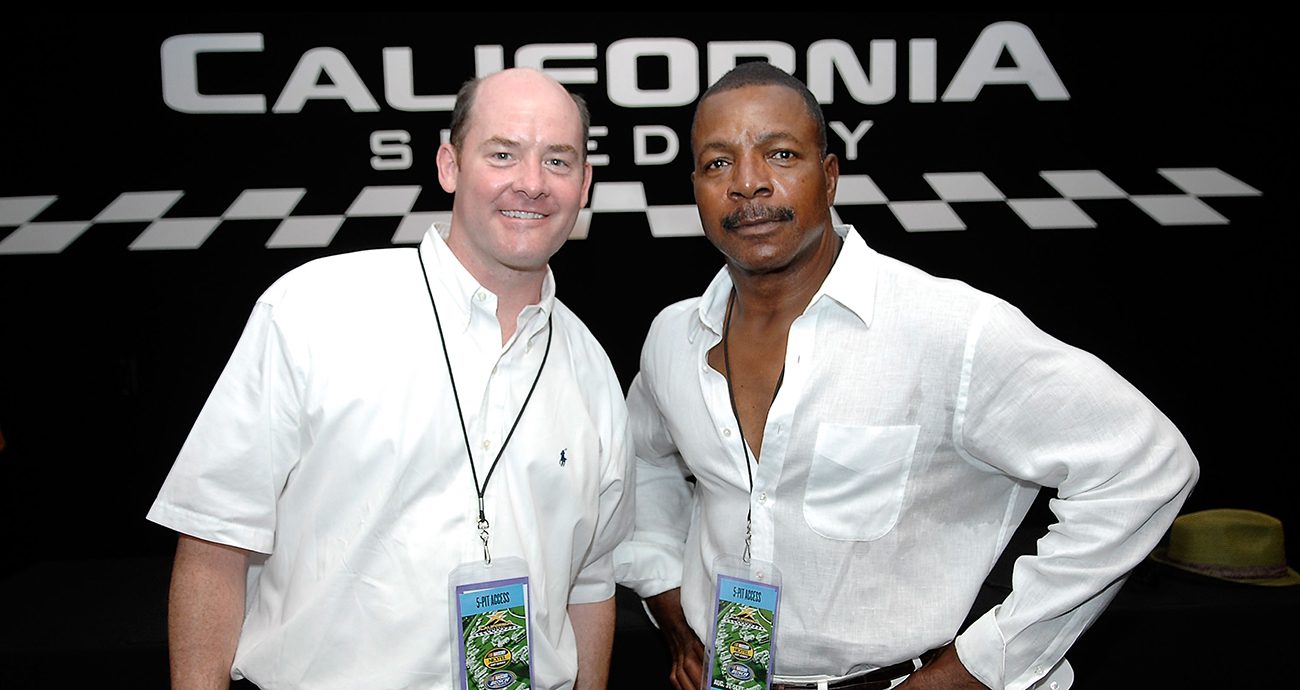
David Koechner and fellow actor Carl Weathers at Auto Club Speedway in 2007 (Steve Grayson | Getty Images for NASCAR)
As Ferrell explained in a 2016 ESPN oral history, the filmmakers wanted to have fun with NASCAR rather than simply make fun of it. That meant finding the sport’s actual peculiarities, then stretching them until they became ridiculous.
Greg Germann, who played fictional team owner Larry Dennit Jr., discovered a similarly unfamiliar world.
Germann’s childhood racing experience included witnessing a figure-eight race and demolition derby in Colorado. The scale of NASCAR, its enormous following and the intensity of the action at track level came as something of a revelation.
“When we did the movie, you know, 20 years ago, that was one thing that really surprised me. I was shocked at how many people. I mean, we’re all in our own bubbles. But how big the fan base is, you know, relative to, I don’t know, the NFL, NBA, even like the World Cup?” Germann told NASCAR.com. “That was eye-opening for, I think, a lot of us, to see how big the fan base is and how exciting it is and stuff. And, you know, we’re not exposed to it.
“ … Talladega, it’s like, to be down there on the track when they’re going. It’s insane. It was eye-opening, really.”
Two decades later, he remains interested enough to ask questions and catch back up after his NASCAR absence. During an interview about the film’s anniversary, Germann wanted to know how the current championship format worked, where Talladega fit into the schedule and which drivers were still in contention.
A participant in this weekend’s Dega-Con festivities, it’s the film that brought him to NASCAR in the first place – and back to it.
That might be as useful an illustration of the movie’s broader appeal as any box-office statistic.
“Talladega Nights” opened at No. 1 in August 2006, eventually earning more than $148 million domestically. Its audience was vast, reaching well beyond NASCAR’s existing fan base and introducing millions of moviegoers to a world they might never have explored otherwise.
For some, Ricky Bobby may have been the first NASCAR driver – real or fictional – they came to know. Through him, the sport became something more than cars circling some track down south. The movie offered recognizable teams, rivalries, sponsorships, personalities and an entire ecosystem of people whose lives revolved around what happened on Sundays.
Ricky and Cal Naughton Jr.’s “Shake and Bake” partnership turned the complicated relationship between NASCAR teammates into something immediately understandable, and the sponsors were practically supporting characters themselves. Bobby’s Wonder Bread, Naughton Jr.’s Old Spice and the green Perrier car of Jean Girard (portrayed by Sacha Baron Cohen) gave each driver an instantly identifiable, distinct personality.
And Ricky’s responsibilities, like those of every other NASCAR driver, hardly ended when he climbed out of the car. There were commercials to shoot, sponsors to satisfy, reporters to entertain, crêpes to refuse to eat and an entire public identity to maintain.
None of this was intended as a documentary, obviously. But beneath the absurdity was a surprisingly functional introduction to the sport’s relationships, business and spectacle.
The movie didn’t teach NASCAR’s rule book; it taught the shape and culture of the sport.
Still, the authentic racing environment alone doesn’t explain why Ricky Bobby has endured. Plenty of fictional worlds look convincing, and far fewer produce characters that people keep bringing along into their own lives.
Ask Koechner to explain the movie’s cultural staying power, though, and he initially wants no part of an elaborate analysis.
Trying to explain why a comedy connects with an audience, he suggests, is a fine way for an actor to wander into territory where he doesn’t belong.
“If it made you laugh, then it’s good,” he said. “That’s as far as I could go.”
Fair enough.
But ask why people still connect with Ricky Bobby himself, and there’s considerably more thread to pull on.
“Well, for me, if you’re asking me, it’s because he has a dream.”
Getty Images
“So Ricky Bobby’s dad takes off. We’ve got abandonment and neglect right there, so he’s got to overcome those things. You know, it’s all back to Joseph Campbell’s hero’s journey. And as Plato says, the cave … you’ve got to go through the cave to get to the light, and do you remain in the darkness or do you come out in the light?
“When you talk about why people respond to it, they might not be intellectually aware of what they’re necessarily doing. … I’ve had hardship, I’ve had disappointment. I felt that I wasn’t good enough. … So then we all have to thrust ourselves out there to be seen in the way we want to be seen. So that’s really the story of this whole thing.”
Germann finds the character’s humanity in the man playing him.
“That’s Will,” he said when asked why Ricky remains so recognizable. “You know, like with ‘Anchorman,’ with Ron Burgundy, or the other characters that Will has created. You know, he’s iconic. All this stuff on ‘Saturday Night Live’ … and then you add to that, but he’s genuinely one of, like, the nicest guys around. I think that has … what kind of comes out of his work when you see him is he’s a genuinely good guy. So his comedy really connects with people.
“He has a kind of a magic ability to do that. And I think that’s why Ricky Bobby really radiates in that way.”
The jokes may be enormously quotable, but the feelings underneath them are ubiquitously relatable. And once audiences made those characters their own, they didn’t seem especially interested in giving them back.
Koechner sees that evidence whenever he travels for his stand-up career.
He has appeared in “Anchorman,” “The Office” and a long list of other recognizable projects, but which credit follows him most closely depends on where he happens to be performing. In some places, it’s “Anchorman” or “The Office.” Back home in Missouri, and particularly across the South, “Talladega Nights” tends to move up the billing.
“The fun for me, because I tour and do stand-up in different parts of the country, I’ll be known for different things,” Koechner said. “It’s interesting to kind of clock the regional thing you’re known for.”
But it’s the interaction with fans – sometimes people who have carried a favorite movie with them for two decades – that provides the occasional reminder of how far that shared experience has traveled.
“In your day-to-day life, you don’t think about yourself in (the movie),” he said. “You think about yourself and your family in the world. But then when you’re out in the world, you go, ‘Oh, that’s right. I did something that a lot of people have shared.’ And so be aware of that, which is just joyful. But you don’t look for it, but when it happens, you go, ‘Oh, that’s right. Yeah, look how fortunate I’ve been. Look how, you know, blessed I have been, or am.’ So, you know, to think about 20 years, you’re like, well, that was such a fun thing. And it worked, because in movies you don’t know it’s going to work. But it worked, and you were in it.”
At NASCAR tracks, that shared experience has long since extended beyond repeating favorite lines.
Getty Images
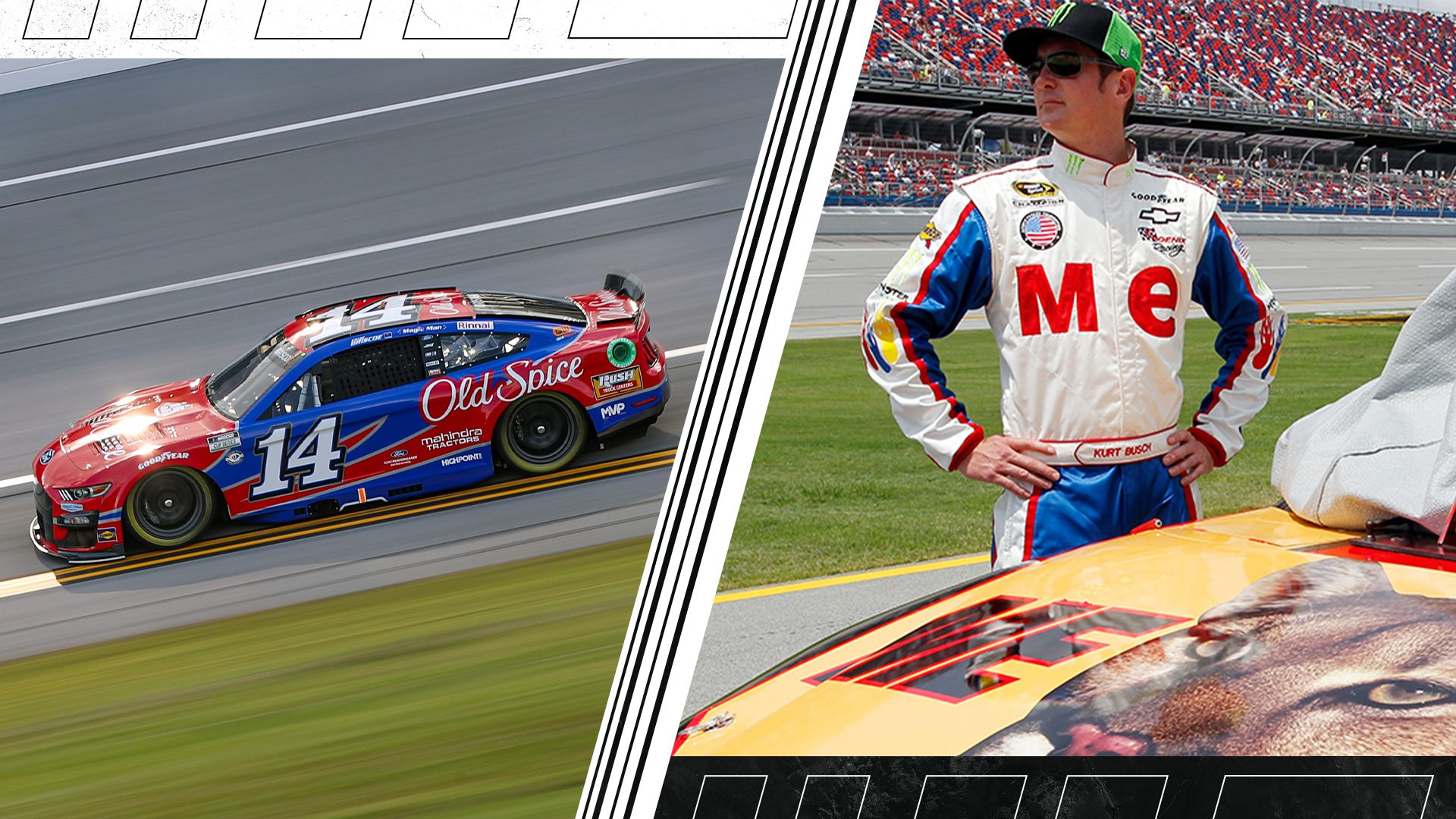
NASCAR Hall of Famer Kurt Busch brought Ricky’s cougar-emblazoned “ME” design into actual Cup Series competition at Talladega in 2012, then returned the following year with Wonder Bread colors on Furniture Row Racing’s No. 78 Chevrolet.
In 2023, Chase Briscoe and Ryan Preece brought the movie’s most famous partnership back to the track, with Briscoe’s No. 14 Ford carrying Cal’s Old Spice colors – and his face carrying a sweet-ass handlebar mustache – and Preece’s No. 41 sporting Ricky’s Wonder Bread scheme.
And the connection has hardly remained confined to what happens on the race track. In 2023, Cup Series champion Kevin Harvick literally purchased the Lake Norman mansion used as Ricky Bobby’s home in the film.
The staying power isn’t simply a matter of nostalgia or clever marketing. NASCAR fans recognized enough truth beneath the exaggeration to claim the film as their own, while people who knew little about the sport found the characters and their world accessible without needing to understand everything happening under the hood.
This weekend’s Dega-Con celebration takes the relationship to its logical extreme, turning a 20-year-old comedy into a gathering built around the characters, jokes and images fans have kept alive themselves. All during a pivotal postseason weekend for each national series.
And as Hollywood prepares another trip into NASCAR with Tom Cruise’s return as Cole Trickle in a “Days of Thunder” sequel scheduled for 2028, the sport has another opportunity to introduce itself to audiences through the shared stories, community and personalities that surround the competition.
“Talladega Nights” demonstrated how effective that invitation could be, even when delivered by a man who believed in himself first and foremost, because if you ain’t first, you’re last.
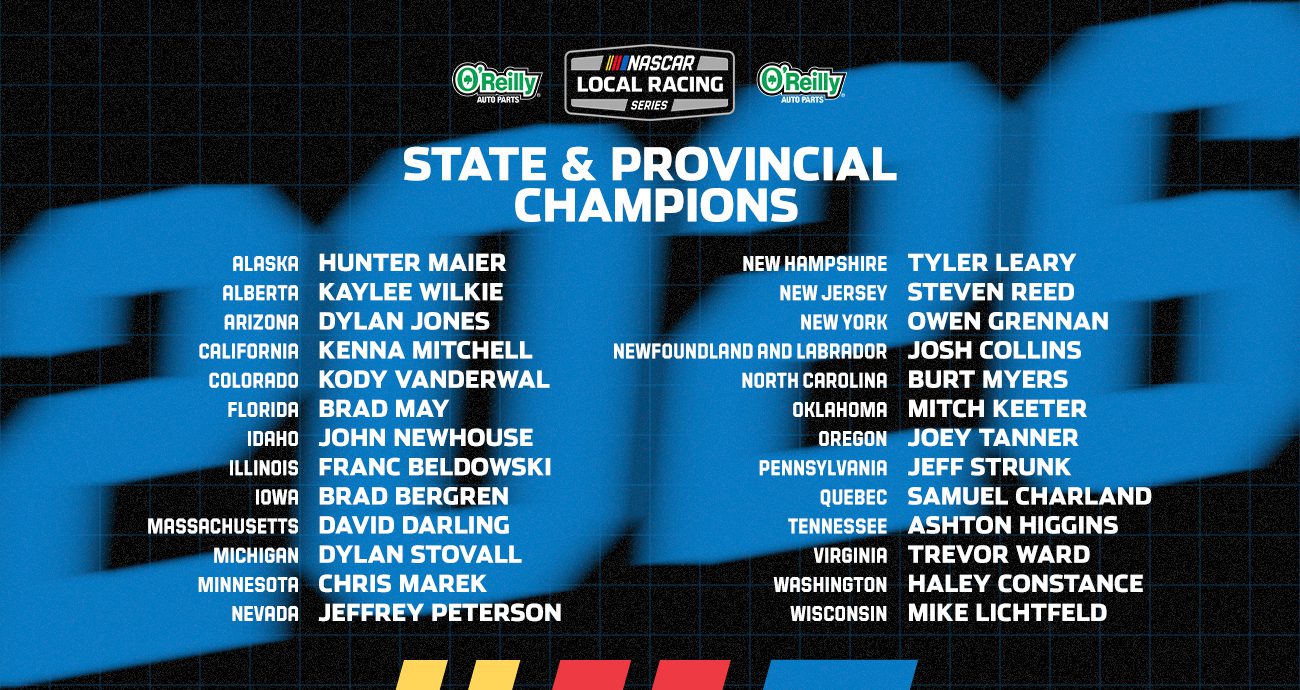
Each year, state and provincial champions for the Local Racing Series are determined by drivers’ 14 best finishes at a track or tracks in a given state or province.
Many who secured these titles this season are new to the board. Others are familiar racing veterans who are mainstays on the scene in their respective states or provinces.
Those who win state and provincial titles in the Local Racing Series are awarded trophies and custom firesuits, not to mention invites to the NASCAR Regional and International awards banquet in Charlotte.
Below are all of the state and provincial champions for 2026 and the numbers they posted on the track this season.
2026 NASCAR Local Racing Series state and provincial champions
Alaska: Hunter Maier
Tracks: Alaska Raceway Park
NASCAR stats: 2 wins, 8 top fives, 8 top 10s in 10 features
Alberta: Kaylee Wilkie
Tracks: Edmonton International Raceway
NASCAR stats: 5 wins, 9 top fives, 10 top 10s in 10 features
Arizona: Dylan Jones
Tracks: Tucson Speedway, Colorado National Speedway
NASCAR stats: 9 wins, 13 top fives, 15 top 10s in 15 features
Kenna Mitchell (Photo: Scott Marshall/NASCAR)
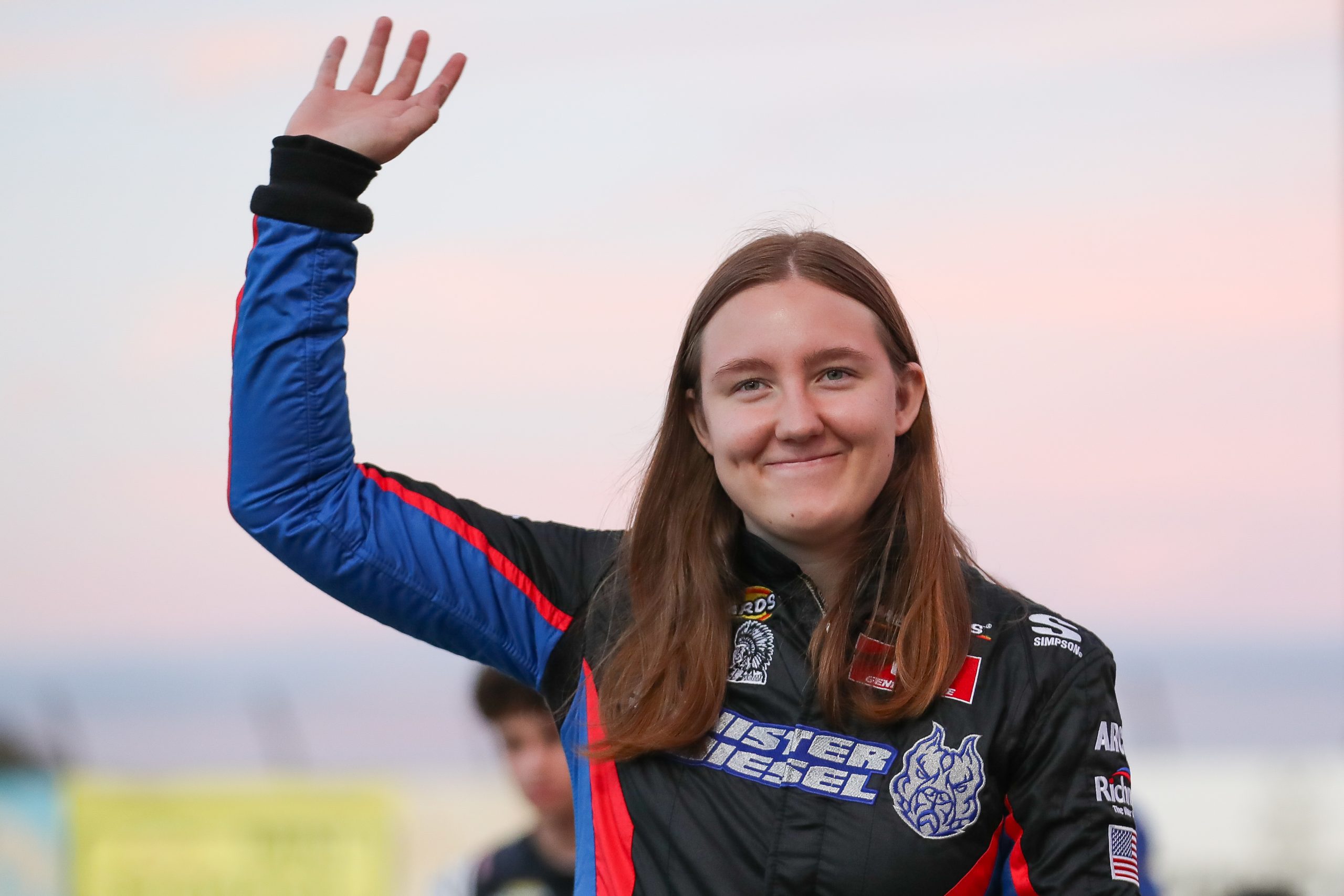
California: Kenna Mitchell
Tracks: The Bullring at Las Vegas Motor Speedway, Kevin Harvick’s Kern Raceway, All American Speedway
NASCAR stats: 12 wins, 13 top fives, 13 top 10s in 13 features
Colorado: Kody Vanderwal
Tracks: Tucson Speedway, Colorado National Speedway
NASCAR stats: 5 wins, 10 top fives, 11 top 10s in 11 features
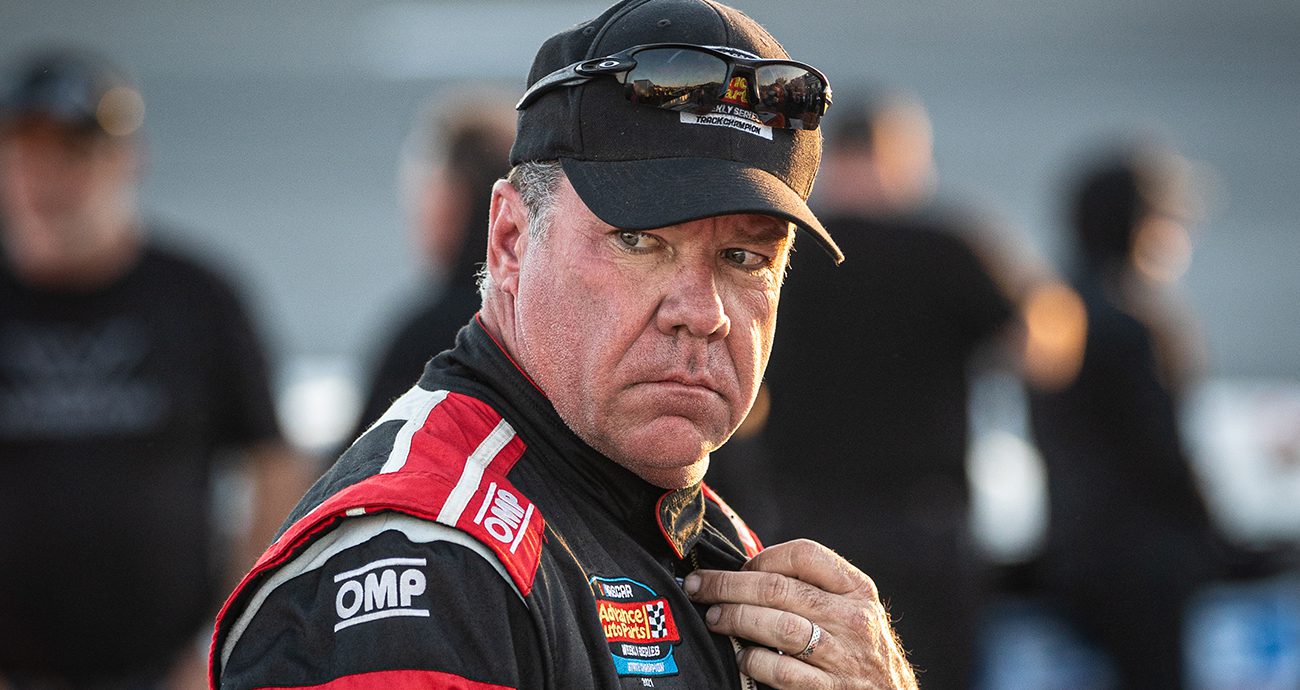
Florida: Brad May
Tracks: New Smyrna Speedway
NASCAR stats: 2 wins, 6 top fives, 6 top 10s in 8 features
Brad May (Photo: Ted Malinowski/NASCAR)
Idaho: John Newhouse
Tracks: Meridian Speedway, Magic Valley Speedway, Motorplex at the Mill
NASCAR stats: 6 wins, 16 top fives, 16 top 10s in 16 features
Illinois: Franc Beldowski
Tracks: Grundy County Speedway, LaCrosse Fairgrounds Speedway
NASCAR stats: 4 wins, 8 top fives, 10 top 10s in 10 features
Iowa: Brad Bergren
Tracks: Adams County Speedway
NASCAR stats: 4 wins, 11 top fives, 12 top 10s in 12 features
Massachusetts: David Darling
Tracks: Seekonk Speedway
NASCAR stats: 5 wins, 12 top fives, 12 top 10s in 12 features
Dylan Stovall (Photo: Julia Schachinger/NASCAR)
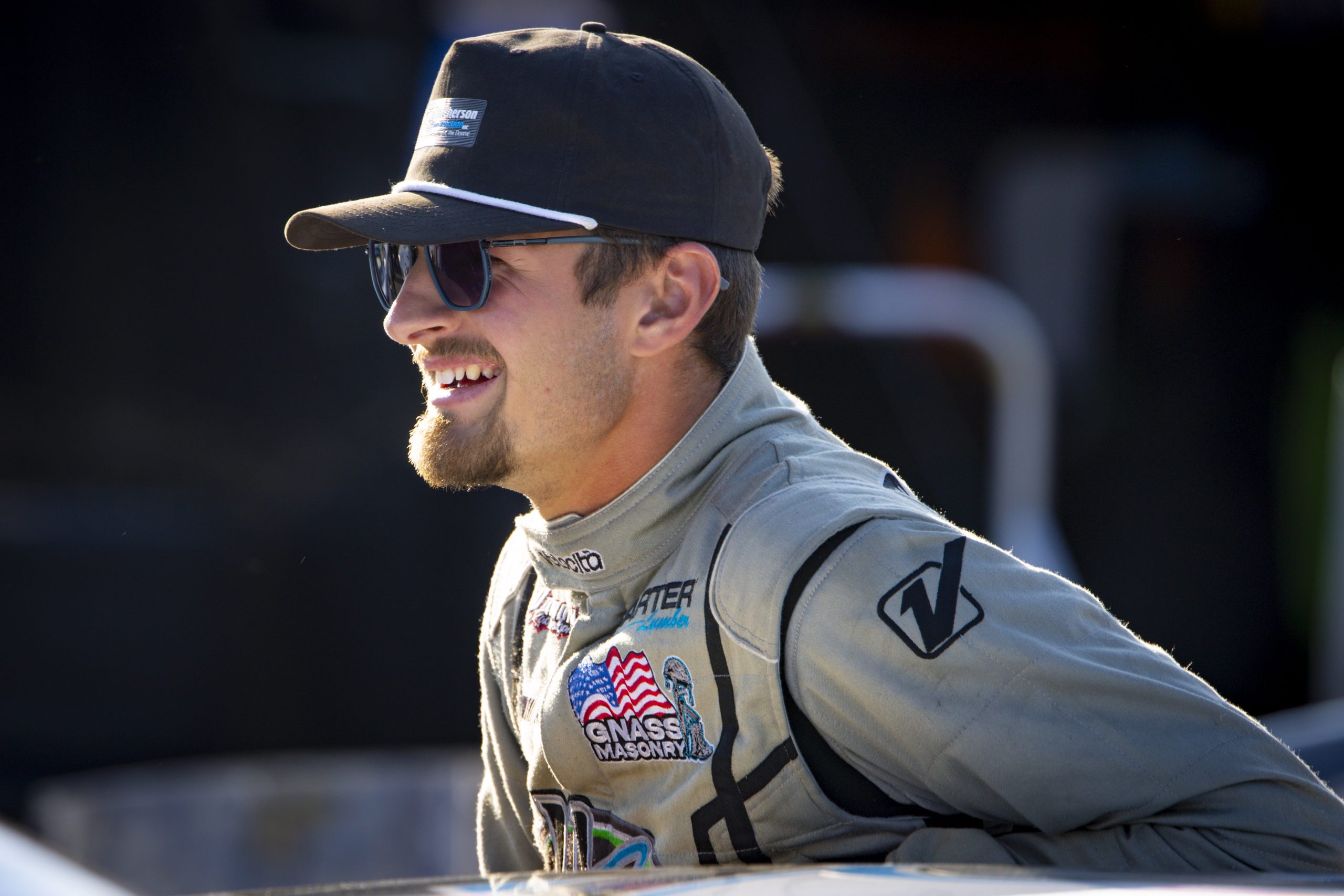
Michigan: Dylan Stovall
Tracks: Berlin Raceway
NASCAR stats: 0 wins, 6 top fives, 9 top 10s in 10 features
Minnesota: Chris Marek
Tracks: Elko Speedway
NASCAR stats: 5 wins, 12 top fives, 16 top 10s in 17 features
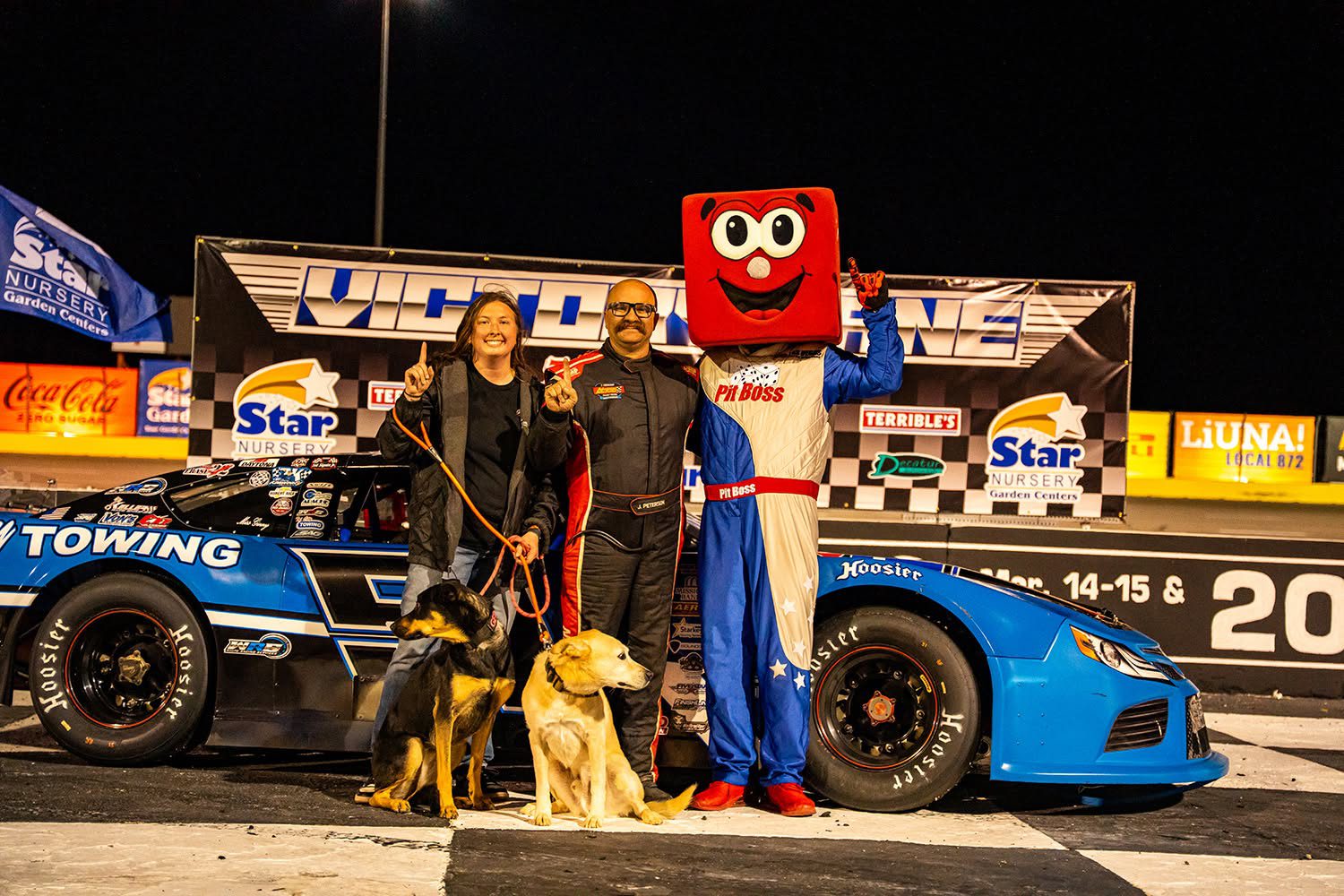
Nevada: Jeffrey Peterson
Tracks: The Bullring at Las Vegas Motor Speedway, Kevin Harvick’s Kern Raceway
NASCAR stats: 11 wins, 11 top fives, 11 top 10s in 12 features
Jeffrey Peterson (Photo: Las Vegas Motor Speedway)
New Hampshire: Tyler Leary
Tracks: Monadnock Speedway
NASCAR stats: 3 wins, 13 top fives, 16 top 10s in 16 features
New Jersey: Steven Reed
Tracks: New Smyrna Speedway, Wall Stadium
NASCAR stats: 2 wins, 9 top fives, 11 top 10s in 11 features
New York: Owen Grennan
Tracks: Riverhead Raceway
NASCAR stats: 1 win, 7 top fives, 8 top 10s in 8 features
Newfoundland and Labrador: Josh Collins
Tracks: Eastbound International Speedway
NASCAR stats: 2 wins, 6 top fives, 6 top 10s in 7 features
What a difference one week in the desert can make.
In this space over the past few weeks, we’d been tracking as Kyle Larson’s march toward a second consecutive Cup Series championship intensified with each passing race of The Chase presented by Mobil 1. Destiny seemed so clearly on Larson’s side that, even when Chase Briscoe rattled off two consecutive wins, it actually helped Larson’s title odds by ensuring valuable victories didn’t go to his primary rivals in the standings. Life was good for Larson.
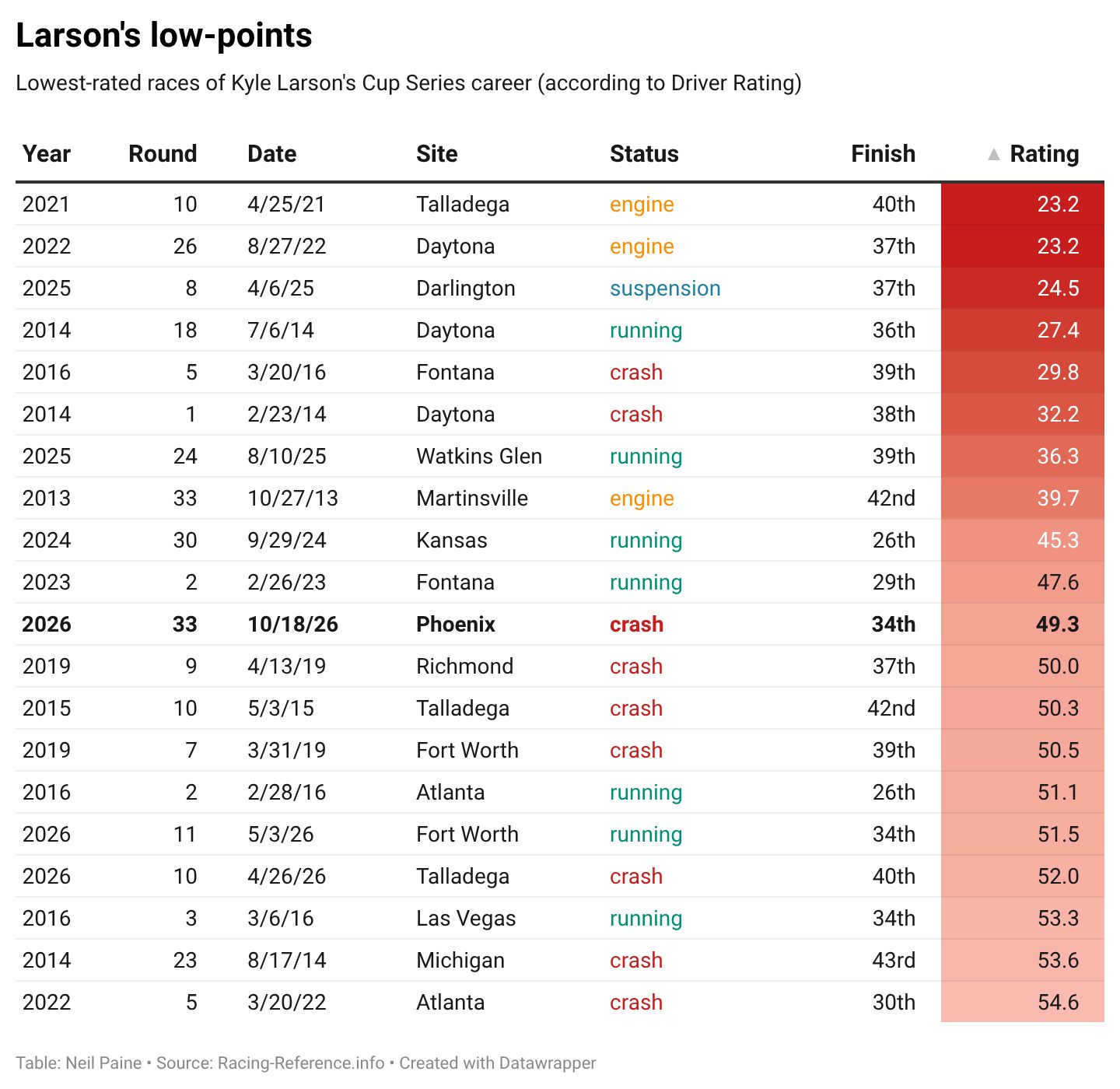
But that all came to a screeching halt this weekend in Phoenix. Larson had a rough qualifying, starting 22nd on the grid, and his team never achieved a satisfactory setup with the No. 5 car. He scored zero stage points, his average running position in the race itself ended up being just 21.98 — his seventh-worst run of the season — and that was even before a Lap 293 wreck ended his day prematurely with a 34th-place finish.
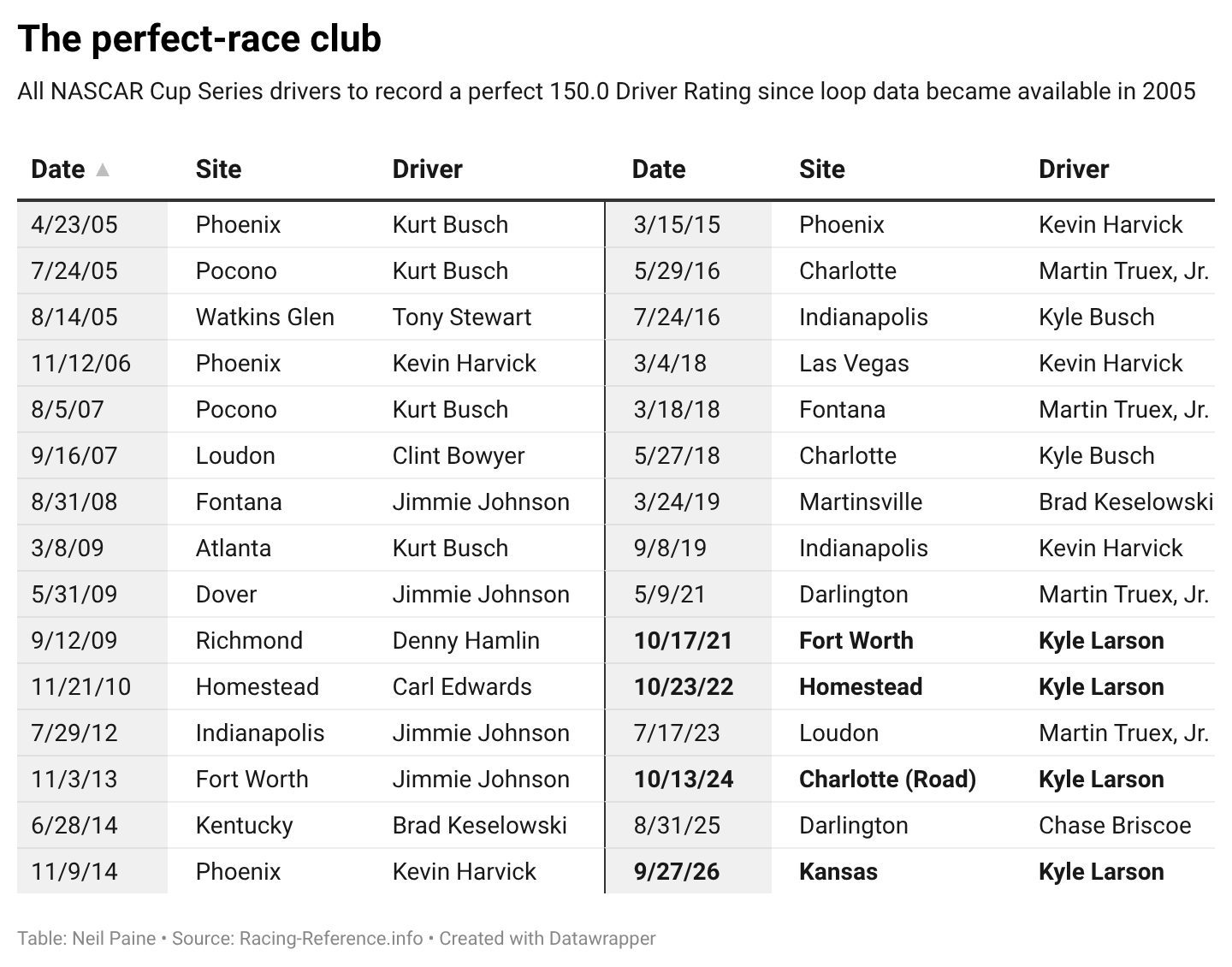
Add it up, and Larson’s Driver Rating on the day was a miserable 49.3 — the 11th-worst drive of his career, and his worst of 2026 to date.
“You guys thought I was lying to you all week when I said we weren’t good here,” Larson said afterward — though, in fairness, he’d previously finished top four four straight times at Phoenix. “I didn’t expect to be good, but I didn’t expect to be that bad, either. … We were just trying to kind of fight as much as we could and just scratch them off or whatever finish we’re gonna get.”
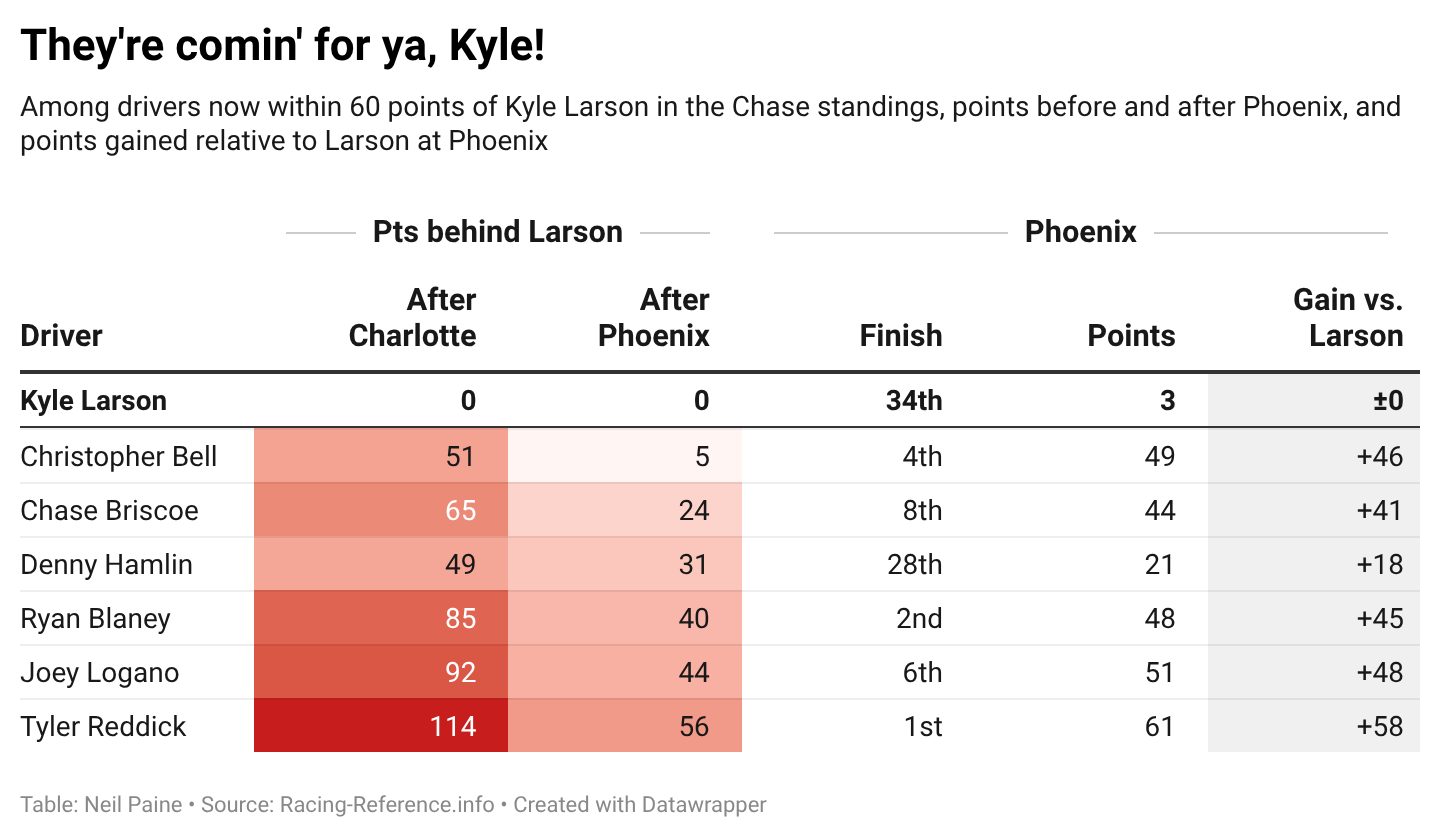
While he still came away with a slim points lead, it was the kind of day Larson couldn’t really afford if so many of his top competitors were also going to do well simultaneously. (Aside from Denny Hamlin — who finished 28th but did score 12 stage points — each of the other top seven Chase drivers through Charlotte also finished eighth or better at Phoenix.) Before Sunday, only two drivers sat within 60 points of Larson; now, six do:
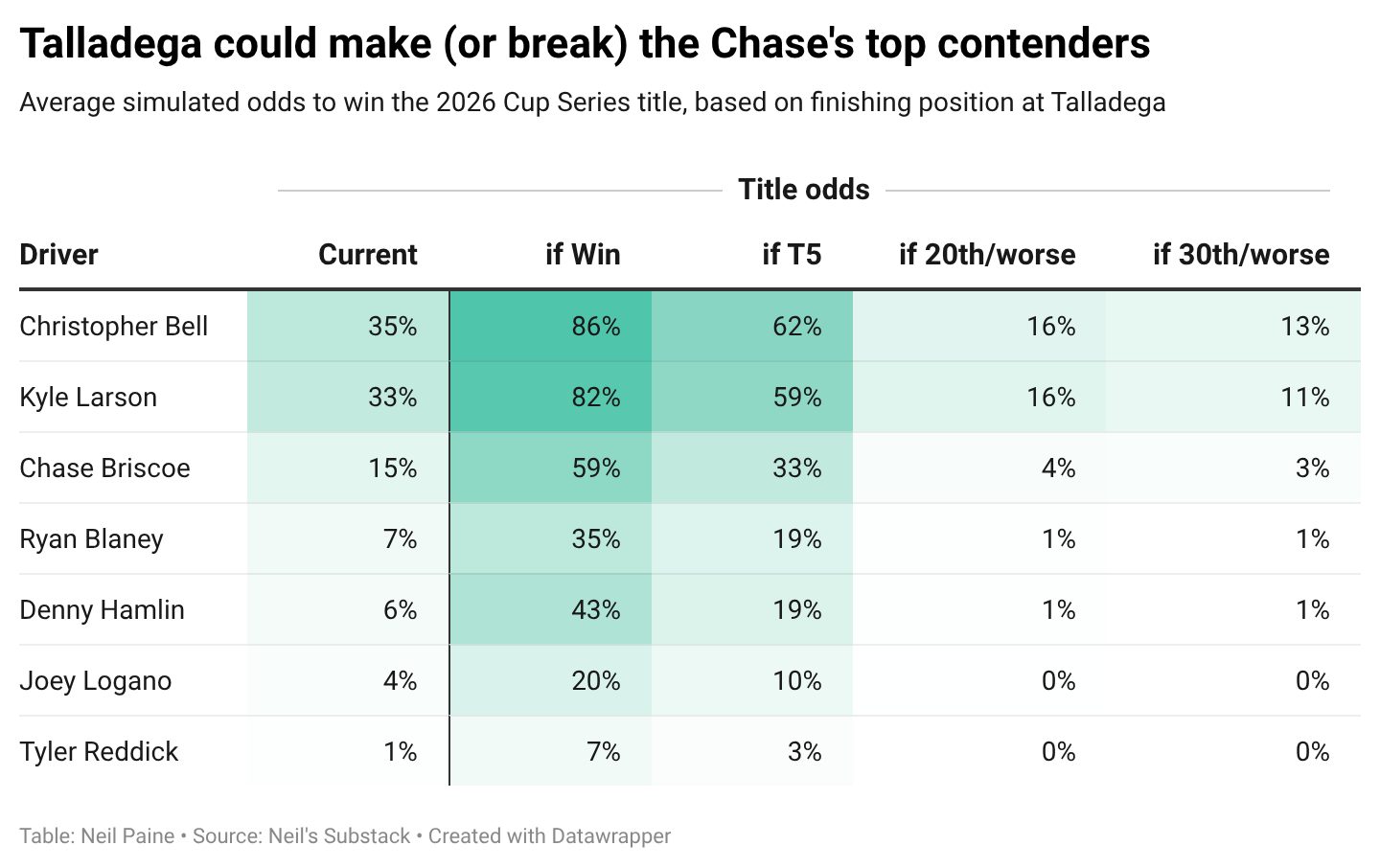
As a result, Larson’s odds in my Cup Series championship forecast model took a massive tumble, from a commanding 72.5% (versus 10.6% for next-best Christopher Bell) coming out of Charlotte to 32.6% after Phoenix — which actually trails Bell at 35.2%! (Though Larson still sits ahead of Briscoe at 14.6%.) Suddenly, it’s the wide-open title fight we thought Larson might just pull away from only a few weeks ago.
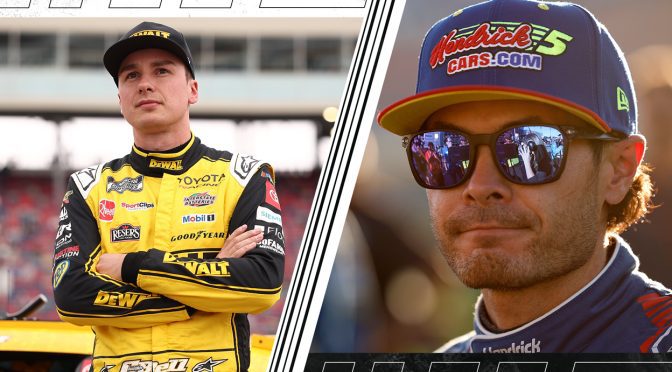
Bell, though, presents the greatest challenge to Larson’s tenuous perch atop the current standings.
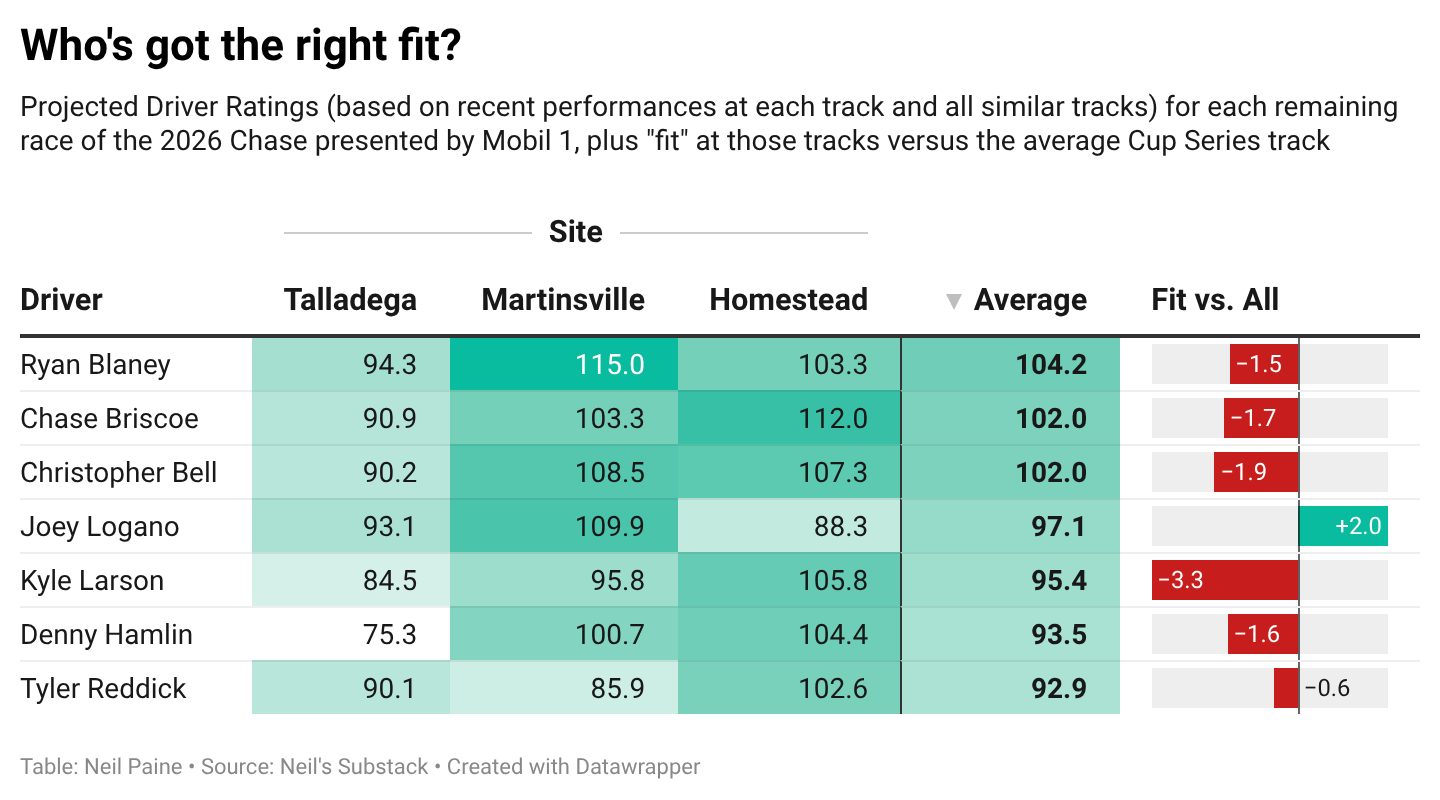
For one thing, as much conversation as we’ve had about Larson’s dominant start to The Chase, Bell has been better than Larson by average Driver Rating over the seven races of The Chase to date — 111.4 to 109.2 — and he’s had the superior rating head-to-head in four of seven outings. (And that sample includes the literally perfect 150.0 rating Larson produced at Kansas.) He’s also been better on each remaining track type — superspeedway for Talladega, short-track or flat-track for Martinsville, mile-and-a-half for Homestead-Miami — this season, all of which help explain why my forecast model has Bell slightly favored to outperform Larson at all three season-ending stops.
Of course, Larson does have the superior record on drafting tracks and especially mile-and-a-half tracks if we zoom out to the whole of the Next Gen era (since 2022), so some of this varies based on sample size. (My model gives more weight to more recent results, for what it’s worth.) And track-fit isn’t everything — just ask Hamlin, who looked like a perfect fit for this year’s Chase races on paper, but now needs some luck in order to win his first championship. But Bell is in a sweet spot for superior track-fit and closeness in the points to Larson, and that makes him the biggest immediate threat to take control of the championship race.
Bell’s not alone in terms of having opportunities to capitalize on the remaining schedule, either. Ryan Blaney (40 points back) actually has the highest average projected Driver Rating across the final three tracks, while Logano (44 behind) is the only leading contender whose remaining schedule projects better than the Cup Series’ full-season track mix. Briscoe is just 24 points back and owns the highest projected Driver Rating at Homestead-Miami, giving him a potentially powerful closing argument if he can stick within striking distance.
Meanwhile, Larson faces the biggest projected drop from his own baseline — leaving him with plenty of rivals positioned to erase his slim margin over the field.
What does this all mean for Talladega this weekend? It just makes NASCAR’s most feared track the highest-pressure race left on the schedule, too.
In the model, Sunday’s YellaWood 500 carries the highest championship leverage of any remaining race — meaning it has the greatest potential to swing each contender’s odds from their current state, for good or for bad. If any of them win at Talladega, they may just find themselves becoming a strong favorite for the title (especially if it’s Bell, Larson or perhaps even Briscoe) … and if any of them have a disastrous day on par with Larson’s at Phoenix, or worse — a distinct possibility in the chaos of the draft, with the Big One lurking around every turn — they could drive themselves directly out of the championship picture.
We’ve already seen how much can change in just the span of a single race: One week ago, Larson seemed to have one hand on the championship trophy. Now he’s in a serious battle with little margin for error and a bunch of challengers coming for the crown. And with Talladega up next, the biggest moves in this title fight may still be to come.