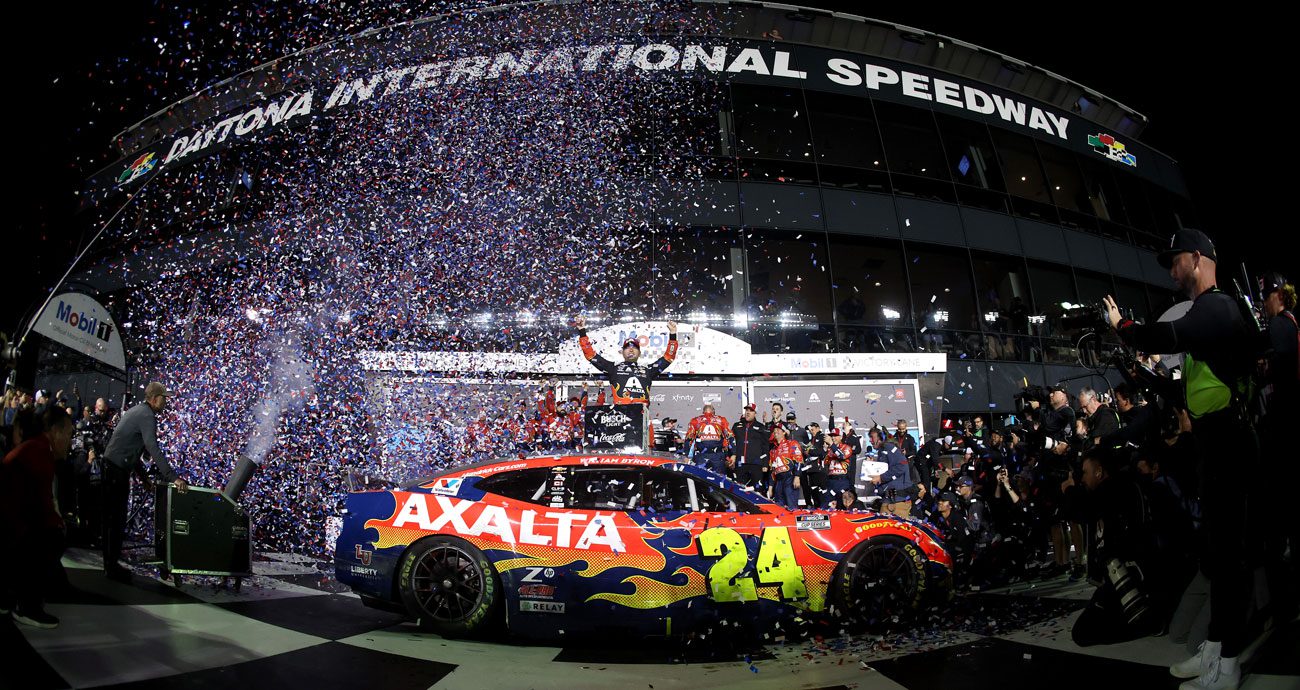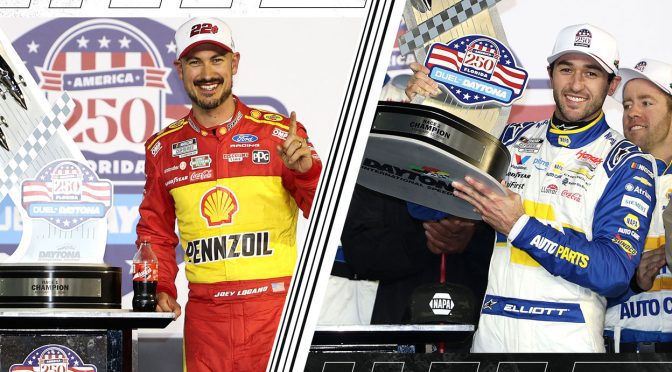
DAYTONA BEACH, Fla. — Joey Logano won the fourth America 250 Florida Duel of his career on Thursday night to secure a third-place starting spot in Sunday’s Daytona 500 (1:30 p.m. ET, FOX, HBO Max, MRN Radio, SiriusXM NASCAR Radio).

In a second Duel that ran caution-free, Chase Elliott took control of the race on Lap 53 of 60 and held off Carson Hocevar by 0.065 seconds to win his third 150-mile qualifying race and earn the fourth starting position for the Daytona 500.

RELATED: Daytona 500 lineup | Speedweeks schedule

With an earnest push from Team Penske teammate Ryan Blaney, Logano was at the front of the field when NASCAR called the third caution of the first Duel on Lap 63, three laps into overtime.

Both Logano and Blaney are among the favorites to win Sunday’s 68th edition of the “Great American Race.” Blaney ran second and will start fifth in NASCAR’s biggest race.

“Just a lot of teamwork all the way through,” Logano said of the win. “I think about the 22 team in particular. Nick Hensley, our gas man, did a fantastic job getting us in position out of pit road. (Spotter) Coleman Pressley up on the roof giving us great information. My teammate Ryan Blaney being committed and working together.

“It’s nice when everything works out the way it’s supposed to.”

Logano has finished ninth or better in 12 straight Daytona Duels.

Former Daytona 500 winner Austin Dillon ran third, followed by Brad Keselowski — recovering from a broken right femur — and John Hunter Nemechek. Shane van Gisbergen, Daniel Suarez, Casey Mears, Ryan Preece and Alex Bowman completed the top 10.

WATCH: Logano on winning Duel 1 | Elliott reacts to Duel 2 victory

Mears came from a lap down to earn the one Open position in the Daytona 500 available from the first Duel. Mears advanced when fellow Open competitor Corey LaJoie — running in the top five at the time — turned into the outside wall in a chain-reaction collision on the final lap of overtime.

Anthony Alfredo had a relatively stress-free run to claim the Daytona 500 spot available to Open cars in the second Duel, or so he thought. Though Alfredo finished 18th, 23 seconds ahead of BJ McLeod — the next-best Open driver — his finish was disallowed after post-race inspection, and McLeod will compete in the “Great American Race” on Sunday.

According to NASCAR Cup Series director Brad Moran, a transmission cooling hose on Alfredo’s No. 62 Chevrolet was not fastened properly, and another hose was disconnected, affecting both cooling and airflow.

The complexion of the first race changed dramatically after Mears slid into the Ford of Noah Gragson coming to pit road on Lap 46. Preece had led 38 laps to that point but needed more fuel on his stop and fell back after the subsequent restart on Lap 50.

Mears lost a lap because of his spin into the infield grass, but regained it as the beneficiary under caution under the second caution for a five-car accident on Lap 56 that eliminated the No. 24 Chevrolet of William Byron, the two-time defending winner of the Daytona 500.

Byron will start Sunday’s race from the rear of the field in a backup car.

In the final wreck on Lap 63, Mears’ No. 66 Ford nosed into the Chevrolet of Daniel Suárez after passing LaJoie’s spinning Ford for the critical position. Mears had the leading Open car when NASCAR called the caution that froze the field.

“I hit somebody square,” Mears said, unsure whether his Carl Long-owned car could be repaired or if a backup would be required. “And I knew when I hit him flat, it didn’t tear up the car too much, and I was going to be able to get back (to the checkered flag).

“But I didn’t know who was in front of me, still, whether or not we made it. All the guys started going nuts on the radio.”

Sensing danger as the first Duel barreled toward a frenetic conclusion, Daytona 500 pole winner Kyle Busch dropped to the rear of the field after the Lap 50 restart to preserve his No. 8 Richard Childress Racing Chevrolet for Sunday’s race. He finished 18th in the 23-car field.

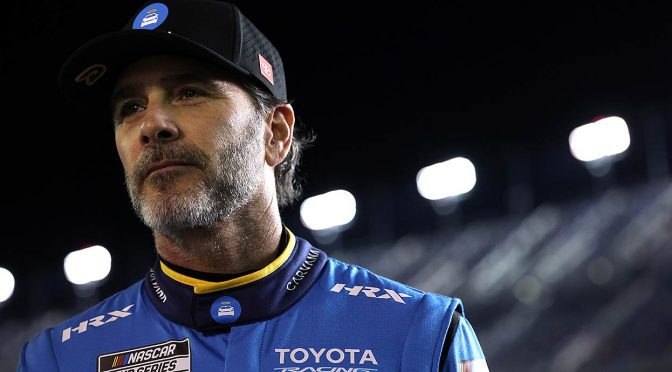
Seven-time Cup champion Jimmie Johnson, already locked into the 500 on an Open Exemption Provisional, ran a conservative race and finished 15th.

In the second Duel, Elliott led twice for nine laps and became the third Hendrick Motorsports driver to win three or more Duels. NASCAR Hall of Famer Jeff Gordon leads the organization with five.

“A great way to get the blood pumping for sure on a Thursday night,” said Elliott, who is seeking his first Daytona 500 win. “There was a lot going on those last handful (of laps). Really, ever since we came off of pit road after the cycle, we were getting after it. It was a lot of fun.

“Had some great support there. Carson did a great job helping me control those lanes, helping get Team Chevy for Victory Lane tonight. Certainly, owe him an appreciation for just kind of sticking with it, also pushing me well. It’s real easy to get people out of control. Appreciate that.”

Reigning Cup Series champion Kyle Larson ran third, followed by former Daytona 500 winner Michael McDowell and Christopher Bell. Josh Berry, Ricky Stenhouse Jr., Todd Gilliland, Ty Gibbs and Denny Hamlin claimed positions six through 10, respectively.

Chase Briscoe, who locked into the second starting position during Wednesday night’s time trials, led a race-high 38 laps but fell victim to a lengthy green-flag pit stop on Lap 45, lost the draft and finished 20th.
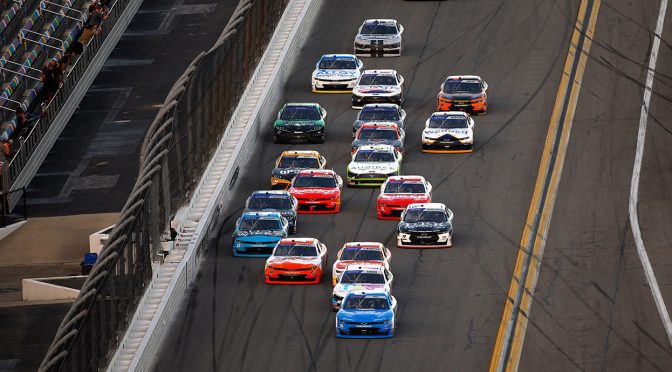
DAYTONA BEACH, Fla. — High drama and long-shot endings once again proved the narrative of the night in Thursday’s America 250 Florida Duels at Daytona with Casey Mears and BJ McLeod claiming the final two Open positions for the 41-car field for Sunday’s Daytona 500 (1:30 p.m. ET, FOX, HBO Max, MRN Radio, SiriusXM NASCAR Radio).

They will join 23XI Racing’s Corey Heim and JR Motorsports’ Justin Allgaier, who secured their Open car starting spots in Wednesday night’s Busch Light Pole qualifying session. Seven-time NASCAR Cup Series Jimmie Johnson, owner/driver of Legacy Motor Club, is using an Open Exemption Provisional and raced his way up to a 31st starting spot for Sunday.

RELATED: Daytona 500 starting lineup | At-track photos: Daytona

Team Penske’s Joey Logano (Duel 1) and Hendrick Motorsports’ Chase Elliott (Duel 2) were Thursday’s race winners.

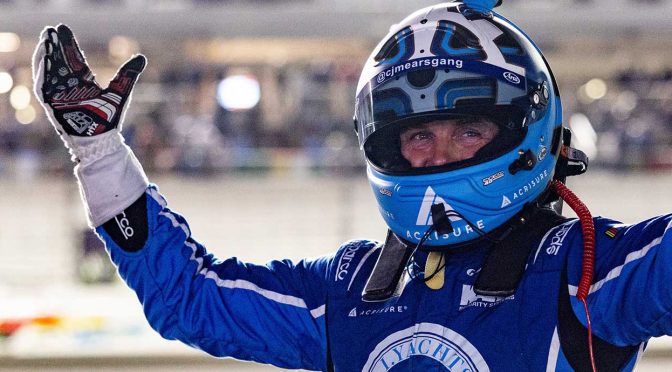
Mears, a former longtime full-time NASCAR Cup Series driver and race winner for the legendary Hendrick Motorsports team — and nephew of Indianapolis 500 great Rick Mears — turned in a video game move on the final half lap of the opening Duel finishing eighth and earning an unlikely ticket into Sunday’s race — his first Daytona 500 start since 2019.

“This is just one of those places where there are enough random things happen and stuff that happens that’s out of your control, and sometimes you’re on the right side of it and sometimes you’re not, and fortunately today, we were on the right side,” said an emotional 47-year-old Mears.

“It was a big range of emotions, but the one thing that’s interesting this time around is this is all a bonus round for me. My career pretty much ended back in 2017-2018 and to come back and just have the opportunity to do this again is a big deal, so I’m kind of soaking it all in and enjoying every moment.”

His Carl Long-owned Garage 66 Ford team only has 10 members and even brought a back-up car — not necessarily for Daytona — but to try again at Atlanta’s EchoPark Speedway next week in case he didn’t end up qualifying for Sunday’s race.

At one point a miscue coming to pit road left his No. 66 Ford Dark Horse Mustang stuck in the grass by pit road, but he got out and crucially lost only one lap, which ultimately made all the difference. He made it up on a later caution.

For all but that final overtime lap, RFK Racing’s fourth car driven by Corey LaJoie ran among the front-runners — consistently best among the three open cars in that first Duel. And he seemed easily poised to take the position transferring him into the race. Until the final lap.

Unfortunately for LaJoie, that’s when he spun and collected multiple cars in the melee while Mears was able to zig and zag forward from the back of the field and move into a position on the Daytona 500 grid.

MORE: Full Thursday recap

“It’s been incredible to work with these guys, and didn’t see this opportunity coming about,” LaJoie said from the track’s infield care center. “Didn’t see it, you know, ending like this, but, I mean, at the end of the day, God’s so good, even in the valley. It sucks. It sucks.”

McLeod, 42, finished 19th in the second — caution-free — Duel race but was awarded the Dayton 500 transfer spot after post-race inspection found a rules violation on the 18th-place Beard Motorsports car driven by Anthony Alfredo.

This will be the sixth Daytona 500 start — and first since 2023 — for the Floridian, McLeod, who owns and drives the No. 78 Life Fast Motorsports Chevrolet. His best career finish in the 500 is 19th and came in his 2019 debut in the race. He does have a pair of top-10 finishes in the Daytona summer 400-miler.

During post-race inspection, inspectors noticed a transmission transaxle cooling hose in Alfredo’s car that was supposed to be attached but instead was disconnected. NASCAR Cup Series Managing Director Moran noted that all hoses are checked post-race and “if anything is found like this during the season it would be a DQ during the race” and noted it is not an “appealable” violation because it came in a qualifying event, not a race.

“First of all, unfortunate to be here,” Moran said. “Any small open team, we don’t like to have these problems, but we do have to do our job, make sure there’s parity amongst the field and also parity amongst people trying to make the 500.

“During inspection, we noticed this hose, which is a transmission cooling transaxle cooling hose. Comes off of the right side quarter window, and it’s supposed to go into the transaxle cooler. It needs to be airtight, needs to be fastened.

“We have many rules, as you all know, that no parts can fall off the car for obvious reasons. We don’t say what the intent is, but these parts have to be fastened properly. Unfortunately, this one piece wasn’t on the right side. There was also another hose disconnected for driving cooling, which affects airflow.”

As for Mears, Sunday will mark his 495th start in the NASCAR Cup Series with the goal of getting to 500 starts this season. He said he’s targeting superspeedways and road courses on the 2026 schedule for the best chance of qualifying into the field as an open team.

“I just can’t believe we’re sitting here right now, everything was just completely stacked against us from top to bottom,” Mears said, adding with a smile. “Thank God we were just in the right place at the right time and we were able to get it home. … Feels good to be here. Haven’t been here in a while.”

Austin Hill comes to Daytona with the same confident attitude that carried him to three straight season-opening victories from 2022 through 2024—a streak that ended last year because of a rear end gear failure.

The preeminent superspeedway racer in the newly-entitled NASCAR O’Reilly Auto Parts Series, Hill will try for his 11th career drafting track victory in Saturday’s United Auto Rentals 300 at 2.5-mile Daytona International Speedway (5 p.m. ET, The CW, MRN Radio, SiriusXM NASCAR Radio).

Hill succeeds at Daytona in part because he enjoys the inevitable close-quarters racing.

RELATED: O’Reilly Auto Parts Series schedule | Daytona weekend schedule

“I actually have a lot of fun with it,” said Hill, who is embarking on his fifth full-time season in the No. 21 Richard Childress Racing Chevrolet. “Everyone talks about pressure and questions if the pressure is going to get to you. But for me, I just go into Daytona weekends with the same mindset that I always do.

“We try to run up front, do our thing, stay out of wrecks and hope that it’s enough at the end.”

Hill didn’t win last year’s Daytona opener. RCR teammate Jesse Love did. Love went on to claim the series title at Phoenix Raceway, providing perfect bookends to a season otherwise dominated by rookie phenom Connor Zilisch, who won 10 of his 32 starts.

Zilisch has moved on to the NASCAR Cup Series with Trackhouse Racing, to the delight of Love and his fellow championship contenders.

“Obviously there is a lot of want and desire to go back-to-back at Daytona, a lot of want and desire to start the year off with a win and get RCR’s fifth win in a row,” Love said. “Definitely looking forward to it. I’m kind of tired of the offseason. I’m just ready to get back in my swing of things.

“I’m excited, not nervous or anything like that, which is different from past years where I typically feel like I am a little bit nervous to start the season. But now I have my feet under me, I know what to expect and what not to expect and mostly I am a little bit wiser now to understand similar things that can happen that I don’t normally think of.”

Zilisch’s departure also should be a boon for JR Motorsports veteran Justin Allgaier, who won the series championship in 2024. Allgaier is running both the Daytona 500 and O’Reilly Auto Parts Series race.

On Wednesday, Allgaier locked into the Daytona 500 field in the No. 40 JRM Chevrolet, one of eight Open cars trying to make the race.

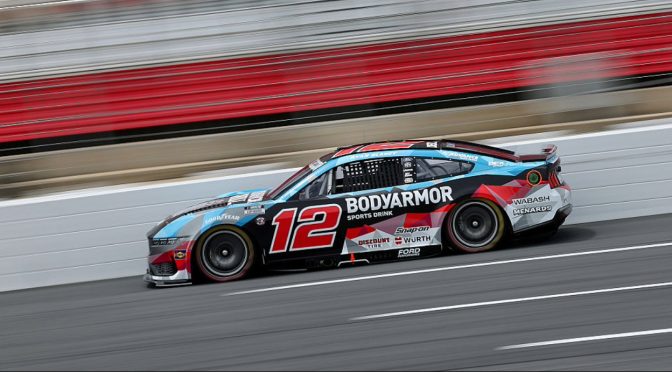
DAYTONA BEACH, Fla. — NASCAR today announced a multiyear extension of its longstanding Premier Partnership with Coca-Cola North America, one of the sport’s most enduring and influential partners. As part of the renewed agreement, the partnership expands into the sports hydration category, with the addition of BodyArmor Sports Drink as the Official Sports Drink of NASCAR, further deepening Coca-Cola’s presence across the sport and marking the next chapter in a relationship built on tradition, loyalty and a shared passion for racing.

Coca-Cola has been deeply woven into the fabric of NASCAR for decades, playing an integral role in some of the sport’s most iconic moments — from winning celebrations to immersive fan experiences at tracks across the country. The renewed Premier Partnership reinforces Coca-Cola’s designation as the Official Soft Drink of NASCAR, while maintaining category exclusivity and expanding into new categories that reflect the evolving lifestyles of today’s athletes and fans.

“Coca-Cola has been a part of NASCAR’s DNA for generations, and this extension reflects the shared values, trust and long-term vision between our organizations,” said Michelle Byron, executive vice president and chief partnership & licensing officer, NASCAR. “In addition, welcoming BodyArmor as the Official Sports Drink of NASCAR further deepens our longstanding partnership with Coca-Cola, while adding a performance-focused brand that enhances our overall partnership portfolio and creates new opportunities to engage fans.”

The renewed agreement delivers a robust activation platform across NASCAR, including at-track experiences, retail amplification through point-of-sale activations and expanded storytelling across key properties such as the eNASCAR Coca-Cola iRacing Series. Coca-Cola will also continue its presence across every NASCAR Cup Series event, reinforcing its visibility and impact throughout the season.

“This extension represents the continued evolution of our relationship with NASCAR, one that is rooted in passion, innovation, and a deep connection with fans,” said Chris Bigda, senior director of sports marketing, Coca-Cola North America. “By expanding our partnership to include BodyArmor, we’re doubling down on NASCAR and creating new ways to connect with athletes and fans through performance-driven brands in one of the most exciting environments in sports.”

As the Official Sports Drink of NASCAR, BodyArmor will receive category exclusivity and integrated visibility across key NASCAR platforms. The brand will be anchored by longtime partner Ryan Blaney, while Coca-Cola’s Racing Family — including Daniel Suárez, Joey Logano, Denny Hamlin, Austin Dillon and Chase Elliott — will continue to play a central role in storytelling that highlights the athletes and personalities who power the sport.

“We’ve been proud partners of Ryan Blaney and Team Penske for nearly 10 years, and we’re thrilled to expand that relationship as the Official Sports Drink of NASCAR,” said Tom Gargiulo, CMO, BodyArmor Sports Nutrition. “NASCAR is one of the most physically demanding sports in the world, so we’re excited to bring our premium hydration products to drivers, teams and fans who deserve the best in performance and hydration.”

The partnership will also continue to prioritize community impact, with initiatives supporting military, youth and diversity programs, including Daniel’s Amigos and NASCAR Salutes at the Coca-Cola 600, underscoring a shared commitment to making a meaningful difference beyond the race track.

The renewed agreement reinforces one of the longest-running partnerships in professional sports, blending legacy and innovation while positioning NASCAR and Coca-Cola — alongside BodyArmor — for continued growth in the years ahead.

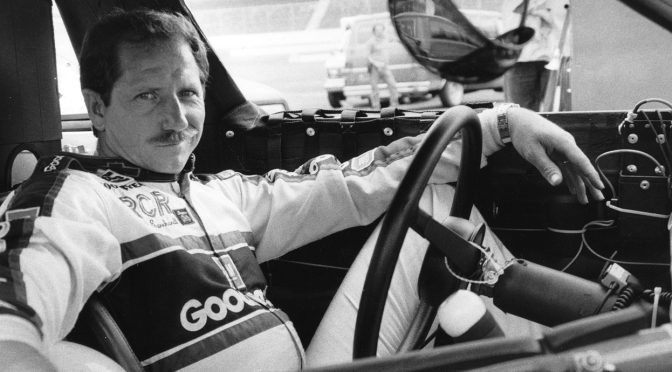
Editor’s Note: This month marks 25 years since Dale Earnhardt tragically lost his life on the last lap of the Daytona 500.

“What would Dale Earnhardt do?”

It was a question asked long before “The Intimidator” was robbed of his life  25 years ago on the last lap of the Daytona 500.

For more than two decades, Dale Earnhardt held a massive role that somehow transcended his incomparable career as a Hall of Fame driver.

He was the North Star of NASCAR.

Every major decision by the leadership in Daytona Beach and Charlotte was vetted through the highly valued common sense of the blue-collar hero who hailed from a North Carolina mill town. Drivers turned to Earnhardt for advice on everything from cultivating farmland to building their brands. (Earnhardt’s business team formed an LLC to quietly help secure sponsor deals for the competition.) Fans who plastered their homes, coolers and bodies with his iconic No. 3 clung to his actions and words as sacrosanct guidance.

A confidante in the highest corridors of power, Earnhardt had the ear of Bill France Jr. The late NASCAR chairman would drop in on Earnhardt’s team radio during races (using “Captain Jack” as his handle) to consult his deep-sea fishing buddy on track conditions during rain delays.

“Earnhardt was so powerful, no one would say no to him,” Ramsey Poston, the former managing director of NASCAR communications, said in 2021. “He basically ran the sport. It’d be like if Tom Brady were running the NFL.”

Accordingly, the question still is asked throughout the NASCAR industry.

“What would Dale Earnhardt do?”

But another question sadly emerged on Feb. 18, 2001.

“What would Dale Earnhardt have done?”

There are two ways to answer that.

Purely from a competitive standpoint, Earnhardt unquestionably would have added to the totals of 76 Cup victories and seven championships. Two months short of turning 50, Earnhardt entered 2001 with a renewed verve in his driving, and Richard Childress Racing targeted a record-breaking eighth title by investing extra money in his team.

There also is no doubt that Earnhardt, who made his Rolex 24 at Daytona debut two weeks before his fatal crash, one day would have raced at the 24 Hours of Le Mans. GM Racing already had mapped out the logistics of getting Earnhardt to France and a spot had been reserved in the No. 3 Corvette for the world’s biggest sports car endurance race.

Consider the post-NASCAR path of another seven-time Cup champion. Jimmie Johnson competed at Le Mans in the Garage 56 entry, raced the Indy 500, and tested a Formula One car. It’s easy to imagine Earnhardt on a similar journey (with his longtime ties to GM, picture his involvement in this year’s launch of the Cadillac F1 team).

He loved racing with every fiber of his being and would have been active in motorsports as long as he was physically able.

But the second part of what would have come next is harder to address.

What else would Earnhardt have done outside the confines of his black Chevrolet (or whatever other vehicles struck his fancy)?

RELATED: Earnhardt’s 1998 win among most memorable Daytona 500 moments

It’s a tricky contemplation given the enormous sway of someone whose clout in pop culture has been compared with Elvis Presley, John Wayne and even Andy Warhol (different types of art but a similar approach to commercialized fame).

The unquestioned face of NASCAR at the dawn of the 21st century, Earnhardt touched every level of the sport and could alter its overall course just through simple words and actions.

The aerodynamic rules package that turned his final Daytona 500 into a festival of nonstop passing was largely the direct result of Earnhardt forcefully complaining a year earlier (“the worst racing I’ve seen at Daytona in a long, long time … Mr. Bill France Sr. would be rolling over in his grave”). The trend of drivers racing each other to the airport after races started with Earnhardt (who usually got a head-start on a rain-shortened event because of his ties to the scoring tower). The roots of virtually any driver endorsement deal can be traced to the multimillion-dollar marketing machine that formed around Earnhardt and set the bar for how NASCAR merchandise was sold.

We can guess how he might have reacted to major events such as the Next Gen, charters and The Chase, but the challenge is that they would have already been impacted by Earnhardt (and perhaps never happened) if he still were here.

“I’m pretty sure he’d be heavily involved,” NASCAR on NBC analyst Jeff Burton said in 2021, “and be telling everybody what they’re supposed to be doing.”

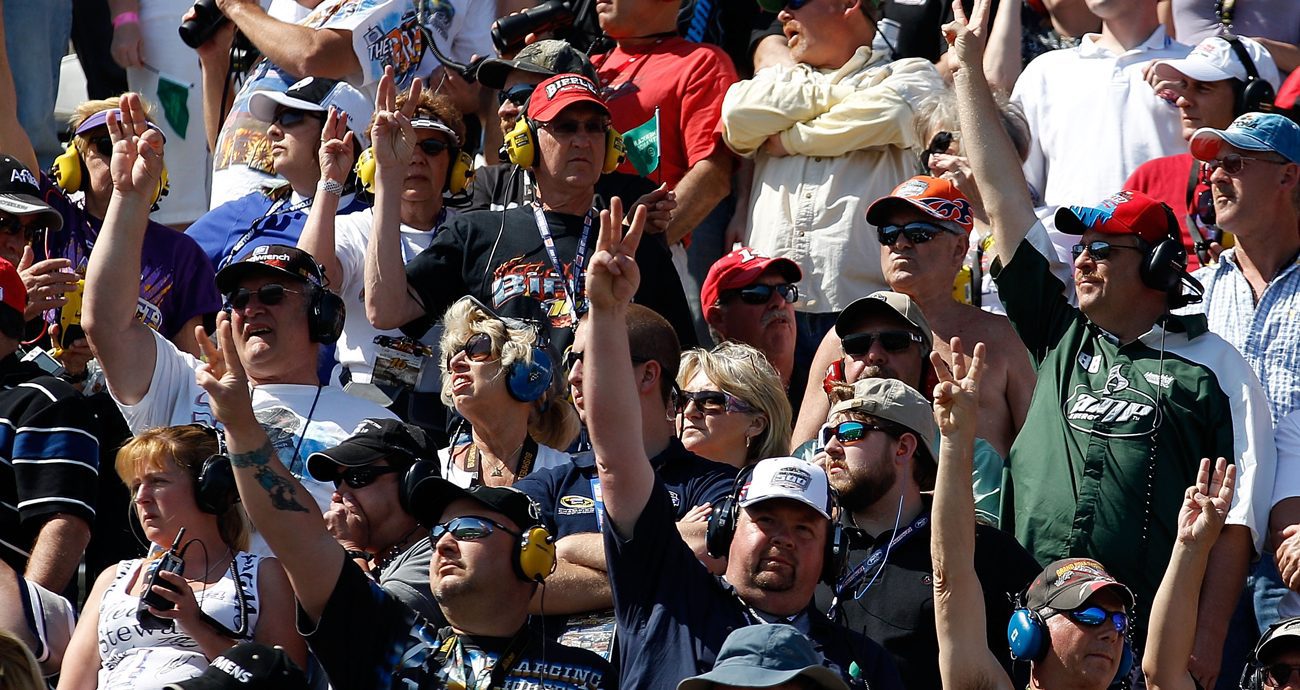
Fans salute Dale Earnhardt by holding up three fingers during the Daytona 500 in 2011 at Daytona International Speedway.
Chris Graythen | Getty Images

And maybe telling millions what happened in races every Sunday.

Nearly all of Earnhardt’s contemporaries entered the broadcast world when their driving careers ended.

Trading the helmet for a headset doesn’t really seem Earnhardt’s style — or at least not on a long-term, full-time basis. Jeff Gordon tried the TV booth for six years but eventually gravitated toward team leadership.

Earnhardt mentored the always polished Gordon behind the scenes, and they equally had a rock star’s command of the room when on camera.

Before Gordon became the first driver to host “Saturday Night Live,” Earnhardt was making movie cameos (check out his turn as a cab driver in “BASEketball”).

RELATED: Every driver who has won the Daytona 500

Today’s on-demand world of podcasts, social media and streaming would have been a transition for him (as for any Baby Boomer), but Earnhardt could adapt to sea changes like any great driver.

He also had the genes for cultivating mass media. It’s no accident that the standard-bearer for the incessantly expanding NASCAR Podcast Universe is Dirty Mo Media, a company that was started and shepherded by Earnhardt’s children.

Family leadership also was the goal for Dale Earnhardt Inc., and Earnhardt’s peers are in consensus that he still would have owned the Cup team that folded several years after his death.

That means Earnhardt’s strong opinions also would have heavily shaped the discussions about championship formats and car designs.

Again, it’s hard to grasp how he would have handled the hot-button issues in NASCAR because many may not have existed in his presence.

“I think about the sport today and where it’s at, and where it’d be if he were still here,” Terry Labonte said in 2019. “And it would have a completely different look because he had a lot of influence on NASCAR and decisions that they made. Whether it would be better or worse, I don’t know. But it would be different.”

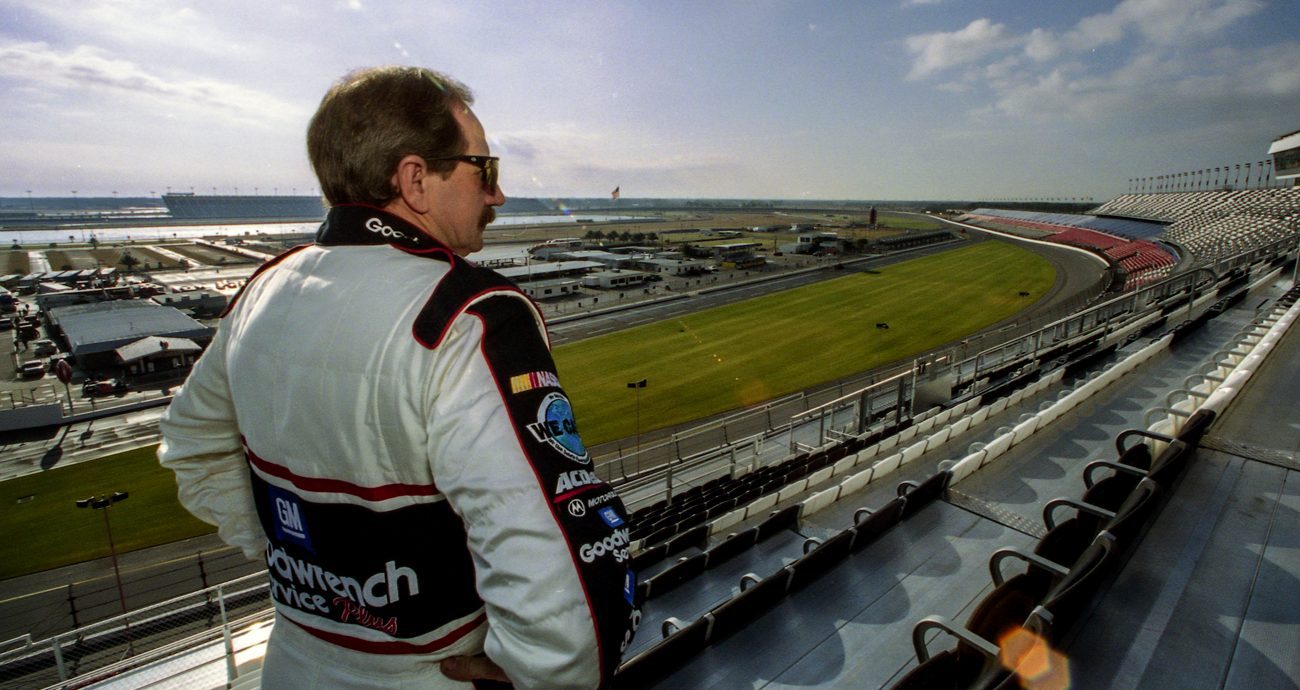
Dale Earnhardt checks out the seating in the Earnhardt Grandstand on Feb. 4, 2001 at Daytona International Speedway.
Brian Cleary | Getty Images

Earnhardt’s death was the most recent in NASCAR’s top three national series. Safety changed forever in his absence, which triggered an ongoing raft of cockpit improvements and the advent of SAFER barriers and mandatory HANS devices.

A full generation of stars have since reached full retirement without a fatality. We will get to watch Gordon, Johnson, Tony Stewart, Dale Earnhardt Jr., Matt Kenseth, Kevin Harvick, Martin Truex Jr., Kurt Busch and others age gracefully into their golden years.

Dale Earnhardt would have turned 75 on April 29 this year.

“His goal was to get to where he loved to hunt and fish and be on his boat,” longtime friend Dale Jarrett said in 2021. “He was going to spend a lot more time in doing that. He was looking forward to those days he didn’t have to be at the race track, and he had earned the right to have some time away.

“Just wish he would have gotten to enjoy that part of his life.”

So, what would Dale Earnhardt be doing now?

Maybe just enjoying himself.

DAYTONA BEACH, Fla. (Feb. 12, 2026) — NASCAR today announced the launch of the NASCAR Local Racing Series Powered by O’Reilly Auto Parts, a strategic reframing of its longstanding grassroots racing platform designed to more clearly reflect the vital role local short tracks play in communities across the United States and Canada.

Formerly known as the NASCAR Weekly Series, the NASCAR Local Racing Series Powered by O’Reilly Auto Parts places renewed emphasis on the competitive, community-driven racing that serves as the foundation of the sport. The updated identity simplifies how grassroots racing is presented to fans, partners, and communities, while reinforcing NASCAR’s long-standing commitment to local competitors and hometown tracks.

“Local short tracks are the heartbeat of NASCAR — they’re where raw talent is developed, hard-nosed competition is on full display, and the next generation of stars earns its stripes,” said Joey Dennewitz, Managing Director of NASCAR Regional. “Week after week, these drivers compete in intense, high-level racing environments that demand skill, resilience, and respect for the craft. The NASCAR Local Racing Series Powered by O’Reilly Auto Parts captures the authenticity, toughness, and community pride that define grassroots racing, while presenting it in a way that is clearer and more accessible for fans and partners alike. This platform celebrates the tracks and communities where racing isn’t just something you watch — it’s something you live.”

As part of the launch, O’Reilly Auto Parts has been named the exclusive entitlement partner of the NASCAR Local Racing Series, further deepening its long-standing relationship with NASCAR, which includes the title sponsorship of the NASCAR O’Reilly Auto Parts Series.

“O’Reilly Auto Parts has a deep-rooted passion in providing excellent customer service and helping customers keep their cars in great condition, whether it’s in local racing or regular commuters” said Hugo Sanchez, Vice President of Marketing and Advertising at O’Reilly Auto Parts. “From local short tracks to the NASCAR O’Reilly Auto Parts Series and throughout the country, our commitment to NASCAR fans and our customers spans the full spectrum. Powering the NASCAR Local Racing Series allows us to continue supporting racers, teams, and local communities.”

In addition to O’Reilly Auto Parts’ entitlement partnership, Grizzly Nicotine Pouches, a brand of American Snuff Company, will serve as a significant partner to local tracks within the NASCAR Local Racing Series footprint, providing additional support through signage and market-level activations.

The NASCAR Local Racing Series Powered by O’Reilly Auto Parts will continue to sanction weekly racing at tracks across North America, serving as a critical entry point for emerging drivers and a cornerstone of NASCAR’s driver development pathway. You can watch NASCAR local races all season on FloRacing.

For more information, visit NASCAR.com/Regional.

The long offseason wait is nearly over, and the Daytona 500 has almost arrived.

But as great as it will feel to hear the roar of the engines and watch the cars run flat-out in the draft at 200 mph, there’s always the same lingering question underneath the spectacle: How much of what happens in NASCAR’s biggest race actually tells us something real about the season that follows?

RELATED: How to watch NASCAR on TV

That’s no knock on the race, of course; as the Super Bowl of motorsports, a win there is season-validating in and of itself. This weekend, William Byron is going for an unprecedented third straight Harley J. Earl Trophy, which would be one of the greatest accomplishments in NASCAR history. But we also know Daytona can be a track where chaos reigns, and dominant performances are no guarantee of a trip to Victory Lane.

It might be surprising, then, to learn that a driver’s performance in the Daytona 500 does have some actual, predictive effect on the rest of their season. (It was surprising to me, at least!)

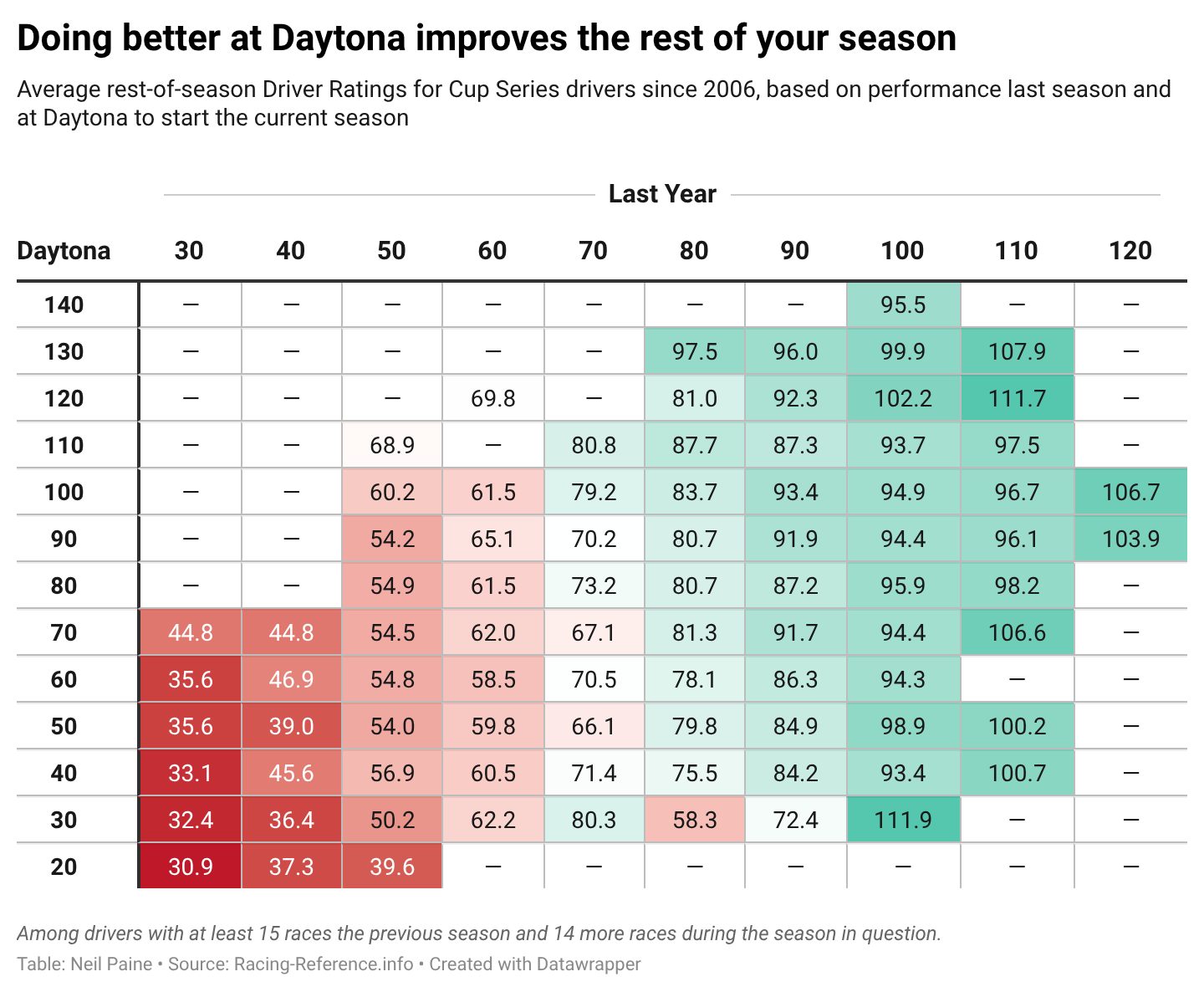
To look into this, I gathered a sample of every Cup Series driver since 2006 who had at least 15 races the previous year, drove in the Daytona 500, and then appeared at least 14 more times the rest of that season. I then set up a model that predicts what a driver’s rest-of-season performance will be based on their Daytona performance, after controlling for how good (or bad) they were the year before.

If we do this for my Adjusted Points+ index stat (which rates drivers based on their finishes relative to a Cup average of 100), we find that a 50 percent improvement in finishing quality at Daytona will lead to a 1.2 percent improvement in finishes over the rest of the season as well. That is, admittedly, a seemingly small effect — but it’s a significant one as well, meaning it is unlikely to have appeared due to random noise in the data. If a driver finishes better than expected at Daytona, we can say it probably indicates at least some kind of slight improvement that will translate to their overall performance all season long.

This is even more apparent when we look instead at Driver Rating, which is more stable because it factors in underlying performance during the race rather than simple finishes. All else being equal, an otherwise average driver (with a previous rating of 70.0) who posted a rating of 100.0 at Daytona — the equivalent of approximately a top-five finish — has tended to improve their rating to 79.2 for the rest of the season, based on data since 2006. When they put up a rating of 110.0 (around what the winner usually has), that number has tended to increase to 80.8.

Again, these changes won’t turn an average driver into a title contender in the grand scheme of the whole season — it means you’d go from being as good as Josh Berry or Kyle Busch last season to Bubba Wallace. But it’s worth noting that Wallace would have comfortably gotten into The Chase last year if the current format was in place, while Berry and Busch would have missed out. So it’s not a small effect, particularly considering that it originates from just one race at the very beginning of the calendar — and arguably the most chaotic one, at that.
Moreover, the predicted boost from doing well at Daytona is even stronger when we just zoom in on performance at superspeedways over the remainder of the season.

Among drivers who had at least three such races the previous year and at least two the rest of the current season, a 50 percent improvement in finishing quality at Daytona will mean, on average, a three percent improvement in finishes at superspeedways over the rest of the season, all else being equal. And our hypothetical Cup-average driver who rattles off a win-worthy 110.0 rating at Daytona to start the year could expect to improve to a rating of 78.0 at superspeedways over the rest of the season, from Atlanta to Talladega.

Seeing as how only one driver last season (Joey Logano at 98.1) eclipsed a rating of 86.0 at superspeedways, this means a strong run at Daytona out of the gates could go a surprisingly long way toward telling us who will rank among the series’ very best in the draft all year long.

None of this means we should overreact to every tough crash or fortunate break on Sunday (1:30 p.m. ET, FOX, MRN, SiriusXM NASCAR Radio). Daytona will always be its own special beast, where luck and survival matter more than almost anywhere else on the schedule. But that doesn’t mean it’s all spectacle, either. Beneath the wrecks and randomness, the “Great American Race” also offers an early signal — however faint — about who has actually taken a step forward or backward since last year. And when that’s all the racing we’ll have to go off of, even a small signal can be worth paying attention to.

DAYTONA BEACH, Fla. — Seven-time NASCAR champion Jimmie Johnson is sitting on some round numbers, in life and in racing. Still a lion in the garage at the milestone age of 50, Johnson has exactly 700 NASCAR Cup Series starts to his credit.

Though the regularity of his on-track endeavors has slowed to a part-time trickle in recent years, Johnson is back in Daytona looking to make the most of start No. 701.

“As a full-time driver, you’re always worried about the next weekend, and the season in NASCAR is so long,” Johnson said during Wednesday’s Daytona 500 Media Day. “During my generation, we had testing during the week. So I mean, I was in a car four days a week, five days a week, for 40 weeks a year, and that put me in a situation where I got a lot of seat time, and I’m very thankful for it, but you didn’t savor moments. And where I am now and the frequency of driving is less and much more targeted to these bucket-list opportunities, I am very aware I’ve got less races ahead of me than I do in the rearview mirror, and I better start savoring these moments. That’s really what I’ve been doing.”

Johnson aims to soak in more memories in Sunday’s season-opening Daytona 500 (1:30 p.m. ET, FOX, HBO Max, MRN Radio, SiriusXM NASCAR Radio), suiting up for his 23rd appearance in the “Great American Race.” He’ll take on the role of owner/driver this week with Legacy Motor Club, wheeling the No. 84 Toyota along with full-time teammates Erik Jones and John Hunter Nemechek.

RELATED: Speedweeks TV times, schedule | At-track photos: Daytona

The bucket list that Johnson references has spanned multiple forms of motorsport in the years since his retirement from full-time NASCAR competition after the 2020 season. He’s driven in the Indianapolis 500 and other IndyCar events, become a virtual regular at the Goodwood Revival historic races in England and was a key part of the Garage 56 effort that brought NASCAR to Le Mans in 2023. In recent months, he drove that Le Mans entry at Fuji Speedway in Japan and announced a return to his off-road roots with an entry in the Mint 400 in Las Vegas in March.

This most recent Daytona 500 appearance has kept that bucket full, but this go-around comes without the pressures of past efforts. Johnson will have a guaranteed starting berth in the 41-car field after NASCAR officials granted the team’s request for the Open Exemption Provisional, a “promoter’s choice” spot reserved for world-class drivers. The berth comes with a trade-off: Johnson won’t be eligible for prize money or points, but the knowledge that he’ll race for the win and trophy without having to weather Daytona’s sometimes-rigorous qualifying process is a positive.

“It’s a huge relief,” says Johnson, a two-time 500 winner who had to punch his way in through the 150-mile qualifying races in 2024. “Granted, we’ve lost upside potential with prize money, but to be guaranteed in the race, that stress, the efficiencies that we can focus on as a team to make sure we’re more competitive for the race and even help our other two cars, that’s worth it to us.”

The strength-in-numbers boost is another plus for Johnson & Co., who bring the number of Toyotas in the field to 11 after 23XI Racing’s Corey Heim qualified. It also prompts the question of how much the Legacy Motor Club trio will be able to work together, and when that team spirit of cooperation gives way to individual competitive nature.

MORE: Power Rankings | Media Day photos

“I think he would do whatever would be best for Legacy, right?” says Jones, who scored his first Cup victory in Daytona’s summertime 400-miler in 2018. “It’s his team, and I know Jimmie’s a competitor and wants to win another 500 as much as anybody in the field. But I think if he’s in a situation where he’d be putting at risk that none of the Legacy cars won the race, I think he’s going to take the option that one of us is going to win the race, and if that means it’s me or John Hunter, I think that’s the choice he’s going to make. Kind of a cool spot to be in for him, I feel like, as a guy who’s accomplished plenty in his career and has the chance to go out and run it again this year and hopefully have a couple of cars in it, in contention.”

Says Johnson, after a moment to ponder and reflect: “I have no idea what I would do in that moment. I really don’t. And I feel like it’s circumstantial, you know, if it’s the Hail Mary, there’s no need. But if I legitimately have a shot, then it’s a different situation. I’ve only raced one way, which is to win. So, I really find it hard to believe when the helmet doesn’t go on, that I’m not looking around, regardless of the car that’s there, and want that clean air, and want to be the first one to strike.”

Shifting into team-owner mode, Johnson talks of Legacy’s season-long goals in measured but optimistic tones. Jones finished 24th in the Cup Series standings last year, with Nemechek 25th, an improvement of several spots for each and something that the organization aims to build on as its third season with Toyota approaches.

Legacy Motor Club made a handful of personnel changes in the offseason, most notably with the hiring of Justin Alexander to take over the pit box for Jones’ No. 43 Camry, shifting former crew chief Ben Beshore to director of race engineering. Johnson says he hopes those fine-tuning moves for the LMC roster make for steadier performance, especially with a postseason format change that rewards more dependable results week to week.

“I think that our expectations are still very similar,” Johnson says. “We had looks at wins last year, we legitimately did. Where we’re most focused right now is the consistency. We want to be here for the long run. The format is going to benefit consistency with the format change. For us to be racing for a win one weekend on a mile-and-a-half and go to the next mile-and-a-half and run 20th with both cars, we’ve got to average that out and get that part under control. As we have developed our infrastructure, there’s a lot of telling signs of why we had the inconsistencies. We still need to go live it, but it’s nice to look back and rationally look at elements and say ‘this makes sense, this is why,’ and I feel like we’ll have a much more consistent year.”

Editor’s Note: This story has been updated following Thursday’s Duel at Daytona to reflect Byron’s result in the qualifying race.

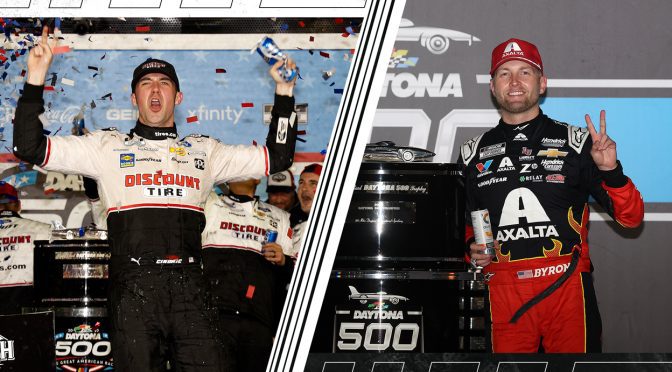
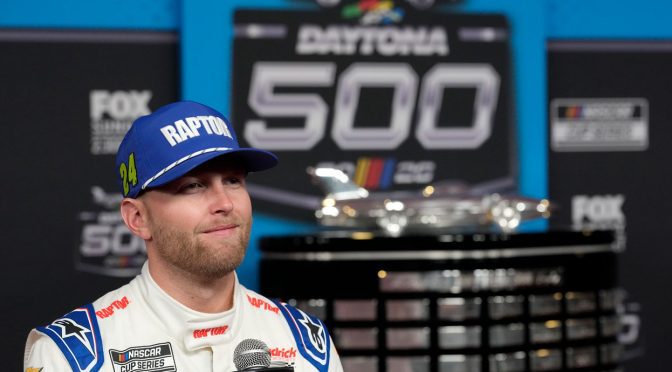
DAYTONA BEACH, Fla. — William Byron has a chance to do something no other driver has done in NASCAR history: win three consecutive Daytona 500s.

Byron is one of only five drivers in the event’s 67-year history to win it in back-to-back years, joining Richard Petty, Cale Yarborough, Sterling Marlin and Denny Hamlin.

On Sunday at 1:30 p.m. ET (FOX), Byron will try his hand at creating history in the NASCAR Cup Series season opener.

RELATED: Daytona schedule | At-track photos: Daytona

Byron, 28, says he isn’t thinking about what lies ahead of him too much. But he knows what’s at stake and what a third straight victory in the “Great American Race” would mean to him.

“Obviously that’s the goal,” Byron said during Wednesday’s Daytona 500 Media Day. “I get reminders of the previous races, whether I see just the videos or whatnot. Yeah, it’s great career-defining moments that we’ve had. It’s awesome. It’s special. But I don’t really think ahead too much. I just think about what it’s going to take in these next couple days leading up to it.”

Byron admitted his surprise that no other driver has ever accomplished the feat, a stat made more jarring when considering Petty scored a record seven Daytona 500 wins. But even in more modern-era drafting styles of the last 25 years, when the leader could perhaps dictate the moves of cars behind, never did anyone score the three-peat.

“I’m a little surprised that there wasn’t a run by somebody like a Dale Jr. or something,” Byron said. “He and his team had a pretty good hold on what it took to be competitive, and he made great decisions. It just shows how hard this race is and how much pressure there is.”

The history at hand was top of mind for crew chief Rudy Fugle in a Jan. 24 interview at Hendrick Motorsports. In 2025, Fugle led Byron and the No. 24 team to the regular-season title after 26 races. That began with their second Daytona 500 win together.

“To have an opportunity to do something that nobody ever has done before in the history of NASCAR is huge,” Fugle said. “So we definitely are making sure that we’re preparing correctly, getting the cars and the parts going. I think it’s a little easier because most of the company recognizes we have a chance to do something never done before, even in a place with as much excellence as Hendrick Motorsports. So we just really want to try to help all those things go. At Daytona, there’s a lot of things out of our control. But what we can control, we want to have all those T’s crossed and I’s dotted.”

What has made Byron most effective in recent superspeedway endeavors, he says, are quick-thinking decisions that land correctly in addition to the right eyes in the sky and the hands working under Fugle’s direction.

“I do feel like I have a good instinct for making good decisions on the track,” Byron said. “I have a great spotter in Branden (Lines) that guides me well and a really good team with a well-prepared car that handles well and does all the things I want it to do. I think it’s just a combination of all those things and kind of just having a good overall feel for it.”

William Byron celebrates his 2025 Daytona 500 win.
Jared C. Tilton | Getty Images

There is a certain anticipation Byron has felt festering through the offseason. After contending for the Cup Series championship three months ago at Phoenix Raceway, Byron’s urge to get back behind the wheel grew antsy in the cold winter months. No better way to cure that ill than by climbing back behind the wheel this week at Daytona.

“I feel really excited. I’m ready to get racing again,” Byron said. “I feel like I had a great offseason, but I found myself in the offseason just feeling like I actually wanted to get back in the car. I wanted to experience those emotions again. I kind of missed that. There’s a lot of aspects I didn’t miss, but the aspect of racing and being in the car with my guys and everything, that I really missed as the offseason went on.”

A new factor for the No. 24 team in pursuit of history will be a new body for the Chevrolet Camaro ZL1 this year. New features include a larger hood dome, revisions to the front grille and redefined rocker panels from previous seasons. And while those changes may ultimately be subtle, they make last year’s notes slightly less reliable.

“Aerodynamics are complex, so through wind-tunnel testing and GM and all those things, we have a basic idea of what to expect for the car by itself,” Fugle said. “So the cars will do completely different things at different ride heights that we haven’t even got to see yet in the wind tunnel, just because of what happens with slightly different aero factors in each configuration of where you race it. And then, more importantly, in the draft and getting pushed and pushing and sucking up. So I expect to learn — you’ll never stop learning on the body. We were learning at the end of last year on the old body for three years. But this body, I expect to learn all year long for sure in pretty big chunks.”

MORE: Setting Daytona 500 lineup | Scenes from Media Day

Byron hoped to have a classroom session before his first time in the draft during Thursday night’s Duel at Daytona, the twin 150-mile qualifying races that will set the starting lineup for the Daytona 500. Instead, Byron wound up in the first of two 60-lap dashes and was one of the first Chevy drivers to learn how the new car works in the drafting pack.

“Selfishly, I think if I could be in the second Duel, it would be great to get a visual for what that looks like — how they’re doing it in the first Duel, then execute that or try it myself in the second,” Byron said. “Yeah, I think (the new body is) an unknown, for sure. It looks a lot better on paper. It looks like it’s going to be an advantage, possibly, or something we haven’t had in the past. Hopefully that’s the case.”

Unfortunately, his learning was cut short at Lap 57 of the qualifying race. When leader Bubba Wallace was sent spinning, Chris Buescher received contact that turned him hard into Byron’s door. The pair nearly saved their cars, but Buescher lost control and spun into the side of Byron’s car, simultaneously squeezing the No. 24 Chevrolet into the SAFER barrier. The No. 24 team confirmed Thursday evening it will go to a backup car for Sunday’s race and start from the rear.

That doesn’t mean all is lost, though. Byron also started the 2024 Daytona 500 with a backup car after a crash in that year’s Duel. He ended that weekend in Victory Lane.

“We’ve won this race with a backup car, so I’m not super worried about that aspect,” Byron said. “But it does suck that you put a lot of work into the primary and you don’t get to race it. … Stinks to start in the back on Sunday and not get the points tonight, but we’ll just move on.”

That Byron has won each of the last two runnings of the “Great American Race” comes as a notable twist to his previous Daytona results. His finishing rate at the 2.5-mile behemoth is a mere 50% — eight DNFs in 16 total Daytona starts, with four of those crash-outs coming in the Daytona 500. That also includes a stretch of four consecutive wrecks that knocked him out of the race early.

It seems that dismal stretch has taken a turn for the better. Since the summer race in 2023, Byron has finished four of the last five Daytona races with two wins and three top 10s in that span.

MORE: Active drivers with Daytona 500 win | Every Daytona 500 victor

“It just feels like I’ve been, at this track in particular, able to have some things go my way and also make good decisions in those moments that I had opportunities,” Byron said. “It’s a mix of that — like being in the right place — and then having those chances to make good decisions. I feel like, for a while, it was a joke. I couldn’t finish a race here. My first six years, I couldn’t finish the race, but I was always in the mix. I don’t know. I think it’s kind of finally tipped the other way.”

Winning two consecutive Daytona 500s already proves he’s trending in the right direction. The question now is whether fortune will favor him for a third consecutive year in the “Great American Race.”

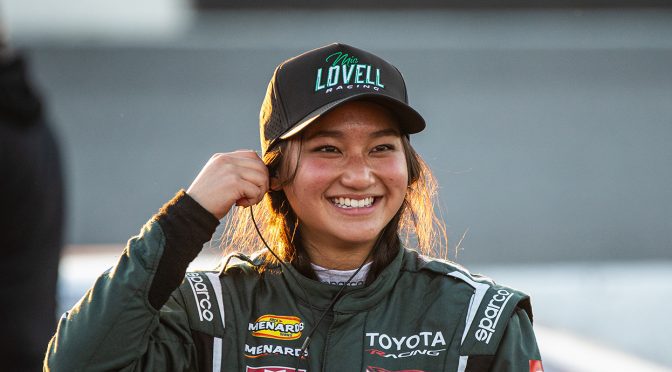
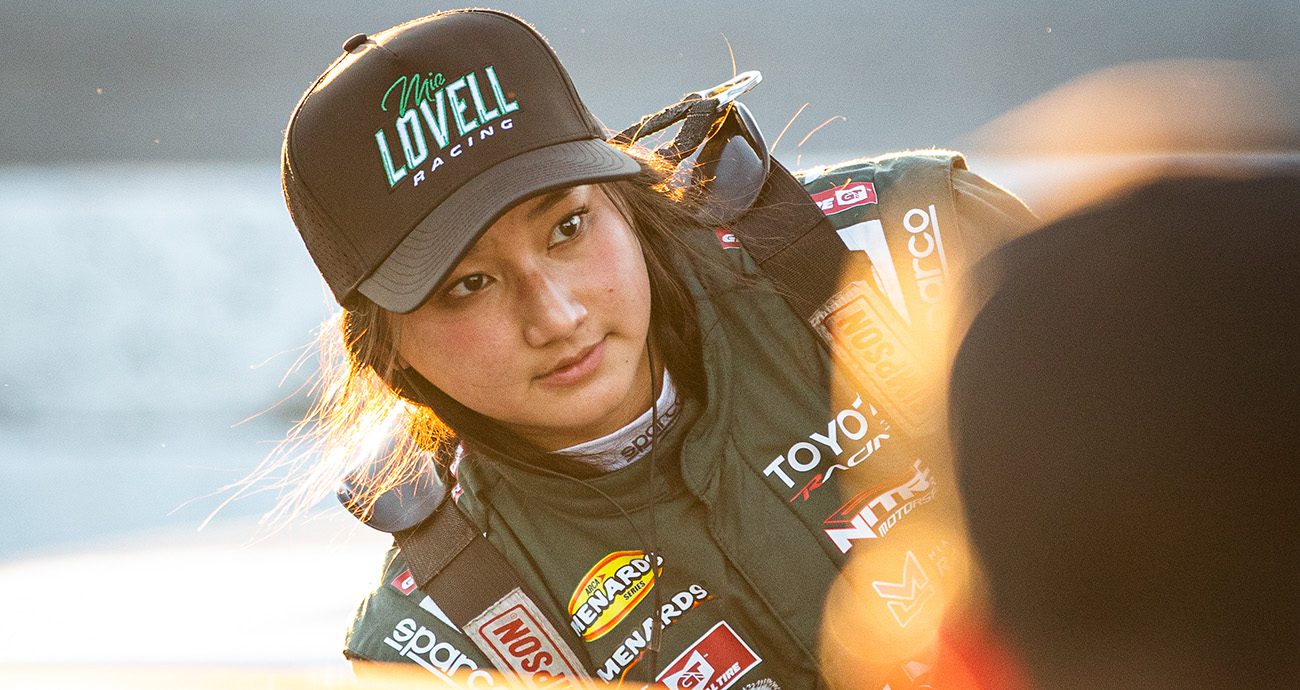
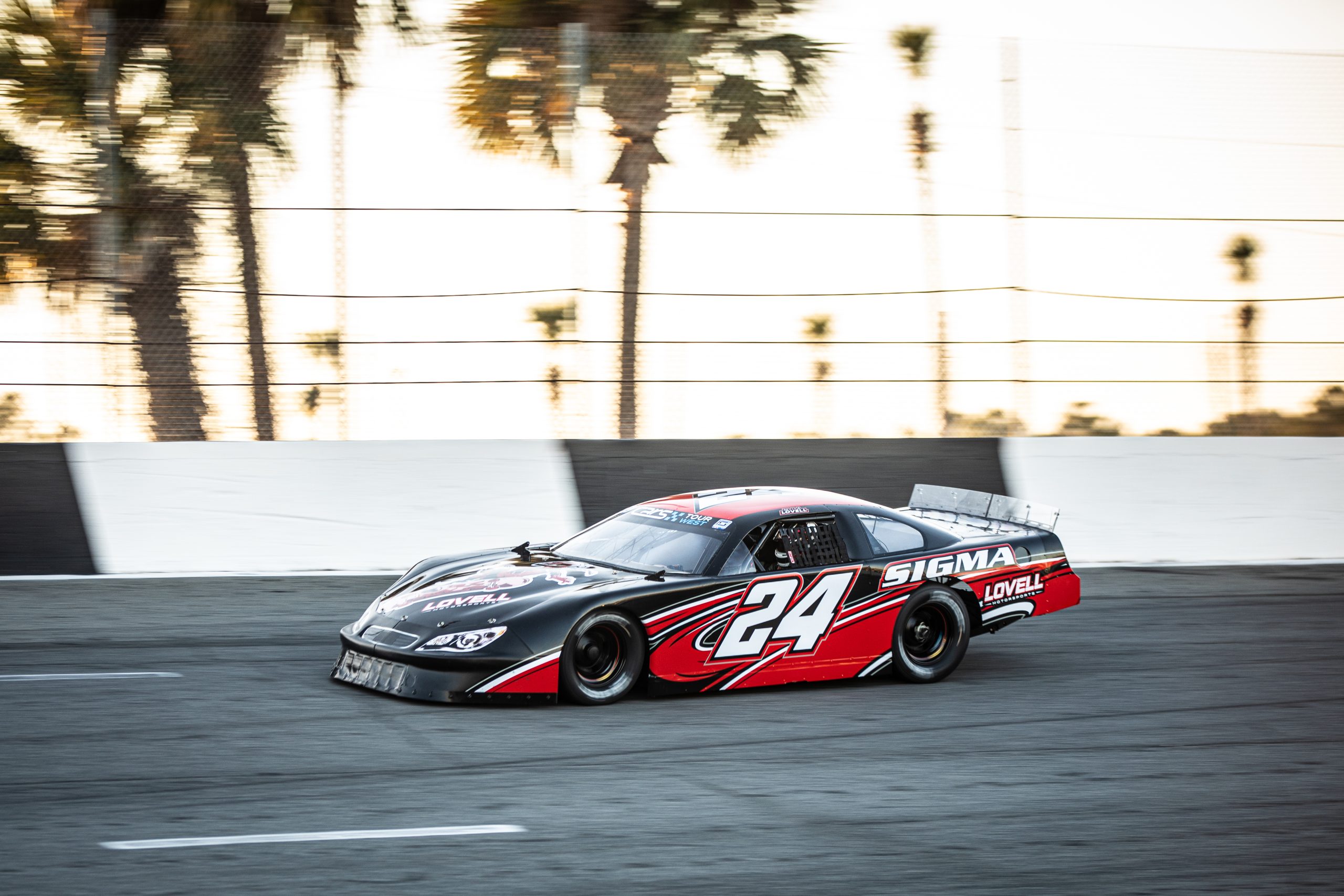
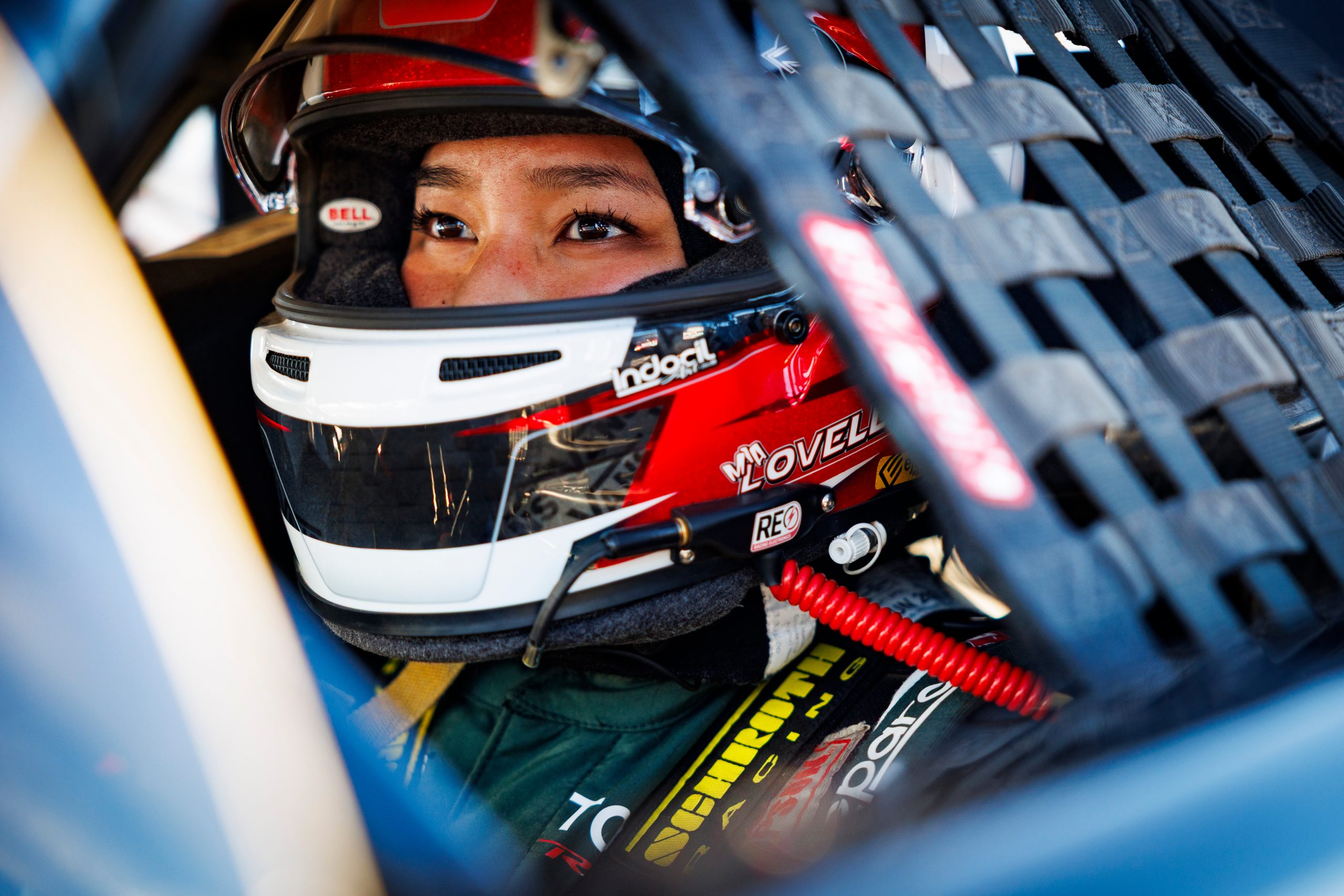
NEW SMYRNA BEACH, Fla. — As she drove her No. 24 Sigma Performance Services Pro Late Model on track for qualifying at New Smyrna Speedway on Wednesday, Mia Lovell experienced one of several possible nightmare scenarios.

She spun on her warm-up lap down the backstretch.

Such a circumstance would rattle any driver making his or her World Series of Asphalt debut, but Lovell knew the only thing she could do was regroup and finish the run. She showed no signs of being intimidated during the rest of her session and ended up posting the seventh quickest time of 24 cars, her best qualifying performance of the week to that point.

Lovell did not get the corresponding result she wanted Wednesday after being collected in a late-race crash while battling inside the top five, but she has seen her own personal improvement after each day on track. She knew mistakes were going to be a part of her first World Series experience, but she emphasized the importance of showing resolve through every obstacle.

Even something as unorthodox as spinning while coming up to speed in qualifying.

“Sometimes when you’re scrubbing tires, that stuff just happens,” Lovell said. “You just have to keep focusing on your job and hope it doesn’t affect you too much.”

Mia Lovell
(Photo: Ted Malinowski/NASCAR)

Stalwart composure has long been a focal point for Lovell in everything she has done in life up to this point; the trait was refined during her time as a professional skateboarder.

After she began skateboarding at age 5, Lovell quickly developed a passion for the sport and soon found herself competing in numerous competitions. Among the accomplishments she obtained as a skateboarder included multiple gold medals during the 2019 California State Games, an Olympic-style competition for amateur athletes.

Lovell intended to continue pursuing skateboarding as a career, but the onset of the COVID-19 pandemic altered those plans. With no skateboarding competitions occurring due to restrictions on mass gatherings, Lovell started accompanying her dad Mike Lovell to a nearby club track and watch him turn some laps.

During one of these trips, Mike elected to put Mia in a car to gauge what she could do behind the wheel. It only took a few laps around the track for Mia to decide she wanted to become a professional motorsport driver. She began committing herself to make that dream a reality.

“Obviously I love skating; it’s so much fun. But racing really just made me tick,” Lovell said. “There’s so much that goes into it aside from what you actually do on the racetrack, like the technical side and the mental aspect of it. I love everything about it.”

Ever since he adopted Mia from China when she was seven months old, Mike has done everything he can to support her interests. While his daughter’s love for an activity as dangerous as action sports would naturally concern any parent, Mike trusts Mia to take care of herself and seek out guidance if she needs it.

From Mike’s perspective, Mia’s maturity and foresight are what propelled her to success as a skateboarder. Those qualities are why Mike believes his daughter is going to thrive in motorsports as soon as she gets more laps under her.

“As a child, Mia was always kind of abnormal as it relates to other kids,” Mike said. “She was so disciplined, focused and structured as a kid. I was never like that, but she was always very committed to everything she did. When she got behind the wheel, she took a very methodical approach and looked at everything she could utilize to progress quicker.”

The limited experience Mia Lovell had in auto racing prior to the World Series was in road course competition. She ran two full-time seasons in Toyota Gazoo Racing GR Cup North America before making six starts in the Trans Am Championship’s TA2 class last year, scoring top 10s in half of them.

Lovell also got to make select Pro Late Model appearances throughout 2025 in a collaborative effort between Sigma Performance Services and Preston Peltier. The strongest of these starts came at Colorado National Speedway during the summer, as Lovell brought home a fifth-place finish in a talented field that consisted of Keelan and Kevin Harvick.

Mia Lovell
Despite finding some success in her first Pro Late Model starts, Mia Lovell is still acclimating herself to all the intricacies of the discipline. (Photo: Ted Malinowski/NASCAR)

Leaning on the expertise of Peltier and Sigma Performance Services has helped Lovell transition more seamlessly into oval racing. Having only been competing since she was 13, Lovell knew she had to learn about late model racing rapidly if she wanted to keep pace with those whose careers started before they turned 10 years of age.

Along with perfecting her race craft, Lovell feels she is communicating more actively about her car’s needs, which is helping her gradually close the gap on her more experienced competitors.

“Each step up we have, there’s more of a leadership role you have to take on for the team,” Lovell said. “Coming from the road racing side to the ovals, [you] need to get better about car feedback and try to absorb as much as [you] can. I’m relatively new to the sport compared to most of my competitors, but I’m working hard to make up for lost time.”

The intensity of oval racing was the most significant learning curve. Lovell was surprised by how often drivers battled each other side-by-side, but she said those intense situations taught her valuable lessons on risk management, patience and how to be aggressive at the right time.

As a father, Mike Lovell wanted to see Mia start winning races instantly but admitted those expectations were unrealistic. Consistency in Pro Late Models was always going to take time, but Mike has seen firsthand the growth Mia has undergone and how she is focusing on just finishing races for now.

Mike is confident success will find Mia in motorsports if she continues to trust the resources and people around her.

“We started like so many people do, coming into it with a ‘win, win, win’ [mindset],” Mike said. “We would set goals and rewards for [Mia], but at some point, it was the personal growth of recognizing that worrying about winning that early is absurd. It’s the process. What do we need to learn mentally and how do we prepare physically?

“Once you refine that process, then you’ve got a shot at winning.”

The World Series at New Smyrna is the next chapter in Mia Lovell’s development. She is surrounded by an even mix of fellow prospects seeking to one day advance into NASCAR’s top ranks along with established Pro Late Model veterans, all while navigating New Smyrna’s fast but abrasive layout.

While her time at New Smyrna has been met with mixed results, Lovell has enjoyed being a part of such a prestigious event. Many drivers currently in the top levels of NASCAR were once in Lovell’s position, so she is willing to embrace both the positives and negatives the week has to offer if it makes her better in the long run.

“My goal is to gain as much experience as I can and learn as much as I can,” Lovell said. “You don’t get a lot of opportunities to have five nights of races in a row. I’m trying to make the best out of each race, make the best out of each session. If I make a mistake, I have the grace of knowing I can do it again tomorrow.”

Mia Lovell
Every race Mia Lovell has competed in at the World Series this week has built up the confidence she has in her car and her driving ability. (Photo: Adam Glanzman/NASCAR)

Mike Lovell expected the World Series to be far from perfect for Mia with how demanding it can be on even the most seasoned of drivers. Despite some of the misfortune Mia has endured, Mike still considers the week to be a successful one, as he got to be right beside his daughter as she took another crucial step forward in her racing career.

From the moment Mike brought Mia home for the first time, he has devoted his life to her. Mike is proud he gets to share his lifelong passion for motorsports with Mia and hopes the two of them get plenty of chances to celebrate victories together.

“It’s the most proud thing I’ve ever experienced,” Mike said. “I love racing and that’s how [Mia] got into it. The most enjoyable thing I’ve ever done is being at the track with my daughter, watching her progress, excel, learn, prove and grow. It’s one hell of a ride.”

Were it not for circumstances outside of her control, there’s a decent chance Mia Lovell is still a professional skateboarder and not an aspiring auto racer. Reflecting on the two sports, Lovell considers racing much safer than skateboarding but admitted there is still a level of danger that comes from battling others while going more than 150 mph.

Even when caution is being exercised, Lovell said the pre-qualifying spin Wednesday shows mistakes can still happen at low speeds. If she wants to continue making progress, Lovell knows she needs to carry all the lessons learned from the World Series into the rest of her planned starts this year.

“The number one thing I want to take away from this week is to gain some maturity behind the wheel,” Lovell said. “[I also] want to gain a level of wisdom, I guess. You can be the fastest driver on Earth, but if you don’t make it to the checkered flag, what good does that do? That’s the only time it really matters.”

Lovell’s path to sustainability in racing has been a meticulous grind, much like the journey she once took as a skateboarder, Relentless dedication garnered Lovell plenty of accolades in skateboarding, so she is not worried in the slightest about her outlook in motorsports.

The wins will come in due time.