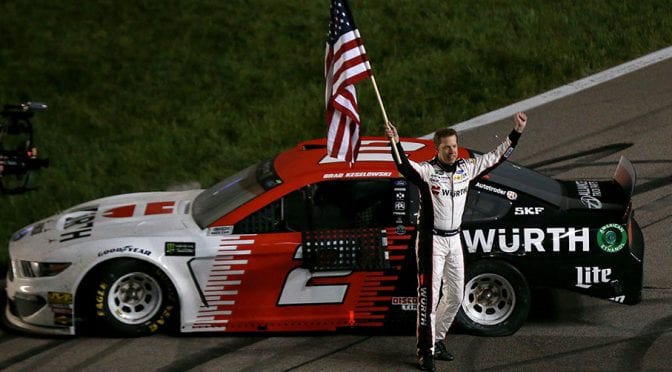
Kentucky Speedway is a 1.5-mile tri-oval which opened in 2000 and was first introduced to the Monster Energy NASCAR Cup Series schedule in 2011. The 72-feet wide asphalt racing surface has a 1,600-foot backstretch with a 17-degree banking in Turn 1 and 2 and a 14-degree banking in Turn 3 and 4. The inaugural race took place in July 2011, and was won by Kyle Busch and Joe Gibbs Racing.
RULES PACKAGE
The Kentucky Speedway rules package will mirror the setup used at other 1.5-mile tracks this season — the same package most recently at Chicagoland in the race won by Alex Bowman. The engine will be fitted with a tapered spacer generating an expected horsepower of about 550. Cars will also feature aero ducts.
TIRES
Each Monster Energy NASCAR Cup Series team will get 12 sets of Goodyear Eagle Speedway Radials — three sets for practice, one set for qualifying, and eight sets for the race (7 sets plus one transferred from qualifying or practice). The tire features a new compound change that adjusts for a relatively newer and smoother racing surface, as Kentucky was repaved before the 2017 race.
STATS
Brad Keselowski has dominated the 1.5-mile track, picking up three career wins in eight starts — more than any other driver in the track’s history. That tops Kyle Busch and Martin Truex Jr., who are tied with two wins apiece.
A Chevrolet driver has never won at Kentucky — only claiming a trio of runner-up finishes. A Toyota team has hoisted the trophy in five out of the eight races at the track.
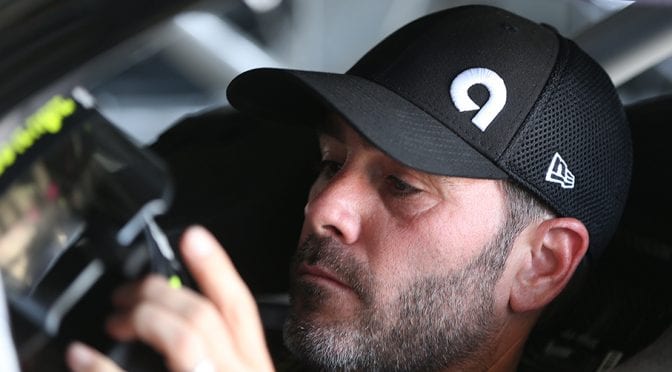
Despite being winless in 2019, Jimmie Johnson boasts the longest active streak of top-10 finishes at 1.5-mile tracks with four. The longest top-10 streak of his career is six, spanning from the late 2015 to early 2016 season. The seven-time Cup Series champion also has the most 1.5-mile wins is NASCAR history at 28 — 11 more than former teammate Jeff Gordon (17).
Dating back to the track’s inaugural race in 2011, Kentucky Speedway has the highest percentage of wins from the pole position with drivers starting first winning 37.5 percent of the time. That’s nearly 2.5 percent better than second-highest Michigan International Speedway (35.29 percent).
Saturday night’s Monster Energy NASCAR Cup Series race will be televised live on NBCSN and streamed live on NBC Sports App. For the radio broadcast, tune in to coverage on PRN and SiriusXM NASCAR Radio. Navigate to NASCAR.com for the live leaderboard and interactive options, including in-car cameras on Drive and in-car audio on RaceView.
2018 RACE WINNER
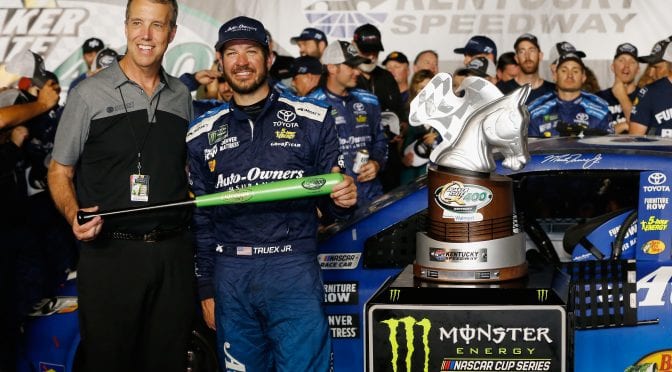
Martin Truex Jr. started on the pole and made his way across the finish line to take home the checkered flag in last year’s edition. Truex Jr. led 174 of 267 laps en route to a dominant performance that landed him his fourth and final win of the 2018 campaign. He also reached Victory Lane at Kentucky in 2017 — will Truex make it a three-peat?
ACTIVE KENTUCKY WINNERS
Brad Keselowski (three), Kyle Busch (two) and Martin Truex Jr. (two).
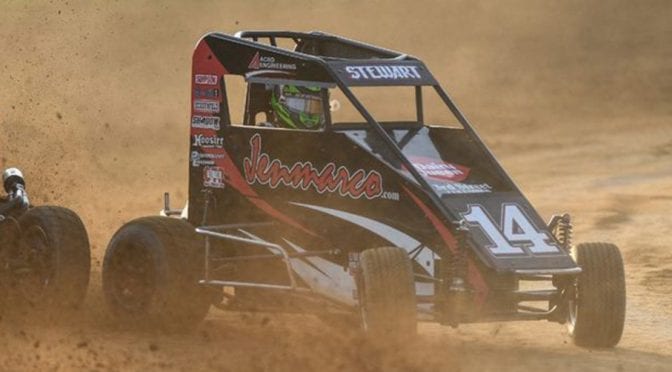
Tony Stewart, a recent inductee of the NASCAR Hall of Fame Class of 2020, defended his back-to-back titles at the King’s of the UMRA Three-Quarter Midget Race on Tuesday night at the Bartholomew County 4-H Fairgrounds.
The annual TQ Midget race was co-sponsored by the Tony Stewart Foundation, which provides grant funding to well-qualified organizations serving children who are critically ill or physically disabled, animals at-risk or endangered, and drivers injured in the sport of motor racing.
Stewart, once again racing in his hometown of Columbus, Indiana, has collected the checkered flag in this event each of the last two years, with Tuesday night’s win completing the trifecta.
The three-time Monster Energy NASCAR Cup Series champion battled handling issues throughout the night, leading to a rough start to the competition. After a less-than-ideal fourth-place finish in his heat race and a fifth-place run in qualifying, Stewart gained an edge in the main event with an inverted top-six starting order that gave him the outside line on the front row.
In the opening lap, Stewart sped his way into the lead — a lead he never surrendered. He went on to dominate all 25 laps, holding off strong pushes from polesitter Anthony Lawrence and 14-year-old Emerson Asxom, en route to his third consecutive hometown-race victory.
You could say retirement is going pretty well for Matt Kenseth.
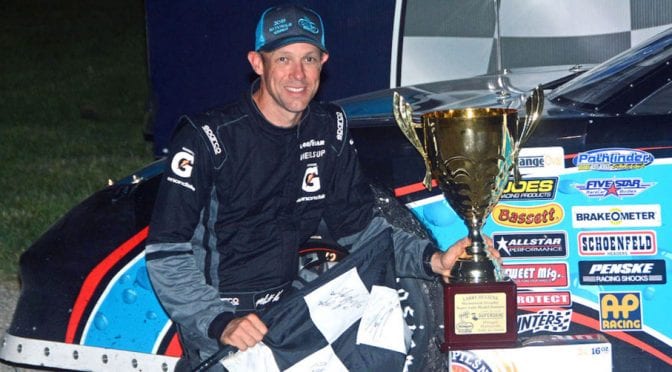
Well, if “retirement” can include still racing and still winning with incredible last-lap moves, as he did Tuesday night to capture the checkered flag at the 40th SUPERSEAL Slinger Nationals presented by Miller Lite.
Kenseth, 47, led just one lap in the annual 200-lap super late-model short track race — the final one. He made an aggressive pass on Ty Majeski on Turn 4 of the final lap to secure the win in his first race since last season’s Monster Energy NASCAR Cup Series finale at Homestead-Miami Speedway.
Majeski, who at 24 is nearly half Kenseth’s age, said, “Exactly what I’d have done.”
Kenseth’s move denied Majeski a second consecutive win at the Slinger Nationals, and was Kenseth’s record eighth at the Wisconsin track. Kenseth has not raced at Slinger Speedway since 2016 when he edged Erik Jones for the victory.
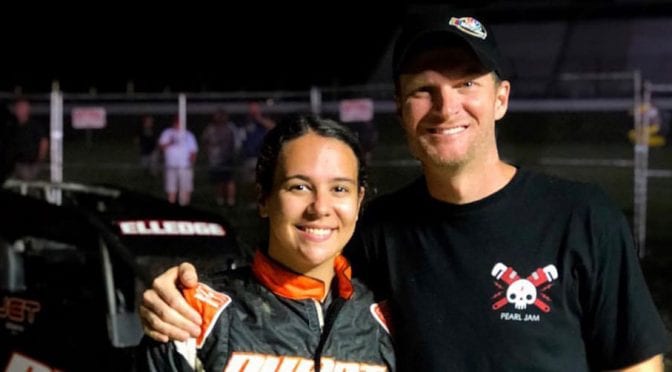
Karsyn Elledge was shaken up but appeared uninjured following a frightening wreck during a USAC Racing midget car event Tuesday night at Red Dirt Raceway in Oklahoma.
Elledge, driving the No. 1, began to tumble down the track entering Turn 3 and flipped high enough to careen over the Turn 3 wall and crash onto the ground outside the track, near the woods.
NASCAR.com profiled Karsyn Elledge earlier this year as she makes her way up the sprint car ranks, with a spotlight firmly affixed to her. The 18-year-old has a racing pedigree as a member of the Earnhardt family — and she has the Earnhardt racing gene, too.
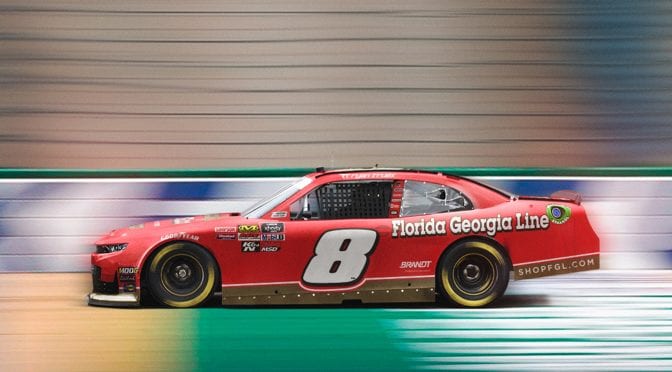
MOORESVILLE, N.C. – Ryan Truex will roll into Kentucky Speedway this weekend with JR Motorsports’ No. 8 team, carrying a new partnership from award-winning country music duo Florida Georgia Line and the band’s official merchandise website, ShopFGL.com.
“I’ve been anxious to get back behind the wheel of this No. 8 car ever since we had such a strong run back in Phoenix,” Truex said. “To be able to do it with Florida Georgia Line and ShopFGL.com is awesome. We have a great relationship with FGL lead singers Tyler (Hubbard) and Brian (Kelley), who are currently on their ‘Can’t Say I Ain’t Country’ tour. I think everyone agrees that country music and NASCAR fans are synonymous with each other, which makes this a perfect relationship. I love the look of this throwback scheme and can’t wait to unload at Kentucky.”
The old-school red and gold paint scheme of the FGL / ShopFGL.com Chevrolet drew inspiration from the classic liveries of motorsport legends Dale Earnhardt Sr. and Tim Richmond. The paint scheme is also replicated on the fan-favorite single “Speed of Love” T-shirt, available at ShopFGL.com. To celebrate the partnership, fans that visit ShopFGL.com can use promo code GORYAN20 for 20 percent off their entire order.
Since 2012, FGL has earned prestigious honors from the AMAs, ACM Awards, CMA Awards, Billboard Music Awards and CMT Music Awards, plus left its mark on several chart-crushing songs as writers.
The duo were Billboard’s first-ever Trailblazer Award recipients.
The Kentucky event marks Truex’s second race of the 2019 season. His lone start for JRM came in March when he drove the No. 8 to the team’s season-best finish, a second-place effort at Phoenix Raceway.
The No. 8 is currently ranked 12th in owner points on the strength of four top-five and 11 top-10 finishes.
The Alsco 300 at Kentucky Speedway airs on Friday, July 12 at 7:30 p.m. ET on NBCSN.
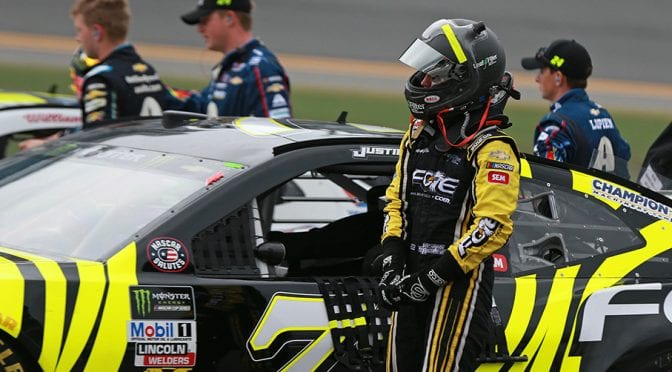
Nearly 48 hours after Justin Haley’s first career Monster Energy NASCAR Cup Series victory in a rain-shortened Coke Zero Sugar 400 at Daytona International Speedway, Spire Motorsports employees are still busy going through the email inbox.
In an exclusive interview with NASCAR.com, Spire Motorsports co-owner Jeff Dickerson shed light on how business has been positively impacted after launching a behind-the-scenes start-up to the limelight of NASCAR’s premier series — explaining how opportunities that were originally declined by companies have been brought back to life.
“That’s encouraging,” Dickerson said. ” … I think that’s really what Sunday did — those guys decided to give us another look and turn those things into meaningful partnerships, not just for us but for the sport.”
Through the hype of a surprise triumph, sticking to the game plan is the only plan for the No. 77 team, formed last December after the purchase of defunct Furniture Row Racing’s charter from former team owner Barney Visser.
“I don’t know that anything has changed,” Dickerson said. “I think everyone was expecting us to burn it down and tear it down. … The fact of the matter is, the guys drove home, they came to the office on Monday morning and they reached out to not only to the sales leads for Spire Motorsports, but for the sales lead for our clients. It’s literally business as usual.”
Joe Garone, the president of Spire Motorsports who held the same role previously at Furniture Row Racing, also has played a vital role in keeping the train on the tracks despite the spotlight a win provided.
“We knew what we were fighting this year,” Dickerson said. “We knew we were up against it. We knew we were getting a late start, and Joe is really adamant about making sure to give us a little bit of hope and encouragement. … Joe has been really good about saying, ‘Hey, stick to the plan, stay on the path, this is exactly what we did.’ They were able to do it a little bit under the radar and so were we until about Lap 127 the other night.”
Dickerson credited co-owner T.J. Puchyr for keeping the team grounded while continuing to work through what the future holds for the up-and-coming group.
“We’ve had to stay pretty disciplined here on what we’re trying to accomplish,” Dickerson said. “We will be punching above our weight class here a handful of times, and we’ll announce that a little bit down the road. It’s just what T.J. has been preaching to our group. We have a plan, and we’re going to stick to that plan. It wouldn’t have mattered if we had won the race or finished dead last, we have a plan. I think that plan will come into focus for everybody here soon enough.”
Dickerson noted that even though he knows the 77 team got “super lucky” Sunday, it also didn’t happen by accident.
“It’s a big deal to win a Cup Series race, period,” Dickerson said. “No matter where you do it, no matter how it happened. It’s a thing where if we’re going to take advantage of this moment, we’ll be back and we’ll show the world what we’re trying to do. We just don’t have a fast forward button. Hopefully, we’ll have plenty of these moments. If everyone can just be patient … we’ll show you what we’re trying to do. It was just a little sudden.”
Overall, Dickerson and the team are well aware starting a new organization is extremely difficult and one victory isn’t going to build Rome in a day. Still, they have confidence in the direction NASCAR is taking in years to come — both in the Generation 7 car and the business model.
“It’s a significant undertaking, it’s obviously a big risk,” Dickerson said. “I think that risk is also kind of tempered with, we believe in the sport. We believe in what the France family is doing.”
After unique — and crazy — pack racing at Daytona International Speedway, the Monster Energy NASCAR Cup Series (MENCS) returns to a more familiar setup with Kentucky Speedway’s 1.5-mile layout.
The Monster Energy Series has already visited six 1.5-mile racetracks, the last three of which were run at night. Kansas Speedway was scheduled as a traditional night race, while the Coca-Cola 600 at Charlotte Motor Speedway started around 6 p.m. ET but finished under the lights. The race ran at Chicagoland Speedway two weeks ago was scheduled to be a day race, but rain pushed the green flag back to approximately 6:30 p.m. ET.
This is important because the cars drive differently in the heat of the day compared to the cooler night temperatures.
And with Saturday’s race at Kentucky also scheduled for an evening start, we can lean on those past three night races to make our NASCAR Props Challenge picks for the Quaker State 400.
1. Only three active drivers have won a Cup race at Kentucky. Will we see a first-time Kentucky winner this weekend? Yes or No?
Based on betting odds, this is surprisingly close, but when there is not a clear edge, I’ll always lean toward the field against just three drivers.
Pick: Yes
2. O/U 18.5 lead changes?
In eight races at Kentucky, 2011 was the only event that finished with more than 17 lead changes.
Pick: Under
3. Which former Kentucky winner will finish higher? Kyle Busch or Martin Truex Jr.?
While Truex and Busch have put up similar numbers — in terms of average running position and fast laps — at Kansas, Charlotte and Chicago this season, I’ll go with Truex as the two-time defending race winner.
MOORESVILLE, N.C. – The NASCAR Throwback weekend at Darlington Raceway has become one of the most highly regarded events on the schedule. From the retro schemes honoring those who left their mark on the sport to the retro mustaches, it’s truthfully an all-around walk back in time.
Corey LaJoie and Go Fas Racing (GFR) will travel back to the year of 1991 to honor 1999 Monster Energy NASCAR Cup Series champion Dale Jarrett. LaJoie’s GFR Ford will mimic the Nestle Crunch scheme Jarrett powered in the then-Busch Grand National Series in 1991.
The 43-time NASCAR national series winner took the blue and white scheme to Victory Lane five times during the sponsor’s tenure, with two of those victories coming at Darlington. The scheme also made appearances in Victory Lane at Bristol Motor Speedway, Charlotte Motor Speedway and Rockingham Speedway.
In conjunction with his victorious efforts at Darlington in NASCAR’s second-tier series, Jarrett boasts three wins in the Cup Series at the track “Too Tough to Tame.”
It’s also fitting that the 2014 NASCAR Hall of Fame inductee wheeled the No. 32 while driving the Crunch scheme just as LaJoie currently races the same number in NASCAR’s premier division. While Jarrett only drove the number in the Xfinity Series, the North Carolina native’s resume also includes a trio of Daytona 500 wins coming in 1993, 1996 and 2000.
LaJoie is proud to honor such a remarkable driver and his outstanding achievements in our sport.
“The car looks great and I’ve always been a fan of Dale, so to carry this scheme around Darlington is awesome,” LaJoie said. “I think we did a great job keeping the scheme as close to the original as possible while incorporating the CorvetteParts.net logos into it. I can’t thank Tom and TJ Keen enough for allowing us to run this design – it’s one of my favorite schemes. I might even have to shave myself a mustache so I don’t do the car a disservice.”
The Crunch-inspired scheme will flaunt longtime GFR partner, Keen Parts/CorvetteParts.net. Whether you’re looking for a complete interior for your vintage ’58 Corvette or a performance accessory for your ’09, they have the Corvette part you need and the expertise you want as Corvettes are their sole focus.
Join us as we venture back in time Labor Day weekend at the 1.366-mile South Carolina track. NBCSN will carry coverage of the crown-jewel Southern 500 on Sunday, Sept. 1, at 6:00 p.m. ET.
Editor’s note: The following article was written by Team Penske driver Brad Keselowski.
Follow him: Facebook | Instagram | Twitter
After I won at Kansas back in May — my 30th career Cup victory — a few different reporters asked me what reaching that milestone meant, and whether or not I felt it was a threshold for eventually making it into the NASCAR Hall of Fame. The win was a big deal to me, to be sure, and while those questions were definitely premature in my mind, they also really got me thinking.
What does make someone worthy of being in the Hall of Fame?
I’ve had this debate with some members of the Hall of Fame voting panel over the years — a collection of some 50-odd people that includes Hall of Fame board members, NASCAR members, former champions and some media members, too. It’s always an interesting conversation for a number of reasons.
First, there’s no consensus among the people who vote about what makes somebody a Hall of Famer, which I think is kind of funny. Second, every year there are one or two surprises who get in that shock you, and one or two people where you scratch your head and wonder, “Wow. How are they not in?” It almost baffles you.
Today, I want to bring that conversation to you. I’m going to share my own criteria for what makes someone a Hall of Famer, and then open the conversation to the entire NASCAR fan community, too.
Some amazing representatives of our sport were inducted in the 2019 Hall of Fame class: Jeff Gordon, Jack Roush, Roger Penske, Davey Allison and Alan Kulwicki. And while without question, every one of those people deserves a spot in the Hall, they’re also a great segue to my first point.
I don’t think that five people should be entered into the Hall every year.
Todd Warshaw | Getty Images
When it was first created about a decade ago, it made sense for the first few classes to have so many members. Now it probably doesn’t. So I’d actually like to see the number of new additions to the Hall of Fame get scaled back to maybe two or three new members each year so that it remains something special.
My second top-level criteria is that I don’t think all the members of the Hall of Fame should be drivers, but they should be famous. It’s called the Hall of Fame for a reason.
There are some people who made very significant contributions to the sport, but also who were never in the limelight. Whether that’s by choice or not, that kind of nixes their eligibility for being a Hall of Famer. Part of being in the Hall of Fame is the connection you build with fans. If you made it a point to stay out of the limelight, you never really built that connection, and that should be held against you. This sport is here for the fans, and the way you build those relationships and use them to help people however you can — to entertain them, to connect with them, those things all really matter.
Don’t misunderstand me: There are people who did a lot for the sport who weren’t on center stage in the same way, and they deserve to be honored. But that’s what NASCAR’s Landmark Award — given to people who made landmark achievements in the sport outside the spotlight — is for. The Hall of Fame should be something different.
Lastly, I think that there should be some basic standards of character, too. And if you’re a person who goes on in your post-driving career and wins the Nobel Prize or has some other remarkable achievements, that should probably factor into your eligibility in a big way, without a doubt.
QUALIFICATIONS FOR A DRIVER
Naturally, because I’m a driver, people are going to ask my perspective for what makes a Hall of Fame driver. Truthfully, that’s probably where I have the most credibility.
First and foremost, you have to consider Cup race wins. Before we had the playoffs, and the Chase, and all these recent things we’ve installed, I would have said that championships should go before wins. Now I don’t feel that way. Now I feel like wins are a bigger deal than championships. So it completely flips my line of thinking. I’m sure there’s some people out there that don’t feel that way.
In fact, somebody asked me who the top 50 greatest drivers in NASCAR were, and I ranked Dale Earnhardt somewhere around No. 7 or 8. A bunch of people got mad at me about it. (I’m sure it’s about to happen again now, too.) “He’s got seven championships,” they said. “Only two other people have that. That should put him at least in the top three.”
I just don’t view it that way. As a driver, in the wins column, No. 8.
That’s a bit of a controversial opinion, because obviously he’s got a mystique to him that people value. But I feel like race wins should come before everything else, and that’s why I’ve got him where I’ve got him.
After wins, you have to consider the number of championships a driver has, and then third, the number of major victories. In NASCAR, we have about four or five indisputable majors and winning those races is important: the Daytona 500, Indianapolis, the Coca-Cola 600, the Darlington Southern 500. I put the Bristol Night Race up there, too. Winning any of those races is a really significant win as well.
Brian Lawdermilk | Getty Images
Finally, I think that drivers can do things off the track that increase their Hall of Fame attractiveness. The top thing there — and this gets back to the point about being famous — is building your relationship with the fans. Again, that should be really important. Bill Elliott won NASCAR’s Most Popular Driver 16 times. That’s got to count for something in the Hall of Fame, right? Same thing goes for Dale Jr. He didn’t win any championships, but he was a Hall of Fame driver in my mind simply because of his popularity, and what he meant to the fans.
Then of course, there’s contributions you make after you’re a race car driver. Take guys like Benny Parsons or Darrell Waltrip, who both transitioned from their driving career to a broadcasting career, and in doing so, were beloved by the fans for a long time. That’s got to count for something.
SMOKEY TIME
From the standpoint of drivers in the Hall of Fame, I think NASCAR’s done a pretty good job so far. Still, there are other people, as I mentioned at the start of this, who aren’t in the Hall of Fame, but should be. For the last few years, I’ve felt that way about Roger Penske, and I feel similarly about someone like Joe Gibbs.
If I had to pick one person who absolutely should be in the Hall of Fame and not only isn’t, but has never even been nominated, it would be Smokey Yunick.
In the 1960s, Smokey Yunick was basically like Elon Musk. He was an innovator — not just in NASCAR, but in a wide range of scientific endeavors, experiments, sort of a crazy scientist but in a good way. He created the first vehicle to go 80 to 100 miles on a gallon of gas, and this was in the 1970s. He created all kinds of inventions that are used today in the automotive landscape and beyond.
RacingOne
He also loved racing. Racing was partially what pushed him to create some of these inventions. It also made him the guy you wanted to drive for because you knew, without a doubt, he would have one of the best cars. All the elite drivers came to him. He was famous, and not just in stock racing circles. He built cars for the Indianapolis 500. He built cars for the Big Three, test cars, prototype cars.
In his day, he was a superstar.
He also had a very tumultuous relationship with NASCAR. He pushed the limits of legalities a lot of times, and NASCAR frowned upon that and was very harsh to him. In return, he told them what he thought about that in a not-so-nice way, and more than once walked away from the sport. In the end, they broke up in not-so-favorable terms.
But his impact on the sport was undeniable, and still felt to this day. He was a legend. I, for one, would like to see him get his due in the Hall.
THE DEBATE BEGINS
So those are my thoughts on what makes a Hall of Famer. What do you think? What are your criteria? Who should be in the Hall of Fame but isn’t? Who’s driving today that should be one day?
I’d like to know what you think. Share your ideas and opinions with me on social media, at @keselowski on Twitter, @BradKeselowski on Facebook and @BradKeselowski on Instagram.